Latest News

a, Martlets, Men's Varsity, Sports

Sports briefs – Jan. 14

Redmen Hockey

The Redmen (14-5-1) moved into a tie with the Queen’s Gaels (12-2-5) atop the OUA East Division with an impressive 4-3 win over the Gaels on Saturday at the Kingston Memorial Center.

After a slow, defensive struggle in the first period, McGill came out of the first intermission with a renewed sense of urgency, striking three times in the span of 72 seconds. The stunned Gaels called a timeout after a goal by second-year McGill winger Max Le Sieur made it 3-0 for the Redmen halfway through the second period. Queen’s came out of their huddle reignited, answering the barrage with two quick goals of their own. The rally was short-lived, however; the unfazed Redmen responded 61 seconds later when rookie defenceman Samuel Carrier connected on a power play goal to put McGill up for good.

McGill will host Queen’s for an anticipated rematch on Friday, Jan. 17 in the annual Management Carnival Game at 7:00 p.m. in McConnell Arena. The team will be looking to push their dominant streak over the Gaels to 25 consecutive victories.


Martlet Hockey

The CIS no. 1 ranked McGill Martlets (11-0-0) poured on five goals against the Carleton Ravens (1-9-3) in a lopsided 5-1 win in Ottawa on Saturday.  Led by sensational senior forward Leslie Oles, McGill jumped out to an early 3-0 lead in the first period and outshot the Ravens throughout the entire game.  After two quick unassisted goals in the first period, Oles scored again early in the second frame to complete her second hat trick of the season. Martlet goaltender Andrea Weckman continued her hot play in net, shutting out the Ravens until late into the third period.  The performance brought her Goals Against Average (GAA) to an impressive 1.82.

The Martlets play Carleton again next Saturday, Jan. 18 in Ottawa. McGill will look to stay undefeated on the season.


Martlet Volleyball

The McGill women’s volleyball team (9-4) had a strong winter break, winning five of seven exhibition games at a training camp in the Dominican Republic.  The Martlets started the camp off strong, winning a convincing three sets to one over the Dominican U-17 squad, who they would go on to sweep.  After winning their first four matches, the McGill squad fell twice to a taller Dominican U-20 team in close contests.  Highlights from the trip included spectacular offensive performances from sophomores Marie-Pier Durivage and Ashley Norfleet, who recorded a remarkable 15 digs in a tough loss to the U-20 national team.

The squad resumed regular season action on Sunday against the Sherbrooke Vert et Or (7-8), and pulled through in the fifth set of a thrilling matchup. It was a seesaw affair with McGill and Sherbrooke trading sets. The Martlets had the chance to put away the Vert et Or in the fourth set, but ended up falling 23-25. Norfleet, a sophomore power hitter, paced the squad with a game high 20.5 points, which included 19 kills. The team hosts the RSEQ leading Montreal Carabins on Friday Jan. 17 at 7:00 p.m. at Love Competition Hall.

a, Arts & Entertainment, Music

Sharon Jones and the Dap-Kings — Give The People What They Want

Give the People What They Want, Sharon Jones & the Dap-Kings’ fifth studio album—and first release in almost three years—harks back to their critically acclaimed 2007 album, 100 Days, 100 Nights. Thematically, this album is similar to their previous efforts of love and heartbreak, happiness and personal crises; however, it is musically where this album excels in comparison to its predecessors.

The album’s energetic opening track “Retreat!” with its galloping beat and multi-layered production, is rather reminiscent of Adele’s megahit “Rolling In the Deep.” “Retreat!” leads right into the slower yet seductive “Stranger to My Happiness,” which wouldn’t sound out of place in the ’60s. “Long Time, Wrong Time” opens with a cleverly simple guitar line that plays throughout the remainder of the song, echoing the easy-listening sound of the entire record.

This album’s production is solid; the band and Gospel singers add tremendously to the experience of the album, making it a truly authentic sound. Jones has orchestrated a sound that reaches back to the height of the ’50s and ’60s blues; it’s timeless, and along with the witty lyrics that simply throw out questions and musings about today’s society, the album is cohesively pulled together with her deep, raspy soulful voice. It’s hard to find this much energy on an album today.

Jones questions the listener, “What do the people want?” What are we all truly looking for and expecting? And although “People never get what they deserve,” this album delivers musically, lyrically, and thematically. Give the People What They Want does just as its title implies, and it does it well.

a, Student Life

Advice on navigating advising

As we settle into another semester, many students find themselves facing looming questions they put off over the holidays. What’s the best way to find a summer job or internship? Do you have enough credits to graduate on time? How can your budget accommodate another semester’s tuition fees?

One of the most frustrating experiences for a McGill student is waiting for hours outside an advisor’s office, only to be redirected to another line. As our spare time begins to disappear with the return to school, the Tribune sets out to explain where to turn when you need help at McGill.

Faculty advisors

Your faculty advisor is your go-to person for information concerning your degree. Go to them for problems or questions regarding course registration, to make sure you will have enough credits to graduate, and to discuss the majors or minors that interest you. You should also talk to them if your personal, financial, or medical circumstances are going to affect your academics.

For most degree programs, you can find this advisor in your faculty’s Student Affairs Office. See your program’s website for more detailed information.

Are you wondering what courses you should take to fill the requirements for your major? The answers to program-specific questions can be found in departmental advising. Visit them for information on course requirements, scholarships and financial aid, equivalencies for courses completed at other universities, and exemptions from required courses.

Departmental advisors are often only available at the busiest advising times like Add/Drop period. They usually have specific office hours, so be sure to plan accordingly. Visit your department’s office or their website to learn how and when you can contact their advisors.

Career advisors

Operating under the Career Planning Service (CaPS), career advisors provide assistance with numerous employment-related queries. Are you graduating soon and don’t know what to do with your degree? Considering applying for graduate school? The answer is probably at CaPS. CaPS also offers a peer advising service that helps undergraduate students prepare for their careers and the job market, and where students can even receive help improving their LinkedIn profile.

CaPS is located in the Brown Building. Visit or call their office at 514-398-3304 to make an appointment, or drop by their C-Lounge sessions for advising without an appointment.

Financial advisors

If you’re interested in budgeting but are having trouble creating or sticking to your financial plan, McGill Scholarships and Financial Aid offers advisors who can help you get back on track. This could include anything from tips on how to cut back expenses to planning how to repay loans and avoid debt. Before you book an appointment, make sure you’ve already tried out the Frugal Scholar Money Management Program, which enables students to manage their own finances independently. See http://www.mcgill.ca/studentaid/finances for more information.

To book an appointment with an advisor, fill out your financial profile on Minerva before contacting the Student Aid Office at 514-398-6013.

The Student Advocacy Program

In the event that you’re faced with an accusation for a disciplinary offence or want to file a formal complaint against the university, you can receive free advice and representation through the Student Advocacy Program. As part of the Legal Information Clinic at McGill, this program can provide you with an advisor who will help you prepare your case, give you information about your rights, and represent you in internal McGill procedures.

The Legal Information Clinic and the Student Advocacy Office are both located in the SSMU Building. You can also contact Student Advocacy at 514-398-4384.

Service Point

While not technically an advising service, all students find themselves dealing with Service Point’s endless lines at some point during their time at McGill, so it’s important to know exactly when you need to brave the crowds. Many of its services concern paperwork you may need to supply or acquire in the course of your degree, such as legal documents, international health insurance, transcripts, and diplomas. Financial matters like tuition and RESPs are also dealt with here, as well as student cards, exam deferrals, and help with Minerva.

Service Point is open throughout the year. Go early in the morning or postpone your visit until later in the semester if possible to avoid lengthy wait times. You can contact them by phone at 514-398-7878.

a, Men's Varsity, Sports

Basketball: McGill splits weekend series with Laval

The McGill Redmen (5-1) continued their quest for a second straight RSEQ Championship with a home-and-home series against the Laval Rouge et Or (2-4). In the first matchup of the weekend, McGill pummeled the visiting Rouge et Or with an 88-69 victory at home. A day later, the two teams headed  out to Quebec City, a trip that ended in a 78-68 loss as the Redmen suffered their first defeat of the season.

In the first game of the weekend, the Redmen offence was firing on all cylinders despite the absence of star point guard Simon Bibeau, who was away for personal reasons. The team topped its season scoring average by 13 points against an underrated Laval squad. With the game close in the early stages, Coach DeAverio made the decision to move third-year shooting guard Vincent Dufort to small forward, in the hopes of exploiting Laval’s man-to-man defence. The move paid off; the Rouge et Or had no answer for Dufort’s speed as he dropped a season high 27 points.

“I just had a mismatch,” said Dufort. “They had a bigger guy on me, and I was able to take him off the dribble.”

Freshman forward Francois Bourque continued his dominant season, posting his third career double-double with an efficient 23 points and 12 rebounds in just 21 minutes. With Dufort playing small forward, Nathan Joyal saw his minutes increase as he tallied double digits for the third time this season.

Point guards Ave Bross and Jenning Leung had big shoes to fill with Bibeau out of the lineup. Bross facilitated the offence and played strong defensively while the freshman Leung brought a youthful energy off the team’s bench.

“I thought [Bross] did a really good job in the second half,” said Coach DeAverio. “[Bross and Leung] worked well together and they both picked each other up at crucial times.”

(Laurie-Anne Benoit / McGill Tribune)

The Rouge et Or jumped out to an early lead in the first frame, but McGill kept it close while coping with foul trouble. The Redmen tied it up late, before a Dufort jumper put them ahead in the final minute of the second quarter. The team came out of the break with newfound defensive intensity and increased their lead to 13 by the end of the third frame. The Redmen’s smothering second-half defence held Laval’s big men, Boris Hadzimuratovic and Antoine Beaumier, to a combined six points after both reached double digits in the first half.

“[Laval] played exceptionally well in the first half,” said DeAverio. “We didn’t protect the basket […], so our objective in the second half was to guard the paint […] I think they scored [just] 29 in the second half [….] Our defence was the big difference.”

Unfortunately, the team’s defensive intensity was not the same the following day in Quebec City, as the Redmen gave up a regular season-high 78 points. McGill dealt with foul trouble and turnover issues all game.

“Playing on the road is always a difficult task and [playing] back-to-back games adds a whole new component,” DeAverio said after the loss. “We are a young team that is still evolving, searching for consistency in our level of effort and concentration.”

The Redmen get a much-needed break before Bibeau rejoins the team and they head out for another home-and-home series with Concordia (2-3) on Jan. 23 and Jan. 25. Look for McGill to bounce back against a surging Stingers team that has won its last two contests.

a, Science & Technology

McGill joins ranks of universities teaching MOOCs

This semester, McGill joined the ranks of MIT, Harvard, and other leading universities with the opening of registration for its first ever Massive Open Online Course (MOOC) Chem181x. The course, known as “Food for Thought,” will be offered by professors David Harpp, Joe Schwarcz, and Ariel Fenster starting this January and lasting 13 weeks.

MOOCs, founded by the company edX, were designed with the purpose of expanding access of high quality education online. The instalment of Chem181x brings a brand new approach to education within McGill’s learning sphere, as MOOCs are not offered for credit, but rather to foster knowledge for the sake of learning. They are free to anyone around the world who is interested in receiving an education from these prestigious universities.

While students cannot obtain a degree from enrolling in MOOCs, they may receive a certificate of completion depending on their participation in the course. This is measured via various methods, including online discussion boards. Students have the option to “audit a course,” meaning they have access to all the course material and online discussion forum without necessarily attending every lecture. For those who are interested in greater commitment, they can choose to complete the course in its entirety to achieve different types of honour code certificates. Either way, the flexibility of MOOCs remains one of their largest appeals—with a virtual classroom that is open night and day, students can study on their own schedule and at their own paces.

Harpp has been heavily invested in making this project happen at McGill. According to him, McGill chose to get involved in edX, “partly to see if we could work up a better version of existing visuals and presentations [of our courses in] a more engaging format.”

According to Harpp, professors were also interested in learning how people from around the world would respond to their approach to teaching.

Digital teaching is not new to McGill. “We were already fairly knowledgeable about how digitally recorded lectures were received, because we invented the McGill recording system with programmers way back in 2000,” said Harpp.

Today, McGill offers around 350 recorded courses each year. With experience and positive feedback received over the past 13 years, Harpp said he felt McGill was ready to enter the realm of virtual teaching on a global scale, as well as keeping [McGill’s] ‘brand’ alive by maintaining pace with other top-quality universities.

According to Harpp, the process of joining edX was filled with negotiation between high academic officials of McGill and edX management. He jokingly ascribed the process as similar to speed dating, where different representatives from Harvard and MIT came to meet with numerous members of McGill’s faculty, deans, and a variety of instructors, until McGill was asked to join edX. After cautious deliberation, Provost Anthony Masi and Laura Winer, head of the Teaching and Learning Services agreed that McGill would participate in the project.

Similar to the popular World of Chemistry series offered by the same professors on campus, CHEM181x is designed to offer a scientific framework for understanding food and its impact on health and society from past to present.

“One thing we hope to portray is that science can partially answer quite a few questions but that there is no magic menu for managing one’s life,” said Harpp. “We want to portray what the science is telling us and to hope that most of the viewers will be vigilant about charlatans and to develop some good level of critical thinking.”

Harpp foresees the virtual environment as one where different points of view will come into play due to the broad audience. This, he hopes, will help engage groups of students to do local research on food and food services and share those experiences among each other.

“This may not transpire but we are open to ideas as to how we might better deliver our course,” he said.

Given the nature of these online courses, a significant amount of preparation goes into the instalment of such a class. According to Harpp, it takes a full week of work to go into the production of an hour of this online class.

“Editors, our designer, helpers and the lecturer have collectively put in a total of [over 30 hours of work] for a one hour segment,” said Harpp. A focus group of about 20 people has also been involved in this project in order to provide constructive feedback.

Due to the resources required and the variety of people involved in the development of such a course, the costs for producing a MOOC are higher than those associated with a standard course.

“We have obtained a significant donation from interested parties [to help offset these costs],” Harpp said. Although funds are available to relieve professors involved in the MOOC of their usual teaching hours, the McGill professors participating in the MOOC project have chosen to continue teaching their usual courses without changes.

McGill hopes to offer more MOOC courses as time goes on. “Natural Disasters,” taught by Professors John Stix and John Gyakum, is poised to make an entrance to the world of edX later in 2014. Courses from other faculties, such as Management, have been proposed as well.

“This is the end product of our involvement with lecture-capture,” said Harpp. “It is a natural evolution and also [is] not easy. If [this] were easy to do and deliver in a simple but effective way, it would have happened years ago. It is a worthy challenge to see if we can make a course […] even better—not only for local consumption but for delivery to civilians in diverse locations”.

For more information or to register for edX courses, visit www.edx.org.

a, News, SSMU

SSMU votes to advocate non-compliance with Charter

SSMU advocates for a stance of non-compliance with Bill 60

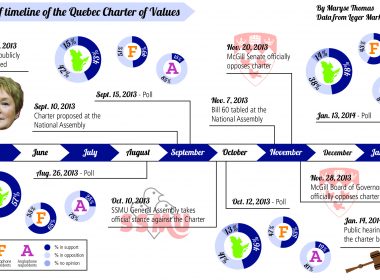
The Students’ Society of McGill University (SSMU) will advocate that the university adopt a policy of non-compliance towards the Parti Québécois’ proposed Charter of Values, following a motion passed at the Dec. 5 Legislative Council meeting.

If implemented, the Charter would limit state personnel, including those working in state-funded education, from wearing conspicuous religious symbols. Both McGill’s Senate and the Board of Governors have passed motions condemning Bill 60 earlier this year, but neither motion mentions the possibility of non-compliance.

“There is a long step between saying that you are against something and taking action against it,” Councillor David Benrimoh said. “[Non-compliance] would be taking action against [the Charter] to make sure that our campus is safe for diversity.”

According to the motion, other Montreal institutions such as the Jewish General Hospital and the English Montreal School Board have adopted policies of non-compliance should the law pass.

Council’s motion also stipulates that university employees should have the right to wear full facial coverings as part of their freedom to wear religious symbols.

AELIÉS accuses SSMU of reneging on promised money

SSMU Vice-President External Samuel Harris spoke on a failed motion to censure SSMU at the Dec. 7 meeting of the Quebec Student Roundtable (TaCEQ).

The motion came from the graduate student association of Laval University (AELIÉS), which accused SSMU of not paying an allegedly promised share of $40,000 towards an ongoing court case. TaCEQ is participating as an intervener in the case, which involves a university student who is challenging the constitutionality of mandatory membership in student associations.

According to Harris, there is no documentation of such a promise.

“Unfortunately for AELIÉS, the minutes from this meeting in February are lost, so no proof in this respect exists,” Harris’ executive report reads. “SSMU has consistently said it will contribute $10,000 for the case, and TaCEQ board decisions have been passed many times reaffirming this.”

The motion at the TaCEQ meeting failed without support from TaCEQ’s other student associations.

a, Arts & Entertainment, Film and TV

Remakes vs. originals

For every cover like Jimi Hendrix’s rendition of Bob Dylan’s “All Along the Watch Tower” that gives a classic song a fresh and worthy interpretation, there are efforts like HIlary Duff’s take on The Who’s “My Generation” that should be banned from the airwaves. Here’s how some of 2013’s prominent song covers stack up against the original recordings they were inspired by. 

Rolling Stones (1976): When the Rolling Stones decide to take a break from their blues-heavy rock and roll to write a ballad, they usually do a pretty good job. Like Stones classics “Angie” or “Wild Horses,” “Fool To Cry” slows things down and brings out a ton of emotion. Its soulful combination of guitar and electric keyboards gives the music a Hall & Oates-type feel, but there’s no mistaking Mick Jagger’s distinctive vocals for those of Darryl Hall. On this track, Jagger does a lot of talk-singing, which matches the measured pace of the music. However, the final minute of the song features an edgier breakdown that feels a bit unnecessary given the earlier mood.

Tegan and Sara (2013): Before they were approached by Lena Dunham to do a commissioned cover of “Fool To Cry” for the hit television show Girls, the female Canadian duo had actually never heard of the song. Considering that, and the challenge of emulating a ballad in which Mick Jagger croons about the woman he goes to make love to in the poor part of town, Tegan and Sara do a fantastic job with their cover. They switch up the verse rhythm by making the only prominent instrument a soothing finger-picked electric guitar, and add more texture to the chorus by harmonizing together on the hook, “Ooh, Daddy you’re a fool to cry.” Also, the breakdown gets cut in this version.

Verdict: This is a matchup in which there’s really no wrong choice. The Stones’ original sets the bar extremely high, and brings more than its fair share of soul to the table. But Tegan and Sara hit the mark on every one of their stylistic changes, and it all comes together surprisingly well. By the slightest edge, this one goes to the girls. Thank you, Lena Dunham!

— Max Berger


The Bee Gees (1967): “To Love Somebody” was released during 1967’s “Summer of Love,” and has been loved by artists ever since, becoming a pop standard that has been covered by the likes of Janis Joplin, Leonard Cohen, and many others. The Bee Gees’ original opens with a signature riff before marching ahead into a verse that embodies the era’s psychedelic musical vibe. Things come to a flourish in the chorus with a horns section that complements the passion of the Gibb brothers crying out the refrain, “You don’t know what it’s like.”

 Michael Bublé (2013): Bublé keeps a lot of the song’s key elements the same. The tempo remains upbeat, and the instrumentation is pretty similar. It features a much more prominent bass line, however, and seems Motown-esque at times. There are a frequent number of fills in between bars, and it makes for an enjoyable variety of short licks and call-and-response vocals. However, the chorus underwhelms in comparison to its predecessor, and the voices of Bublé and his backing singers don’t mesh nearly as well as the Bee Gee harmonies do.

 Verdict: In this competition, it’s The Bee Gees that stay alive. Bublé doesn’t do a bad job, but there’s no exclamation mark that lifts the cover enough to surpass the original. The 1967 “To Love Somebody” is groovy, soulful, and absolutely lives up to its strong reputation.

— Max Berger


Michael Jackson (1982): Holding the 58th spot on Rolling Stone’s 500 Greatest Songs of All Time list, Michael Jackson’s angsty lament, “Billie Jean” is an R&B/dance-pop gem. Sung from the point of view of a man being harassed by a woman claiming to be pregnant with his baby, this track keeps listeners attentive with its engaging lyrics and driving bass line. The song has all Jackson’s trademarks, from the finger snap to his iconic vocal hiccup, and plenty of satisfying synthesizer, a staple of ‘80s pop.

The Civil Wars (2013): The darkly seductive harmonies of folk-pop-country duo Joy Williams and John Paul White of The Civil Wars are perfectly suited to the tone of “Billie Jean,” which they cover seamlessly. They have stripped the song down to its bone, with nothing but their haunting vocals and an acoustic guitar. The well-timed twangs of the guitar, captivating vocal dynamics, and palpable chemistry between Williams and White makes for a mesmerizing listen.

Verdict: The Civil Wars are just a band that says they’re the one. Their rendition of “Billie Jean” is a great listen, but you can’t beat the King of Pop.

— Kia Pouliot


The Beatles (1967): “All You Need Is Love” has become an anthem for Beatles fans, and its title, a slogan. As far as pop songs go it falls outside the box, but stays very much in line with the many artistic liberties The Beatles were taking at the time. The sound on this track feels like a cross between Pet Sounds-era Beach Boys and a royal symphony; there’s orchestral backing, lots of vocal harmonies—and a George Harrison guitar solo to remind you that you’re listening to a rock band. The Fab Four’s timeless message is delivered loud and clear over an equally timeless musical arrangement.

The Flaming Lips (2013): Never straying far from their signature psychedelic sound, the Flaming Lips have remade the Beatles classic “All You Need is Love” into something that can best be described as a revelatory slice into a post-apocalyptic world. The song opens on a bed of strings and harp, carrying listeners into the Flaming Lip’s fantastical vision of such a world. The whole concept of love being all that you need does in retrospect seem questionable, but is well played off in this contemporary rendition. The only thing that’s really missing is a sense of resolution. What comes off as the start of something new instead finds itself closing their latest album, left to finish prematurely and unexpectedly.

Verdict: Both concepts are so clearly opposite—any remnants of a Beatles influence have long been lost between the layers of distortion—yet work well on their own. But ultimately, the original would have to take the cake for its overall cohesiveness that makes it what it is—memorable enough to be remade now, and probably again in the future. 

— Leyang Yu


Amy Winehouse (2006): The title track of Amy Winehouse’s Grammy-award-winning album released in 2006, “Back to Black” is about Winehouse’s relapse into drinking and depression after the loss of a lover. The simple drums and keys play background to Winehouse’s powerful vocals, which intentionally stand out in the mix, even oncew strings make an entrance. The song itself is one of the biggest, most encompassing statements of Winehouse’s troubled career—which is perhaps why it resurfaced on the top 10 of the UK singles chart after her death in 2011. As a modern classic, does a cover for a movie soundtrack do it justice?

BeyoncÉ feat. Andre 3000 (2013): This cover brings covers full circle—it was done for Baz Luhrmann’s remake of The Great Gatsby (2013)—and, with performances from Andre 3000 and Beyonce, literally brings Amy Winehouse’s culturally-appropriated Motown style ‘back to black.’ Three Stacks deadpans “You with your head high, and your tears dry / get on without your…guy” over slow wobble bass. On certain lines, he shifts the octave of each couple words he sings, which is creative, but also slightly silly. After a twangy guitar bridge, Beyoncé sings a sultry second half, which is more of an attempt at imitating Winehouse.

Verdict: Listing to both versions of “Back to Black” back-to-back is pretty impressive—“Back to Black” is a vocals-centric song, and the voices of Winehouse, Beyoncé, and Andre 3000 are three of the most interesting in post-2000s popular music. However, the cover produced for The Great Gatsby lacks the signature tormented belting that Winehouse was famous for, and her passion makes the original the clear superior.

— Will Burgess

a, Science & Technology, Student Research

Delving into the laser lab

Enclosed within the Wong building is a laser lab—and in between homework and classes, this is where Luke Matus spends the majority of his time.

“I’m in chemical engineering, so I had no experience in lasers or surface engineering,” said Matus, a U2 engineering student. “I was just interested in getting into research in general, and I had talked to the professor about it.”

Matus became involved with the biomedical service-engineering lab through the Summer Undergraduate Research program for Engineers (SURE), where he works under the supervision of associate professor Anne Kietzig and the PhD student Jorge Lehr. After spending this past summer at the lab, Matus decided to continue his involvement the following year. Currently, he is finishing off parts of his summer project, and he will complete a research course at the lab next semester.

Matus explained that joining a team when he had no experience in the field was a challenging task.

“The first two weeks of the project were [focused on] reading all of the papers published about lasers and about their surfaces and wetting behaviour,” Matus said. “There was a huge learning curve, and continued as I went along.”

Despite the initial challenge, the experience pushed Matus to develop his problem solving skills.

“A lot of times, you have to learn on-the-go, and if you don’t know how to do something yourself, it takes way longer,” he said. “You [figure out] how to do things yourself, [which] speeds up your project as you learn how to solve the small issues that always arise in research.”

“If there is a problem with the laser, I don’t troubleshoot the laser,” Matus joked.

Matus’ project involved a infrared femtosecond-pulse laser set-up, which performs infrared labeling. By mounting titanium samples on a stage in front of the laser, he can use the laser to alter the surface of the sample. Then, Matus changes the properties of the samples and tests them to see how the laser affects these new surfaces. Matus explained that he is looking to design the samples to have specific wetting behaviour—the ability of a liquid to maintain contact with the surface—on the surfaces.

“There is a big box [in the lab], which is the laser,” Matus explained. “Then there are a ton of equipment and different boxes that run different programs within the laser—they have different functionalities [….] Once you have everything set up you open [the laser] and there are samples on the stage. The stage is controlled by a computer and you have a program that completes whatever pattern you want.”

While Matus enjoyed his time at the lab, he is thinking of applying to an industry job next summer. “I really like the research […] but I want to try something else.” He explained that research might be a possibility for his future, but is still eager to explore many fields of engineering to find out what fits best for his career path.

That said, Matus found his work at the lab highly rewarding—both in terms of how it pushed him as a student and the results he acquired.

“I guess one of the things that stuck out was that […] one of the conclusions that I came to sort of reflected on this paper [on which I had based my research], and I proved [an additional part of it] in my own research,” Matus said. “It was like ‘Oh, I looked at this PhD or grad student work and I actually contributed something, even if it’s not published.’ It was rewarding.”

a, Science & Technology

2013 Technology: a year in review

1. Wearable computing 

Between Google Glass and the smart watch—including the models Galaxy Gear and Pebble, wearable computing is a rising trend. Pebble was founded by Eric Migicovsky and released in 2013. Originally, Migicovsky wanted a device that would allow him to use his smartphone without crashing his bicycle; from this stemmed the idea that a watch could serve as a notification hub for the smartphone in his pocket. Pebble was designed keeping in mind that more complex tasks are left to a phone. Unlike Google Glass—a wearable computing head device that seeks to replace the smartphone—Pebble acts as a simple accessory for people to use to supplement the functionality of their phones.

2. Building intelligent machines 

Starting in 2011, Watson—IBM’s Jeopardy winning computer—wowed the world with its sharp answers that ousted Ken Jennings, the record holder for the longest winning streak on this question-answer game show. One of the reasons for Watson’s success was “deep learning”, the driving force behind machines able to recognize objects, translate speech, and do many other things that come naturally to the human mind. Google has become a hub for this field; one of Google’s deep learning systems was shown ten million images from YouTube videos, and it proved to be almost twice as good as any previous image-recognition systems. Furthermore, this October, Rick Rashid, Microsoft’s chief research officer, put on display a new system that Microsoft had been working on which could take speech, transcribe it into text, translate it into another language and then voice the text in the translated language, in a simulated voice. Deep learning is an increasingly interesting field that has immense scope for improvement and will definitely be something to watch out for in the coming year.

(redorbit.com)
(redorbit.com)

3. Ephemeral messaging 

The world’s attention was captured this year by Snapchat- an app that allows you to send an image or a video with a short text for a limited period of time to a friend. The novelty of this app is that people can send embarrassing photos or messages without having to worry about them being saved. With most people having used social networks for a few years now, there is a wealth of messages and posts from our digital pasts that we probably don’t want on the Internet. This ephemeral messaging and sharing concept is helping restore a sense of privacy in the way we communicate, as not everything we say is recorded. In other words, it is restoring candidness in conversations and our online interactions- just like in the real world.

4. 3D printing 

As 3D printing gradually becomes less expensive and more accessible, the potential for its use is rapidly increasing. Until recently, 3D printing was only used as a manufacturing technique to produce small-scale items for consumer use. However, the company General Electric (GE) is pushing to produce fuel nozzles for new aircrafts using this technique. This is the first endeavour into mass-producing a significant product through 3D printing. The benefit of using this technique over the traditional manufacturing methods is that it uses fewer raw materials to produce and is hence cheaper for the manufacturer. As a result, the parts are lighter, give greater fuel efficiency, and are more economical for the aircraft operators. If this turns out to be successful, we could see this methodology of using 3D printers to produce parts percolate into other industries as well.

a, Science & Technology

First malaria vaccine en route for 2015

According to the World Health Organization (WHO), Malaria causes an estimated 660,000 deaths each year worldwide. Presently, there is no available vaccine for this mosquito-borne disease—only preventative measures, such as bed nets, insecticides, and anti-malarial pills, which have had a limited effect. However, in a considerable step forward, the British drug company GlaxoSmithKline (GSK) announced that they were seeking regulatory approval for the world’s first malaria vaccine: RTS,S.

According to David Poland, senior communications officer at the Program for Appropriate Technology in Health (PATH) Malaria Vaccine Initiative, RTS,S is the scientific name given to this malaria vaccine candidate. The name represents its composition.  Poland explained that the aim of the RTS,S vaccine is to trigger the immune system to defend against the deadly malaria parasite Plasmodium falciparum when it enters the bloodstream. It’s designed to prevent the parasite from infecting, maturing, and multiplying in the liver, after which the parasite re-enters the bloodstream and infects red blood cells, leading to the disease symptoms.

“Among the many components found in the RTS,S vaccine, the specific combination of a protein known as the Circumsporozoite protein (CSP) with the hepatitis B antigen is what appears to make it efficacious,” Poland said.

According to Poland, the RTS,S vaccine has been in development for more than 20 years. The vaccine was created in 1987 by scientists working at the GSK laboratories, and it wasn’t until 1995 that the first clinical tests for the vaccine began in the United States. In January 2001, GSK and the PATH Malaria Vaccine Initiative (MVI), with grants from the Bill & Melinda Gates Foundation, entered into a public-private partnership to develop an RTS,S-based vaccine for infants and young children living in malaria-endemic regions in sub-Saharan Africa.

Before the vaccine is introduced, the candidate drug must be assessed for its safety and efficacy profile. This is accomplished through a clinical trial. Specifically, there are three trials (Phase I, II, and III) that evaluate the safety and efficacy by testing the vaccine on various sample sizes. The trials must be designed in consultation with appropriate regulatory authorities and the World Health Organization (WHO). Each phase can be thought of as a pole vault—when the vaccine clears one phase, the bar advances to a higher height, until either the vaccine fails to prove efficacy, or it clears all three phases. According to Poland, the company is at Phase III of the clinical trial.

The Phase III efficacy trial of RTS,S started in May 2009 and is still underway at 11 sites in seven African countries (Burkina Faso, Gabon, Ghana, Kenya, Malawi, Mozambique, and Tanzania) with 15,460 infants and young children participating. According to the MVI, this is the largest malaria vaccine trial in Africa to date. Outlined in the press release published last month by GSK and MVI, researchers enrolled two groups of participants: infants aged 6 to 12 weeks  and children aged 5 to 17 months. The participants initially received three doses of either RTS,S or a “control vaccine,” allowing researchers to evaluate the efficacy of the vaccine on a large scale, while continuing to monitor safety and potential side-effects during the 18 months of follow up.

“To date, this trial has indicated that the RTS,S vaccine candidate is safe to administer to young children and provides some protection against malaria disease,” Poland said.

Specifically, the trial has shown that the RTS,S vaccine candidate has an acceptable “safety and tolerability profile” and that based on 18 months of follow-up after their third injection, it reduces clinical malaria cases by 56 per cent in young children 5-17 months of age and by about 31 per cent in infants 6-12 weeks of age. “The potential public health impact is noteworthy,” Poland added.

“The next steps in RTS,S development come in 2014, when we expect to complete this trial and fully analyze the data” Poland explained. “In 2014, the pharmaceutical partner on RTS,S development, GSK, will also be filing for a regulatory opinion with the European Medicines Agency (EMA).”

“If the opinion is supportive, the World Health Organization has indicated that a policy recommendation for the RTS,S malaria vaccine candidate would be possible as early as 2015,” Poland said. “[This will] pave the way for decisions by African nations regarding large-scale implementation of the vaccine through their national immunization programs.”

Read the latest issue

Read the latest issue