

Latest News

a, Science & Technology

Moving beyond the classroom as a budding entrepreneur

Throughout his years at McGill, Jeff Kelisky never forgot his father’s advice, “Leave the world better than when you arrived.” Now, as a global business builder, Kelisky continues to strive to make his mark in the world of business and computer science.

Kelisky graduated from McGill in 1988 with a B.Sc. in mathematics and computer science. Since then, he has been involved in multiple start-up and corporate foundations, including his current position as CEO of the company Picsolve—a company specializing in image capture and distribution. Kelisky attributes much of his success to the strong foundations he acquired at McGill.

“The power of the written word is not to be underestimated,” explained Kelisky, when asked about his experience studying at McGill. He elaborated that the writing courses he took outside of his mathematics and computer science degree really enriched his education.

“You learn to think logically and very early on learn to specify everything as precisely as possible, and care for a wide range of possible scenarios,” Kelisky added. He explained that the combination of computer science and writing courses equipped him with a set of tools from which to use in the business world.

There were some skills, however, that Kelisky acquired after graduation.

“I underestimated the power of raw confidence,” said Kelisky, “People are looking for answers, in terms of companies trying to sell something to customers or putting a proposal together [….] The [situations] where I accelerated the most […] were when I felt confident enough to say, ‘this is what I think needs to happen.’”

To him, the point where he moved on from being a student to an entrepreneur was when he gained the confidence to bring to the table a well thought-out solution.

In an earlier talk this year at McGill, Kelisky explained how his journey as an entrepreneur involved a balance between working towards a long-term goal and leaving some things to serendipity.

“You need to actively manage the role between them,” Kelisky said. “I absolutely would have a direction for myself [but those who work hard] tend to be luckier than most.”

“The more you try and stick to a core [goal], the more you seek these opportunities out and the more you find such things to be serendipitous—they wouldn’t have happened if you weren’t [as] focused.”

One of the problems computer science graduates are facing is the decision whether or not to become involved in pre-existing corporations or try their luck at starting up their own company.

Having had experience in the world of start-ups, Kelisky acknowledges that there is a tremendous amount of learning that comes from the experience. However, he cautions graduates to carefully analyze all the factors that will go into a start-up. These include market demand, potential for future growth, and most importantly, whether or not investors back your idea.

“One of the most powerful things is translating what you know into solving real-world problems,” Kelisky added. “When you make the handshake at the end of the deal, that is when you know you have transformed something that was just an intellectual construct to something that matters and the world has acknowledged.”

In the end, Kelisky says he believes that perseverance is the key to being successful as an entrepreneur.

“In most cases, the difference between success and failure, whether it is a retailer creating a new concept [or] a techie starting a new software platform […] the distinguishing character is that they don’t quit.”

Kelisky explains that entrepreneurs will be told over and over again that their idea won’t work. He advises students to listen to these criticisms and analyze what they are talking about. The important part is to be able to learn from this process of rejection and create a better iteration of the product.

a, Research Briefs, Science & Technology

Research briefs

Safety questioned in hands-free texting apps

An article in the November issue of Scientific American revealed a surprising twist to the popularity concerning hands-free texting apps, such as Voice Text Pro and DriveSafe.ly. Developers assumed that, since drivers would not need to take their eyes off the road to use them, these apps would be a step towards greater safety.

Although talking on the phone while driving is not a safe idea, it isn’t solely the dexterity associated with handling a phone that causes accidents. Rather, what is concerning is the fact that the driver’s concentration is divided.

What does this mean for hands-free texting? A study released this past April by the Texas A&M Transportation Institute proved the assumptions of this so-called “safer” practice wrong. The experiment looked at three different groups: drivers texting by hand, drivers texting hands-free, and drivers that were not texting at all.  The results of the study indicated that there was no difference between the first two groups of texters, reporting, “response times were significantly delayed no matter which texting method was used.”  Case in point, hands-free texting is definitely not a safer alternative, and these apps are no exception.


 App developed to dispell surgery fears

The Montreal Children’s Hospital hopes to help ward off fears of children’s first surgeries with the release of the app My First Surgery. The app is works on iPads and is currently free to download on iTunes.

My First Surgery is geared towards both children and adults who are about to undergo surgery for the first time. Developed by pediatric surgeon Robert Baird, there are two components to the app: an interactive child view that features bright colours and computer animation, and a parent view that provides further information on the surgery.

The app begins by asking the child how they feel about surgery, with which the child can choose between various teddy bears labeled with different emotions: “all cool,” “curious,” “scared,” or “confused.” Next, a new screen pops up and a cartoon surgeon explains to the child what will occur in the operating room.

According to the Montreal Gazette, the app features instructional videos for patients that provide information about the necessary preparations for surgery, such as blood tests or fasting.

“I felt that this app would be the kind of tool that would augment things just a little bit more, maybe in some small way decrease the anxiety of both the kids and the families,” Baird told the Montreal Gazette.

Though currently available in English, the app will be translated into French, and made compatible with iPhones and Android devices.


Scitech calendar 

International Research in Science and Engineering: Information session

Learn more about finding undergraduate international research positions and hear from other Science and Engineering students about their international research experiences.

November 6th, 4:30 p.m. in Adams Building, Room 5

Annual BASiC Semi-Formal: The Great Gatsby 

Nov. 9th,  9 p.m. – Nov. 10th 2 p.m. at Thomson House

Science Graduate and Professional Schools Fair 

Nov. 13th from 10 a.m. – 3 p.m. in the SSMU Ballroom

McGill Science Games Hype Night

Nov. 14th, 9 p.m. – 11 p.m. Bracelets will be on sale this week.

Osteopathic Medicine in Canada

Join second-year medical students from Michigan State University (MUS) for a presentation on becoming a Doctor of Osteopathic Medicine (D.O.) Speakers include McGill Alumni and class of 2016 President, Bo Pang.

Nov. 15th, 6 p.m. – 8 p.m. in Leacock, Room 219 

Medical Direction’s Annual Wine & Cheese

Join Medical Direction for an evening where you have the opportunity to talk to professors, application advisors and current medical students. Check out their website for upcoming information on ticket sales.

Nov. 19th, 6 p.m. – 9 p.m. at Thomson House Ballroom

a, Student Life

Pizza Navona

A fair amount of takeout pizza in Montreal—certainly from establishments along St. Laurent—can best be described in degrees of mediocrity. While there is an abundance of respectable, acceptably priced fast food in this city, pizza is a niche in a state of indifference. A market consumed by mediocre, standardized product from the national chains, and an unpredictable but similarly mediocre product from most independent pizzerias.

Into this market steps Pizza Navona, which set up shop this past summer across the street from McLennan Library. The sign outside advertises two cheese pizza slices and a soda for just over $4 ($5 with tax). In other cities, this would be a middle-of-the-pack price, but here in Montreal, it constitutes a deal of note. The real question is, does it taste any good?

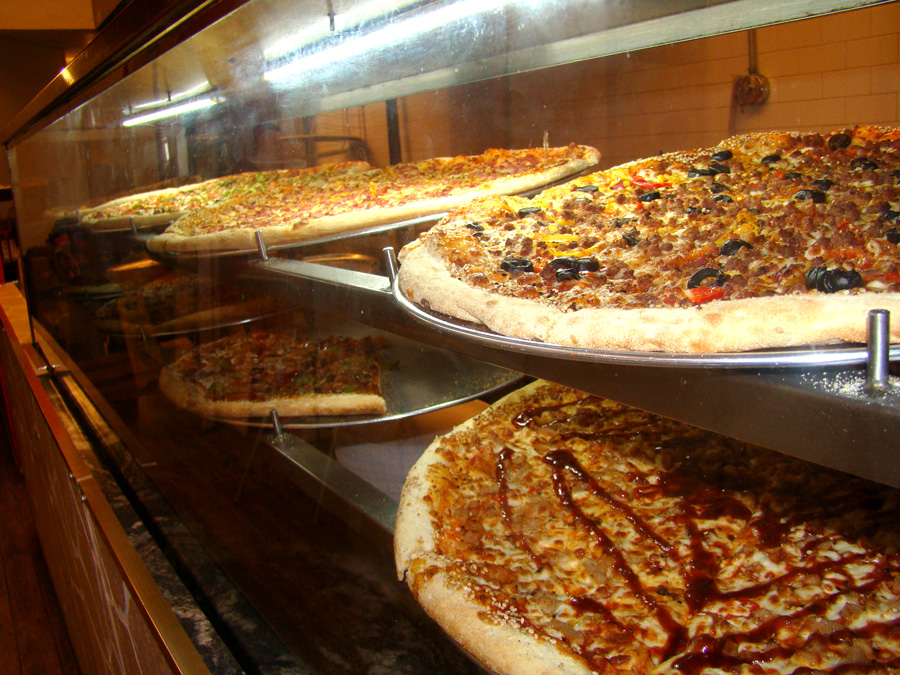
The pizza slices at the restaurant—all nine varieties—are kept in a glass box and heated briefly in the oven before serving. Of the varieties, Mexican pizza is superior, but it is a bit smaller than the other slices; in contrast, the barbecue chicken pizza is better in concept than execution. Pepperoni is a solid, if unremarkable choice if the plain cheese slice simply won’t do. All slices can be topped with Parmesan cheese and spicy oil (which the employees says is made on-site) at no extra charge.

Pizza Navona also serves up non-pizza options including paninis and salads.

I tried the cheese and Mexican slices, which came to $5.75 without a drink. Cheese slices alone are $1.99; topped slices are $2.99 each. Both were acceptable. The cheese slice had a soft crust, with a light crisp at the bottom. The cheese blends particularly well with the parmesan and oil, and the edge of the slice, which is sprinkled with sesame seeds, tastes particularly appetizing when folded over the last bits of cheese. The Mexican slice was a sharp, somewhat spicy fusion of flavour. The crust and the toppings—olives, peppers, and ground beef—all blended effectively.

The atmosphere at Pizza Navona is just what you would expect. For a pizza joint, the relatively comfortable seats and five tables—an ample number for the space—make it a reasonably appealing place to stay and eat. A television in a corner of the eating area is often tuned to some disposable daytime fare, but occasionally live sports are shown. Either way, it isn’t particularly obtrusive.

While Pizza Navona may not stand out for its atmosphere or quality of food, it’s certainly a worthy destination for a quick lunch between classes, and the large variety of dressed pizzas should have something to offer to any taste. The $5 price for two slices and soda is on the cheap end of downtown options. While Pizza Navona seems to harbour high aspirations, the result is just good enough; better than absolute mediocrity, but less than it first seems.

a, Opinion

Endorsement: ‘yes’ to services for Post-doctoral fellows

Currently, Post-doctoral fellows, students who have completed PhD programs and are now directly contributing to academic research, exist in a precarious limbo here at McGill. Classified as students by the Quebec government, they don’t receive the benefits of staff members. However, they are also not entitled to a package of student services that most members of the Students Society of McGill University (SSMU) and the Post-Graduate Students’ Society (PGSS) take for granted, including  the McGill Health Clinic, Mental Health Services, Counseling, and Career Planning Services, just to name a few.

A PGSS referendum for post-doctoral students to opt into paying the Student  Services Fee, $138.46 a semester will be open for voting between Nov. 4 and Nov 8, inclusive. While individuals can already opt into the fee individually in person, proponents of a “Yes” vote say that post-doctoral fellows being in the system as a bloc will allow them to negotiate for services tailored to their highly unique needs.

The Tribune endorses a “Yes” vote on this question. Post-doctoral students make substantial contributons to McGill, especially through their work on research projects, yet are in a seeming gap in the system, recognized as neither students nor employees, despite performing the roles of both. This fee, which would be non-opt outable in the event of a “Yes” vote, gives access to a vast  array of services that will improve the lives of the post-doctoral students on our campus.

Full disclosure: the Tribune Publication Society (TPS) is also running a fee levy question in this referendum period. Adrien Hu, Steven Lampert, and Carolina Millán Ronchetti are on the TPS ‘Yes’ committee.

a, Arts & Entertainment, Music

Aokification nation

What does Steve Aoki—notorious cake thrower and DJ extraordinaire—do when he’s not performing for hundreds of university students? He drinks green juice.

“It sounds like we’re partying every night, but we’re usually healthy [….] I’m drinking the craziest drink right now, it’s pure green and kind of tastes like grass.”

Later in our interview, Aoki describes it as the “gnarliest juice,” but maintains that it’s important to stay healthy and fit on the road.

“These bus tours are really good because I can bring my whole team on the road. I have a trainer on the road with me. I have to see a physical therapist because I’ve actually thrown my shoulder out [by] throwing cakes.”

After over 17 years in the music business and an average of 250 shows per year, it’s no wonder Aoki takes the time now to keep well and take care of himself. His “Aokify America Tour” features the talents of Waka Flocka Flame and Borgore, among others, and is making stops all over North America—including one in Montreal on Oct. 30.

A sceptical reader might question Steve Aoki’s enthusiasm for putting out music and touring after so many years, but there’s no doubt about it—he loves what he does, and loves watching music evolve, both as an artist and the head of a successful record label, Dim Mak.

“The sound of music keeps changing, not just on a linear level—it’s exponential,” he says. It’s an exciting time. I wanna hear how people are changing music and creating their own [stuff]…I love being part of a culture that embraces new [things].”

However, it is unsurprisingly difficult to live a life that’s mostly on the road, never staying in one place for more than a couple days.

“I accepted this life a long time ago, but it’s hard for people that are new to it, because it’s fast-paced,” Aoki adds. “You have to be able to pick yourself up and go, and be flexible. It’s good for your brain, to rewire [it] and not get stuck in one place.”

Although he’s now unquestionably one of the most successful men in EDM—DJing and producing are only two of his numerous projects—Aoki maintains that he never could have imagined his career reaching such a wide scope when he founded Dim Mak records in 1996.

“You can’t really foretell [that] something like this [will] happen. It’s all about embracing your small victories and building on them. You can have your big goal [at the beginning], but at the end of the day you might not reach that goal—you might reach a different goal.”

For Steve Aoki, at the moment, one of those goals includes the Steve Aoki Charitable Fund, which he founded last year. The fund donates one dollar from every ticket sold on the Aokify America Tour to charities supporting brain research—a cause that is very important to him.

“Everything comes from our brains, we should be spending more money, and funding and research on our brains because there’s so much we don’t know about them [….] We can learn how to live healthier, better, longer lives.”

Short of solving the mysteries of the human brain, Aoki has been focusing on making music in his downtime.

“Right now I’m finishing my album on the bus, so hopefully it’ll probably come out in May or June,” he says.

Eventually, he’ll get some well-deserved time off from work at the end of the year—but not too much.

“I always have eight days at the end of the year for proper days off […] to take out my mom and hang out with my family. Then I go back into the studio.”

Steve Aoki performs at 7:30 p.m. on Oct. 30 at Metropolis (59 Ste. Catherine St. E). Tickets are $42.50-$54.55. Opening acts are Waka Flocka Flame, Borgore, Dirtyphonics, and Kryoman.

a, News, SSMU

Student-run café to open Jan. 6 in SSMU cafeteria

A student-run café is set to open on Jan. 6, 2014 in the SSMU Building, according to an announcement last Friday by the Students’ Society of McGill University (SSMU).

The location of the student-run café will be in the second floor cafeteria of the building. The space was previously occupied by Lola Rosa Xpress, which chose not to renew their sublease this year. The location remains equipped with the utilities required to run the café.

The announcement followed the McGill administration’s recent approval of SSMU’s proposed use of the space on the morning of Friday, Oct. 25, which is a requirement for all usage of room in the SSMU Building. SSMU President Katie Larson said that the announcement had been delayed due to various factors.

“There was confusion about whether the former Deputy Provost (Student Living and Learning) had given explicit consent to the project,” Larson said. “So [we] decided that before we advertised the project publicly we would need to get a new written approval so McGill was not surprised.”

The café will be staffed by students and financially managed in a manner similar to that of other SSMU operations, such as Gerts Bar and Mini-Courses. According to Larson, its day-to-day operations will be organized by a coordinator of the café, who will also work on a budget with SSMU Vice-President Finance and Operations Tyler Hofmeister. Actual financial management will be performed by SSMU’s accounting department.

“As for actually accounting, bookkeeping, all those professional services, we would have them in-house already,” Larson said. “So we are able to use them to support [the operation].”

Hofmeister said that the café is not expected to raise revenue.

“SSMU is a non-profit organization [and] as such, we attempt to run all operations at a break even basis,” he said.  “To be clear, the café is aiming to make revenue it’s first year—enough to offset the associated expenses with operations in this year.”

The announcement follows nearly three years of discussion within SSMU, which began in Fall 2010 when McGill shut down the student-run Architecture Café due to alleged financial instability. The closure prompted protests by students and led SSMU to endorse a boycott of McGill Food and Dining Services (MFDS), as well as the suggestion of establishing a similarly run café in the SSMU Building.

Former SSMU president and current manager of the café Josh Redel said that in addition to providing jobs for students, the café will serve as a building block for related student initiatives, such as projects on sustainability and catering.

“At the start, we’re looking at some very interesting plating options and compostable materials and such but we’d very much love for a group of students to look into creative ways of doing takeout [and] looking into the plating issue in the cafeteria,” Redel said. “We hope that the [café] will be like a framework for students to be able to do projects like that, so that they have real life experience.”

According to Redel, the café will be inspired by ideas brought up during the Sustainability Case Competition held in March 2012, an event where teams of students developed designs focused on economic and environmental sustainability. Although the competition advertised that the winning team’s design would be implemented, Larson said this is no longer possible given the circumstances of the café.

“They ran the competition without having a concrete way to implement [the winning idea],” Larson said. “It was miscommunicated in that way [….] which is unfortunate, because with great ideas, you don’t want to push people away with miscommunication.”

Andrew Wu, one of the four members of the winning team and a current U3 Arts and Science student, said that the current SSMU proposal is very different from the café design his team developed.

“During the competition, the stated goal was to create a socially inclusive café that was both environmentally and financially sustainable; all participants in the competition firmly believed in this goal, which is why there was such a high level of commitment towards the project,” Wu said.

“While much is still unknown about the student-run café, it’s somewhat disheartening to see that the vision is no longer what it used to be,” he added. “That said, I am still optimistic that the student-run café can preserve the elements of sustainability that the cafe proposal was all about.”

Redel noted that the designs would continue to serve as inspiration for the café.

“We’re using a lot of information from all the teams to start,” Redel said. “If we use any of their research, they will be credited for it for sure.”

Leading up to the official opening, SSMU will run a campaign to raise awareness of the café, engage students in its operation, and provide feedback regarding what students envision for the café. The campaign includes a naming contest, which will be determined through a student-wide vote through social media.

Redel stressed the importance of this student initiative.

“To be able have a space like that on a campus in downtown Montreal is a once-in-a-lifetime opportunity, and I really hope people understand the impact of that,” Redel said. “I hope people get out and get engaged. It’s not just about consultation, it’s about being deeply integrated into how the café functions.”

a, Recipes, Student Life

Roasted Pumpkin Seeds

Take part in the autumn festivities by saving your seeds from your pumpkin for a Halloween treat!

1) Rinse seeds until you’ve got rid of pumpkin fibres.

2) Dry them with paper towel or a tea towel and place them on a baking sheet lined with parchment paper or aluminum foil. Sprinkle with some salt and olive oil, and other seasonings if desired—be creative.

3) Cook at 325oF for 10 minutes then flip seeds over. Place back in oven for another 10 minutes, but watch carefully to prevent burning.

4) Take the seeds out when they are a light golden colour. Let cool before eating.

Other seasoning ideas:

— garlic powder

— cajun spice

— jalapeno

— barbecue spice mix

— cinnamon and sugar

— parmesan cheese and pepper


a, Editorial

TaCEQ a waste of SSMU funds

One of the lesser-known expenses of the Students’ Society of McGill University (SSMU) is the portion our association devotes to membership in the Table de concertation étudiante du Québec (TaCEQ). Established in 2009, TaCEQ is a federation of student associations that seeks to advocate for broader student interests at the national and provincial level. However, given TaCEQ’s dubious leadership structure and lack of tangible achievements in the past five years, SSMU should seriously reconsider its membership in the organization.

Currently, the other members of TaCEQ include the undergraduate and postgraduate student unions of the Université Laval—CADEUL and ÆLIÉS, respectively—and the post-graduate student union of the Université de Sherbrooke, REMDUS. The numerous issues with SSMU’s membership in TaCEQ start right here. The minimum membership for a federation to be nationally recognized is four student associations on four different campuses, a mark which TaCEQ has yet to meet. The lack of national recognition prevents the union from receiving certain government subsides, which means TaCEQ’s constituent student unions shoulder the entire cost of keeping it afloat; SSMU pays for just under a third of TaCEQ’s budget—this year that totaled about $17,000.

The lack of national recognition substantially reduces TaCEQ’s influence in political advocacy, especially compared to that of the much larger Fédération étudiante universitaire du Québec (FEUQ) and Association pour une solidarité syndicale étudiante (ASSÉ).

In light of SSMU’s tumultuous past experiences with FEUQ, TaCEQ’s highly decentralized structure—each student association directs decisions on campaigns, spending, and political positions, while also holding an unconditional opt-out—has been advertised as an asset. However, this decentralized structure also leads to internal disputes. SSMU’s relations with both of the Laval student associations in TaCEQ have been distant at best. Additionally, a congress planned to address structural reform this October was singlehandedly blocked by ÆLIÉS.

The suspension of the congress points to another problem with TaCEQ—a paucity of accomplishments to date. In its five years, TaCEQ has failed to achieve tangible results, most recently on the tuition debate in 2012. One of the organization’s few accomplishments was attending the provincial government’s Higher Education Summit this past year, an event of dubious success.

Even worse, TaCEQ is hardly a transparent organization. Five years into its existence, the association has yet to produce English versions of even basic online documents, an issue TaCEQ claims will be rectified early next year. It has also been noted that official reports, such as meeting minutes, shed astonishingly little information on the operations  of the organization.

Is any of this worth $17,000 a year? While there might be some value for SSMU to be a part of a larger federation of student associations, it is clear that the interests of many of its members are not quite served by what has largely been a stagnant, ineffective organization. TaCEQ’s lack of major achievements, balky decision-making apparatus, and cumbersome annual budget—$53,500  this year—are all critical shortcomings with the organization. The money SSMU spends on TaCEQ could be put towards funding for clubs, the forthcoming student cafe, or any number of initiatives more relevant to McGill students.

Recent news that REMDUS  is  holding a referendum this December to leave TaCEQ provides the perfect  opportunity to demand changes. SSMU needs to put serious pressure on TaCEQ to make tangible, quantifiable improvements to its management structure. Insufficient progress within a clearly defined and short timetable should trigger a SSMU referendum question to withdraw from the organization.

 Click here to read the Tribune’s investigative report “Is TaCEQ right for SSMU?”

a, Science & Technology

BBM for smartphones receives unexpected hype

After firing 4,500 employees due to sales losses and signing an agreement to sell the company to FairFax Financial for $4.7 billion USD, what could BlackBerry Ltd. possibly do to regain its momentum in the smartphone industry? Perhaps releasing its BlackBerry Messenger (BBM) service for free to Android and iPhone users will do the trick.

On Oct. 21, BlackBerry Ltd. launched BBM for Android’s Google Play Store and Apple’s App store. According to the Blackberry blog, over 10 million people downloaded the service worldwide in the first 24 hours of its release.

The company stated that, “[it was] one of the best single-day openings for a mobile app to date.”

Andrew Bocking, the executive vice president of BBM for BlackBerry, reported in the Blackberry blog that the app quickly rose to being the number one downloaded app that day in over 75 countries including Canada, UK, U.S., Indonesia, and most of the Middle East.

“We intend to be the leading private social network for everyone who needs the immediate communication and collaboration of instant messaging combined with the privacy, control, and reliability delivered through BBM,” Bocking wrote in a press release.

The app was originally due to be released late in September; however, this was postponed until October after a version for Android devices was leaked online.

To date, the BBM app is available for Android users running Android 4.0x and iPhone users running iOS6 and iOS7. Users can download BBM from their app stores or by visiting BBM.com. Those who signed up online or had pre-existing accounts for BBM can immediately begin using the service. Otherwise, BBM has set up a simple line-up system to deal with the demand.

“If you didn’t sign up in advance, don’t worry—we are focused on moving millions of customers through the line as fast as possible,” Bocking wrote.

BBM was one of the first instant-messaging apps for smart phones that allowed for calling, texting, video chatting, and the ability to share screens with other BlackBerry users. It rose in popularity during the late 2000s, but faced a user decline with the emergence of Apple and Android smartphones.

As of now, BBM for Android and iPhones allows for instant messaging, and an update feed for contact activity while using BBM’s unique PIN and barcode system for adding contacts. The company hopes to bring BBM Video, BBM Voice, and BBM Channels to Android and iOS.

Despite the hype, BBM is still up against some serious competition. The multi-platform service WhatsApp has already established approximately 200 million customers worldwide. This app allows for instant messaging, voice messaging, and group chats like BBM. The service also allows users to send multiple file types through chats, which BBM cannot do as easily.

Unlike WhatsApp, BBM gives the user complete control in adding contacts through the PIN and barcode system. WhatsApp lacks this control; anyone set up as a contact on a smartphone is automatically set up as a contact on WhatsApp.

It’s difficult to determine whether BBM will surpass its competition. Each excels in some areas and lack in others. The clash of these two titans is inevitable, and only with time will we know which prevails and dominates.

a, Arts & Entertainment, Music

Fire of Anatolia: sure to set the stage ablaze

Since its establishment in 1999, Fire of Anatolia (originally titled Sultans of the Dance) has been continuously dazzling audiences around the globe with its impressive spectacle of dance and percussion. Conceived and produced by Mustafa Erdoğan, a native of Turkey, this unique performance draws inspiration from the ancient mythological and cultural history of Anatolia. The overarching themes of the show; love, culture, history, and the peace of Anatolia; are told through an artistic representation of some of the region’s most important myths and histories. This renowned dance group is acclaimed worldwide—they have performed in 87 countries and 275 cities, selling out each of the 35,800 live performances—however, they have not yet graced Canadian stages. This will soon to change as Fire of Annatolia make their Canadian debut at the beginning of November, with performances in Toronto, Ottawa, and Montreal.

As CEO at Sorite Entertainment in Toronto and a key organizer of the Fire of Anatolia Canadian tour, Basri Yilmazer has given some insight into the expectations for the Canadian premiere of this eastern gem. Yilmazer discussed the fact that it is a real synthesis of East and West, combining music and dance styles from all over the world while maintaining an overarching focus on Turkish culture and history.

“[It is a] very good representation of the country,” he said, and with great excitement added, “I have never seen such a show!”

Although Fire of Anatolia has been on the stage for more than 10 years and performed for a range of diverse audiences, its has remained essentially unchanged—a testament to its success. Yilmazer, playing off the idea of dance as the universal language, said that the show is “targeting everyone—that is why it doesn’t need to change.” The original form of the performance is able to deliver its message effectively to any viewer who sees it, and Yilmazer attested to its strengths.

“[The dancers] are going to be amazing, [the audience is] going to be impressed for sure […] with this presentation of ‘traditional East’ meets ‘contemporary West,’” he said.

Aside from winning multiple awards around the world, Fire of Anatolia also holds two Guinness world records. The first record is for the fastest dance performance—reaching an amazing 241 steps per minute—and the other for the largest audience to a dance performance, reaching 400,000 people in Ereğli, Turkey. This remarkable troupe, made up of more than 50 dancers and featuring more than 3,000 dance figures, many of which date back more than 1,000 years, will surely be a worthwhile extravaganza. Yilmazer has even announced that the Prime Minister will be in attendance at the Ottawa performance. If you’re looking for a unique, exciting and aesthetically beautiful experience, Fire of Anatolia promises to be a performance to remember.

Fire of Anatolia will be in Montreal at 8 p.m. on Nov. 4 at the Théâtre St-Denis (1594 St. Denis). Tickets are available at ticketpro.ca from $52-$92.

Read the latest issue

Read the latest issue