Latest News

a, News

PGSS Council discusses supervision, upcoming referendum

Review of supervision

Post-Graduate Students’ Society (PGSS) Secretary-General Jonathan Mooney announced two major projects that PGSS is currently working on. The first is the improvement of the quality of supervision for students in all departments by clarifying students’ and supervisors’ rights and responsibilities. The second project focuses on ensuring that international students receive tuition waivers—a type of financial aid that reduces or eliminates tuition fees for students who qualify.

“We plan to work with departments and faculties to promote the use of funding that is sent by the central administration to the faculties to support and retain international students on tuition waivers for these students,” Mooney said. “Some of this money, which is tied to the number of international students in a faculty, seems not to be reaching these students.”


Fortier addresses funding, student space

Principal Suzanne Fortier fielded questions from graduate students at Council and outlined future projects. These include reviewing supervision and funding for graduate students. Questions mainly concerned the university’s financial situation and the lack of workspace for graduate students.

PGSS Financial Affairs Officer Erik Larson asked Fortier to explain the financial state of McGill. Fortier said that she places importance on putting money towards attracting talent to the university.

“If we agree that it’s largely about [investing in] people, maybe we’ll have to see other things that aren’t as good as we’d like them to be because while important, they’re not a top priority,” she said.

Economics Councillor, Guillaume Lord. expressed concern about the allotment of workspace for graduate students.

“Space is very uneven across departments,” he said. “A lot of people in our department do not have office space, and it was heartbreaking for me to see this at the beginning of the year. […] Office space is not only a workspace; it’s also a community space.”

Fortier said she had not known this was an issue, but that a solution would not be easy. She mentioned that she would add the issue to future discussions on issues of space at McGill.

“Physical infrastructure is an issue at this university,” Fortier said. “We’re pretty tight on space and we […] don’t have much extension room, and of course there’s the matter of funding.”


Tribune fee referendum

Council approved a PGSS referendum question regarding funding for the McGill Tribune. If the question passes during the November referendum period, graduate students will pay a non-optoutable fee of $0.75 to the Tribune for both the Winter 2014 and Fall 2014 semesters, with a vote on renewal in 2015.

“Right now, our mandate as a newspaper is only towards undergraduate students,” said Carolina Millán Ronchetti, editor-in-chief of the McGill Tribune, at the meeting. “However, we recognize that post-graduate students face unique challenges [ …. ] Membership will help bring more coverage [of] issues that pertain to post-graduates such as supervision and office space.”

Mooney explained that the Tribune ran a similar question last May, which asked graduate students for $1.00 per semester, but that the question did not pass by a small margin.


McGill Writing Centre

Another question Council approved to run in the referendum period is for a fee of $1.50 per term to support graduate use of McGill’s Writing Centre.

However, Council voted against a motion for PGSS to contribute a one-time sum of $3,000 from PGSS’s Special Projects Fund. Without the fund transfer, the Writing Centre will no longer offer tutoring services to graduate students.


Letter opposing Charter of Values

Mooney asked Council for feedback regarding a letter to Parti Québécois (PQ) leader Pauline Marois that he wrote on behalf of the PGSS, which expresses their opposition to the section of the proposed Charter of Values that bans public workers from wearing conspicuous religious symbols.

“Some of our members are technically state personnel [ …. ] and so [the charter] implicates us directly,” Mooney said. “Freedom of expression is particularly important in a university setting.”

Council was supportive of the letter, though upon the suggestion of  Lord, a section of the letter stating that PGSS does not oppose other sections of the Charter was removed.

a, Arts & Entertainment, Music

Tony Dekker – Prayer of the Woods

Tony Dekker, lead singer and songwriter of Great Lake Swimmers, is set to release his first solo album, Prayer of the Woods, this week.  For someone who has been so integral to the production of such a popular and successful Canadian indie-band, his solo act—although decent—is a bit of a let down in comparison to what the band has done as a cohesive group.

There isn’t anything inherently unappealing about the album. Its overall sound is certainly enjoyable: calm, introspective, and meditating. It’s meant to evoke images of nature and to celebrate a human retreat into simplicity. But its wispy feel at times begs for a little more substance.

The indie world has seen a lot of soft, alternative rock as of late: Bon Iver, William Fitzsimmons, Sufjan Stevens—the list goes on and on. It takes a certain nuance to stand out among the overcrowded population of confessional warblers, and it’s safe to say that this album is lacking whatever that special something might be.

Nevertheless, there is some serious musicality infused into the tracks.  Most notable among Dekker’s work is standout piece “Talking in Your Sleep,” a dreamlike, faster-paced tune. It contrasts from others with bright, waltzing rhythms, and well-crafted harmonies. The beautiful harmonica solo has a nostalgic feel, reminiscent of American folk band Beirut.

For all fans of Great Lake Swimmers, this album is definitely worth a look. Prayer of the Woods is successful in transporting listeners to a more peaceful place and natural state of mind. Just don’t expect anything too unique.


a, News

Walrus Magazine brings discussion on energy to McGill

Last Tuesday, McGill hosted “The Walrus Talks Energy,” an event intended to raise awareness about energy use and sustainable practices in Canada. The event was sponsored by Suncor, Canada’s largest energy producer and provider, and organized by The Walrus Magazine. It featured eight speakers of varying backgrounds and professions.

The Walrus Magazine is a general interest magazine that focuses on Canadian affairs as well as their relation to the rest of the world. According to Shelley Ambrose, co-publisher of The Walrus Magazine, the purpose of the event was to provide a platform for increasing knowledge about energy and driving the conversation on the future of energy in Canada.

“We need to have the conversation on energy in terms we can all understand,” said Ambrose. “To do that we need to achieve some energy literacy because creating a vision for the future is very challenging and complicated [.…] All of these amazing people doing these amazing things feed our brains and help us cope with these big decisions that we have to make.”

The speeches touched on a variety of issues, from the political climate surrounding energy and the pricing of energy to more specific topics such as the use of LED light- bulbs and the role of Indigenous peoples in a sustainable Canadian future.

Peter Calamai, fellow of the Institute of Science, Society, and Policy and one of the speakers at the event, talked on the importance of independent research in the energy sector and the need to change people’s perception of energy use in Canada.

“Canada’s use of energy is profligate, [it is] way above everyone else’s in the world, but most people don’t realize it,” Calamai said. “A lot of what’s going to help this problem are technical advances, but it’s also going to be major scientific discovery.”

According to Ambrose, the decision to hold “The Walrus Talks Energy” at an academic institution such as McGill was made as a way for promoting student awareness and involvement in the energy discussion. Kali Taylor, co-founder of Student Energy, a global movement of students focused on building a sustainable energy future, emphasized  the necessity of educating students on the issues in the energy sector.

“I think the way we think about energy is broken,” Taylor said. “Student Energy is a non-profit organization that focuses on educating the next generation of energy leaders and empowering them […] so our whole meaning for being is that we want students to be more educated, inspired and united to take on [….]energy in the future.’’

The event attracted over 200 students and members of the McGill community. Remi Kahwaja, U4 mechanical engineering, said he attended the talk because his career could be related to the topics that were addressed.

“You rarely hear about specific Canadian energy issues so I thought it might be interesting.” Kahwaja said. “I would like to work in the energy sector later in Canada, so it’s about getting involved.”

Mariana Smailes, U1 Arts and Science, said the talks were informative in relation to techniques on energy saving that can be applied across McGill.

“I’m actually working with the McGill Energy Project right now and so, as a student group on campus, we’re really interested with how energy is being efficiently used on campus,” she said. “It was very interesting to see some of the things they said that would be [applicable] at McGill that would change maybe the student perspective on energy.”

a, Arts & Entertainment, Music

RJD2 – More Is Than Isn’t

RJD2  has earned his reputation as one of instrumental hip-hop’s best composers and producers—and one of the genre’s most consistent, with triennial releases since 2004. After listening to his highly anticipated album More Is Than Isn’t, it’s fair to say he’s lived up to his name.

Blending musical styles that rarely go together is one of RJD2’s fortes. More Is Than Isn’t offers an array of styles that will satisfy any mood: “Behold, Numbers!” is a calm but funky tune; “Milk Tooth” is all over the place, switching constantly from dark sections to happier ones; and the end of “Suite 3” changes so much it’s hard to tell what’s going on.

Nevertheless, RJD2 sticks to his hip-hop roots and collaborates with rappers like P. Blackk, STS, Khari Mateen, Phonte Coleman, and Blueprint. In particular, the mix of laid-back rap with funky beats, in the background of “See You Leave (feat. STS And Khari Mateen),” makes it my personal favourite on the album.

The trilogy of the “Suite” songs is also an album highlight. RJD2’s jazz-oriented, melodic, and slow-tempo beats in “Suite 1” and “Suite 2,” juxtaposed with the inconsistency of “Suite 3,” imply a build-up of atmosphere. While this album may not receive the same hype that much-lauded debut Deadringer did, RJD2 has delivered an album that surpasses expectations.


a, Student Life

Branching out: exploring McGill’s libraries

McGill’s downtown campus is home to no fewer than 13 libraries, but students commonly limit their study space to one or two—often simply out of habit or convenience. In honour of the abundance of midterms and papers this week, this is the first in a series of spotlights on McGill libraries to help you branch out and learn to appreciate each library for its individual character.


McLennan-Redpath Library Complex

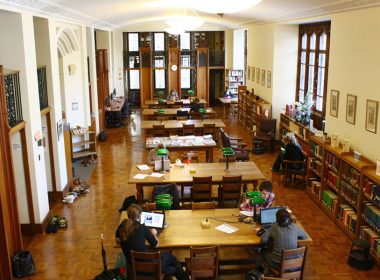
Consisting of Redpath Hall, Cybertheque, Blackader, and McLennan, this library complex is the largest, oldest, and possibly the most notorious library on campus. Particularly during exams, the building tends to be over-run by stressed-out, sleep-deprived, caffeine-fueled zombies. The seven-story building houses the Humanities and Social Science library collections, which include books for the faculty of Arts, Management, Religious Studies, Social Work, and Education. Furthermore, the library holds a collection of government, government agency, and intergovernmental organization publications; the Blackader-Lauterman collection of architecture and art; and McGill’s collection of rare books.


History

Although the library collection dates back to 1855, it wasn’t until 1893 that Peter Redpath, a businessman and member of the McGill University Board of Governors at the time, donated the oldest part of the library complex, Redpath Hall. The Hall was the first building constructed to store the main university library collection.

In 1969 the reinforced concrete McLennan Building opened—named after Isabella McLennan, who helped fund the purchase of many of the school’s books. While some describe McLennan’s interior as stale, impersonal, and dull, the repeating concrete pattern was meant to elicit a calm and quiet atmosphere to facilitate focused studying.

Redpath and McLennan merged to form the Humanities and Social Sciences Library in 1988 and throughout the 1990s materials from other departments were incorporated into the collection.

Much to the chagrin of a majority of the student body, the building continues to face ongoing construction. The library grows and changes to fit the student body’s needs, and is now much more focused on serving the demand for study space and digital research tools, and less focused on books.


Capacity

With a staggering 2,000-plus seats for quiet study throughout the library complex, it’s shocking that they all manage to fill up around exam time. Included in this number are large group tables, and carrels conducive for efficient individual work. Graduate students and Honours undergraduates can reserve carrels by applying at the service desk on the main floor.

For more collaborative learning, meetings, or presentation practice, there are individual rooms that can be reserved online through the library website, including high-tech glass pods in Cybertheque with computer adaptable large flat-screens. There are also open group study areas in Cybertheque and Redpath where talking is permitted.


Food

The basement of Redpath has a cafeteria with staples like Tim Hortons, Pizza Pizza, and Bento Sushi. Snacks, beverages, and coffee can also be purchased from vending machines right outside the cafeteria. Signs indicate that food is not permitted upstairs, although that doesn’t seem to deter most people.


Resources

Besides stacks—on stacks, on stacks—of books, the library has much more to offer. They even have their own blog, the McLennan Post, which features posts written by librarians on topics pertinent to students and faculty who use the library. The library also has microform readers and scanners that are connected to the library’s network, allowing for printout retrieval from uPrint machines.  On top of that, the library runs workshops on topics such as research strategies and how to get your research published. Workshop schedules are posted on the McGill Library website.


Something special

One of the true treasures of McLennan is its Rare Books and Special Collections section on the fourth floor. The collection was started in the 1850s and contains books, memorabilia, maps, and other artifacts from a wide range of different disciplines. Due to the fragility and value of the collection, there are guidelines for accessing these resources. Visitors must register upon entering and personal belongings like bags, hats, and coats must be stored in special locations. Once this is done, you can carefully browse through the collection at your own will, although you must return all material to the Reading Room staff before you leave.


Hours of Operation 

*24-hour access only in the Redpath Library Building and on the main floor of the McLennan Library Building. The upper floors of McLennan (2- 6) are open for study until midnight.

Monday-Thursday: 8 am – Midnight

Friday: 8 am – 10 pm

Saturday: 10 am – 10 pm

Sunday: 10 am – Midnight

a, Science & Technology

Science from science fiction: Star Wars

From the moment it was first ignited in an old hermit’s home in the middle of Tatooine, the lightsaber captured the imagination of moviegoers. The steady humming of a blue blade of plasma bouncing off its scarlet counterpart has made generations of fans all over the world want one of their own. Made popular by the Star Wars Episode IV: A New Hope, the lighsaber has generated quite a legacy for itself.

Lightsabers have remained in the realm of fiction ever since they first appeared on screen. No known physics model could explain the ways the bars of light made contact with each other. However, this past September, recent findings by a team of scientists from Harvard and Massachusetts Institute of Technology (MIT) showed light behaving in a fashion reminiscent of the blade of the lightsaber.

Harvard Professor of Physics Mikhail Lukin and MIT Physics Professor Vladan Vuletic managed to bind photons—particles of light—together to form molecules. Using weak laser pulses, the scientists shone photons through a special medium—a cloud of rubidium atoms—in a chamber just a few degrees above absolute zero. Normally, photons are described as massless particles that do not interact with each other; when you shine two rays of light together, the beams simply pass through one another. However, when Lukin and Vuletic sent two photons through the special medium, the particles escaped the other end as a single molecule.

This phenomenon—where the photons clumped together as if they had mass and formed molecules—can be explained through the Rydberg Blockade concept. As the photons travel through the cloud, their energy excites the rubidium atoms in the medium along their path. This excitation causes the photons to interact in such a way that they slow down tremendously. The photons regain their normal behaviour once they leave the special medium, exactly like when light passes through water or a prism.

While Star Wars fans would love their own lightsabers, the motivation behind this particular research was instead its potential applications in quantum computing—a field introduced in the ’80s by mathematician Yuri Manin and theoretical physicist Richard Feynman.

Quantum computers are similar to current computers on the market, except that instead of using bits as a storage basis, they use qubits. A bit represents a 1 or 0 in classical computers, and is simply an electrical switch, which can be either on or off. A qubit, on the other hand, relies on the quantum mechanical notion that something can exist in all its states at once.

As computers progress, the size of their processors continue to get smaller. There is a limit to this, however, and manufacturers are rapidly approaching the smallest sizes possible. Theoretically, quantum computing would help increase computers’ processing power.

Lukin and Vuletic’s findings provide a clue in the direction of the storage of quantum information and on the process of inducing photon interaction—two important concepts for designing a quantum computer.

With the discovery of a new state of matter comes a veritable flurry of new applications. In an interview with the Harvard Gazette, Lukin suggested that by utilizing this phenomenon crystal structures could one day be made entirely out of light. The day we all own our own lightsabers might not be so far off.

Despite the fact that these “blades of light” do not radiate heat, generate energy, nor can they be contained in a single hilt at the moment, these findings just go to show that science will go to the greatest of lengths to realize the impossible.

a, News

McGill community addresses gentrification in QI project

The potential gentrification of a Montreal neighbourhood as a result of the Quartier de L’Innovation (QI) development project was the topic of a discussion group held by McGill’s Social Equity and Diversity Education (SEDE) Office last Friday. The event was part of SEDE’s second annual Community Engagement Day (CED)—a day of discussions, speaker events, and activities aiming to bridge the gap between the university and the surrounding community.

The QI is a neighbourhood development project by McGill and l’École de technologie supérieure (ETS) that aims to foster research and innovation in the neighborhoods of Griffintown, Petite Bourgnone, Saint-Henri, and Pointe Sainte-Charles. The development project consists of various tasks and sub-projects led by professors and students organized into the four ‘pillars’ of innovation—industrial, education, urban, and social and cultural.

Attendees of Friday’s discussion included Vincent Perez, the representative of the community of Petite Bourgnone in the QI, as well as McGill professors and students.

“The main focus of the Quartier de l’Innovation is knitting together the fabrics of the neighbourhood,” said Professor William Straw, director of McGill’s Institute for the Study of Canada.

Due to the extensive changes to the district projected by QI, there have been concerns regarding potential gentrification of the area.

Nik Luka, a professor of architecture and urban planning at McGill who sits on the board of the Montreal Urban Ecology Centre, questioned the way that the initiative is going to proceed regarding the relationship between local residents and those involved in the development of the area.

“How can planners and architects in particular work with local residents and other stakeholders on projects that we always have to work on, in ways that are productive, generative, [and] positive? How can we tap into what people know about their area?” he asked. “How [do] you make the connections when something new comes into a certain area? It’s a very important theme that we haven’t done enough work on.”

According to Perez, McGill’s influence in the area will prevent commercial overtaking, as an educational institution would uphold an emphasis on the arts, sciences, and culture in the area.

“University existence within the city prevents the commercial overtaking that many fear when they hear about approaching gentrification,” he said.

Dan Moczula, Communications Coordinator for CED, described the event as a way to create dialogue among members of both the McGill and the Montreal communities.

“The way we try and do this is to use CED to put people in contact with organizations and with people who they normally wouldn’t meet in all the time they spend around the McGill downtown campus,” Moczule said. “This fosters the discourse that breaks down a lot of walls and a lot of preconceptions that students may have about these communities.”

Louisa Bielig, U2 Arts, said these efforts to connect the McGill community to Montreal made CED worth attending.

“I was at CED last year, and that’s how I got into volunteering,” Bielig said. “I met my organization [Entraide Bénévole Montréal at CED] and I’m still doing it now. You see issues through the eyes of other people […] and CED provides the starting point for this exposure.”

Emily Boytinck, the project coordinator from SEDE, pointed to this year’s continuation of CED as a promising sign for the event’s continued success in the future.

“The success of this year’s event is very exciting, and the momentum is steadily building,” Boytinck said. “Preparations for next year will be underway before the end of this year.”

Boytinck encouraged students who are interested in becoming involved to ask for more information at the SEDE office, located on McTavish Street.

a, Science & Technology

Ask Scitech: Can we rust to death?

Clad in a red iron power suit, this American superhero is known for defending the world with the Avengers. However, Iron Man’s plates of armor proved more than just a military weapon; they also saved his life and allowed him to escape captivity to become the superhero he is today.

What distinguishes this character from his super counterparts is that unlike Spiderman and Superman, one in every 200 people in North America faces a similar condition; and they, too, can attribute their survival to these suits of iron.

Hemochromatosis is a hereditary genetic disorder that disrupts how the body metabolizes iron. A mutation in the gene HFE, which controls the amount of iron absorbed from the bloodstream, is responsible for this disease. Though rare, the condition can lead to life-threatening conditions such as cancer, heart arrhythmias, and cirrhosis. So, why would such a deadly disease be bred into the genetic code? According to Sharon Moalem, author of Survival of the Sickest, hemochromatosis is still prevalent within the population because it could have conferred a selective advantage to those suffering from the bubonic plague in the 1300s.

Normally, the body regulates the amount of iron it absorbs from food. Through releasing the peptide hormone hepcidin, it can control how much iron is absorbed by the intestines, used in body processes, and stored in various organs. Hence, when the body detects sufficient iron levels in the bloodstream, it reduces the amount of iron absorbed by the intestines, allowing any excess iron to simply pass through. In this case, if one were to stock up on iron supplements, it would still be impossible for the body to overload on iron.

Hemochromatosis disrupts the normal role of hepcidin in a person. The body consistently believes it is in a perpetual state of iron deficiency and absorbs the compound unabated, even once it has surpassed a typical absorption limit. This iron loading has deadly consequences. Over time, the excess iron is deposited throughout the body in various organs and acts as a poison by disrupting their function and causing disease. In a sense, hemochromatosis victims are rusting to death.

So, if hemochromatosis is such a lethal disease, why is it still prevalent in our population? Thanks to a process known as natural selection, everything in our genes happens for a reason.

The link between hemochromatosis and human survival can be explained by the relationship between organisms and iron. Iron plays an important role in almost every organism’s survival. Just as humans require iron for their metabolism, many forms of bacteria also depend on this compound in order to grow and propagate within their host. As a result, the human body has developed several mechanisms to sequester its iron reserves in an effort to make it unavailable to invading pathogens. Starve the pathogens, and it becomes more difficult for an infection to develop.

Curiously, people with hemochromatosis are actually less susceptible to infection than a non-hemochromatic person. Although the disease distributes excess iron throughout the body, it comes with one very beneficial side effect: the excess iron that the body absorbs isn’t distributed everywhere throughout the body. Macrophages—the police cells of the immune system—end up with significantly less iron available to pathogens than normal.

This iron-lock down in macrophages confers a significant advantage to people fighting infection. When a normal person’s macrophages encounter an invading pathogen, the pathogen may often harness the iron and use it to grow, spreading the infection throughout the lymphatic system. For a person with hemochromatosis, the lower iron content available to pathogens  in macrophages means that the cells not only have the ability to kill intruders, they can also starve the infectious agents to death.

“People who have the hemochromatosis mutation are especially resistant to infection because of their iron-starved macrophages,” Moalem explained in his novel. “So, though it will kill them decades later, they are much more likely than people without hemochromatosis to survive the plague, reproduce, and pass the mutation on to their children.”

Moalem adds, “In a population where most people don’t survive until middle age, a genetic trait that will kill you when you get there but increases your chance of arriving is, well, something to ask for.”

a, News

First student-run mental health conference confronts stigma

McGill’s first student-run conference on mental health took place last Saturday and featured guest speakers, discussions, and workshops aimed at addressing the impact and stigma of mental health, as well as discussing possible solutions to these problems at McGill. Named “Students in Mind 2013,” the day-long event was attended to full capacity, with 120 members of the McGill community present.

According to Clara Lu, chair of the organizing committee, the conference was meant to provide a platform for discussion as well as to showcase the resources pertaining to mental health that are available at McGill.

“While in the past there have been substantial efforts by students to act on mental health, few until now have brought all of our diverse mental health resources together under one roof,” Lu wrote.

Lu said the planning of the event was unique, since the organizing committee is independent and completely student-run.

“We did encounter some initial difficulty gaining support, since we weren’t officially associated with the university or any established student group,” she wrote. “In the past few months, however, we’ve received overwhelming support from student health services, SSMU, PGSS, MFDS [McGill Food and Dining Services], and many other groups, all of which recognize the need for an effective conversation about mental health among the students they serve.”

Conference participants were provided with a package that explained the significance of mental health at academic institutions like McGill. Over the last two years, Mental Health Services at McGill has encountered a 25 per cent increase in cases they have handled.

Doctor Joseph Rochford, a professor in the department of psychiatry who spoke at the conference, said he views the increase in people seeking support as a societal trend rather than a phenomenon specific to McGill.

“I believe [the increase] has come from concentrated efforts through a number of institutions, [including] universities, hospitals, advocacy groups, even much of the mainstream media, to inform the public of what mental illness is, where it comes from, and what can be done for it,” Rochford wrote.

Sarah Berry, a PhD student and research associate for the Opening Minds Anti-Stigma Initiative of the Mental Health Commission of Canada, offered an analysis of the social and economic stressors that students face, which may contribute to vulnerability to mental illnesses.

“The issues facing students are, as always, wide-ranging and complex,” Berry wrote. “However, students are undertaking post-secondary education at a particularly challenging juncture: high tuition costs paired with high loan interest rates, and relatively dire prospects in an increasingly competitive post-grad job market mean that financial stress is elevated [….] All of these stressors emerge at a time in one’s life when serious mental health issues are most likely to appear.”

According to Berry, the key to tackling mental health issues is to do so through student initiatives.

“Grassroots, peer-to-peer exchanges are the best way to start tackling stigma and to address both short- and long-term solutions to student mental health issues,” she said. “Ongoing dialogue will hopefully lead to more regular on-campus initiatives, and ultimately to a more supportive campus and learning environment.”

In addition to a wide range of speakers, the conference also included workshops designed to address personal mental health and peer support.

Marina Smailes, U1 Arts and Science, praised the conference as a student-run initiative.

“It’s really invaluable to have students running [the conference] because they know how to present it in a way that really makes it accessible to all students and can then bring in other more knowledgeable people to give more advice,” she said.

According to Lu, the committee aims to make Students in Mind an annual event.

“We hope to expand to maybe even 200 [attendees] in future years,” Lu said. “We’d like to even invite other campuses.”

Rochford said the conference had a positive impact, but he also stressed that it could be improved in the future.

“We know that education can reduce […] stigma, so this is why ‘Students in Mind’ events are so important.” Rochford said. “But if the only people who show up for these kinds of events are friends and family [of people with mental health illness], then we’ve only addressed a small part of the problem. We have to find ways to reach a broader audience—one that is bigger than just friends and family—so that we can get the message out most effectively.”

a, Behind the Bench, Sports

Third man in: Sandman closes the curtain

Baseball recently saw the greatest closer to ever play put a cap on his storied career.  Mariano Rivera sealed his legacy as baseball’s top relief pitcher with one and a third perfect innings over the Tampa Bay Rays during the New York Yankees’ last home game of the 2013 season. Long-time teammates Derek Jeter and Andy Pettitte made the walk out to the mound to pull Rivera from the game, who despite his best efforts, couldn’t help but show emotion. His heartwarming smile quickly turned to tears as he was embraced by teammates and overcome by the ovation from the crowd. After tipping his cap and acknowledging the fans who had cheered for him since his debut in 1995, he took his place on the bench and looked on as the Yankees finished their final home game of 2013.

Rivera’s story could have been a fairy tale. Born in 1969 in Panama City, Panama, he grew up in a poor fishing village. Following a brief stint in Panama as a starting pitcher Rivera signed with the New York Yankees in 1990. Over the next five years, Rivera dominated the minor leagues despite surgery to his pitching arm. However, once called up to the majors, Rivera struggled to settle into a role as a starting pitcher. He found his true calling in 1996 as a set-up man before ascending to the closer’s role the following season. Since then, he has redefined what it means to be a dominant closer.

As a major league closer, Mariano Rivera has an incomparable resume. When Rivera began his reign, Lee Smith was the career leader in saves, with 473; Rivera’s 652 saves have since made Smith’s numbers look almost pedestrian. He has thrown the final strike in four World Series, twice as many as any other pitcher. His 42 post-season saves and 11 World Series saves far surpass the next best marks of 18 and 6, respectively. His 2.21 career ERA (earned run average) is good for thirteenth of all-time, and his 1.00 WHIP (walks and hits per inning pitched) ranks third all-time. He’s pitched to a 0.70 post-season earned run average and set the bar for clutch post-season performances, having earned World Series MVP honours in 1999 and ALCS MVP honours in 2003.

Rivera undoubtedly changed the game of baseball. Never before had the sport seen a pitcher so absolutely dominant and unforgiving with just one pitch—his cutter tormented the American League’s best hitters for nearly two decades. However, what was more impressive than his signature pitch was his ability to instill fear in opposing lineups. Rivera’s entrance music, “Enter Sandman” by Metallica, was all it took to signal to everyone in the stadium that the game was over. Despite the ease with which Rivera mowed down his opposition, he never showed a hint of the ego, nor the braggadocio, associated with the fiery closers of this generation; Rivera would simply walk over to his catcher and thank the backstop. It was the same automatic routine 652 times. His great achievements and reserved personality on the mound have earned him respect from players, coaches, and sportswriters alike.

In addition to this, the Sandman’s presence in baseball changed the salary structure for relief pitchers. Rivera was awarded a $7.25 million salary following arbitration in 2000, the highest figure given to a player irrespective of position at the time. It is because of his landmark deal that relief pitchers now have the clout within an organization to be  able to demand salaries that are comparable to those of starting pitchers.

Rivera is universally recognized as simply the best there has ever been. That recognition was evident as the Yankees played their final games in opposing teams’ stadiums for the 2013 season. Those visits saw Rivera receive gifts from opposing teams ranging from donations to his charity to prized game memorabilia. The most memorable was the Minnesota Twins’ rocking chair built from broken bats that his pitches had shattered in hitters’ hands. The splintered bats serve as a timeless reminder of the futility faced by opposing hitters, managers, and fans alike as Rivera was called upon to carry the Yankees to victory. After 19 years, five World Series, and one legendary career, Mariano Rivera has given more to baseball than could possibly be given to him in return.


Read the latest issue

Read the latest issue