Latest News

a, Student Life

Mixed Drink Recipes

The Last Wish

Bacardi 151® is a drink that makes any shooter special and memorable, tequila is what brings out the best and worst in all of us. Throw in Triple Sec® and you have the icing on the cake—to a bartender anyway.

Ingredients:

1/3 oz. Bacardi 151®

1/3 oz. Tequila

1/3 oz. Triple Sec®

Pour each of these into a shot glass in the order above, and enjoy the love/hate relationship that is sure to follow.

Burning Bank

As an avid ‘Coke over Pepsi’ fan, I was always disappointed when my server would bring my mixed drink with the latter whenever I ordered an [insert cheap liquor here] and Coke. So here’s my drop shot to be submerged in one kind of pop, and one kind of pop only. You guessed it: Coke.

Ingredients:

½ oz. Fireball®

½ oz. Goldschläger®

3-4 oz. Coca-Cola®

Pour Fireball and Goldschläger equally into a shot glass—the order does not matter. Drop into a tall, thin glass of enough Coke, so that the shot glass is fully submerged, and presto! A balance of sweet and spicy, and a possible candidate for Coke’s newest ad campaign. Just remember, you heard it here first.

Nilufar serves delicious and inexpensive Middle Eastern food. (yelp.ca)
a, Student Life

Nilufar offers exotic fare on a budget

Shawarmas and pitas are among  McGill students’ favourite foods. With their special sauces and spices, they make for comforting, savoury, and yummy choices. While it’s not all that hard to find a place that serves Middle Eastern food in Montreal, if you don’t find the right place your experience will be mediocre at best.

We all have our go-to places for the nights when braving the kitchen just doesn’t appeal. These are often near by, but once in a blue moon there is a truly compelling reason to get out of the McGill bubble and head towards Concordia. One such draw is a truly delectable Middle Eastern fast-food restaurant by the name of Nilufar.

A block past the Guy-Concordia Metro Station, this unassuming gem is not very noticeable amongst all the other restaurants one can find on rue Ste. Catherine. The sign is now, after 20 years in business, a faded green and pink banner, and the place looks rather run-of-the-mill. This impression doesn’t last long, once you get inside.

Nilufar is best known for their soup, falafel pita, and drink combo which comes with a big serving of soup, a pita with two medium-sized tomato and lettuce falafel, and a choice of lemonade or peach juice for just under three dollars, tax included.

Over the past few years, I’ve tried my fair share and have become something of a falafel aficionado. I’ve bought falafel balls from Costco, I’ve made them from a pre-made mix bought at my local grocery store, and I’ve had the dish at other restaurants. It’s no exaggeration when I say that Nilufar’s is the best falafel I’ve tasted. It’s crispy on the outside yet moist and flavourful on the inside—the perfect texture.

While the unbelievable price might have you think that you’re in for some questionable ingredients; this is far from the truth. Nilufar’s menu boasts homemade barley, vegetable, lentil, Moroccan, and Tanzanian soups, just to name a few. They don’t have all of these options every day, but you won’t be disappointed with any soup you choose; all are hearty and will more than fill you up. My personal favourites are the Moroccan and the barley, but if you like something a little spicier, the Tanzanian soup is definitely for you.

As a vegetarian, I have only tried Nilufar’s falafel, but the restaurant also offers a multitude of meat dishes. Fear not, meat-lovers, you’ll be just as satisfied with your savoury shawarma as the veggie lovers are with their falafel. You will just have to pay a little bit more. Nilufar also serves Halal food, and is vegan friendly—making it a perfect option for any restaurant-goer.

While Nilufar offers catering—including personalized menus—for private events, most people prefer to dine-in, whether by themselves for some peace and quiet, or in a group to catch-up with friends. An added bonus of dining at Nilufar is the short wait. Food is served in less than eight minutes—or 15 on a particularly busy day.

With its quick service, home-made food, and cheap prices, Nilufar is great for students looking for satisfying, filling, and home-cooked meals on a budget.

Nilufar is located at: 1923 Rue Sainte-Catherine O, Montreal, Quebec

Opening hours are: Mon-Fri: 10:00-21:00, Sat: 11:00-19:00, Sunday: Closed.

Telephone: (514)-846-1947

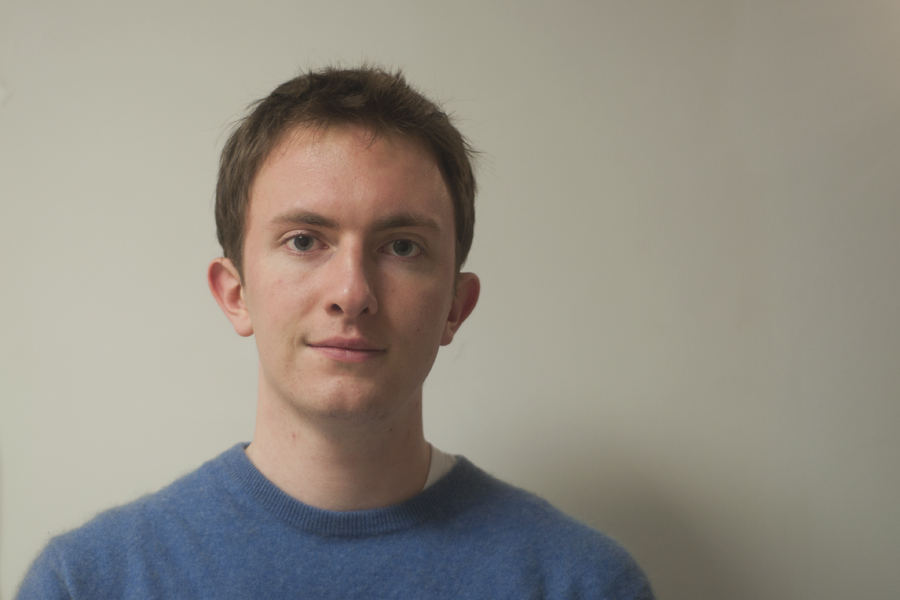
Vanessa Wattamaniuk U3 Political science (Simon Poitrimolt / McGill Tribune)
a, Student Life, Student of the Week

Student of the Week: Vanessa Wattamaniuk

This student of the week was nominated for her work on the executive team of the Women in House program. 

Q: What’s your dream job?

A: I would actually like to be a parliamentarian eventually. Or [something] where I could work to impact policies … but have a chance to travel on the job and really communicate with people—facilitate groups of people.

Q: So some sort of mediation between parliament and the voters themselves?

A: Yeah, I guess that would lead me to lobbyist or something like that. I’m not shutting any doors, but I’d like to be able to create change, and work with people.

Q: What’s your favourite study spot in Montreal?

A: I really like McLennan, there’s this little nook in the back of the first floor that I like to study at.

Q: If you won the lottery, what’s the very first thing you would buy?

A: A trip to somewhere; maybe to visit my sister in South Africa. She’s interning [there] as a photographer.

Q: What’s the last song you remember listening to?

A: I may have watched the Phantom of the Opera last night. So the last song from that.

Q: What’s the first thing you think of when I say ‘Winter break’?

A: Home. I haven’t been home for a year, so I’ve been looking forward to it.

Q: Were you in Montreal last summer?

A: I was just working here and really spending my first summer in Montreal, which I’ve wanted to do for a while. I [worked] at Provigo … but I got a chance to go to the jazz festival and do a little bit of travelling.

Q: What’s next on your travelling bucket list?

A: I’m planning to take a year off of school once I graduate. I would like to work in a different country; I’ve been to Europe a couple of times, but I’ve yet to do a real Euro-trip. I’d also like to go to South Africa to visit my sister.

Q: You were nominated for your work on the exec team for Women in House, can you talk a bit about that program?

A: It’s two days [in Ottawa], Wednesday and Thursday [of last week]. There are three coordinators, and each year it changes, so people who are participants in the program the year before get selected to be coordinators the following year. There’s not really any staff involvement; it is funded by different groups from McGill, but [Women in House] was really completely student run; just the three of us.

Q: So what do the two days entail?

A: The first day you just organize speakers; a lot of prominent parliamentarians. We [had] morning speakers … [like] Nancy Peckford, who’s the director of Equal Voice [an organization dedicated to electing more women to parliament] … and then we [took]a tour of parliament, [attended] question period, and in the afternoon we [heard] MP speakers. This year we had Elizabeth May and Niki Ashton [among others]. In the evening, we [attended] a reception hosted by Senator Fraser just for us. There are several senators and a couple of MPs who come, and it’s a much more casual setting. The second day all of the girls [got] paired up with a member of parliament, and they [got] to shadow them for the whole day.

Q: Are the girls paired up randomly, or do you and the other two coordinators have a say in that?

A: Each of the [applicants] writes quite a bit about themselves, so from that we get a general idea of their interests. From there we try to pair them with the MP that is most appropriate for them.

Q: Are you part of the process for selecting next year’s coordinators?

A: Yes, so [during] second semester we’re going to be getting applications for people who want to be coordinators next year. The three of us will see who works best together as a team, because that’s really important.

Q: How old is this program?

A: This was our 12th anniversary.

Q: Which MP did you shadow last year?

A: I shadowed Kelly Block from the Conservative party. Even though our political ideologies weren’t necessarily aligned, it was really interesting just going to the committee meetings, and hearing people speak about programs I’d actually heard of.

Q: What advice would you offer to other girls interested in this program to get the most out of it?

A: One thing I know I have problems with sometimes is, if they’re MPs, I feel they must be these supernatural beings that are so intelligent; and I’ll find myself hesitant to speak my mind. But just realize that they’re people, and you can just approach them and speak with them. That’s the way you’re going to get the most out of the program, [by] just speaking to them on a person to person level.


a, Opinion

Making the moustache matter

I can’t exactly remember the conversation where my mom told me that my dad might have prostate cancer. Ironically enough, it happened on a November evening, but in the long months that ensued, we never said the words out loud again. We’d never been confronted with a something so deadly and so scary. Cancer is a heavy word—ominous, terrifying. It’s a word that makes you re-evaluate any and all of your past decisions, and makes you reconsider all upcoming ones. Talking about cancer is hard. But it’s important.

Enter Movember. This annual campaign began ten years ago and encourages men to grow a moustache in November to raise awareness and research funding for prostate cancer. The movement, which began in Australia, gained significant momentum in the past years, and teams of ‘Mo Bros’ and supportive ‘Mo Sistas’ from all over can now register online and raise large sums for national prostate cancer organizations. Last year, Canadian participants raised over $785,000 for Prostate Cancer Canada, with over $2 million raised overall by teams around the world.

In my years at McGill, I’ve seen Movember gain momentum and visibility on our campus. But like other movements that are based on fashion statements, conversations about Movember often revolve around the moustaches themselves. (Is it bushy enough, or is there scarcely enough fuzz? Is it well-groomed, or unkempt?). It’s rare to hear discussions that transcend the visual portion of the campaign, and instead, focus on the meaning behind the moustache. It is time to take a step away from evaluating people’s moustaches, and rather, to think of the reasons that they’re rocking the ‘mo: to raise awareness for prostate cancer.

Although some people do raise funds with their moustaches, many jump on the bandwagon, sporting a moustache without knowing enough about the cause behind it.  Even if you aren’t raising money this November, remember that you can effect change and reduce the stigma associated with men’s health. If we can talk about embarrassing moustaches, why not also talk about what some view as embarrassing health topics?

Some facts to get you started in discussing men’s health: the prostate is walnut-sized gland in the male reproductive system. According to the Canadian Cancer Society, 26,500 men were diagnosed with prostate cancer in Canada last year, and 15 per cent died because of it.  One in seven men will develop prostate cancer during his lifetime and one in 28 will die of it. Prostate cancer has a high survival rate—at 96 per cent—but only if caught in its early stages. Because early detection can really make a difference, doctors recommend that men have annual check-ups starting at age 40 or 50.

As the daughter of a prostate cancer survivor, I appreciate Movember because it’s a month to ask difficult questions and consider their answers. Do you know if your father, grandfather or other relatives had prostate cancer? This will double a man’s chances of having it later on. Have your loved ones ever had a check-up, and do they understand how important it is to have an annual one? These are questions that often don’t come up in regular household conversations—they never did in mine—but whose answers may surprise you.

This November, I encourage you to make the moustaches you see on campus a chance to start a conversation about the symptoms, risks, and implications of prostate cancer. Regardless of your ability to grow a moustache, these are important questions whose answers might one day affect people you care about. Talking about cancer is always difficult, but it’s important to be comfortable, or at least able, to discuss prostate cancer today, so that if the day ever comes that you need to face it head-on, you’ll know what the discussion entails and you’ll be better prepared to face it.

SSMU’s ‘roaming council’ in Burnside 511. (Michael Paolucci / McGill Tribune)
a, News

Council debates creation of additional representative to TaCEQ

Last Thursday, the Students’ Society of McGill University (SSMU) Council met in Burnside 511, one of two Active Learning Classrooms at McGill. Included in the topics of discussion was its relationship with the Quebec Student Roundtable (Table de concertation étudiante du Québec, or TaCEQ) and the possibility of creating another representative position on TaCEQ.

McGill currently has four representative seats on TaCEQ. SSMU Vice-President External Robin Reid-Fraser said Council would increase SSMU commitment to TaCEQ if they created another permanent position for representation.

“McGill has a lot of people who are from outside Quebec,” Reid-Fraser said. “My understanding is that a lot of people don’t even know we are a part of TaCEQ, or what it’s for. So it’s important for us to get word out there with things like newsletters or organizing events like panel discussions.”

Created in 2009, TaCEQ is a province-wide round-table for member student associations to lobby the government as a collective. SSMU is currently one of three members alongside student associations from Université Laval and Université de Sherbrooke. With these three associations, TaCEQ represents 65,000 students in Quebec.

“Ultimately, TaCEQ is intended to function as a formalized round-table, where member student associations can, with a louder voice, lobby the government with improved success,” the SSMU website reads. “The structure of TaCEQ is built to prevent it from turning into a large organization carried away with its own purpose and disconnected from its base.”

TaCEQ is mostly volunteer-based and operates with a small budget. It does not charge its own membership fees like other large student associations, according to Reid-Fraser. Instead, TaCEQ approves its finances at the beginning of the financial year and its  expenses at monthly meetings.

“Currently we use this structures because TaCEQ is small and fairly new compared to the other associations,” Reid-Fraser said. “If we get more member associations and are able to work with a larger budget, then the structure may changesomewhat.”

Some councillors raised concerns about electing a new representative to TaCEQ, and suggested that SSMU does not take full advantage of its current level of representation, since many of McGill’s seats are empty during meetings. They also discussed to whom the new TaCEQ representative would be responsible, and under which student organizations on campus the representative would serve.

“I would really want to integrate [SSMU Council] and the TaCEQ representatives,” Reid-Fraser said. “Once we get a better picture of what we need [at the] next [TaCEQ] meeting, I’ll be able to bring the feedback and issues back to Council and go forward from there. Hopefully we can find agreement by then [about] what we’re looking for.”

SSMU Council is usually held in the Lev Bukhman Room in the Shatner Building. Thursday’s meeting was SSMU’s second “roaming Council” of the year, which is why it was held in Burnside 511.

“The purpose of ‘roaming Council’ is to expose the council to different parts of campus, and I think the active learning classroom is an exciting project that could be great for students,” SSMU President Josh Redel said.

As part of the Student-Centered Active Learning Environment with Upside-Down Pedagogies project, Active Learning Classroms (ALCs) were designed in 2009 to facilitate learning and teaching experiences. Since then, the Teaching and Learning Spaces Working Group at McGill has overseen ALCs at McGill to help enrich education experiences.

“You’re not in rows, you’re not facing the same direction, and you can roll around on your chairs,” Oksana Maibroda, McGill’s Educational Technology Consultant, said. “What this room allows for lecture, is that if the teacher wants to work on certain subject, he or she has a lot of ways to communicate to the students.”

Burnside 511 features multiple large overhead projection screens, as well as chairs and desks which allow  students to face one another, rather than a professor’s podium. Much like a computer lab, the rotating chairs are easily adjustable and designed to facilitate students break ing into discussion groups.

“This is one of the many cool things that McGill’s been working on,” Redel said. “At McGill, the problem is how to make classrooms smaller and more interactive. It’s cool that people on the administration and staff members are working on this.”


a, Opinion

McGill loan scandal highlights a bigger problem of transparency

Last week, the Montreal Gazette reported that McGill is filing a lawsuit against Arthur Porter, former executive director of the McGill University Health Centre, over an unpaid loan (see “News in Brief,” page 2). The unfurling fiasco has brought forward one disconcerting revelation after another.

It’s hard to choose which part of the scandal is most shocking: it could be the additional sum of $92,000 Porter was paid, on top of the publicly disclosed salary of $256,000. It could be the undisclosed amount he was paid as an assistant professor in the faculty of medicine, despite no evidence that he taught in that capacity. Most puzzling of all, though, is the $500,000 loan he received from McGill in 2008, at an annual interest rate of one per cent, for which he is now being sued.

Here, some obvious questions emerge. McGill has, to date, failed to specify exactly what the loan was for, and why such a large figure was offered to an executive director at rates far below prime. The Montreal Gazette found that the loan was part of a “housing loan agreement”—a questionable term. According to the National Post, low interest loans are apparently a standard perk for university administrators on top of their salaries. Porter’s teaching salary—for lecturing he allegedly never did—also has yet to be explained.

[pullquote]“There are some serious matters of contention still on the table, and we ask that McGill come forward with an explanation.”[/pullquote]

As paying students of this university, we feel that we are entitled to hear answers to the simple questions of what the loan was for and what teaching Porter actually did. Either something went very wrong and the university simply does not know how this all fits into a larger tangled web of deceit, or the practice of paying nonteaching executives as professors and supplying them with loans at such low rates is standard. Both are similarly disturbing and require explanation.

What concerns this editorial board most, however, is that it’s entirely likely that none of this would have gone public had it not been for McGill’s lawsuit against Porter. The affair raises a number of bigger questions about how our university manages its finances and discloses the salaries of directors and senior administrators.

Most importantly, we would like to know if other university officials have been receiving personal loans of hundreds of thousands of dollars at negligible interest rates, or been appointed to positions and paid for work they never did. Salaries of top university administrators are made public in Quebec through annual reports submitted to the National Assembly. This public disclosure, unfortunately, means nothing if the figures aren’t correct. (Salaries of directors of publically-funded institutions, like the MUHC, are similarly available via access to information requests).

McGill will do its best to brand Arthur Porter as the guilty party, and that won’t prove to be terribly difficult. Before this incident, there was much controversy around the MUHC project, including several allegations of corruption. In September, a provincial anti-corruption unit raided the offices of the MUHC. Porter left the country in 2011, after abruptly resigning as chairman of Canada’s Security and Intelligence Review committee. His departure came amidst allegations that he sent $200,000 of his own funds to a Montreal businessman, hoping to secure a $120 million infrastructure development project that would have benefitted Porter’s own company in his native Sierra Leone.

However, this affair is indicative of a broader lack of transparency. There are some serious matters of contention still on the table, and we ask that McGill come forward with an explanation. At a time when the administration cries bloody murder about underfunding, this debacle could be highly damaging to McGill’s credibility if it cannot provide answers. At the same time, if it cannot account for such large sums, it is going to have a hard time convincing major players, including the provincial and federal governments, that it deserves the additional funding it claims to need.

As students, we would like to know exactly what the loan was for, and whether offering low-interest loans to senior administrators or directors is standard practice. Similarly, we would like answers as to why there was a discrepancy between Porter’s actual salary and the publically disclosed figure, and whether such divergences are common. Assurances that posted salaries are correct—and more generally that there is transparency in compensation for top university officials—are first steps towards maintaining the trust of tuition-paying students.

a, Opinion

Quebec’s refusal to accept Albertan oil is all political

Last Wednesday, Parti Québécois (PQ) Environment Minster Daniel Breton raised considerable controversy. When asked about proposals currently being brought forward to start moving crude oil from Alberta’s oil sands to refineries in Montreal and further east in the Maritimes, he rejected the notion outright.

“Albertans want to bring their oil onto our land, without our consent,” he told La Presse.

He also cited environmental risks, stating that “this is a question of protecting the environment that’s on our territory.”

The Alberta oil sands are a hotly-debated topic on the environmental front. For years, critics have targeted the extraction process as excessively harmful, but that’s not the issue brought forward by Mr. Breton. His concern, judging by his quote, is the impact of the project on Quebecois land.

Unlike the hotly disputed Keystone XL and Northern Gateway projects, which would lay down new pipelines in a process both lengthy and harmful to the surrounding areas, these current proposals primarily involve the repurposing of existing infrastructure. Enbridge is seeking to reverse the flow of their pipeline, which currently moves crude oil from Montreal to Sarnia. Similarly, TransCanada wants to convert their Canadian Mainline pipeline, which currently carries natural gas, into an oil line. The work required to make these modifications is minor.

Mr. Breton also cited the 2010 Kalamazoo River oil spill as a reason for Quebec to be wary of the proposals. While the disaster in Michigan certainly serves as a harsh reminder of what can go wrong with pipelines, these are risks that Quebec is already taking with the existing Enbridge line. Reversing the flow of oil will not increase the likelihood of a rupture.

The environmental concerns seem even more dubious when one considers that New Democratic Party leader Thomas Mulcair has come forward in favour of these proposals. Mulcair has vehemently opposed the other aforementioned pipeline initiatives, on the grounds of both environmental and economic concerns. However, provided the project developer pays for any environmental damage caused, he believes that the economic benefits greatly outweigh any drawbacks in this case.

Currently, refineries in Eastern Canada process crude oil shipped in from Saudi Arabia, Africa, and Venezuela. Once refined, the oil is sent inland to Canada, to the eastern United States, or as far south as Texas. Replacing these imports with Albertan oil would keep more profits within Canada.

As Mulcair rightly points out, the alternatives to this proposal involve shipping the bitumen to the U.S. or China, eliminating potential high-paying Canadian jobs. The West-East pipeline would create more jobs in the East, and increase the export capacity for our refined oil.

Ultimately, Mr. Breton’s comments seem to indicate an ideological opposition to the proposal, rather than a stance based on the facts of the issue. Rather than addressing environmental or economic concerns, his comments derive from a purely political stance. The rhetoric used is distinctly nationalist, even employing the Quiet Revolution slogan ‘maître chez nous’ (‘masters of our own home’). While Mr. Breton’s sovereigntist approach is certainly in keeping with the Parti Québécois’ stance, it may be problematic for the province’s future.

This sort of dogmatic unwillingness to even consider proposals such as these could prove seriously harmful to Quebec, deterring job creation and economic growth. The PQ has vowed to get tough on corporations, but a recently filed lawsuit—in which a number of corporations including Wal-mart and the Gap are threatening to pull out of Quebec over increasingly strict language laws—seems to demonstrate that this stance is to the overall detriment of the province thus far. To set a precedent in which opportunities are being struck down on uniquely partisan grounds will only worsen this. While the party did get elected on a platform stemming from a particular set of ideologies, these cannot take precedence over general economic well-being.

The questions of judgement that these issues bring forward could ultimately damage the party itself. As a newly-elected minority government with an upcoming confidence vote, this is not the time for the PQ to be trying to score political points with a separatist base by shunning real issues. If the Party plans to occupy any sort of long-term leadership role, it will have to learn to temper its ideologies and take all aspects of that role seriously.

a, Opinion

Justin Trudeau and the Political Centre

I never knew too much about Justin Trudeau—who is now in the race for the leadership of the Liberal Party of Canada—other than the fact that his father’s stint in the Prime Minister’s office inspired my own father’s lifelong conservatism.

“Pierre Trudeau was the first and only Liberal I’ve ever voted for,” my father would say. My inclination  was to paint all Liberal Party members with the brush of its late leader Stéphane Dion—whose infamous cry of “Do you think itʼs easy to make priorities?” fit right in with the Conservatives’ ‘Stéphane Dion is not a leader’ advertisements. This led me to expect a humiliating defeat in Trudeau’s March 2012 boxing match against Conservative Senator Patrick Brazeau. The upset raised the possibility, that, behind Trudeauʼs flowing brown hair and smoldering eyes, may lie reserves of true strength. I didn’t think about it for too long, though, because he is, after all, part of an increasingly irrelevant third party.

Since Trudeau entered the leadership race, many have noted the similarities he shares with Barack Obama. Trudeau is young, handsome, charismatic, and has a real chance of bringing optimism and enthusiasm back into Canadian politics. But the similarities don’t end there. Like Obama, Trudeau was in Parliament for less than four years before beginning to campaign for higher office. And like Obama, Trudeau’s pre-political experiences reveal him to be a lightweight. Before serving in Parliament, Trudeau was more or less a permanent student, flitting from one intellectual obsession to another. He studied literature at McGill, education at UBC, engineering at the University of Montreal, and then, finally, returned to McGill University to begin a degree in environmental geography. This last degree was ultimately abandoned in favour of his 2007 parliamentary run. Some may look at Trudeau and see a Renaissance Man. Others may view him as unable to begin something and stick with it.

Recent articles in the National Post and the Toronto Sun have revealed that Trudeau is seeking to hire Mitch Stewart, a top campaign strategist for Barack Obama’s 2008 and 2012 election bids, to join his leadership campaign. To quote the National Post, Trudeau is seeking to exploit “the U.S.-style tactics and U.S.-style strategy used in the recent U.S. campaign” to ease his way to the leadership.

Does Trudeau really think this is going to help him? Barack Obama’s 2012 campaign, lest we forget, hinged entirely upon tearing down Mitt Romney’s character, shifting the focus of the election away from his own record, and appealing to the Democratic base through wedge issues. Obama abandoned any pretense of being a centrist, Clinton-esque, pro-business Democrat through his misleading attacks on Bain Capital and patronizing tone towards the successful (“if you’ve got a business, you didn’t build that”).

The Liberal Party has always been a big-tent organization, appealing to broad swathes of the Canadian population. It has never strayed too far left of Canada’s political centre.

Now, more than ever, its viability depends on portraying itself as a ‘middle-of-the-road’ alternative between a ‘far right’ Conservative Party and a ‘far left’ New Democratic Party (NDP). If Justin Trudeau were to adopt the divisive and polarizing campaign tactics of the United States Democratic Party (and, to be fair, its Republican Party as well), the Liberal Party will enter NDP territory and complete its fade into obscurity.

Justin Trudeau seems like a nice guy, even if his pre-political experience suggests he would be an ineffective Prime Minister. But for the sake of a middle-of-the-road, ‘left-of-center’ Canadian political faction, however, I do hope he eschews the divisive and polarizing rhetoric of Barack Obama’s 2012 re-election campaign.

a, Opinion

Letter to the Editor

Provost Masi’s letter in the last issue of the Tribune was a response to The Daily’s editorial “Demanding student voices at the top” (Oct. 29, 2012). The Daily editorial criticized the lack of student involvement in the selection of a new Deputy Provost (Student Life and Learning).

Our administration can play politics with competing student papers, which can even be healthy, but shouldn’t do so without mentioning the source of the letter.  The Provost used many big words about democracy in his ‘letter,’ but his submission is little more than a strong assault on those with differing opinions about the role and achievements of his Deputy Provost and the procedures currently in use to select his new successor.

The Daily piece noted, “the advisory committee is just that: advisory.” This summarizes the disappointment of fee-paying students who are not recognized as true partners with this educational institution.

Also troubling is the committee’s over-representation of McGill-elected working academics and staff members.  It reminds me of the famous Communist public relations notion of “social consultations,” when party members (who represented five to 10 per cent of the total population) were asked at special meetings to approve some key decisions that the Politburo had already agreed upon.  Nobody was allowed to criticize top policies that were then officially recognized as the ‘will of the majority.’

Manipulative methods used by power-hungry functionaries have analogous patterns—no matter if these techniques are applied in former Libya or Iraq, Communist Russia, or here today.   We have learned by chance about the questionable McGill techniques disclosed by a former student leader, Andrew Doyle.  In an online comment on the editorial in question, he revealed that all previously democratically-selected delegates of one such advisory committee “were made to sign confidentiality agreements several times, and the Provost stressed the secrecy of the process over and over again.”  In his letter, Masi describes McGill as “a student-centred University that puts student considerations at the forefront” after quoting various Task Forces that supposedly solve the university’s problems. Those two quotes are quite consistent and reflect the true treatment of our community by McGill’s governing bodies.

Until today, we were uninformed about the ‘intimidation sessions’ that convert isolated representatives into puppets of the administration.  It is deplorable that strongly-supported delegates of academics, staff members, and students were denied the right to oppose such questionable requirements of confidentiality.

Clearly, more transparency is needed in decisions concerning the selection or evaluation of administrative leaders.  It is also depressing to hear that Doyle, instead of feeling humiliated by this experience, now advises new members of such committees: “Just try not to do any damage but make the most informed recommendations as possible.”  This reaction resonates with my personal impression after dealing with colleagues afraid to utter even one sentence about their work on such a commission for fear of retribution.

Taking these events into perspective, we should not be astonished by the total silence of the latest committee mandated to search for a new principal, which was formed months ago. How can we be assured what documents, statements, or declarations they were expected to sign or not? It is clear, now they are scared and so remain quiet, that it will be more effective to ask previous members of such committees. This may work, as some of them are now retired.  The first steps toward demanding more transparency and respect for democracy in our universities are the most important, and thus, the most difficult. However, change is never easy.

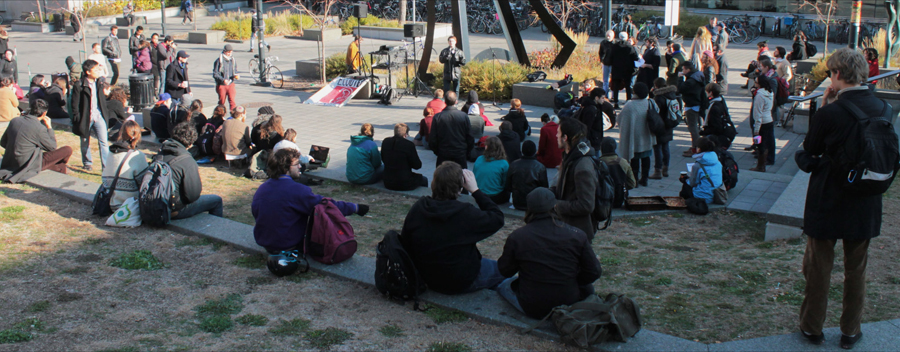
Students gather in James Square for the event. (Remi Lu / McGill Tribune)
a, News

Students and faculty reflect on Nov. 10 and student movement

Last Friday, students gathered in James Square to hear a series of presentations on the historic and present challenges faced by McGill. Student and faculty speakers presented on topics including unions, disciplinary charges from last spring’s student demonstrations, and the question of the democratic nature of the university’s structure.

The Post-Graduate Students’ Society of McGill University (PGSS) and the Students’ Society of McGill University (SSMU) organized the event as a commemoration of International Students’ Day, which falls on Nov. 17. According to PGSS Vice-President External Errol Salamon, the event also allowed students to reflect on the events of Nov. 10, 2011, when an occupation of the James Administration Building ended with riot police dispersing students on campus.

“There are still long-standing issues from the 2011-2012 academic year that haven’t been resolved,” PGSS Vice-President External Errol Salamon said. “This event ties into International Students’ Day because it enables not only students, but also other members of the McGill community to share … their local struggles and issues, many of which are common struggles.”

As examples of these ongoing struggles, Salamon pointed to the Quebec debate on tuition, as well as the academic disciplinary charges that some McGill students still face for participating in non-violent protests during the Winter 2012 semester.

Former SSMU Vice-President External Joël Pedneault gave a presentation that emphasized the importance of continuing to raise awareness about those who face ongoing disciplinary action or criminal charges for their participation in student protests. He received a ticket for participating in a demonstration last year.

“It’s important not just to ask for a general amnesty,” Pedneault said. “That seems like the most obvious thing … but the danger of formulating demands in that broad, sweeping way is that they could easily be taken halfway by those who have the power to decide who gets criminalized and who doesn’t.”

Pedneault said it is more important to spread information about those who have been banned from the island of Montreal, or who face jail time for cumulative charges.

Another presenter, Justin Marleau, stressed the importance of unions on campus. As the vice-president Teaching Assistants for the Association for Graduate Students Employed at McGill (AGSEM), Marleau said unions help to address the problems caused by the high student turnover rate at universities, which results in a lack of institutional memory among student organizations.

“We need to fight this administration every single day, for every single right that we should have,” Marleau said. “Every time we negotiate a new collective agreement they cut our hours, and they like to justify it with budget cuts. … But it has nothing to do with money. It has to do with what they care about—nice buildings, fancy facilities, HD TVs all throughout campus, with nothing about the quality of education for undergraduate and graduate students at McGill.”

Although the event was held in part to commemorate International Students’ Day, some speakers pointed out that struggles at McGill are not confined to students. Thomas Lamarre, a professor in East Asian studies, said the way McGill is run affects faculty as well as students.

“At McGill, we’re given an image that the form that our struggles should take is democracy—that we are supposed to go and sit in meetings, deliberate, pass bills, and vote on things,” Lamarre said. “But the truth is, a university is not structured like a democracy. So when we’re told that if we behave, it will become democratic, it’s simply a lie. It simply misdirects all of our energy from the actual struggle.”

Lamarre concluded by calling on students and faculty to stop “pretending” the university is a democracy.

McGill Dean of Students Andre Costopoulos attended the event, and said he thought the speakers made relevant points about the university’s history and community.

“Unfortunately, sometimes the way those important points are expressed doesn’t favour dialogue,” he said. “For example, some of the speeches started with [personal] attacks  instead of focusing on the issues at hand. But the issues and the points themselves are important and should be considered.”

Throughout the presentations, students frequently expressed their support by cheering. Isaac Stethem, U3 arts, said he appreciated the presenters’ comments, and emphasized the importance of encouraging dialogue about challenges at McGill.

“I thought it was really important to remember what happened on campus last year … but also to remember that it’s not just about one thing that happened a year ago,” Stethem said. “It’s about … continuing the struggle to make the university more democratic [and] to make it more responsive to the needs of students and faculty.”


Read the latest issue

Read the latest issue