

Latest News

a, Opinion

Who is responsible for making the GA more relevant to students?

On Oct. 23, the Students’ Society of McGill University (SSMU) released the results of the online ratification for its fall General Assembly (GA). The online vote ratified two motions—one to rename SSMU’s Breakout Room, the other to build a rock climbing wall in the SSMU building. Compared to the disappointing voter turnout for the GA itself, which failed to maintain a quorum of 100 students, nearly 3,000 people voted in the online ratification, surpassing the required quorum of 10 per cent of the student body. By requiring approval from a much larger percentage of the student body, the online vote acts as a check on a forum potentially dominated by a small, impassioned group of students well-versed on a specific issue. The online vote has acheived this by making the vote easier and more accessible to students unable or unwilling to attend the Assembly. 

At the same time, more could be done to make this form of participation more relevant and visible. While quorum was exceeded by three per cent, a remaining 87 per cent of students still did not participate in the online vote. The Tribune’s editorial board was split on the following question: does responsibility for ensuring greater participation rest on SSMU, or with the student body itself?

Point: Better participation must come from students

The online vote’s success proves that the GA reforms of President Josh Redel and the SSMU executive have come to fruition. Certainly there are always improvements to be made, but the fact is more than 13 per cent of undergraduate students voted online this year. In previous years, voting was limited to live participants at the GA. SSMU frequently struggles to attract even one per cent of the student body to attend in person for the whole evening.

The ratification’s success also shows that students respond to improvements in the voting process. Anyone who voted online knows that it took less than three minutes, and was easily accessible through the new SSMU GA website, which has information on the motions and legislative process.

The question is how much easier students need voting to be. SSMU, it seems, has done its part in encouraging those it represents to vote. While there could always be more publicity, more outreach, and more communication, the onus now lies with students to share their opinion, if they have one.

The truth is that most students do not have strong opinions about changing the name of the SSMU Breakout Room. And while a rock-climbing wall would certainly be an exciting addition, the issue is not likely to attract the attention of over 21,000 students. Perhaps this points to a problem in the kinds of motions presented at the SSMU GA, but as it stands, the GA merely reflects the initiatives of those willing enough to submit a motion.

Essentially, SSMU is the voice of the student body. It should not be their job to make students have a voice; their job is to make it easier for students to share their voice. Considering that students can now vote online, watch livestreams of the GA, express concerns to the GA “mood watcher,” learn about motions on the website, and do all of these things from their smart phones, it’s now time for students to participate in the dialogue. They have no reason not to.

Counterpoint: SSMU has more to do

While a seamless ratification is certainly a success for SSMU’s reforms to the GA, it is not enough. The online vote is a necessary but insufficient step in the right direction. Voter turnout of 13 per cent is an improvement, but it is not an accomplishment. The onus remains on SSMU to make these motions more visible and relevant to students.

This begins and ends with SSMU demonstrating motions’ relevance to students. Beyond a series of emails, the small percentage that voted did so without any other prompting by SSMU: there were no posters calling for participation, elucidating that a rock-climbing wall was at stake. The key to increasing student involvement is not only to clarify how a motion is submitted—which the SSMU’s website does—but to transcend each motion’s “whereas” clause to communicate to students what is really at stake.

A broader discussion needs to take place about why students should care about their student government. This discussion needs to come from SSMU, and not only because this is appropriate and within its purview as a group elected and funded by students. SSMU is the only group that is in the position to have this discussion; out of all of the groups on campus, SSMU has the funds, the reach, and the mandate to engage and represent all students.

In order to attract the remaining 87 per cent of the student body, SSMU’s first goal should be to facilitate participation from all groups on campus. This includes a more active role from the rest of the SSMU councillors, in particular faculty representatives, in directly engaging their own constituents in the voting process. It also includes fostering a culture of participation among first years—reaching out to residences and holding student government workshops, or allowing students to vote before grabbing dinner by setting up a station in residence lobbies.

It will always be incumbent upon student government to demonstrate why students ought to engage in student politics. SSMU built the GA, and SSMU uses the GA as one of its ways to pass motions. The student society derives legitimacy from the active and direct engagement of its constituents in such a forum. As such, it is SSMU’s job to continue to work towards a solution to the GA problem. We can complain about the lack of student engagement until we’re blue in the face, but that will change nothing—particularly as students most likely will not be listening.
a, Opinion

The faults—and merits—of anonymity in ‘hacktivism’

A hacking group calling itself Team Ghostshell recently unveiled “ProjectWestWind,” a leak of 120,000 files taken from the servers of post-secondary schools globally. The list of 100 institutions whose servers were compromised included the University of British Columbia and McMaster University. The group posted the leaked files alongside a statement encouraging a discussion of the direction in which higher education is headed.

This sort of ‘hacktivist’ action has grown popular in recent years, following the example of high-profile groups such as Anonymous and WikiLeaks. These groups work outside the scope of the law, which is generally vague in this realm due to lack of legal precedent. They justify their actions on a moral basis, but there is always an element of risk when working on the fringes of legality.

As a result, many of these organizations—Team Ghostshell included—work under a veil of anonymity. Most notably, Anonymous has succeeded in garnering considerable attention in the mainstream media. Working in anonymity allows such a group to execute and advertise its projects on a large scale without having to fear for their own personal security. These projects are not lucrative, and those who take them on have lives outside hacking—day jobs, families, and friends. Obscuring their identities allows them to avoid compromising these other components of their lives.

Other organizations have chosen to put forward a public figure to represent the group—the most notable example being WikiLeaks founder Julian Assange. Throughout the height of his organization’s release of leaked diplomatic cables, classified videos and correspondences, Assange was immensely visible in the media. He made appearances on talk shows and presented a human face for the world to associate with WikiLeaks. The risks of this approach are evident, as Assange is currently trapped in Ecuador’s embassy in London, which has granted him diplomatic asylum while he sorts out his legal struggles.

Despite the risks, there are some undeniable advantages to Assange’s method. Many of these groups claim to seek increases in government accountability and transparency—a bit of a contradictory stance for organizations that are shrouded in secrecy. Julian Assange gave WikiLeaks a sense of legitimacy that demystified it, and his voice advocated the organization’s cause to the public. By contrast, Anonymous’ press releases and announcements are delivered in a robotic, ominous voice, one that would not be out of place in a dystopian science fiction movie. This inaccessible delivery of their message precludes them from much of the media attention they might receive otherwise.

A further issue with operating in secret is the communicational disconnect in an organization without specific hierarchical structure. In many of these organizations, members may be anonymous even to one another. In such an environment, all those involved certainly share a common ideological standpoint, but risk failing to advance the discourse beyond ideology. Team Ghostshell’s recent large-scale hack was a chance for it to spark discussion and have its ideas heard, but rather than a pointed critique, it offered a generic, disjointed message which only spoke of change in the broadest terms.

When a hacking group circumvents the law on ideological grounds, it needs to cover said grounds as incisively and effectively as possible. Failure to do so brings into question the validity of the organization, and takes out of the question any notion of its place as some sort of purveyor of vigilante justice. As with any other company or organization, if it is unable to carry out its purpose, a restructuring or changing of priorities is in order.

In many cases, the condition of anonymity is an impediment both to a group’s ability to construct a coherent message, and to the public’s reception of this message. While not every group will have a member willing to throw himself or herself into the spotlight in the way that Assange did, there are certainly steps to be taken to soften the image of the shadowy, anonymous organization.  It begins with specifying how change needs to happen.

In a world where online presence and social media have made self-marketing easier than ever before, it is not unrealistic to expect these groups to follow through on their projects with a clear, coherent statement regarding what they are seeking to prove. If nobody understands their message, then what’s the point?

a, Opinion

Democracy’s weakest link: uninformed voters

As the presidential election campaign in the United States reaches the home stretch, one thing has become abundantly clear—barring any truly egregious mistakes by either campaign, this election is going to be particularly close. Thanks to the quirks of the Electoral College, the results in what are popularly known as ‘swing states’ are acutely important. However, the voters that are still in play in most of these states, ‘undecided voters,’ are, by many accounts, generally under-informed about the campaign. Typically, they consider themselves too busy to actually keep up with the issues, but still vote out of a sense of civic duty.

The first question this prompts is: how are these voters deciding? According to a trove of political science research, voters with ‘low information’ on the candidates, policy proposals, or the campaign itself, often use heuristics—mental shortcuts—to narrow down their choices. Much of this academic research has focused on what these heuristics are. In general, they include partisan party identification, visible physical characteristics, such as gender and race, candidate job occupations, and most disturbingly, ballot positioning.  Past research has found that the order of candidates’ names on the ballot can influence voters’ decisions.

Political campaigns have come to believe that ‘low information’ voters can be swayed by even more trivial cues. In the tightly contested 2008 Obama-Clinton Democratic campaign, strategists put a concerted effort into getting candidates onto ‘soft’ entertainment and lifestyle television programs, based on the belief that a decisive group of voters would be swayed by their haircut and clothing preferences, among other things.

So what can be done? Many of the historical ‘checks’ on American democracy were crafted with the express purpose of preventing the rule by an uninformed mass. Some have argued that a renewed fear of uninformed voters is simply a new manifestation of this old elitist loathing for the common man. However, the point of democracy, especially as opposed to a more totalitarian form of government, is not simply that citizens will vote in elections. Rather, the point is that a representative mass of the population, armed with proper information on policies, would reach generally better decisions than an autocratic dictatorship.

So what is to be done? The inevitable first response is to improve civic education at the primary level, but education can wear off as people age. The more immediate solution, at least in the case of the United States, would actually be to eliminate the Electoral College and replace it with a raw popular vote-based system. This would bring the entire country into play, instead of a select few states with particularly fickle populaces, and solve or at least ameliorate the problem of ‘low information’ voters in two ways. First, candidates would have to talk to a larger cross section of the country, rather than ignoring states with clear party leanings. This would revive voter engagement by making their votes matter more substantively. Second, the area in play during the election would be extended from a group of about seven states, thereby reducing the influence of easily persuadable ‘low information’ voters in ‘swing states’ to begin with.

The optimal solution to this whole problem of the ‘low information’ voter is not to keep them from participating in elections, as the harm of such efforts would far outweigh any benefit gained. Rather, we should give them the information to participate more gainfully, or to reduce their influence to the point that they aren’t the decisive demographic in our elections.

a, Opinion

A viewpoint on language politics in Quebec

Two weeks ago, the Canadian Press reported on the Parti Québécois’ controversial educational reforms. These have centered on plans to extend the provisions of Bill 101, Quebec’s legislative piece regarding its language policy.

The PQ’s Education Minister, Marie Malavoy, wants to hold off on the Liberal plan to implement intensive English in grade six in all public schools, a program that was supposed to be fully in place by 2015. In addition, the PQ government also wants to abolish mandatory English classes for grade one and two students, and make small changes to the high school history curriculum to emphasize the sovereignty debate, as reported by the CBC on Oct. 12. Malavoy has rejected accusations that she is trying to politicize the province’s school system, instead crediting the change to staffing issues and concerns about the impact on students with learning disabilities.

Despite these allegations, it’s clear that the PQ government needs to address the issue of language politics, which has manifested itself at a more grassroots, individual level. Last week, a paramedic in Vaudreuil-Dorion, Quebec, was reported to have flatly refused to speak in English to a man whose daughter had gone into a febrile seizure. While this is simply one incident, not addressing this fundamental issue within Quebec reflects badly on the government, as it won’t address domestic sources of tension among its citizens.

French carries a significant value—not only in Quebec, but also within the International Organization of La Francophonie (IOF), an affiliation of 56 Francophone countries and 19 observers from all around the world, unified around “humanist values promoted by the French language,” according to its website. Notably, the header title of the IOF website, “La voix de la diversité” (literally translated to “The voice of diversity”), does not have an English translation on the IOF’s website; this voice of diversity is French! Subtle hints such as these allude to a resurgent French cultural movement. After all, in the 17th century, French was considered the language of diplomacy and international relations in the world. To my knowledge, no other language has been as collectively and actively unified for its maintenance on a global level.

As such, just arguing that the issue in Quebec is linguistic and cultural is inadequate. The tension is specific to Quebec because of its historical context. Though Canada was founded as a French colony, the French actually ceded Quebec, then New France, in the Treaty of Paris (1763). After a brief period of an interim, non-military administration, the British ratification of the Quebec Act in 1774 officially mandated Quebeckers to become British subjects. At the same time, it sought to retain and protect most property as well as the religious, political and social culture of French-speaking Canadians.

The Constitutional Act, which essentially created a geographical divide between British and French subjects in Upper and Lower Canada respectively, replaced the Quebec Act in 1791. Upper Canada received British laws and institutions, while Lower Canada fell under French law and institutions. Herein arguably lies the first sources of tension that still exist today—French Canadians felt overshadowed by English subjects, while the English found that French-Canadians still had too much political standing.

While it’s certainly possible to appreciate the historical roots of the Quebec sovereignty movement, it’s also possible that it’s an outdated cause. Canada’s identity has definitely changed drastically since the 18th century.

Therefore, if the issue is still Quebec’s political status in Canada, the PQ should stop trying to implement its antagonistic, and arguably isolationist, language policies. On the contrary, open dialogue to incite understanding for Quebec’s reasoning should be adopted so that people understand Quebec’s role in history. If there needs to be greater recognition of the official bilingualism of Canada, or even a greater understanding of sovereignty history, laws cannot just be passed within Quebec, but also the rest of the nation.

It must be up to all Canadian citizens to make an informed choice, and perhaps Quebec is within their right to demand secession. But with no mutual understanding of why that is, and by equipping just the members of Quebec with this knowledge, no fruitful political action can be taken between Quebec and the federal government. Rather, this discussion needs to be placed in a historical context.

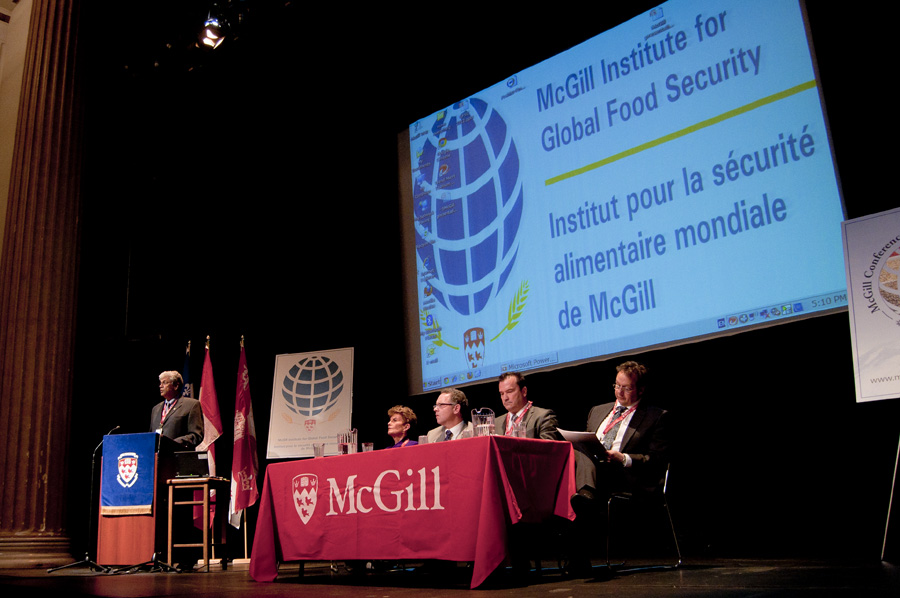
Panel opens Food Security Conference. (Simon Poitrimolt / McGill Tribune)
a, News

Global Food Conference opens with price volatility lecture

The fifth McGill Conference on Global Food Security opened on Oct. 16 with Jean Lebel’s keynote speech on price volatility. Lebel, the Vice-President of the Programs and Partnerships Branch of the International Development Research Centre (IDRC), spoke about the challenges created by the unpredictability of food prices, and how to address these issues worldwide.

“Food security exists when all people at all times have physical and economic access to sufficient, safe, and nutritious food,” Lebel explained.

Changing agricultural conditions are one factor contributing to the volatility of food prices. While some factors in price variations are relatively predictable, such as the availability of local crops in different seasons, Lebel explained that they are ultimately difficult to predict due to external elements, like the weather.

Lebel emphasized that further investment in agricultural practices can mitigate the impact of fluctuating food prices on those living in poverty, who are highly susceptible to price volatility.

“It is estimated … that economic growth generated in agriculture is on average four times more efficient, effective, and benefitting the poorest half of the population than growth generated outside of agriculture,” Lebel said. “Growth in small agriculture significantly decreases poverty, and in most cases, also contributes to greater economic equality.”

According to Lebel, efforts to help these populations have significantly increased in recent years. He pointed to the G20’s Agriculture Market Information System (AMIS) as one effort to lessen the impact of changes in food prices.

Simon Poitrimolt / McGill Tribune

“[AMIS] brings member countries together to share their information on prices, production, [and] policy options that are available in front of multiple parties,” Lebel said. “Rather than going on speculation, countries have come together, have shared their information, have better knowledge, and can make better informed decisions.”

To provide an example of ways people can help lessen the impact of price volatility, Lebel pointed to some of the IDRC-funded research in developing areas of the world. He restated IDRC’s commitment to bring knowledgeable people from all over the world together around common research projects, in order to find the best solutions.

“Through the research process, we hope that we can find a sustainable way of bringing food to the people, increasing their food security, [and] considering everyone as a community,” he said.

However, Lebel also acknowledged that increasing food security continues to be a difficult task. Currently, one in every eight people in the world is undernourished and consumes fewer than 800 calories  in a day. Despite significant reductions in malnourishment in Latin America, the Caribbean, and Southeast and Eastern Asia, Lebel said the numbers in Sub-Saharan Africa and Southern Asia continue to grow.

Lebel concluded by calling for increased support in alleviating malnourishment and for greater investment in agricultural research.

“I am optimistic by nature, but I’m not a fool,” he said. “We’ve seen some progress—insufficient. We have seen money starting to flow back into agriculture, [but] what is preventing me from sleeping at night with all this development and all this optimism is that we miss opportunities to raise innovation at a scale that really makes a difference.”

Jessica Wu, a PhD candidate in the University of Calgary’s faculty of veterinary medicine, works on an IDRC-funded project on food security in Sri Lanka.

“[The speech] was very broad-based [but] he brought up a lot of good points,” Wu said. “It [was] really nice to see the results from some of the food security research projects that are going on, [but] it certainly is an extremely optimistic viewpoint.”

a, News

Suzuki and Rubin visit McGill on End of Growth Tour

On Oct. 15, economist Jeff Rubin and environmental activist David Suzuki spoke on the importance of creating a sustainable future. Held in Pollack Concert Hall, the End of Growth Tour lecture was co-sponsored by the McGill Bookstore, the Marcel Desautels Institute for Integrated Management, and McGill’s Institute for Sustainability in Engineering and Design.

Rubin, the former chief economist at CIBC World Markets and a McGill alumnus, used an empirical analysis of the economy to explain why we may soon witness a stagnation in innovation and economic growth. He emphasized the circumstantial imperatives of the market, where the overconsumption of oil and a resulting rise in oil prices have led to an decreased demand for oil, and increased investment in green technology.

Rubin underlined the importance of energy—and oil in particular—in driving modern growth, and noted that the decline of its production may have dramatic consequences for the environment.

“Oil, still, is the single largest source of power for the global economy, and as a transit fuel, it has no substitute,” Rubin said. “If we step back and look at the history of our economy over the last 40 years, it’s hard not to notice that every major recession has oil’s fingerprints all over it.”

The higher the price of oil, he added, the less oil people can afford to consume.

“When we see triple digit oil prices, what we’re seeing is the boundary of a finite world,” he said. “I think the key to adjustment that has to be recognized in so many cases, is [that to] make do with less is better than always wanting more.”

David Suzuki, cofounder of the David Suzuki Foundation and long-time environmental activist, tied Rubin’s economic perspective to the impact of society’s increasing detachment from an identity as biological creatures.

“Our species thinks it can take over and use whatever we want, spew our chemicals and toxic waste back into [our home] without paying any price,” Suzuki said. “We can’t … see the consequences of our actions because we’ve lost our sense of where we belong and what our home is. We elevate the economy above our very own domain.”

Suzuki criticized what he called humans’ subordination of our planet’s needs to societal constructs—constructs such as capitalism and the economy. He said  humans have lost touch with nature, which has resulted in a notion of human superiority and exceptionalism even though we depend on nature.

“We need air, we need water … we need the earth because that’s where our food comes from,” Suzuki said. “Furthermore, what keeps the planet habitable for us is the diverse array of living species on the planet. Those are the most fundamental needs for our very survival and our health.”

Suzuki asked the public to understand that nature is more important than anything created by humans.

“We created things like boundaries, economics, capitalism, corporations, [and] markets,” he said. “We invented [them] but we bow down to these things as if they dictate us. We can’t change nature. The only things we can change are the things we invent … Let’s take back democracy, and show our leaders what really matters to us.”

As a part of a nationwide lecture tour, this event highlighted arguments and observations from the speakers’ latest books—Rubin’s The End of Growth and Suzuki’s Everything Under the Sun.

Anna Stein, events coordinator at the McGill Bookstore, was pleased with the way the discussion progressed.

“[The speakers] had a great time together, and had a lot of interesting things to say,” Stein said. “I’m so happy to have McGill as a venue for them.”

Students echoed her appreciation of the speakers and the topics they covered.

“It was a solid event,” Thomas Raissi U2 biochemisty, said. “I obviously didn’t agree with everything they said, but I liked how Rubin’s points on economy complemented with Suzuki’s environmental points. They were both pretty good speakers.”

a, News

What happened last week in Canada?

Conservatives introduce controversial omnibus Bill C-45

Last Thursday, the Canadian government introduced another massive budget bill, Bill C-45. Critics, including the New Democratic Party (NDP), have denounced the bill as “covering way too much ground.”

C-45 proposes significant changes to Member of Parliaments’ pension plans, the Navigable Waters Protection Act, and tax credits for small businesses, as well as changes to the Environment Assessment Act.

According to Finance Minister Jim Flaherty, all of C-45’s stipulations had been presented in the budget published this past spring. He said the changes will save taxpayers $2.6 billion over a period of five years. NDP finance critic Peggy Nash, however, expressed concern for the bill’s overwhelming size.

According to the National Post, the Conservative government took pension reforms out of the omnibus bill on Oct. 19, following pressure from opposition parties. The opposition is also pushing to have other sections, such as those concerning the environment, separated from the bill, arguing that the measures need more in-depth study. The Conservatives have said that they are open to doing so if the opposition agrees to pass those changes quickly.

B.C. universities call for increased government funding 

An Oct. 18 report to the B.C. legislature’s select finance committee called for an increase in post-secondary funding by $180 million. The report was presented on behalf of the Research Universities’ Council, which represents six of B.C.’s major universities.

In 2011, B.C. Premier Christy Clark revealed a jobs plan that predicted the creation of approximately one million jobs in B.C. over the next 10 years. According to Thursday’s report, a large majority of these estimated jobs are expected to require some post-secondary qualification, and the province will face a shortage of educated workers to fill them if the government does not act to make universities more economically accessible to students.

Unlike Ontario, Alberta, and Quebec, B.C. currently lacks a student grant program, and a graduate fellow program. The B.C. government has also already announced a $50 million cut to post-secondary spending over the next two years.

Supreme court limits right to online privacy at work

The Supreme Court of Canada ruled on Oct. 19 that employees using work-issued computers for personal reasons only have a limited right to privacy.

According to the decision, employees may enjoy a certain amount of privacy when conducting personal business on work computers, as long as their workplace allows them to do so. However, if personal use of computers is not permitted, employers have the right to search and copy the information on the computer’s hard drive.

The Court clarified that the right to search workplace devices does not extend to beyond the office. Law enforcement officers must obtain a warrant in order to search or collect data.

Following the ruling, the Court ordered a new trial for Richard Cole, a high school teacher charged with possession of child pornography in 2006. Sexually explicit photos of a female student were found on Cole’s laptop, which was issued to him by the school. The reopened trial will take the new ruling into consideration.

Eight face charges in London, Ontario bullying case

Last Friday, eight girls were arrested and charged with criminal harassment following an investigation into a bullying case at a high school in London, Ontario.

Police said they received information regarding the case from the school’s anonymous reporting portal, as well as from direct statements. Their investigation revealed that the eight girls physically, emotionally, and cyber-bullied another student at the school.

The police have confirmed the victim in question is safe.

Friday’s arrests follow the recent and tragic suicide of a British Columbia teen, Amanda Todd. Todd endured years of cyber-bullying and was also physical attacked by her high school peers. Her death has sparked a national outcry and debate over how to better prevent bullying and make bullies accountable for their actions.

According to the Vancouver Sun, the girls were released from custody “on a promise to appear in court.” Police have said they are continuing the investigation, and that they may lay additional charges.

Parti Québécois flip-flops over language bill extension

Last Friday, the Parti Québécois (PQ) withdrew its proposal to extend provisions of Bill 101 to Quebec childcare centres.

According to CTV News, PQ Family Minister Nicole Léger presented the idea on Oct. 17, “as legislation that would be introduced in the next few weeks.” Léger argued that young children should be exposed to French at an earlier age. The Liberal opposition quickly expressed its outrage at the proposal.

Diane De Courcy, Quebec minister of language, immigration and cultural communities, confirmed on Oct. 18 that the PQ would not abolish the current freedom-of-choice rules surrounding daycares, calling the move “out of the question.”

Bill 101 is the Charter of the French Language that declares French as the official language of Quebec, and seeks to make French the “normal and everyday language of work, instruction, [and] communication.”

Team Ghostshell leaked records from 100 universities (Mike King / McGill Tribune)
a, News

Team Ghostshell hacks university servers around the globe

On Oct. 1, a hacking group under the moniker Team Ghostshell unleashed “ProjectWestWind,” a venture that has since leaked 120,000 records from 100 universities worldwide. The group targeted major learning institutions like Harvard and Cambridge, as well as two Canadian universities—McMaster University and the University of British Columbia.

The group allegedly intended to bring about a discussion on the state of higher education.

“We have set out to raise awareness towards the changes made in today’s education, how new laws imposed by politicians affect us, our economy and overall, our way of life,” Team Ghostshell wrote in a post on pastebin.com. “How far we have ventured from learning valuable skills that would normally help us be prepared in life, to just, simply memorizing large chunks of text in exchange for good grades.”

Four servers were hacked at McMaster in Hamilton, Ontario. Team Ghostshell accessed files that included the names of people who participated at departmental events, as well as names of students, and degree dates. These actions have led the general public to believe that the hackers’ actions were not meant to do actual harm, but rather to make a statement.

Despite the innocuous nature of the information, the attack still brings up the issue of software security. McGill has an IT Security Incident Response Protocol, which details their response to an incident where confidential data has been compromised or the IT systems are attacked. Steps include assigning an Incident Officer to identify the problem and take “corrective action.”

“All software have bugs and all universities are targets,” McGill Chief Information Officer Ghilaine Roquet said. “We receive bug fixes regularly by all our software and hardware suppliers.”

Derek Ruths, an assistant professor in the school of computer science at McGill, explained that any information available online—whether it be grades, enrollment information, or course registration—is at risk of being hacked.

According to Ruths, McGill purchases its software platforms from various software companies.

“It is not necessarily the case that running the wrong software is going to get you hacked,” he said. “Sometimes there are just vulnerabilities in the software itself. For example, if myCourses had a huge bug in it, it may be very possible for hackers to easily get the enrollment of the entire university by simply accessing the right myCourses pages.”

In order to diminish the chances of being hacked, universities must then be careful about the level of security of the software they purchase, Ruths arged. Although he does not have details about the security of McGill’s software, he believes there is no reason to be concerned at the moment.

“There’s nothing going on with McGill’s software that makes me suspect that it is insecure, but most software that is hacked usually looks pretty secure on the surface,” he said.

According to Ruths, there are also some students at McGill who intentionally look for bugs and report them to IT services.

“They do it on their own accord,” Ruths said. “They consider it a service. If they see a page and something strikes them as a little odd about it, they will tinker around to see if there is a problem. If they find that there is a problem, they will immediately report it. This is the kind of behaviour that I think should be encouraged on some level because … when good people find problems, systems get better.”

Although Ruths said all software is at risk, McGill IT’s response protocol means that the university is prepared to deal with hacking, should it occur at McGill.


a, News

Investigation finds no misconduct in McGill asbestos study

An internal investigation found no proof of misconduct on the disputed research of former epidemiology professor John Corbett McDonald.

McDonald’s research on the health effects of chrysotile asbestos  came under scrutiny in early February following a CBC documentary which suggested that  McGill had allowed the asbestos industry to sponsor and influence scientific studies.

The controversy led Vice-Principal (Health Affairs) and Dean of Medicine David Eidelman to request a preliminary internal review by the chair of the department of epidemiology, Rebecca Fuhrer, despite calls from anti-asbestos activists to organize an independent investigation. On April 4, Eidelman announced that Fuhrer had not found any evidence of research misconduct, and requested that McGill’s Research Integrity Officer Abraham Fuks conduct an additional investigation on the integrity of McDonald’s research.

“The financial support from the industry was acknowledged in publications and there is no evidence to suggest that the sponsors influenced the data analyses or the conclusions,” Fuks’ report reads. “I find no warrant to initiate further investigations of the allegations that we have received.”

Eidelman presented the report to Senate, the highest academic body in the university, on Oct. 17.

“[The report] casts a lot of light … [and] allows one to understand why people may make allegations,” Eidelman said. “I don’t believe we have anything to hide. We have no investments in the asbestos industry … [the] conspiracy is simply not true.”

The report notes that although McDonald received funding from the Quebec Asbestos Mining Association (QAMA), his research was also funded through the federal Department of Health and Welfare.

“It is clear QAMA’s interests were designed to protect the asbestos industry with the implication that if it funded the research, it would thereby control the outcomes or their dissemination,” the report reads. “[However], this does not by itself demonstrate that the research was controlled or that its dissemination was influenced by QAMA.”

Further allegations claimed that McDonald had denied his connection to the asbestos industry. Fuks argues that McDonald did not make an attempt to hide that the funding for his research came from asbestos companies, and that “there is no evidence that the design of the research, its conduct, and its reporting was influenced by the industry.”

Kathleen Ruff, anti-asbestos activist and recipient of the Canadian Public Health Association’s 2011 National Public Health Hero award, called the report “biased, misleading, and inaccurate.” The report mentions her among those who provided materials to the investigation, such as newspaper clippings and other documentation.

“I provided evidence to Dr. Fuks, showing that Prof. McDonald used his research to lobby against improved occupational safety standards for asbestos workers,” Ruff told the Tribune. “Dr. Fuks ignored this evidence of collusion with the asbestos industry … legitimate concerns were ignored, and critical information was excluded from the report. No meaningful involvement was allowed.”

The report noted that McDonald has been criticized for studies that found that amphibole asbestos is more closely associated with mesothelioma, or malignant tumours, than chrysotile asbestos.

“Some of the controversies in this contested field stem from the choice of language to describe the data derived from the research,” the report reads. “In fact, the statements by [McDonald] and colleagues were generally carefully worded and explicitly supported by their research findings.”

Ruff disputed the claim in Fuks’ report that McDonald’s findings have been corroborated and supported by the scientific community.

“The key conclusion of Prof. McDonald’s research is that chrysotile asbestos is virtually innocuous except at astronomically high exposure levels,” she said. “This conclusion is rejected by the overwhelming consensus of scientists. There is, to my knowledge, not a single reputable, independent scientist who has replicated this finding.”

Among the criticisms the report addresses is those by Brown University professor David Egilman, who questioned McDonald’s methodology and suggested that the his research methods were flawed. According to the report, McDonald used older methods to contrast data from previous decades, as there was no data to compare to if he used newer techniques. Fuks writes that McDonald “understood the drawback [of using older methods] and assessed [the] data accordingly. ”

Ruff noted that McDonald testified before the Occupational Safety and Health Administration in 1972 against a proposal to increase US safety regulations regarding asbestos and that in 1999, he spoke at a conference in Brazil, organized by the Ministry of Labour and Employment, allegedly presenting findings that chrysotile asbestos could be eliminated by the body except at extremely high levels of exposure.

Fuks declined to comment on the report.

The report recommends that McGill’s Board of Governors consider avoiding investing in asbestos companies, and that McGill host an academic conference on the current evidence on the toxicity of asbestos, and the burden of dealing with asbestos in old buildings.

During Senate, Eidelman welcomed the suggestion to host a conference, and said that he aimed to organize one in the near future. Other professors, like Associate Professor of Political Science Catherine Lu, expressed interest in the suggestion.

“The Report raises some questions,” Lu said. “In terms of the conference proposed, do we need to think of a conference that also discusses the relationship between universities and industries with an agenda?”

The report does not mention that in early February, over 70 medical doctors and health researchers called for the resignation of asbestos exporter and member of the McGill Board of Governors Roshi Chadha. Chadha took a leave of absence for the remainder of the winter semester and resigned from the Board early in the summer.

—Additional reporting by Bea Britneff. 

a, News

SSMU Council tables GA motions

At last Thursday’s Council meeting of the Students’ Society of McGill University (SSMU), concerns about ambiguity in the SSMU constitution led councillors to vote to commit all nonbinding motions passed in the Oct. 15 SSMU General Assembly (GA) to the Steering and Policy committees. These committees will investigate SSMU constitutional ambiguities, and determine whether to bring these motions to the next council meeting, to be held on Nov. 1.

The fall GA lost quorum after passing two motions. The remaining four motions were therefore nonbinding, as they were adopted by what then became a consultative forum.

Following precedent from last year, Speaker Michael Tong decided to bring the adopted motions to Council after consultation with the movers of the motions and the Steering Committee. Tong explained that the SSMU constitution allows for two options when motions pass under a consultative forum.

The by-laws say that motions of this character “shall be inscribed upon the agenda of the next general assembly or at the discretion of the speakers in consultation with the movers and the Steering Committee, upon the agenda of the next council meeting.”

SSMU President Josh Redel said that he does not believe there has ever been a clear distinction on whether a motion that comes to Council from a consultative forum is considered a Council motion or still a GA motion.

The ambiguity in the constitution also extends to the process of passing unbinding resolutions, since a resolution passed last semester now requires the online ratification of motions passed at a SSMU GA. At the Oct. 15 GA, only the two motions passed with quorum moved into the online ratification process.

Speaking on behalf of the Steering Committee, Redel recommended tabling all four motions, which included one regarding SSMU support for accessible education, opposition to Plan Nord, opposition to Canadian military involvement in Iran, and ethical investment at McGill.

SSMU Vice-President University Affairs Haley Dinel, who also sits on the Steering Committee, explained that the idea was to table the motions at Thursday’s Council, rewrite them in Committee, and conform them to fit into SSMU’s mandate.

SSMU Vice-President Clubs and Services Allison Cooper said she wanted to consider ratifying the first of the four motions—the motion regarding renewing support for accessible education. SSMU Vice-President External Robin Reid-Fraser supported Cooper’s suggestion.

“I feel that this is a motion that comes from … a policy SSMU has had for five years … and that was renewed last year,” Reid-Fraser said. “[Ratifying this motion] is just renewing that policy. It’s not a new thing.”

Other councillors had reservations about proceeding with one motion, and tabling the rest.

“I believe that if we do decide to table the motions, I think we should table them all together or not table them all together,” Nicole Georges, arts representative to SSMU, said. “I really think that we should follow procedure and keep them all together … [I don’t think] we should start cherry-picking.”

Redel expressed concern about violating direct democracy, saying that he did not think the four motions should be changed or debated upon by Council.

SSMU Vice-President Internal Michael Szpejda suggested that Council first address the now apparent ambiguities of the SSMU constitution.

“We should fix the [ambiguity] first so we can be sure of how we pass these motions,” Szpejda said. “Then [we should] bring these motions back to Council.”

SSMU Vice-President Finance and Operations Jean Paul Briggs then proposed a motion which mandates the Steering and Policy Committees to further discuss the constitutionality of whether or not the four GA motions should be brought to the next Council on Nov. 1. Briggs’ motion passed with 18 votes for and seven against.

Following Council, Cooper expressed her disappointment about the vote.

“First off, the decision to table the GA decisions went against a precedent that students and movers of motions were expecting,” she said. “I think debating them … is entirely within Council’s role.”

Read the latest issue

Read the latest issue