

Latest News

a, News

Royal Society of Canada honours 12 McGill scholars

Two weeks ago, 12 McGill University scholars and researchers were honoured by the Royal Society of Canada (RSC). Eight will be inducted into the RSC as new Fellows, while the remaining four have received awards and medals.

Established in 1882, the RSC is the senior Canadian collegium of distinguished scholars, artists, and scientists. Dedicated to promoting learning and research in the arts, humanities, social, and natural sciences, the RSC also prepares expert assessments on critical issues of public policy.

“It is truly extraordinary for so many McGill researchers to receive medals and fellowships in a single year,” Vice-Principal (Research and International Relations) Rosie Goldstein said in an interview with the McGill Reporter. “We are extremely proud of all the honourees and the immeasurable contributions they make to research, teaching, and learning at McGill. Collectively, they embody the University’s history of excellence, while reaffirming that McGill remains at the forefront of research in Canada.”

Hans and Tamar Oppenheimer Professor in Public International Law François Crépeau is one of the newly-appointed RSC Fellows. Among his many other achievements, Crépeau was appointed the United Nations’ Special Rapporteur on the Human Rights of Migrants in 2011.

“It is humbling to think that people I have been working with think me worthy of such recognition,” Crépeau said, speaking of the colleagues who nominated him.

Dr. Siegfried Hekimi is the recipient of the Flavelle Medal, an honour awarded for “an outstanding contribution to biological science during the preceding ten years or for significant additions to a previous outstanding contribution to biological science,” as described by the RSC website.

Hekimi’s research involves investigating the molecular mechanisms of aging. His findings challenge the widely accepted free radical theory—a theory that states that organisms age because their cells accumulate free radical damage over time. When asked how he felt about receiving the Flavelle Medal, Hekimi, like Crépeau, replied modestly.

“What is humbling is when you see who else got [the award],” Dr. Hekimi said. “The list includes Best and Banting, who discovered insulin, Dr. Penfield . . . and also the last Canadian Nobel Prize winner, Michael Smith.”

Dr. Chao-Jun Li, a professor in the McGill department of chemistry and Canada Research Chair (Tier 1) in Green Chemistry, was also named Fellow of the RSC. Li’s research stems from the search for chemicals and chemical products—like clothing, cosmetics, and paint—that do not lead to harmful health or environmental concerns. Li also explores new chemical reactions in order to discover scientific tools to increase the efficiency of chemical production, thereby decreasing its negative consequences.

“When exploring new scientific frontiers, very often you will encounter many obstacles, frustrations, and uncertainty,” Li said. “We certainly have. Being inducted to RSC gives me an assurance of the importance of our research efforts and encourages us to continue.”

The induction and awards ceremony will be held Saturday Nov. 17, during which the new Fellows will be officially inducted into the RSC, and the awards and medals will be presented.

“I’m greatly indebted to all the students and collaborators who have worked with me over the years,” Crépeau said. “Without [their] unfailing support, keen insight, and challenging questions, I wouldn’t be where I am today.”


a, News

McGill places 18th in QS World University Rankings

McGill ranked 18th overall in the world in the 2012 QS World University Rankings, released Sept. 10. Although McGill moved down one spot from its 17th place finish in 2011, this latest annual ranking marks the sixth consecutive year that the university has placed in the QS top 20.

Launched in 2004, QS World Rankings is considered one of the world’s most widely known university ranking systems. It ranks universities annually based on six factors: academic reputation (40 per cent), employer reputation (10 per cent), student/faculty ratio (20 per cent), citations per faculty (20 per cent), international faculty ratio (five per cent), and international student ratio (five per cent).

In a news release, Principal Heather Munroe-Blum expressed satisfaction with the results.

“We are pleased by McGill’s continued strong performance in these rankings,” Munroe-Blum said. “It is a tribute to the talent, dedication, and hard work of faculty, staff, and students throughout our university. We are also delighted that three great Canadian schools are now listed in the top 50 of this world ranking, with two in the top 20.”

The other Canadian university to place in the top 20 was the University of Toronto, ranked in 19th place. The University of British Columbia was the third-ranked university in Canada, placing 45th.

For the first time, the Massachusetts Institute of Technology placed first in the overall rankings, followed by the University of Cambridge in second, and Harvard University in third.

According to QS Head of Public Relations Simona Bizzozero, 2,586 universities were surveyed this year. Of those, 729 universities from 72 countries were ranked.

“In [2004] we considered the top 500 universities for research citations based on a bibliometric database,” Bizzozero said. “[In subsequent years], we added to the initial group—other universities which received votes from the academics and employers we survey every year.”

According to Bizzozero, other universities were included based on specific considerations, including national rankings, survey performance, geographical balancing (recognizing the different priorities and characteristics of universities in different parts of the world), and direct case submission.

In individual department rankings, McGill placed 36th in social sciences and management, 32nd in arts and humanities, 29th in life sciences and medicine, 38th in natural sciences, and 46th in engineering and technology.

The full rankings, as well as more details about the methodology of the QS ranking system, can be found at www.topuniversities.com.

— Karen Huang

a, Opinion

Search for next principal, a chance to start anew

An advisory committee was formed in April to find a successor to Principal and Vice-Chancellor Heather Munroe-Blum, whose second term ends on June 30, 2013. The committee will nominate a candidate it feels is best suited for the role, from an administrative and governance standpoint; the following are some  key qualities we hope to see in candidates for the principalship, from a student perspective.  This search presents an opportune moment for students to reflect on the values they hope McGill’s next principal will embody, and to indirectly influence the direction the university will take in the coming five years.

Munroe-Blum’s 10 year tenure, by no means without its share of controversies, can nevertheless claim a number of successes. Under Munroe-Blum’s governance, McGill has maintained its standing among the world’s top universities despite continual funding shortages. Munroe-Blum has also been a staunch advocate for recruiting new talent—more than 1,000 of McGill’s 1,600 tenure-track, full-time faculty were appointed in the last 12 years.

In the next five years, McGill’s focus needs to be on innovation and interdisciplinarity, and the next principal must take this to heart. McGill faces competition from all angles—larger, better-funded universities like the University of Toronto are outcompeting McGill for national grants, while smaller universities are outpacing McGill when it comes to implementing new and innovative programs. McGill’s traditionalism is often a barrier to both student and researcher achievement. Students are frequently unable to take courses in other faculties; for example, an undergraduate civil engineer wishing to broaden their horizons and take courses in architecture should  be supported and encouraged by their faculty to do so. To uphold the mission of the university, productive cross-faculty collaborations must not only be sought out, but encouraged. Candidates for the position, therefore, must demonstrate a commitment to fostering such an exchange of ideas.

The next principal must also strive to achieve a fair balance between research and teaching. Working closely with deans and department heads, the principal needs to value—both in rhetoric and funding—training professors to be good teachers. Munroe-Blum’s successor must prioritize investment in teaching support. This is closely related to the renewed focus the new principal must place on developing student life at school.  In 2006, Munroe-Blum established the Student Life and Learning Portfolio in an attempt to enhance the student experience at McGill. This was a step in the right direction, but more needs to be done. An applicant well-suited for the principalship must set clear priorities for the improvement of teaching and learning.

After the tumult of last year, a new principal, in many ways, brings a fresh start to dialogue on campus. The Tribune encourages the McGill community to approach this situation with an open mind. When choosing a successor, we call upon the advisory committee to choose a candidate who demonstates a strong ability to actively foster discourse among diverse groups on campus— even when the opinions of said groups may be at odds with those of the administration. Relationships are not a one way street, though, and students also need to ask themselves how they can contribute most productively to the discussion at hand. A less polarized campus, one where collegial debate is encouraged and different views coexist, is undoubtedly a more welcoming and productive one.

a, Opinion

Off the Board

There are few things that I completely treasure. For some inexplicable reason, everything for me comes with a caveat, something that prohibits me from fully embracing its excellence.  The Miami Heat was the best team in basketball last season, but don’t speak to me about it until LeBron wins his sixth title. Arrested Development may be the funniest television show to hit the air, but the movie will likely be a letdown. This past year, however, I finally found something I adore wholeheartedly.  And, unlike with any previous muse, I’m not afraid to admit it. I unconditionally love Twitter.

Before I come off as a pretentious social media advocate, I should  confess that at first, I was reluctant to join Twitter and engage in such a public space; I thought Facebook was enough. I had the impression that Twitter was used by people who shared their unwanted thoughts and exact whereabouts, things that weren’t on the top of my priority list. My family was definitely a proponent of this opinion. When Twitter took off, there were countless dinner conversations about its stupidity. “Why do I care when Jennifer Lopez uses the washroom?” my sister asked repeatedly.

But at some point, I began ignoring my family’s disdain and entered the Twitterverse without their blessing. I made an account and began following my favourite athletes, musicians, writers, and comedians, and was exposed to a wealth of instant information. Ryan and Kelly from The Office are best friends in real life? Twitter confirms. Kevin Durant took a picture of Russell Westbrook sleeping on the team bus? He did! Thanks, Twitter.

But Twitter is not used exclusively as a platform to discuss our guilty pleasures and superficial opinions. It is also useful during landmark events. Along with millions of others, I found out about Osama Bin Laden’s capture and death long before it was reported on television. It was as if Bin Laden himself tweeted that he was done for. Though this need for immediate information can seem unnecessary—so what if I found out about Bin Laden’s death an hour late?—there’s something valuable about Twitter’s ability to spread news quickly.

For example, Toronto Blue Jays’ star Brett Lawrie was present at the Eaton Centre shooting in Toronto this past June. Lawrie has over 100,000 followers on Twitter, and as one the Jays’ most popular players, thousands of those followers are Torontonians. His warnings were retweeted hundreds of times, providing public awareness to people who may not have been following him. The instant spread of news kept mall-goers aware in a time of chaos, and perhaps even prevented people from going to the mall. For that, we should be grateful to have access to such a platform.

According to an article in Forbes Magazine this past May, 31 per cent of adults aged 18-24 use Twitter, up 13 per cent from the previous year.  I read that statistic as: 69 per cent of you don’t know what you’re missing. That, and my family must have brainwashed all of you. Nevertheless, I’m optimistic about Twitter’s growing importance. In the same article, a Twitter spokesman reported that “it took us three years, two months and one day to reach one billion tweets. Now, we see more than one billion tweets every three days.”

If I haven’t been convincing enough, then ask yourself why you wouldn’t want to be involved with a website that offers instant news, hilarious content, and engaging commentary. It’s a space in which you can share your thoughts to just friends (in the case of a private profile), or to the whole world, if you’re feeling confident. Any which way, I encourage McGill students to join Twitter. And while 140 characters didn’t give me enough leeway to pour my heart out, know this: 140 characters are enough to have an impact.

Though those 140 characters  might be used to discuss JLo’s washroom trip, I think we can get past that.


a, Opinion

A real Romney gaffe

It’s easy to understand why Mitt Romney must be feeling frustrated right now. The four-day Republican National Convention was first hijacked by a hurricane, and then by an old man talking to a chair.  Meanwhile, the majority of the media met the Democratic National Convention with plaudits, and Obama has seen a slight bounce in the polls. The media continues to characterize Romney as a man without any ideas, and at the same time, extreme ideas—a radical Republican, yet also a flip-flopper.

Frustration aside, the Romney campaign’s response to the recent tragedy at the American Embassy in Libya—on September 11th of all days—was out of line, and unbefitting of a candidate for the Presidency. In response to the horrific attack that claimed the lives of Ambassador Chris Stevens and three other embassy workers, Romney released a statement saying:

“It’s disgraceful that the Obama administration’s first response was not to condemn attacks on our diplomatic missions, but to sympathize with those who waged the attacks.” This response referred to a tweet from the Egyptian Embassy stating: “We firmly reject the actions by those who abuse the universal right of free speech to hurt the religious beliefs of others.”

Romney’s response was wrong on many levels. First, he launched his broadside against Obama on September 11th, a day on which campaigning was tacitly paused, instead of waiting until the following day.

Secondly, Romney was referring to a tweet that was not endorsed by the Obama administration, but was tweeted under duress by the American Embassy in Egypt, and later disavowed by the White House. Earlier in the day, a mob stormed the U.S. Embassy in response to an awful movie titled Innocence of Muslims, only to be followed soon after by a similar mob in Libya. It is perfectly understandable that those in danger inside the embassy would seek to defuse tensions by stating they were categorically opposed to the aforementioned movie. Did Romney not think that the public would be able to assess the situation in which this tweet was sent?

[pullquote]Romney’s rush to judgment was an attempt to score political points, instead of waiting to hear about the facts—an undesirable attribute in a President.[/pullquote]

Romney’s rush to judgment was an attempt to score political points, instead of waiting to hear about the facts—an undesirable attribute in a President. Indeed, there have been unconfirmed reports that the Obama administration may have bungled intelligence tips before the attack, and that proper due diligence may have averted the events that followed. It would have been far more prudent for Romney to actually see if there were legitimate grounds on which to criticize Obama. Alternatively, Romney could have criticized the Obama administration’s simplistic thinking about the situation in Libya, best exemplified by Hillary Clinton’s statement that, “we came, we saw, he [Gadhafi] died.”

Finally, as pointed out by The Atlantic, Romney handled himself in a far less dignified manner than previous Republican presidential contenders. When running for president, Ronald Reagan and George H. W. Bush both rightly stated that the nation had to stand in support of the Carter Administration’s botched hostage rescue in Iran. After the attack in Libya, Romney should have realized the solemnity of the moment, and called on the American people to respect the memory of those who died in the attack. The political games should have been delayed to a later time. The fact that Romney was unable to perform this simple political calculus really raises questions about his future temperedness in office. This is another boon for the re-election campaign of Barack Obama.

a, Opinion

Defining Montreal—One foot in front of the other

I didn’t quite fathom the impact coming back to Montreal would have for my of-late inactive and frail body. Mentally, I was expecting my intellect to sharpen, the range of my thinking capacities to widen, and my perspectives to broaden. This is thanks in part to the research that I am here for,  as well as my epicurean love for English, that has me signing up for challenges like “52 classics in 52 weeks.” What I didn’t expect was the speed, and unchecked chutzpah, with which ‘Run the Montreal Marathon’ joined the list—all it took was one trip up Mount Royal to seal the deal.

[pullquote]Hailing from a seaside city halfway across the world, what was the glam factor that made running, here, in this city of sights, so much more addictive?[/pullquote]

Five runs and 40 kilometres later, I got to thinking about what made the whole idea of putting one foot in front of the other so enticing. Hailing from a seaside city halfway across the world, what was the glam factor that made running, here, in this city of sights, so much more addictive? Quite simply, this city is a beautiful place to run. It boasts the beauty of manicured lawns and opulent homes (if you’re in Westmount), Lachine Canal, the picturesque St. Laurent Trail, and the Atwater market. The right and adequate infrastructure in place ensures that people can be on the road any time of the day. With dedicated running tracks and biking trails, and several comrade-in-arms for inspiration, it would be hard to stay off the road.

Of course, it’s easy for many Montrealers to take this infastructure for granted, but the emphasis on urban health is a direct indicator of the physical well-being of the residents of a city. Not only is it vital for physical fitness, but a sense of community stems from how thoughtfully our urban spaces are planned. In addition to the running trails, the bike paths of Montreal were among the first in any North American city and span over 400 kilometers today. Montreal also has the largest bike sharing program (BIXI) in North America. A bicycle policy adopted way back in 1995 by the Quebec government has ensured that cycling remains a top option for one’s daily commute, weather permitting.

With the requisite support systems in place, what could have been a choking metropolis on a ventilator is instead breathing lungfuls of unadulterated oxygen. The ‘Canada Running’ series seen in Montreal showcases the entire spectrum of competitive runs. On Sunday, the annual Terry Fox run kicked off from Mount Royal, while April will hold the Montreal Marathon. These regular running events keep the city on its toes.

Renewed emphasis on building sustainable communities and greening existing ones is a growing trend, and Montreal already has quite a head start, despite the vicissitudes of weather. Governmental policies which, through infrastructure, empower the city’s citizens to lead active lifestyles is sure to inspire generations of Montrealers to run. The prospect of a sustainable, healthy community lies within the vicinity of such a development. In the words of Nobel Peace Prize winner Dr. Woodrow W. Clark II, who spoke at McGill last week, “Block by clock, city by city, region by region, communities can change how they live.” Montreal is showing just how: by putting one foot in front of the other.

a, Opinion

Nexen’s tough reality: an opportunity for Canada

Last Thursday in Beijing, Alberta Premier Alison Redford and other Canadian leaders met with senior Chinese government and business officials to discuss China’s largest foreign investment to date. The state-owned China National Offshore Oil Company (CNOOC Ltd.) made an offer of $15.1 billion to buy over 60 per cent of Nexen Inc.’s public shares at $27.50 a share. Lysle Brinker of the HIS Herald valued each share at $21.50, stating that China’s offer is, “[a] very high price.”

The choice, or lack thereof, should seem quite obvious. The reality is that Nexen, a Calgary-based oil and gas company, does not have the means to fund its growth plans. Currently shouldering a debt of $4.3 billion, Nexen’s revenues dropped 14 per cent over the past four years, with profits falling 37 per cent over the last year. In light of Nexen’s recent losses, refusing this deal is impractical to say the least. Critics of China’s North American investments are certainly justified in believing that if foreign companies are not allowed to buy and take over Chinese firms, the Chinese should not get this privilege in return. However, to refuse this deal would be a dire miscalculation of what Alberta—and the rest of Canada—could stand to gain.

First, Canada could gain bargaining power. Harper’s warnings to Washington can finally gain some credibility—if the U.S. does not agree to construct the TransCanada Corp’s Keystone XL pipeline, Canada will take its business to Asia. Second, foreign investment funds provide capital for the development of projects that otherwise would not have been funded, thereby creating jobs for many Canadians. Multiple gestures have also been made to ensure a mutually beneficial relationship, and allay concerns the public might have with a state-controlled Chinese enterprise buying an Albertan company. China has agreed to keep Nexen’s current management and employees, to establish CNOOC’s North and Central American Headquarters in Calgary, to implement and enhance an expenditure program in Canada, and to list CNOOC’s shares on the Toronto Stock Exchange. According to the CEO of CNOOC, Li Fanrong, “[CNOOC intends] to be a local company as much as a global one.”

This is not a question of China’s right to our country’s resources, but whether Canada can make the right decisions for the future of the Canadian oil patch. It puts Christian Paradis, the industry minister, in the spotlight, and tests his ability to accurately gauge, prove, and help our population to tangibly see the net benefit of this deal for the nation. It begs the question of whether or not our established institutions can find an appropriate middle ground between economic prudence and ceding sovereign control of our natural resources.

Maude Barlow, the head of Council of Canadians, worriedly said, “Canada is the most open country in the world in terms of ‘come on in and buy anything,’ and we won’t set any rules.” Here lies the chance to encourage foreign investment the right way. This is an opportunity for Canada to enforce its existing environmental, labour, regulatory , and commercial rules for foreign investors. This is also an opportunity to make smart economic decisions, perpetuate a strong self-image, and gain leverage as a force in the industry.

Graduating into the real world. (www.iastate.edu)
a, Student Life

How long can I stay?

There is more to planning your education than choosing your school, faculty, major, and minor. University attracts learners from a range of diverse experiences: mature students, little ducklings fresh out of high school, and those who opted to take a year (or two) in between high school and university for travelling, work, or a combination. The flexibility that university provides ensures that students have the freedom—to a certain extent—to map out their own unique timeline.

At McGill, we have an eclectic mix of students coming from CÉGEP, Advanced Placement (AP) programs, or the International Baccalaureate (IB) program, all of which have the potential to shorten your time as an undergrad. Indeed, there are significant advantages to advanced programs: students can come into the classroom with a better idea of university workloads and with experience in how students are tested at post-secondary levels.

We all dream about the day we’re going to walk across the stage, snatch that diploma from HMB or some other relevant McGillian, and take some really pretty pictures on campus with our parents and pals. But how fast do we want that day to come? Should we be rushing to complete our undergrad degree, when the post-graduate employment rate is grim anyway? As far as I know, you won’t be forcefully dragged off of campus, kicking and screaming, if you decide to elongate your college era just a little bit longer than originally prescribed. (Just a little, though).

After consulting my peers, polarizing evidence suggests there are both significant pros and cons to ‘taking your time’ with your degree. Allow me to outline the most palpable advantages and disadvantages to the victory lap, and perhaps I can push you closer to making that tough decision between a four-course semester or not.

First and foremost, adding an extra semester to your degree allows you to take four courses instead of five for a total of five semesters, (and more than five semesters if you choose to take a course in May — which you should, because May in Montreal is beautiful.) A lighter course load has several advantages, the most obvious being a bigger window of time. What you choose to do with a four-course semester can directly impact your success; whether you choose to have a part-time job to relieve stress-inducing financial burdens of school, to engage in an extra-curricular opportunities to enrich the community and bulk-up graduate school applications, or more simply, to enjoy the peace of mind that you’ll have one less midterm, one less exam, and one more open timeslot during the week to finish readings, lab work, or assignments.

A four-course semester decreases the probability of experiencing debilitating stress levels that can really get you and your morale down in the dumps as soon as the inevitable storm of work piling up commences. Most importantly, a lighter course load carves out time to enjoy other, equally important aspects of your educational experience. This increases the potential to enrich your undergraduate degree beyond your courses.

The extended undergraduate degree is sometimes brushed off as a sneaky way to exploit the sense of security that comes with school. While society—or your parents—aren’t pressuring us to have a big, important job, there is a sense of comfort that comes from knowing your main task is to attend lectures, complete the tasks outlined on the course syllabus, and attain the course credit. But beware: the looming anxiety of the alternate universe known as “adulthood” smashes into your consciousness violently the moment you wake up and realize “oh, I’m graduating this year.” Adding an extra semester can lighten the impact of this “uh oh” moment—but should we sacrifice the joys of comfort, if comfort invites the risk of jeopardizing the natural progression into adulthood?

The most notable disadvantage of extending your undergrad is the financial burden. It will inevitably cost more money—although there won’t be a big difference in tuition price (as we pay per course), all other expenses incurred with attaining an education will be extended for another semester. If you are lucky enough to live at home you may not have to worry about rent and groceries—but the price of STM passes, gas, or that hard-to-kick Sinfully Asian sushi habit are some of the inevitable expenses that assault the bank account.

Still can’t decide what path is right for you? Make your own list of pros and cons, see where your strengths and weaknesses lay, consider how necessary it is to graduate quickly, calculate the extra costs, and ultimately decide how long you want to extend one of the greatest periods of your young adulthood.

( Michael Paolucci / McGill Tribune )
a, Sports

Lightning strikes: Redmen end 23-game drought

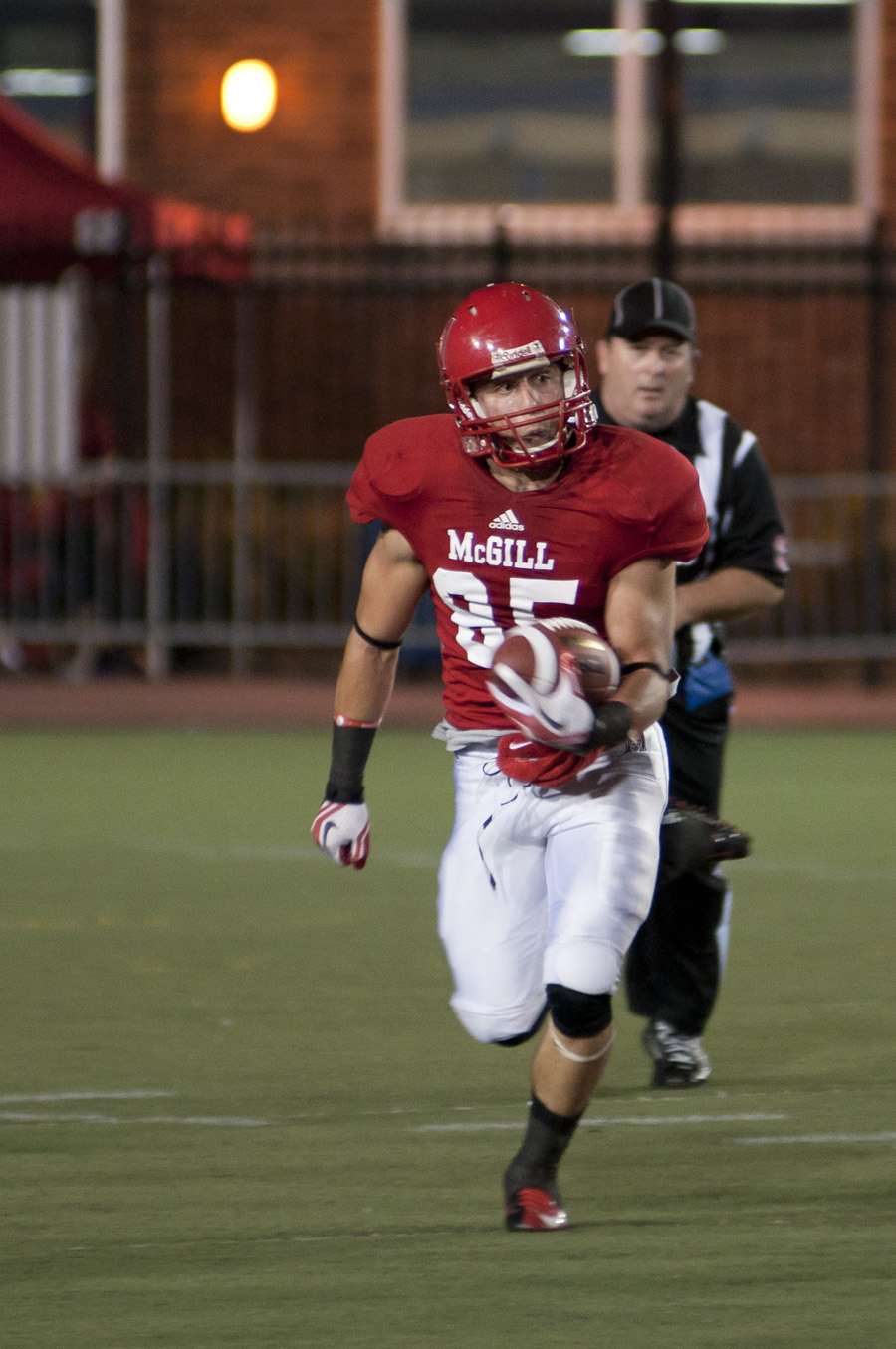
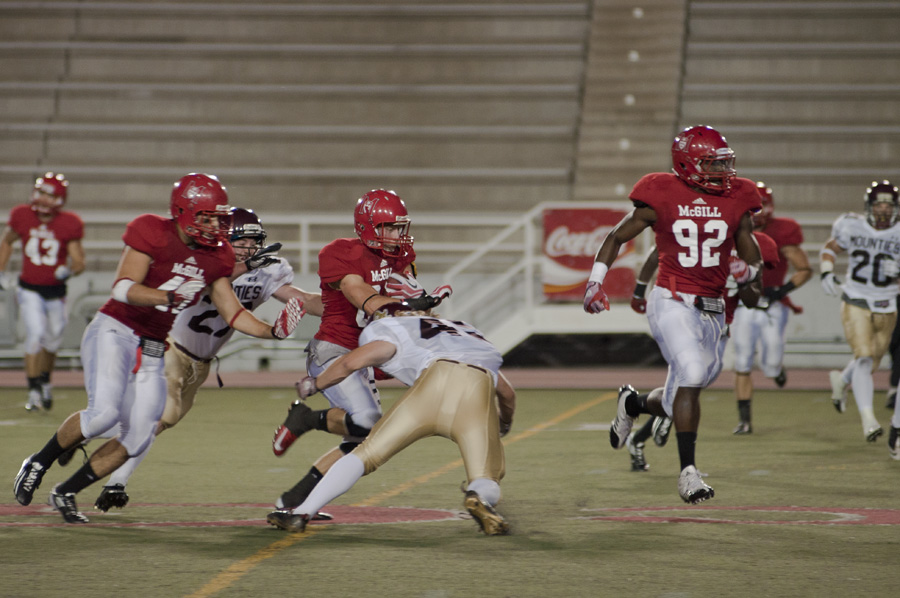
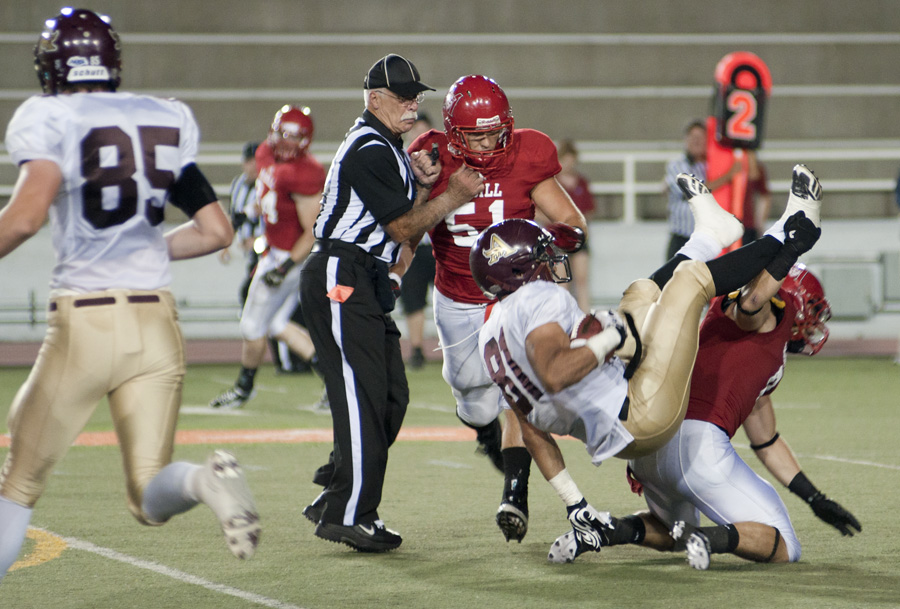
It’s been 1,077 days since the McGill Redmen’s last football win. That is two years, 11 months, and 11 days. Since then, the program has struggled to get back on its feet. New Head Coach Clint Uttley has tried to make the team tougher and practice harder. This extra work had not garnered any results on the field—until Friday night, when the Redmen (1-2) snapped their painful 23-game losing streak with a convincing 36-9 victory over the Mount Allison Mounties (0-2) at Molson Stadium in front of the “Fill the Stadium” crowd.

Post-game remarks indicated that Coach Uttley was pleased with the result, attributing much of the Redmen’s success to their execution on offence. “We had two really good weeks of practice, and we saw a good return on that investment,” Uttley said. “We really executed the offence for the first time [this] season.”

Much of the offensive struggles so far in the season have been a result of an unsettled quarterback position. Previously, both sophomore Dallon Kuprowski and junior Jonathan Collin have tried their hands at leading the Redmen’s offence but neither was able to generate much success. Fifth-year quarterback Ryne Bondy got the chance on Friday and took full advantage of it, leading the offence both in the air and on the ground. He completed 13 of 22 passes for 189 passing yards and three touchdowns, adding a game-high 69 rushing yards.  Tailbacks Luis Guimont-Mota and Taylor Kuprowski also contributed to the dominant ground game, combining for 120 rushing yards.

2,187 raucous fans came out to support the home team in the fifth annual “Fill The Stadium” game, and the Redmen repaid them early by scoring 35 points in the first half. Bondy and receiver Gabriel Aubry opened the scoring with a bang, connecting on a 59-yard touchdown pass. Bondy would then take the rock himself on the next drive—faking a handoff and then bouncing off a tackle on his way to an 8-yard scamper for the major bringing it to 14-0 McGill.

Amazingly, Bondy was not yet finished. He closed out the first quarter with a well-placed lob to Sean Murphy at the back of the end zone, giving the Redmen a 25-0 lead. That drive, like many others that night, was set up by a beautiful 48-yard punt return by Yannick Langelier-Vanasse. Coach Uttley praised his return man after the game.

“Yan has found his niche in the return game and he’s getting more comfortable each week,” Uttley said. “He has really exceeded expectations.”

In fact, the coach was pleased with his entire special teams unit, crediting the group’s success to a revamped coverage team comprised mostly of freshmen. He highlighted the athleticism of the unit as being instrumental in numerous one-on-one matchups in the return game.

As halftime approached, the weather broke and rain began to pour, causing a 12 minute stoppage in play. With the score heavily in McGill’s favour, many fans headed for the exits, while others took cover under the overhang of the upper deck. This weather contributed to a very sloppy second half. Jonathan Collin took over for Bondy, as the team planned to compare the two performances. Unfortunately, Collin had to battle with the unfavourable conditions and he struggled, throwing an interception early. In all, the Redmen turned the ball over three times in the second half and were penalized far too often, knocked for 140 yards on 12 infractions—more than Coach Uttley was hoping for. Uttley emphasized that cutting down on these mistakes will definitely be a focus moving forward.

McGill will have a much tougher opponent the next time out, when it hosts the No.3-ranked Laval Rouge-et-Or on Sept. 21. However, this victory will undoubtedly give the Redmen a confidence boost and something to build on going forward into the season.

a, Behind the Bench, Sports

Still in Armstrong’s Peloton

For the past 10 summers, I’ve had an odd July morning ritual. I wake up early and watch the Tour de France. What compels me to watch this low-tech version of NASCAR? One reason: Lance Armstrong and his inspiring story.

I was extremely saddened a few weeks ago when the United States Anti-Doping Agency (USADA) stripped Lance of his seven Tour de France titles, citing alleged instances of doping. Although most headlines posted that Lance had indeed lost all of his titles, it is still unclear whether the International Cycling Union (UCI) will actually go through with this drastic ruling.

The USADA was able to claim victory because Armstrong refused to challenge his case in court, saying that the USADA courts are a farce. While there is some legitimacy to this notion—for instance, the USADA uses standards of proof far below those of a regular American court—it is more likely that Armstrong knew that he would probably lose.

The USADA allegedly had testimonies from 10 former teammates and associates of Armstrong, all of whom claimed to have seen Armstrong participate in widespread doping. Most importantly, one of these 10 people was Armstrong’s right-hand man, George Hincapie. Unlike former accusers, such as Tyler Hamilton and Floyd Landis, Hincapie’s honesty is beyond repute.

Typically, I have little sympathy for dopers. However, there are several mitigating factors that I believe leave Lance’s accomplishments intact.

First of all, cycling is well known for its notorious drug culture. Miguel Indurian, winner of five Tour de France titles in the 1990’s, admitted to cheating after his retirement. Winners before Armstrong, such as Jan Ullrich, Bjarne Riis, and Marco Pantani, have also been caught for drug use. If Armstrong is included, that would make 15 straight winners of the Tour de France, from 1991-2005, drug cheats. Cycling’s current star and two-time winner, Alberto Contador, has also been caught for doping. The UCI cannot even give most second place finishers the title of winner, because they too have taken performance enhancers. Given these facts, it seems hard to indict Armstrong for doping in a race where everyone else was doping too.

Secondly, Armstrong won his titles as much through guile as he did with physicality. Armstrong was an incredibly skilled tactician, scoping out the course months in advance, putting in tons of repetitions on all of the key stages. His teams were always solely focused on Lance winning, whereas other teams were not. It is incredibly reductive to say Lance just won because he doped and not because of other  physical and mental factors.

Thirdly, while many imagine doping as having to do with steroids, the term has a much different meaning in cycling; although arguably, doping tactics in cycling are much more disturbing. Given the physical toll of a monthlong 3500-4000 race, cyclists take drugs to keep their blood oxygen levels at a high percentage to maintain their endurance. Thus, Lance would allegedly give himself blood transfusions of his own blood in an attempt to maintain his edge—seemingly a lesser form of doping.

Fourth, the USADA clearly has a vendetta against Armstrong, vigorously pursuing him before all others. When an agency does this, they bring themselves into disrepute.

Finally, it is hard to ignore that Lance Armstrong has raised hundreds of millions of dollars for cancer research and inspired thousands of people with his story.

For all these reasons, I will continue to support Lance, and confirm that those early mid-summer days were not a waste.

— Joshua Freedman

Read the latest issue

Read the latest issue