

Latest News

a, News

Initiative seeks to create city-wide policy on affordable and accessible student housing

A new initiative to study and develop affordable student housing in Montreal is gaining support from universities around the city.

After being approached by independent research organization L’Unité de travail pour l’implantation de logement étudiant (UTILE), the Students’ Society of McGill University (SSMU) has begun to take part in UTILE’s citywide initiative.

UTILE is a non-profit organization created in Jan. 2013 by students from Université du Québec à Montréal (UQAM), Université de Montréal (UdeM), and other Montreal universities. The organization is currently working on a project called Prospection des habitudes et aspirations résidentielles étudiantes (PHARE).

The purpose of the project is to collect data about student housing from a variety of universities in Montreal, with the intention of creating options for affordable student housing in the city.

“We created this non-profit because we realized that there’s absolutely no one that’s working on affordable student housing in Quebec,” Laurent Levesque, UTILE executive director, said. “One of the things we want to push forward is to record and have data on [the] Quebec student housing situation.”

According to SSMU Vice-President External Samuel Harris, UTILE initially approached SSMU and other student associations in the city in hopes of collaborating in data collection.

“There’s a lot of [data] about affordable housing, social housing—and those are very important—but [with] affordable student housing [….] a lot of advocacy and research has not been done,” Harris said. “There’s a lack of hard data, as opposed to anecdotal stories about the experiences of students.”

Similarly, the Concordia Student Union (CSU) also saw value in participating in this type of data collection.

“We’re very aware of the fact that housing is often a very serious concern for many students,” said Gene Marrow, CSU vice-president academic and representative for CSU in the PHARE initiative. “Through our Housing and Job Bank, which also acts as a sort of legal information clinic, we have the chance to learn about a lot of the individual situations facing students. However, without solid representative data, it is hard to dress a portrait of the average student at Concordia.”

On March 7, SSMU sent out a survey via email to a sample of SSMU members. It asked questions focused on the student’s current housing situations, factors considered when deciding on a new lease, and price ranges that are within the student’s budget.

“In April, we’ll have the data [and] what’s really exciting about this project is that the firm will produce the market […] for affordable student housing,” Levesque said.

After the data has been collected, UTILE and the student associations hope to use that information in order to develop student-housing policy. While a concrete policy has not been determined, the goal would be to ask the city to develop student housing policies that would make housing more affordable.

“We hope to publish this to make a case for the need for affordable student housing for Montreal , especially at a time where the need is recognized by private developers who are making luxury student housing in very high numbers,” Levesque said.

Levesque noted that the city has already expressed interest in the research.

“The city wanted to have more information on the student housing situation before going forward on the policy,” he said.

Alongside the current research initiative, UTILE is also looking for a location to build its first co-ops for student housing. Levesque said it will have 100 to 200 rooms, and construction will hopefully be completed by 2016.

“It’s already almost entirely funded […] from the government of Quebec, which created a pilot program [from] the Societé d’Habitation du Quebec (SHQ), which is funding our first building,” Levesque said. “Our project will be the first inside that program.”

Levesque explained that the co-op is just one example of the direction that UTILE hopes to take with this new concept of student housing. UTILE wants to create a more communal style of student living, with students from  different universities living together.

“We don’t want to only build student housing as we’ve been building [it] for 40 years,” said Levesque. “We think that it’s a great opportunity to rethink student housing and adapt it to the needs of students of the 21st century [….] The model we’re developing […] is based [on] communal living.”


a, Martlets, Men's Varsity, Sports

Sports briefs – Mar. 11

Basketball

The Martlets completed a three-peat on March 1, claiming their third consecutive RSEQ title with a 63-50 win over the UQAM Citadins. Leading the way was RSEQ Player-of-the-Year, Mariam Sylla, who recorded a double-double—her 10th of the season—with 22 points and 13 rebounds.

The game featured a strong defensive showing from the Martlets, who held their opponents to a mere 21.2 per cent from the floor and 28.6 per cent from outside the arc. Particularly dominant defensively was co-captain Hélène Bibeau, who earned six of her nine rebounds on her own in what was her final RSEQ game.

The championship win came after a 46-35 takedown of Laval the day before, in which senior guard Françoise Charest led the way with 15 points. Sylla also had a strong night, chipping in seven points and 13 rebounds which, along with her performance against UQAM, earned her RSEQ Athlete-of-the-Week honours.

With the RSEQ title in hand, the Martlets will move to the CIS Championship weekend, to be held in Windsor, Ontario from March 14-16. They enter the tournament having placed seventh and fifth in the past two years respectively, and will be looking to continue their rise by improving on their past results.

a, Arts & Entertainment, Music

The Fray—Helios

The Fray is back! Just over a year since releasing the commercially-successful Scars & Stories, the alternative rock band from Colorado have returned with their fourth—and ultimately, fairly predictable—studio album, Helios.

The first 10 seconds of the opening track “Hold My Hand” are as brilliant as anything they’ve previously released, highlighted by their signature irresistible piano-based sound. But at the 20-second mark, it changes. In comes an electronic undertone, pulsing and very much present—perhaps a new musical direction for this band? A pounding drumbeat follows, succeeded with an intricately designed guitar riff before the song climaxes with a massive choir-backed final chorus.

But nothing else on the album comes across as particularly different. From there on, Helios is a mix of up-tempo stadium fillers and subtler yet still catchy piano ballads. The Fray has delivered strong performances on each song: vocally, musically, and even lyrically. It’s clear that the songs are well produced, and Isaac Slade’s lead vocals are as brilliant as ever—but maybe that’s the downfall.

Songs like “Wherever This Goes” are good songs—easy to listen to, with a clear beat, and pleasing vocals. However, once it’s over, it’s over. There is no lasting impact. It’s the kind of song one hears, enjoys it, and then moves on, and it’s unfortunately the same with the album as a whole. Helios has its noteworthy moments; “Our Last Days” is truly a great song, but it suffers in the sense that realistically, it isn’t that far from anything The Fray have done before. While the faint electronic influence is present, and the band have clearly developed their sound into Five For Fighting territory, it is very much a typical Fray record.

a, Arts & Entertainment, Music

Spring—Celebrations

In listening to Celebrations by Sprïng, a band that self-identifies as a “psychedelic rock band,” it’s hard to determine whether the multifarious tracks are true exemplifications of intelligent prog-rock, or if they’re too distracted and overdone to make a serious impression.

Although the latter may be true for the average, one-time listener, those with a keen ear and taste for a more unorthodox, experimental style might notice that the band’s credentials do impress. The Vancouver- based bunch more or less morphed from the band SSRIs—a highly acclaimed, prog-punk group, which made waves in the scene for more than five years. Sprïng features a handful of talented musicians and composers. Many of the group’s sonic experiments do contain praiseworthy elements: expert finger picking, complex, perpetually changing time signatures, and incredible layering of major and minor harmonies. However, these virtues somehow fall short of coalescing into an enjoyable, meaningful listening experience.

When SSRIs rebirthed as Sprïng, they certainly matured; the over-processed electronics and keyboard use in SSRIs’s album Effeminate Godzilla Sized Windchimes, has been replaced with softer vocal harmonies and intricate acoustic instrumentals in Celebrations. It’s reminiscent of a college kid coming back home for Christmas break and wondering why he or she was ever so rebellious in high school. However, this kid still gets mad when mom and dad impose a curfew on Friday night—the sporadic, head-banging, electric guitar riffs are more annoying than pensive.

Too ‘angst-y’ to really settle on a concrete sound, Sprïng flits back and forth between a palatable, more traditional indie groove (similar to Fleet Foxes or Belle and Sebastian), a pop ‘60s British psychedelic feel (like Magical Mystery Tour at some points), and a good amount of cumbersome, ambient babbling. Interesting in its own right, I wish Sprïng the best in honing its diverse abilities into a more clear-cut niche

a, Creative

Montreal en lumiere

a, Arts & Entertainment, Film and TV

Keeping up with The Americans

*Spoiler alert!* It is unsurprising that in a time when American politics have reached new levels of dysfunction, Hollywood has capitalized on it by pumping out political dramas left, right, and centre. Hit series such as Scandal and House of Cards focus squarely on the inner workings of Washington politics: the backroom dealings, the power players, and their litany of flaws. The Americans, on the other hand, opts to take a different look into the world of political theatre through the lens of the American Dream.

Using characters who are KGB undercover agents and FBI G-men, The Americans—like most television shows worth watching—chooses to focus on the human condition. Dead drops, dead ends, and dead spies are only a way to examine relationships between people and consequently, the show allows viewers to empathize with people who are just like them. At times during the first season, it didn’t matter who the incognito Jennings family were or what they actually did. All  that mattered was that they were a married couple struggling to make the most of a life that was planned out for them in the Moscow Politburo.

The second season begins slowly, with Elizabeth (Keri Russell) emerging from her gunshot wound-induced slumber in the middle of the woods. As she comes home to her family, the viewers realize that two to three months have passed by. Now that Phil and Elizabeth’s marriage has stabilized, the focus shifts to their ability to raise a family. Their teenage children, Paige (Holly Taylor) and Henry (Keidrich Sellati), are growing up and growing curious. At the end of last season, Paige was seen heading downstairs to see her mother emerging from the laundry room in the middle of the night. The teenager’s naivety wears away as she begins questioning her parents’ guidance, routinely sneaking around to learn more about the secrets her parents keep from her. However, this backfires on Paige as she walks in on her parents rekindling their love, a situation which requires a family meeting to weather the fallout.

Also of note is the brief introduction of another family to the fold, albeit only for one episode. The family, whose parents are spy friends of Phil (Matthew Rhys) offers an interesting parallel to the Jennings’. At an amusement park in old town Alexandria, the two families are seen in a peaceful and tranquil state, simply enjoying a quiet weekend away from it all. The serenity is ominous as Phil later walks into their hotel room to find that family brutally murdered—a sign that despite how quiet or peaceful things may seem, danger is always lurking.

Thus far, the show hasn’t introduced any major new characters; and even more interestingly, Claudia, (Margo Martindale), who acted as the Jennings’ constant thorn-in-the-side handler, has been nonexistent. It will be interesting to see how she reintroduces herself to their lives as the tension between Moscow and the Directorate S operatives rises.

Also of interest is the development of the relationship between Nina (Annet Mahendru) and Agent Beeman (Noah Emmerich). So far, Nina has fully embraced the role of being a triple agent and it is clear that she has Beeman in the palm of her hands. If she is able to continue to manipulate her former lover, it will be a great favour to the cause, but I won’t be surprised if Agent Beeman—who so powerfully controlled the narrative of the first season—returns.

The most important plotline to follow coming up will be how each of the characters gains or relinquishes the trust of their fellow characters. In a world where victories are measured by economic resources, scientific progress, and the number of nuclear weapons a given side has, simple characteristics become the most powerful bargaining tool any character in The Americans has. Simply put, trust is scarce, and finding someone to trust is nearly impossible. The sooner everyone begins operating under the philosophy that they can trust no one, the safer—and more paranoid—they will be.

a, Recipes, Student Life

Salted Caramel Bread Pudding

Ingredients

¾ cup granulated sugar

6 tbsp unsalted butter

3 pinches coarse salt

12 ounce loaf challah bread, cut into ½ inch slices

8 large eggs

1 cup 2% milk

¼ cup crème fraiche, plus ¾ cups to serve

¼ tsp vanilla extract

Night before

1. To make caramel, in a small saucepan heat sugar, butter, and salt on medium heat for 8 minutes or until sugar begins to brown.

2. Reduce heat to medium low and stir, mixing sugar and butter together until the caramel is a copper colour.

3. Pour the caramel into a casserole dish and tilt to just coat a bit of the sides of the dish.

4. Place dish in refrigerator for 30 min to allow caramel to solidify.

5. Remove dish once cooled and assemble bread within dish in an overlapping, circular fashion.

6. In a small bowl, combine 1 cup milk and ¼ cup crème fraiche.

7. In a large bowl whisk together eggs and the milk- crème fraiche mixture. Once smooth, add vanilla extract.

8. Pour mixture over the bread, ensuring all bread is soaked.

9. Cover tightly with plastic wrap and chill in refrigerator overnight.

Morning

1. Preheat oven to 375°F.

2. Unwrap dish and bake for roughly 30 minutes or until centre is no longer wet, but still moist.

3. Cut around the edges of the dish, place a serving plate on top of dish, and flip pudding onto serving plate.

4. Serve pudding with the crème fraiche that was set aside.

a, McGill, News

Qualitative vs. quantitative: A look at McGill’s admissions policy

While academic grades were once seen as the only standard for analyzing a student’s ability for admissions, this stance is changing for many in today’s society.

McGill is sometimes criticized for being too “grade-centric” with their admissions process, as many programs at McGill only consider transcripts for admission.

Other universities in Canada, such as Queen’s University and the University of British Columbia, have adopted a more qualitative admission system that considers factors such as essays, recommendations, and extra-curricular engagement.

“Grades have become a measure of what you’ve memorized, not what you’ve learned,” Arielle VanInderstine, U0 Arts and Science, said. “McGill should adopt a more qualitative system of admissions to encourage bright young learners and thinkers, not test-takers.”

Kim Bartlett, one of several directors of admission, is responsible for undergraduate admissions in several faculties, including Arts, Engineering, and Management. She emphasized that admissions policies at McGill are different depending on faculty; for example, Medicine and Dentistry require an interview process.

Bartlett said the university’s values drive its admission policies.

“The central concepts are the idea[s] that admission is competitive and based on proven academic performance,” Bartlett said. “Competitive means that there is no prior decision about who gets in; we want the best candidates for the spaces. The [latter means] grades or test scores on the transcript, not about what your potential could be but what you have done.”

However, some students question this rationale.

“It’s important for a university to choose people who are not only good at testing and writing exams but who also have intellectual depth,” Sarah Nafisa Shahid, U1 Arts, said. “You don’t want to admit student[s] who are just good at writing exams [….] You want the next Bill Gates or Zuckerberg to be in your alumnus.”

While grades do not capture the whole story, Bartlett said qualitative admissions can also be problematic. When admissions require students to have community engagement, they have to be really careful that they do facilitate the exclusion of some groups.

“In many cases, we have students of lower socio-economic levels who are not able to participate in extracurricular activities because they are working, and they need to work to support their families,” she said. “In some cultures volunteerism is just not part of the mainstream, [while] in places like the U.S. it is really prevalent.”

Mila Ghorayeb, U1 Arts and Science, said admissions based on grades are the most fair to everyone.

“Grades are more objective whereas qualitative measures such as how much one volunteers comes down to a matter of opinion,” Ghorayeb said.

Student opinion on the topic appears to be divided.

“I strongly dislike writing application essays and talking about myself; I’m not very good at it,” Ilias Hurley, U0 Engineering, said. “I would really dislike having my getting into McGill depend on an essay. Judging by the people I’ve met. At McGill the admissions system is at a good level.”

Others have argued that qualitative measures would contribute towards a more cohesive and active community on campus.

“Some people are more orientated towards academics while others focus on extracurricular,” Céline Garandeau, U1 Science, said. “Allowing a qualitative system will hopefully result in a more well-rounded student body.”

Bartlett emphasized that changes are not currently under consideration by the Senate. Change in admissions policies are made at the faculty level.

a, Student Life, Student of the Week

Student of the week: Alexander Langer

Always interested in human rights, Alexander Langer worked as an intern last summer at the Roma Community Centre in Toronto, an organization serving the Roma community across Canada. The organization provides assistance including education, settlements, and legal services.

Langer says he appreciates the work that organizations like the centre do to promote human rights.

“Society is judged on how we treat vulnerable people, especially asylum seekers and refugees,” he says. “They crawl out of poverty, they lift themselves out [by] their bootstraps, and I think it is invaluable for society to encourage them to do so.”

He tells the story of a friend from Hungary, who is a refugee in Canada. As a Roma, he faced persecution in his homeland—he was spit on, fired from jobs for no reason, and threatened—and his family came to Canada to build a better life.

After the friend volunteered at the community centre, the organization helped his family find a sponsor and navigate their way through the refugee system. Now with the help of humanitarian workers, his friend is able to put his past behind him and start anew.

Langer believes he had a tangible impact at the organization. Witnessing the impact of the organization on individual lives has influenced his outlook on the time he spends in the classroom.

“I felt like I managed to concretely accomplish things [at the community center],” Langer says. “I love the university, but a lot of times it seems like it doesn’t really matter to the actual world.”

As the chair of exhibition debates with the McGill Debating Union, Langer has managed to combine his enthusiasm for advocacy work with his involvement in the McGill community. He organizes events that attempt to foster discourse on critical world issues, including an upcoming debate on March 13 to discuss freedom of speech and hate speech.

Given his political science major and his commitment to human rights, Langer says he has considered a future in politics.

“I think if I were to get involved in politics, […] it would be working policy,” Langer says. “I would struggle to contain my out-there views—I am socially libertarian. I would struggle to make the compromises necessary to be an elected official.”

The main point Langer wishes to impart to McGill students is that to make a difference, you have to take real action.

“The disadvantage of [studying in university is] we aren’t actually doing anything,” he says. “A lot of kids on campus sit around and talk critical theory, but they are scared to get out and get their hands dirty. They are afraid of having to swallow [that] the world isn’t like university.

If you want change, you can’t just sit around; you have to get out there and do something and engage with the world as it is.”

McGill Tribune: What is your biggest pet peeve?

Alexander Langer: People walking slowly on the sidewalk right in the middle so no one can get around them.

MT: Salty or sweet?

AL: Salty—sweet is kind of sickly.

MT: Favourite pizza slice?

AL: Chicken with goat cheese, sundried tomatoes, and mushrooms.

MT: If you were stranded on a desert island, what one item would you bring?

AL: Maybe The Lord of the Rings—I could finally get through it. Practically, there are lots of things I would want, but if I could only bring one, I don’t need to be practical. I am going to die at some point.

MT: What makes you the happiest?

AL: Spending time with my family—especially my niece and nephew.

MT: If you could travel to one country, where would you go and why?

AL: This is difficult, but it would be Spain. Three words of explication—sun, wine, and fish.

a, Martlets, Sports

Hockey: Martlets fall short in RSEQ; set sights on Nationals

Led by two goals and an assist from team captain Kim Deschenes, the no. 1 ranked Montreal Carabins toppled McGill 6-3 on Saturday to take home the RSEQ women’s hockey championship. Despite winning the first game of the best-of-three series, the Martlets were unable to seal the deal, as the Carabins escaped two must-win games to capture the Dr. Ed Enos Cup.

The Martlet squad looked dominant in the first frame of Saturday’s contest, controlling the puck and out-skating its opponents on both ends of the ice. However, with less than five minutes remaining in the first, freshman forward Jordan McDonnell was called for a bodychecking call that would prove to be costly for McGill.

Slicing through the exhausted Martlet penalty kill, Montreal’s Deschenes needed only a few seconds to get open outside the McGill crease and tap in a perfect feed from Carabins teammate Janique Duval.  Deschenes would later add what proved to be the winning goal on an assisted play three minutes into the second period.

Trailing by three goals with the minutes winding down in the final period, McDonnell got the home crowd back on its feet with a slapshot that found the back of the Montreal net to make the score 5-3. With McConnell Arena beginning to rumble for the first time since the second period, Martlet Head Coach Peter Smith pulled the team’s goalie to put McGill a player up. However, the Carabins would put the game away with an empty netter shortly thereafter.

Despite outshooting Montreal 45-24, the Martlets were undone by a sloppy second period in which they failed to convert on three power plays, including a crucial 5-on-3 opportunity. Montreal goaltender Elodie Rousseau-Sirois was spectacular, making 42 saves on the night to keep her team alive.

“We had a lot of shots on goal and we couldn’t find the back of the net, so you have to give [Rousseau-Sirois] a lot of credit,” Smith said.

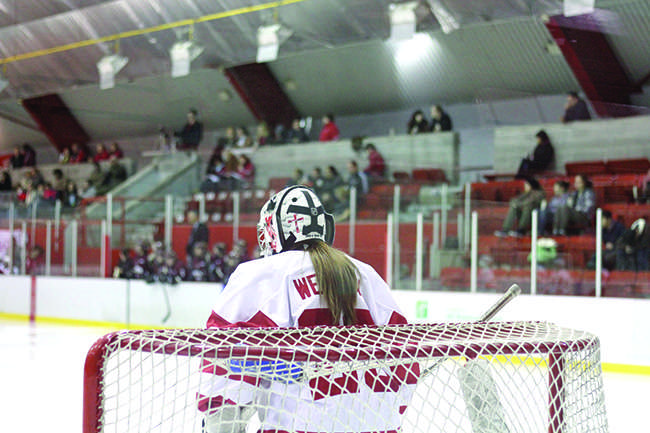
Meanwhile, Martlet goalie Andrea Weckman had an uncharacteristically quiet game on Saturday.

Weckman, who was pulled late in the second period after letting in four goals on 23 shots, suffered only her second defeat in what has been an otherwise impressive season. The four goals—the most allowed by Weckman in any game this season— pushed her goals against average up to 1.25 on the year, still good for no. 1 in the league.

Sophomore Taylor Hough replaced Weckman to finish the game, limiting Montreal to one goal on nine shots over the remaining 23 minutes.

Leading the way once again for the team was senior forward, Katia Clement-Heydra, the heroine of Game 1 of the series and RSEQ Player-of-the-Year, chipped in a goal and an assist in McGill’s last game of the season, which proved too little too late as her team fell just short of bringing home the  conference championship.

“[Clement-Heydra] has grown tremendously,” Smith said. “She’s gotten better every year, but the leap this year was huge [….] She came back in September and worked real hard to get fit and gain confidence, and it’s made a huge difference in her game.”

The season, however, is far from over for the Martlets. Despite the loss, they will travel to Fredericton to compete in the CIS Championship, which will take place from March 13-16. Though the team qualified for the tournament on a wildcard berth, Smith and the Martlets are undaunted by the challenge they will face in the championships.

“We would have like to go out riding on a win, but we’ve put that aside,” Smith said. “We’re a team that learns from our mistakes, and I think our team has gotten better with every speed bump we’ve hit.”

Read the latest issue

Read the latest issue