With Valentine’s Day just around the corner, it’s time to think about a way to impress that special someone. They say the way to someone’s heart is through their stomach, so why not give a home-cooked meal a try? Not a master chef? Not a problem! Here are some easy to follow recipes for a three-course meal that is sure to impress.
Appetizer
Raspberry goat cheese salad with caramelized pecans
A red and white, sweet and fruity Valentine’s Day inspired salad.
Ingredients:
2 tbsp butter
1 cup halved pecans
2 tbsp packed brown sugar
3 cups spinach
½ cup goat cheese
1 cup raspberries
2 tbsp olive oil
1 tbsp balsamic vinaigrette
Instructions:
1. In a small pan, melt butter.
2. Add pecans and brown sugar. Stir continuously over low heat for 3-5 minutes, until all sugar is dissolved.
3. Transfer pecans onto a baking tray lined with parchment paper and leave to cool for 20 minutes.
4. Toss spinach, goat cheese, and raspberries together with olive oil and balsamic vinaigrette.
5. Top with pecans.
Lamb chop (blogspot.com)
Main Course
Lamb chops with Parmesan asparagus and rosemary potatoes
This meal incorporates sophisticated flavours, yet is simple to prepare.
2. Cover with thyme, olive oil, and chopped garlic. Place in fridge for four hours.
3. In a large pan, sear lamb chops on high heat in olive oil for three to five minutes on each side.
4. Add salt and pepper as desired.
Parmesan asparagus
Ingredients:
1 bunch green asparagus
½ cup grated Parmesan
2 tbsp olive oil
Instructions:
1. Preheat oven to 375o F.
2. Wash asparagus and remove about 1.5 inches from the bottom of the stems.
3. Place asparagus in oven-safe dish and toss with Parmesan cheese and olive oil.
4. Cook for 20 minutes.
Rosemary potatoes
Ingredients:
1 bunch rosemary
10 small potatoes
2 tbsp olive oil
Salt and pepper
Instructions:
1. Preheat oven to 375o F.
2. Halve potatoes and top with olive oil, rosemary, salt, and pepper.
3. Cook for 40 minutes in oven-safe dish.
Cupcakes
Dessert
Chocolate brownie cupcakes
Chewy, gooey, warm brownie cupcakes, served with strawberries and vanilla ice cream.
Ingredients:
3 eggs
100 g milk chocolate
200 g bittersweet chocolate
2/3 cup salted butter
1 cup packed brown sugar
1¼ cup all-purpose flour
½ tbsp baking powder
1 cup strawberries or raspberries
Vanilla ice cream
Baking cups (cupcake liners)
Instructions:
1. Preheat oven to 375o F.
2. Line 12-cup muffin pan with baking cups.
3. Melt chocolate and butter over low heat, stirring until smooth.
4. In a large bowl, beat together sugar and eggs until creamy.
5. Sift flour and baking powder into batter.
6. Stir in chocolate.
7. Fill baking cups approximately three-quarters full with batter.
8. Bake for 12 minutes.
9. Let brownies cool for 10 minutes.
10. Serve with strawberries and vanilla ice cream.
With a mere two weeks remaining before the RSEQ playoffs, the McGill Martlets (10-2) squeezed by the UQAM Citadins (7-5) in a 62-56 statement win Thursday evening at Love Competition Hall.
The victory—the Martlets’ ninth of the season—saw the return of starting point-guard Francoise Charest, who had missed two weeks due to a lower-body injury. McGill followed up Thursday’s performance with a 65-56 win at UQAM on Saturday, gaining a narrow two-point lead atop the conference ahead of the second-place Concordia Stingers.
Contrary to their normally dominant starts, the Martlets looked lost out of the gate as UQAM shot a blistering 56.25 per cent in the first-quarter. The Citadins attacked early on, swinging the ball for open shots and punishing McGill on defence. The Martlets had no answers for UQAM as the visitors closed out the first-quarter with an 11-point lead.
“They had 24 points in the first-quarter,” said Head Coach Ryan Thorne. “We were a little taken aback [by their full-court attack.] It’s hard to prepare for their pressure—they’re really good at it. So I think we were a little tentative early to start.”
The Martlets were plagued by a pesky UQAM defence whenever they had the ball in their hands. Sophomore forward Mariam Sylla was frequently taken out of the action by the Citadins’ Jessica Lubin, forcing her to look for the other Martlets on offence. Sylla finished the half with an uncharacteristic five points on 1-5 shooting from the field. As a result, McGill went into the locker room with a nine-point deficit: 34-25.
“[Lubin] is really athletic and she’s good in the post, and I know that she’s a really good rebounder also,” Sylla said. “My goal was not to always try and find a way to score on her because I knew the help was coming. So I was just there to make my teammates contribute as much as possible when they came to double me.”
A markedly different team started the third quarter. Charest had been out for two weeks and looked noticeably rusty in the first-half, but soon began to dictate the pace of the offence as she settled into the flow of the game.
“The past two weeks have been hard because I wasn’t playing, but I practiced this week and I felt great,” Charest said. “There was not [as much] pain, so I felt ready for the game.”
Thorne and Charest have been together for five years now, and Thorne’s reliance on her ability to run the Martlet offence is obvious.
“[Charest] is our team leader [and] the quarterback of [our] team,” Thorne said. “She controls the pace. The girls feel more confident when she’s on the floor with them. And as the coach, you feel more confident knowing you’ve got your team leader out there. She’s an extension of me.”
The Martlets managed to close out the third-quarter on a 4-0 run, entering the fourth frame with a narrow 45-43 advantage. Charest netted two three-pointers to start the last quarter, and McGill proceeded to finish the game on top, 62-56.
If the Martlets are to make a run at one more RSEQ Championship, they must learn to adjust when Sylla is shut-down on offence—as she was in the first half of the contest against UQAM Thursday evening.
Thorne acknowledged the issue after the game.
“No matter what, we’re still going to play through Mariam,” Thorne said. “We’re going to play inside-out. People are going to collapse, help off her, and then we’re going to get good opportunities on the perimeter.”
The Martlets have four games remaining on their schedule before the RSEQ playoffs. Their next game will be on Thursday, Feb. 13 at 6:00 p.m. against the Laval Rouge et Or at Love Competition Hall.
In the past few years, debate has raged over the Keystone XL project, a 1,897 km pipeline between the tar sands in Alberta and Nebraska, in the U.S. While many have opposed the pipeline, largely on environmental grounds, a new report has been released by the U.S. State Department concluding that the pipeline would create a minimal increase to carbon emissions. Despite the nine-year-long debate over the pipeline, it is a decision that ultimately falls to U.S. President Barack Obama, as Canada has been in full-support since the beginning. However, even given the supposed short-term benefits, the environmental impact of the pipeline must be taken into account.
At first glance, there seems to be a compelling case for the pipeline. One argument put forth is that this pipeline would further reduce American reliance on the Middle East for oil. Another point is that the oil would still be extracted from the tar sands; the pipeline would simply make extraction an easier process. Furthermore, proponents argue, if the pipeline wasn’t built, railroads would instead take the bulk of oil, most likely transporting it to the same location, just in a less timely and safe fashion. Such an argument would seem to negate claims of environmental harm—the oil’s going somewhere anyway.
However, perhaps the most convincing argument for the pipeline is the alleged benefit to the economy. The State Department’s report claimed that 2,000 temporary jobs would be created for two years and then, once the project is completed, the pipeline could potentially support 40,000 permanent jobs. With unemployment in the U.S. still elevated, this type of economic opportunity is tempting even when accepting negative environmental consequences. For these reasons, the general belief is that Obama will approve the pipeline.
While these reasons for agreeing to the XL Pipeline seem legitimate, they overlook major problems. The State Department’s finding that carbon emissions would not be largely affected is based on the assumption that the oil extraction would occur either way. This assumption is not necessarily true, as shown by an executive of Cenovus Energy, another company involved in the oil sands, who reportedly said, “If there were no more pipeline expansions, I would have to slow down.” This slow down in extraction would benefit the environment overall. There would be fewer carbon emissions as well as a stronger push for alternative energy sources with oil not as readily available. While our reliance on oil will remain for many years, making access easier will only lengthen the process towards cleaner energy. Railroads would be used in place of the pipeline, but that is more laborious, and thus, production would slow. Additionally, potential investors may be less willing to invest if there does not seem to be any progress with oil exploration.
While it is true that jobs would increase with the pipeline installation, there is a question of what we value: job security now or the security of our planet later? We need to look to the future, because the repercussions are great, and the impact not easily reversed.
This sensation from New Zealand has made no shortage of headlines; however this song, embedded in her re-issue, Pure Heroine – Extended, remains relatively unknown. Singing over a smooth, pulsing beat with an unusually simple organ in the background, Lorde reinforces why she’s here: her relatability. “If being afraid is a crime, we hang side by side.”
Girls Like You
Artist: The Naked And Famous
Album: Passive Me, Aggressive You
Released: September 6, 2010
From the get-go, the track’s muted yet racing beat and whispered lyrics, which are followed by sudden heavy drums, climax in an epic chorus which cleverly warns—from a detached perspective—that negative actions result in negative consequences. However, the lyrics clearly don’t match the quality of the song: It’s all positive.
Long Highway
Artist: The Jezabels
Album: Prisoner
Released: September 16, 2011
The galloping beat and distant guitar strumming creates a final sound that echoes the song’s lyrical content: “Mesmerizing [….] Paralyzing [.…] (and) something you can feel.” It’s absolutely fantastic.
Au Pair
Artist: Underground Lovers
Album:Weekend
Released: April 5, 2013
A brilliant song from a lauded alternative band. There’s no denying the awesome guitar riff, so with its quirky beat and simple vocals, your foot will be tapping within the first 10 seconds.
For 43 consecutive games against RSEQ opponents, the CIS no. 1 ranked Martlet ice hockey team emerged victorious. Many of those wins have been blowouts, but on Friday the tables were turned as their streak was snapped by the no. 2 ranked Montreal Carabins in a 5-1 loss. Like most other Martlet games, the team snatched the lead early when Brittney Fouracres converted a power-play goal five minutes into the first period. However, by the end of the second frame, the Carabins had flipped the script and taken a 2-1 lead on the strength of their own special teams play. The final stanza featured three more goals to put the game out of reach. McGill dominated the shot total 34-21, but sophomore goaltender Taylor Hough was unable to replace standout fifth-year senior Andrea Weckman.
On Sunday, with Weckman back in net, the Martlets returned to form, blowing out the Concordia Stingers by a score of 6-2. Sophomore winger Gabrielle Davidson—who was uncharacteristically shut out against the Carabins—tallied a hat-trick, bringing her goal total to 28 and tying the CIS season record. Alternate captain, Katia Clement-Heydra chipped in with two assists to bring her points total to 39, third in the CIS. McGill’s final game of the regular season is a rematch against the Carabins. The game between the two powerhouse squads will be held at McConnell Arena on Saturday, Feb. 15 at 7:00 p.m.
Track and Field
The McGill track and field program made its way south of the border to The Armory in New York City, New York for the annual Armory Collegiate invitational meet. The meet brought together more than 100 universities and colleges from across North America with the Redmen and Martlets facing their stiffest test to date. Although no McGill athletes won medals, a few standouts emerged; Scott Hancock, a triple jumper and a hurdler, posted a mark of 14.16m in the triple jump to secure a spot at the CIS nationals. Hancock produced two more top 10 finishes at the meet, finishing eighth in both the 60m dash (8:42) and the 60m hurdles (8:48). The Redmen 4x200m relay team also fared well, finishing fourth with a time of 1:29.51. On the Martlets side, sophomore jumper Caroline Tanguay continued her excellent streak of performances with a 10th place finish in the high jump (1.69m). Also, sophomore long distance runner Alison Barwick finished eighth in the 3000m race (10:10.01). McGill’s athletes now return home for the Redmen Invitational to be held in the Tomlinson Field House on Saturday, Feb. 15.
Redmen Hockey
The last time that the McGill Redmen (20-5-2) won 20 games in the OUA East and made it to the CIS Championships, they came home with a University Cup as national champions.
On Friday, McGill won their 20th game of the year in dominant fashion against the UOIT Ridgebacks (7-16-4) by a score of 9-2. Sophomore winger Patrick Delisle-Houde led the way with a hat-trick and two assists while David Rose added one goal and four assists, and linemate Cedric McNicoll chipped in with two goals and three assists. Rookie netminder Jacob Gervais-Chouinard parried away shots with ease, tallying 30 saves.
The Redmen goaltenders have had the luxury of playing behind the second most productive offence in the nation, easing their job and relaxing the pressure for a tandem that has proven to be one of the best in the OUA. Delisle-Houde now also leads McGill’s balanced attack— 10 players have at least 20 points—in scoring with 36 points, narrowly edging out McNicoll, who has 34, and blueliner Ryan McKiernan who has 33 points. McGill is currently first in the meat-grinder that is the OUA East, with 42 points in 27 games. The team has one game remaining, a home tilt against Nipissing on Feb. 14 at 7:00 p.m. in McConnell Arena.
Swimming
At the start of this year there were doubts as to whether the McGill Redmen swimming team would be able to regroup after the loss of All-Canadian Steven Bielby. This past weekend at the RSEQ Championships in Sherbrooke, any shred of uncertainty that remained was erased. Senior sprinter Pierre-Alexandre Renaud snagged three golds and one silver medal, en route to being named Swimmer-of-the-Year, while three others were named to the All-Conference team. Renaud, a team captain, set an RSEQ record in the 200m butterfly (2:00.23) and also garnered gold medals in the 400m freestyle(3:55.24) and 4 x 200m freestyle relay (7:35.08).
On the Martlet side, the squad notched one gold, eight silvers, and nine bronze medals, giving the entire McGill program a combined 30 podium finishes. Katie Caldwell, last year’s Swimmer-of-the-Year as a rookie, captured the team’s sole gold medal in the 200 m IM(2:13.97). Most notable though was the fact that both the Redmen and the Martlets achieved their primary goal for the season, to finish second in the RSEQ.
Traditionally, swimming in Quebec is dominated by the Montreal Carabins, a program that hasn’t been unseated from the pinnacle since 1999. Following this weekend, McGill has qualified 20 swimmers for the CIS Championships to be held at the University of Toronto from Feb. 20 – 22. Look for Head Coach Peter Carpenter to push both teams to improve on their eighth place finishes from last year’s nationals.
To move forward, Jay Malinowski needed to look back. Not long before the Bedouin Soundclash frontman began working on Martel—the 18-track album that his current project, Jay Malinowski & The Deadcoast, releases today—the idea of such an ambitious venture seemed inconceivable based on his trajectory at the time.
“I was at a point in my life where I wasn’t sure if I was going to play music again,” Malinowski tells me somberly. “I just was not in a state of mind to do it anymore. That was about two-and-a-half, three years ago; I went back to Vancouver where my family lives, bought a place there, and sort of started to refigure my life.”
Moving closer to his family proved to be the the thing that helped suspend Malinowski’s musical hiatus, but it was an ancestor—not a living relative—that provided the spark he needed.
“All the choices that I’ve made in my life,” Malinowski begins. “Were they based on a grand set of historic circumstances and patterns that we have? [….] That’s when I started to think about the past, and to think about Charles Martel.”
Charles Martel isn’t your average family ancestor. As Malinowski family archives reveal, the young Huguenot witnessed the gruesome death of his mother in Lyon, which arose over religious differences. Later, he would escape France and fight alongside British General James Wolfe during the battle of Louisbourg in 1758. His most important legacy, however, is his patriarchal position as the first of a long line of globetrotting sailors.
That’s the impetus for Martel’s nautical theme. Malinowski divides the album into two nine-song halves titled “Pacific” and “Atlantic” and each track corresponds to a different port around the world, making the record a journey just as much as a collection of songs. Malinowski also has plans to release an accompanying novella called Skulls and Bones (Letters From A Sailor To A Long Lost Granddaughter) that he’s currently in the process of completing, though two chapters have already been pre-released.
The unique album format also lends itself well to experimentation with global and classical musical styles; this was something Malinowski had been hoping to do for a while when he recruited the Vancouver strings trio The End Tree to form The Deadcoast.
“I wanted to work with classical musicians because they have such a different background than what I was used to,” he explains. “[The End Tree] were aware of Bedouin but they were like ‘That’s not really what we do; we don’t do pop music.’ Then I told them ‘It’s not going to be pop music, it’ll just be this more dissonant stuff.’ And that really fit well with what the character of Martel is about; sort of old-world, but really rough around the edges.”
For many people—myself included—there’s a very different Martel that comes to mind in conjunction with the ocean.
“It’s funny, I think that must be a Montreal thing,” responds Malinowski when I bring up the coincidence. “Because I’ve heard it twice today and [Life of Pi author] Yann Martel is from Montreal.”
Although he grew up in Vancouver, Malinowski is originally from Montreal, and feels a definite attachment to the city. As it turns out, his birthplace happens to be the same place that Bedouin Soundclash’s biggest record was born.
“A lot of my history is based in Montreal personally,” he says. “The first label [Bedouin Soundclash was] ever on, Stomp Records, was here [….] “We recorded “When the Night Feels My Song” just down on Rachel and St. Laurent.”
Given the way that Malinowski has branched out musically, I wouldn’t have been surprised if he didn’t plan on returning to Bedouin Soundclash after Martel—but he quickly assured me otherwise.
“I always go back because it’s my first love, you know, Bedouin,” Malinowski says. “We just wanted to take a break for a bit and recalibrate, but we’ll definitely be doing something.”
While the Olympics often garner attention as a series of events showcasing determination, hard work, and perseverance, there is a dark side associated with the Games: the abuse of performance enhancing drugs (PEDs).
PEDs have long been connected to the Olympics. As far back as the first games in ancient Greece, athletes attempted to boost testosterone by eating sheep testicles and extracts of mushrooms and plant seeds. Today, their use is still widely prevalent, although the World Anti-Doping Agency (WADA) tries its best to maintain fair play in competition.
“It would be naïve to think that all athletes […] are clean,” said David Howman, the WADA director general.
While there is pressure on athletes to bring home gold medals, PED use brings with it potential side-effects, the disgrace if caught, and the risk of dependency.
Amphetamines:
Often nicknamed “black beauties”, these drugs are stimulants which release excitatory neurotransmitters such as dopamine that stimulate the central nervous system. Their purpose is to boost individuals’ energy levels while inducing feelings of power and reducing fatigue. However, their use often distorts the users’ sense of reality, and in athletes’ cases, it may cause them to compete even when injured. Worse, these drugs are related to many adverse effects including convulsions, insomnia, hallucinations, paranoia, nerve damage, and potentially death due to blood vessel ruptures.
The production of amphetamines began in the 1930s and their use spread shortly after. Tragically, Danish athlete Knut Jensen collapsed at the Rome Olympics in 1960 after using amphetamines. He died soon after, causing the International Olympic Committee to form a medical committee and establish drug testing for future Games.
Diuretics:
Diuretics are often prescribed to induce urination and are used to treat several disorders such as kidney diseases, high blood pressure, and heart failure. However, they are also commonly used by people suffering from eating disorders as it provokes weight loss, and by athletes right before being tested for drugs.
Taken orally or injected, the drugs’ sole purpose for athletes is to act as a masking agent. In other words, they remove or dilute enhancing drugs such as steroids out of the body by increasing urine volume. Some adverse effects include hypovolemia—decreased blood volume—and metabolic acidosis—high blood acidity leading to potential risks of cardiac arrhythmias, coma, or death.
Gymnast Luiza Galiulina of Uzbekistan tested positive for a diuretic substance (furosemide) in the 2012 London Olympics, and was banned from competing for two years. Runner Mariem Alaoui Selsoui of Morocco also tested positive for the same substance in the 2012 Games, after already having gone through a two-year suspension between 2009 and 2011 for using erythropoietin.
Erythropoietin (EPO):
EPO first emerged in 1987 as a way of boosting blood thickness. The drug is a peptide hormone that stimulates red blood cell production from the bone marrow, and is prescribed to treat anemia (due to kidney disease).
Athletes’ interest in it, however, comes from the fact that EPO improves endurance by enhancing oxygen delivery to muscles. Abnormally high red cell count leads to reduced blood flow—due to the increased thickness—which is linked to risks of stroke, heart disease, and thrombosis (blood clot).
A test to identify EPO was introduced in the 2000 Games. Past users in the Olympics include 2012 race walker Alex Schwazer of Italy, who was subsequently disqualified after having tested positive.
Various other enhancers derived from anabolic steroids, such as nandrolone to ephedrine, have also been used by athletes despite dire consequences. To date, advances in technology have resulted in the creation of new drugs, including gene doping—when specific mutations are created to improve athletic performance. Therefore, anti-doping agencies have to be consistently updating their testing methods and banned substances list. Even before the Olympic opening ceremony in Sochi, Russian biathlete Irina Starykh, along with two other biathletes, tested positive for doping violation; Starykh has since then withdrawn from the Sochi Olympics. The next two weeks will be revealing as to the pressure of the Games and whether athletes succumb to drug abuse.
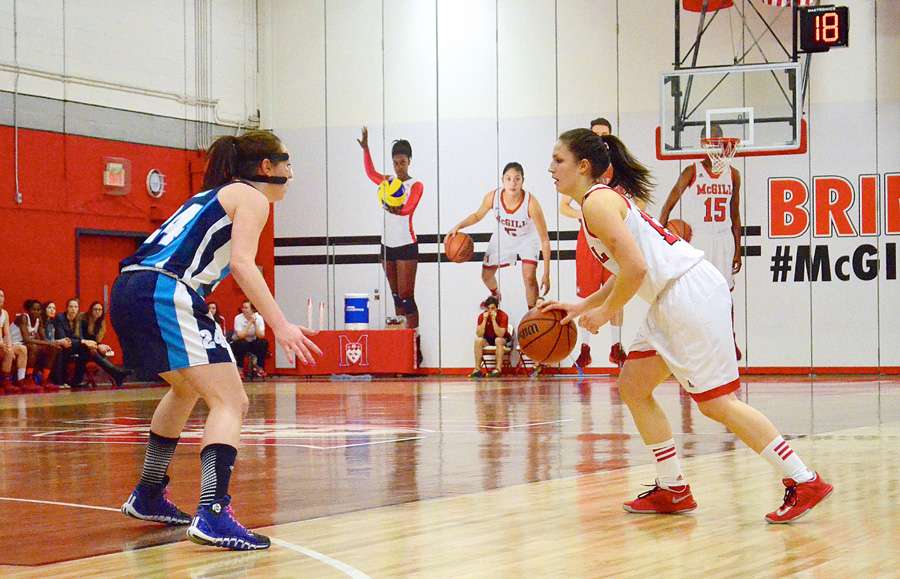
She catches the ball in her shooting pocket, both feet already squared towards the basket. In one smooth motion she elevates off the ground, the ball released before her defender can close the space between them. The only thing more pleasing than the textbook follow-through is the splash of the net as the basketball drops through the rim—her fourth three-pointer of the night. One hour later her brother catches the ball in the same spot, netting his own three in much the same way. Their shooting forms are nearly indistinguishable, developed through a childhood of basketball together.
Identical noises echo throughout Love Competition Hall in both contests: the squeak of sneakers on the newly polished court, the grunts under the rim, and the rhythmic pounding of leather on the hardwood. These are the sounds of the game the siblings have loved since they were little—the same game that has made them inseparable through the years, regardless of the distance between them.
_______________
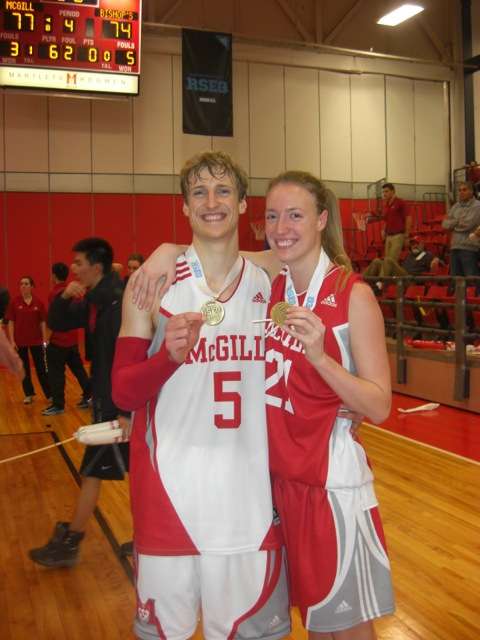
Simon Bibeau sits down, shedding his backpack with a sigh of relief. Standing an easy 6’2”, clean shaven with an unkempt sweep of hair, it can be easy to forget that he is a student first, and athlete second. Sitting next to him is his sister Hélène, two and a half years his senior, a neat ponytail of blond hair tied back behind a friendly smile. Both Bibeaus possess a sense of controlled confidence, complemented with a humbleness that belies their ability on the basketball court.
The siblings have stated that this will be their last season representing McGill—Hélène is playing out her last year of CIS eligibility, and Simon, an investment management major, is looking to get a jump on his life after basketball.
Born in St. Bruno, Quebec, the Bibeau siblings were raised abroad, with stops in Morocco, Uruguay, and Mexico. When Simon was five years old, his father installed a basket hoop on top of his bedroom door, where he practiced his shot as often as he could.
“[My father] told me that my eyes lit up—I was very excited when I first touched a basketball,” he recalls.
Hélène, on the other hand, while retaining her family’s aptitude for sport, had managed to avoid the draw of basketball in her early years.
“In my elementary years I was more into girly sports like gymnastics and dancing and all that,” she says. “I don’t know why; I would see Simon and my dad playing but it didn’t really interest me that much.”
She had a couple more years of reprieve before she finally succumbed to the game in Grade 6, when her peers told her that her height would lend itself well to basketball.
(courtesy of the Bibeau family)
Their first coach was their father, François Bibeau, a former Université Laval basketball player who drilled them on the mechanics of shooting from an early age. When they weren’t practicing their fundamentals they played HORSE together, interspersed with the occasional game of one-on-one. Although things between them never got too heated, the siblings’ competitive spirit was obvious early on.
“We had a basket outside our house,” Hélène says. “The memories I have are just of me leaving the court angry. At that time I was a post-player […] and Simon [has always been] a point guard. Even if he was younger he was always better than me. So I remember just sometimes being mad at that.”
Hélène and Simon both left home early to play for intensive basketball programs—Hélène leaving at 14 for Lévis, Quebec, and Simon at age 16 for Hamilton, Ontario. Hélène went on to represent McGill after playing for three years in CEGEP. Simon’s dream of playing Division 1 basketball in the United States ultimately fell-through despite serious consideration by Princeton and Dartmouth. As a result, he turned towards McGill—an attractive destination considering Hélène had just completed her rookie year there.
Upon arrival to McGill, both Bibeaus immediately turned their respective teams around. Hélène’s pinpoint shooting from range had an immediate impact on the Martlets, who used her unusual skill set as a post-forward to help stretch opponents’ defences. Simon’s handles, shooting, and control of the game helped the Redmen become a winning team after numerous losing seasons. Together, they turned two disappointing programs into perennial powerhouses. With the playoffs only two weeks away, both siblings are gunning for a final RSEQ Conference Championship.
As they recall their respective arrivals at McGill, however, an air of nostalgia settles over the conversation. The years have flown by and this is their swan song.
“I came in [four years ago] and I remember I was extremely keen on playing five years,” Simon says. “That’s one of the reasons why I chose number five—my goal and my vision was to play for five years, and I had set lofty goals about breaking records or being an All-Canadian [….] And it just didn’t pan out that way [….] I grew so much as a person, as a student, as an athlete—I think in all aspects.”
Five years ago Hélène had been picking out her jersey number. In the time since, she has had a wealth of experiences with the Martlets.
“I’ve always kind of been the mom for the team,” she says. “Before the playoffs I would always prepare motivational videos for the team and organize fundraisers [….] I love all the girls on the team [and] my coaches, and that’s why it’s going to be very sad to leave them behind.”
The Bibeaus’ impact on the basketball program at McGill is immeasurable. They are each stars in their own right—Simon for his scoring and passing prowess, and Hélène for her shooter’s touch and veteran leadership to the Martlets.
(courtesy of the Bibeau family)
Despite their achievements as individuals, it may be their legacy as McGill’s Bibeau Siblings that will live on once their basketball careers are over.
“I think we both contributed to our teams—and I think they’ll remember us for our shooting I guess,” Hélène says with a laugh. “Oh, and [when in-game announcer] Rob Watt says, ‘Bibeau!’ [after either of us score]—my friends walk up in the streets and they all say it that way. It’s nice; I wish I could just put it in a box and listen to it.”
Although the Bibeaus have shared many special basketball moments together—most notably last year’s back-to-back provincial championship victories—it may be the siblings’ relationship off the court that stands out most, more than any individual or team accolade.
“I think what most of my teammates and my sister’s teammates and people from the McGill basketball community will remember is that my sister and I have a very special bond,” Simon says. “Sometimes it’s maybe even weird for the outsider to see how close we are and how we understand each other. Sometimes we have very funny moments and people laugh at how we act together because we are very goofy. I think that individually it doesn’t show, but when we get together there’s an explosion of fun and stupid stuff.”
For the Bibeaus, basketball is family. Even as they close out the current season and contemplate what comes next, they will always return to their roots.
“I think we owe it a lot to our parents,” Simon says. “I’d like to give them credit here because I think that they really provided us with an environment to blossom.”
And indeed, many years and coaches later, there is one person who knows their play better than any other. When asked whether their father is happy with their shooting form these days, the siblings laugh.
“I think so,” Hélène says. “Although he [still] has little critiques: ‘Be more stable; your feet should be low.’ But overall I think he’s happy.”
That was the question posed on the first day of class by the professor who teaches my T.S. Eliot course. He went on to explain that those who weren’t already familiar with Eliot would almost certainly find it impossible to like him after becoming acquainted with the facts of his life. In addition to being one of the preeminent literary minds of his generation, Eliot displayed public anti-Semitism and had a reputation for being a generally unpleasant person. For me, the warning was another reminder of something I already knew: we’re not obliged to admire the artists responsible for the art we admire.
The weekend following that class, Woody Allen was honoured with a lifetime achievement award at this year’s Golden Globes ceremony. In the wake of that presentation, there’s been a heavy stream of discussion concerning the moral justification for giving the award to Allen despite the accusations of sexual assault that were brought against him by his adopted daughter, Dylan Farrow—for which there wasn’t enough evidence to convict Allen with when an investiagtion was conducted by the state of Connecticut 21 years ago.
Farrow herself has been largely responsible for the renewed attention towards the situation. After opening up about her feelings in a Vanity Fair piece published last November, she’s continued to share her side of the story with the media in light of Allen’s Golden Globe award. On Feb. 1, Farrow published an open letter in The New York Times detailing her grievances and ongoing struggle. The notoriously private Allen responded last Friday with an op-ed of his own in the same newspaper, denying her claims and promising that the article would be his final public comment on the matter. Later that day, Farrow released another accusatory response through a spokesperson, vowing at its conclusion, “I won’t let the truth be buried and I won’t be silenced.”
The entire saga is disheartening; the resurfacing speculation casts a dark shadow over Allen’s public image, regardless of whether or not Farrow’s accusations are true. However, the larger question that it begs us to ask ourselves is essentially the same one that my professor put forth to his class: How should we feel about an artist’s work when we’re offended by their behaviour? Although there’s a temptation to want to scorn everything they’ve produced, appreciating their art doesn’t have to be seen as a validation of their actions or views.
The connection between an artist and their work is so strong that it’s often easy to forget that a separation can exist between the two. For example, when we read a piece of poetry that isn’t distinctly marked as being the thoughts of a character, our gut reaction is to experience it as if the poet were speaking directly to us—which they are in many cases. But the possibility also exists that the voice we’re hearing is that of a subtle persona developed by its author, which they may want us to view ironically rather than sympathetically. But ultimately, there’s still a connection between an artist and their craft that makes us wonder just how much the latter is a reflection of the former.
Because of this inherent bond, we come to grow attached to artists based on what they’ve produced. Especially in a visual medium like TV or film where an actor can make a name for themselves with a signature role, it’s hard to imagine aspects of their personality not matching up with their on-screen counterparts—like when Michael Richards, who portrayed Seinfeld’s happy-go-lucky Cosmo Kramer, went on a racist tangent while performing a comedy set at the Laugh Factory in 2006.
In Farrow’s open letter, she begins by asking her reader, “What’s your favourite Woody Allen movie?” and closes the piece by assertively rephrasing the question into “Now, what’s your favourite Woody Allen movie?” in an attempt to make us feel guilty for enjoying any of his work. I sympathize with Farrow for the plight she’s had to endure all these years—because no matter the truth behind the events, she’s suffered greatly—but I can’t say that it will change the way that I feel about any of Allen’s films.
That’s not to say that if Farrow’s allegations were true, I wouldn’t disapprove of Allen—I would think considerably less of him as a person. But knowing the uncomfortable truths of an artist’s personal life isn’t an excuse to boycott everything they have produced.
Long before I knew of T.S. Eliot’s racist inclinations, I had read “The Waste Land” and “The Love Song of J. Alfred Prufrock” and was absolutely captivated by their messages and the scope of their composition. Knowing what I know now, I still consider them to be some of the most impressive works of literature I’ve ever read. Eliot on the other hand? I respect his genius but pity him for whatever unnecessary hatred was inside of him.
It’s ideal when an artist can represent the same greatness as their art; but when they don’t, it doesn’t mean we have to shut our eyes to their work—we just have to view the artist through a harsher lens.