Latest News

a, Science & Technology, Student Research

Memory-making in action: researchers film brain activity

This January, scientists at the Albert Einstein College of Medicine of Yeshiva University captured on screen the process of the brain making memories. Using mice to perform their experiments, researchers added fluorescent tags to mRNA (messenger ribonucleic acid) molecules that helped them track these molecules as the brain underwent the active process of creating memories. mRNA carries copies of instructional materials for the formation of proteins from the cell’s DNA.

“It’s noteworthy that we were able to develop this mouse without having to use an artificial gene or other interventions that might have disrupted neurons and called our findings into question,” said Robert Singer, author of the two papers published in the journal Science, to Science News at the Albert Einstein College of Medicine.

This development is crucial because neurons are inherently sensitive and can be damaged easily if the experiments are not performed carefully.

The mRNA molecules that the researchers tracked help control the direction of another class of molecules called beta-actin proteins that are essential for making memories. By ‘tagging’ the mRNA molecules, the researchers were able to observe the movement of these proteins in real-time inside a functioning brain to look deeper into how the brain works and stores memories.

“Having a long, attenuated structure means that neurons face a logistical problem,” Singer said. “Their beta-actin mRNA molecules must travel throughout the cell, but neurons [also] need to control their mRNA so that it makes beta-actin protein only in certain regions at the base of dendritic spines.”

The first paper out of the two focused on the work conducted by Hye Yoon Park, who is a PhD instructor at the Albert Einstein College and  Singer’s former student. It explains how the researchers developed the mouse model and how the stimulation of the neurons in the hippocampus—the part of the brain responsible for making memories—shed light on the travel paths of the beta-actin proteins to their destinations.

The second paper showed that stimulating the neurons caused beta-actin protein to accumulate precisely in the location needed to form memories.

Researchers watched as flourescent beta-actin mRNA molecules formed in the nuclei of neurons—the control centre of these cells—and travelled within dendrites—projections of the neurons.

“This observation that neurons selectively activate protein synthesis and then shut it off fits perfectly with how we think memories are made,” Singer said.

The results from this study open a window into the intricate inner workings of the brain and spark a further interest in this field that may accelerate our understanding of the human brain.

a, Arts & Entertainment, Film and TV

Oscar shorts

For most Academy Awards viewers, the two short film categories represent a void in the ceremony that lacks the familiarity of the other televised fields. To help you avoid the otherwise inevitable unpreparedness, the Tribune compiled cheat sheets that will provide all the knowledge you need to fill out an informed ballot—or you can just see the films yourself. They’ll be screening at Cinema du Parc (3575 Parc) until Feb. 6. Screenings take place at 1:45 and 8:15 p.m. Student tickets are $8.50.

Oscar-Shorts-Live-Action-Ribbon

Live action:

As attested to by famed directors, producers, and actors, the short film is a highly underappreciated art in the world of cinema; short films allow for a purely cinematic experience that forces the viewer to see, hear, and feel in rapid succession.

The five live-action short films nominated for the 2014 Academy Awards ranged from funny to suspenseful; politically-charged sermons to thought-provoking cliff-hangers; but all of them remain unified in their ability to utilize poignant dialogue and meaningful camerawork to display a message far beyond the half-hour time frame.

Anders Walter’s Helium tells the story of a young dying boy, Alfred (Pelle Falk Krusbaek), who is given hope through the stories of a hospital janitor, Enzo (Casper Crump), about the world of Helium, “where sick kids go to get their strength back.” Of all the nominated films, Helium is the most visually striking as it displays in vibrant, fast-moving colors the imaginations of a young-boy. Where Helium falls flat was in its failure to develop the storyline of Enzo, whose fairy tale drives the plot. Despite this oversight, Helium’s strong dialogue makes for an emotionally stirring piece that’s well balanced in humour, seriousness, and childlike wonder.

The Voorman Problem, a UK film from Mark Gill, tells the tale of a psychiatric doctor’s (Martin Freeman) encounter with a prisoner (Tom Hollander) who claims to be God. Overall, this is the most interesting of the five films, somewhat like a psychological thriller without any jump-scares. It’s designed to leave you mouth-agape, wondering what just happened. What I liked most about The Voorman Problem was that it kept me wanting more, as if it was a sneak preview to a new reality TV show. However, in comparison to the other nominated features, it lacks an emotional link.

Avant Que De Tout Perdre (Just Before Losing Everything) tells the story of a young wife, Miriam (Léa Drucker) who escapes with her two children from her abusive husband. Director Xavier Legrand’s film stands out as a result of its suspenseful nature, depicted atypically through images rather than music. The set-up of the movie has the plot unravel slowly, showing a frantic woman who is revealed through context clues to in fact be a victim of spousal abuse. This film leaves you on the edge of your seat up until the last moment; and while its fast-paced camera work keeps viewers on their toes, it allows some thematic concepts to get muddled and be left unfinished.

Selma Vilhunen’s subtitled Finnish film Pitääkö mun kaikki hoitaa? (Do I Have To Take Care Of Everything) tells the story of a family rushing to make it on time to a wedding. This film is the shortest of those nominated, clocking in at seven minutes, and is also the funniest, making good use of visual and situational humour. While it’s a welcome relief to watch in regards to some of the heavier films featured alongside it, this short film fails to rank with its competitors in terms of visual dynamism and thought-provoking story lines. Despite this, it’s still a heart-warming film with a happy, carefree message of love and acceptance.

My pick for the Academy Award goes to Esteban Crespo’s Aquel No Era Yo, the tale of a young boy (Mariano Nguema) and his experience as a child soldier in Africa. Aside from being an emotional rollercoaster and a cinematic attack on the senses, this film provides a no-holds-barred look into the world of a child soldier. This film is produced in collaboration with multiple projects that aim to help children around the world live safer, healthier, happier lives. By providing a raw, unedited look into the world of a child soldier, this film makes a powerful and lasting statement.

—Morgan Alexander 

Oscar-Shorts-Animated

Animated:

A children’s bedtime story, a phantasmagorical dream, and everything in between make up this year’s animation shorts Oscar nominee pool.

Disney delivers Lauren MacMullan’s Get a Horse, featuring Mickey Mouse (using the archived voice of Walt Disney) and the gang—Minnie, Peg-Leg Pete, Horace Horsecollar, and Clarabelle Cow—in an oddly self-reflective narrative about the evolution of animation. Stylized in their two-dimensional 1928-esque black-and-white renderings, Mickey Mouse and his friends engage in a raucous, simplistic comedy. The film takes an unexpected turn when Mickey is thrown out of ‘the screen,’ landing in the theater’s venue and converted into a colored three-dimensional cartoon. The gang constantly crosses between the 2D and 3D worlds, and even goes so far as ‘rewinding’ and ‘fast-forwarding’ segments of their ‘film’ by using the screen as a vintage flip book.

Mr. Hublot, a French short from Laurent Witz and Alexandre Espigare, tells a heart-warming story of a peculiar obsessive-compulsive man, outfitted in mechanical parts, living alone and adopting a robotic dog from the streets that turns his ordered environment upside down. Set in a steampunk-esque environment, the man comes to cherish his adopted pet and learns to make room in his ‘tin’ heart and ordered living space. Using stop-motion and computer animation, Witz and his team produce a visually intricate feast for the eyes. Yet more compelling is the story of this man and his dog filled with belonging, friendship, and love. You can’t help but root for the tiny robotic puppy we first encounter on the streets.

A Japanese contender, Possessions, directed by Shuhei Morita, is the oddball of the bunch. An 18th century traveling ‘fix-it’ merchant takes shelter from a storm in an abandoned hut filled with discarded possessions that are fittingly ‘possessed.’ The items come to life and break out in song-and-dance in creepy fashion; it makes for some puzzling questions as to Morita’s vision regarding the plot. Though the conclusion leaves more questions than answers, the colours in the animation are vibrant and distinct.

Max Lang and Jan Lachauer bring together the stellar voice talents of Simon Pegg, Gillian Anderson, and Sally Hawkins in Room on the Broom. This children’s bedtime story is distinguished by its simple, bright colours and animation, along with the poetic rhyming narration. Though overly extensive in length, the film does possess the makings of a perfect children’s tale through its delightful humor and morally-sound happily-ever-after ending.

American director Daniel Sousa, along with composer Dan Golden, brings us Feral. Out of all the nominees, this one is the hardest to define. This poetic film tells a story about a wild boy living in the wilderness among wolves who is taken by a hunter to live among a human society. With stark colours and absent dialogue, it’s a visual essay examining the brutalities of nature and human society for an innocent boy, left to navigate both worlds on his own. The entirely hand-drawn animation depicts an expressionistic, surreal reality with its muted sound and metaphorical imagery. Accused of having a vague, inclusive ending, the narrative is poignant and effective in its examination of the binary realities of light and dark; wild nature and civilization; and child and man.

Though it would be thrilling to see Mr. Hublot take the win for Best Animated Short, it would be surprising if the poetically beautiful Feral does not bring the Academy Award home. But in Oscar tradition, Get a Horse, may surprise audiences and take the golden statuette home for its self-reflective examination of the art of animation.

—Mira Sharma

a, Science & Technology

The music of the immune system

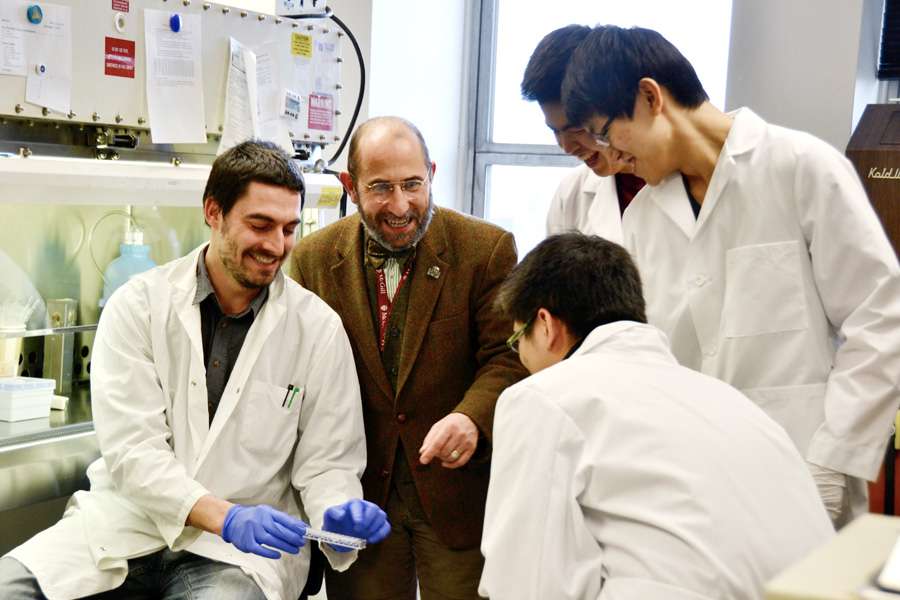
Sitting in on an interview with Chair of the Department of Microbiology and Immunology Joaquin Madrenas, it’s easy to be mesmerized by his knowledge, charisma, and aptitude to take on life.

“I feel fortunate; I enjoy everything!” said Madrenas. “[Aside from science, I try to engage in various activities] with my friends and family in an attempt to make sure my life is a continuum.”

One of these activities—music—has shaped both the lectures he gives at McGill and, in June 2012, inspired a Ted Talk about the impact of infectious diseases. In his teaching, Madrenas relates the crescendos and decrescendo, as well as other musical elements of symphonies with the different  phases of disease.

Throughout his career, Madrenas has made influential contributions to science through his publications in many top journals. However, his experiences transcend that in research. Madrenas holds a medical degree from the University of Barcelona and is currently an active professor at McGill.

“I think I [always saw myself conducting research], but my primary vocation has always been medicine,” Madrenas said.

“I consider myself a physician that had the opportunity to be confronted with patients’ needs, which [I could] tackle through research. I [hope that at the end of my career] I can say that I have contributed to improving the quality of life of my patients.”

Although he doesn’t practice clinical medicine anymore, Madrenas works very closely with human health through research.

“In the lab, we have two lines of research,” he explained. “Both have in common the discovery of novel ways to regulate immunity. We are looking at how microbes learn to live in humans without causing disease and finding out what mechanisms they use in doing so. Those mechanisms could be [useful in] developing templates for new treatments. [We are also looking] to find out how biological membranes are put together to facilitate communication between the [outer and inner] world of the cell.”

(Cassandra Rogers / McGill Tribune)

Despite his own research accomplishments, Madrenas now finds gratification from others working in his laboratory. He emphasizes the importance, as a professor and scientist, to change other people’s lives.

“Moments of discovery are tremendously gratifying [and when they come] from one of my students or trainees, they are even more so,” he said. “Seeing your trainee succeed and become successful on his or her own is tremendously rewarding.”

As for what inspires him, Madrenas is a man of values and simple pleasures.

“My family and my wife in particular [are a] constant source of joy and intellectual challenge. My environment is [also a] source of inspiration,” Madrenas said.

He insists that this includes his colleagues and staff at McGill and beyond.

“Figuring out how the things we witness [occur] is also inspirational. I have found it practical to be inspired every day by very little things…. At the end of the day, success is anything that allows you to get a sense of happiness,” Madrenas said. “[It is] an internal sense of happiness, which includes peace, respect and fulfillment. I think happiness is a state of mind, [which] you work on […] One can be very happy while being bored, [just as] one can be happy being challenged,” he said. “At the end of the day, I am a happy person.”


McGill Tribune: What do you look for in students who are applying to work in a laboratory?

Joaquin Madrenas: [It’s] a combination of qualities that projects a positive profile for recruitment, [which] include enthusiasm, drive, intellectual brilliance and past track record of achievement [….] I am always looking for brilliant students or trainees to come to my lab to work in our team, so the need to see a fit in [that framework] is also very important.

MT: What is your biggest fear?

JM: Losing the energy to tackle life, becoming disenchanted with everything I see, and losing my ability to be primed by what surrounds me.

MT: What are you reading right now? 

JM: I am reading three books: a biography of Johannes Sebastian Bach, the novel 14, and a book I currently read on the bus on leadership styles.


Full disclosure: Maral Saghaei spent summer 2013 working in Madrenas’ laboratory.

a, Opinion

Goodbye and good riddance

When people ask me about my post-graduation plans, I often tell them that I’m done with school. I’m looking for a job on a midterm campaign, I tell them, and maybe I’ll head to law school somewhere down the line. But what I invariably add is that I’m not actually done with school, I’m done with McGill. For the past four years this university has been at best exasperating and at worst downright hostile. Through a mélange of inept bureaucracy, rampant grade deflation, and insufferably pretentious and hypocritical undergrads, McGill has routinely been a source of immense frustration.

While I don’t hesitate to brag about my school’s academic pedigree, or whip out the latest turn of phrase gleaned from my latest political science course pack, my praise for what will soon be my alma mater is rather forced. When pressed to elaborate on what I enjoy most about going to McGill, I often cite examples from beyond the confines of the Roddick and Milton Gates. Montreal is a wonderful city, the French immersion is invaluable, the community is warm and accepting, and my friends are among the best people I’ve ever met. However, with the exception of the latter, none of these redeeming qualities hold any extensive ties to this school. A stubbornly anglophone faculty and student-body—coupled with a general atmosphere of superiority—make McGill an island in this francophone metropolis, while the competitive nature of over 20,000 highly qualified students all vying for the same internships makes conferences an act of both preening and self-loathing.

What I have found most frustrating though is the degree of universal indifference and exclusivity that permeates nearly all aspects of McGill life. Never one to offer a helping hand, McGill’s student services are more than happy to let you drown unless you explicitly ask for a lifeline. Whether it’s fulfilling graduation requirements, applying to study abroad, or getting an appointment with student health services, McGill’s administrative and departmental offices are never forthcoming in providing students the tools they need to succeed. Rather they are hidden behind a web of paperwork, outdated and poorly organized filing systems, and scorn for what many faculty and staff see as spoiled students reliant on handholding.

Among students, McGill is lacking in a substantive and hospitable campus culture. Unwilling to coalesce around sports like many other public universities, McGillians are seemingly united only in times of divisiveness. The single largest gathering of students I’ve ever seen was the infamous 2012 Arts General  Assembly,  which brought together thousands of disgruntled and ideologically motivated students for six excruciating hours of caustic debate, recounts, and general vitriol—all of which failed to resolve the issue despite such a massive degree of involvement. Never have I seen a concerted effort on the part of any student organization to actively bring together and involve students with SSMU, the university, or even general social or academic issues. Although many groups will put on an air of openness and inclusivity, it’s as if McGill is one giant mixer where everyone greets each other with a closed fist.

Lastly, there is the rampant hypocrisy that characterizes much of the campus discourse. As a loud and ever-present voice for social justice and staunch opponent of human oppression, the McGill Daily is nonetheless happy to publish article after article brimming with anti-Semitic venom. Look no further than last week’s feature, which not only sought to legitimate a fringe anti-Zionist Jewish group (viewed by many Jews in the way that most Christians view the Westboro Baptist Church) but actively perpetuated grossly offensive stereotypes, such as Jews owning the media and the Israel lobby’s (imaginary) iron grip on Western political institutions.

The duplicity continues with SSMU, which for all its posturing as the sole representative of McGill’s undergraduates puts extraordinarily little effort into providing services in French. Not only is the SSMU executive routinely made up of all anglophone students, but every GA I’ve been to has lacked an English-French interpreter, has had an entirely English agenda, and has seen questions asked only in English, with no translation offered. Moreover they have never bothered to link their efforts towards preventing racist or culturally insensitive costumes at Four Floors to the larger issue of the systematic underrepresentation of people of colour and other visible minorities in the student body, faculty, and staff, despite a mandate which calls for the inclusion and acceptance of these groups.

Am I happy I went to McGill? Yes, the experiences I’ve had and people I’ve met here simply don’t exist in North Carolina. Did I get a world-class education from a prestigious academic institution? Absolutely. But given this school’s blanket antagonism towards harmony and unity, I can safely say that the degree I receive this June will be my last from McGill.


Daniel Braden is the creator and curator of “McGill Memes.”

An abridged version of this article appears in the Feb. 4 issue of the Tribune.

a, McGill, News

McGill rescinds ATI appeal, will not pursue discretionary powers

McGill has withdrawn from their pursuit of the jurisdiction to disregard Access-to-Information (ATI) requests, according to a statement released Jan. 24.

The settlement concludes a legal dispute that began in December 2012, when the university sought the right to ignore ATI requests at its discretion due to an increased volume of requests.

The Commission d’accès à l’information du Québec rejected McGill’s initial motion to gain discretionary control at a preliminary hearing last October. The university then announced its intent to appeal  the decision to the Québec Court of Appeal, before negotiations for a settlement officially began on Nov. 27.

The withdrawal of the motion is part of the settlement, in which McGill also agrees to set a timetable for responding to some of the contested ATI requests, with the first set of responses due on Feb. 28.

“Under this agreement, McGill has undertaken to respond to a number of redrafted requests within a negotiated time-frame,” the joint statement reads. “On their part, the students and community members will withdraw certain requests [that were too vague]  but keep their right to file requests for review before the Commission d’accès à l’information of McGill’s responses to the redrafted requests.”

Kevin Paul, one of the students who submitted ATI requests and was named in the settlement, said he believes  McGill’s withdrawal came from a belief that courts would reject its appeal.

“We see the initial motion as a politically motivated effort to block ATI requests from an indeterminate group of people for an indeterminate period of time,’’ Paul said. “McGill has recognized that not only would it not win in courts on this, but that its efforts are bad for public relations.”

Paul said the defendants would now look to McGill to disclose the information they requested over one year ago.

“While we’re happy that McGill has withdrawn its motion, ultimately what we want is an actual disclosure of information,” Paul said. “We want documents in our hands that are neither incomplete nor redacted in unacceptable ways.”

a, Arts & Entertainment, Theatre

Family matters spiral out of control in All My Sons

The ‘dystopian suburban soap opera’ has become somewhat of a cliché in recent years. Between Alan Ball’s film American Beauty, Tracy Letts’s play August: Osage County, and David Chase’s television series The Sopranos, writers have managed to wring an impressive amount of drama out of debunking the American Dream. Legendary playwright Arthur Miller provided them a marvelous template to work from with his play All My Sons, currently being performed by the McGill Players’ Theatre.

Director Matthieu Labaudinière emphasizes the American setting of the play immediately with the Tin Pan Alley-era jazz that plays as the house lights dim. As the stage lights come up, we are exposed to American suburbia through the set’s white picket fence, bright red door, and lone rocking chair. Set designer Patrick Higdon also places dead rose petals around the stage and strewn tree branches at its centre to hint at the dark side of the seemingly idyllic world Miller will soon reveal.

The tree branches represent a central motif in the drama. The Kellers plant the tree to which the branches belong in honour of their son Larry, an air force pilot who has been missing in action for three years. As the play opens, Joe Keller (Oren Lefkowitz) and his neighbours Jim Bayliss (Ben Mayer-Goodman) and Frank Lubey (John Hanchar) discuss the fallen tree and the effect it will have on Joe’s wife Kate (Julianna Astorino), who clings to the notion that Larry still might be alive.

The Kellers’ other son, Chris (Matt Smith), is introduced shortly, and here we begin to see Miller wrestle with issues of class and education. As Joe peruses a copy of the local paper, Chris asks to read the book review section. Joe scoffs at Chris’s desire to be educated, and Chris shows an equal disdain towards his father’s philistinism.

Miller continues to probe the depths of these issues as we learn more about the characters. Joe owns a local factory that produces aircraft machinery. Chris, on the other hand, aspires to use his education to escape blue-collar life. The tension between these two philosophies forms a central pillar of the drama.

Much of the play’s interest derives from the relationships between these men and the two most prominent female characters, Kate, and their former next-door-neighbour, Ann Deever (Noush Kadian). Ann comes to visit for the first time since Larry, her former lover, went missing. We soon understand her motivations, as she and Chris are revealed to be romantically attached and intent upon getting married. Though Joe accepts their marriage, Kate’s attachment to Larry and her refusal to acknowledge his death prevent her from coming to terms with the relationship.

Although Miller initially presents Kate as the character who is most removed from reality, the delusions which cloud the judgements of both Chris and Joe rise to the surface as the play progresses. Both Chris’s idolization of Joe, and Joe’s refusal to admit the precariousness of the situation involving him and his ex-business partner Steve (Ann’s father) seem more and more absurd as Miller provides more information about each of the characters. By the end, we see the extent of the denial under which the three of them live under.

The complexity of these roles require the actors to embody a wide range of personas throughout the drama, and they manage (for the most part) to convey the tolls which the strife takes upon their characters. Astorino’s portrayal particularly stands out. She depicts both Kate’s initial plucky aplomb and the devastation of her self-realization to deliver a wrenching performance.

All My Sons is a deceptively complex take on the American suburban melodrama, and the Players’ Theatre has delivered a strong interpretation that deftly navigates the play’s many intricacies. Miller’s play probes issues of class, family, and war; this production makes a strong case for the continued relevance of its takes on those topics in the present day.

Though urban Montreal might sometimes feel far-removed from small-town American life, All My Sons shows the universality of the emotions it depicts.

All My Sons starts at 8 p.m. on Jan. 29—Feb. 1 at Players’ Theatre. Student tickets are $6.

a, News, SSMU

SSMU to consider severing ties with Quebec student roundtable

The Students’ Society of McGill University (SSMU) could seek to leave the Table de concertation étudiante du Québec (TaCEQ), after fellow member association at the Université de Sherbrooke (REMDUS) voted 73.2 per cent in favour of leaving the student federation Friday.

TaCEQ is a federation of student associations that represents approximately 60,000 students from three universities in Quebec, and aims to share resources in research and congregate to lobby the Quebec government, according to its website.

The REMDUS referendum to leave TaCEQ was consultative, as the results will need to be ratified in the association’s General Assembly (GA) on Feb. 6. However, according to REMDUS President Marie-Pier Boisvert, it is likely that the results will be ratified.

“[The referendum] is strictly a consultation, it’s not decisive, and it’s going to be up to the General Assembly to decide,” Boisvert said. “But what I have in mind right now, is that they’re probably going to accept […] the referendum’s results.”

SSMU Vice-President External Samuel Harris said it would be unlikely that REMDUS would not leave.

“I don’t think they could ever strongly contradict results that strong,” Harris said. “We’ll see what happens though.”

According to Boisvert, the referendum was prompted by an accumulation of frustrations by the members of REMDUS, the most recent of which was TaCEQ’s failure to hold a congressional meeting to reform the organization.

“[We felt] it’s high time TaCEQ changed some of its oldest practices,” Boisvert said. “There always seemed to be some sort of hold up from one association or another [.…] We’ve been trying very, very hard to have this congress for reform, and we felt like we were the only ones who really wanted it.”

If the results of the referendum are upheld, only three student associations from two universities would remain in TaCEQ: Université Laval’s postgraduate student association (AELIÉS), Université Laval’s undergraduate student association (CADEUL), and SSMU.

In order to be a recognized student federation, an organization must have student association members from at least four different academic institutions.

According to Harris, who serves as SSMU’s representative to TaCEQ, SSMU now faces the uncertain future of its relationship with the federation.

“We’re reflecting right now,” Harris said. “The question is, is it worth staying without [REMDUS]? I think it’ll be extremely difficult to make it work.”

At Thursday’s SSMU Council meeting, Arts councillor Ben Reedijk argued that SSMU should leave TaCEQ, pointing to the $17,000 that SSMU contributed toward the federation this year.

“TaCEQ is very tenuous; we don’t really know what’s going on with it,” Reedijk said. “I’ve been very frustrated with it, and I don’t really feel like SSMU would be responsible to its constituents if we continued funding it past the point where we really have to, at this stage.”

Harris said the decision for SSMU to withdraw from TaCEQ could be made in several different ways, as early as this semester’s referendum period.

“I think it was a [SSMU] Council decision that created [TaCEQ] in the first place, so arguably, some would say Council could [vote to leave],” Harris said. “The most transparent way would be by referendum [….] The referendum period will have higher turnout, and I’d be more willing to do that.”

TaCEQ will be holding a meeting on Feb. 9 to discuss the organization’s future, as it is currently engaged as an intervener in a court case regarding students’ right to free association with student societies. These legal and financial obligations will continue to tie the student associations together over the next few months.

“We have other things we need to clear, financially,” Boisvert said. “Even if we disaffiliate, we’re still going to be a part of [the TaCEQ court case]. We want to stay close to these other associations [….] There are no hard feelings; we want to have those links.”


a, Men's Varsity, Sports

Basketball: Ogundokun puts up career numbers as Redmen cruise

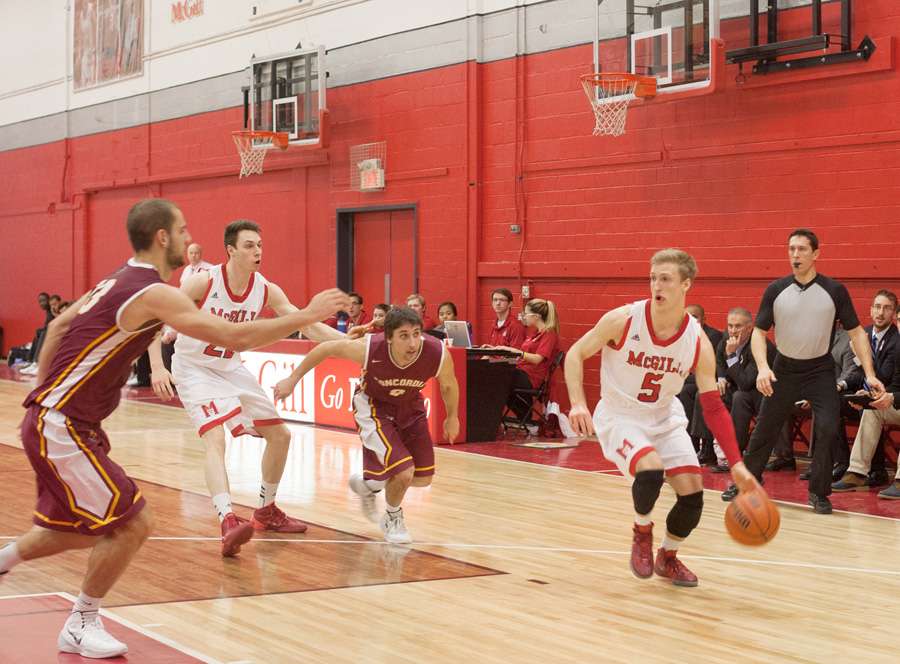
After back-to-back road losses, the stumbling McGill Redmen (6-2) regained their moxie as they coasted to a 70-49 win over the Concordia Stingers (6-4) on Saturday night. The team continued its perfect record at home and jumped from third to first in the division thanks to a Laval win over Bishop’s. Concordia’s offence had no answer for McGill’s dominant man-to-man defence as the Stingers shot a pitiful 32 per cent from the field.

With over 400 fans in attendance on Saturday, Love Competition Hall had no shortage of energy. Prior to the game, Redmen Head Coach David DeAveiro stressed the importance of protecting home court and turning McGill into a place no team wants to play.

“I think our guys understand that we always have to defend our home court,” DeAveiro said. “We know we’re good at home, now we [just] have to win some tough games on the road.”

After a heartbreaking loss at Concordia last Thursday, DeAveiro refocused the team while emphasizing hustle and controlling the boards.

“We watched the video [of the] Concordia [game] and I thought that as well as Concordia played, we really beat ourselves,” DeAveiro said. “We talked about fixing two things, […] not letting anyone out-hustle us today, [and] we got out-rebounded last game, and I think we [out-rebounded] them 50-31 tonight. So we addressed the things we thought needed to be addressed, and the kids responded really well.”

The host’s response came early as the Redmen snatched the game’s first eight points. After a poor showing at Concordia in the team’s previous matchup, freshman guard Dele Ogundokun was scorching hot, registering a career-high 21 points along with seven boards and a pair of steals.

“My teammates were giving me the ball, [I was] attacking the glass, and just doing what I needed to do for the team,” Ogundokun said. “Tonight’s win was [just] a whole team effort.”

McGill forward Francois Bourque’s rookie season has been nothing short of spectacular, as he recorded his fourth double-double this season with 12 points and 11 boards. Veteran forward Vincent Dufort just missed the double-double mark with 11 points and nine rebounds. While point-guard Simon Bibeau’s return didn’t make a huge difference in the game, his 15 minutes on the floor gave third-year guard Ave Bross some much needed rest after being the team’s primary facilitator in the Redmen’s previous three outings.

(Wendy Chen / McGill Tribune)

Defensively, the team played well, as it held the Stingers to a season-low 49 points. The Redmen held Concordia stars Mukiya Post and Adam Chmielewski to just 11 and nine points respectively after the tandem combined for 45 points in the previous game. “We tried some different things with [Chmielewski] this game; we tried to play different guys on him, [we] put a fresh guy on him, [then] a taller guy on him,” DeAveiro said. “We just changed it up so that he didn’t get the same look over and over again.”

The Redmen have regained their composure just in time for a crucial home-and-home series with the Bishop’s Gaiters on Jan. 30 and Feb. 1. In the teams’ first matchup on Nov. 28, the Gaiters choked up a 10-point halftime lead in a resounding 81-63 Redmen win. After Bishop’s fell to Laval on Saturday, the Redmen and Gaiters are now deadlocked at the top of the conference at the halfway mark of the season. The team that comes out ahead next weekend will establish a tight grip on the race to win the RSEQ.


Vincent Dufort attacks the paint. (Wendy Chen / McGill Tribune)
a, Science & Technology

Gene therapy shows promise in combatting blindness

In her novel Light in my darkness Hellen Keller wrote, “There is no better way to thank God for your sight than by giving a helping hand to someone in the dark.”

Robert MacLaren, a surgeon and professor at the University of Oxford, has set out to do just that by using gene therapy to treat certain types of blindness with hopes that, in the future, the technique could be used to effectively combat this impairment.

The results for the patients of this experimental gene therapy were published in The Lancet medical journal and have the potential to encourage further research in this area. The trials focused on nine patients who suffered from a particular type of blindness called choroideremia, an inherited disease resulting in progressive blindness. Choroideremia is due to a genetic defect that causes the light-sensitive cells at the back of the eye to degenerate. As these cells die, the retina begins to shrink, leading to the gradual loss of vision.

The therapy involved surgery to inject the missing gene responsible for the choroidermia disease. The gene piggybacked on a virus that acted as a vehicle of delivery, helping the gene navigate right to the retina. Since the initial surgery, the results have been very inspiring—every one of the patients showed an improvement in vision, ranging from higher perception in dim light, to being able to read more lines on the eye chart.

“This [treatment] has huge implications for anyone with a genetic retinal disease such as age-related macular degeneration or retinitis pigmentosa, because it has for the first time shown that gene therapy can be applied safely before the onset of vision loss,” MacLaren said in an interview with the University of Oxford News.

One of the first trials was conducted with a 63-year-old man, Jonathan Wyatt, who at the time of the surgery had very minimal vision. Since undergoing treatment, he has experienced a significant improvement in sight.

“Now when I watch football on TV, if I look at the screen with my left eye alone, it is as if someone has switched on the floodlights,” Wyatt said in an interview with the University of Oxford News. “The green of the pitch is brighter, and the numbers on the shirts are much clearer.”

Another patient, Wayne Thomson, had a similar experience.

“I’ve lived the last 25 years with the certainty that I am going to go blind; and now, [after the operation] there is the possibility that I will hang on to my sight,” he said.

Since choroidermia is a degenerative disease, it may be premature to have very high hopes for the treatment. MacLaren’s paper consists of data for only six months past the surgeries. Therefore, it is still uncertain if the efficacy of the treatment is permanent or transient.

Regardless, MacLaren’s study has sparked optimism among other researchers. Jean Bennett from the University of Pennsylvania applauded these efforts, saying that the technique could be helpful in fighting against other causes of blindness like macular degeneration. However, Bennett is cautious to jump to conclusions.

“We can do as much work as we can in the laboratory and try to sort out all the variables, but there are always surprises,” she said in an interview with ABC News.

The researchers remain optimistic and look forward to the future results of the study.

“I am incredibly excited to see what will happen,” MacLaren said. “The difficult bits are done. We know the virus carrying the gene therapy gets into the cells and the retina recovers after the surgery. Now it’s just waiting to see how the patients progress.”

a, McGill, News

Wait times decrease at Mental Health and Counselling Services due to surge in funding

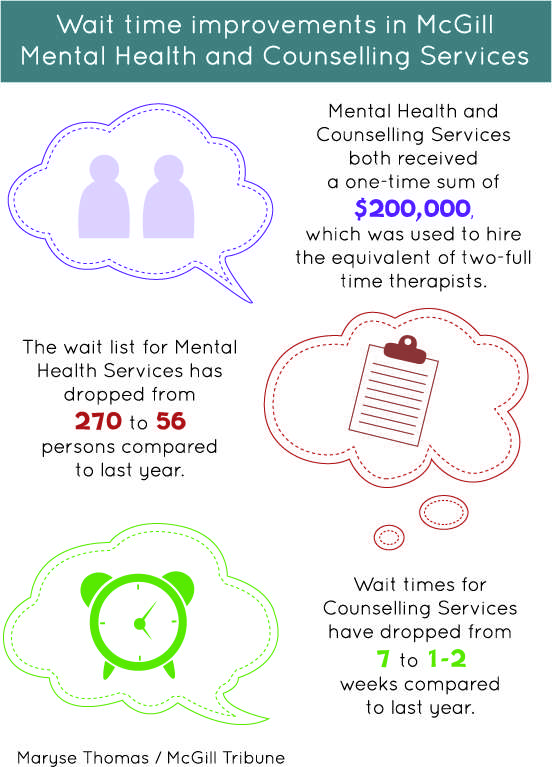
Wait times for students accessing McGill’s Mental Health Clinic and Counselling Clinic have been reduced dramatically due to an increased $400,000 of funding in the Fall of 2013.

In comparison to this time last year, the waitlist for Mental Health Services has decreased from 270 to 56 persons, while wait times for Counselling Services have decreased from seven weeks to one or two weeks.

The injected funds derive from a $5 million surplus within the Student Services Contingency Fund, which accumulated due to various factors including savings in wages from the 2012 MUNACA strike and conservative student enrolment numbers. According to Executive Director of Student Services Jana Luker, both services were given $200,000 each to address extreme situations.

“We recognized that counselling was a crisis, and that it was acute and it was wrong; it bothered everybody a lot,” Luker said. “The only reason Student Services is here is to help students and support students and we weren’t able to do that in a timely manner.”

In order to reduce the wait times, both clinics hired the equivalent of two full-time therapists.

“We had the funds for two full time equivalents; it ended up being more than two people but part-time,” Vera Romano, director of Counselling Services, explained.

Luker said new technology-based applications are also expected to help keep wait times low.

“There’s a bunch of [online and mobile] apps we are trying to use to treat people with anxiety and depression,” Luker said. “Anxiety doesn’t always show itself conveniently between nine to five, Monday to Friday. We are trying to see if we can teach people simple methods of treating their own anxiety [….] Then you won’t see people in an acute phase lining up later on.”

In addition, Romano attributes the reduction in wait times to initiatives by other members of the McGill community such as students and the administration.

“The response to the crisis I think on some level was coming together and prioritizing the mental health issues, the psychological issues, the wellness issues by the students especially, by the professional service deliverers—which is us, and—I think by the admin,” Romano said.

(Cassandra Rogers / McGill Tribune)

While the additional funds are having an impact this semester, they are a one-time source of funding, which means the services will need to find alternative methods of funding to keep wait times low in future years.

Rather than redistribute student services fees and take away funds from other significant services, Luker suggested the option increasing of Student Services fees to hire new therapists permanently. Currently students pay $549 per year towards Students Services.

“We won’t do [it] this year; we would have to take it to referendum,” Luker said. “If students knew that an increase in Student Services fees—an extra $10 per person—would go directly to hiring two more therapists, then the students could decide for themselves.”

Read the latest issue

Read the latest issue