


Latest News

a, Opinion

To move forward, CLASSE must condemn violence

If you left home on the rainy afternoon of Sept. 22 and found yourself confused amidst a reiteration of the student protests that reached their height in May, you certainly weren’t alone. Many Montrealers were puzzled by the Saturday protest—after all, hadn’t the newly-elected PQ just rescinded the tuition increase after months of unrest?

The demonstration, organized by Coalition Large de l’Association pour un Solidarité Syndicale Étudiante (CLASSE), was both a celebration of the hike reversal and a call for a move toward free education—the student group’s ultimate goal.

The issue of the tuition increase may have been settled, but only for the time being. A minority Parti Québécois government is hardly a model of political stability, and the party has already discussed indexing tuition to the cost of living. CLASSE’s demonstrations for free education, even on the heels of what many consider to be a huge victory, is hardly misguided.

What concerns this Editorial Board most, however, is not the timing of the protest, but the reports of violence committed that day.  Among other physical confrontations, rocks were hurled at police, and protestors hit and chased cruisers along Peel Street. These actions are unacceptable in a civil, peaceful society. We understand that police are—in many cases—the first to aggress, by kettling protestors and employing dispersal tactics which compromise participants’ safety. Violent reaction is unwarranted on both sides, but a special onus lies on CLASSE, especially because achieving its goals requires that it win the approval of the greater public.

The central problem lies in the way CLASSE has dealt with violent confrontations and damage to property in its demonstrations. Though it was forced to issue a statement condemning “deliberate physical violence against people, except in cases of legitimate defence,” during strained negotiations with the government in early April, the group does not systematically condemn violence. More specifically, no statement was issued following the protest on the 22nd, and the group failed to provide authorities with a street route of the protest.

This is not surprising—anti-police sentiment still dominates much of the group’s rhetoric, and perhaps with reason, since police often do react to protests with unnecessary violence.  Although peaceful protests are often co-opted by more radical and violent groups, failure to condemn acts of aggression and separate themselves from those who commit these acts means CLASSE is permitting them to happen. If CLASSE seeks legitimacy, it needs to rise above this, even if it’s not ‘fair’ in light of police reaction. Groups looking to affect change need to hold themselves to a higher standard.

Above all, CLASSE struggles most with its public image. The student group cannot possibly achieve free tuition without the support and approval of the greater Quebec public. Improving its publicity can only begin with a separation of its vision and activism from hooliganism and violence. Contrary to its portrayal in the national media, CLASSE’s membership is incredibly principled—their belief in the merits of free education stem from a well thought-out ideological stance on how to improve society. They are hardly whiny, entitled teenagers, as they are often portrayed in the national media. Their perseverance these past months has more than demonstrated this commitment and idealism.

Now that the tuition hikes are repealed, many expect greater stability in Quebec, and this is why violence is so much more delegitimizing for CLASSE. The Tribune acknowledges the important role a group like CLASSE plays in Quebec society, particularly in its contribtions to the national debate on education. While the feasibility of free post-secondary education is hardly undisputed, it is undoubtedly an ideal worth aspiring to.  Rights to civil and peaceful protest, in all its forms, must be actively protected. Violence, however, has absolutely no place in this process. To strengthen its image and broaden its appeal—two goals it must achieve to ultimately change policy—CLASSE must condemn all acts of violence committed at its demonstrations.

a, Opinion

Why are American universities so expensive?

We have seen over the past year  in Quebec that the issue of university tuition can be incredibly polarizing. Indeed, in much of the debate over the recent planned tuition hikes, anti-hike activists drew ominous comparisons not only with the higher rates in the rest of Canada, but with the comparatively astronomical sticker prices in the United States. The average cost (tuition and fees) of attending an American four-year private university is $27,293, with ancillary fees adding almost another $10,000.

While private American universities certainly represent the highest end of the tuition spectrum, universities overall in the United States are expensive compared to other developed nations. However, it bears noting that the astronomical figures often quoted in the public debate can be misleading; unlike in Canada, the sticker price of tuition is not paid by most students in the U.S. Indeed, while the list price has risen well past the rate of inflation nationwide, the average actual price paid by students—across all types of universities—has actually stayed steady over the past 10 years, growing from $12,650 in 2001-2002 to $12,950 this past year.

However the discrepancy between this supposed sticker price and the actual price paid by students by no means signifies that the American university system is working. Rather, the extremely inefficient scaling of tuition is merely a manifestation of the system’s dysfunction. This price discrimination is examined under the Bennett Hypothesis, named after the Reagan-era Education Secretary William Bennett.

Emerging in the late ‘80s, the Bennett Hypothesis posits that increases in federal aid are far from making college more affordable. Instead of increasing accessibility by making more aid available to those who need it, increases in aid actually drive up the cost of tuition. Universities have raised their tuitions beyond the rate of inflation, confident that federal aid would cushion the increase.

While the theory has since been controversial and is supported by inconclusive empirical evidence, studies have demonstrated that increases in tuition are not simply redistributive from richer students. At least at the top end of American universities—highly ranked private institutions—increases in federal student aid have been met with increases in tuition totalling more than just the amount of additional federal aid.

Another explanation for skyrocketing university tuitions is the dogged competition for students that universities engage in, year after year, for the highest scoring applicants. This competitive pressure is not misplaced in the realm of education. However, consumers—parents and prospective students—choose universities based on the very definition of imperfect information. University ranking systems, including the oft-quoted U.S. News and World Report ranking, contribute to this. U.S. News tends to take into account input statistics like entering SAT scores and spending per student, in addition to the rather nebulous concept of ‘prestige,’ which counts for anywhere from 22 to 25 per cent of an institution’s score. This is all instead of looking at what happens to students after their four-year stay at these institutions.

[pullquote]The complexity of the issue makes addressing the cost of a university education…an issue far too complex to receive serious treatment.[/pullquote]

This would not be so bad if universities did not have an incentive to blatantly game this sort of system. Many institutions, looking to vault their way upwards in the rankings, but without  having any Ivy “prestige” to trade on, have begun an arms race to attract the supposed ‘best and brightest,’ with fancy dorms, nicer buildings, and sports like squash. This behaviour is rewarded in several ways. Firstly, as earlier noted, the U.S. News rankings take into account selectivity, which means that convincing more students with higher SAT scores to even fill out an application to the university raises one’s ranking. Nicer buildings and dorms mean that you’re spending more money per student. Another notch upwards in the rankings.

This extravagant spending puts the burden of higher tuition on less affluent students. Many institutions in or near the upper tier today seem to have made this transition: George Washington University, Boston University, and New York University have all, over the course of a decade,  put themselves in the same conversation as the Ivy League and other established elite institutions, largely on the back of this tuition-fueled push.

A number of international think tanks have proposed solutions. A study by the Organization for Economic Cooperation and Development (OECD) earlier this year suggested income-contingent loans as a solution to ensure access, advocating for moderate tuition levels in combination with means-tested grants. At the same time, a paper by the American Enterprise Institute suggested seriously rethinking the cost structure at American instructions—reducing the amount of tuition-funded research, downsizing under-enrolled departments, and trimming administrative bloat.

Perhaps the biggest problem facing American universities today is that this analysis provides only a snapshot of the forces pushing tuition up at the high end. Gone unmentioned are the inflated cost structures of American universities at every level, and the effects of student debt at the back end. It is undoubtedly complex and multifaceted. On some level, the complexity of the issue makes addressing the cost of a university education—beyond small-bore campaign sloganeering about interest rates on a small number of government student loans—an issue far too complex to receive serious treatment from American politicians. If anything, that should be the cause for real worry.

a, Opinion

Letter to the Editor

In his recent article, “Moral superiority and student politics,” Abraham Moussako argues that students have no duty to participate in campus politics. I’d like to refute that idea by arguing that judgements about the duty to participate are necessarily made in reference to particular facts about a particular issue.  In other words, we can’t make blanket statements about the moral status of political participation.

To illustrate this point, let me offer the following two examples:

Imagine that the administration decided to stop admitting women, non-whites, and handicapped people to the university, citing the reason behind this policy as the (supposedly) inferior mental capacities of these groups.  Obviously, the campus would be in an uproar, and I think even Mr. Moussako would agree that we all would have a duty to rally in support of our friends and colleagues.

Conversely, imagine that McGill decided to increase Heather Munroe-Blum’s salary by one penny.  In this case, I think even the scariest of McGill’s radicals would probably not even bat an eyelash.

What I’m trying to get across by these two examples is that you need to take into account the particulars of the issue when you make judgements about the necessity of getting involved.  In his article, Mr. Moussako does make a slight concession to this idea: he says while some issues are too insignificant to get worked up about, others do have relatively important consequences.  However, he also says we need not worry about these other, significant issues because they are “complex, morally ambiguous matters of economics and politics.”

Frankly, I’m puzzled by the idea here that we can ignore a duty we find difficult to fulfill.  To be sure, many of these issues require a lot of thought in order to wrap your head around them.  However, if they’re important enough, I think we’re still obligated to take a stance on them.  As Mr. Moussako emphasizes, it need not be one stance in particular.  However, it should at least be one informed by careful thought, and maybe even a conversation with someone you disagree with.

a, Opinion

Letter to the Editor

As a known student radical and victim of police brutality, I find Abraham Moussako’s Guest Column (“Moral superiority and student politics”) generally callous and presumptuous. In particular (and more relevant to my critique), I found the text personally offensive.

In his recent opinion piece, he looks down upon the complex dynamic structure of our highly politicized campus, and offers a theoretical account so divorced from reality that it could only have been published in the McGill Tribune.

If pressed to do a genuine analysis of his major argument, it would go something like this: Moussako attempts to understand the conflicts on campus that appear to disrupt the naturally peaceful social structure of campus. He projects the cause of this on the invasive “campus radicals” who he then accuses of participating in what he calls a “stark, good vs. evil viewpoint that would make Rumsfeld and company proud.”

I can’t imagine what made Moussako write that. Rumsfeld famously ignored the unknown knowns (the subconsciousness) in his speech about the known knowns. He also lied about WMDs in Iraq, and is an international war criminal. The connection seems tenuous to me. Maybe Moussako hasn’t interrogated his hidden assumptions, or actually investigated what drives the people he lambasts.

His division between “the university” and “the world” is arbitrary at best. It is hard to understand why we should view campus politics as separate from the politics of the world at large. The concern here is about people’s engagement in important social and political issues, both locally and globally. Campus is only part of where you can draw that out.

Assuming this premise is not wrought with unreflexive irony, we still look beneath to find that the target of his criticism is actually a straw man of the radical left campus political scene. He postulates that the goal of their presence on campus is to try to get others also involved in campus politics—like some industry bent on growth.

Finally, I want to explicitly assess Moussako’s claim that “there is no moral virtue to campus politics.” I will offer a short list of facts on which I find would be an ethical abomination not to take a moral stance. If you subscribe to Moussako’s false dualism, then maybe no point on the list could be considered to be relevant to the university; but I will leave all this for the reader to decide:

First, Professor Gregory Mikkelson was beaten with a nightstick and pepper sprayed in the face by the riot squad while on his way to retrieve his daughter from the nursery on Nov. 10th, 2011.

Next, A CEGEP student named Francis Grenier was playing the harmonica just across the street from the Schulich School of Music on Mar. 7th, 2012, when a flashbang grenade thrown by the police obliterated his eye.

Finally, police kicked my [expletive removed] and smashed my arm in April—which required multiple surgeries to set. If I said I was scrapping with the Pigs at the time, I would be lying. I was hit from behind, and then kicked repeatedly when I was down.

I am not preaching of any logical relations that these situations necessarily show, but a sympathetic reader should continue reading. If your heartstrings were pulled a little by any of this, even better. For everyone left over, I’m not really sure what I can do for you.

Even if you stand ideologically opposed to those who fought in the 2012 Quebec student strike, you should respect that they struggled and suffered for our tuition refund, rather than cling to a $254 cheque from the armchair of analytic certainty.

Ultimately, Moussako attempted to make a “politically neutral” analysis, not realizing that he can only do so by never acknowledging the sacrifice of his dissenting colleagues—many of whom were pepper sprayed and risked being beaten by standing firm in protests. Why did they risk it again just to picket a few classes and talk to you about tuition hikes? These dedicated people went back to the streets when strike vote results sided with the status quo. On the side of the police and the tear gas.

If Moussako’s goal was to side with power, then he succeeded. By examining “campus radicals” through his own preconceived notions, he doesn’t seriously consider what the actual concerns are for these people. Instead, he trivializes the struggles and experiences of those who confronted real violence trying to have their voice heard.


a, Opinion

Letter to the Editor

I write this fully admitting that I am a bit of a nerd: I grew up listening to the radio. Mostly I enjoyed the National Public Radio (NPR) in the States, but at the ripe old age of five,   I also happily proclaimed to my dad that our local Oldies station was my favourite. That was the ‘90s. Yet in the age of iPods, YouTube and torrents, I still listen to the radio.

In the past few years, studies conducted in Europe have revealed that radio listenership has actually increased over the past 30 years. According to one study, conducted by the United Kingdom’s Radio Advertising Bureau, listening to the radio might actually make people happier than watching TV or surfing the web. This may be because the voice on the radio provides a sense of companionship, and listeners can still be productive and do other things while they listen.

Beyond companionship, however, the popularity of radio is on the rise because programmers filter content in an age in which anyone can have their very own studio at home, thanks to Garageband. This is a facet of radio that is more valuable than ever before. In 2008 alone, over 105,000 full-length records were produced in the United States, compared with one-quarter of that in the early 2000s, according to Neilsen Soundscan. Sure, there is Pitchfork and other music reviews, but wading through them is time consuming, overwhelming, and, quite frankly, mostly pretentious dribble. Why not let the radio DJ—your new music critic friend!—play you a selection of only the best and most interesting tunes, allowing you, in turn, to decide what you like?

Other forms of media, such as social networking and blogging, complement and enhance radio, rather than replace it. Beyond simply calling in to hear a request, listeners can interact with programmers on their Facebook or Twitter pages in real-time.

Although geographically separated, many listeners can communicate at once. For example, CKUT, McGill’s campus-community station, has a “Clip of the Week” feature on the main page of its website, which enhances the listening experience by highlighting segments of a show you might not normally listen to. CKUT’s Campus Mixtapes (campusmixtapes.org) allows CKUT DJs and McGill students to curate digital mixtapes, which can be in turn, shared on Facebook.

Online archives mean you can always go back and hear a show later, no matter where you are in the world. Beyond music, campus community radio stations in Canada provide a home for many different community voices to express themselves, that don’t otherwise have the opportunity. Also, by tuning into the news and culture programs, you’re likely to learn a little something about your city and your world that you might not have known before.

My love of radio inspired me to get involved with CKUT on literally the first day I arrived in Montreal. CKUT has been a media mainstay in Montreal since its founding 25 years ago, and is still relevant to campus and the greater community. I think it will continue to be for at least another 25 years.

Carol Ellen Fraser

Full disclosure: Carol Ellen Fraser is an elected student representative to and current Chair of the CKUT Board of Directors. To learn more about CKUT,  visit their website at ckut.ca

glutenfreetoronto.com
a, Recipes, Student Life

Thanksgiving Stuffing

This tasty recipe is sure to make your side dish a main event this holiday weekend. Whether you’re serving it in a turkey or as a vegetarian alternative, you can bet it will be a hit! This recipe makes enough for about 8-10 people, so you may want to halve it if your dinner party is smaller. Otherwise, you’ve got leftovers for weeks!

Ingredients

4 oz. sausage meat (or 1 cup finely chopped mushrooms if you’re making a vegetarian dish)

2 tbsp butter

2 cups chopped onions

1 cup finely chopped celery

¼ cup minced parsley

½ tsp black pepper

¼ tsp nutmeg

¼ tsp ground cloves

½ tsp salt

1 tsp dried thyme

1 tsp dried sage

10 cups dried bread crumbs

1 cup chicken stock (substitute1 cup of your favourite white or red wine if you  prefer)

Method

Crumble and brown the sausage meat in a frying pan with butter. If you are making the vegetarian version of this dish, cook the mushrooms with butter on medium heat for about five minutes, or until they’ve reached the desired tenderness.  Add the celery and onions, and cook until the onions start to brown. Remove pan from heat and add minced parsley and seasonings. Add dried bread crumbs and toss. Slowly, stir in the chicken stock or wine (from personal experience, I highly recommend using red wine), until evenly mixed. Spoon the stuffing into your turkey and roast until turkey is done, or simply moisten with additional wine and bake in a buttered dish, covered with aluminum foil for 30-45 minutes at 350 degrees farenheit.

a, Student Life

10 Reasons why autumn is awesome

If you’ve been outside in the past month, you have likely noticed that summer is now over. Though the change of season signals an inevitable descent into the cold, dark winter, the drop in temperature gives students and Montrealers alike a chance to switch up their wardrobes and pastimes. Put away those tired, sweaty short shorts and worn out tees—it’s sweater season! Here are ten ways to enjoy the fall:

1. Rocking the bulky sweater

If sundresses signal summer, the bulky sweater is fall’s hallmark outerwear. There’s nothing like a chunky, brightly-coloured wool sweater to let people know that you are hip, you know what season it is, and you enjoy wearing itchy clothing. Take advantage. If you want to be hilariously ironic, find the tackiest pattern you can, and rock it.

2. Hearty Soups

After a long, hot summer, it is finally time to get your soup on! Take a break from midterm studying to indulge in a liquid meal that will warm you to the core. Stay toasty with a spicy black bean soup, or try your hand at the classic homemade chicken-noodle. You might even find a new recipe or two in the Tribune!

3. Red, Yellow, and Orange-Colored Pants

Nothing says ‘autumn’ like bright and cheery foliage, and there’s no reason these colours should be limited to nature. In the spirit of the crisper weather, make sure to warm up your palette with some funky orange or yellow pants. While these hues may or may not be ‘in’ this fall season, make like a tree and ignore the fashion trends. Your boring old blue jeans will still be waiting in your closet for you once all the trees are bare.

 4. Getting Decorative with Some Gourds

Around this time of year, mini summer squash pale (literally) in comparison to their larger and brighter fall relatives—the pumpkin and the butternut squash. Stick one in the middle of your kitchen table for an instant centerpiece, or carve one up and display it in your window to ward off friendly neighbours this midterm season.

5. Sporting Events

While the Montreal Alouettes are wrapping up their season, the McGill teams are just getting started. Grab a gourd, practice your McGill chants, and head to Molson Stadium in your wool sweater and orange pants for some soccer, football or rugby, and a healthy dose of school spirit.

6. Apple Picking

This mainstay fall activity is a cheap—though labour-intensive—bonding experience. Head to one of Quebec’s many apple-picking farms and load up on apples for the semester. One solid trip and you’ll have enough ammo to keep you stocked with apple sauce, apple cider, apple pies, and apple anything, until the new year.

7. Walks up Mont Royal

Though the mountain offers gorgeous views of Montreal any time of the year, this season’s changing and falling leaves make autumn the most beautiful time to head up the winding Chemin Olmstead.

8. Seasonal Beers

New seasonal produce begets creative flavours of your favourite beers from Montreal’s many microbreweries. Be on the lookout for St. Ambroise pumpkin beer, and stop by microbreweries like Dieu du Ciel in the Mile End, or downtown’s Brutopia for their fall specialties.

9. The magic lanterns

Every fall for the last 20 years, over  a thousand lanterns light up the Chinese Garden at Montreal’s Botanic Gardens. This year, they are accompanied by lights at the Japanese Garden. For its 20th anniversary, the festival’s theme will be the Feast of Peaches.

10. Halloween

Now is the perfect time to start brainstorming your costume (or costumes, if you side with those who believe Halloween needs to be celebrated for more than one night). Head to Eva B’s, or any other of Montreal’s bountiful second-hand stores for inspiration and a good bargain.

(Alexandra Allaire/ McGill Tribune)
a, Student Life, Student of the Week

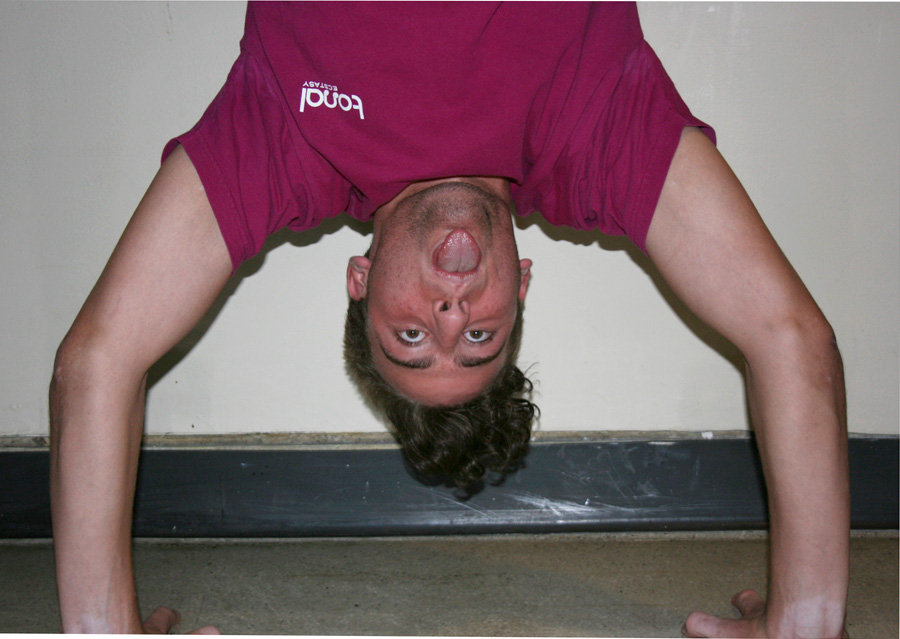
Student of the Week: Alex Gershanov

Q: What is your motto?

A: “Energy.”

Q: Which fictional character would you most like to date?

A: Rihanna.

Q: Who is your hero?

A: That guy with the golden voice—this guy who was homeless but he has this amazing radio voice.

Q: Batman or Superman?

A: Batman.

Q: What is your lucky charm?

A: My “rage” shirt. The one that says “rage” on it.

Q: If you could say one thing to Kim Kardashian, what would it be?

A: “Take me.”

Q: Yams or Sweet Potatoes? (They’re different)

A: Neither. I stick with potatoes.

Q: What word or expression do you most overuse?

A: “Word.”

(Alexandra Allaire/ McGill Tribune)

Q: Describe your favourite article of clothing.

A: I have a tank top from this new Montreal-based company that’s called “Cure,” and it has brass knuckles on it, and it says “Wisdom is Power.”

Q: Kris Humphries or Lamar Odom?

A: I don’t know either one of those people.

Q: Name one song that takes you back to O-week of first year.

A: Take Over Control – Afrojack

Q: Which historical figure would you most want to have a beer with?

A: Alexander the Great

Q: What’s your least favourite sound in the world?

A: “It’s ok, it happens to everyone”

Q: Jay Leno or Conan O’Brien?

A: Conan. [Forget] Jay Leno.

Q: What’s the last song you remember listening to?

A: Mykonos – Fleet Foxes.

Q: How many times have you had poutine since you’ve moved to Montreal?

A: Like, 15.

Q: Michael Jackson or Michael Jordan?

A: Jackson.

Q: Rank the Harry Potter books from best to worst.

A: 4, 2, 3, 1—haven’t read the other three.

Q: Describe Montreal in three words.

A: For the taking.

Q: James Franco or Dave Franco?

A: James Franco.

Q: Sports Illustrated or Cosmo?

A: Sports Illustrated.

Q: If you were a Crayola crayon, what colour would you be?

A: Royal Purple.

Q: What’s the first thing you think of when I say Thanksgiving?

A: My birthday.

Q: Who would play you in the movie of your life?

A: Nicholas Cage.

Q: Why are you an asset to McGill?

A: I’m a beatboxer for an a capella group, and I try and get involved in engineering events. I make cool music on the street, drumming and such on buckets and pans, and I bring the energy. I am the energy.

a, Recipes, Student Life

Sweet Potato Recipe

Here is a classic feel-good family recipe that is perfect for Thanksgiving. Easy to prepare, this dish is a staple at any table come Thanksgiving weekend; it will definitely have you coming back for seconds!

Ingredients

3-4 large sweet potatoes

¼ – ½ lb salted butter

¼ cup milk

1 tbsp brown sugar

Additional brown sugar for topping

Method

Peel, dice, and boil sweet potatoes until tender. Drain and mash with butter, milk, and 1 tbsp brown sugar.  Using a handheld mixer, whip the mixture until light and fluffy.  In an 8” x 10” baking dish, spread the whipped sweet potatoes in an even layer and cover liberally with a layer of brown sugar.

Bake at 350 farenheit degrees until brown sugar melts and bubbles. Watch carefully, as the sugar can burn quickly. Serve warm and enjoy.

a, Student Life

Long Weekend Getaways

If you hail from Canada’s West Coast—or if you celebrate Thanksgiving in November for some strange reason—and aren’t going home this long weekend for turkey, take advantage of the extra day off. Go exploring!

Burlington: The largest city in Vermont is only two hours away by car or bus. Its relaxed charm is second only to the wide variety of activities it boasts. Choose from your standard apple-picking and shopping on Church Street, to the wacky Pumpkin Regatta, an annual boat featuring floating, hollowed out pumpkins.

Quebec City: Check out the province’s capital in all of its autumnal glory. Roam around Vieux-Quebec for some old-world architecture only a few hours away by bus or train.

Ottawa: The nation’s capital is only two hours away, and easily accessible by any mode of transportation. Go visit Parliament Hill for a dose of Canadian national pride.

Saratoga Springs: Halfway between Montreal and New York City, this sleepy college town boasts a race track and the Skidmore college campus. Recharge for the weekend at one of its numerous Victorian bed and breakfasts.

New York City: The city of cities is only eight hours away by Greyhound. Make the most of your weekend and grab an overnight bus, or find a ride share, to visit the best city in the world!

Montreal: Stay in Montreal and try your hand at making your own Thanksgiving dinner!

Read the latest issue

Read the latest issue