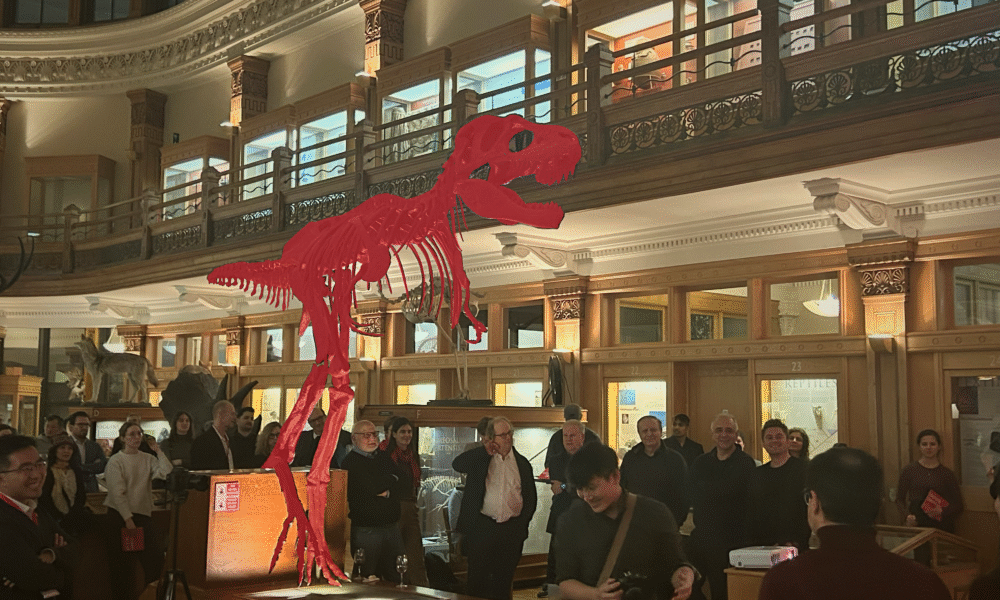



On the rainy evening of Nov. 27, the McGill Engine Centre hosted its 11th annual celebration of innovation and entrepreneurship at the Redpath Museum. The event highlighted the students, faculty, and researchers who applied innovative tech solutions to real-world problems with the help of Engine.
In an interview with The Tribune, Andromeda Wang—a former undergraduate student in the McGill Desautels Faculty of Management and a current administrative coordinator for the McGill Engine Centre—explained what Engine is all about.
“Engine is an incubator for early-stage tech-driven startups, and what we do is we help students [and] faculty across McGill with their startup ideas […] by giving them training on more of the business side,” she said. “We are primarily tech-driven, so STEM, anything technologically innovative, science, math, […] medicine is a big one, and […] we offer the kind of business support and support for innovation at McGill.”
The McGill Engine Centre helps dedicated students turn their tech dreams into a reality by providing them with mentorship, funding, and community, among other things. One of the Centre’s key programs is the TechAccel Program, which is open to McGill undergraduate, graduate, and post-doc students interested in launching their own start-ups. This program has granted over $265,000 CAD in funding since 2016 and is an exciting prospect for students looking to bring their ideas to fruition.
“It’s essentially your tech idea, and you […] get assigned a mentor [because] you get to talk about your ideas, do the market research, and, you know, create community within the startup and technological innovation space at MGill and even beyond,” Wang said.
The TechAccel Program takes three cohorts of students annually, and each cycle lasts around 18 weeks. For those who are just looking to get their foot in the door without long-term commitment, Engine offers a number of additional resources.
“We also host workshops every week during the school year on pre-startup skills. So it covers market research, how to find your customer, Startup Law 101, those are just a couple of the topics we have,” Wang said. “We also have a more in-depth collaboration with McGill SKILLSETS, which again covers kind of the startup skills you need, but it goes a little bit more in depth.”
The McGill Engine Centre also works with McGill engineering students completing their capstone projects. TissueTinker, one of many tech-driven solutions highlighted at the event, began as one of these capstone projects and is now an operational startup.
“[TissueTinker] is a cancer modelling solution that allows you to 3D print living human tissue to test new drugs on directly without the need for animal studies,” Madison Santos, one of the company’s three co-founders, said in an interview with The Tribune.
The company engineers materials that simulate different bodily tissues, such as organs. These serve as a scaffold into which researchers can incorporate their cells of interest, whether they are from patients directly or sourced commercially. From there, the researchers can load the scaffold into TissueTinker’s bench-top 3D bioprinter, enabling them to print living tissue to use for their research.
Not only does TissueTinker’s work facilitate groundbreaking cancer research, but it also does so while lowering some of the environmental and emotional expenditure associated with animal research. Furthermore, TissueTinker employs many students, ultimately allowing the founders to carry forward the community-building initiatives that the McGill Engine Centre helps foster.
“We were all students once. I would never have gotten to this point had somebody not taken a chance on me when I was a student, and I feel we kind of owe that to the next generation to take the chance on people that might also be able to do great things and help them get started, whether it, you know, will long term remain with us or whether they will find their own things and fly off,” Santos said.
The McGill Engine Centre and the companies that it has helped remind us that community-building is essential, as it is these connections which allow us to flourish on academic, interpersonal and societal levels.


