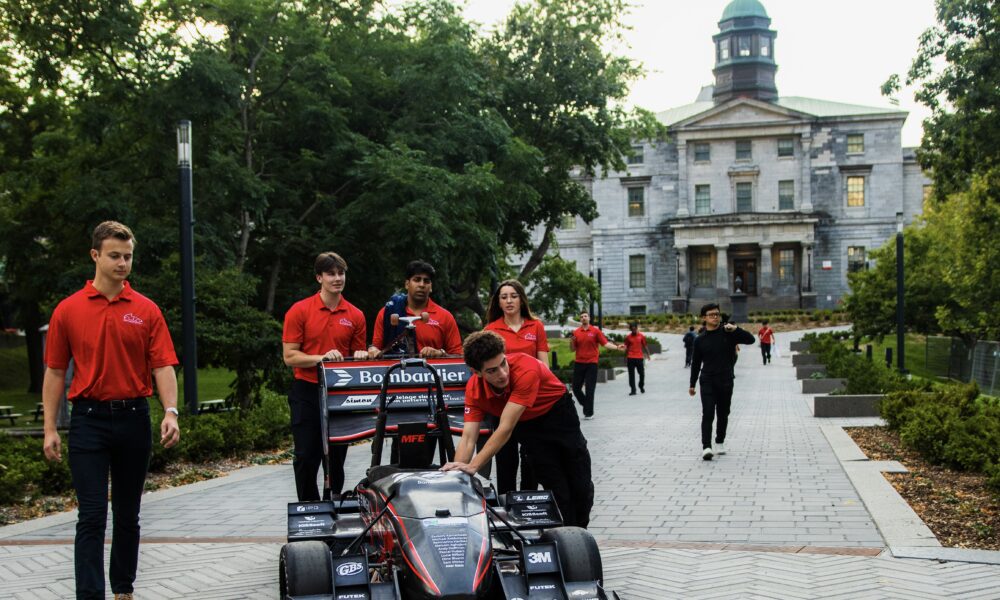

If you’ve walked through the McConnell Engineering Building, you may have wondered why on earth a racecar sits in the centre of the lobby. It seems vaguely fitting—after all, it is the engineering building—but the central questions remain: Who built it, and why?
The answer: McGill Formula Electric (MFE).
MFE is McGill’s Formula One team. It competes in events organized by the Society of Automotive Engineers (SAE), with the season culminating in a key competition each June in Michigan.
At MFE’s workshop, U3 Electrical Engineering student and team captain Raj Kirpalani, and the team’s technical program manager Lora Izambard, U3 Mechanical Engineering, detailed the inner workings of the mysterious team that lurks in the McConnell basement in an interview with The Tribune.
“When people think about Formula One within a student context, they think Formula One with a slightly smaller car, which is actually not really exactly how it goes,” Kirpalani said. “It is still a very formula-styled car, especially when it comes down to the engineering of it. Things like the aerodynamics and the vehicle dynamics, they stay very similar.”
However, in Formula SAE events, speed is not the only important metric.
“The competition’s goal is really to create well-rounded engineers at the end of the university cycle,” Izambard explained. “Because it does teach you about the actual technical engineering, but you also need to have a very strong background in project management, overall organization, managing the budget, managing logistics, [and managing] a lot of business and commercial relationships.”
The competition is split into seven categories, only four of which involve the car actually moving. There is an acceleration event—a 75 metre dash, if you will—and a 22 kilometre endurance event. A ‘Skid pad’ event measures cornering capabilities, and, lastly, teams compete in the traditional ‘Hot Lap’ race around the track.
After months of designing, manufacturing starts with a bang during an intensive, month-long chassis layup session; over these weeks, the team works 24/7 to build the structural frame for the car. While most North American university teams rely on welded steel-tube skeletons, MFE boasts a carbon fibre monocoque. This single-piece frame allows their final design to be lighter with increased torsional rigidity, helping the frame resist twisting under pressure.
Next, each subteam attaches its pseudo-independently constructed systems to the chassis, ultimately creating a functional car. The team then tests the car until competition season arrives.
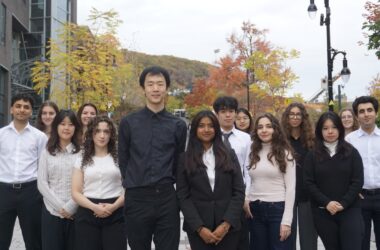
By competition season, a central transition has occurred: What starts as a muddle of 400 general members—with disciplines ranging from engineering and computer science to business and history—grows into one cohesive community.
“MFE feels like a very close-knit family where, especially when the workload gets very tough, I think we lean a lot on each other,” Kirpalani explained. “I think a lot of people would think that if you get so involved in the design team, you might lose out a bit on that side of your social life [….] I would almost say it’s the opposite […] [MFE] kind of becomes a friend group in and of itself.”
The MFE community, however, is decidedly male-dominated. While women make up 35 per cent of McGill engineering students, they account for 25 per cent of the MFE team leads. They are actively addressing this by implementing women-only workshop sessions and collaborations with groups like POWE McGill.
“It’s one of my personal life battles, getting more girls on the team,” Izambard said. “I want to keep emphasizing that we’re super open, and that […] we actually need more women.”
Still, MFE works to foster feelings of belonging. They host social events for members, have holiday traditions, and participate in events like Engineering Frosh.
“We have an award ceremony at the very end of every competition, at the Airbnb, just for us. And it’s cute awards like ‘rookie of the year,’ stuff like that, to really bring us together.” Izambard said.
While many join teams like MFE with their resumes in mind—many of the leads intern at companies like the Canadian Space Agency, Tesla, and Astranis—MFE’s sense of community is what keeps people coming back year after year.
As Kirpalani said, “You come for the CV-building and the technical [skills], but you stay for the family.”
MFE is hosting a competition for its car’s wrap design, with submissions open until Dec. 10.


