
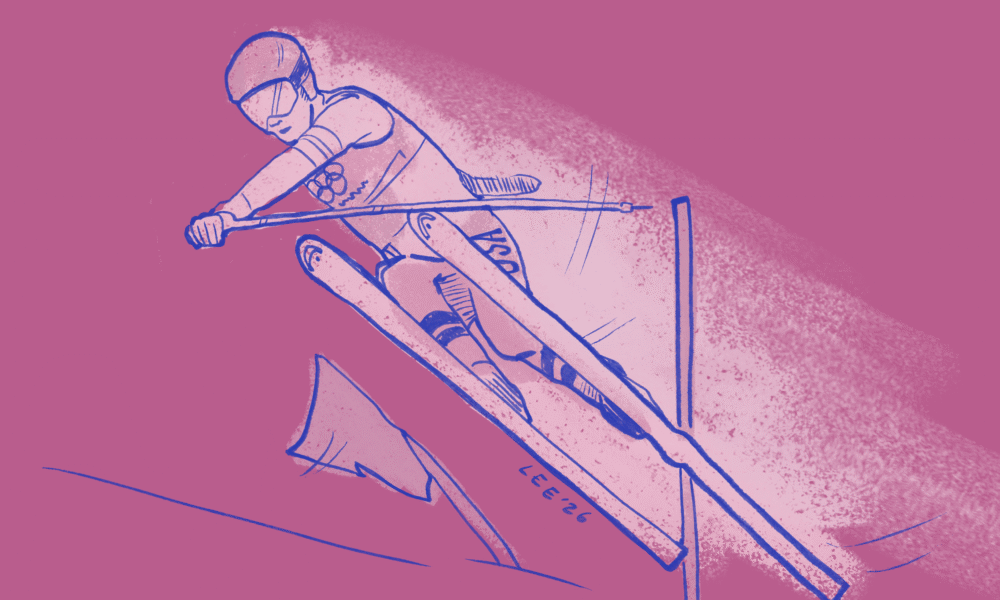




13 seconds. That is all it took for an iconic Olympic comeback to collapse into chaos.
One moment, Lindsey Vonn was charging down the Olimpia delle Tofane at highway speeds. The next, she was tumbling violently down the hill, skis dangerously strapped in as her body crumbled. A stunned silence blanketed Cortina d’Ampezzo while medics rushed to the slope.
The crowd watched anxiously as a stretcher bed dangled in the wind below a helicopter, which would airlift Vonn away. She had suffered a complex tibial fracture just nine days after completely rupturing her anterior cruciate ligament (ACL). For many, it was a grim sense of déjà vu: Another brutal crash, another potential career-ending injury.
But once the shock faded, a question remained: In elite sport, who decides when an athlete is truly ready to return from injury?
The stakes are immense because Vonn’s legacy is enormous. This was not a reckless newcomer chasing headlines, but one of history’s most decorated skiers—an Olympic downhill champion and multi-time World Cup winner who spent two decades mastering a highly dangerous sport.
Athletes at this echelon understand risk intimately. It is woven into every choice they make. This experience suggests that Vonn’s decision to race with a completely ruptured ACL was not an act of carelessness, but of conviction.
At the heart of the debate is athlete autonomy. Elite competitors spend years developing an almost forensic awareness of their bodies. They know the difference between pain and injury, fatigue and failure, fear and focus. In downhill skiing, where racers hurtle down thin snow at breakneck speeds, readiness cannot be reduced to a scan or a checklist. Confidence, reflexes, and instinct matter just as much as ligament integrity. To deprive an athlete of the final decision feels, to many, like stripping them of ownership over their own lives.
However, medical science complicates this narrative. Doctors are trained to see what competitors are incentivized to ignore. While an athlete faces different external and internal pressures—national expectations, sponsorships, and the haunting fear of a closing ‘window’—a physician sees the mechanical reality. A compromised joint increases the probability of catastrophic failure, regardless of how sharp a racer may feel in training. This creates a difficult dilemma: Should medical teams hold absolute veto power while medals and careers hang in the balance?
In a definitive sense, Vonn’s crash was probably not preventable. Downhill skiing routinely claims perfectly healthy racers. This particular accident began with a single, technical mistake—a clipped gate and lost balance. Yet, repeated serious injuries inevitably shift the conversation toward recovery standards and risk tolerance. In the high-velocity world of alpine racing, the distinction between a freak accident and a foreseeable disaster is often only visible in hindsight—and in Vonn’s case, the timing offered some relief: She was reassured that her ruptured ACL had played no role in her Olympic crash just days later.
Another dimension of the debate is the gendered lens through which the public evaluates high-stakes decisions by women in sport. When women in sport make high-risk decisions that end poorly, the backlash is often merciless. The rhetoric that “she should have known when to quit” ignores the psychological gravity of elite competition. For these athletes, retirement is not a simple career change: It is often an identity crisis. Had Vonn chosen safety over the start gate, the ‘what if?’ might have haunted her longer than any physical fracture.
We see this double standard often. When Simone Biles withdrew from Olympic events to prioritize her mental health, she initially faced backlash before later being hailed as a pioneer. When Serena Williams returned from life-threatening childbirth complications, her ambition was celebrated until her results wavered. Women are often applauded for their determination only until it pushes past what spectators deem ‘reasonable.’ At that point, ambition is recast as irresponsibility.
The reality is that for an athlete like Vonn, there is no ‘right’ choice: Compete and risk disaster, or step aside and endure a lifetime of regret. Following her crash, Vonn wrote in an Instagram post, “I hope if you take away anything from my journey it’s that you all have the courage to dare greatly.” For those whose identities are forged in the arena of sport, her words serve as a reminder that both racing and walking away carry a heavy cost—and that the courage to choose, however imperfectly, is what defines greatness.