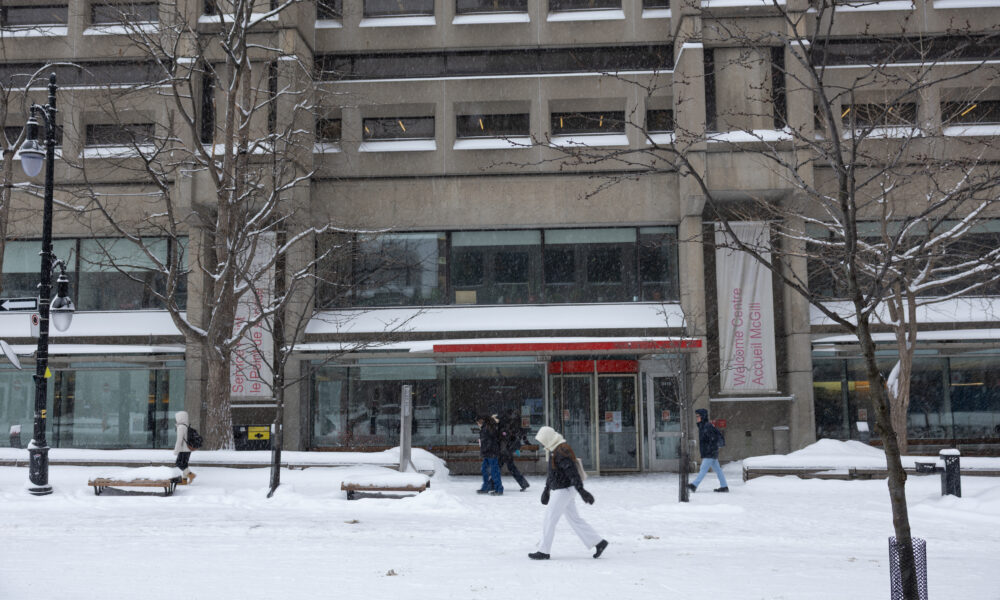



In February of 2025, following the completion of her honours-level Bachelor’s degree in clinical nutrition in Gaza, Aya was admitted to McGill’s M.Sc. thesis program in Human Nutrition. Now, a year later, she remains trapped in Gaza, unable to provide the necessary biometric data to complete her application.
Because of limited border crossings in Gaza under Israel’s genocide and the lack of a visa application centre (VAC) in Palestine, Aya was forced to defer her admission to McGill to the Winter 2026 semester, and then again to the Fall 2026 semester. With the former now well underway, she has yet to receive the support she needs to provide her biometrics. This would result in a third deferral, after which she will lose her offer of admission.
“This opportunity [to attend McGill] represents years of hard work finally being recognized,” Aya said in an interview with The Tribune.
Aya is one of 130 Palestinian students who have been accepted into Canadian universities but remain barred from travel to begin their studies; 70 of these students, like Aya, are trapped in Gaza even after the ceasefire, while 30 have evacuated to Egypt.
The biometric requirement that holds Aya in Gaza has already been circumvented by a number of countries—including the United Kingdom, France, and Ireland. These countries have all established programs to either evacuate students to Egypt or Jordan to obtain biometrics, or to waive the biometric requirement entirely, with the understanding that students in Gaza face exceptional circumstances and cannot be held to standard visa stipulations. In 2022, under this same logic, Canada—rightfully—waived the biometric requirement for some Ukrainians fleeing Russia’s war in their country. The same support has not been extended to Palestinian students.
“I know students who got scholarships from other countries and [have] been evacuated and started their degrees, but there’s [still] no action [from the] Canadian government to help us get evacuated from Gaza,” Aya said.
While awaiting political action from the Canadian federal government and Immigration, Refugees and Citizenship Canada (IRCC), Aya is working full-time as a nutrition officer with an international non-governmental organization (NGO).
Though the famine has subsided, malnutrition persists in the Gaza Strip as food remains expensive and insufficient—a scarcity created and upheld by Israel’s continued restriction of food supplies into the region. Her days involve supporting malnutrition screening, food distribution, and medical treatment, while her evenings are spent taking independent online courses to supplement her work.
“Living in Gaza, we continue to struggle under extremely difficult conditions, as there is still severe food insecurity [….] A lot of children and pregnant, lactating women are malnourished. The struggling is still the same,” Aya explained. “Even when food enters Gaza, prices remain extremely high, converted to before the genocide, and most families have no source of income.”
From Aya’s nutritional perspective, the food in Gaza is not just deficient in quantity, but also in quality.
“Even what enters Gaza is for commercial use, a lot of snacks, a lot of […] energy drinks,” Aya said. “It’s not high-quality food, [like] vegetables and fruits, to resolve the malnutrition impact in children, in elderly people.”
In Gaza, expertise in clinical nutrition like Aya’s saves lives. By failing to facilitate Aya’s education and research at McGill, the Canadian government and IRCC are denying a lifeline to those in Gaza, where Aya plans to return after her studies.
“These delays affect far more than one individual future,” Aya said. “When opportunities like these are lost, the impact extends to [the] entire community, as my goal has always been to return and help my community in Gaza.”
For Palestinian scholars in Gaza today, education is not so much a personal undertaking as it is an imperative responsibility to their Palestinian homeland and those who remain in it.
“That’s why we are looking for this opportunity,” Aya said. “It’s not a choice. It’s mandatory to have a good education.”
The future of Gaza lies in academic expertise capable of rebuilding from the ground up.
“Supporting our ability to study,” Aya said, referring to all prospective Palestinian students and scholars, “is also an investment in the future recovery and resilience of our community.”


