

After completing a Bachelor’s degree in Information Technology (IT) from the Islamic University in Gaza, Nada stayed on to begin an IT Master’s program in September 2023. By Oct. 11, 2023, the Israel Defense Forces (IDF) had razed her university to the ground.
“I felt like, ‘Okay, […] I can’t go back. I cannot go back there now,’” Nada said in an interview with The Tribune.
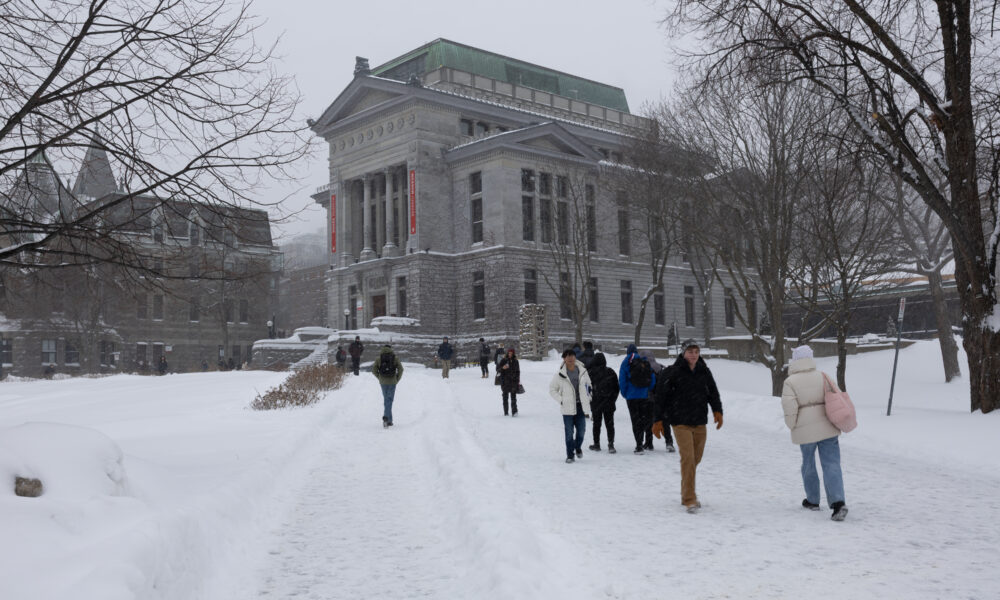
In May 2024, Nada evacuated the Gaza Strip to Cairo, Egypt, with her family. From there, she applied to McGill. With funding and application support from the Palestinian Students and Scholars at Risk (PSSAR) network and McGill Computer Science Associate Professor Paul Kry, she was accepted to the Computer Science Master’s Program in July 2024.
“[McGill] was my first choice because it’s one of the top universities in Canada, and I’ve heard a lot of good things about it,” Nada told The Tribune. “So I felt like, ‘I’m going to be welcome there.’”
She submitted her student visa application in December 2024, and today, more than a year later, Nada remains stuck in Cairo, working as a remote lecturer for students in Gaza. She is currently waiting for Immigration, Refugees and Citizenship Canada (IRCC) to approve her visa in time for the Fall 2026 semester. Without the visa, her McGill admission will be revoked.
Nada is one of 130 Palestinian students accepted into Canadian universities but barred from travel to begin their studies. 70 of these students remain trapped in Gaza even after the ceasefire, while 30 have evacuated to Egypt. For those in Gaza, where there is no visa application centre, obtaining the biometric data required for a visa application is impossible. But even those who, like Nada, evacuated from Gaza and submitted the requisite biometrics, still find themselves paralyzed by IRCC’s discretionary impunity.
When asked about the value of education for her, Nada set aside her long list of personal accolades to explain that the pursuit of education lies at the heart of being Palestinian.
“[Pursuing higher education is] actually not unusual, and it has nothing to do with the situation that we’re in right now. Most of the [Palestinian students] are looking for postgraduate degrees. We have one of the highest literacy rates in the whole world,” Nada said.
Gaza has an illiteracy rate of 1.9 per cent, making it one of the most literate territories in the world. In fact, literacy has continued to improve despite Israel’s genocide in the Gaza Strip.
Today, all twelve universities in Gaza have been destroyed by the IDF. Still, Palestinian students and scholars have only redoubled their efforts to attain an education that now reflects not only a hunger for learning, but an investment in the reconstruction of Gaza—their home.
“Most of the people who are looking for opportunities to study abroad [are] looking to have, like, two years or three years outside to see the world and then come back to their normal life, their people, their community, or their house and everything that they own,” Nada explained to The Tribune.
“I want to live the experience of studying abroad and getting the knowledge from a very different perspective than the one that I know [….] And I really, really want to take this back, and I want to share it with my students. I want to share the information. I want to share the knowledge.”
But before the ongoing advocacy for Palestinian students and scholars admitted to Canadian universities can elicit substantial results, Palestinians must be afforded individuality independent of their relationship to suffering.
“When it comes to the situation that we are in right now, whether it’s the students who are still in Gaza or the students who are outside of Gaza, we all are stuck waiting for something to happen, for a miracle,” Nada said. “I guess I would love for the people to see us as individuals.”
When asked what she looks forward to upon eventually landing in Montreal, Nada smiled.
“I’m very excited for feeling a new beginning,” she said. “I’ve been feeling stuck in Egypt for the past two years, and I’ve been waiting and waiting and waiting [….] If I got my visa accepted and I was able to come to Canada, I feel like [there would] be so much joy [from] having a new beginning, and having a new experience, and having an actual life.”


