
From uncovering the genes that cause birth defects to serving as Chair of the Board of Directors of the Canadian Black Scientists Network, Professor Loydie Jerome-Majewska has been a catalyst for change across fields. She serves as a professor in McGill’s Department of Pediatrics and senior scientist at the Research[Read More…]
Tag: genetics

How dominant genomic narratives reinforce colonial narratives
The ‘Vanishing Indian’ myth—the idea that Indigenous populations are destined to disappear— has long been used to excuse and enact the physical and cultural genocide of Indigenous Peoples in the Americas. This rhetoric remains prevalent in modern genomics, often supporting the treatment of modern Indigenous Peoples not as autonomous communities,[Read More…]

SCAnning the genome to uncover the genetics of a neurological disorder
Recent advances in molecular biology techniques are bringing new insights into complex diseases. These insights extend to spinocerebellar ataxias (SCAs), a group of progressive neurodegenerative disorders characterized by the deterioration of the cerebellum—a brain structure critical for balance and movement coordination. In 2019, between 30 and 48 per cent of[Read More…]
When a DNA test doesn’t go the way you expected…
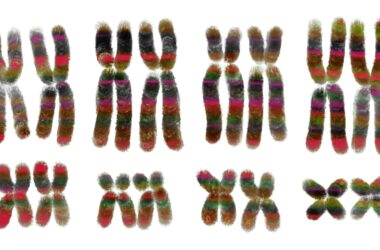
Imagine taking what appears to be a harmless DNA ancestry test, expecting to uncover more information about your heritage, only to be met with the discovery that your assumed parent is not biologically related to you. Direct-to-consumer DNA tests—such as those provided by 23AndMe and Ancestry—typically provide three pieces of[Read More…]
Solving the bacterial genome: Visualizing chromosome segregation

A potential powerhouse for curing mitochondrial diseases
On March 26, 2024, the Annual George Karpati Lecture invited Dr. Rita Horvath from Cambridge University to speak on mitochondrial medicine—to share her expertise on everything from mechanisms to treatments. Horvath has spent over 25 years studying genomics and biochemistry for the diagnosis and treatment of rare neurological disorders. The[Read More…]

McGill iGEM takes on innovative synthetic biology research
Many undergraduate students desire to delve into research at McGill in labs led by primary investigators and professors. Undergraduates themselves, however, have equally promising initiatives to lead exciting investigations. One of these student groups, McGill iGEM, is an undergraduate synthetic biology research team that has made impressive progress in recent[Read More…]

Ball python pigmentation research is coloured in by crowdsourced data
When you think of genetics research, what animals first come to mind? Fruit flies? Mice? Our understanding of genetics is defined by a small number of model organisms—the ones used to study a particular biological phenomenon because of how similar their genes are to humans. Mice are the most common[Read More…]

Mapping behaviour using genetic biomarkers
What if you could visibly lay out your entire genome sequence in front of you and see almost everything that explains who you are, from your eye colour to whether you’re an introvert or an extrovert? If this were true, we look at someone’s genes and calculate whether they will[Read More…]

The glowing DNA that can act as protein motion sensors
In the methodical world of scientific research, there is irony to be found in serendipitous stories of discovery. More often than expected, a scientist’s day in the lab is filled with more head-scratching than “eureka” moments. It is in these moments that a curious scientist would dig deeper, even in[Read More…]


