

Noah Margo-Dermer worked in a summer camp as a music programming director for the past two summers. After the summer of 2013, Margo-Dermer decided to take a step into the world of busking.
“After playing music so much over the summer, I missed it,” he said. “So out of the blue, I decided to go busking at the Sherbrooke metro to see what it was like and to see if I could actually make any money doing it [….] I did pretty well. [It was] definitely better than minimum wage.”
According to Margo-Dermer, he found a lot of similarities between working his summer job and busking in the metro.
“There were a lot of parallels […] in terms of engaging kids in the summer camp and trying to engage random people walking by,” he said. “[The latter] is actually a lot harder and scarier.”
Margo-Dermer credits the Montreal busking system for his willingness to busk.
“I do really love how easy it is to just go busking at one of those [lyre] signs in the metro,” he said. “I don’t think the system is disorganized. I think a better word might be ‘unconventional’ because so many other cities require buskers to get licenses. I think because [Montreal’s busking system] is so simple and intuitive, it makes it easy to keep the whole thing running and in theory makes busking accessible to anyone. Had I had to get a license, I probably would have never gone.”
Although Margo-Dermer researched the system in Montreal while he was contemplating busking, the first day he went to busk was a spontaneous decision. For Margo-Dermer, it is this spontaneity that makes it difficult to commit to it.
“[Busking] is not totally a structured thing, and that is why I don’t think I kept on doing it—because you need that drive,” he said.
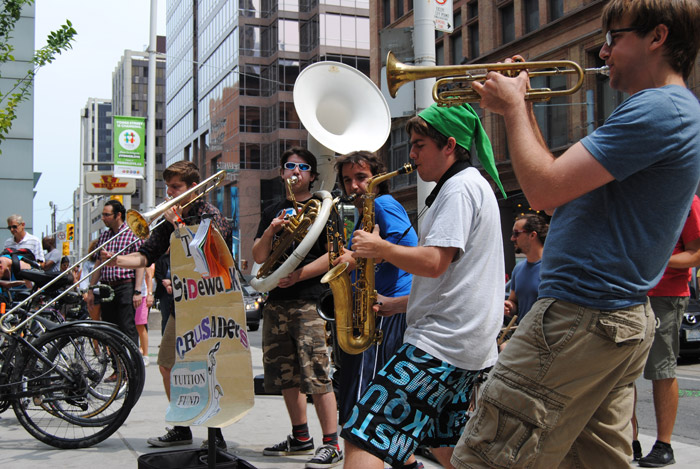
Busking for thought
More in a:
-
 Boundless: McGill Tribune Special Issue
November 30, 2016
Boundless: McGill Tribune Special Issue
November 30, 2016
-
 The Sport Authority EP. 7: Looking back at Sam Hinkie and The Process
April 12, 2016
The Sport Authority EP. 7: Looking back at Sam Hinkie and The Process
April 12, 2016
-
 Rare books: The hard spine of the modern library
April 5, 2016
Rare books: The hard spine of the modern library
April 5, 2016