


On Jan. 6, far-right supporters of former United States President Donald Trump stormed the American Capitol Building in an attempted insurrection that killed five. Throughout Trump’s presidency, far-right extremist hate groups proliferated on social media and in public spaces. Political figures, including the president himself, have also depreciated the gravity of their own actions, which has in turn brought far-right radicalization into the mainstream.
Far-right extremism, also referred to as the extreme right, is defined as a branch of right-wing political ideology and action that is more radical than the mainstream realm of conservative politics.
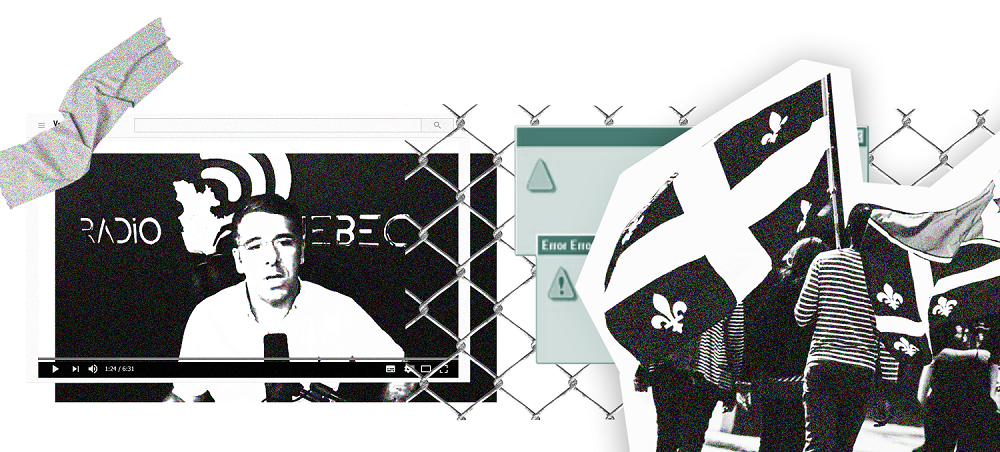
Some Canadians may see far-right politics as a distinctly American phenomenon, but far-right hate groups have long been lurking across the country, including in Quebec. Four years ago on Jan. 29, a far-right extremist killed six and injured 19 at a Quebec City mosque, inspiring similar attacks around the world in years to come. Much like in the U.S., Canadian extremist networks have only grown stronger through social media, and even more recently, the COVID-19 pandemic.
In Quebec, the far-right has existed for decades. Frédérick Nadeau is a Social Sciences and Humanities Research Council postdoctoral fellow at the Centre of Expertise and Training on Religious Fundamentalism, Political Ideologies and Radicalization (CEFIR), a research centre focussing on political radicalization based in Cégep Édouard-Montpetit. According to Nadeau, the existence of far-right movements in Quebec dates back to at least to the Quiet Revolution. Up until around the 2010s, however, such groups generally flew under the radar. For the first half of the decade, these groups were mostly made up of young skinhead neo-Nazis.
“Starting in 2015-2016, with La Meute, the Soldiers of Odin, and Storm Alliance, we see that the extreme right becomes less ‘clandestine,’” Nadeau wrote in an email to //The McGill Tribune.//* “It abandoned the [neo-Nazi] approach characteristic of the skinhead groups prior to 2015, and adopted a more (ultra)nationalist and identity-based ideology.”
In essence, far-right extremist groups became more palpable, making the average person more likely to get involved, thus rendering them more accessible to new demographics. Nadeau explained that the makeup of these groups has shifted from primarily young, violent skinhead types to middle-aged workers and otherwise ‘ordinary’ people. As these shifts in formal or informal group membership occured, public debates sprang up over several controversial pieces of legislation.
“This trend can be linked to the opening of the floodgates we see in the wake of debates surrounding reasonable accommodations (2006-2008), and the Charter of Values (2013), which permitted a normalization of hostile discourse towards immigration and Islam,” Nadeau wrote. “We therefore encounter a plethora of xenophobic and islamophobic groups on social media, and we see groups looking to exit the virtual space to materialize in the ‘real world.’”