


Content warning: Police brutality, racial violence
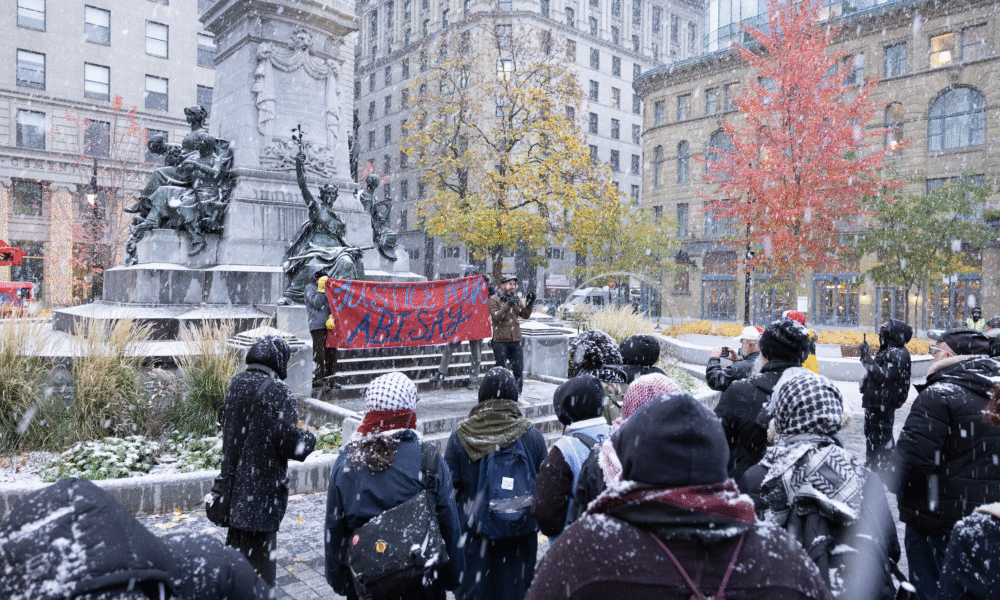
Despite freezing rain, a group of approximately 50 protestors rallied in Montreal’s Philips Square at 3:00 p.m. on Nov. 9 to march with the Defund the Police Coalition to denounce instances of police brutality in Greater Montreal this year.
On Sept. 21, 15-year-old Afghan-Canadian Nooran Rezayi was with his friends when an individual called 911, telling emergency services that a group armed with weapons was at the intersection of rue Joseph-Daigneault and rue de Monaco in Saint-Hubert. Officers with the Service de police de l’agglomération de Longueil (SPAL) arrived ten minutes later. Within 58 seconds, one of these officers—whose identity remains unknown—shot Rezayi twice, killing him.
In another act of police violence, on March 30, Latinx man Abisay Cruz was killed by Service de police de la Ville de Montréal (SPVM) officers, who were responding to a call regarding a person in crisis. While three officers handcuffed Cruz, one of them forced his knee into Cruz’s upper back. In a video captured during the altercation, Cruz can be heard yelling, “I’m going to die.” Moments later, he lost consciousness. After being transported to a hospital, Cruz was declared dead. His death is currently under investigation by the Bureau des enquêtes indépendantes (BEI).
Protesters at the rally directly called out the BEI, Quebec’s police watchdog that investigates potential misconduct. Since its implementation in 2016, zero of the 52 BEI cases concerning police officers who have fatally shot civilians have resulted in charges against an officer. Quebec’s Ligue des droits et libertés has questioned the BEI’s independence, citing its reliance on police services in initiating its investigations, and the fact that the majority of BEI staff come from the policing sector.
One of the speakers at the rally discussed a recent provincial decision allowing police officers to remain silent and withhold information during BEI investigations.
“The Court of Appeal of Quebec decided that it was more important to protect the right to silence than the right of the public to information,” the speaker stated. “The police officer who killed Nooran told himself that in Quebec, you can kill anyone, anyhow, as a police officer, because the system is behind you.”
The SPAL, responsible for Reyazi’s killing, has been held in high public regard recently as a reformed, community-oriented police organization. In an interview with The Tribune, an individual at the rally who wished to remain anonymous spoke about these reforms.
“We’ve seen that not only are they not effective, but they are used by the police to justify further killings, imprisonment, [and] surveillance,” the attendee said. “We [need] to move towards mutual aid. We [need] to move towards systemic changes that eliminate the conditions that lead to […] crime in the first place.”
Another individual, who wished to go unnamed, commented on their experiences with police violence at previous protests.
“You can’t expect the police to police themselves,” they shared, in an interview with The Tribune. “I was forcibly pushed by an [(SPVM)] police officer at the March 15 protest [against police brutality]. I could have been seriously injured [….] My cameras were damaged.”
The individual added that rallies are an important way of fighting police repression and making the cause visible.
“Excessive force shouldn’t happen at all [….] When police brutalize [protestors] and people see that, it has a dissuading effect [on protest attendance],” they said. “We have to put pressure on our politicians.”
In recent times, there has been an increase in heavy and often violent police presence on McGill’s downtown campus, such as SPVM’s presence at Independent Jewish Voices’ peaceful celebration of Sukkot in October, at Association of Graduate Students Employed at McGill (AGSEM) protests in 2024, and at pro-Palestinian protests throughout 2024 and 2025.
A 2019 report commissioned by the City of Montreal found systemic bias in street checks performed by Montreal police; compared to white people of the same age, Indigenous, Black and Arab people between ages 15 to 24 were four to five times more likely to be targeted by checks. In 2024, the Black Coalition of Quebec filed a $171 million CAD class-action lawsuit alleging that the City of Montreal was responsible for systemic racial profiling within its police force; a Quebec Superior Court judge agreed.
Some quotes in this article have been translated from French.