


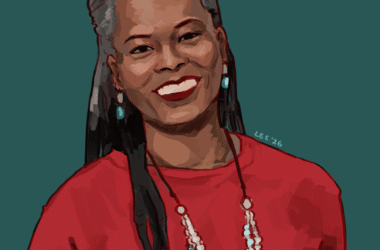

Food. Gender. Tech. Queer history. What do these topics have in common? They are all key research areas for Alex Ketchum, a historian and an Associate Professor in McGill’s Institute for Gender, Sexuality and Feminist Studies, whose research explores how these topics intersect.
Ketchum has long been interested in feminist and queer theory, incorporating them into her studies. She pursued her Bachelor’s degree at Wesleyan University, and both her Master’s in History with a specialization in Gender and Women’s Studies and her PhD in History at McGill.
Ketchum studied feminism in the 1970s—a salient period in second-wave feminism when women first stood up against the oppression inherent in unpaid domestic labour—for her honours undergraduate thesis. She wrote about the Bloodroot Vegetarian Restaurant in Bridgeport, Connecticut—a feminist establishment which has since permanently closed after 48 years of operation. Her Master’s and PhD expanded on her previous work by focusing on the history of feminist restaurants across Canada and the United States.
Ketchum’s work materialized in two books. Ingredients for Revolution examines the labour dynamics of feminist restaurants and how they challenged traditional hierarchical restaurant structures by experimenting with new ways of organizing labour and compensating staff. Queers at the Table is a collection of essays, recipes, and comics that illustrate the relationship between queerness and food.
In 2019, Ketchum launched a speaker series through which she organized over 100 events spotlighting feminism and accessible communications and technologies. As part of this project, Ketchum was named one of the 100 Brilliant Women in AI Ethics in 2021.
While researching the themes of feminist communications technologies for the speaker series, she became interested in queer groups such as the High Tech Gays and Digital Queers, which organized 2SLGBTQIA+ workers in tech companies, particularly in Silicon Valley and the Pacific Northwest. These workers brought together their technical expertise to support 2SLGBTQIA+ nonprofits and community organizers.
“Queer people transformed the internet,” Ketchum said in an interview with The Tribune. “The internet transformed queer people. But [what came out of this project] is a larger argument about the kind of mundane aspect of activism and information. Activism is much more than marches […], but so much of it is about teaching people and information sharing.”
To conduct her research, Ketchum primarily combines interviews, literature reviews, and archival research.
“I love going to archives more than anything in the world,” Ketchum said. “It is my favourite part of research. I am looking through photographs, […] audio materials, or old foam clips.”
Ketchum noted, however, that researching marginalized communities presents challenges.
“When […] you are doing research around marginalized communities, […] you sometimes have to deal with different kinds of pushback or backlash, like trolling, doxing and death threats,” she said. “As we are seeing an increase in homophobia and transphobia, it is emboldening bigots, so there is just starting to be a bit more harassment [….] Also, sometimes work on different marginalized communities is not taken as seriously.”
Ketchum is committed to making her work accessible beyond academia. In her book, Engage in Public Scholarship!, she argues that academic research should be communicated in ways that reach broader audiences.
Her most recent research project explores how space programs have historically defined the “ideal astronaut” and excluded queer people from space exploration. It also examines how the 2SLGBTQIA+ community responded through activism and creative visions of a more inclusive future in space.
“If you look at my […] career, it might seem like I had a plan, […] but a lot of times, when we look at other people’s careers, we do not see how winding the path was. But I think the thing that has helped me through the different trials and tribulations is I kept following the passion and making decisions about things that I was interested in and trusting my gut about staying committed to my values.”
For people interested in this research, Ketchum is also organizing the Queer Food Conference at McGill from May 1 to May 3, 2026, for which students can register.