
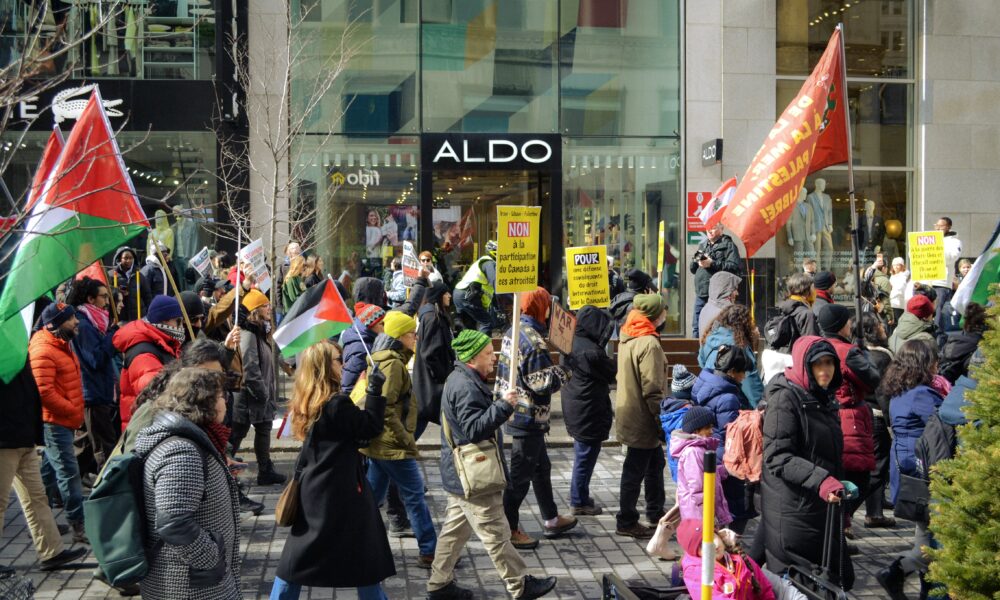


Hundreds gathered at Dorchester Square on March 21 at 1:30 p.m. to protest what organizers described as a war led by the U.S. and Israel across the Middle East. Demonstrators filled the downtown park with Palestinian flags, anti-war banners, and chants of “Ceasefire now” and “Ça suffit” to voice their opposition to military operations targeting Iran and Lebanon, and to condemn Canada’s role in the escalation.
The rally was organized by a coalition of grassroots groups: Coalition du Québec Urgence Palestine, Collectif Échec à la guerre, Divest for Palestine, and the Palestinian Youth Movement. They framed the demonstration as part of a broader international movement against war, militarism, and Western intervention.
According to the United Nations, more than 1,000 people have been killed and over 2,500 injured in Lebanon since early March, with more than 1.2 million displaced. Aid agencies warn that continued escalation could push up to 45 million people worldwide into acute hunger, as supply chains and fuel costs would be disrupted.
Strikes have also targeted Iranian infrastructure, including nuclear facilities. For many demonstrators, these developments were central to their decision to take to the streets. In an interview with The Tribune, Boutaïna Chafi, the media representative for the protest, explained that the loss of human life is what brought many onto the streets.
“We’re talking about the tens of thousands of people in Lebanon from the south being displaced, and people living in makeshift tents and on the beach, and being bombed every day in Beirut,” Chafi said. “In Iran, we are talking about critical infrastructure for daily life to be sustained that are being purposefully destroyed by Israel and the U.S.”
International agencies have echoed concerns about civilian harm. UN officials report that airstrikes have destroyed residential buildings in densely populated areas, often killing entire families. In Lebanon, dozens of healthcare workers have been killed, while hundreds of schools are now being used as shelters for displaced families.
A central theme of the protest was Canada’s perceived complicity in the conflict. Demonstrators accused the federal government of supporting U.S. and Israeli military efforts through arms exports and political alignments.
Two demonstrators, Lisa D. and Sam B., who were at the protest with the Revolutionary Communist Party, emphasized Canada’s complicity in the war.
“Canada has a responsibility to stop sending arms to Israel and the U.S., and to stop the world from helping and protecting Israel on building sites,” said Lisa D.
Sam B. added: “I think that what people want to show today is that the Canadian people don’t want this war. Nobody wants war. It gives us, as people, nothing.”
Recent polling suggests public opinion in Canada leans strongly against military escalation, with 67 per cent of Canadians opposing involvement and favouring a neutral stance. A representative of the Mouvement québécois pour la paix (MQP) spoke with The Tribune, criticizing Carney’s lack of decisiveness on the issue and appeasement to the U.S.
“[Carney] knows that around 70 per cent of the Canadian population is against the war in Iran and is against any policy or position that will accompany the United States,” the representative, who asked to remain anonymous, said. “At this stage right now, Canada does not do much for the war in Iran, but it’s the absence of condemnation which speaks volumes, especially when Carney claims to want a foreign policy independent from U.S. demands.”
Criticism of Canada’s role extended to its membership in the North Atlantic Treaty Organization (NATO), which protestors described as a vehicle for U.S. foreign policy. The representative from MQP described it as an obsolete organization.
“We understand NATO to be primarily a U.S. tool of foreign policy, despite the propaganda depicting it as a defensive organization,” the representative said. “It had a role during the Cold War. Yet, since the fall of the USSR, we’ve seen that it has been involved in Libya, Yugoslavia, and in Afghanistan for example. Ultimately, it has been used as a tool for U.S. domination.”
Chafi situated the current conflict within a broader historical pattern of intervention.
“This is a playbook that they’ve always, always used in the region,” Chafi noted. “They see a country that is able to sustain itself despite sanctions, and they will just come in and destroy everything that is needed in order for people to survive. This is what’s happening in Cuba right now. This is what they’ve tried doing in Venezuela. They’re doing it right now in Iran. They’ve done it in Iraq. This is the same playbook that has not changed. And so this is why we’re able to see through the narrative that the U.S. is pushing through, that democracy is not something you bring by destroying and killing people.”
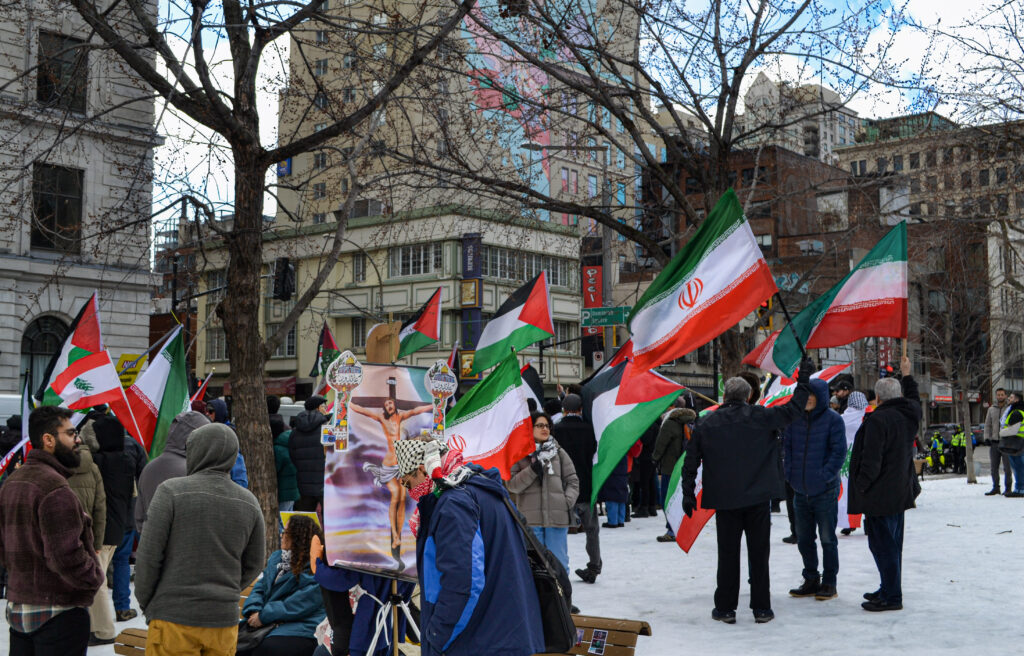
The representative from MQP also criticized the role of Canadian institutions, including McGill, in global militarization.
“McGill has multiple ways in which it directly contributes to the military industrial complex,” the representative affirmed. “We know that McGill does a lot of research with regards to the production of military goods and high-tech missiles. McGill did research on thermobaric weapons, and most of those were sold over to American industrial complexes that are then utilized to bomb various countries across the world [….] We’ve also seen McGill being extremely hostile to the youth, expressing its demands for Canada taking a real position against genocide, against massacres. So McGill plays a very important role, I think, both in legitimizing wars, but also in producing wars.”
McGill’s Media Relations Office declined to comment on these claims.
The demonstration brought together a wide range of political perspectives, from anti-imperialist activists to Quebec sovereigntists. Andréa, who attended carrying a Québec Solidaire flag and withheld her last name, described this as a matter of self-determination: A principle in the United Nations Charter affirming the right of peoples to determine their political status and pursue their economic, social, and cultural development.
“As an independentist, personally, I cannot claim the right to self-determination for my own people without demanding it for others who need it,” Andréa said. “Supporting Palestine, supporting all oppressed peoples around the world, that’s the foundation when you are an independentist.”
Andréa also criticized what she described as a broader shift in political discourse when asked about media coverage of this conflict.
“Misunderstood or poorly conveyed, that’s the question. Unfortunately, there has been a shift in political discourse toward the right over several years since […] the early 1980s,” Andréa said. “The discourse has shifted to the right, and it continues to shift to the right on absolutely all issues. Fascism, misogyny, all of that is part of this rightward shift, orchestrated by the richest people in the world, who basically profit off the blood of the poor.”
Chafi also emphasized that domestic migrant justice is linked to international conflicts.
“There’s a significant part of the migrant diaspora here who has migrated to this country as a result of intervention, as a result of coups, as a result of government changes,” Chafi said. “The rights of migrants are fundamental to our struggle, because most of us in the streets, most of us in these movements, are either sons or daughters of immigrants or immigrants themselves.”
Other participants expressed more radical critiques. One protestor, who wished to remain anonymous, described Canadian political leaders as constrained, arguing that foreign policy decisions reflect a broader system of control.
“Tell me who pays the musicians, and I’ll tell you who calls the tune. Those who control the economy are the ones who command. If they control the economy, they own it. But politicians are only managers. They are not the ruling elite. They do not lead; they are commanded. So when we oppose them and when we rise up, the best outcome is to stop them from continuing their dirty work,” the protestor said in an interview with The Tribune.
Various activist groups at the protest are involved in ongoing campaigns targeting economic ties to the conflict. La Coalition du Québec Urgence Palestine highlights investments by the Caisse de dépôt et placement du Québec (La Caisse), which activists say include billions of dollars in companies linked to Israeli occupation and military activity. The Coalition du Québec Urgence Palestine has since launched a campaign calling for divestment from such holdings, urging Quebecers to pressure public institutions to withdraw investments.
“We refuse to be complicit,” read one flyer distributed at the protest.
While the demonstration focused on public visibility, organizers stressed the importance of continued action beyond the streets.
“There are many things Canadians can do,” Chafi said. “Writing to [Members of Parliament], supporting campaigns like arms embargoes. These are simple actions that can have a real impact. This is about more than one conflict. It’s about the kind of world we want to live in.”
As the crowd began to disperse in the late afternoon, the message of the protest was clear: Opposition to war abroad is inseparable from demands of justice, accountability, and solidarity at home.
*Quotes from Andréa and the protestor who wished to remain anonymous were translated from French.