
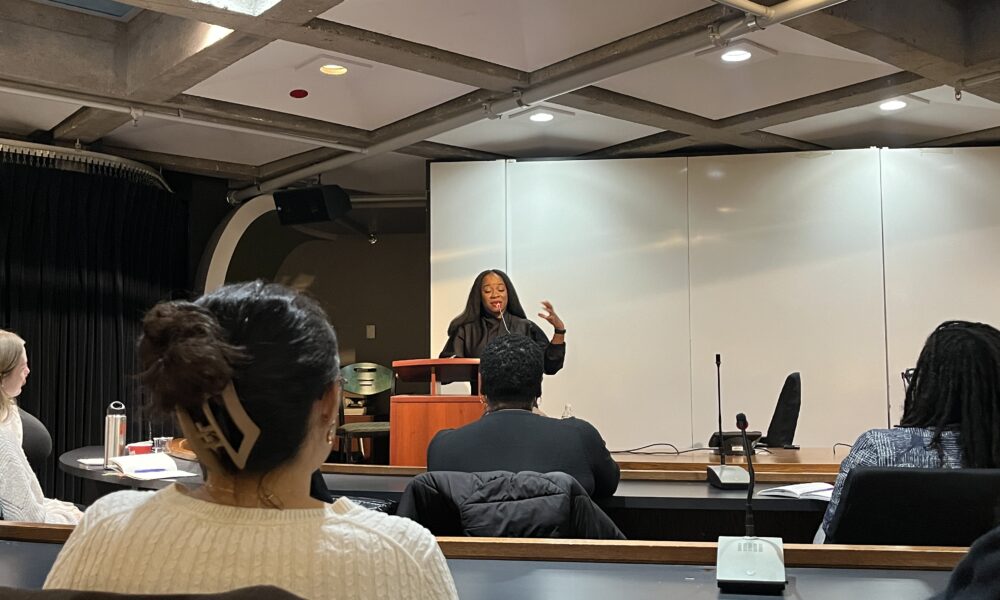



On March 19, the Department of English Student Association (DESA) hosted a guest lecture featuring Titilope Sonuga, a Nigerian-Canadian poet and playwright. Sonuga has previously been appointed Poet Laureate by the Edmonton Arts Council, and she was also the first poet to perform at a Nigerian presidential inauguration. This lecture marks the beginning of DESA’s new Annual African and Diasporic Literature Lecture Series, which will explore regionally specific African literary and poetic traditions.
The event began with DESA president Moyọ Alabi, who addressed the lack of engagement with African and diasporic literature in McGill’s academic field.
“The [lecture series] initiative aims to address gaps in the curriculum by creating space for African and diasporic literary voices, and by providing opportunities for students to engage directly with contemporary writers and their work,” Alabi said.
The microphone was then passed to Sonuga, who started by explaining her atypical entrance into the world of poetry.
“I studied civil engineering. I built roads and bridges, and would write poems in the margins of construction drawings on the side of the road, lamenting my choices and thinking, ‘Why didn’t I study something else, why didn’t I study literature?’” she asked. “I’m a poet whose work is preoccupied with this idea of memory, womanhood, all of our inheritance, and I believe that the spoken word is powerful and prophetic [….] It’s important for me to advocate for this idea of an expanded literary imagination.”
Sonuga underscored her pride in telling and amplifying the stories of West Africa.
“I am blessed to stand in the oral tradition of West African speakers, this lineage of women who are custodians of memory, of lineage, of myth,” Sonuga said. “They are the keepers of songs, of stories that have kept us and buoyed us across oceans […] I speak in stories and poems, and so tonight will be a blend of both, a blend of my personal history and my arrival in this place, and my thoughts about poetry and art and the power that it has.”
Sonuga then recited her poem. She emphasized how Yorùbá—her mother tongue—allowed her to navigate her sense of belonging in the margins of two cultures.
“A poem takes on the attributes of every mouth that it passes through. It is coloured by every finger that grazes the page,” she said. “This dynamic edit made by the living for those left behind to translate what was etched in stone on clay, what was spoken in West Africa.”
She continued by describing a transformation in the language she grew up with and the language she is now most comfortable with.
“In my twenties, I wrote poems on the streets of my childhood, I wrote my way back to myself in a tongue that was not the one my grandmother gave me, but a one I had created for myself, and I let my contradiction sit side by side,” she said. “I found new spaces for parts of me that didn’t quite fit, and I offered myself grace for all the ways I had forgotten and the ways that I never will.”
After the recitation, Amber Rose Johnson, Assistant Professor in the Department of English, moderated a Q&A session with Sonuga, where she shared her own interpretation of Sonuga’s poem.
“This idea of often being a little out of place, a little out of place in the engineering job, and then out of place in the poetry world, and a woman who was too much water, and left-handed and gap-toothed and always being a little kind of on the outside [.…] It is a privilege in some way,” Johnson said.
Sonuga reminded the audience that art shines in the margins, and that emerging artists must not be afraid of failing. They must reposition the periphery as the centre, all the while pushing themselves out of their comfort zone.
“Do it again so you could do it better,” Sonuga said. “There’s no better time than right now. Just do the thing.”
Speaker and DESA president Moyọ Alabi is an editor at The Tribune and was not involved in the editing or publication of this article.