
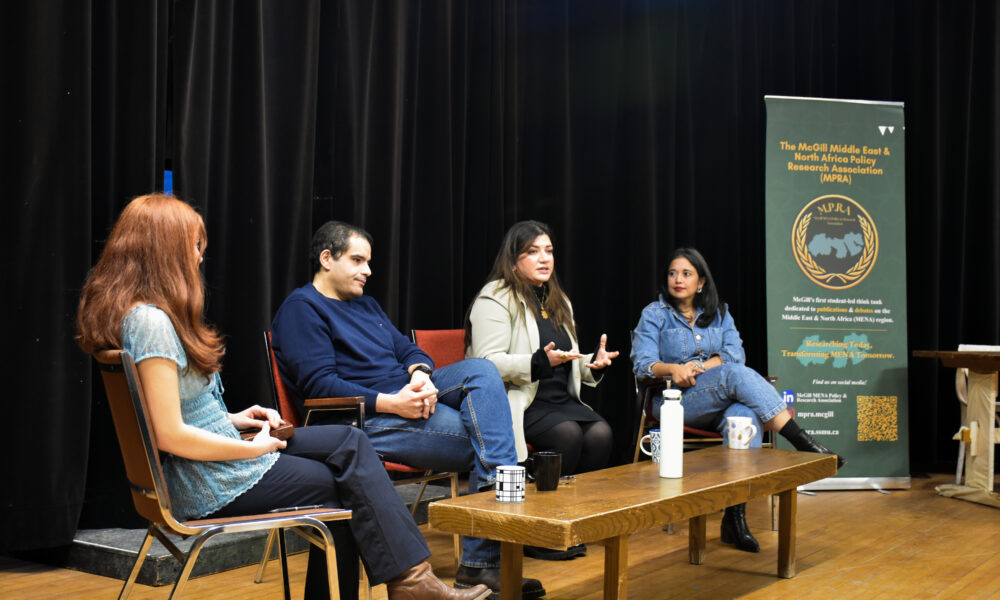



On April 9, the McGill Institute of Islamic Studies hosted a panel event titled “Journalism After Gaza: A Roundtable Discussion on the Present & Future of the Media,” featuring Saman Malik, Sana Saeed, and Kareem Shaheen. The panel was led by Pasha M. Khan, associate professor at the Institute of Islamic Studies and its Chair of Urdu Language and Culture, and moderated by Julnar Aizouki, U2 Arts. The event was hosted in partnership with the McGill Middle East and North Africa (MENA) Policy and Research Association (MPRA), a student-led think tank offering opportunities for research and debate regarding politics in the MENA region. The panelists discussed how the language Western media institutions employ, and the misinformation they promote, delegitimize Palestinian identity and struggle.
The event began with MPRA Editor-in-Chief Christy Khairallah, U2 Arts, spotlighting a card-writing initiative the MPRA is leading in tandem with Palestinian Students and Scholars at Risk: A Canadian nonprofit providing support to Palestinian students who have been admitted to Canadian universities, but are currently stuck in Gaza in administrative limbo.
Saeed, DC-based writer and critic, host and senior producer of Al Jazeera’s AJ+, and creator of the award-winning series The Occupation Style Guide, opened the discussion by describing ongoing hypocrisies in reporting on the genocide in Gaza.
“The last three years of the genocide in Gaza were […] the worst in terms of what we’ve ever seen in terms of news coverage,” Saeed said. “[Reporting was used] to manufacture justification of not just the bombing of a population, but the extermination of an entire nation.”
Shaheen, editor at New Lines Magazine and former Middle East correspondent for The Guardian, followed up by drawing comparisons between coverage of Gaza and propaganda published by major news outlets during the Iraq War, situating current media complicity in the genocide in Palestine within a broader history of distorted coverage in the Middle East.
“During the Iraq war, [journalists] would write these front page articles [with] all this fake information that Iraq had weapons of mass destruction […] and [The New York Times] would publish it uncritically,” Shaheen stated. “The same malpractice is occurring [now] in the way the media is covering these stories [concerning Palestine].”
The panelists next reflected on how, in the past decade, journalists across Canada have repeatedly communicated their discontent with mainstream media’s vague coverage of Palestine through open letters. However, as Malik—director, writer, and former CBC producer for the fifth estate, Big News, and For the Culture—noted, these letters were often met with minimal institutional accountability—if not backlash and aggression.
“Some of the journalists [who signed these letters] were literally taken off of stories. They were blacklisted,” Malik said.
Recounting her experience working with Al Jazeera in the United States, Saeed highlighted how Arab and Muslim journalists who speak out against improper coverage of Gaza are disproportionately persecuted.
“[My coworkers and I at Al Jazeera] started getting emails from [Arab and Muslim] journalists who [asked], ‘Can you remove my name from [coverage discussing Palestine]? I’m being threatened with a dismissal,’” Saeed recounted. “There is activism allowed in journalism, but it’s always one way.”
According to Malik, this practice of targeting journalists on the basis of their ethnic and cultural backgrounds reflects deeper assumptions within the field of media regarding who is allowed to speak with authority.
“This idea of objectivity as it relates to journalism [claims] you can only be objective if you are a straight, white man,” Malik said. “Everything else is considered […] biased.”
However, as Saeed explained, while mainstream outlets suppress Arab and Muslim reporters for speaking out about gaps in coverage on Gaza, reporters with ties to the Israel Defense Forces (IDF) or Israel’s broader colonial project continue to publish misinformation without being penalized.
“In 2024, [The Wall Street Journal published an] accusation that [United Nations Relief and Works Agency] workers were involved in the October 7 attacks [….] One of the byline [writers] for that article was someone who was not only a former IDF soldier, but someone specifically doing pro-Israel propaganda just a year prior and [who] went through training on how to construct popular narratives from blogging and writing,” Saeed recounted.
The implications of this double standard, Saeed argued, go further than editorial negligence, carrying not just moral but legal weight.
“Under the Geneva Conventions, […] media complicity in a genocide […] is absolutely a war crime,” Saeed stated. “In order for mass violence to be legitimized, it starts with language, even language that we think might be innocuous [….] The words you use to describe the conditions of a human being determine whether they are given the right to live or if they are given the right to be killed.”
The panelists moved to discuss the implications of this surge in unchecked propagandistic reporting by mainstream outlets for the future of journalism more broadly. Shaheen commented that, moving forward, journalists must remain cognizant of the limitations of a single exposé or breaking news headline.
“People think that the way journalism works is that there’s this great investigation, you land on it, you publish it, and then the world changes,” Shaheen said. “But the way most journalism changes people’s minds is [through] repetition [….] That’s why it’s really important to talk about language, […] because [language] cements a vision or a viewpoint or a reaction in the public mind about [Gaza].”
Malik argued that media literacy and discernment is one of the most critical tools through which to combat disinformation surrounding Israel’s genocide in Gaza.
“With the misinformation of how polarized everything is, knowing and understanding the difference between a journalist versus [any]one with a camera […] is very important,” Malik stated.
Saeed emphasized the importance not only of reforming Western news agencies’ and the public’s attitudes towards Palestinians, but also of consistently uplifting Palestinian voices.
“The thing that does give me hope are Palestinian journalists [continuing their work] in Gaza. Over 200 have been killed, […] they continue to be targeted and killed, and no international journalists are allowed into Gaza, so we’re losing those stories more and more and more every day,” Saeed stated. “Then, all we’re left with are extremely biased outside perspectives on Palestinians [….] Anyone who’s interested in journalism should look at Palestinian journalists […] and what they were able to do for a world and industry that has let them be annihilated.”