

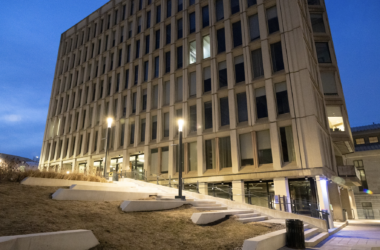
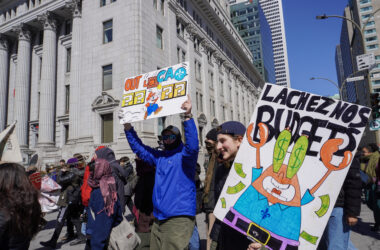

From March 27 to 29, l’Organisation Révolutionnaire Anarchiste (ORA) hosted RAFALES, a free series of workshops and talks educating participants on theoretical and practical methods for practicing anarchism against fascism and authoritarianism. Run in the Comité social Centre-Sud building, the series provided lunch and dinner to attendees and had several tables of priced and free educational materials, including novels, zines, and pamphlets on past and upcoming protests and campaigns against fascism.
The workshop, titled “The Far Right in So-called Quebec: History and Anti-Fascist Resistance,” was hosted by speakers Mylène and Serge, who chose to withhold their last names. The first section, led by Mylène, focused on Quebec’s attitude towards immigration throughout the 20th century. Afterwards, Serge discussed Montreal-based white supremacist groups and how they attract and radicalize members.
Mylène began by clarifying that while Quebec has never been under a fascist regime, several of its key leaders in the past have openly supported fascist dictators and their ideas. Although the right-wing of Quebec between the 1900s and the 1930s were far from homogenous in ideology, they were united by an anti-communist and antisemitic stance. This led to the creation of several newspapers dedicated to anti-immigration rhetoric, arguing that accepting immigrants to the province would eventually destroy French culture.
“The reactionary element of the anti-communist religious right really made a conflation between Jewish immigrants as a breeding ground for subversion […] as if they were evil communists who came to create rebellion and subversion in Quebec,” Mylène said. “In that year, several small groups were created which would have had common points in anti-communist propaganda and, originally, xenophobic remarks.”
In an interview with /he Tribune, Michelle, a volunteer at RAFALES who withheld her last name, emphasized that the accessible environment RAFALES creates—offering free food, childcare, and materials to attendees—is integral to attracting new members to the movement, and further destigmatizing anarchism.
“In Quebec, we are really facing a rise of the right, and it’s super important to talk about it, to see the signs, and to be ready to act in different ways, including in more radical ways,” Michelle said.
“As an anarchist, I think it’s super important to somewhat de-demonize this term to help people understand it a bit more [.…] It can be gathering everyone together, learning, sharing meals, educating ourselves among ourselves, sharing our knowledge, and meeting each other.”
Mylène explained that during the second half of the 20th century, both left- and right-wing parties in Quebec were anti-immigration, leading to the eventual 1995 referendum, which moved to grant the province sovereignty from Canada. The referendum failed by a margin of around one per cent of voters.
Serge then explained that although there are more progressive groups rallying for the separation of Quebec from Canada, many others have escalated, now relying on arguments based on racial as well as religious differences. He highlighted the Frontenac Active Club, a neo-Nazi group based in Quebec, whose express purpose is to prepare themselves for, and hasten the arrival of, what they believe is an imminent race war in Canada. Serge also warned attendees to be wary of groups that do not publicly claim white supremacist ideology, but have proven connections to white supremacy groups, pointing out that White Lives Matter often acts as a funnel for people with racist sentiments to be radicalized into supremacists and join more extremist online forums.
“When you identify as a fascist Nazi, you dehumanize an entire part of the population,” Sergio said. “For me, you lose a bit of your status as a human being [.…] You lose what makes up a bit of the human essence.”
All quotes were translated from French.