
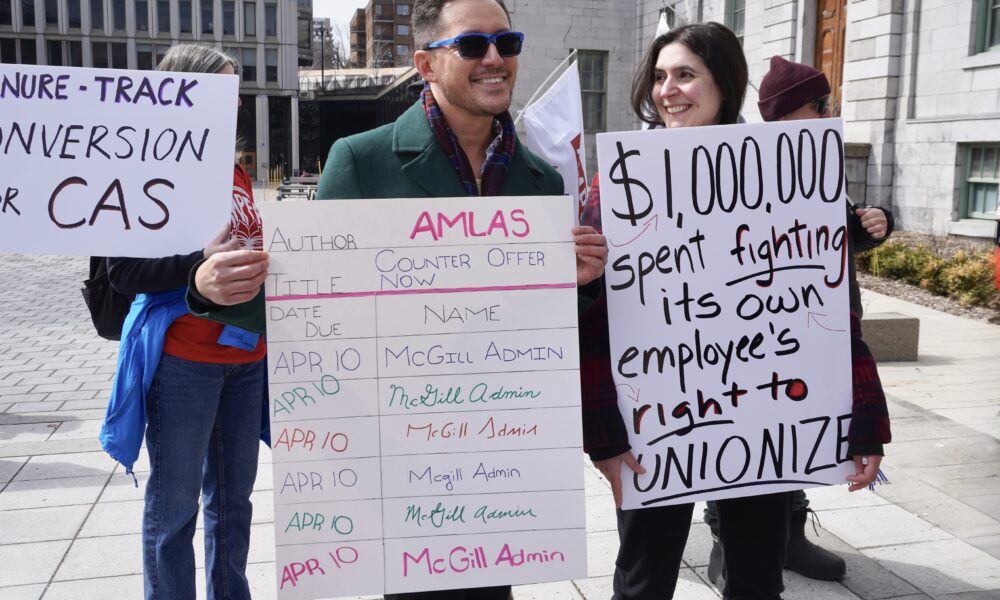


On April 2, around 60 professors gathered outside the McCall MacBain Arts Building in a rally organized by the Confederation of Faculty Associations of McGill (COFAM). Following a few speeches delivered by faculty representatives, the group walked to the James Administration Building while chanting “Le mépris, ça suffit !” and “Quoi ? Une contre-offre ! Quand ? Maintenant !”
COFAM consists of five associations: the Association of McGill Academic Staff of the School of Continuing Studies (AMASCS/AMPEEP), the Association of McGill Professors of Education (AMPE), the Association of McGill Professors of the Faculty of Arts (AMPFA), the Association of McGill Professors of Law (AMPL/AMPD), and the Association of McGill Library Academic Staff (AMLAS). Amid ongoing negotiations with McGill to improve faculty working conditions, the rally marked COFAM’s launch of the “Full Counter-Offer Now!” campaign.
In an interview with The Tribune, Edward Dunsworth, associate professor in the Department of History and Classical Studies and organizer with AMPFA, explained that professors have gathered at the rally to denounce McGill’s stalling tactics in bargaining.
“The university has been around [for] 200 years,” Dunsworth said. “[Professors] have never been unionized until the last few years, compared to the rest of Quebec, where [at almost] every other university [professors] are unionized [….] More and more faculties are continuing to unionize, so McGill needs to adapt to that new reality and bargain seriously, and get things moving at the bargaining table.”
Dunsworth continued to mention that COFAM had delivered their list of demands in July 2025. Up until the rally, COFAM still has not received an adequate or complete response from McGill.
“One thing that’s been really challenging is that McGill has responded piece by piece to certain articles,” Dunsworth noted. “It’s really difficult to bargain like that. We need a full response to be able to properly negotiate and possibly make advances in one area and make compromises in another. It’s impossible to do that without a full picture of what the counteroffer is.”
Barry Eidlin, associate professor in the Department of Sociology and second vice president at AMPFA, delivered a speech to the crowd highlighting why a counteroffer is important for achieving COFAM’s non-monetary demands.
“We believe in this university, and we want to be able to teach our students with adequate support,” Eidlin said. “We have a message to the administration today. Come to the table, negotiate. You might not like something in the offer, that’s fine. That’s why you make a counteroffer. That’s how bargaining works. Rest assured that this is not a problem that the McGill administration can simply ignore, because we’re not going away.”
COFAM’s non-monetary demands call for better transparency and fairness for faculty, with little to no financial impact on the university. Such demands include a tenure-track pathway for ranked Contract Academic Staff (CAS), improved retirement options, and more transparent regulations in tenure, appointments, renewals, and promotions. In a speech to the audience, Kyle Kubler, a CAS faculty lecturer at the McGill Writing Centre and the AMPFA’s treasurer, highlighted some of COFAM’s other non-monetary demands—including enshrining academic freedom into the framework of labour relations.
“We’ve seen over the past couple years the way that our academic freedom has been challenged in various situations. We want to take academic freedom, put it into our collective agreement, and make it stronger than it currently is,” Kubler said. “[We also want] unique recognition for our Black and Indigenous colleagues, to identify ways that we can also recognize the service and the research that they do for their academic profiles, as well as making sure that the histories of racism and colonialism are […] recognized within our country.”
Dunsworth highlighted that bargaining must happen more efficiently in the interests of both the university and its faculty.
“We have made some progress in bargaining, but we need to move things along quickly,” Dunsworth said. “That’s the best for the university, for us to reach a deal, carry on doing the teaching and research and service that we care a lot about and want to continue to do.”