

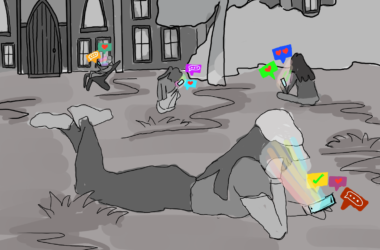


Are these the good old days?
Julie Raout, Staff Writer
“I wish there was a way to know you’re in the good old days before you’ve actually left them.”
The Office’s Andy Bernard nudges us with a gentle reminder that happiness often goes unnoticed until it has slipped away.
Haven’t we all reopened a keepsake box, smiled in remembrance of childhood memories, and wished we had spent more time existing in their softness as the moment had taken place?
Amid the tumult of university life, we often make the same mistake. We overlook the threads of joy that keep our lives from unravelling into a cluster of deadlines and crises. We get caught up in eight-page essays, Perusall assignments, and MyCourses notifications. Schoolwork also gets tangled up in other gusts of life’s hurricane—finding time for hobbies, contending with bureaucracy, and dealing with The Big Personal Thing we seldom talk about.
Yet, one day, just like any other, our time at McGill will be over. As I brace myself for my last year as a McGill student, Andy Bernard’s words echo in my mind. I know that by graduation, I will be leaving the good old days. It’s a weird feeling, knowing that I will fondly look back on a time in which I am still living.
Knowing sneaks up on you. It lurks in the comfortable silence of a late-night conversation. It rests in the small pleasure of a sweet treat bought as an ephemeral escape from the readings sitting dauntingly on a McLennan desk. It blends with the warm chaos of laughter around a dinner table and manifests in the quiet realization that these are the people you will miss when you move away. It even lies in reaping the consequences of your academic irresponsibility, knowing you won’t regret—not even one bit—having spent time with friends instead of studying.
Today, I stress about final exams, finding an internship, and having time to make dinner. But I know that I’ll look back at this whirlwind of assignments, bad decisions, messy conversations, and all the times I have smiled in between, and think: “I was happy back then.”
Sometimes, happiness is not a feeling noticed in the moment; it’s the joy you don’t consciously feel because you’re too caught up in living it. Maybe all we can do, then, is welcome the premature nostalgia, take a second to breathe it in, and, when we have let it settle in our chests, dive right back into the moment we can’t let unfold without us. Don’t let the good old days pass by and drift into memory like the pretty candle you never wanted to ruin, or the childhood stickers you never used out of fear of running out.
A requiem for my old self—Do growing pains ever end?
Defne Feyzioglu, Opinion Editor
Change isn’t always welcomed with celebration. Sometimes it comes with mourning. Sometimes it feels like losing someone you once knew so well—the body you lived within. And usually, it is the old you who gets left behind.
It is not easy to bid farewell, regardless of when or to whom. Leaving behind pieces of yourself isn’t always a clean break, it often resurfaces—like it did for me one afternoon in early winter, as I found an old diary buried deep in one of my ‘everything drawers’. That day, as the sun was setting way too early, I realized for the first time that those scribbles belonged to my former self—not to the person I had become.
That’s the strange part about moving: You don’t just change—you become someone in a new place, and in the process, you lose parts of yourself that once felt absolutely vital. You learn what kind of person makes sense in your new environment. You translate your humour, enhance your softness, dilute your anger, and retell your story until the version of you that first arrived is not the version that stays. Yet while relocation is growth, it is also erosion. And no one really teaches you how to mourn what gets worn away.
That evening, I came to terms with the fact that the girl I used to be was gone because, somewhere along the way, I had stopped being her. I had moved countries, survived Montreal’s harsh winters with my dangerously low iron levels, met people I would have never encountered, connected with new cultures, set aside my native language in the process, and refound my identity. If immigration teaches you anything, it’s that ‘becoming yourself’ is not a clean, triumphant arc. You gain a life that fits the place you now call home, but you leave behind a version of you that you can never really return to.
If we are souls—and not in the Cartesian way, but in the way often described in a romanticized coming-of-age novel—then the body I once carried, though it is still mine, now belongs to a completely new person. I recognize what I have lived through, but I no longer feel like the person who has lived it.
While I have wished to grow, to learn and explore, I am not sure if I have ever wished to be erased. One hopes to change and accepts the moments that have been foregone in the process, but celebration, reinvention, and growth must leave room for the grief that comes with them. It seems strange to think that I was gone once, and I will be gone again and again and again—then remade. I wonder if it will hurt as much each time, if the pain of change and growth will ever ease.
Yet, I now welcome this fear and the pain I carried; the bittersweet ache of nostalgia I once felt for the person I used to be has quietly become subsumed by sympathy. And maybe that is where life’s strange mercy is hidden: We never quite stop grieving, but instead learn to hold the people we once were gently as we grow beyond them. It is a lovely day to be reborn, after all.
The responsibility of memory
Asher Kui, News Editor
As you leave campus through the Roddick Gates, drifting out into the bustling traffic on rue Sherbrooke, the city unfolds into an endless stream of cars—each carrying a license plate that reads Je me souviens.
The motto of Quebec, Je me souviens—or I remember in English—was first coined by Eugène-Étienne Taché in 1883, and was inscribed beneath the province’s coat of arms on the Quebec Parliament façade. It was not officially adopted as the provincial motto until 1939, and only began appearing on license plates in 1978.
Taché never explained what Je me souviens truly meant, leaving it open for interpretation today through the context in which it was created. The same year the motto was added to Quebec’s coat of arms, former Prime Minister John A. MacDonald authorized the creation of the residential school system, placing Je me souviens within a broader pattern of systemic oppression and violence against Indigenous Peoples in Canada. The Indian Act had come into power just seven years earlier, in 1876.
Taché’s slogan was added to the Parliament’s façade alongside bronze statues, each commemorating important figures in Canadian history. Out of 26 statues that were supposed to create a pantheon of Canada’s founding narrative, only two featured references to Indigenous life—the Nigog Fisherman and A Halt in the Forest. Such diminished representation—along with the overemphasis of the ‘noble savage’ image of Indigenous Peoples in Canada—reflects a broader colonial framework of commemoration, in which Taché’s work reproduces a narrative that continuously marginalizes Indigenous voices and experiences.
In such light, Je me souviens is not merely a celebration of our heritage; it implores us to reconsider what we remember and what we ought to remember. The memories we reproduce are not neutral—just as Taché curated his own version of history through the Parliament’s design, collective memory is moulded by our perceptions, our values, and our prejudices. What is preserved as heritage worthy of celebration, what is relegated and marginalized, and what is deliberately suppressed are choices—choices that have decided how we understand the past. To remember, then, is not simply to recall what happened, but to critically engage with existing narratives.
Memory thus becomes a responsibility. Je me souviens is more than a catchphrase found in souvenir shops, or a slogan carved in stone. It is an omnipresent reminder that memory holds immense power. If memory can be used as a tool of silencing and distortion, it also has the capacity to drive meaningful change. Our responsibility is to ensure that memory preserves truth, rather than just echoing the past—so that it can be used to reconcile, inspire, and build a future we are willing to stand behind.