
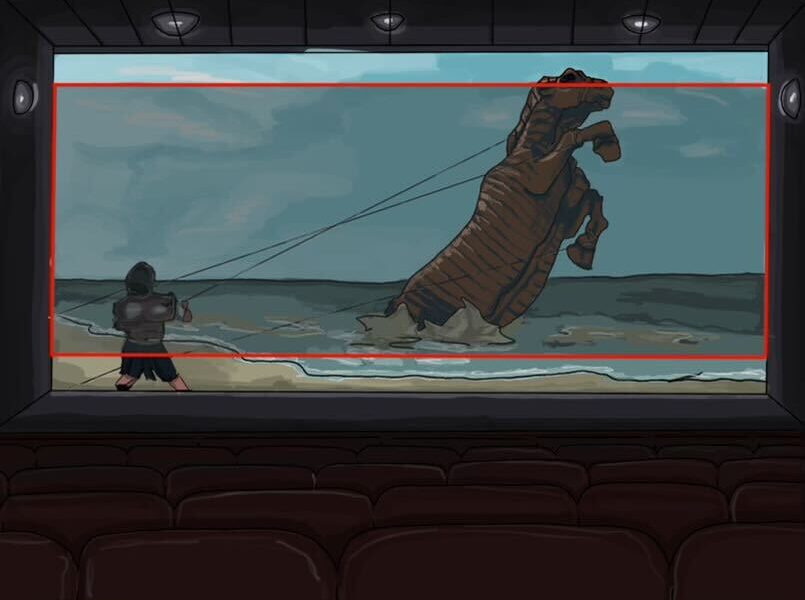



On a muggy Tuesday evening, my father and I amble down to our town’s local theatre to catch one of the summer’s biggest films: Christopher Nolan’s The Odyssey (2026). As we squish into the old cinema’s musty velvet chairs, we joke that our legs will not be the only thing cramped during the course of the film—against the independent theatre’s small screen, Nolan’s shots will be boxed in, too.
Even prior to The Odyssey’s release, film buffs and casual watchers alike have been buzzing about Nolan’s decision to shoot in Image Maximum (IMAX). The term refers to a filming process that features higher-definition visuals and a taller 15-sprocket filming capacity, creating an immersive, large-screen experience. The change from the standard cinematic 35mm aspect ratio of 2.39:1 to IMAX’s 70mm aspect ratios of 1.90:1 or 1.43:1 forces directors to adapt each stage of production, from storyboarding to editing. Given the unique screen dimensions IMAX requires, viewers of The Odyssey must watch the film in an IMAX theatre, projected by an IMAX projector, lest the shots be cropped.
IMAX Corporation, the Canadian production company that manufactures IMAX cameras and projection systems, debuted at the Montreal Expo in 1967. The technology was initially used for nature documentaries until Disney produced Fantasia 2000 in the 90s. Since, its success has risen quickly with the design of revolutionary cameras, post-production and projection techniques that increased aspect ratios, and visual definition. Many recent films have incorporated IMAX technology as well, such as Sinners (2025) and Oppenheimer (2023).
The format attracts attention from filmmakers for its undeniable capacity to render scale and detail. Quebecois director Denis Villeneuve used the format for the blockbuster sci-fi series Dune: Part One (2021) and Dune: Part Two (2024) to capture the looming sand dunes of fictional desert planet Arrakis. For the yet-to-be-released Dune: Part Three (2026), Villeneuve even hand-crafted a custom spherical IMAX lens to create specific optical characteristics, particularly Arrakis’s signature light flashes. At the 2021 Venice International Film Festival, Villeneuve described that the Dune series was not just designed like any other films and then projected in IMAX, but were instead conceptualized around the technology.
But what makes The Odyssey actually transformative in its cinematography is that it is the first feature film to be fully shot in IMAX 70mm: Previous IMAX films have used a mix of IMAX and Super Panavision. The epic story of Odysseus—and director Nolan’s massive clout—received a similarly colossal budget of $250 million USD, which made Nolan’s pioneering use of the $80,000 USD IMAX projection prints for an entire film possible.
Visiting The Odyssey’s website offers future viewers a chance to click through different aspect ratios of the film and decide whether paying extra for that IMAX ticket is worth it. Despite the clear superiority of the IMAX version, the cost of tickets for such viewings of The Odyssey offers new insights into the equity of movie-watching. Since the film’s release, X users have highlighted the visual disparity between IMAX and non-IMAX showings of the film, even going as far as to argue that “The Odyssey is a movie where poor people literally see less.”
Going to the movie theatre is already a luxury that many can’t afford, with a standard ticket at Cineplex costing $18.69 CAD, over two dollars more than the Quebec hourly minimum wage. An IMAX ticket, on the other hand, costs a whopping $31.34 CAD. Only 41 cinemas worldwide are capable of projecting 70mm IMAX film and this contributes to the steep pricing and exclusivity of tickets.
Theatre experiences have always come with costly add-ons. As a kid, I remember asking my mom to purchase the more expensive Blu-ray versions of my favourite films, as they included bonus videos and bloopers. Or the time when, for my dad’s birthday, we splurged and all went to the D-BOX version of The Flash (2023), spending the 144-minute runtime being shaken and jostled while sporting derpy, plastic 3D glasses.
Yet, the difference between these extra-cost movie experiences and seeing The Odyssey in IMAX is that the former are simply additions to the original films, which one could still enjoy for the standard cinema price. Conversely, the IMAX version of The Odyssey is the only way to experience Nolan’s true vision of the movie, which he has baked in from its inception. Those who do not wish to drop 30 bucks on a movie ticket must resign themselves to a hampered screening, plagued by problematic cropping and letterboxing.
Though it is but the top of Telemachus’s (Tom Holland) head or the tip of Odysseus’s (Matt Damon) spear that is cropped from the average cinema screen, with rising ticket prices, the new popularity of IMAX seems like just another factor pushing movie-going into an exclusive space. Nolan has hidden a new classist practice of filmmaking inside the shiny hollows of a three-hour-long Trojan Horse. It is your choice whether or not to let him in.