
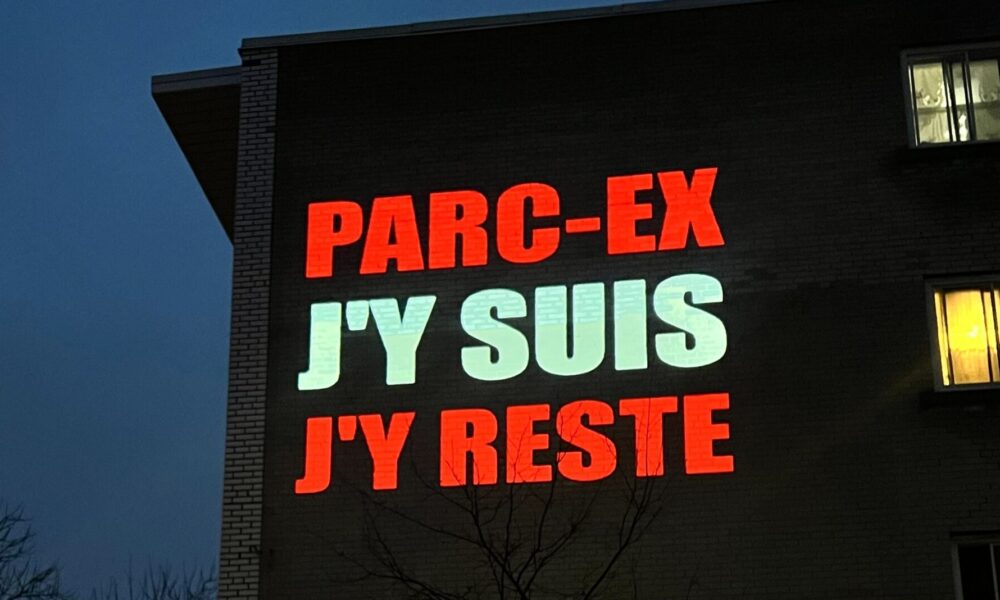

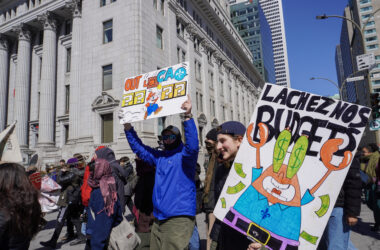


Over 100 tenants and fair housing activists gathered outside 955 av. d’Anvers on March 31 to denounce what organizers called abusive rent increases imposed on residents. Organized by the Regroupement des comités logement et associations de locataires du Québec (RCLALQ) and the Comité d’Action de Parc-Extension (CAPE), the rally’s attendees demanded better rent control. In collaboration with artistic and activist collective Le Sémaphore, the organizers projected messages like “No to abusive rent increase,” and “Je refuse je reste” (“I refuse I’m staying”) onto the building’s exterior.
The building’s tenants, part of a complex of 18 buildings for a total of 165 units, reported receiving increases of up to 20 per cent. According to a representative from the rally, one tenant received a rent increase of $300 CAD, and many of these notices do not include meaningful renovations to justify them. March 31 is the deadline for many Quebec landlords to send rent increase notices, making it a deliberate day for action.
In an interview with The Tribune, Noémie Beauvais, a community organizer with the RCLALQ, explained that the increases reflect a persistent gap in tenant protections despite recent regulatory changes. Quebec introduced a new rent-setting formula in January, but Beauvais noted that the reform has done little to curb excessive demands from landlords.
“The calculation is a bit different. It is a bit easier for tenants to understand,” Beauvais said. “But the problem is the same. If the landlord wants to just put any number on the notice, then [the tenants][…] feel like they have no power.”
The complex has changed ownership multiple times in recent years. In a speech to the crowd, Rizwan Khan, a community organizer with CAPE, highlighted that conditions have deteriorated across each transition.
“These buildings have been affected for a very long time with cleanliness and hygiene issues related to negligence from the owners*,” Khan said. “The new owners also introduced new building regulations with abusive clauses and pressured tenants by saying, ‘If you want your new key to the building’s front door, you have no choice but to sign.’ These are the kinds of tactics that are used by far too many landlords, and this has to stop*.”
In an interview with The Tribune, Sohnia Karamat Ali, an organizer with CAPE, emphasized how the cycle of ownership changes has worn tenants down.
“This is the third administration,” Karamat Ali said. “We started mobilizing against the first who were here five, six years ago. After a huge mobilization, they just sold the building [….] It is like every time, we start from zero again.”
Ali Kamruzzaman, a 70-year-old tenant who has lived in Parc-Extension for 27 years, told The Tribune that many residents are afraid to push back against the increases. He urged fellow tenants not to acquiesce to their demands.
“My message is: Do not be scared,” Kamruzzaman said. “We have the Parc-Extension Action Committee, and you can ask them. They can advise you where to go. You have the rental board.”
The rally is part of a province-wide campaign organized by the RCLALQ against the 2026 rent increase season, with similar actions held in Quebec City and Granby. The Tribunal administratif du logement set a baseline increase of 3.1 per cent for leases renewing after April 1 under a new formula tied to the consumer price index, down from the 4.1 per cent in 2025. But the rate has done little to slow a broader trend: Average rents in Quebec have risen by roughly $1,800 CAD per year since 2023, and asking rents in Montreal have doubled since 2019. The RCLALQ reaffirmed that a revised framework should include stricter limits on annual increases tied to actual maintenance costs and new legal obligations for landlords to justify any hikes above the standard rate.
Émile Boucher, a community organizer with the RCLALQ, stressed that the rate only functions as a floor, and tenants in the complex are facing increases nearly seven times that amount.
“There is no effective rent control,” Boucher said in an interview with The Tribune. “Landlords can still propose whatever increase they want. They are not required to follow the recommendations of the Tribunal administratif du logement, and that is an enormous problem for us. People will experience rent hikes individually because they receive the notice, they have to accept it or refuse it, they have to pay. But we are showing that this is a collective problem, and tenants are not alone in this*.”
*These quotes were translated from French.