Latest News

Alexandra Allaire / McGill Tribune
a, Opinion

Alternatives in the AP debate

Dartmouth College recently announced its decision to stop granting credits for high Advanced Placement (AP) scores, starting with the class of 2018, after a nearly unanimous faculty vote.  This new policy has caused a lot debate among students, faculty, and administrators at various universities about whether or not advanced standing credits should carry over to university. Dartmouth’s decision is based on the claim that AP courses don’t match the academic rigour of the programs at their Ivy League institution. Their plan, therefore, is a sweeping change in policy in which they would stop accepting AP credits completely.

With tuition costs at an all-time high, and bachelor’s degrees depreciating in value, many students are looking for ways to cut down on some of the time and money spent on their undergraduate degrees.  AP courses provide a cheap way for talented and motivated students to earn university credit in high school, and potentially exempt themselves from a semester, or even an entire year at university.  This could save students tens of thousands of dollars on their educations, and reduce the high levels of student debt that lurk over so many students upon graduation.

In addition, despite Dartmouth’s claims, many students who scored well on their AP tests may, in fact, possess equal or even greater knowledge to that which they would have acquired at a university. The small settings of AP classes in high schools, and the close attention that teachers are able to provide often result in students who are tremendously knowledgeable about the subjects that they study.  If universities stop accepting AP credit, many students may be forced to take classes for material they have already learned.

McGill’s current policy requires students to report all the AP exams they have taken, and students are usually granted credit for scores of 4 or 5.  As a result of this rule, many incoming students to McGill are granted U1 status in their first year.

While entering McGill as a U1 certainly has many advantages, it can cause some students to feel overwhelmed, as they are expected to declare their majors earlier, take more challenging courses right away, and complete their program in three years. The Arts Undergraduate Society (AUS) recently addressed this issue in a general assembly motion, calling for the AUS to lobby the faculty of the arts to change the advanced credit system. The proposed reform would allow students entering with 24 or more credits (the number needed to enter as U1) to instead enter as U0 if they so desired.  Students would still have the option to use advanced standing credits to avoid prerequisites. Since every student is different, this would be a more personalized and flexible way for students to apply their advanced standing credit towards university, and it could help ease the stress that many students face when they enter as their first year.

Dartmouth’s decision, however, brings to light an important concern.  Universities shouldn’t be expected to accept advanced standing credits if they aren’t compatible with their standards of education.  However, advanced standing credit is beneficial to students for a variety of reasons, and shouldn’t be done away with.  The main purpose of APs is to allow students to tailor their education to their own needs.  Therefore, the solution to how universities should treat advanced standing credits is to adopt a more personalized system.

As the AUS motion proposed, students should be able to choose whether or not they want their advanced standing credits to carry over to university.  Universities, too, should be able to tailor the system of advanced credits to their own requirements by administering placement tests to ensure that students who are “advanced,” according to their AP scores, do indeed meet the requirements to enter certain higher level courses.  There is no need to stop accepting advanced standing credit as Dartmouth plans to do.  A much less drastic change is required: a more tailored system that takes into account both the needs of individual students and university standards.

a, Opinion

Shopping south of the border

Earlier this month, Finance Minister Jim Flaherty convened with senators in Ottawa to discuss lowering import tariffs in an effort to combat a persistently “irritating” American-Canadian price gap.  Despite the two currencies residing at near-parity, there is a price gap between Canadian and American retailers, compounded by an even larger discrepancy between sales tax rates. As a result, Canadians flock across the border in droves every bank holiday, and even on the casual weekend to reap the bountiful harvests of American consumer products.  With import tariffs as high as 18 per cent, Canadian retailers—as well as consumers—feel ripped off by impediments to selling and buying products with stark competition just across the border, and many feel the federal government should do something about it.

This great southern migration is a phenomenon with which I am quite familiar. Torontonians at McGill may be well aware of my particular case study: the Walden Galleria Mall.

A haven for thrifty Ontarians, the Walden Galleria includes over 200 stores, 11 sit-down restaurants, a movie theatre, and is located just outside of Buffalo, New York—my hometown.  While local mall-goers, myself included, enjoy complaining about the widely foreign-dominated parking lot, how “the Canadians” steal our post-Christmas deals on “Boxing Day,” and how they must have taken all the remaining size fours from the Urban Outfitters sale rack, the truth is, we love you guys. Honestly, we couldn’t live without you.  Aside from the poorly groomed waste of a tourist destination which is the American side of the Niagara Falls, the Walden Galleria is just about all that western New York has going for it right now.  With a slumping job market, continued population decreases, and as one of the most impoverished American cities, Buffalo is (almost) economically nothing without its loyal, Canadian fan base.

But Canada isn’t simply here to help out economically depleted, former rust belt American cities.  Business has no sympathy: there are winners, and there are losers.  And right now, Canadian businesses’ heels are digging into the mud, and the rope’s bristles are slowly gnawing at their feeble, clenched hands.  But does the exchange rate mess have to be a tug-of-war?

As an American international student in Canada, I can’t quite devise a solution to promote Canadian business without keeping my home country in mind.  So perhaps, from a third-party, politically unmotivated, expatriate perspective, there is, rather, a North American system of respect and compatibility to be celebrated.  While the U.S. thrives on consumerism, Canadians benefit from federal social welfare, such as healthcare—in place of really cheap clothes.  In America, you get clothes, and then you die.  In Canada, you get clothes from America, and then you don’t die.

According to Numbeo, an online cost-of-living database, consumer prices in the U.S. are 18.31 per cent lower than in Canada.  While the Canadian federal government could certainly lower certain tariff burdens, making domestic products lower for consumers, and businesses more competitive with their American counterparts, it seems unlikely that Canadian retail prices will be able to rival those of the United States any time soon. The Canadian and American economic systems are fundamentally different; the partial compensation of a tariff won’t affect any great reversals. Ideologies will persist until they come to an improbable halt; so please, Canadians, continue to cut me off in the parking lot, and take the next spot closest to the entrance.

Alexandra Allaire / McGill Tribune
a, Opinion

Continuing the fight for a freer internet

Today’s generation is a product of the internet, having grown up with this technology and the wealth of information that it provides. They are encouraged to constantly build upon previous ideas, and they share their wealth of knowledge through this easy-access medium. Epitomizing this generation was Aaron Swartz—an entrepreneur, co-creator of RSS and co-founder of Reddit, and a prominent internet activist on the side of internet freedom and unrestricted access to information. In July 2011, Swartz entered MIT and downloaded a large number of academic articles from JSTOR, a popular digital library, in protest of inaccessible academic information. He was caught and arrested. When trial began, federal prosecutors sought to give him decades in prison, and up to a million dollars in fines—a punishment many have called disproportionate. Sadly, on Jan. 11, 2013, Swartz took his own life, causing wide-ranging dismay in the internet community.

Academic articles such as those that Swartz downloaded are a vital part of the learning process. Students at institutions that subscribe to such publishers as JSTOR are fortunate enough to have the information; but what about those who cannot access it? There are many people who are equally interested in learning, but do not have the opportunity because they are not part of such a community. This is not an appropriate course for a society which claims to encourage learning and seeks to foster an environment of innovation. Simply due to circumstance, many people with a potential to innovate are restricted by the lack of resources made available to them. If we truly want to create a society of continued progress, we should share knowledge with all those who wish to access it.

There is an ever increasing number of young internet entrepreneurs who were self-taught. By restricting previous research papers and access to knowledge, we are hindering similar potential innovations in all fields. In this age of entrepreneurialism and self-initiative, it is counter-intuitive to restrict the resources that are necessary to promote such ambition. This limitation on learning has given rise to the freedom of the internet debate. Information that is at students’ fingertips has made life easier; and so, much like a public library, shouldn’t it be free for all who seek it?

Swartz stood for something that is extremely relevant in students’ lives. It is a battle that needs to be fought and, with Swartz’s death, has lost an essential fighter. This is an era of phenomenal growth and change, and we must constantly be aware that we are setting precedents for the freedom of information online. If the laws created now tighten copyright restrictions, they will be incredibly challenging to change later on. Now is the time to demonstrate the importance of open access ,and the continuing development of technology and knowledge.

The rise of the internet has unlocked a myriad of opportunities, which restrictions and censorship will only decrease. With the accessible and credible repositories of knowledge online, those who previously never had the opportunity to learn now can. People are finding new skill sets that are incredibly applicable to modern day, and would be irrelevant without the internet. We must take advantage of this potential instead of limiting it, as it will ultimately foster returns for our society. None of this is possible without open access to information, something that Aaron Swartz fought for, and something we must continue to protect in years to come.

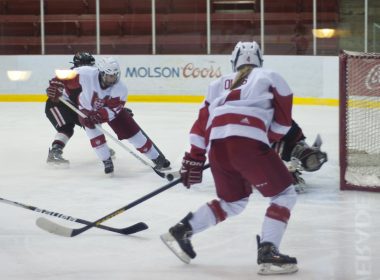
First-year forward Gabrielle Davidson (15) scored two goals in the Martlet victory. (Simon Poitrimolt / McGill Tribune)
a, Sports

McGill caps fifth undefeated season in school history

So how does it feel to be at the top? Leslie Oles grins, “It feels great.”

She would certainly know. Oles and the McGill Martlets finished off the regular season this weekend at McConnell Arena, undefeated in conference play for the fifth time in school history. They enter the playoffs next week, riding a 26-game win streak over CIS opponents after routing the Concordia Stingers 7-1 Saturday afternoon in their last game of the regular season.

The Martlets blazed to a quick start, with McGill’s Stefanie Pohlod, and Mélodie Daoust scoring one goal apiece in the first two minutes before the Stingers could even get their skates straight. Concordia was no match for the Martlets defensively, as McGill dominated their opponents with offensive pressure in the first period. The Martlets controlled the puck, zipping crisp passes to create open looks for teammates, as well as hustling to fight for second-chance opportunities. Fourth-year forward Kim Ton-That and rookie forward Gabrielle Davidson scored goals for McGill at 14:38 and 15:50, respectively, to close out the period 4-0.

At this point in the year, this level of dominance is to be expected from the Martlet team, who have routinely blown out their competition throughout the season.

“We’re a hard-working team. We have a lot of different components to our team, and that’s what makes us successful,” Oles said. “We have a lot of skill, and we have a lot of grit.”

McGill did not miss a beat in the second frame. Davidson picked up right where she left off, netting her second goal of the afternoon two minutes into the period. The only bright spot for the Stingers came midway through the stanza as they put together a couple of solid offensive chances, amounting to a good number of shots. However, Martlet goalie Andrea Weckman was more than up to the task as she calmly denied all the Stingers’ attempts. McGill answered back immediately, as Logan Murray tipped home a goal with 10:32 remaining to put the home team up 6-0.

(Simon Poitrimolt / McGill Tribune)

“We got contributions from everybody,” Martlet Head Coach Peter Smith said. “We had 18 skaters dressed … [and] all 18 skaters really contributed to [our] success today. Andrea made some good saves in net. [It was] good, Martlet-style hockey.”

McGill continued to showcase their teamwork and cohesion in the third period. Daoust recorded her second goal of the contest at 4:52. The puck seemed to be around Concordia goalie Carolanne Lavoie-Pilon throughout the period, as demonstrated by McGill’s incredible 32-7 shot advantage. Concordia managed to net its lone goal of the contest a minute later, which ultimately proved to be a non-factor en route to the Martlets’ 7-1 victory.

The Martlets boast a number of conference leaders, most notably second-year Daoust who has scored a league-leading 52 points, followed by Katia Clément-Heydra and Oles, to round out the RSEQ top three scorers. Goalies Weckman and Taylor Salisbury have also been outstanding this season, claiming first and second place in the conference with save percentages above .900.

Beyond the dominating statistics, Coach Smith emphasized the importance of intangibles to the success of his team.

“[Although] we have good skill, we work hard. Our practices are terrific. … I honestly can’t remember a sub-par practice that we’ve had this year; and I think that what you do in practice carries over into games.”

When asked if the coaching staff would change its approach to games in anticipation of the playoffs, Coach Smith assured that the Martlets would stick to the keys of their success.

“The biggest thing for us is that we stick to our plan. We’ve developed a plan over the course of the season, and I think that it’s important that we stick with that,” he said. “We’ve never really played according to the scoreboard. We play to do the right thing at the right time, and that’s what we need to continue [doing].”

Despite all their wins, the Martlets have not given themselves a chance to bask in the success of their record. However, in recognition of their final regular season game, the team allowed itself a moment to take pride in its terrific play and 20-0-0 undefeated record.

“[Our record] is not something [we] really think about every day, but today in the locker room we took a little moment … to really appreciate what we’ve done this year,” Oles said.

The Martlets begin the RSEQ semifinals on Wednesday against Carleton in a best-of-three series.

a, Sports

Around the Water Cooler

In case you were too busy dodging a meteorite, here’s what you missed this past week in the world of sports… 

SPRINTING — South African Olympian Oscar Pistorius was arrested, and charged in the murder of his 29-year-old model girlfriend Reeva Steenkamp on Thursday. Pistorius was held in jail over the weekend, and will stand trial for bail on Tuesday. The story came out of nowhere, as Pistorius is revered in South Africa for being the first double-leg amputee to participate in the Olympics. The “Blade Runner” also competed at the 2012 Summer Paralympic Games in London, and won gold medals in both the 400-metre race and in the 4×100-metre relay.

The defence claims that the shooting was an accident, as Pistorius is known for his paranoia about home intruders. Police found a bloodied cricket bat at Pistorius’ home on Sunday, but have yet to identify whose blood it is. If it belongs to Steenkamp, it will undoubtedly become a key piece of evidence against him. Regardless, such a tragedy is extremely unfortunate, and almost unthinkable, especially considering that he is a national and Olympic hero.

BASKETBALL — All-Star weekend took place in Houston this past week, as the NBA’s finest showcased their talent and fashion sense throughout the various events. Team Chuck defeated Team Shaq 163-135 in the Rising Stars Challenge on Friday night. Denver Nuggets high-energy forward Kenneth Faried was named MVP of the game after recording 40 points and 10 rebounds. We’d say about 38 of them were dunks, which is not surprising since no one played defence. Cleveland Cavaliers star guard Kyrie Irving took home the three-point shootout, while Toronto Raptors rookie Terrence Ross won the dunk competition. Ross paid tribute to ex-Raptor dunk champion Vince Carter, by putting on an old-school purple Carter-era jersey before throwing down a 360, one-handed windmill—yeah, no big deal. In the weekend’s final event, the West came out on top 143-138. Chris Paul dropped 20, and added 15 helpers, en route to MVP honours; and while everyone else took a breather on their defensive ends, Kobe blocked King James from behind … so that was interesting.

HOCKEY — A devastating injury stopped the NHL world on Wednesday, as Ottawa Senators star defenceman and reigning Norris Trophy winner Erik Karlsson had his Achilles tendon sliced by Pittsburgh Penguins forward Matt Cooke. The incident occurred after the two players were tangled along the boards. The NHL decided not to take disciplinary action against Cooke, since the injury appears to have been accidental. The NHL will be without Karlsson for the remainder of the year, but the Sens are hopeful that he’ll be ready for the start of the 2013-2014 season. Despite being deprived of watching Karlsson gracefully skate around NHL teams, the injury definitely improves the Habs and Leafs’ playoff chances. Sens fans, we feel for you.

Dianna Ros faciliated the Martlet offence throughout the win on Saturday. (Simon Poitrimolt / McGill Tribune)
a, Sports

Monster second half propels Martlets past Gaiters

The conference-leading McGill Martlets faced off against the struggling Bishop’s Gaiters on Saturday at Love Competition Hall. Despite a sloppy start, the Martlets controlled the game in the second half, and finished off with a decisive 72-31 victory over the Gaiters to extend their winning-streak to three.

McGill’s first field goal came from a deep three by second year point guard Dianna Ros. After an unsuccessful drive by first-year forward Mariam Sylla past two Gaiter defenders, the Martlets regained the offensive board, and kicked the ball out to Ros with the shot clock running down. She knocked down the bucket, scoring two of her nine points on the afternoon. She also added a game-high five assists in the victory.

“I was just trying to be aggressive, and that’s it,” Ros said after the game.

As usual, Sylla was a force to be reckoned with in Saturday’s contest. She dominated on offence, scoring 15 points and pulling down seven rebounds. She has now scored double-digit points in each of the past nine games, and has become a staple for the Martlets on both ends of the court. Head Coach Ryan Thorne complemented Sylla’s effort.

“Mariam Sylla is always going to do a good job inside, and on the glass,” Thorne said. “She hit some nice shots from the perimeter, too.”

McGill struggled on offence in the first quarter, scoring only 13 points in the first 10 minutes. Nevertheless, hard defence in the paint forced the Gaiters to take low-percentage perimeter shots. In the second quarter, the Martlets tightened up their defence, and allowed just one Bishop’s bucket while racking up 17 points of their own. McGill finished the first half leading 30-15.

(Simon Poitrimolt / McGill Tribune)

The Martlets stepped out on the court in the second half looking like a completely different squad than the one that exited after the second quarter. Good offensive ball movement, leading to open shots and hard drives in the paint, gave McGill some easy chances. They converted more often than not, and extended their advantage to 49-19 by the end of the third.

With a commanding lead in the fourth quarter, the Martlets turned to their bench for points. Coach Thorne was quite pleased with his subtitutes’ production.

“Someone that impressed me a lot was [third-year guard] Abena Addo,” he said. “She came in, and she worked hard on both ends. … [Third-year center] Valerie L’Ecuyer also did the same thing; so for me, that’s just a reason to give them some minutes over the next couple of games, and let me see how much they can do.”

The bench contributed 20 points in the fourth quarter alone, en route to the Martlets 72-31 victory.

The Martlets have just two games remaining in the regular season before the RSEQ semifinals on Feb. 27. Thorne spoke about the message he’s sending to his team as the playoffs loom.

“I think the message that we tried to give them during this game was to play a certain level of excellence from [start to finish]. [This] is what we’re going to be preaching over the next couple of games and into the playoffs,” he said. “We can’t change our level [of play] depending on [our opponent]. We have to play at this level and above, no matter whom it is.”

The Martlets will be looking to clinch home court advantage in the playoffs in their home regular season finale against Laval on Feb. 21.

Christian McCue spots up for the jumper. (Liam Maclure / McGill Tribune)
a, Sports

Execution key for Redmen in pivotal divison contest

Execution, poise, and defensive intensity marked a hard fought win for McGill over Bishop’s. The Redmen beat the Gaiters 78-60 in Saturday’s battle between the RSEQ division leaders, played out in front of a packed and stuffy Love Competition Hall. A highly contested and entertaining game throughout, the Redmen—sparked by the leadership of Adrian Hynes-Guery, and Te’Jour Riley’s inspired play—pulled away in the fourth quarter, to seal a second victory over Bishop’s this season.

Both sides, having already secured playoff berths, played to gain home court advantage in the upcoming post-season. The weight of this matchup was evident from the get-go, as the teams started out fast in the early minutes with high energy and hot shooting.

The visiting side started off by applying aggressive full-court defence, which the Redmen calmly thwarted with their agile guards and ball-handling forwards. McGill operated its offensive set to a tee, patiently swinging the ball from side to side, and cutting from the perimeter. This execution was key in the Redmen victory.

“The guys really listened to the game plan,” Assistant Coach John Dangelas said. “They listened to [Head Coach Dave DeAveiro]. They were told to move and cut, and they did. [Our success came from] executing the plan.”

Riley was particularly impressive, and started off his great individual performance with seven points in the opening quarter. With the shot clock running down, he took charge,  rambled into the lane, and scored in athletic fashion. In the hard-fought, high-energy first quarter, the back-and-forth action favoured the Redmen as they led 26-18.

With the starters on the bench, Bishop’s rallied in the second quarter, relying on their free throw shooting. Their 6’10’’ interior big man, Mike Andrews, scored 19 points on 8-16 shooting in the game. Andrews’ size presented the Redmen with unique challenges, and drew tons of fouls on McGill. With Aleksandar Mitrovic on the bench due to early foul trouble, other players were forced to play bigger roles and step up on defence.

By the end of the second quarter, the momentum was clearly beginning to shift in Bishop’s favour. However, McGill remained hot from the outside, led by Hynes-Guery, who canned two back-to-back corner three-pointers. The Redmen led 39-34 at the break.

The second half remained tight, with highlights coming on both ends. First-year guard Christian McCue—who went 4-4 from three-point range—hit a buzzer-beater near half court at the end of the third, capping a late charge by McGill and leaving them with an eight point lead.

The fourth quarter belonged to Hynes-Guery and McGill’s stifling team defence. It was a gutsy defensive performance—stepping in to take charges, collapsing in the paint, and providing help defence all-around—which distracted Bishop’s flow and shooting rhythm. An emphatic block by Vincent Dufort midway through the quarter sent the home crowd abuzz, and was emblematic of the defensive effort down the stretch.

“We just executed our strategy. It was a good team effort. And personally, I was able to hit the shots [I needed],” Hynes-Guery said. “Defensively, we stepped up to make key stops on [their big men]. And we never looked back from there.”

Indeed, they never did look back in the fourth quarter, pulling away convincingly with defensive stops and timely baskets, culminating in a 78-60 victory.

If there is anything to take away from the Redmen’s impressive performance, it’s that they seem ready to execute and pull together down the stretch in order to make a strong run in the RSEQ playoffs. McGill has two games remaining in the regular season and needs one last win to secure their first division title since 2001. The Redmen host Laval on Feb. 21, before closing out the regular season at UQAM on Feb. 23.

Hubert Morin will graduate after three years as the Redmen starting goalie. (Wendy Chen / McGill Tribune)
a, Sports

Playoff life nasty, brutish, and short for Redmen

One year after bringing home the school’s first national championship in its 135 year history, the McGill Redmen learned that the only thing harder than winning a title is holding onto it. On Sunday night, the Redmen’s season came to a decisive end, as they lost 2-1 to the Nipissing Lakers in deciding game of the OUA East quarterfinal. To say they failed to deliver, however, would ignore the unprecedented rash of injuries that plagued the team towards the end of the season. All things considered, the Redmen played through adversity, leaving everything on the ice, but ran out of gas by Sunday night.

Alexandra Allaire / McGill Tribune

“I couldn’t be prouder of a group of guys,” Redmen Head Coach Kelly Nobes said after the Game Three loss. “We’re playing with, essentially, our hands tied behind our back with so many guys out of our lineup. We just ran out of juice. I go back to what we’ve done over the season, but the last six weeks or so where we’ve been anywhere from seven to 11 guys out of the lineup, and that’s just unheard of.”

After losing a penalty-filled Game One that saw a combined 86 penalty minutes handed out to both teams, the Redmen stormed back on home ice to tie the series in a convincing 4-1 contest. On Sunday night, they jumped out to an early lead when rookie Jonathan Brunelle found a trailing Nicolas Biniek. Nipissing deserved more in the first period, and converted just under five minutes into the second on a power play, when Lucas McKinley picked up a rebound and slid it past McGill netminder Hubert Morin, to tie the game. The Lakers went ahead for good late in the second on a goal by Jeff Leaist that sealed both the game and the series.

Leaving aside the devastating loss of manpower—the team lost 130 ‘man-games’ this season—the Redmen will still be left wondering ‘what-if’ as they contemplate their power-play, which went 0-for-24 in the series and 0-for-12 on Sunday night, including two five-on-three advantages in the third period alone.

“We got some good chances on the five-on-three,” Benoit Levesque, who wore the ‘C’ in place of injured captain Patrick Belzile, pointed out.

Coach Nobes also stressed that for some members of the team, the strain of playing an abnormal 35 minutes took its toll on their execution late in the game.

For some players, the loss means not only the end of the season, but the end of a career. After the team completed its customary salute to the fans in the centre-circle after the celebrating Lakers had left the ice, Morin—having just finished his fifth and final year at McGill—lingered on the ice, likely remember his time as a Redmen that had far more success than crushing defeat.

Alexandra Allaire / McGill Tribune

“It’s so confusing right now,” Morin said after the game. “I’ve always been to the finals, national championships, and now I’m a little lost. I started as a third goalie, and then in the end, I played three years as the first goalie … won a national championship and three Queen’s Cups. I don’t realize yet that it’s over, but at the same time, I can’t be upset because I left it all out on the ice.”

For those who will return next year—the team loses Morin, Belzile, and Marc-Andre Daneau, but could potentially return the rest of the roster—the future is bright.

“The blessing in disguise is that those younger guys who maybe wouldn’t have gotten as much icetime and opportunity that they would have if everyone was healthy,” Nobes said. “They played a ton in a bunch of different situations. They’ve grown as players, and that will serve our program well long-term.”

While the curtain has closed on the 2013-2013 Redmen season, Nipissing will travel to Trois-Rivieres to face the Patriotes in the OUA East Semifinals starting Wednesday. McGill’s loss means that UQTR will represent Quebec at the CIS Men’s National Championship, scheduled for Mar. 14-18 in Saskatoon.

a, Behind the Bench, Sports

Why do we glorify athletes?

George Best was an incredible soccer player, most notably appearing for Manchester United through the ‘60s and early ‘70s. In fact, he was so good, that if the soccer adage, “Maradona good; Péle better; George Best,” is true, then he was the greatest of the day. Best combined a deft touch on the ball with incomparable pace, delighting audiences and fans across the globe. Unfortunately, he was also a notorious drinker. 

Often reported to have played matches hungover or skipping them entirely to party—once he even showed up on a primetime chat show shockingly inebriated—his alcoholism led to his undoing. In 2000, he was diagnosed with severe liver damage. For most, a condition of this magnitude would be the end; however, Best was not most people. Rallying behind him and his athletic genius, the public bolted him to the top of the donor list, and funded his transplant through the National Health Service.

Sadly, despite the success of the transplant and the obvious preferential treatment he received due to his celebrity status, Best refused to quit drinking, and ultimately died in 2005 from the interactions of alcohol and the immunosuppressant drugs one must take following a transplant. In a macabre twist of self-reflection, his final address to the masses before his death was a message that read, “Don’t die like me.”

More recently, Baltimore Ravens star linebacker and Super Bowl XLVII winner Ray Lewis retired a champion. His final victory seemed hardly tarnished by his connection to the banned substance “deer antler spray” less than a week before the Super Bowl to help him get over a triceps tear he suffered earlier in the year. His hulking 37-year-old frame is almost certainly a product of years of steroid-induced muscle gain. In fact, the mere occurrence of a triceps tear—which is generally far too small of a muscle to invoke a tear—and his miraculous comeback when doctors told him that his year was finished, lends greater credence to the banned substance claim.

Shockingly enough, is that many of Lewis’s fans are unaware that in 2000, he and two friends were arrested and charged with murder and aggravated assault for the death of two men following an altercation outside a nightclub. Lewis’s bloodstained white suit, which witnesses saw him wearing, was never recovered, nor the blood of the victims in his limousine ever explained. Finally, after admitting to giving a misleading report to police the day after the event, and plea-bargaining by testifying against his co-conspirators, Lewis pled guilty to a mere misdemeanour charge of obstruction of justice. The plea bargain was never proposed to the others involved in the case; and, unsurprisingly, Lewis returned to the NFL to glowing reviews and undying adoration for his “killer” instincts and hard-hitting abilities.

Yet, what does this all mean? This is assuredly neither a plea to promote sobriety, nor an embittered, sensationalist attack against Lewis. It is, instead, a critique of our glorification of athletes, and our unwillingness to recognize them as equals. With their status, they get off scot-free from mistakes—ones that deserve to punished in a fitting, and unbiased manner.

This sentiment is not just damaging culturally, but ultimately hurts the celebrity, as his or her period of privilege comes to an end. No one can be the best forever, and when the skill that made that person sensational inevitably fades, that individual is often ill-prepared to combat the reality of being “normal.”

78 per cent of NFL players declare bankruptcy just three years removed from the league, with 60 per cent of NBA players joining them after five years. This comes at a time when salaries are higher than ever, and are continuing to rise. Clearly, there is a rupture between what is expected of athletes in the league, and what is expected of them beyond the league.

Whether this disconnect is related to addiction, the law, or financial planning; we, as the consumers of their great talent, can truly benefit from admiring sports stars for their athleticism—while remembering that they too, are just humans and therefore must operate under the same moral rules.

So the next time you see Tom Brady out on the football field, remind yourself that he put that uniform on the same way you would—one leg at a time—regardless of how good-looking he may be once he does. Trust me, it’ll help him too.


Jason Choi, Anatomy and Cell Biology, U1 (Alexandra Allaire / McGill Tribune)
a, Student Life, Student of the Week

Student of the Week

Q: What’s a typical Urban Groove rehearsal like?

A: It’s every Sunday, and it starts with a warm-up and stretch, and then a killer ab routine. This semester [we’re doing] something special [in rehearsal] called internal workshops. It’s where one member is selected each week to do a special workshop for everyone else. So we’ll have dancers who specialize in different styles like contemporary, Bollywood, tutting [a dance move mimicking King Tut], and popping, and they’ll do special workshops for that week. And then we just dance around.

Q: Is practice more rigorous when you’re getting ready for a show?

A: It gets more hectic. We tend to arrange more practices apart from the Sunday [ones]. It gets insane—every single day of the week we’ll have practices.

Q: What’s your favourite song to dance to?

A: I like dancing to songs that people would normally not dance to. Like the Tetris song. I’m really into ‘corneographies’ now; instead of choreography, it’s ‘corny-ography.’ You play around with the lyrics of the songs, and you use really corny songs like Taylor Swift songs, but then you….do really corny moves with the lyrics. Big dancers like Mike Song [choreographer for America’s Best Dance Crew and Step Up Revolution] and Anthony Lee [of World of Dance fame] are really….into corneography, and I’ve been watching them lately.

Q: What’s your signature dance move?

A: [It’s] not a dance move, but I think people know me for tutting. [My style is] an abstract form of tutting, where you make boxes with your hands. Popping is a genre of hip-hop. People know break dancing as the crazy flips and stuff, but popping is a more intricate style of hip-hop, where you get to play around with the music more. It’s [a] more lyrical movement. Tutting is [a sub-genre] within popping, where you just make cool shapes with your body.

Q: You’re also involved with World Vision. What’s your position with them?

A: I’m a volunteer coordinator, and my job is to recruit volunteers and find places to volunteer in the Montreal area.

Q: What kinds of events and fundraising do you guys do?

A: Last semester, we were volunteering at the [Montreal] Women’s Centre. They get a lot of donations from make-up companies and food companies, and our job is to sort out [clothing donations]. This semester, we’re going to volunteer at a homeless shelter in Atwater.

Q: The 30 Hour Famine was held last Friday and Saturday. Can you tell me about it?

A: Yeah, people do the 30 Hour Famine and they raise pledges for World Vision. It’s also an awareness thing, to  experience what [children in developing countries] experience. At the end of the 30 hours, we have a “breaking the fast” dinner, and that’s when we [raise] money from people who actually did the famine, and friends of [those] people. It’s a 10 dollar dinner, and that also raises money [for World Vision].

Q: What’s your secret talent?

A: I can twist balloons [into animals and shapes].

Q: What reality TV show are you perfect for?

A: K-Town. It’s like the Asian version of Jersey Shore. It’s in K-town, L.A.

Q: What’s the very first thing you would buy if you won the lottery?

A: Jeans. I have an obsession with denim.

Q: What’s the best reason to visit your hometown?

A: [My hometown is] Seoul, South Korea.  Good food, good people, nice subway system—and they have Wi-Fi everywhere.

Q: What’s the last song you remember listening to?

A: God’s Gift, by J. Cole.

Q: What’s your guilty pleasure?

A: Buying jeans.

Q: What word or phrase do you most overuse?

A: “My jeans.”

Q: If you could change one thing about Montreal, what would it be?

A: The slush. I don’t mind the [long] winter, just the slush. And the salt.

Q: Who would star in the movie of your life?

A: Childish Gambino.

Read the latest issue

Read the latest issue