

Latest News

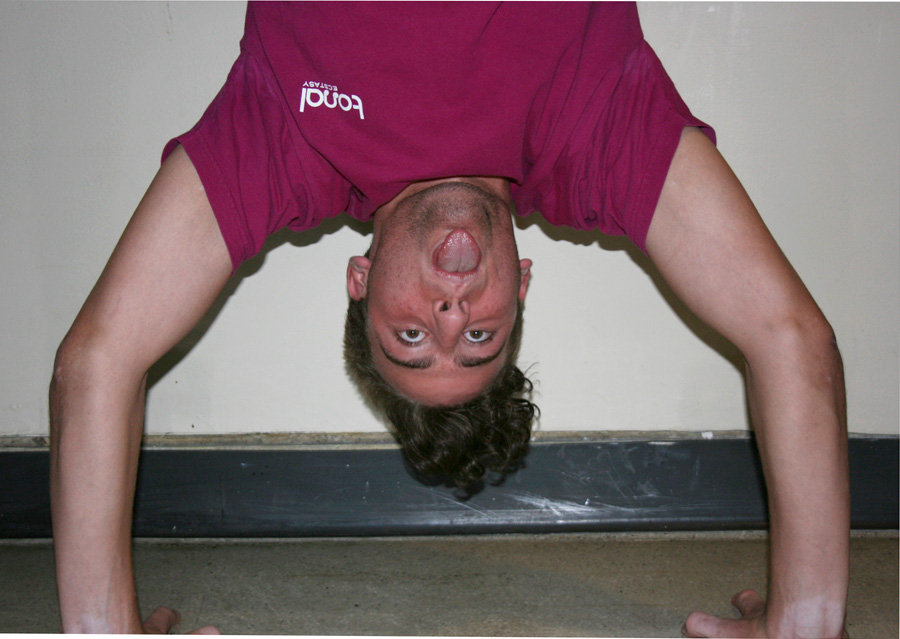
(Alexandra Allaire/ McGill Tribune)
a, Student Life, Student of the Week

Student of the Week: Alex Gershanov

Q: What is your motto?

A: “Energy.”

Q: Which fictional character would you most like to date?

A: Rihanna.

Q: Who is your hero?

A: That guy with the golden voice—this guy who was homeless but he has this amazing radio voice.

Q: Batman or Superman?

A: Batman.

Q: What is your lucky charm?

A: My “rage” shirt. The one that says “rage” on it.

Q: If you could say one thing to Kim Kardashian, what would it be?

A: “Take me.”

Q: Yams or Sweet Potatoes? (They’re different)

A: Neither. I stick with potatoes.

Q: What word or expression do you most overuse?

A: “Word.”

(Alexandra Allaire/ McGill Tribune)

Q: Describe your favourite article of clothing.

A: I have a tank top from this new Montreal-based company that’s called “Cure,” and it has brass knuckles on it, and it says “Wisdom is Power.”

Q: Kris Humphries or Lamar Odom?

A: I don’t know either one of those people.

Q: Name one song that takes you back to O-week of first year.

A: Take Over Control – Afrojack

Q: Which historical figure would you most want to have a beer with?

A: Alexander the Great

Q: What’s your least favourite sound in the world?

A: “It’s ok, it happens to everyone”

Q: Jay Leno or Conan O’Brien?

A: Conan. [Forget] Jay Leno.

Q: What’s the last song you remember listening to?

A: Mykonos – Fleet Foxes.

Q: How many times have you had poutine since you’ve moved to Montreal?

A: Like, 15.

Q: Michael Jackson or Michael Jordan?

A: Jackson.

Q: Rank the Harry Potter books from best to worst.

A: 4, 2, 3, 1—haven’t read the other three.

Q: Describe Montreal in three words.

A: For the taking.

Q: James Franco or Dave Franco?

A: James Franco.

Q: Sports Illustrated or Cosmo?

A: Sports Illustrated.

Q: If you were a Crayola crayon, what colour would you be?

A: Royal Purple.

Q: What’s the first thing you think of when I say Thanksgiving?

A: My birthday.

Q: Who would play you in the movie of your life?

A: Nicholas Cage.

Q: Why are you an asset to McGill?

A: I’m a beatboxer for an a capella group, and I try and get involved in engineering events. I make cool music on the street, drumming and such on buckets and pans, and I bring the energy. I am the energy.

a, Recipes, Student Life

Sweet Potato Recipe

Here is a classic feel-good family recipe that is perfect for Thanksgiving. Easy to prepare, this dish is a staple at any table come Thanksgiving weekend; it will definitely have you coming back for seconds!

Ingredients

3-4 large sweet potatoes

¼ – ½ lb salted butter

¼ cup milk

1 tbsp brown sugar

Additional brown sugar for topping

Method

Peel, dice, and boil sweet potatoes until tender. Drain and mash with butter, milk, and 1 tbsp brown sugar.  Using a handheld mixer, whip the mixture until light and fluffy.  In an 8” x 10” baking dish, spread the whipped sweet potatoes in an even layer and cover liberally with a layer of brown sugar.

Bake at 350 farenheit degrees until brown sugar melts and bubbles. Watch carefully, as the sugar can burn quickly. Serve warm and enjoy.

a, Student Life

Long Weekend Getaways

If you hail from Canada’s West Coast—or if you celebrate Thanksgiving in November for some strange reason—and aren’t going home this long weekend for turkey, take advantage of the extra day off. Go exploring!

Burlington: The largest city in Vermont is only two hours away by car or bus. Its relaxed charm is second only to the wide variety of activities it boasts. Choose from your standard apple-picking and shopping on Church Street, to the wacky Pumpkin Regatta, an annual boat featuring floating, hollowed out pumpkins.

Quebec City: Check out the province’s capital in all of its autumnal glory. Roam around Vieux-Quebec for some old-world architecture only a few hours away by bus or train.

Ottawa: The nation’s capital is only two hours away, and easily accessible by any mode of transportation. Go visit Parliament Hill for a dose of Canadian national pride.

Saratoga Springs: Halfway between Montreal and New York City, this sleepy college town boasts a race track and the Skidmore college campus. Recharge for the weekend at one of its numerous Victorian bed and breakfasts.

New York City: The city of cities is only eight hours away by Greyhound. Make the most of your weekend and grab an overnight bus, or find a ride share, to visit the best city in the world!

Montreal: Stay in Montreal and try your hand at making your own Thanksgiving dinner!

a, Student Life

Customer etiquette

Any good writer seeks to express the truth, be it in politics or interior decorating. Until now, it seems that a large portion of the restaurant-frequenting world has been blind to what really happens behind the scenes in these hectic establishments that appear calm and cool to the blind eye.

I’ve been working in restaurants for the better part of my legally employable life. In addition to chapped fingers from searing hot plates and an eclectic group of work pals, I have experience with classic culinary customer encounters. these anecdotes epitomize the irony of how little people understand about the workings of an eatery—despite how much time they spend in restaurants.

Situation one: What is that thing beside my lamb shank? 

It is essential that you know exactly what you are ordering. Read the menu description carefully. This can even work in your favor: was the promised slab of goat cheese left behind in the kitchen? It very well could have. However, you will only know that if you actually read about what you are ordering. If you don’t know what something means, ask your server, as it could be a fancy-pants name for a spice or garnish  you loathe. Contrary to popular belief, servers and chefs actually aren’t mind readers, so this process is in your hands and your hands only.

Situation two: the water wasters

Indeed, maintaining a good level of hydration is necessary for survival. But why—when it comes to water—is it appropriate for one person to order for everyone else? You don’t walk into a restaurant and say, “14 T-Bone Steaks. All medium rare,” do you? Of course, the discrepancy here is that water is free, and most people don’t get too upset if something free magically arrives to them from the heavens. It’s only free for you, though: it takes the same amount of time and labour to pour a glass of water as it does a glass of wine or pop. No one is getting paid for the 27 glasses of water you ordered for all of your friends, not even knowing if they really want them.

Situation three: the time paradox

Understandably, when you are dropping a three-figure sum on a nice meal, you expect your evening to run pretty smoothly. In the more expensive establishments, the food is—believe it or not—made to order, using as many fresh ingredients as possible. You have to sacrifice the convenience of quickness to maintain the quality. Why are you rushing in the first place anyway? Enjoy yourself, and take refuge in the thought that all good things come in time; and that McDonalds burgers, although excellent in their own way, are made in five seconds and cost three dollars for a reason.

Situation four: family matters 

Restaurants and young children are the worst match in the modern world since your Aunt Linda and Facebook. Children simply aren’t equipped with the same level of patience that (most) adults are, and they often fail to think twice about creating an artistic masterpiece on the freshly laundered restaurant linens. One of the most common parental intervention methods used is to order their children’s meals first.  This is an attempt to avoid intermittent painful shrieks ignited by an unwanted stomach growl. Unfortunately, the technique is completely illogical, since the kids will be finished their meal long before their parents, leaving a large window of time to wreak havoc.

The next time you are at a restaurant and observe that grumpy-looking group beside you, chomping at the bit to devour their meal while their kids are swallowing pasta noodles whole, accompanied by their full, untouched glasses of water—walk on over and remind them that they aren’t the only ones expecting to eat tonight. Although everything appears to be easy-peasy, at least a half a dozen people are working really hard to make sure your belly and your mind walk out of the door satisfied. Not up for a divine intervention? Then just please refrain from ordering ‘water for the table.’

a, Student Life

Snag the best seats in the house on game night

The NHL may be locked out,  but every sports fans knows: there’s always a game on somewhere. Where should you watch that game in Montreal? The Tribune has some tips.

Champs — A Montreal staple, Champs has two floors of TVs and specializes in showing multiple games at the same time. Fans have the option of sitting at small tables or booths downstairs in one of two   relaxing areas separated by the bar, or upstairs at long tables reserved for big hockey games. Head upstairs if you want to watch the game with the real fans. If the Canadiens are playing, you’ll have the opportunity to learn a little bit of French that you wouldn’t have heard in school. The food is decent but it’s made better by the serving staff dressed like referees—just don’t treat them like you would the real guys in the zebra stripes.

Peel Pub — Like big crowds and  lots of TVs? Head to Peel Pub to get your fix. The bar is narrow and has two floors, but the sheer number of televisions will have you constantly second-guessing which one shows you the best angle. The menu is extensive, with over 100 items, but the highlight is ‘The Canadian:’ two grilled hot dogs with poutine ‘Quebecoise’ and cole slaw for just $5.99. Peel Pub is often quite crowded on Saturday evenings for Hockey Night in Canada or big UFC fights (get there really early if Georges St-Pierre is fighting) but the crowds should tell you this is the place to be.

McLean’s — Though it is known by some as ‘the place next door for when Peel Pub is full,’ McLean’s doesn’t deserve this reputation. Beer towers and taps built into the tables allow you to stay seated and continuously pour beer without getting up to go and refill at the bar. The pool tables upstairs are nice for those less interested in sports and more in the mood for competing amongst themselves. It’s not quite Peel, but still an option.

Ye Olde Orchard Pub — Much smaller and noasting fewer TVs, Ye Olde has a more intimate atmosphere than some of its competitors. Conveniently located on Prince Arthur just before St Laurent, it’s a good place for those living near McGill to go without making a long trip. Call ahead to make sure your preferred game is being shown, and enjoy some more unique beers other than the usual Boreale or Molson Ex.

Home — If you want to stay close to home, why even leave? At home, you have complete control over the TV, can watch whichever game you want, and can turn it off after your team blows it. The menu consists of whatever you have in your fridge, plus whichever restaurant’s deliwvery number you have on speed dial.

She sees­—do you? (goethe.de)
a, Arts & Entertainment

At the intersection of light and technology, art emerges

In When Do I See Photons? Oswald Wiener, cybernetician, author, and inspiration for the inaugural exhibition at the Goethe-Institut’s new locale, poses this very question. Photons, the smallest particles of light, stimulate our retinas. So what does it mean to ‘see’? Five artists, all students at Transmedialen Raum de la Kunsthochscule für Medien Köln, a prominent German media school, seek to answer this question through a mix of software and nature.

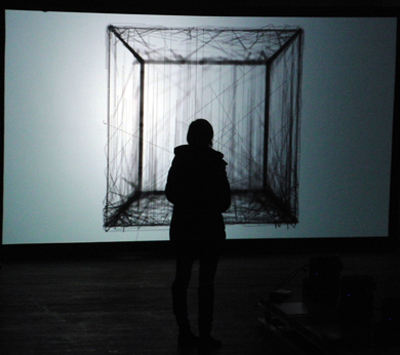
Four of the exhibit’s five works are short films projected onto a screen, and are visible from both inside and outside of the building through the institute’s floor-to-ceiling windows. These films looped one after the other, interrupted only by white-on-black titles and credits. Jan Goldfuss’ EntroPI, by far the most intriguing and unusual piece, used mathematical procedures and algorithms to create a complex black-on-white animation. This piece felt inherently organic, playing with the mind, making the viewer question what it is the eye perceives. Is it airborne bacteria, smoke, or dust? Lines, waves, and geometric formations emerge subtly from the multi-dimensional canvas created within, and just as quickly melt away from perception. While  entirely computer-generated (the artist goes so far as to leave exposed animation framework and holes to demonstrate this), EntroPI manages to be universal, and naturally stunning.

In Cellular Performance, Verena Friedrich documents the manipulation of human and animal cells in black and X-ray white. These cells shift to form words and letters that come in and out of focus with the motions of the living organisms that constitute them. It’s an interesting concept to wrap one’s mind around; is this a statement on the impermanence of language, the ever-changing nature of human invention, or the idea that technology takes on a life of its own? The answer is unclear, but Friedrich’s cells are engaging to observe and make one feel acutely mortal and self-aware.

Though interesting and emotionally engaging, the three remaining works are less visually arresting. Suija Kim’s [S] offers an up-close, greyscaled view of natural objects and phenomena. Stones, waves, and exploding geysers are filmed with dizzying camera angles and points of view that play with the ability to comprehend what it is that’s being shown on screen. Hörner/Antlfinger’s Two Homes juxtaposes footage of a farm and chicken coop with edited YouTube clips of a small parrot performing impressive tricks and caressing his owner’s hand. The fifth artist, Vera Drebusch, was present to engage visitors in her work Beamer Walks—essentially a tour of Montreal’s Quartier des Spectacles by the light of an electric torch. This was then captured on camera to become, in turn, one of the films being shown.

As my mom pulled up beside the Goethe-Institut to give me a lift home, she passed the films projected in one of the windows, as well as the glass room in which a mini-rave complete with colourful strobe lights and an excellent DJ imported from Germany for the occasion was taking place, and said bemusedly, “Are you sure this is an art exhibition?” Pass by the Goethe-Institut to see for yourself, but the five artists on display, though often esoterically, manage to raise not only the question of When do I See Photons and what it means to see, but the most fundamental question of all: What is art?

When Do I See Photons? runs through Dec. 31 at the Goethe-Institut, 1626 Saint Laurent. Admission is free. 

(Eric Chad / Players’ Theatre)
a, Arts & Entertainment

A local twist on an absurdist classic

Samuel Beckett’s oft-cited yet largely misunderstood piece of absurdist theatre, Waiting for Godot, has had its own share of lingering­—not idly, but in a constant state of rework, reinterpretation, and reproduction. In the 60 years since its publication, the show’s vagabond characters Vladimir and Estragon have plodded from stage to stage, until finally setting up their meagre camp in McGill’s own Players’ Theatre this season.  Thoroughly re-envisioned for a modern audience, director Isaac Robinson’s take on Beckett’s slim but weighty work is one part respectful preservation, one part winking reinterpretation.

From Beckett’s vague set description, the Players construct a familiar Montreal site: the back alley of a seedy bar, the door marked “Delivery Room: Godot’s Bar.” Amid flyers plastered across the set’s wall hides the central set prop: the indispensable willow tree.  Estragon (Martin Law), in his patchwork jacket and ill-fitting boots slumped beneath the “tree,” could just as easily be the unlucky gentleman of the show’s original time as of today. Law, lank-limbed, unshaven, and slumped with all the pride of a man recently awoken after a night spent in a ditch, portrayed Estragon (“Gogo” affectionately) with deadpan excellence.  From tattered bowler to exposed toe, Law embodied the hardened Estragon with an appropriate lack of panache.

As his companion, compatriot, and sometimes combatant, Vladimir, or “Didi” (Rachel Resnik) played the clown to Estragon’s straight man. With arms splayed in pantomimed emotion, voice jumping an octave a minute, and face contorting from girlish pouts to livid glares, Vladimir acted (and acted indeed) as Gogo’s perfect counterpart.  Resnik played the traditionally male role with slight femininity, skewing the somewhat homoerotic undertones of Vladimir and Estragon’s bond.

In place of this, enter Pozzo and Lucky. In this production they were presented as near caricatures of queer stereotypes. Pozzo, played by Sebastian Biase with appropriate bombast, comes off as the aging aesthete toting a handsome young toy—or in this case, slave.  Martin Roy as Lucky, limp-wristed and pouty, shed his character’s traditional ropes and chains for bondage paraphernalia and biker shorts, modernizing and somewhat undermining the monstrousness of human ownership. As the vagabonds’ visitors confuse dominance and subservience, knowledge and madness, and all of life’s seeming opposites, the two distorted our notion of certainty in human existence.

For all its comically modern touches—replacing Pozzo’s chicken and wine for KFC and Molson—the Players’ Theatre production did Beckett’s work its due justice. The anxious irresolution on the page translated to the stage, giving viewers a substantial show that remains unresolved. Like the quasi-MacGuffin Godot, meaning loitered in every line and action, yet never quite materialized.  The characters were helpless and hopeless, the audience jarred and confused, and we are left with nary a conclusion in sight. This production of Waiting for Godot left us waiting—but in eagerness, not want.

With love-struck gamblers and fortuitous drama, Guys and Dolls is a sure bet. (Simon Poitrimolt / The McGill Tribune)
a, Arts & Entertainment

Love, laughs, and the libertine; a story of Guys and Dolls

Big names and voices will grace the Montreal stage this fall as the Segal Centre for Performing Arts kicks off its 2012-2013 season with its up-close-and-personal rendition of Tony-award-winning  performance Guys and Dolls. A sexy comedy of skewed morality, Guys and Dolls follows two gambling gangsters, Nathan Detroit and Sky Masterson, as they attempt to manipulate and one-up each other within the glamourized setting of a gritty 1940s New York City. Despite its small-scale setting, the production boasts an impressive list of seasoned Broadway and Stratford Festival veterans, all under the expert direction of Diana Leblanc.

Leading this skilled cast is Tony-nominated American actor Scott Wentworth, who portrayed the notorious Masterson in two previous runs of the musical at the Stratford Festival. Wentworth spoke fondly of his history with the show, referring repeatedly to its clever writing, humour, and edginess­—all of which he believes will appeal to a wide array of audience members.

Despite stereotypes surrounding older musicals—overly extravagant and disconnected from real human experience—Wentworth claimed that Guys and Dolls manages to bypass the sentimentality and old-fashionedness typically ascribed to its contemporary productions.

“It’s about your grandparents’ world, but it’s also about everybody’s world,” Wentworth explained. He praised what he and others have interpreted as being the central message of the show: taking risks and following your bliss. Wentworth believed that this prominent theme helps the show transcend generational barriers, and will particularly appeal to university students who are contemplating their futures.

(Simon Poitrimolt / The McGill Tribune)

“In a way, the message [of the show] is that you have to risk something, you have to gamble something […] if that’s what you want,” Wentworth said. “That’s a good thing to think about for those [of you] in your early 20s.”

Alongside the big Canadian names appears a group of Montreal performers and McGill graduates, most notably musical director Nick Burgess, comedian Massimo and Montreal-based actor Marcel Jeanin. Among the local talent is actor and stand-up comedian Mike Paterson, a graduate of Dawson College’s DOME theatre program. Paterson, responsible for most of what he described as the “low comedy” of the show, stressed the importance of the comedic aspects of both lyrics and dialogue. The well-written humour, he believed, played an important role in maintaining Guys and Dolls’ legacy.

Like Wentworth, Paterson believed that a modern audience will not find it difficult to relate to the show’s different characters and subplots, despite its dated setting. “Two gamblers bet that they can’t take a religious girl to Cuba, and that’s the kind of thing that I would [do] with my guy friends,” he joked.

Equipped with a stellar list of collaborators, along with a script and score which have entertained generations of theatre lovers, Guys and Dolls is likely to have something for everyone.

Guys and Dolls runs through Oct. 28 at the Segal Centre for Performing Arts, 5170 Cote-Ste-Catherine. Student tickets are $29.

a, Arts & Entertainment

Private View, public remembrance

What do masks, political upheaval, and student theatre have in common? On Wednesday Oct. 10th, all will be part of the debut of Tuesday Night Cafe (TNC) Theatre’s latest production, Private View. The show will honour an important figure of Czech history, former president of Czechoslovakia Vaclav Havel, while telling a compelling story of individual struggle against the backdrop of political turmoil. Written in 1978 by Havel, the play is directed this year by McGill’s own Gabriela Petrov, U3.

The story centres around protagonist Vanek’s visit to the newly renovated home of his married friends, Vera and Michael, in the wake of the ’60s Soviet occupation of Czechoslovakia. He finds that his friends have decided to remain unaffected to the political situation, instead focusing on the pursuit of pleasures in food, sex, family, and leisure. Vanek tries to communicate to them the desperate nature of their country’s predicament, but in the end the characters must all make their own choices.

According to Petrov, this is a story that remains relevant in today’s world. “There are a lot of comparisons to be made when you think about the nature of the protests that have been going on and the fact that these characters are dealing with a world in which protest is impossible,” Petrov said. “So they try and rebel in their own ways.”

TNC is one of McGill’s oldest student-run theatre companies, producing plays written by both internationally-renowned authors and student playwrights. Private View is the first play Petrov has directed while at McGill, but she has acted her whole life.”

“I’m a performer, first and foremost,” she said, “but I found it immensely helpful to be able to approach directing from the angle of the actor.”

Petrov noted that her history of acting gave her insight into what to avoid as a director, often drawing  on her personal experiences see the show from the shoes of her cast.

She believed that directing Private View was one of her most edifying experiences at McGill.

The retelling of Private View honours Havel’s legacy, an intriguing figure who was a staunch opponent of Soviet intervention in his country. He was known for his political dissidence, and most of his written works creatively challenge social injustices. Havel’s death in 2011 elicited tribute by well-known figures worldwide, from U.S. President Barack Obama to Czech novelist Milan Kundera.

Private View made its first North American appearance in 1983 at New York’s Public Theatre. In a review for the New York Times Magazine, the late art critic Mel Gussow wrote that “the dehumanizing effects of totalitarianism are demonstrated with wounding honesty and irony in Vaclav Havel’s ‘Private View.’ This…is an event of artistic and political urgency.”

Throughout the play, the subconscious desires of the couple are acted out by masked figures. The use of masks is not something often seen in theatre productions, but they serve to make the TNC’s rendition stronger.

“It was hugely different to be part of a play with masked actors, even since the audition process” Petrov said. “It was challenging at first, but we had an amazing group of people who are so talented…I’m really excited about the show.”

Given the play’s rich history, relevance to current events, and the production’s creative presentation, there’s certaintly reason to be.

TNC’s production of Private View runs from Oct. 10th to Oct. 13th, and Oct. 17th to Oct. 20th at Morrice Hall

a, Arts & Entertainment, Music

Cruel Summer: G.O.O.D. Music

If summer was cruel to producer Kanye West, this album makes me wonder if it was just because his artistic ambition was not up to its usual standards. Coming out on the tail end of the warm season, G.O.O.D. Music’s Cruel Summer largely misses the mark of a classic summer album.

With over 15 artists featured, the songs are too varied, and do not seem to centre around any particular theme. Each song has some merit and is worth listening to, but as a whole, the composition does not have the usual cohesive vitality of a Kanye-produced album. Songs mostly fall into two respective camps: aggressive hustler anthems and soulful, introspective melodies.

Of the former, the two most notable are the high-energy “New God Flow” and “Mercy,” which were released as singles prior to the album. The only other truly worthwhile song in this category is “The Morning,” in which seven artists deliver clever, revved up verses. In the second, more melodic category of songs, standouts include “To the World,” in which R. Kelly returns from oblivion to deliver some memorable lyrics. Another notable contribution is made by Ma$e, the one-time Diddy sidekick, on the seductive and progressive track “Higher.” “Bliss,” a soulful duet delivered by John Legend and Teyana Taylor, is wonderful, and Kid Cudi’s “Creepers” is also a highlight—if only because it’s reminiscent of the former rapper’s contributions to the genre. “The One” is another gem, balancing a hopeful melody with earnest, skilled rap.

If Cruel Summer had been a playlist of rap and R&B songs someone had thrown together for me, I would have probably loved it. However, from something produced under Kanye West’s name, I can’t help but expect more.

Read the latest issue

Read the latest issue