

Latest News

a, Student Life

Ways to keep you from falling ill this fall

It’s the start of a new term, which means that you will face many new people, new activities, and new sickness-causing bugs. Chances are, most of us are going to fall ill this semester; but this doesn’t mean that we can’t try our best to prime our immune systems to fight the nasty germs. Here are some all-natural, tasty, and consumable ways to give your immune system an edge against germs this Fall. 

1. Eat Pumpkin Pie. Pumpkins, like carrots and other orange vegetables, are loaded with beta-carotene and other carotenoids. These powerful anti-oxidants fire up the immune system by activating pretty much every immune cell in your body. Enjoy pumpkin out of a can, as a pie, a soup base, in an easy-to-make pudding, or in bread. Note that taking a beta-carotene supplement is not as effective as eating sources rich in all the carotenoids, as they work best together to ramp up immunity.

2. Be ‘C’ Crazy. As Mom always told us, eating oranges during cold season is essential. This is because citrus fruits—and actually better yet, kiwis, sweet potato, red bell peppers, kale, and broccoli—are rich in potent anti-oxidants, namely vitamin C, which act as an overall sickness tonic. If you take supplements, 200 milligrams a day is optimal to provide immune-boosting effects. Anything more will be flushed down the toilet.

3. Beef up with Protein. Protein is a necessary part of overall system maintenance and bolstering your immune defences. Lean proteins such as poultry and legumes are best. Try to incorporate at least one portion of dense protein per day into your diet: five to seven ounces of lean meats or one to two cups of beans. In addition to protein, beans give you a boost of immune-supporting iron.

4. Sunbathe. Some say summer tanning  carries some health risks, but it also boosts your immune system and cancer-fighting abilities! Vitamin D is critical to wake-up the less active, disease-fighting T-cells in order to evade invading germs. Indulge in fortified milk and cereals during the dark Canadian winters to keep your stocks of vitamin D high.

5. Indulge in ‘E’. As the untold hero of immune health, vitamin E activates a different kind of immune cell, the natural killer (NK) cell, which acts as the search party of the immune system. NK cells seek out cancer cells and germs, and actively destroy them. Found mostly in fatty fishes, vitamin E can also be taken as a supplement at 100-400mg a day.

6. Bio-‘whata’-noids?

Bioflavonoids create a super-barrier to your cells. This prevents nasty germs and pollutants from latching onto your cells and slowly eating away at the normal protective barrier in order to launch an attack from the inside. How can you get these? By eating your fruits and vegetables, and drinking hot black or green teas.

7. Eat Smelly Garlic. A double whammy: garlic both scares away your diseased friends from getting too close, and simultaneously enhances the proliferative capacity of immune cells and their activity. The smellier the garlic the better! The sulfur-containing compounds of garlic and onions are the main source of its action.

8. Mushrooms? Yes, mushrooms enhance the production of cytokines—little molecules that coordinate and activate the action of those immune cells.

9. Go Spicy. Now is the best time to enjoy that runny-nose-provoking Indian food! Chilis, hot mustard, pepper, radishes, and garlicky substances are also known as mucolytics as they mobilize mucous. This not only makes for an embarrassing eating experience full of sniffles, but  also prevents the build-up of germs in the mucous layers of your nose and throat.

10. Ginger. Ginger potently and specifically targets viruses that instigate the common cold, and suppresses coughing. It is also anti-bacterial, anti-septic, and basically anti-anything-that-makes-you-sick. Boil some of this tangy root in water to enjoy a home-brewed cup of health!

a, Student Life

How to banish your hangover

Despite being the joyous, wonderful start to the weekend, Saturday mornings can be the most excruciating part of your week. You may remember what you did the night before, and why you feel so utterly awful; or worse, you may have no recollection. Never fear, my friends. Next time this pickle comes your way, grab ten bucks, do up your shoe laces (if you managed not to lose them last night), and head on a culinary mission to brighten your morning.

First stop, Middle Eastern food.  It’s called a Shawarma. Pita, hummus, garlic sauce, chicken, pickles, some sort of salad, all combined into a divinely toasted wrap. This meal cures a hangover like nothing else in the world. Forget any pointless shakes or juices your healthy subconscious would persuade you to try; these babies are moist, juicy, greasy, and so satisfying, that your hangover will simply melt away.

What if hummus is not your thing? What if the presence of lettuce and tomato is just ‘too healthy’ to assist your stubborn, growling stomach? Maybe you would be better off embracing any fragment of French within you by seeking out a crêpe. Like the Shawarma, these are little lifesavers wrapped in paper and easily eaten on the run. However, one difficulty involved needs to be mentioned: should you go as large as the Eiffel Tower itself and order one stocked with eggs, cheese, ham or a combination of those? On the other end of the spectrum, your stomach might be more inclined to head down the strawberries and Nutella track. I shall leave that one up to you. Either way, they both rank equally in the feel-good stakes.

Now for my third recommendation. What is that I hear you chanting? ‘Poutine, poutine, POUTINE!’ While poutine is a popular hangover cure, I cannot condone it or recommend it. I simply like my fries crispy, not drowning in gravy, and I stand by my beliefs.

So let us return to the calorie-laden delights that we can all enjoy. When you are slapped with a hangover—the slap being self-served—let’s be honest, there are two little guys who will always be there for you: one is named Ben, and the other Jerry.  This chilled dessert is probably not the first thing that comes to mind with the post-beer cravings hit—it’s more traditionally associated with the post-break-up funk—but it does not disappoint. With an already scrumptious base of creamy ice cream, and additions such as cookie dough, chocolate chips, nuts and bits of cake batter, one is guaranteed to feel on top of the world after this indulgence.

Use this short list the next time your morning begins with no dignity, no memory, and no food in the house. Good luck on your next culinary quest to combat the booze-induced blues.

Sherbrooke failed to stop McGill all game. (Sarah Papadopoli / McGill Tribune)
a, Sports

McGill rugby make it look easy, crush Vert et Or by 90

The McGill Martlets’ (2-1) rugby team handed it to the Sherbrooke Vert et Or (1-2) on Sunday afternoon, dominating both offensively and defensively on its way to an astounding 102-12 victory.

McGill entered the game needing a boost of confidence, following last week’s letdown defeat to Concordia. “The girls had a tough time recovering from their loss against Concordia and [this] was a good way to wash that taste out,” Head Coach John Lavery said. Playing on their home field with their family and friends watching, the Martlets took the opportunity to get back in stride.

Martlet captain Brianna Miller was critical of her team’s start, but thought they executed better as a unit as the game progressed. “I think, as a team, we started a bit slow, but after we took it up and stuck to our game plan we really showed Sherbrooke that this is our home field,” Miller said. Her impact in the game was noticeable, as she scored two tries and made twelve conversions in the game.

Second-year prop Rachele Rose praised Miller’s role both on and off the field.

“Miller, our captain; and Victoria Horne, our co-captain; keep pushing us on and giving us speeches … everyone is building each other up.” Rose, a former Junior Varsity member who moved up to the Varsity team this year, scored her first try on Sunday. She emphasized the support each of the players receives. “I was really uncertain about myself and my confidence was low but … I just went out there knowing my teammates would have my back. So really, it’s not my try, it’s our try.”

Rose’s statement could not be more true. Eleven different players on the Martlets converted a try against Sherbrooke. Of those eleven, Miller, Marie-Helene Laforest, and Milda Sabiston each scored twice, while Casey Thorburn added a game-high three of her own.

(Sarah Papadopoli / McGill Tribune)

The Marlets operated efficiently on the offensive end, running through their phases extremely well. If they were ever stopped by Sherbrooke, they did a fantastic job of rucking over, keeping the ball in their possession, and setting it back up. Sherbrooke had a tough time slowing down the McGill attack, as it seemingly took four of their players to bring down a sole Martlet. Capitalizing on this physical strength, McGill used quick, smart passing to find the open players and lanes on the field. Time and time again, McGill players sprinted uncontested to the middle of the goal posts, after strategically breaking through Sherbrooke’s defensive wall.

Coach Lavery stressed the change in his team’s offensive strategy. “We [are] changing the point of attack in our offence. For the first half of the season, we were running off our scrum half, and today we were running off of Miller,” he said. “It was a bit challenging to place this offence and run it in a game context and it got a bit scrappy at times, but they kept their structure and they had a lot of fun.”

While many tries were uncontested, there were points at which McGill’s play became a bit disjointed. At these times, the team’s leaders, like Miller, stepped up to work out the kinks in the Martlets’ game.

Nevertheless, evident from the result, McGill has begun to eliminate small, yet costly, mistakes. Looking ahead, the Martlets should figure to be a serious threat to any opponent they play during the remainder of the season. With the victory, the Martlets move to 2-1 on the season, and will head on the road to take on Bishop’s on Sept. 21. They will be back in action on friendly soil Sept. 30, when they play the Ottawa Gee Gees.

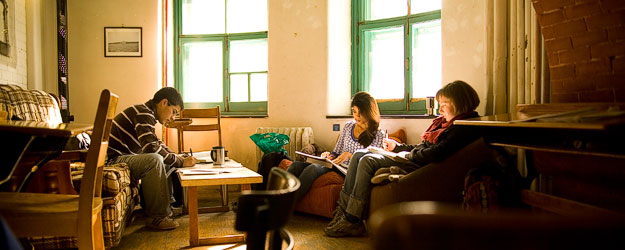
SSMU's initiative to create a student-run café was a response to the administration's closing of the Architecture Café in Sept. 2010 (pictured above, Claudio Calligaris / mcgill.ca).
a, News

Student-run café plans halted due to financial concerns

The Students’ Society of McGill University (SSMU) has halted plans for the creation of a student-run café due to concerns about the financial feasibility of the project. SSMU executives say they are currently looking into alternate plans for a unique student space in the SSMU building.

The student-run café project was first proposed in 2011 as a response to the closing of the Architecture Café in Sept. 2010, and was set to open in the fall of 2013. The original leader of the project, former SSMU Vice-President Finance and Operations Shyam Patel, said that  SSMU conceived the café concept with the intention of creating more student space and jobs on campus.

“I personally liked the idea of a café space because it bridges the gap between the classroom experience and practical experience for many students,” said Patel, who has not been involved in recent decisions. “A student-run café would encourage the participation of students at a managerial level, and would provide much needed practical experience regardless of a student’s program.”

According to current SSMU Vice-President Finance and Operations Jean Paul Briggs, however, the plans to create a student-run café are complicated by an existing eight-year contract with La Prep, which states that no other food service in the building is permitted to sell specialty coffees and teas.

“[This] is problematic because it limits the offerings of the [student-run] café,” Briggs said. “In addition, there are already seven food services in the SSMU building … it would be very hard for the [student-run] café to compete and differentiate itself [with respect to] price, quality, or variety.”

In addition, the building is already at full occupancy, meaning that SSMU would have to evict a current tenant to create space for the new café. According to Briggs, this means the new café would have to make up for the lost revenue from that tenant—as well as the financial demands of renovating the space and buying the necessary equipment—in order to remain financially sustainable as an operation.

While SSMU could potentially locate the café outside of the SSMU building, Briggs was not optimistic about the practicality of such a project, based on previous student ventures like Haven Books.

“They don’t work because they are [constantly] changing management [and] employees year-to-year,” he said. “There’s very little continuity and institutional memory, and that leaves it as a very risky and troublesome opportunity for us to pursue.”

Despite these challenges, Briggs said he will pursue the project’s original goal to create a unique student space in the SSMU building, with the assistance of the students involved in last March’s sustainability case competition—an event in which teams presented their design for the café to a panel of judges.

“We want to use the creative and dedicated people who put so much time and effort into the case competition to develop an idea for a new, unique student space that meets the ideals that were set forth,” Briggs said. “I think there are many ways within that framework that we could satisfy those needs, and do something really useful without jeopardizing our operational feasibility.”

Patel expressed some concern over the stalled plans. He said that the Operations Management Committee explored these financial concerns last year, and that the limitations cited by Briggs would extend to any attempt to create student space in the building. However, he explained that there is still value in pursuing the development of a space for students.

“Any form of student space is beneficial … however, there needs to be an emphasis on student-run space rather than space for students,” Patel said. “There are many spaces that can be used and accessed by students on campus, however, students do not necessarily have the opportunity to be a part of the decision-making process in regards to how the space should be managed, used, and developed.”

These changes in plans will have the most immediate impact on the members of Fireside Café—the team that won the SSMU sustainability case competition last year, and whose design was supposed to be adopted for the student-run café. Rebecca Rosenthal said she and her team are looking forward to discussing the feasibility of the project with those involved in the decision.

“Throughout our experiences during the competition, we witnessed students, faculty, [and] administration [as they] worked harmoniously towards a common goal, and how this collaboration can lead to mutually beneficial gains,” Rosenthal said. “We hope to continue working with SSMU and many others to ensure that decisions with far-reaching impacts on student lives are made in the best and most inclusive way possible.”

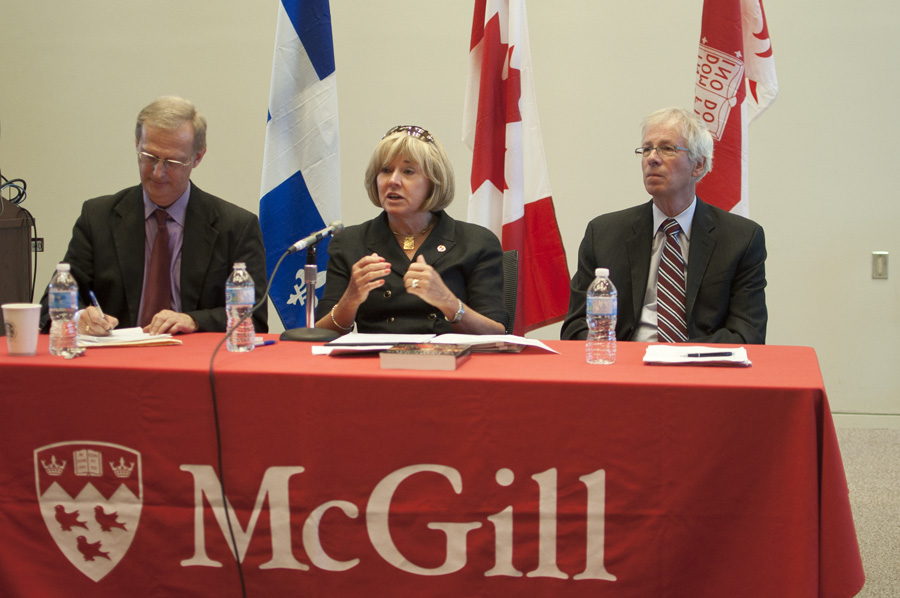
Panelists discussed proposed changes to the Senate. (Simon Poitrimolt / McGill Tribune)
a, News

Panel debates Senate reform effects on linguistic minorites

Last Wednesday, in Chancellor Day Hall, Linguistic Rights McGill held their inaugural panel discussion on Canadian senate reform and its impact on linguistic minorities. The panel consisted of Stéphane Dion, former leader of the Liberal Party of Canada; Céline Hervieux-Payette, former Leader of the Opposition in the Canadian Senate; and Louis Massicotte, professor of political science at Université Laval.

“With this event, we sought to create a forum where academics, legislators and students could … share knowledge, experience, and possible solutions and outcomes in regards to the issue of reforming our chamber of sober second thought,”  Andrea Suurland, president of Linguistic Rights McGill, said.

Currently, the Governor General of Canada appoints members of the Senate on the advice of the Prime Minister. Senators can keep their positions until they reach the age of 75, and each province and territory is entitled to a specific number of seats, as determined in the Canadian Constitution.

Proposed by Prime Minister Stephen Harper in 2011, Bill C-7 would amend the constitution to make the senate a democratically elected body. The Bill proposes that senators should be elected by each province, and be limited to a nine-year term.

According to Dion, one of the major problems with Bill C-7 is it would make both the Senate and the House of Commons essentially equal powers.

“What Steven Harper is trying to do does not exist in any place in the world,” Dion said. “I think it is very dangerous to have two elected chambers able to stop each other.”

Dion also suggested that having a powerful, elected Senate would  be a disadvantage to provinces such as British Columbia, which,  for historical reasons, have fewer representatives in the Senate.

In his opening address, Massicotte addressed the importance of the Senate to linguistic minorities, as a larger percentage of people from minorities are found in the Senate than in the House of Commons.

“From 1963 to 2006, 17 per cent of the 253 senators came from a minority language community,” Massicotte said in French. “Language minorities are almost two times better represented in the Senate than in the House of Commons.”

Massicotte explained that using province-wide elections to select senators would likely lead to fewer minority language senators, since language minority populations are often concentrated in small areas.

“We shouldn’t exaggerate, however, in presenting the Senate as the defender of linguistic minorities,” Massicotte continued. “The first line of defense for official language minorities is very clearly the Charter of Rights and [Freedoms].”

Hervieux-Payette, a sitting senator for the senatorial division of Bedford, Québec, said that the senators selected under the existing system are dedicated and experienced.

“The [high] level of education amongst Senate members is for the good of the community,” Hervieux-Payette said in French.

The panelists also gave their opinions on whether or not the Senate would ever be abolished.

“I don’t think [abolishing the Senate is] a Canadian priority,” Dion said in French. “[The Senate] isn’t a problem, even though it isn’t optimal. It’s useful.”

Massicotte agreed that abolishing the Senate is not feasible.

“You would have to go around the Constitution to abolish the Senate,” Massicotte said.

He also pointed out that the Senate could not be abolished without a referendum question, and that both the House of Commons and the Senate must approve all referendum questions.

Overall, this panel was an opportunity for students in the McGill community to learn about their country’s politics from a Quebec perspective.

“I thought [the panel] was informative,” law student Annie O’Dell said. “I don’t have an opinion on Senate reform yet, so it was nice to hear [experts] talk about it.”

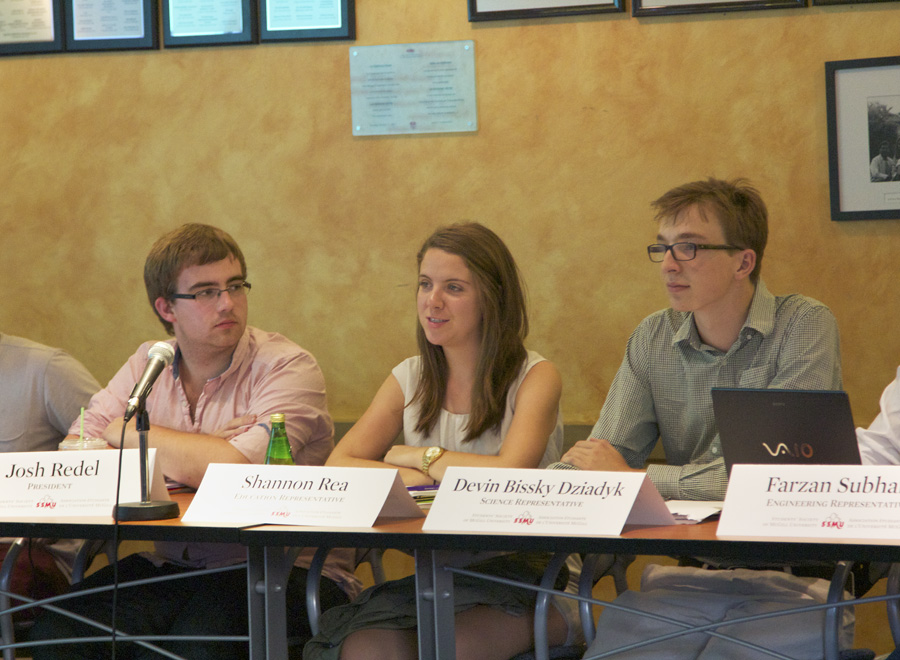
Redel described GA reforms at Council. (Anna Katycheva / McGill Tribune)
a, News, SSMU

SSMU General Assemblies to undergo substantial reform

The Students’ Society of McGill University (SSMU) is preparing to implement an online ratification system for all resolutions passed at the upcoming General Assembly (GA), as per a referendum question passed last semester. Scheduled for Oct. 1, the GA will also undergo several adaptations aimed to facilitate students’ participation in future debates, including interactive streaming software, workshops explaining procedural rules, and an increased volunteer presence.

Last semester, the referendum question calling for online ratification of GA resolutions cited the low quorum and attendance of GAs as grounds for making the resolutions accessible to those who could not attend the assembly. Previously, as few as 100 students could vote on a GA resolution that would affect more than 25,000 undergraduates.

“An online voting system would allow students to participate in the democratic process, which would produce a decision more representative of the Society,” the motion read.

However, an increased capacity for participants also means that the GA will have to meet a higher quorum—10 per cent of the society’s members—when ratifying decisions online. SSMU Vice-President External Robin Reid-Fraser emphasized the need to accommodate those who are unable to attend the GA, despite the challenge in reaching quorum.

“Just to have another way that people can be participating in the GA is going to add to it, since some people—just because of where they live, or because they have kids, or for whatever reason—can’t be there,” she said. “But if they can just access a laptop and watch, then that could be a great way to make those accommodations.”

The opportunity to view GAs online may limit the number of people willing to physically participate. To address this, SSMU President Josh Redel is looking to use interactive streaming software that will enable viewers to ask questions, submit amendments, and participate in straw polls.

Redel is also looking to encourage higher attendance at GAs by minimizing the time absorbed by procedural delays. For example, in the upcoming GA, voting will be conducted using clickers—the same device used by many students to respond to questions in class.

(Michael Paolucci / McGill Tribune)

“These are all technical things, [but] I think people will be so much happier being able to debate than having to spend 20 minutes debating and then spending 40 minutes voting, re-voting, counting, and getting a final decision,” Redel said. “If it can be 60 minutes of debate and then three minutes of getting the final count, then that, to me, is worth it.”

SSMU executives also spent the summer researching how other universities conduct their GAs. This helped them identify other ways to streamline the process, and make it more accessible to students who are not familiar with the rules by which the SSMU GA is run.

“Before the GA actually starts, we want to have a preliminary conversation, debate a bit, and have a workshop with the speakers about the very basics of how things operate during the GA,” Redel said. “There’s also going to be a lot more information as you come in to the GA. It will explain all the changes we’re making [and] how to take advantage of them.”

In addition, there will be volunteers in the aisles to answer questions outside of debate, as well as a “mood watcher”—a volunteer with whom GA participants can silently communicate their concerns, possibly through email or text messaging.

“Basically, people who don’t feel like the GA is being productive, either technically or personally—if they feel like it’s not safe space or something—will be able to communicate with the mood watcher privately,” Redel said. “Then the mood watcher can make announcements to the crowd.”

Allison Cooper, SSMU vice-president clubs and services, said she is hopeful that these changes will improve the general student perception of GAs.

“I think it’s sad that the pessimism around SSMU GAs reached such a [low] point before we were able to make all these improvements,” Cooper said. “As long as students still see the value of debate and having us all come together—which is such a good thing and … rare thing at McGill—then all the streamlining and support will be worth it.”


a, News

Severed Canada-Iran relations affect Iranians at McGill

On Sept. 7, Prime Minister Stephen Harper announced a sudden end to the diplomatic relationship between Canada and Iran. The Canadian embassy in Iran was shut down, and Canadian diplomats were recalled. Because of this situation, there is uncertainty about the status of over 121,000 Iranians residing in Canada, 262 of whom are currently students enrolled at McGill (26 undergraduates, 232 graduates, two post-doctorates, and two continuing studies students).

According to Majid Sheikholeslami and Ali Salimi, president and vice-president external (respectively) of the McGill Iranian Students Association (MISA), many Iranian students have been experiencing difficulty having their legal documents—such as passports and military service exemptions—processed.

“Every single [Iranian] student has been shocked [by] such a sudden decision,” Sheikholeslami and Salimi said in an email to the Tribune. “[Iranian] students with expiring study permits needed to renew their passports first, in order to be able to renew their study permit in Canada. … This has made the situation so complicated right now, since this can stop them from being able to continue their education in Canada.”

According to Pauline L’Écuver, International Student Services director, the largest concern for Iranian students is the issuance and renewal of passports, which are necessary to obtain a student visa.

“Some accommodations are being made on a case-by-case basis for financial situations, such as the deferral of fees or emergency loans,” she said. “However, we have students still waiting for student visas in Ankara, some who have waited over 100 days. The Canadian government has said they will try to address this backlog, but it may be too late.”

To assist affected Iranian students, MISA has offered to be a point of contact between students and the resources at McGill they may require for help. MISA will also offer services that will help resolve problems with students’ immigration statuses, especially those who face expiration within the next 30-60 days. Furthermore, the association is also preparing a proposal for McGill’s Admissions Office, asking them to relax some of their admissions policies for Iranian students.

“We are trying to ask them to ease [the admissions] process for our students, specifically regarding their requirement of ‘getting their transcripts and diplomas certified by the Iranian Ministry of Foreign Affairs, as well as the Department of Justice,’” Sheikholeslami said. “We hope that we [can] overcome this difficult situation as soon as possible with McGill’s support.”

On Sept. 23 at 2:30 p.m., MISA will also host a General Assembly in room 202 of the SSMU Building, in order to provide everyone with an environment for further discussion on this issue.

Tensions between Canada and Iran have been on the rise now for several months. Beginning this past April, Canada closed its visa office in Iran, and soon proceeded to close all sections of the Canadian embassy in the country, leaving only essential services for Canadians travelling to Iran.

In July, funds from Iran were slowly cut off and bank accounts of many Iranians residing in Canada were frozen. The lack of single wire-transfer system created complications for Iranian students, effectively forcing their parents to send money through third parties, such as exchange bureaus.

“I think [these recent events] reflect both a concern over the vulnerability of the Canadian Embassy in Tehran, and perhaps even more so, this government’s particular views on Iran,” Rex Brynen, professor in McGill’s Department of Political Science and specialist in the Middle East region, said.

Brynen said he finds it difficult to imagine an improvement in Canadian-Iranian relations in the near future, unless there were to be a consensus on Iran’s controversially firm stance on sustaining its nuclear program. However, Brynen doubts that other countries will follow Canada’s move in severing diplomatic ties unless their own relations with Iran deteriorate significantly.

Despite the continuing uncertainty, L’Écuyer offered a final, positive remark on the situation of students.

“There do not seem to be many students with immediate concerns in the coming weeks or month,” L’Écuyer said. “So hopefully when these passport issues do come up, we will have found a solution.”

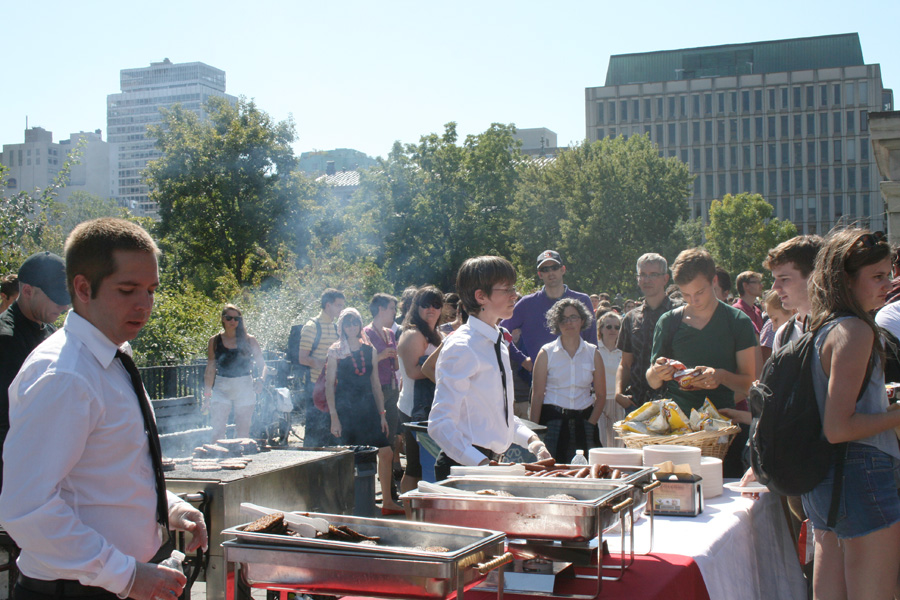
Principal Heather Munroe-Blum greets students outside of James Admin. (Alexandra Allaire / McGill Tribune)
a, News

McGill admin hosts BBQ for students and staff

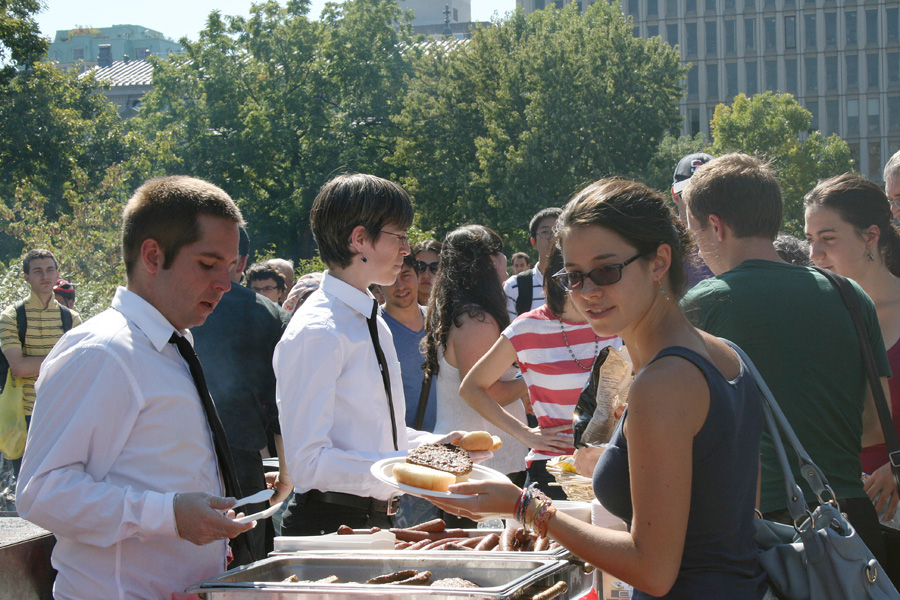
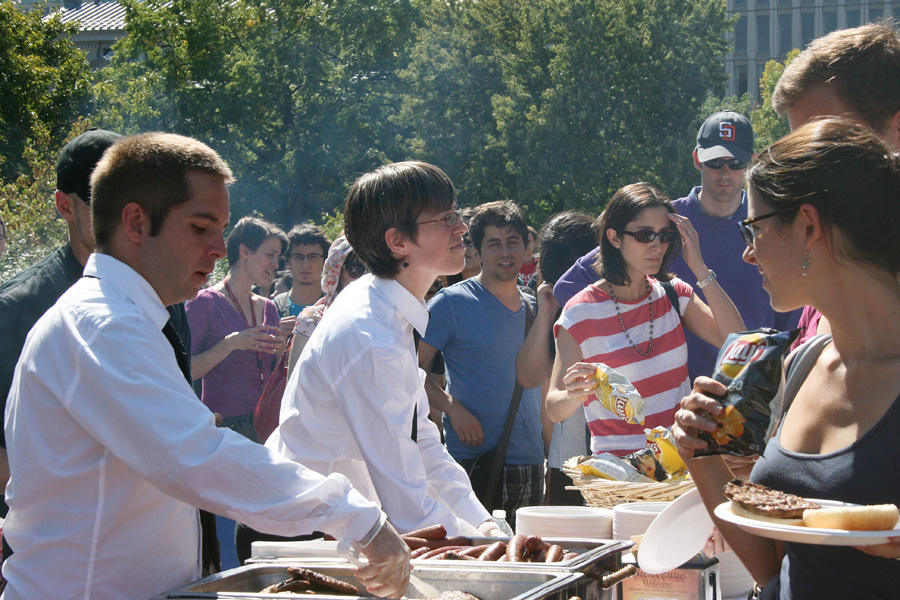
Students, professors, staff, and other members of the McGill community gathered in James Square for a barbecue hosted by senior members of McGill’s administration on Sept. 13. Serving free burgers, veggie burgers, and hot dogs to approximately 3,500 people, the barbecue is the latest effort on the part of the administration to connect with students and the McGill community at large.

Susan Aberman, chief of staff for the Office of the Principal, was part of the team that helped plan the barbecue. She said her team chose to host a barbecue because of past successful lunch events.

“[A barbecue is] a nice social event for people to get together,” she said. “We did it at the end of last year … here in James Square. All the faculty came out. It was so successful [that] we thought, ‘let’s do it again.’”

This time, Julie Timmins, manager of events and stewardship for the Office of the Principal, ordered over 3,500 burgers. There were four grilling stations, each with a separate grill for veggie burgers.

Principal Heather Munroe-Blum informed students of the event by email on Sept. 6, formally inviting all members of the McGill community to join. On the day of the event, Munroe-Blum mingled with students and staff alike.

“It’s the beginning of the year [and] it’s my last year [as McGill’s principal],” Munroe-Blum told the Tribune. “[This barbecue is] a good way to start the year … just to have a community-building experience. And that’s something people have asked for—to have opportunities to just come together.”

Deputy Provost (Student Life and Learning) Morton Mendelson, who also greeted students at Activities Night the previous evening, explained at the barbecue that part of his job is to reach out to students and attend community events. He also touched upon the challenges that affected student-administration relationships last year, and how he hopes this year will be different.

“I’m very optimistic about this year,” he said. “It’s gotten off to a great start. I think what you see here is a reflection of people’s [attitudes] about the year.”

While many students were appreciative of the administration’s gesture, some still had reservations about the future.

“[Overcoming past challenges]  is not going to be an issue of giving out free food,” Jaime Sanderson, U4 civil engineering, said. “[It will have to involve] communicating about the issues and actually making changes that are important. However, I can appreciate [the gesture].”

Jessica Si, U3 arts and science, echoed Sanderson’s sentiments.

“As students, I think we always want … to see more of our administration,” she said. “If you think of this as a stepping-stone, it’s a great way forward. If you were to ask if this is enough, then no, of course not. I think there needs to be better relations with the students.”

Other students were just happy for a free meal. Alex Sawaya, U2 engineering, spent the hour hanging out with friends and enjoying his burger.

“It’s very nice of [the administration] to do [this],” he said. “I think they really do care about us.”

According to Doug Sweet, director of media relations for McGill, the administration has planned other student-centred events for this year,  including a pancake breakfast in a first-year residence hall, the annual skating party at McConnell Arena, and a continuation of last year’s community webcasts.

a, News

Royal Society of Canada honours 12 McGill scholars

Two weeks ago, 12 McGill University scholars and researchers were honoured by the Royal Society of Canada (RSC). Eight will be inducted into the RSC as new Fellows, while the remaining four have received awards and medals.

Established in 1882, the RSC is the senior Canadian collegium of distinguished scholars, artists, and scientists. Dedicated to promoting learning and research in the arts, humanities, social, and natural sciences, the RSC also prepares expert assessments on critical issues of public policy.

“It is truly extraordinary for so many McGill researchers to receive medals and fellowships in a single year,” Vice-Principal (Research and International Relations) Rosie Goldstein said in an interview with the McGill Reporter. “We are extremely proud of all the honourees and the immeasurable contributions they make to research, teaching, and learning at McGill. Collectively, they embody the University’s history of excellence, while reaffirming that McGill remains at the forefront of research in Canada.”

Hans and Tamar Oppenheimer Professor in Public International Law François Crépeau is one of the newly-appointed RSC Fellows. Among his many other achievements, Crépeau was appointed the United Nations’ Special Rapporteur on the Human Rights of Migrants in 2011.

“It is humbling to think that people I have been working with think me worthy of such recognition,” Crépeau said, speaking of the colleagues who nominated him.

Dr. Siegfried Hekimi is the recipient of the Flavelle Medal, an honour awarded for “an outstanding contribution to biological science during the preceding ten years or for significant additions to a previous outstanding contribution to biological science,” as described by the RSC website.

Hekimi’s research involves investigating the molecular mechanisms of aging. His findings challenge the widely accepted free radical theory—a theory that states that organisms age because their cells accumulate free radical damage over time. When asked how he felt about receiving the Flavelle Medal, Hekimi, like Crépeau, replied modestly.

“What is humbling is when you see who else got [the award],” Dr. Hekimi said. “The list includes Best and Banting, who discovered insulin, Dr. Penfield . . . and also the last Canadian Nobel Prize winner, Michael Smith.”

Dr. Chao-Jun Li, a professor in the McGill department of chemistry and Canada Research Chair (Tier 1) in Green Chemistry, was also named Fellow of the RSC. Li’s research stems from the search for chemicals and chemical products—like clothing, cosmetics, and paint—that do not lead to harmful health or environmental concerns. Li also explores new chemical reactions in order to discover scientific tools to increase the efficiency of chemical production, thereby decreasing its negative consequences.

“When exploring new scientific frontiers, very often you will encounter many obstacles, frustrations, and uncertainty,” Li said. “We certainly have. Being inducted to RSC gives me an assurance of the importance of our research efforts and encourages us to continue.”

The induction and awards ceremony will be held Saturday Nov. 17, during which the new Fellows will be officially inducted into the RSC, and the awards and medals will be presented.

“I’m greatly indebted to all the students and collaborators who have worked with me over the years,” Crépeau said. “Without [their] unfailing support, keen insight, and challenging questions, I wouldn’t be where I am today.”

a, News

McGill places 18th in QS World University Rankings

McGill ranked 18th overall in the world in the 2012 QS World University Rankings, released Sept. 10. Although McGill moved down one spot from its 17th place finish in 2011, this latest annual ranking marks the sixth consecutive year that the university has placed in the QS top 20.

Launched in 2004, QS World Rankings is considered one of the world’s most widely known university ranking systems. It ranks universities annually based on six factors: academic reputation (40 per cent), employer reputation (10 per cent), student/faculty ratio (20 per cent), citations per faculty (20 per cent), international faculty ratio (five per cent), and international student ratio (five per cent).

In a news release, Principal Heather Munroe-Blum expressed satisfaction with the results.

“We are pleased by McGill’s continued strong performance in these rankings,” Munroe-Blum said. “It is a tribute to the talent, dedication, and hard work of faculty, staff, and students throughout our university. We are also delighted that three great Canadian schools are now listed in the top 50 of this world ranking, with two in the top 20.”

The other Canadian university to place in the top 20 was the University of Toronto, ranked in 19th place. The University of British Columbia was the third-ranked university in Canada, placing 45th.

For the first time, the Massachusetts Institute of Technology placed first in the overall rankings, followed by the University of Cambridge in second, and Harvard University in third.

According to QS Head of Public Relations Simona Bizzozero, 2,586 universities were surveyed this year. Of those, 729 universities from 72 countries were ranked.

“In [2004] we considered the top 500 universities for research citations based on a bibliometric database,” Bizzozero said. “[In subsequent years], we added to the initial group—other universities which received votes from the academics and employers we survey every year.”

According to Bizzozero, other universities were included based on specific considerations, including national rankings, survey performance, geographical balancing (recognizing the different priorities and characteristics of universities in different parts of the world), and direct case submission.

In individual department rankings, McGill placed 36th in social sciences and management, 32nd in arts and humanities, 29th in life sciences and medicine, 38th in natural sciences, and 46th in engineering and technology.

The full rankings, as well as more details about the methodology of the QS ranking system, can be found at www.topuniversities.com.

— Karen Huang

Read the latest issue

Read the latest issue