Latest News

Winston Pool anchored McGill’s midfield. (Alexandra Allaire / McGill Tribune)
a, Sports

Redmen survive defensive battle; shutout Citadins

Looking to improve upon their preseason success, McGill entered Molson Stadium on Thursday night for their season opener against the UQAM Citadins. Ultimately, the Redmen’s confidence led them to a victory, coming away with a pleasing 1-0 result. Although this was not a dominating performance on the scoreline, McGill (1-1-0) put forth a strong, team-oriented effort throughout. The match—which was nothing more than an ice-breaker for the stronger Redmen side—was marked by the possessive style of play preached by new Head Coach Jose Valdes.

This mentality was evident in post-game talks with Valdes. “[Getting] the [win] is our objective and doing it while playing a possession style of soccer is in our philosophy. We are implementing a different style of play… and win[ning] with it is very encouraging for the team,” he said.

The first half in particular, showed the theory in practice—long stretches of play unfolding with the Citadins (0-1-1) unable to get any touches on the ball, as the Redmen calmly controlled the tempo, attempting to pierce UQAM’s defences.

Finally, this patience was rewarded and the deadlock was broken in the 40th minute of play, thanks to the targeted strike by freshman Henri Ashe-Taylor. Ashe-Taylor broke away from his marker in the midfield and used the space to unleash an unlikely effort from far outside the penalty area. Despite the distance, it was well struck; and the UQAM keeper, Gabard Fénelon, bobbled it backwards into the bottom left corner of his net.

(Alexandra Allaire / McGill Tribune)

In the end, this was all the offensive production the Redmen needed to squeak through with the desired result and start off the season with a bang. The rest was left up to strong defensive performances, headlined by Alexis Pradie, and a few crucial saves by McGill’s keeper Max Leblond, including a necessary one off a UQAM corner in injury time.

“For this system to work, all the players need to stay involved,” Valdes added. “As soon as one element is missing, we notice a weakness in the system and then we cannot succeed. The team did a good job working together and following the game plan.”

Given that it’s still early in the season, it is encouraging to see the Redmen working so well together going forward. However, McGill may need to establish a greater goal tally in their upcoming matches against more challenging foes, should the team wish to return to the CIS Championship. It is still early however, and the starting duo up front, Sebastion Munro and Marc Palaci-Olgun, should be expected to provide more offensive chances as the season progresses.

In other play over the weekend, the Redmen travelled north to take on rivals Laval, but fell short 1-0. McGill journeys across town to take on Concordia on Sept. 14.

Penalties and offensive struggles plagued the Redmen in the first half. (Simon Poitrimolt / McGill Tribune)
a, Sports

Home sweet home? Redmen drop third straight opener

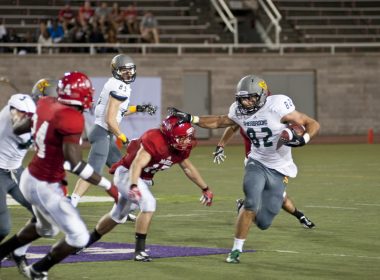
After a somewhat encouraging start to their 2012 season, the McGill Redmen (0-2) took to the field last Friday night against the Sherbrooke Vert et Or in their home opener at Molson Stadium. While intensity wasn’t the problem, the Redmen’s first half was a disaster, paving the way for a 46-14 loss.

Head Coach Clint Uttley attributed the first half struggles to a couple of key penalties and the offence’s inability to move the ball. “We didn’t execute on offence. We had two critical penalties—a pass interference and a crowd penalty—and then it was just a case of our freshmen blowing two coverages which resulted in two long gains,” he said.

Sherbrooke (1-1) scored three passing touchdowns of over 20 yards in the first half alone; the longest came in the first quarter on a 62-yard pass from quarterback Jeremy Roch-Doyon to wideout Sebastian Blanchard. Roch-Doyon torched McGill’s secondary all night, finishing with 340 yards and four touchdowns, while Blanchard won numerous one-on-one battles, tallying a game-high of 149 receiving yards. With just 25 seconds left in the second quarter, the two connected on the final touchdown of the half, making the score 30-0.

(Simon Poitrimolt / McGill Tribune)

There isn’t much that a coach can say when his team heads into halftime with a 30-point deficit, so Uttley kept it simple. “I told them to win the [next] half. For me, at that point, it’s a matter of going possession-by-possession,” he said. “I thought the veterans looked at it and were reminiscing of the past few years, and they didn’t fix it until midway through the third.”

In an effort to spark their sputtering offence, McGill replaced starting quarterback Dallon Kuprowski with backup Jonathan Collin at the beginning of the second half. Collin was more effective, leading a couple of drives in the third quarter, one of which led to McGill’s first touchdown of the night—a five-yard run by first-year tailback Luis Guimont-Mota. The Redmen scored another touchdown just a minute and a half later after Charles-Evens Peltrop forced a fumble on a quarterback sack, leaving McGill with great field position. Receiver Sean Murphy caught the second touchdown from Collin, making the score 44-14.

Looking ahead, Coach Uttley was clear that McGill’s quarterback situation must be resolved if the offence is to put together consistent efforts. “We have to settle our quarterback situation. We were inefficient in the first half, even though it had a large part to do with our offensive line [that] wasn’t holding up, so Dallon got banged up a little bit,” he said. “In the second half, Collin did some incredible things, [but] just had too many turnovers. Once we settle that position, we can move from there.”

The fourth quarter saw little action of note and the game ended 46-14.

(Simon Poitrimolt / McGill Tribune)

Other than Collin, who finished with 121 passing yards, a touchdown, and two interceptions, there were some other McGill players who played well. Freshman wideout Shaquille Johnson put together another solid performance, hauling in four passes for 49 yards, while Murphy added 43 receiving yards on four receptions, in addition to his touchdown. Sophomore Yannick Langelier-Vanasse compiled 159 all-purpose yards, 107 of which came on kick-returns. Linebacker Alex Bernard led the Redmen defence with six tackles.

Overall, it was an embarrassing result for McGill football—a program trying to get back on its feet. Coach Uttley echoed this sentiment. “After all the time and effort, the energy, the money put in, to present a result like that for all the home fans is completely unacceptable.”

McGill looks to right the ship back at home on Sept. 14 against Mt. Allison in the annual “Fill the Stadium” game.

a, Behind the Bench, Sports

Can the NHL recover from another lockout?

When the National Hockey League and the National Hockey League Players’ Association negotiated a new Collective Bargaining Agreement eight years ago, the failure on the part of both parties to reach a new deal resulted in the cancellation of the entire 2004-2005 season. As was well documented, the negative impact of this experience on the league’s reputation was significant. Despite all the bad publicity, the NHL was able to ride out this adverse period on the backs of talented superstars like Sidney Crosby and Alexander Ovechkin. The two entered the league in the following year, boosting the NHL’s popularity. However, should the negotiations for a new CBA result in another lost season, the repercussions from a second lockout in eight years will genuinely hurt the sport’s ability to maintain the positive momentum set by recent seasons.

In the midst of a period when a plethora of young and exciting players exist around the league, cancelling any portion of this year’s schedule would seem counterproductive with regards to what the league should be trying to do: showcasing these up-and-coming athletes.

With that in mind, the negative effect that another lockout could have in non-traditional markets would certainly be detrimental. In particular, it will likely hurt franchises such as the Los Angeles Kings, New Jersey Devils, Phoenix Coyotes, Nashville Predators, and Florida Panthers. All five teams made the playoffs last season—with the Kings and Devils locking horns in the Stanley Cup Final—and gave their fans a reason to be excited. In fact, it can be argued that the fans of these teams have never been more passionate. A work stoppage at this critical time could upset the supporters in these markets so much that any excitement they currently have would be erased by the time a new season finally gets underway. Even though fans in traditional markets will magnetically flock back when the potential lockout ends, the fans of the aforementioned teams are not likely to be as forgiving.

The most devastating effect stemming from another lockout, however, would be damage to the economic well-being in the NHL’s major markets. In big hockey markets such as  Montreal, a vast amount of money can circulate through the economy due in large part to the NHL. A season without hockey in these cities would force thousands of people to lose money that they could have regularly earned. Arena workers, including hot dog vendors and gift shop employees, for instance, will not be able to rely on their sale of hot dogs or team merchandise every time their team plays at home. Moreover, small businesses such as restaurants and bars in the areas surrounding each arena may suffer without the support of its clientele, who purchase services solely when their favorite team is playing. Ultimately, forcing these people out of commission by way of a lockout would turn out to be fundamentally taxing on each hockey-craved city around the league.

As the current CBA expires on Sept. 15, the individuals involved must recognize what is truly at stake. Beyond trying to grow the sport in non-traditional hockey markets, and above the concern that many employees might forfeit income if another lockout becomes a reality, both sides need to do whatever it takes to appease the fans. Without its fans, all the passion surrounding a league is lost.


a, Sports

McGill Olympic & Paralympic Athlete Recap

The world’s attention focused on London this past summer, as athletes from around the globe competed in the Games of the XXX Olympiad.  These seven athletes, in particular, have ties to the McGill community:
Jo-Annie Fortin

McGill Connection: Currently studying psychology at McGill

Event: Synchronized swimming

Finish: Fourth in team routine final


Martine Dugrenier

McGill Connection: B.Ed. 2008

Event: Wrestling

Finish: Fifth in women’s 63-kilogram weight class


Victoria Poon

McGill Connection: Swam for Martlets in 2005-2006

Event: Swimming

Finish: 15th in women’s 50-metre freestyle


Derek O’Farrell

McGill Connection: B.Sc. 2007

Event: Rowing

Finish: Ninth in men’s fours


Doug Vandor

McGill Connection: B.Sc. ‘97, followed by a master’s degree in experimental surgery

Event: Rowing

Finish: 14th in lightweight double sculls


Marie-Andrée Lessard

McGill Connection: B.Comm. 2001

Event: Volleyball

Finish: 0-3 in beach volleyball round robin


[divide]

Paralympics

Valerie Grand’Maison

McGill Connection: Currently studying psychology and history at McGill

Event: Swimming

Finish: Gold in women’s 200-metre individual medley, silver in women’s 50-metre freestyle, silver in women’s 100-metre freestyle

a, Sports

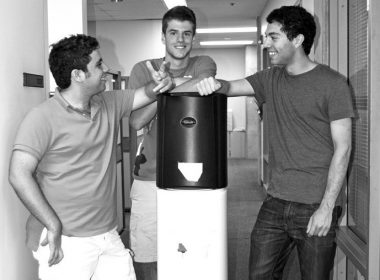
Around the Water Cooler

In case you were catching up on some early readings or the last glimmers of OAP had you occupied, here’s what you missed this past weekend in the world of sports …

PARALYMPICS — Two silver medals evidently weren’t enough for McGill swimmer Valerie Grand’Maison as she added to her impressive medal haul with a gold medal in the 200-metre individual medley on Friday. Grand’Maison didn’t just beat her fellow competitors in the race, but she also out-swam every visually impaired swimmer in history when she won her event in world-record time. While Grand’Maison’s performances should make Canadians and McGillians proud, Canada otherwise somewhat failed to live up to expectations. Seven gold medals and an overall 13th place finish should be seen as a step back for Canada’s. This was likely a result of the rest of the world increasing funding into Paralympic sport rather than a decrease in talent on behalf of the Canadian team.

FOOTBALL — Upsets reigned supreme south of the border this weekend as a number of teams expected to challenge for titles in both the NFL and NCAA college football crashed to defeat against lesser opponents. The story of the weekend was easily the University of Louisiana-Monroe Warhawks, who used a gutsy fourth-down play trailing three points in overtime to pull out a stunning upset of #8 Arkansas. The Razorbacks were expected to be in the BCS Championship mix (thankfully only two more years of that), but dropped out of the rankings after losing to ULM. In the big kids’ league, the Washington Redskins, led by rookie dynamo Robert Griffin III, took out the scandal-ridden New Orleans Saints at the Superdome. On Sunday night, the Broncos knocked off the Steelers in Peyton Manning’s first game in the Mile High City. Peyton’s vintage performance might mean that this was less of an upset than a sign of things to come.

SOCCER — From the reactions on Facebook newsfeeds across this country after the Canadian women’s team’s crushing loss to the U.S. in the Olympic semi-final, one might have thought that we were a soccer-mad country. While we may not be Brazil or Spain, the fervor might carry into 2014 as Canada’s men’s team took a further step towards qualifying for the World Cup in Rio. On Friday night at BMO Field in Toronto, Canada only needed one goal to move past Panama into first place in their group. They are now in the pole position to make it to the final round of qualifying with regional heavyweights Mexico and USA.

TENNIS — The tennis Grand Slam season closed out this weekend at the U.S. Open in Flushing Meadows, NY. Serena Williams won her third consecutive major title, adding the U.S. crown to championships won earlier this season at Wimbledon and at the Olympics. Williams closed out top-seeded Victoria Azarenka to solidfy her place as the undisputed queen of women’s tennis. Elsewhere, Andy Roddick played his final professional match, losing in the quarterfinal to Juan Martin del Potro. After a marathon final match on Monday, Andy Murray emerged with his first Grand Slam title, defeating Novak Djokovic (7-6, 7-5, 2-6, 3-6, 6-2).

Parti Québécois leader Pauline Marois addresses her supporters in victory rally, minutes before fatal shooting. (Simon Poitrimolt / McGill Tribune)
a, News

Quebec elects PQ minority government

The Parti Québécois (PQ) won 54 seats last night in a tightly contested election called in August by the Parti Liberal de Québec (PLQ). The results were announced to an ecstatic crowd of supporters, gathered at the party’s election night rally at Metropolis in downtown Montreal.

As the results rolled in after 8 p.m., Pauline Marois, leader of the PQ, was officially confirmed the first female premier of Quebec. The announcement was followed by a series of televised speeches given by heads of the other parties from their bases. The evening was to conclude with Marois’ victory speech at the Metropolis at 11:30 p.m.

Two tragic shootings, one fatal. 

The night’s festivities were marred by a tragic turn of events. Around midnight, a gunman burst into the venue and fatally shot one bystander, critically wounding another. He fired several shots outside of the venue’s back door. The victim was an electrical technician employed by Metropolis. A contract bus driver for the PQ remains in critical condition but is alive.

According to the Montreal police’s Twitter account, the suspect is reported to have cried “Les anglais se réveillent!” (The English are rising) before opening fire on the crowd. No motives have been assigned to the shooting, as the crime is still under investigation.

In an interview with the Tribune, political science professor Jacob Levy de-emphasized the shooting as signaling a trend in Quebec society.

“I think one shouldn’t read too much into something like that,” Levy said. “It tends to be a mistake to read into one disturbed person’s actions as a sign of the broader times. The killer was clearly motivated by something political and probably something intercommunal, but that doesn’t mean that other Anglos … are in a state of high agitation. That may be the case, but this event doesn’t show it.”

Liberals remain, under a PQ minority

The race was hotly contested, with the PQ defeating the Liberal Party by a margin of .73 percentage points of the popular vote. The Coalition Avenir Québec made significant gains for a new party, and Québec Solidaire doubled their seats in the National Assembly.

Though the Liberals won 50 seats, the head of the party, Jean Charest, lost his Sherbrooke seat to PQ Member of the National Assembly (MNA) Serge Cardin. The loss in Sherbrooke marks the end of Charest’s 28-year career, as he resigned on Wednesday from his position as leader of the Liberal Party.

Despite Charest’s defeat, the Liberals won more seats than suggested by polls prior to the election.

“To my surprise, [the Liberals] are alive and kicking,” Levy said. “They are probably better off without Charest, and are able to start rebuilding and reorganizing effective tomorrow … [for] the election that we’ll probably have in a year and a half or so.”

Indeed, if the PQ cannot find common ground with the opposition parties, this parliament could be short lived. Quebec’s most recent minority government, led by Charest, lasted just 17 months.  Prospects seem contingent on collaboration and leadership.

PQ MNA Bernard Drainville was optimistic about the election’s prospects for his party.

“For the moment, for tonight, what we know is that the Quebeckers voted to remove the Liberals and put them at the door,” Drainville said, addressing the Tribune and other members of the press.

Simon Poitrimolt / McGill Tribune

Tuition and Bill 78

The PQ has already begun to make policy changes that distinguish them from the Liberals. At her first press conference as Premier-Elect on Wednesday, Marois announced that one of the new government’s first priorities would be to freeze university tuition and to repeal Bill 78, also known as Law 12. The announcement comes as a response to student strikes and demonstrations, which were one of the causes for the late-summer election, and has left some students hopeful for the future of Quebec education.

“It sounds like there is a lot of relief from students—from seeing things on social media and Twitter—that the announcement has come so early,” SSMU VP External Robin Reid-Fraser said. “[But] obviously students are going to keep paying attention to what happens after.”

“If there’s a minor possibility of [resolving the tuition dispute], we’ll do it ….” PQ member Jean-François Lisée told the Tribune in French. “We’re the ones who won … so we’ll do our best to deliver 100 per cent of our promises.”

It remains to be seen whether the rest of the National Assembly will allow these changes, although the PQ might try to use an order-in-council, a governmental decree, to put them into effect. The newly elected premier also told the press that her party would implement changes to Bill 101, Quebec’s controversial language law, such as limiting access to anglophone CEGEPs.

“Quebeckers have made their choice, and we will respect the choice and work with all the other elected MNA in Quebec,” Marois said in her election night address in French.

—With files from Erica Friesen and Carolina Millán Ronchetti. 

McGill Tribune / Carolina Millán Ronchetti
a, News

McGill fruit salad breaks world record

With the help of around 300 volunteers, McGill set the new Guinness World Record for the largest fruit salad Aug. 28 on lower field. Weighing 11,197 lbs, the fruit salad surpassed the previous record of 10,440 lbs held by California State University in Fresno. The event, organized by Food and Dining Services, sought to highlight local farming, environmental sustainability, and Montreal community organizations.

Oliver de Volpi, executive chef of McGill Food and Dining Services, explained why his team chose to break this world record in particular.

“Food and Dining chose a fruit salad because we thought it emphasized different points that we feel, as a department, are important—local ingredients, using our own farm at Macdonald campus, and nutrition,” de Volpi said.

Volunteers helped prepare the salad by cutting approximately 12,000 lbs of fruit, loading it into an inflatable swimming pool, and serving it to audience members.

One of the volunteers, Dave D’Oyen, U3 arts, said he thoroughly enjoyed participating in the event and spoke enthusiastically about the anticipation of weighing the final product as well as the satisfaction of breaking the previous record.

“We surpassed [our] target by far,” D’Oyen said. “The goal was just 11,000 lbs of fruit and we even went beyond that. What [the audience is] eating right now isn’t even from the pool […] That is how much fruit came here today. The pool was not touched.”

The salad was a blend of 4,960 lbs of watermelon, 2,231 lbs of pineapple, 357 lbs of strawberries, and several other ingredients. Fifty per cent of the fruit used was grown at the MacDonald campus farm.

Despite the magnitude of the salad, organizers were careful to minimize the amount of waste created. All the fruit peels, as well as all the containers, wooden spoons, and compostable bowls at the event were composted.

“We [also] have our own compost we are starting up with this and we will be donating [the remaining fruit salad] to local missions and charities in Montreal,” de Volpi said.

Organiations who received some of the salad include Old Brewery Mission, Welcome Hall Mission, Meals on Wheels, and Dans La Rue. In addition, 300 portions of fruit salad will be sold on campus, with proceeds going to Centraide.

“It is a pure demonstration of what people in numbers can do and that to me is truly impressive,” Volunteer Joaquim Miro, U2 management, said.

a, News

Orientation Week features “À la carte” events

The orientation week makeover initiated by McGill in the fall of 2011 continued this year, with increased integration of Discover McGill, faculty frosh and events organized by the Students’ Society of McGill University (SSMU). Orientation week also featured a new component of non-alcoholic activities organized by student-run clubs and McGill services, called À la carte activities.  The modifications aimed to make all events and activities more inclusive, sustainable, and community-oriented.

One major change was the integration of SSMU-organized events with faculty-organized events, and the absence of a separate SSMU frosh. According to SSMU President Josh Redel, SSMU frosh had been marked in previous years by poor attendance and unpopularity among first-year students.

“[This year] we were working toward an integrative model, and in terms of that, SSMU frosh didn’t necessarily make sense,” Redel said.

SSMU took care of organizing the opening night concert, Beach Day, the all-ages components, and an additional day of frosh. The faculty associations were then responsible for organizing their faculty-specific events.

Several working groups and a 50-member Orientation Planning Group (OPG) were established to help organize orientation week. The working groups were composed of student leaders from SSMU and faculty associations, as well as staff members from McGill Student Services and the First-Year Office. The OPG also included advisors from McGill administration, Ancillary Services, and residences.

“The groups were a combination of students who [were] the primary stakeholders in the events,” Student Life Coordinator Mitchell Miller said. “The administration [was involved] for sustainability reasons.… [Administrators] have been here for several years and have seen successes and weaknesses that they can talk about.”

One of the more noticeable additions to orientation week were À la carte events. These events – which included workshops, activities, and tours hosted by different clubs and university-run services – were created to complement frosh and to cater to the varied interests and backgrounds of incoming students.

“[The À la carte events] were designed to … first, keep students busy during their first week, and to diversify the huge Discover McGill component,” Redel said.

“They also provided alternatives for students who didn’t want to do frosh, but don’t want to be deprived of an orientation experience,” AUS Vice-President Events Josh Greenberg said.

In past years, frosh had been criticized by students for lacking non-alcoholic events for underage first-years or those who did not wish to drink. The new À la carte component helped solve this issue, as none of the events involved alcohol.

Beyond the À la carte section, SSMU and faculty associations also strove to organize more all-ages, night-time events than were offered in previous years, such as the toga party at the SSMU ballroom.

“Many of the faculty frosh committees joined forces in order to accommodate everyone’s underage students … creating a neat opportunity for students to connect with other faculties,” Greenberg said.

Despite positive reception to structural changes, not all elements of frosh were seamless.

“I waited 7.5 hours on Beach Day … for a bus,” Josh Thon, U0 engineering student, said. “I think [transportation] could’ve been better organized.”

This year also witnessed a sharp increase in the price of frosh admission, with faculties charging over $100 per person, in comparison to approximately $70 in past years. Despite the price increase, many students thought that the events were worth the expense.

“For a little over $25 a day, the kind of activities we did and the kind of fun we had was definitely worth it,” Thon said.

Overall, both orientation organizers and first-year students expressed satisfaction with the results and their experience throughout the week.

“I know a lot more people here now,” Emma Hart, U0 music student, said. “I’m really comfortable walking around campus and [enjoy] recognizing several people along the way.”

“[Orientation week] certainly wasn’t perfect,” Redel said. “However, this year was a really big step forward [regarding] all of McGill working together towards a [successful] orientation.”

Read the latest issue

Read the latest issue