Latest News

Sports

10 questions with … Evan Vossen

MT: How did it feel to win the CIS championship?

EV: It’s a great feeling. The way things happened in terms of the history of the franchise, the program-which is 136 years old-not winning after what we went through last year in terms of losing in the finals, and then to win it in the fashion that we did, in overtime, on the 50th edition of the University Cup, it was really something special for us.

MT: How did the team react when Western scored that tying goal in the third? What was going through your minds?

EV: They scored the tying goal 30 seconds into a five-minute powerplay and I was thinking, “Okay, this is something we’re going to have to dig out of.” But, we have such a character group of guys that nobody got too frustrated, panic didn’t set in, and in the remaining four and a half minutes of the powerplay, we only let by one shot. I think it shows how determined the guys were, and the sacrifices they were willing to make. 

MT: How did it feel to score the winning goal in overtime?

EV: Having that puck go in, I was ecstatic, but it was also so much more for me. Beyond making program history, I don’t know if many people know, but Picard-Hooper, who gave me the pass on the tying goal, his assist set the all-time point record at McGill. There’s just so much stuff that happened in that one play that has such an impact on the school, the team, and all of our lives. 

MT: What will happen to your hockey career now that you’re graduating?

EV: I want to play professionally, probably in North America, so I’m going to look at my options during the summer and, come fall, hopefully I’ll have something to do. If not, I would definitely consider Europe as an option. In the end, if it doesn’t work out, yeah I’ll be disappointed, but hey, I have a degree, and hockey has been so good to me that I have no regrets whatsoever.

MT: What do you think of the Redmen coaching staff?

EV: Since he joined the team two years ago, [Head Coach] Kelly Nobes has been a great addition for us. We’ve had exceptional coaching all five years that I’ve been here. Really, our success the last three years has been thanks to [ex-Head Coach] Martin Raymond’s recruiting, and then Jim Webster [came] in for a year and we lead the nation in scoring that year. Then Kelly [came] in, and we lead in scoring again and win the championship.

MT: As team captain, how much responsibility do you take for your team’s successes and failures?

EV: For me, being a leader is leading by example. It means putting in hard work, but that’s what our team is based around. I don’t have to show the guys the way, the guys show each other the way. And that’s something I noticed when I got to McGill; it’s something that’s instilled within the program, and it’s still being instilled into the young guys that are coming in. 

MT: How do you think the team will respond next season, considering that the team loses eight players this summer?

EV: There are a lot of the first years that got a lot of experience this year because of injuries, so they have a solid base to work with next year. They have most of the defensive core coming back, as well as all the goaltenders, and winning the CIS championship is a huge recruiting tool. So I think they have a solid team coming into next year.

MT: Take us through your typical game day.

EV: Usually, I’ll meet up with Andrew Wright at 9:30 at Cora’s for breakfast. Honestly, I’m not much of a class goer on game days, so I usually have a bowl of soup around noon and follow that with a nap for an hour and a half in the afternoon. Then I’ll get up towards three, eat my pre-game meal, hop into the shower, and get out of my apartment by four. Then it’s down to Second Cup for a coffee and off to the rink. We always have a meeting an hour and a half before the game with the coach, and then we warm up and play. After the game, I usually hang out with the guys, get something to eat and then go to bed.

MT: Who’s your favorite hockey player/team?

EV: I’m a Habs fan, and have been since I can remember. I have to say, especially when I was growing up, my hockey role model was definitely Jerome Iginla. I really enjoy the way he plays and the hard work he puts into his game.

MT: Do you think fighting should be taken out of hockey?

EV: I don’t think you can completely remove fighting because there will be stick swinging incidents, dirty elbows, hits to the head, which have been so popular lately, and I have no problem with a guy going after another guy for a cheap shot. If you’re going to do something like that, and put someone else’s health at risk, I think there’s a price you have to pay.

Science & Technology

A chat with this year’s three Tomlinson Prize winners

Andrew Hendry , Department of Biology

Tell us about your current research.

In essence, my research is trying to understand how ecology and evolution interact. So trying to understand how ecological differences in the environment shape the evolutionary trajectories of populations and shape evolutionary diversification, that’s the origins of biodiversity.

On the reciprocal side I investigate how, as things evolve, that evolution then feeds back to influence ecological properties.

We and others have now shown that things can evolve quite rapidly as you change environments. If those things evolve rapidly, you might expect that as they do so they will have effects on the environment.

When most people think of evolution, they tend to think of the effect of evolution on ecology. Can you give an example of the reverse – evolution having an effect back on ecological populations?

Part of my work is on Darwin’s finches in the Galapagos Islands. What we’re attempting to do there is figure out how adaptation to different food types drives the radiation of that group. There are 14 or so species that all evolved from a common ancestor in the last 2-3 million years. Those species evolved by the process of adaptation to different food types-different seed types and sizes and different plant matter. We try and examine how a variation in food resources and competition among the finches for them has led to the diversification of the finches. So that’s the ecology to evolution side-the plant community shaping the finches.

At the same time, we know the finch beaks will influence what they can feed on. The finch beak present in the environments-the number of species and the size of their beaks, and the number of individuals in each species-will presumably deplete different food resources to different extents. Large-beaked birds will differentially deplete large seeds from environment, and small-beaked birds will differentially deplete small seeds from the environment.

As finch beaks evolve, this would then feed back into shaping the plant community. The  plant community shapes the beaks and the beaks shape the plant community. People are realizing that evolution can proceed rather rapidly, and if that’s so, we need to think about the consequences of that evolution and not just the causes.

What direction do you see your work taking in the coming years?

We have a fairly good understanding now of how environmental change drives evolutionary change. Really what we have for evolution influencing ecological change is a series of scattered examples. What I would hope is to build up a general framework for considering when and how these events occur, what drives them, and then having some nice experiments which test these various hypotheses for what’s going to be important or not.  I would hope that’s where we’d be-to have a general framework and context for predicting these kinds of effects.

Karim Nader, Department of Psychology

What is some of the research you’ve been involved with?

One main theme in the lab is trying to understand the mechanisms that will change whenstore a memory. The old thinking was that once memory is stored, it could never be manipulated or changed and that it stayed there forever. What we found is that if you remind a rodent about a fixed memory, the memory becomes unfixed, or unstored, and needs to be restored. Now this has been found across many species and across tasks.

How might this be used to treat human afflictions?

There are a few clinical implications of this. A lot of psychopathologies have to do with certain circuits acting incorrectly. For example, if you are somebody with Obsessive-Compulsive Disorder (OCD), then the circuits in the brain that control that are just going to be rewired in such a way that it mediates obsessive compulsions. If you are somebody who is an addict, the brain mechanisms that control that kind of behavior are also going to be changed to maintain drug-taking behavior. If you’re somebody with post-traumatic stress disorder (PSTD), then the traumatic memory in your brain has been so strong and stored in such a robust way that the neurons and the mechanisms important for storing memories have been wired into the brain.

Looking into the mechanisms that mediate memory storage doesn’t just tell us about memories,  but about the basics of how neurons change their wiring or connections together in terms of whether that neuron’s contribution is to a memory of trauma or to a memory of OCD or to a memory of drug addiction. What we’re trying to do now is take some of the basic work, and try to translate that to patients.

Now we’re working on patients to see if we can reduce cocaine cravings in human addicts by using that same restorage mechanism. We’re also trying to see if we can come up with a model in rats that will allow us to block circuits from reconsolidation and shift the rats away from compulsions in OCD.

What’s the connection between memory and an affliction like OCD? Are they stored in the brain the same way?

A neuron that is storing a traumatic memory uses the same mechanisms of storage as neurons that are, say, in the spinal cord controlling chronic pain. It’s the same mechanisms as in the circuit that control OCD or addiction. All changes in behavior are going to engage the same kind of mechanisms that undergo a storage mechanism initially, and a restorage mechanism when the circuit seems to be reactivated. The nice thing about reconsolidation is that it extends beyond post-traumatic stress disorder.

In one demonstration with my colleagues Alain Brunet and Scott Orr and Roger Pitman, we showed we could reverse the strength of traumatic memories in PTSD patients-and some of these individuals had trauma for about 30 years. We could reverse that down to below PTSD range with a single 15-minute intervention. No one expected that.

Xue Liu, School of Computer Science

For those who don’t have a background in computer science, how would you describe the research that you do?

My research is focusing on the study and design of scientific foundations and engineering frameworks for building modern cyber-physical systems-computer systems which feature tight integration and close coordination between computational, communication, and physical elements.

During the past several decades, we have seen tremendous growth of computation and communication technologies. They are now more pervasive in our everyday lives than ever before. We see them everywhere, from the automotive industry (autonomous driving, drive-by-wire), to civil infrastructure (smart buildings, smart bridges), to energy (smart grids), to healthcare (intelligent hospitals),  to manufacturing (computer integrated manufacturing systems-CIMS), to entertainment (Wii, XBox), to mobile phones and consumer appliances.  Many of our everyday activities depend heavily on these systems.

What is the Cyber-Physical System Lab?

At McGill, our Cyber-Physical System Lab (CPSL) studies state-of-the-art cyber-physical systems, including the science of designing and building such systems. For example, we have been carrying out research on sensor and actuator networks, industrial control systems, power management of Internet Data Centers, and real-time and embedded systems. Many of this research has practical applications, and we have teamed up with industries such as Bombardier, Bell Canada,
Microsoft, and IBM.

The award aims to promote research in new directions. What do you think the future of parallel computing will be?

With the support of this award, we target the development of innovative and enabling technologies in Green Information Technology. In a recent report released last year, Google reported that the energy used by its data centres is emitting 1.5 million tons of carbon annually. In fact, the IT industry is estimated to account for 2% of global CO2-emissions which is approximately as much as the aircraft industry, and is one of the fastest growing energy-consumption industries. In a world facing the pressing concern of climate change and the sustainability of its natural environments, we hope to create an environmental-friendly IT industry.

The overarching goal of our research is to develop more energy efficient IT infrastructures and technologies to significantly reduce the energy consumed everyday by a range of computing systems including embedded computers, servers and data centers. We will also study pairing Green IT with new technologies including smart grids, and renewable energies such as wind power.

Interviews have been condensed and edited. Compiled by Anand Bery.

Mercedes-Benz

Brabus Bullit C-Class Coupe

This is some dummy copy. You’re not really supposed to read this dummy copy, it is just a place holder for people who need some type to visualize what the actual copy might look like if it were real content.

If you want to read, I might suggest a good book, perhaps Hemingway or Melville. That’s why they call it, the dummy copy. This, of course, is not the real copy for this entry. Rest assured, the words will expand the concept. With clarity. Conviction. And a little wit.

[wzslider]

In today’s competitive market environment, the body copy of your entry must lead the reader through a series of disarmingly simple thoughts.

All your supporting arguments must be communicated with simplicity and charm. And in such a way that the reader will read on. (After all, that’s a reader’s job: to read, isn’t it?) And by the time your readers have reached this point in the finished copy, you will have convinced them that you not only respect their intelligence, but you also understand their needs as consumers.

As a result of which, your entry will repay your efforts. Take your sales; simply put, they will rise. Likewise your credibility. There’s every chance your competitors will wish they’d placed this entry, not you. While your customers will have probably forgotten that your competitors even exist. Which brings us, by a somewhat circuitous route, to another small point, but one which we feel should be raised.

Long copy or short – You decide

As a marketer, you probably don’t even believe in body copy. Let alone long body copy. (Unless you have a long body yourself.) Well, truth is, who‘s to blame you? Fact is, too much long body copy is dotted with such indulgent little phrases like truth is, fact is, and who’s to blame you. Trust us: we guarantee, with a hand over our heart, that no such indulgent rubbish will appear in your entry. That’s why God gave us big blue pencils. So we can expunge every example of witted waffle.

For you, the skies will be blue, the birds will sing, and your copy will be crafted by a dedicated little man whose wife will be sitting at home, knitting, wondering why your entry demands more of her husband‘s time than it should.

News

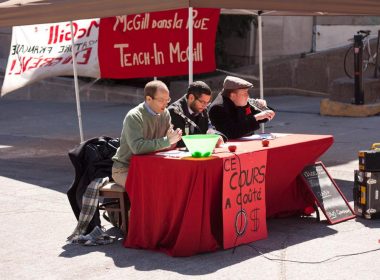
Students mobilize in four-pronged protest

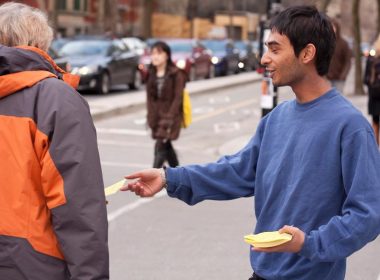
Last Thursday, March 29, a four-pronged student demonstration wound its way through downtown Montreal in a festively themed demonstration that aimed to disrupt the economic activity of the downtown area and highlight several political grievances of the students.

The protest, called Manifestation la Grande Mascarade, was organized by la Fédération Universitaire et Collégiale des Étudiant-esRévolté-es (FUC*ER), and promoted by the Coalition Large de l’Association pour la Solidarite syndicale etudiante (CLASSE).

Organized around the concept of a masked ball, the protest was divided into four groups with each assigned a specific colour and a specific issue to criticize tuition fee increases, police brutality, strike— breaking tactics, and the non-representative stance of several Quebec student unions during the student strike.

In accordance with the masquerade theme of the protest, many participants wore colourful masks and costumes, drawing on the French tradition of the “charivari.”

“In popular contexts, the charivari was a moment when villagers donned costumes and masks and heckled a person in their home in order to criticize their conduct,” CLASSE’s announcement of the event said. “[This protest] will reappropriate this practice by invading the heart of Montreal in order to paralyze the economic and governmental elite, who are deemed illegitimate and harmful for the community.”

Starting around noon in Phillips Square, the protest split into the four groups, which headed in different directions around the city’s downtown. Protesters were largely peaceful, singing, chanting, and playing instruments to attract the attention of bystanders.

“We’re trying to protest in a festive way, without violence,” Steve Melanson, a protester and teacher at the CEGEP Regional De Lanaudière à L’assomption, said. “The violence is symbolic in the way we dress. In the old times, when a family did something wrong, [people] did not go to that family and attack them, but they’d go in front of their house and make noise and sing something … So it’s a symbolic protest.”

Some protesters also overturned construction signs or moved objects on the sidewalk into the middle of the street. Many storeowners and observers smiled or applauded as the demonstration passed along main streets like St. Catherine and Sherbrooke.

Around 2:30 p.m., the four groups converged at Place des Arts, before moving to Université du Québec à Montréal (UQAM), where protestors played music, danced, and burned an effigy of Quebec Premier Jean Charest.

In addition to the tradition of the charivari, some protesters pointed the masquerade theme as a response to Montreal Mayor Gérald Tremblay’s recent comments about the use of masks in protests. Tremblay said he was “disgusted” by the violence of the March 15 anti-police brutality march, which included an overturned police car, damage to several stores along St. Catherine, and over 200 arrests.

“If people want to demonstrate and have legitimate demands, no administration has done more to promote participative democracy,” he said in a press conference after the anti-police brutality protest. “That said, I take for granted that people who want to demonstrate can do so with their faces uncovered.”

In 2009, the Service de police de la Ville de Montreal (SPVM) asked that Montreal create an anti-mask law, but the law was never adopted because of concerns that it infringed on personal freedoms. Other cities like New York, however, have and enforce anti-mask laws.

Tremblay has announced that Montreal’s public security commission will be investigating every aspect of public demonstrations, including the use of masks, in an effort to prevent the recurrence of violent incidences like those of the anti-police brutality march.

Protestor and UQAM student Guy Benoit-Fournel said that the idea of prosecuting student protestors for wearing masks would be problematic.

“Wearing a mask can be a form of expression, which is covered under freedom of expression,” he said. “If you tried to put this in the regulation of the city, you would give an arbitrary power to the police to decide whether someone wearing a mask is legal or not … And in the criminal code, if you cover your identity to commit a criminal infraction it’s already a crime, so there is no need for [this regulation].”

News

Motion to censure SSMU VP External fails by vote of 11-11-1

A motion to censure SSMU VP External JoëlPedneault failed at SSMU Council’s meeting last Thursday, March 29, with a narrow vote of 11 for, 11 against, and one abstention.

The motion, submitted to the floor by nine movers, cited several reasons to censure Pedneault, including his use of SSMU funds to print materials promoting a student strike, his decision to grant students and members of Coalition Large del’Association pour la Solidarite syndicale etudiante(CLASSE) after-hours access to the SSMU office, and his participation in picket lines at other Montreal universities. The motion also referenced the fact that last week the administration excludedPedneault from the university campus for five days.

The motion was addressed during confidential session and then debated in an open session in front of a full gallery, which included members of campus political groups, including the Mobilization Committee (Mob Squad) and the Moderate Political Action Committee (ModPAC).

In a subsequent vote, Council voted against debating in confidential session.

Kady Paterson, education representative and a mover of the motion, said that the motion was drafted on the day of Council.

“It’s us [movers] trying to keep our executive accountable and make sure that our constituents’ opinions are heard,” Paterson said.

SSMU president Maggie Knight opened the debate by emphasizing the gravity of a motion to censure.

“Censure implies misconduct. It implies that policies [and]  rules have been violated—not that somebody’s actions were disagreed with,” Knight said. “Regarding the concerns around VPPedneault’s political actions, I think it’s very important for the SSMU as it goes forward [to consider] that no executive, councillor, or any other member of the society be a scapegoat for policies people disagree with.”

Knight, who stated she would vote against the motion, continued to refute the clauses identifying the reasons for the censure. Among her reasons, she noted that allowing student activists supporting a SSMU mandate to use SSMU printers “could be entirely appropriate.”

“I’m not clear that [granting after-hours access toCLASSE members has] been proven to be true,” Knight said. “To my knowledge, there’s no written rule that says this is not allowed to happen, therefore it is not a specific violation.”

Senator and VP University Affairs-elect Haley Dinel explained her rationale for being a co-mover of the motion.

“It’s because of the actions, not because of the person,” she said. “It’s mainly because a lot of students this year have felt that the way the VP External portfolio [sic] has acted and has not [represented] undergraduates as a whole.”

Some councillors raised concerns of the lack of clarity of some current SSMU mandates.

“I think a lot of actions are being defended by the current mandate of [promoting] accessible education,” arts representative Joshua Fagen said. “Like councillor Hernandez was saying, ‘accessible’ is an extremely vague word. It’s very much open to interpretation.”

Several councillors were vocal about their concerns with the motion.

“I feel that this resolution to censure VP Pedneault would effectively mandate him to not do his job, which to me [is] a contradiction of what we should be promoting the executives to do,” Carol Fraser, VP Clubs and Services, said.  “The pull of Council is to promote executives to do their job. If this resolution passes, I don’t know exactly what VP Pedneault is expected to do.”

Arts representative Justin Fletcher described the atmosphere during debate as tense and emphasized the small margin of the final vote.

“It was crazy to hear that it was a tied vote with one abstention,” he said. “I think it reveals some of the divided sentiments on campus.”

Following the meeting, Pedneault said he was surprised that the motion was submitted.

“A lot of concerns they raised, I never had even gotten an email about,” Pedneault said, referencing the clauses regarding after-hours use of SSMU facilities. “The most shocking part of it was the allusion to disciplinary proceedings against me on campus,” he added.

“The discussion at SSMU is, ‘do we censure Joël Pedneault, in part because he was censured by the university in some way?’” he said. “I don’t see how it makes any sense in terms of challenging power dynamics and abuses of power, and I think it’s a real shame that that’s the discussion we have tonight instead of ‘do we condemn the university’s arbitrary exclusion of three students from campus for no clear reason and no clear procedure?’”

Both Fletcher and Paterson noted that the debate might have been different had it occurred in a confidential session, without the pressure of a majority pro-strike gallery.

“I think it’s fine that [the motion] didn’t pass,” Paterson said. “I think the point was to voice our concerns and air our problems, and actually give them some weight … I think that’s what we’ve done. Passing doesn’t matter.”

Pedneault noted that he will continue to support the strike and the Quebec student movement against tuition increases.

“If the censure motion had passed, I think I still would have been able to walk with my head high,” he said. “I don’t see myself as having committed anything wrong, overstepping any boundaries or going against SSMU mandates.”

Sports

Top Ten Canadian Hopefuls for London 2012

1. Adam van Koeverden – Kayaking

Likely Canada’s strongest Olympic hopeful, vanKoeverden is the reigning world champion in the K-1 1000m, and is a candidate to win a medal in the K-1500m as well.

2. Carol Huynh – Wrestling

Huynh is the defending Olympic gold medalist in the 48 kg freestyle wrestling division, and heads to London as the 2011 Pan Am Games champion.

3. Dylan Armstrong – Shot put

Canadian shot putter Dylan Armstrong will aim for his first Olympic medal, after earning a silver medal at the 2011 IAAF World Championships.

4. Mary Spencer – Boxing

Women’s boxing will make its inaugural appearance as an Olympic event in London, and Spencer is considered the favourite, having already won three past World Championship titles.

5. Tara Whitten – Cycling

Whitten is a former cross-country skier, and specializes in the Omnium cycling event, winning the gold medal at the 2010 UCI Track Cycling World Championships.

6. Karine Sergerie – Taekwondo

Since winning the silver medal at the 2008 Beijing Olympic Games, Sergerie took home bronze in the lightweight division at the 2011 Wold Taekwondo Championships.

7. Annamay Pierse – Swimming

The 2008-2009 CIS female athlete of the year,Pierse is the current world record holder in the200m long course breaststroke.

8. Emilie Heymans – Diving

Heymans is Canada’s strongest women’s diver, and looks to repeat her 2008 Beijing silver medal performance in the 10m platform.

9. Alexandre Despatie – Diving

One of Canada’s most successful male divers,Despatie has won silver medals in the 3mspringboard at the past two Olympic Games.

10. Priscilla Lopes-Schliep – Hurdler

While she is often cast under Perdita Felicien’sshadow, Lopes-Schliep gives Canada its best chance to earn a medal in the 100m hurdles, after winning a bronze medal at the event in Beijing.

Arts & Entertainment

Michael Glawogger’s Whores’ Glory delves into the abyss

Michael Glawogger’s documentaries have long demonstrated his fascination with the dark and gritty. The Austrian filmmaker has focused on the struggles of the impoverished who are forced to eke out a living, first examining how the indigent survive in the world’s largest cities (Megacities, 1998), before moving on to the study of the poorest, most desperate of manual labourers  (Workingman’s Death, 2005). Completing this trilogy with Whores’ Glory, Glawogger opts for even greater circumstantial misery, and documents the practice of prostitution in Thailand, Bangladesh, and Mexico.

Almost immediately, one is struck by the dissonance between the subject matter and the score. Glawogger shows us brothels and scantily dressed women in filthy, overcrowded landscapes. Songs by Cocorosie and PJ Harvey accompany these bleak urban scenes, brusquely snapping the viewer out of a reverie of instinctive sympathy and revulsive disbelief, and into an amalgam of film noir grittiness mixed with the painfully strained sentimentality of a poor script. The audience is repeatedly reminded of this inconsistency throughout the Bangladeshi and Thai portions of the film, as if a sales tag were slapped onto the gravity of the situation. The portrayal of torment and anguish is not made any more poignant with the addition of a clever soundtrack, and the movie ends up hobbled by the score’s cheap Hollywood sentimentality.

Much of Whores’ Glory also suffers from a lack of continuity. Throughout the filming in Bangladesh and Thailand, one has a palpable sense of being presented with a catalogue of life’s difficulties, disguised as art for art’s sake. Although there is some merit to depicting the events as they appeared—without any auxiliary judgment on the filmmaker’s part—I expect that Glawogger, who gave four years to this movie, would have received some insights worthy of sharing in return. Had he employed them to guide the audience’s understanding, much of the film would have felt far more cohesive.

The final part of the documentary, shot in Mexico, somehow avoids these pitfalls. The score almost wholly disappears, with the music provided by a mariachi band that plays outside the large, low building housing the sex workers’ rooms. In addition, Glawogger limits the number of women he speaks to, examining their lives in more depth. This alone makes Glawogger’s project worthwhile.

The great strength of Whores’ Glory, however, lies in the filming. At a recent Q&A, Glawogger explained that he spent many months in brothels in order to gain the trust of both the prostitutes and their regular “Johns.” Indeed, the film captures his subjects at a remarkable proximity. We not only see the array of human flesh through a panoramic pane of glass in an upmarket Bangkok brothel, where the customers make their selections, but we are also taken behind the glass, to hear the girls absentmindedly gossip as they wait for customers.  In Bangladesh, the camera descends into the dizzying maze of prostitutes’ rooms, each one competing with the others for their daily keep; forcibly pulling their customers into their rooms, berated by their madam, and collapsing from exhaustion, all while under the weight of human poverty.

Glawogger gives us a wretched, pitiful sight to see. Be prepared.

Opinion

The Pedneault Affair: Why motion to censure was a bad call

Last Thursday, March 29, a motion was submitted to SSMU council proposing to censure SSMU’s VP External, Joël Pedneault.  The motion, moved by nine council members, only narrowly failed to pass, with  a vote of 11 for, 11 against, and one abstention.

The Tribune believes the nine movers of the motion were unwise to use the tactic of censure as a means to discipline Pedneault. A motion to censure does not exactly help to create a stable atmosphere at SSMU, and such a close result will be very unhelpful in assuaging the increasingly prevalent political polarization on campus. Had the motion passed, it would surely have had a negative effect on student politics. A censure ofPedneault would have  caused resentment from many students who believe he is doing his best to represent their interests, and would have placed a great strain on the rest of the SSMU executives.

Had such negative politics not happened before, a motion for  censure might have been moreforgiveable. However, a similar motion was brought forth just last year, and to disastrous effect. The motion to impeach former SSMU President Zach Newburgh­—regardless of the motion’s legitimacy—induced an atmosphere lacking in co-operation among the executives for the remainder of the year. [Editor’s note: Zach Newburgh sits on the TPS Board of Directors.] The movers of the censure motion therefore failed to learn from past mistakes.

In addition, the motion itself was grounded on some dubious foundations. Some reasons may have been based on understandable concerns, but the use of a censure is a disproportionate and overtly public reaction to something that could have stayed more low key and constructive. Certainly, the Tribune agrees with the motion’s movers that Pedneault’s decision to allow members of the Coalition Large de l’Associationpour la Solidarité Syndicale étudiante (CLASSE), the organisation behind the Quebec-wide student strike, after-hours access to the SSMU office was an inappropriate use of the VP External’s authority. We hold this view because of the fact that SSMU is neither a member of CLASSE nor on strike, and such perks should be reserved for McGill students and organizations.

Yet some reasons were not fair and not accurate. A motion to censure is a means to sort out a constitutional technicality, a punitive measure to deal with  members of the SSMU executive inexcusably overstepping their mandate. Indeed,criticising Pedneault’s participation in the strike and his active involvement on the picket lines of other universities in Montreal is misguided. Considering the other Montreal universities are currently on strike, where else is a VP External, McGill’s liason officer with other Quebec universities, supposed to liase  with our fellow Quebec students—something that constitutes an essential part of his mandate—other than on the picket lines? Moreover, the movers are not respecting Pednault’s right as an individual to participate in the Quebec-wide student strike. As a student representative for McGill, it does make it more difficult for him to do this, but it is not incompatible for him to represent McGill interests during his day job, and his own when he is not on the clock.

Furthermore, the movers were unfair to cite the administration’s exclusion of Pedneault from the university campus for five days as a reason for censure. Surely the exclusion  is a punishment in itself. The motion is merely seeking to punishPedneault for getting punished.

One co-author claimed that the she was satisfied with the result because the aim was partly to voice concerns. Using the possibility of punishment of a VP to facilitate a discussion is inappropriate. We would not be surprised if future executives failed to fulfill their mandates for fear that any misstep—which should be addressed privately first—may result in a censure.

Therefore the Tribune believes that the motion to censure Pedneault was not well thought out, and was an excessively inflammatory means to sort out a problem that could have been far better solved through persuasive discretion. Had a more discrete means already been repeatedly tried to no avail, it would have been a different story, but it was also up to the motion’s movers to make this clear. As they did not, they come across as going against Pedneault  for reasons of complaints with ideology rather than the more just reason for motions, that of a technical complaint.

News

Special SSMU GA cancelled due to lack of strike motion

A Special SSMU General Assembly (GA) scheduled for this past Wednesday, March 28, wascancelled after the undersigned councillorswithdrew their petition. The assembly was called with the knowledge that there might be a motion for a strike vote, but at the time of its cancellationno such motion had been submitted, a contributing factor to the decision to withdraw the petition.

A petition to hold a Special GA of SSMU can be submitted to the speakers of council signed by eight SSMU Councillors, or 200 members of SSMU, who must be from at least four faculties or schools (with no more than 50 per cent of signatures coming from any one faculty or school). According to speakers of council Nida Nizam and Michael Tong, eight councillors signed the petition for the GA.

Adam Winer, one of the undersigned councillors on the petition, said that the movers of the petition had decided to withdraw it.

“The GA would likely have revolved around a student strike, although no motion, to my knowledge, was submitted to that effect before the cancellation of the GA,” Winer said.


SSMU President Maggie Knight noted that the speakers did not receive further interest in submitting a strike motion.

“There was no concerted effort to create a strike motion,” Knight said. “And the speakers had not received any other indication of interest in submitting motions.”

SSMU VP External Joël Pedneault suggested a reason for  the lack of interest in a SSMU strike motion for the GA.

“At SSMU, even if there’s massive turnout it’s always going to be a small proportion of the [student body],” he said. “I feel like people preferred [holding GAs] at the department or faculty level.”

A ‘yes’ vote on a strike motion would have enabled all undergraduates at the downtown campus to go on strike, joining the more than 200,000 Quebec students currently on strike in protest against the Quebec government’s planned tuition increases.

Aside from the fact that no motions were submitted, there were other concerns that led to the cancellation, including the difficulty of finding a practical location and time for an assembly of this size.

“[The 500 person quorum] is larger than any space available in the SSMU Building,” Knight said. “I believe the petitioners … wanted to establish a date and time where it was possible to book other spaces on campus, as it is difficult to book multiple large lecture halls at short notice.”

Student responses to the planned General Assembly were also taken into account when deciding to withdraw the petition.

“Some students had raised concerns about the timing of the GA falling at a very academically heavy point in the semester,” Knight said.

“The special General Assembly would have been an excellent way to encourage student dialogue on the strike and any other topic,” Shyam Patel, VP Finance and Operations, added. “However, the time constraint was not ideal.”

Sports

Around the Water Cooler

In case you were too busy trying to reclaim the Iron Throne, here’s what you missed this past week in the world of sports …

NCAA BASKETBALL — March Madness wrapped up this past weekend, as New Orleans played host to the Final Four. The favoured Kentucky Wildcats took care of business on Saturday by defeating Louisville 69-61. The game was closer than many expected, but Kentucky received huge contributions from national player of the year, Anthony Davis, who finished the game with 18 points, 14 rebounds, and five blocks. By being awarded the nation’s top player honour, the Wooden Award, on Saturday, Davis became only the second freshman to earn the award after Kevin Durant won it with Texas in 2007. In the other Final Four matchup, Kansas came back from a 13-point deficit to defeat Ohio State, who crumbled down the stretch of the second half. Thomas Robinson led Kansas with 19 points and eight rebounds, while Ohio State standout Jared Sullinger was neutralized, hitting only five of his 19 attempted shots. The two storied programs met on Monday night in the championship game. (Results were not released before publication).

FIGURE SKATING — Figure skating rarely makes its way into the Water Cooler, but we felt it necessary to highlight Canadian Patrick Chan’s incredible performance this past weekend in Nice, France. Chan ended an unbeaten skating season by successfully defending his second-straight world figure skating championship title. With the gold medal, Chan continues to ride his wave of momentum after having won almost every male-athlete-of-the-year honour Canada offered in 2011. Moreover, it’s becoming clear that he is the best male figure skater on the planet. Canadians will hopefully take notice of Chan and watch the 21-year-old leading up to the 2014 Sochi Winter Olympic Games. Who knew figure skating could get us this hyped up?

NBA BASKETBALL — The NBA playoffs became that much less exciting after news broke Saturday that Knicks guard Jeremy Lin tore the  meniscus in his left knee guaranteeing that his breakthrough season is over. The “Linjury” is devastating news to many basketball fans, as Lin became one of the most popular athletes in the world in a matter of weeks after coming out of nowhere and igniting the Knicks’ season. In basketball news across the sea, former NBA All-Star Stephon Marbury led the Beijing Ducks to their first-ever Chinese Basketball Association title by defeating last year’s champions, the Guangdong Tigers 124-121. The 35-year old Marbury scored 41 points in the clinching game, and seems to have reinvented his career in China. He averaged 26.2 points per game during the season, but as for any NBA comebacks, Marbury seems very happy in Beijing. With his reemergence, we think it’s time to lace up the old “Starbury” sneakers … remember those?

FOOTBALL — New Orleans Head Coach Sean Payton and General Manager Mickey Loomis are set to meet at the NFL’s New York offices today with NFL commissioner Roger Goodell. The meeting is  on the topic of their hearings about their appeals of suspensions resulting from the Saints’ bounty program. Goodell agreed to give them a chance to state their case. We hopeGoodell welcomes Payton and Loomis into the meeting with a nice cheap shot from behind. In other news, Nike won a temporary restraining order last Wednesday that will prevent Reebok from selling or manufacturing any Tim Tebow-related products. Nike, which begins its five-year run as the NFL’s licensed apparel manufacturer this season, claimed that Reebok used Tebow’sname on New York Jets’ merchandise without permission after Tebow had been traded to the Jets. The Tribune advises the two companies to take this rift to the big man upstairs … or Tebow, because he has a direct line.

Read the latest issue

Read the latest issue