


Latest News

a, News

McGill inaugurates new Desautels trading room

Ryan Reisert / McGill Tribune

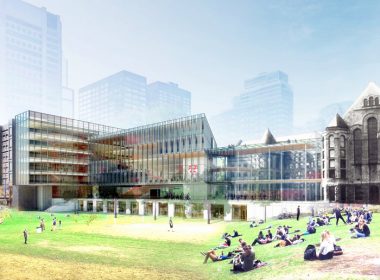
On March 1, McGill University held the inauguration ceremony for the Alphonse-Desjardins trading room on the second floor of the Bronfman Building. The event drew McGill students, McGill alumni who work for Desjardins, senior McGill administrators, and Desjardins employees who were either directly involved with the project or attending in support of the longstanding relationship between the Desautels faculty of management and the association of credit unions.

The focal point of the innovative Alphonse-Desjardins trading room is student access to expensive and esteemed Bloomberg software.

This new trading room will serve as a classroom during the day and a computer lab by night. Finance professor Sebastian Betermier and his students will be the ones primarily working and learning in this new space. Betermier said he looks forward to working with this useful learning tool.

“[The trading room] enhances opportunities … to visualize something. We can go on Bloomberg and see real data,” Betermier said. “All machines [are] equipped with a fake portfolio manager [and students will be] given fake money that they have to invest.”

Kyra Azzopardi, Management Undergraduate Society VP Academic, raved about the new software and how convenient the trading room makes it.

“Bloomberg is a program that gives market news. You can look up a company on its ticker and see its market value,” Azzopardi said. “It’s a really expensive, valuable software program … and now if I’m doing a group project I can just go in there and use it.”

In the last year, the Bronfman second floor underwent a dramatic change from being a traditional business library to the new “Business Intelligence Centre” and student hub.

Desjardins Group, Canada’s leading co-operative financial group, donated 11 group study rooms, new computers, study space, and a state-of-the-art trading room and software. The organization has also pledged to donate $1 million over the next five years for the trading room, coupled with securities trading and technology to support the facility. 

This donation by Desjardins will help McGill’s finance students gain a competitive edge, Azzopardi pointed out.

“A student is only as good as the resources that student has assessable to them,” she said. “Now, as a student, I get to use Bloomberg every day, and that’s going to prepare me better for the job I get. It builds our prestige … builds better resources for our students, and makes them more competitive for the job market.”

The relationship with Desjardins over the years has opened doors for students for internships and full time employment. Desjardins offered $13 million in scholarship money in 2011 alone, the most university scholarships money that any other company gave a university in Quebec that year. Louis Daniel Gauvin, Desjardin Senior Vice President and general manager, and a McGill management graduate, agrees that the relationship with the faculty of management has been mutually beneficial.

“[Desjardins] strongly    believe[s] that education is key to our sustainsable prosperity in a global competitive world,” Gauvin said. “Desjardins has a great story to tell, not well known, but having more people thinking of Desjardins, and attracting the talent in our group, we will benefit greatly from it. And there’s definitely very good talent here at McGill.”

a, News

Former Bank of Canada governor speaks to students

wikinfo.org

Around 300 students gathered on Feb. 28 to hear the former governor of the Bank of Canada, David Dodge, speak about the fiscal challenges that Canada will face in coming years, as compared to the current European crisis. The event was organized by McGill’s Economic Students’ Association (ESA) and is part of the ESA’s first annual speaker series.

“We decided that Mr. Dodge had both the experience and the foresight to come and discuss trending economic topics today, namely the anticipated future problems the government faces in providing social services,” Alexander Severance, U2 representative to the ESA, said.

Dodge, who served as governor from 2001 to 2008, began the talk by describing the economic crisis in Europe, citing increasing wages despite stagnant productivity as a key factor for the debt incurred by nations like Italy and Greece.

He then drew parallels between the European fiscal crisis and Canada’s current economic situation, focusing on Quebec and Ontario. He explained that both provincial governments have continued to improve the quality of the services offered to its populations although income growths, and thus tax collections, have slowed down.

“It’s not just a cyclical problem,” Dodge said. “It’s a big structural problem. In fact, we can’t go out and continue to borrow, we have to deal with the problem.”

Dodge offered some potential solutions to the escalating issue.

“We’ve got to get much better at doing what we do, and in addition, find new things to do where we can add more value. We have to make more airplanes, more pharmaceuticals,” he said. “At the same time, governments are not going to be able to deliver to you and me the same level of services that we have come to expect, because their revenues aren’t growing … [dealing with] the psychology of taking something away from somebody is very difficult.”

He ended his talk with an enthusiastic call for the economics students in the room to be the leaders who will bear these issues in mind when creating policy in the future.

“We need to continue to talk to governments about what some of these structural things are that we can do to improve our productivity,” he said. “Secondly, we need to pressure our government to make structural change in the way they deliver their services to us, and in the amount of services that they deliver so that they can cut their costs. This is very difficult … it means [increasing] pricing to the public.”

At the end of the question period that followed the talk, economics professor Christopher Ragan asked Dodge what he thought about raising tuition fees.

“That was one of my examples [of] where the right thing to do is politically very difficult,” Dodge said. “I guess I think that it is quite important that, whether it’s for healthcare or for education, [that] there be some recognition by the user of the service that they bear some part of the cost directly.”

Dodge also proposed an innovative idea for reforming the tuition system, suggesting that tuition fees increase as students advance through university, when the risks of a higher education are lower.

“I would set a fee scale that rose as you went through [university], because the risk to you as an individual and as a student goes down the longer you stay in university,” he said. “[We should set] the fee appropriate to the risk that you are undertaking.”

He developed his suggestion by describing a typical university student.

“[The risks of a higher education] are quite high in the very first year,” Dodge argued. “You come out of high school or CEGEP and you don’t know what the hell is going on at a place like McGill. You don’t know whether it’s going to be useful for you, if you’re going to like it … by third or fourth year, you should really have an idea of whether this is right or productive for you, or if you’re going to be successful.”

Students enjoyed the event and stayed for a cocktail with their peers.

“Overall, [the event] was a good learning experience,” Chloe Gosselin, U1 management, said. “It’s great that associations create events to apply what we learn into the real world. These give us a lot more interest and motivation [and] makes what we’re studying a lot more fun.”

a, News

Concordia student strike begins

On March 1, Concordia University’s Fine Arts Student Alliance (FASA) voted in a Special General Meeting to strike against tuition increases. With 465 fine arts students holding a voting card, the vote passed overwhelmingly. The strike is set to begin on March 5 at 8 a.m.

The vote was administered and brought to FASA by Artists Working to raise Awareness & Knowledge about Education (AWAKE). Four strike locations will be set up around Concordia, each with their own strike co-ordinator.

According to the mandate passed, the strike will be open-ended and will have weekly general assemblies.

In an email to the Tribune, FASA president Paisley Sim explained that FASA is joining with the Women Studies Student Association, the Philosophy Students Association, and the Political Science Student Association, which have already voted to strike, and that “more are expected to join in the coming week.”

The Concordia Student Union (CSU) will be holding a Concordia-wide Special General Assembly on March 7 to vote on a strike mandate to last only five academic days, from March 22 to March 29. The mandate would include the option to hold another vote if students wished to continue on strike. In addition, students on internships would not be included in the strike and studios and laboratories would be kept open.

“Regardless of the outcome of the March 7 vote, Concordia intends to continue operating as usual,” the Concordia Office of the Provost stated in response to the CSU’s call for a student strike vote. “The university has a responsibility to provide services that are a part of its agreement with our students, even if some of those students decide not to attend class as a form of protest. It is important that students be aware of the potential consequences of missing classes and other instructional activities.”

The FASA included this statement in an email sent out to students to inform them of possible academic repercussions. The CSU also sent out an email regarding the Concordia-wide Special General Assembly.

“What we see is that every time there has been a major setback to accessible education, a strike was enough to force government to change its mind, and a tuition freeze in 2012 is not an exceptional goal,” the email stated.

“With strength in numbers and ongoing support from the CSU … we anticipate more associations and faculty members will join us in protest,” Sim said.  

a, News

McGill student protest rallies support for free education

Last Wednesday, students from McGill University,  l’Université du Québec à Montréal (UQAM), and several CEGEPs in the downtown Montreal area participated in a demonstration for free education. 

Organized by McGill students, Wednesday’s demonstration was one of many in the growing student movement against the Quebec provincial government’s proposed tuition increases, which would come into effect this fall. 

“Awareness is part of it,”  Ethan Feldman, U3 philosophy student, said. “However, we advertised [this demonstration] as a support rally for student action against tuition hikes.”

Around 100 students assembled in front of the SSMU building at 11:00 a.m.

At 11:30 a.m., the crowd of demonstrators moved to the Leacock Building and marched through the hallways towards the Arts Building, playing drums and chanting slogans. After passing through the McLennan Library chanting “McGill on strike!” they gathered in the McLennan lobby.  

McGill community member Nancy Crowe was present in McLennan at the time, supporting the demonstrators. 

“I believe in accessible education,” Crowe said. “It doesn’t have to be free, but it should be affordable. The tuition increases will have students come out [of university] with more debt than they can handle.”

After exiting McLennan, the demonstrators left the McGill campus and marched towards UQAM, taking main roads such as President-Kennedy, St. Catherine, and Sherbrooke along the way. 

This demonstration is part of an attempt by students to raise support for the anti-tuition increase movement. After months of protests and demonstrations, many students across the province are opting for an unlimited general strike. 

“We’ve spent a whole year trying to have our voices heard,” a second year law student who could only be identified as Dominique, said. “A strike is our last resort … it’s a good way of showing how important [education] is.”

“Many faculties and CEGEPs are already on strike in Montreal and in the West Island,” Mona Luxion, a PhD urban planning student, said. “McGill, Concordia, and UQAM are still in the ‘in-between’ position.”

According to the ‘Stop the Hike’  website, as of March 5, 96 student unions representing approximately 123,265 students are currently on strike, including student associations from Collège Lionel-Groulx, CÉGEP de Drummondville, CÉGEP du Vieux-Montréal, and CÉGEP St-Laurent. 

In addition, there are 13 unions representing approximately 9,461 students who have a strike mandate and are currently waiting to begin.  

Some students have remarked that a large percentage of pro-strike students at McGill appear to be arts students, with less mobilization in other faculties. Coalition large de l’Association pour une solidarité syndicale étudiante (CLASSE) committee member Jérémie Bédard-Wien says this is unusual in comparison to other campuses. 

“Many different faculties … have chosen to go on strike. The science and education faculties at UQAM have voted in favour of the strike … CEGEPs have a wide range of technical programs and they have voted for the strike,” Bédard-Wien said. “The most striking for me is the faculty of medicine at Université de Montréal, who voted to go on strike the week of the 20th.”

Bédard-Wien also offered an explanation for why pro-strike mobilization has been less intense at McGill than at other colleges and universities.  

“Students at McGill have organized around different issues in the past, but mostly around issues that are pertinent only to McGill,” he said.  

“There has been a historical barrier between francophones and anglophones in terms of progressive issues,” Bédard-Wien said. “That is why the movement this year on anglophone campuses is historic.”

Outside of McGill, numerous strike votes will continue to take place between now and March 20 at Concordia University, Université de Montréal, and other CEGEPs and universities across the province.  

“We are not going on a general strike because we feel like it,” Bédard-Wien said. “We’re doing it because it’s our last card to play.”

a, News

SUS holds GA on tuition increases

Anna Katycheva / McGill Tribune

Last Friday evening the Science Undergraduate Society (SUS) held a General Assembly (GA) to discuss motions related to the Quebec-wide student strike movement opposing tuition increases. The SUS does not typically hold GAs open to its members and last week’s assembly occurred as a result of student petitioning for a GA.

At the beginning of the evening, the assembly had two motions on the floor – one calling for the SUS to publicly announce its support for accessible education and opposition to all tution hikes, and another which would have seen the formation of an anti-tuition increase strike committee. 

The GA had a quorum of 125 members, and began with just over 100 voting members present. Numbers increased steadily over the first hour, and quorum was reached just in time for the first vote.

After much deliberation and a number of amendments, the first motion on the SUS’ support for accessible education passed with 81 votes for and 43 against. 

A number of amendments were debated and passed, most notably one that weakened the scope of the motion by changing the wording from “a policy … against all tuition hikes, with a long-term goal of free education for all students,” to  “a policy in favor of accessible education and against current tuition hikes.”

The assembly lost quorum moments after the vote on the first motion.

The movers of the second motion withdrew their motion calling for the formation of a strike committee before it was read. They did not want to have their motion voted on consultatively and then taken to the SUS’ General Council (GC).

“We knew it was going to get shot down at [General Council],” Aidan Drake, U1 mathematics and a mover of the motion, told the Tribune. “We [also] feel there needs to be a lot more mobilization before we can properly move towards a strike committee and/or a one-day strike.”

“We also know that those [on the GC]  who are sympathetic are uncomfortable making public their political positions,” Leif Ásgeirsson, a mover of the first motion and member of the Science Undergraduate Mobilization Committee, said.

A major student strike across the province is planned for March 23, and several McGill faculties, including the Arts Undergraduate Society (AUS), the Social Work Students’ Association (SWSA), and the Medical Students’ Society (MSS) will be holding assemblies in the next few weeks to consult their members on whether to move towards taking part in the strike.

Throughout the evening, discourse was very civil. Matt Dolson, the GA’s speaker, kept dialogue moving and helped those attending, some of whom were unfamiliar with the rules and procedures of GAs, to understand the proceedings.

The meeting adjourned at 6:35 p.m.

a, News

Board of Directors ratifies J-Board ruling

Michael Paolucci / Organization

During the March 1 SSMU Council meeting, SSMU’s Board of Directors (BoD) ratified the Judicial Board (J-Board) ruling that invalidated the results of QPIRG’s fall referendum question. In a report released on Feb. 14, the J-Board declared the question to be unconstitutional because it dealt with two separate issues.

The BoD’s ratification of the J-Board decision is a step recently implemented to bring the J-Board into compliance with Quebec law, which requires the BoD to have the highest level of authority in the organization.  

Implementing this step requires changes to the SSMU constitution, which have to be approved by the student body during the upcoming referendum period. However, an agreement made at the Feb. 9 Council meeting requires the board to act in the spirit of these recommendations. This also means that, as specified on the upcoming referendum question, the BoD can only overturn a J-Board decision by a 4/5 majority. 

Although the power for ratification ultimately lay with the BoD, SSMU Legislative Council first voted on a recommendation on the subject to submit to the BoD. Debate at council centred on the council’s duty to the student body and to the democratic framework of the organization. 

“[If we ratify this decision] how can we instil students with a sense of confidence that our democratic processes like referenda are actually safeguarded?” Adam Winer, Clubs and Services representative, said. 

“Those democratic processes must take place within a framework that must be honoured, and when that framework is not honoured we need to step in … we have these checks and balances for a reason,” Joshua Fagen, Interim Arts representative, said. 

Rebecca Yu, U2 political science and history, presented a letter signed by 28 students, which pointed to a potential conflict of interest for J-Board Justice Raphael Szajnfarber, who acted as a spokesperson for Hillel Ottawa in 2008, during a complaint against Ontario Public Interest Research Group (OPIRG).  

Education Councillor Kady Paterson responded that the J-Board investigated the Justice’s potential conflict of interest before deciding that it would not interfere with his position in the case. 

The letter also questioned the terminology of the ruling, saying that the ruling depended on the concept of a “reasonably informed average voter,” a term that the J-Board did not adequately define. 

“[The] J-Board is not a part of student democracy at McGill,” the letter states. “It should not have the power to decide how most students understand referendum questions or anything else, especially without providing a framework to support such a decision.”

Gallery member Brendan Steven, U2 political science and Canadian studies, was concerned by this attitude towards the J-Board. 

“Democracy isn’t just about voting on any question, and not any question put to a mass of people constitutes a referendum,” Steven said. “It’s just very problematic to suggest that having a system of due process … somehow harms the democracy of SSMU [when] it’s an essential part of what democracy is.”

The ratification passed with seven votes in favour, one against, and four abstentions.  

In other business, Council passed several motions that were passed as recommendations at the last SSMU General Assembly. These included a motion to restructure SSMU frosh to make it a “safe space for all students” and a motion declaring SSMU’s opposition to corporate influence at McGill.  

Council also passed a motion denouncing Bill C-10, a bill that introduces new measures against crime in Canada. SSMU will denounce the bill to the university’s Member of Parliament Marc Garneau, the Minister of Justice, and engage in a media campaign against the bill.

a, News

Independent Student Inquiry released to the public

The Independent Student Inquiry (ISI) presented its final report and recommendations concerning the events of Nov. 10 at last Thursday’s SSMU Council. The ISI was created following criticism of Principal Heather Munroe-Blum’s announcement of Dean of Law Daniel Jutras’ internal investigation of the events.

Originally supposed to present their findings in January, two months after the release of the Jutras report, the ISI was delayed because McGill did not respond to their Access to Information requests.  

Harmon Moon, U2 history and one of the five co-authors of the final report, told Council that the report did not represent the views or ideas of the administration, because members of the ISI were repeatedly denied communication with administrators.  

Chris Bangs, another of the co-authors and a U2 economics and political science student, said he will be lodging a student grievance against the Secretary General for violating several articles in the Charter of Students’ Rights throughout this process. 

“It really is tragic that nobody in the administration wanted to talk to us, because it does create this very, very unfortunate idea that this is the report for the students and the Jutras report is the report for the administration,” Moon said.  

The Jutras report was made public on Dec. 15. The ISI final report notes that Jutras was given an “uncomfortable amount of power” as the leader of the internal investigation, and recommends that the university establish a protocol that would mandate either an external third party or an impartial internal body to lead future investigations. 

Based on their research, the ISI compiled 10 recommendations, which include some that respond to Jutras’, but also others they produced independently. These include a recommendation that the university should clarify what is public and private space on campus, defining which areas are acceptable for political activity, and expanding available student space. 

“The status of public spaces should be made explicit, with the goal of integrating students and community members into spaces where they currently feel unwelcome,” the report states. 

The report also states that building lockdowns, like those of Nov. 10, should require explicit justification and should not occur without “appropriate communication” with the university community.  

“Lockdown protocol should also address safety concerns such as medical emergencies,” the report states. “The lockdown on November 10 significantly contributed to affected students’ inability to receive much-needed medical assistance.”

“Students also should never be trapped in buildings and should always be able to leave freely,” the report adds. 

In addition, the ISI recommends that McGill file an official complaint with the police ethics commissioner of the Service de police de la Ville de Montréal (SPVM), in response to the “overly violent” police reaction on Nov. 10.  

“Individual responses to police brutality can be difficult to carry out,” the report states. “Only the university has the authority and capability to speak for and defend the rights of all of its members hurt [on Nov. 10].” 

Allison Cooper, U3 anthropology and co-author of the ISI final report, explained that members of the ISI will now work with SSMU councillors to translate these recommendations into SSMU mandates and protocols. She said it is important for these recommendations to progress beyond the ISI, since Dean Jutras’ recommendations may not allow students to feel that they have a voice in the investigation.  

“We need to make sure that we have all of these people [faculty, students, and staff] together and talking [but] it’s hard for students to feel like the administration-organized events will give them a voice, because …  the topics and questions are all set for you by the people who organize it,” Cooper said. “It’s sort of a sad way that it is perceived, but still, to actually have a dialogue I don’t know if those [administration-run events] are actually the proper fora for that.”

In addition to the student inquiry, the McGill Association of University Teachers (MAUT) has created a committee that will respond to the events of Nov. 10 by making recommendations to the McGill Administration and Senate. The committee was scheduled to submit their report to MAUT Council by March 1.

The ISI final report is available at independentstudentinquiry.blogspot.com

—Additional reporting by Carolina Millán Ronchetti

a, News

Dean Manfredi’s Open Forum marked by low turnout

Discussions on safe space and flawed consultation processes marked the sparsely attended first meeting of Dean of Arts Christopher Manfredi’s Open Forum on March 1. With just over 30 people in the audience, this first of four open meetings focused discussion on the four main issues raised by the Jutras Report on the events of Nov. 10 with regards to free expression and peaceful assembly.

Following Principal Heather Munroe-Blum’s response to the Jutras Report on Feb. 13, a nine-person advisory group was created to assist Dean Manfredi in hosting the Open Forum and producing a written report on the views articulated therein, the process of which is to be finished by June 8 and formally presented to Munroe-Blum by October.

“I think that all of us have a responsibility to ensure that the quality of the discussion is as high as possible and that really depends on the participants themselves. [It] depends on their being here and depends on their making intelligent contributions respectfully on various subjects,” Manfredi said in his opening remarks.

The issue of what peaceful assembly entailed, as well as what should be designated as private versus public space on campus dominated the discussion.

“I do think that there are ethics of peaceful demonstration and perhaps students should actually come to have a discussion about that,” Catherine Lu, a political science professor, said.

 “When [you] occupy the building … you are the same people asking for respect and recognition of the things you do, and you’re disrespecting the people who you want to hear you,” Dave D’Oyen, U2 arts, said of the actions of student occupiers and on the issue of deliberately concealing one’s identity.

“If you’re brave enough to stand up for something then you should be brave enough to accept the consequences that are going to follow,” he added.

The idea of instituting a specific space for peaceful assembly was met with apprehension.

“Part of the action inherently is to disrupt something,” Josh Redel, President of the Engineering Undergraduate Society and member of the Open Forum advisory committee, said. “So if you have a designated corridor that’s far away from classrooms and administration buildings and therefore it doesn’t disrupt anything, what’s the point then? They’re never going to use it.”

Discussion then turned to the validity of people’s feelings towards the events and atmosphere on campus and the relation that had to private space.

“One thing I would like to ask is why people are afraid of students,” Lu said.

Caroline Baril, who works in th principal’s office, referenced her experience witnessing the events of Nov. 10.

“The reason there was fear was that the people that came in never identified themselves as students. They covered their faces so we didn’t actually know [who they were],” Baril said.

“I guess I find the excessive reliance on the language of fear … [as] conflate[ing] the dangers of having an armed intruder with the problems of civic protest, which is that it’s inconvenient and messy and yes it’s not what we would like to happen in our offices but you know, this is part of being a public institution,” Lu said.

“The people who work in my office are members of this community and they currently don’t feel that they have a safe space to work in … It is not legitimate to discount their feelings,” Morton Mendelson Deputy Provost (Student Life and Learning) said in response. “I don’t think that we should assume that people who work in the Deputy Provost’s office should assume that they can have their space invaded.”

Mendelson added that, while the notion of a private space in an office is not the same as that equated with one’s bedroom, people have a self-defined personal space which they consider to be private.

“People’s feelings, while legitimate, are not a basis of sound reasoning,” Lu said in disagreement with Mendelson’s comments. “We start using the language of privacy and rights and basically say that those in positions of authority really don’t have to listen to people who are lower than [them].”

“I personally think that we need to have a lot more discussions about feelings and emotions and about how people feel about issues on campus,” SSMU president Maggie Knight said. “So how do we as a community go ‘yeah, it’s okay for you to feel like this, we might not agree with you … but we acknowledge the validity of that and we recognize that you’re likely to act based on those feelings’?”

Of those students who attended the Open Forum to raise complaints, the main concern was the ineffective nature of such consultative processes.

“To really create peace on this campus, I find forums like this to be pointless,” D’Oyen said. “A forum like this doesn’t reach out to the silent majority. They’re never going to come.”

“I really can’t believe it’s going to be so hard for you to take a day or an hour out of your schedule to stop at a popular place on campus … and say ‘What’s wrong, what can I do, how can I serve you better?'” D’Oyen said in response to Manfredi asking what else the university should be doing.

Remarking on the absence of students at the Forum, as well as the high degree of formality felt in the room, a student who could only be identified as Courtney said she didn’t feel comfortable speaking there.

“The format of this consultation seems so flawed to me,” she said. “I feel like by speaking and just being here right now, I’m almost validating this type of consultation to students and I don’t feel comfortable validating it.”

a, Arts & Entertainment

Fred: Leaving My Empire

Producer Howard Bilerman (Arcade Fire, Wolf Parade) has left his mark on this five-piece alternative band’s most recent album, Leaving My Empire, for better or for worse. He possesses an impressive ability to make the band sound like they are walking a fine line between melancholy and joy, a talent that makes for an interesting album, though maybe one that is somewhat conventional.        “This seems almost familiar,” Joseph O’Leary sings on “Villians,” and he’s right—the same thought popped into my head with almost every track. Whenever Bilerman used Arcade Fire-esque vocals, I thought I was listening to the voice of Win Butler.  Although O’Leary’s voice is quite different from the Arcade Fire vocalist’s, it’s difficult to distinguish the two when all that echo and reverb is added. 

Despite the unavoidable similarities between the production techniques of Leaving My Empire and Funeral, there were many blasts of unique instrumentation and styles that set this band apart (and there are worse albums to sound like than the latter). Poignant melodies, poetic lyrics, and unique chord progressions come together to make this a heartfelt album, and the band displays an incredible togetherness in their vocal and instrumental parts. Filled with moving build-ups leading to epic climaxes, it’s very difficult not to listen to the whole thing from beginning to end each time.

a, Arts & Entertainment

Octoberman: Waiting in the Well

Led by singer-songerwiter Marc Morrissette, Waiting in the Well marks the fourth full-length album released by Canadian indie-rock band Octoberman. At face value, it’s a collection of songs about the frustration and sacrifice that accompanies a long period of waiting.

But in its use of despondent melodies and varied acoustics, Waiting in the Well strikes a soothing tone that will most likely appeal to listeners of indie-rock groups like Belle & Sebastian and Death Cab for Cutie.

Despite Morrissette’s melancholy vocals and sporadic lyrical moments of dejection, the album maintains a comforting and relatively optimistic quality from start to finish. “Dressed Up” is easily the album’s paramount track, a result of both its solid opening and upbeat rhythm, setting it apart from the calm that dominates the rest of the album. Other strong songs include the lighthearted opener “Waiting for Christine,” as well as “Thank You Mr. V,” the band’s poignant tribute to the late Kurt Vonnegut.

Certain songs fail to captivate because of Morrissette’s vocals, which occasionally falter in mediocre tracks like “Actress.”  Listeners should also beware of “Burning Sun,” in which lyrical clichés cancel out the song’s instrumental strength. Despite the relative inferiority of these two tracks, Waiting in the Well brandishes an overall quality and likeability that can be expected to satisfy past fans and those of the indie-rock genre.

Read the latest issue

Read the latest issue