

Latest News

Commentary, Opinion

McGill is leading in research but lagging in workers’ rights

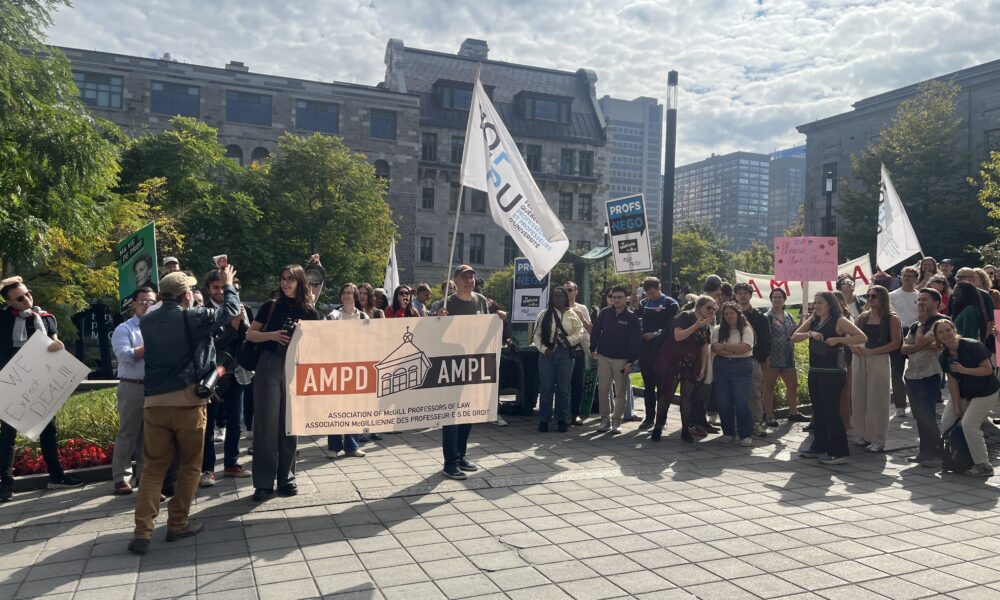
McGill is continually ranked as a top research university in Canada, recently coming in second for medical research. Despite this status, the school consistently fails to adequately recognize the rights of its workers. From pushing its teaching assistants (TAs) to a hard strike for livable wages to undermining its law professors’ union, McGill has time and again resisted progress that would lead to fair labour practices. 

How can a university be leading in research while lagging so severely in workers’ rights? Does top-ranked research come at the expense of workers’ rights, or even worse, in spite of them?

If McGill aims to maintain its prestigious ranking, it must prioritize the needs of its TAs and professors—the driving force behind its research output. This became especially clear after the Association of Graduate Students Employed at McGill (AGSEM) strike in March 2024. After nearly a year of McGill disregarding AGSEM’s demands, the TA strike began. Even as the work stoppage unfolded, the university resisted reasonable requests for a month before finally conceding to a deal. Some of these included a wage increase, demands for more say in Teaching Support budgets and the working hours of TAs, as well as special protection for transgender TAs and support for mental health. 

Some might argue that because of McGill’s high ranking and reputation, it is justified in having high demands of workers, or that these demands contribute towards McGill’s prestige. But many TAs have said that, under these conditions, they have been forced to sacrifice their quality of work to get by. If graduate students are struggling with mental health, overloaded with extra hours, working a second job, or worried about paying rent, they will not be able to produce the cutting-edge research that McGill boasts, or the high-quality education necessary to remain in the undergraduate rankings. 

McGill faces a stark choice: Support its workers or forfeit the benefits of their labour. The university cannot expect excellence while its staff struggles to make ends meet.

A study by Northwestern University shows that productivity increases with minimum wage—that higher pay will lead to better output. So what is standing in the way of McGill prioritizing its workers when it is likely to benefit the TAs and the university alike? 

While the AGSEM strike was significant progress—offering TAs a 15.5 per cent raise over four years—for McGill Law professors, things are different.

Before temporarily suspending their strike on Oct. 1, the Association of McGill Professors of Law (AMPL) was striking for better pay, for more of a say in the governance of the faculty, and for their right to unionize. McGill resisted their demands for months, taking actions to undermine the legitimacy of the union by legally challenging its certification, which was granted by Quebec in 2022. 

McGill’s actions were ruled illegal by the Quebec labour tribunal after two administrators attempted to undermine the union in communications to Law professors just before a critical strike vote. On Oct. 1, AMPL agreed to go back to teaching for now, after McGill threatened to cancel the semester if the strike continued.

Progress has been made since then, but not because of McGill’s support for unions—rather, because of AMPL’s tireless work for months on end. AMPL reached an agreement with McGill on Oct. 7, with McGill agreeing to drop its legal challenge of the union in exchange for AMPL negotiating collective agreements with two other unions in the Arts and Education faculties. Still, this decision took far too long to reach and shouldn’t have been challenged in the first place; it reflects McGill’s stubbornness and reluctance to prioritize constructive dialogue with its faculty and staff. 

So, can McGill balance its high rankings with low workers’ rights? Worker rights are non-negotiable, and McGill can no longer afford to ignore them. Silencing dissent only transforms isolated grievances into a unified call for change. The more the university resists, the stronger its workers’ resolve grows.

News, PGSS

PGSS Council votes on McGill-amended motion, removes mentions of Gaza and genocide

The Post-Graduate Students’ Society (PGSS) met on Oct. 2 for its second Council meeting of the Fall semester. Thirty-six voting members attended the meeting, surpassing quorum—one per cent of regular members, as laid out in PGSS’s Bylaws—for the first time since February of this year. As the previous Council meeting on Sept. 10 had failed to meet quorum and attendees were unable to vote on the motions discussed, this month’s meeting had a particularly long agenda. 

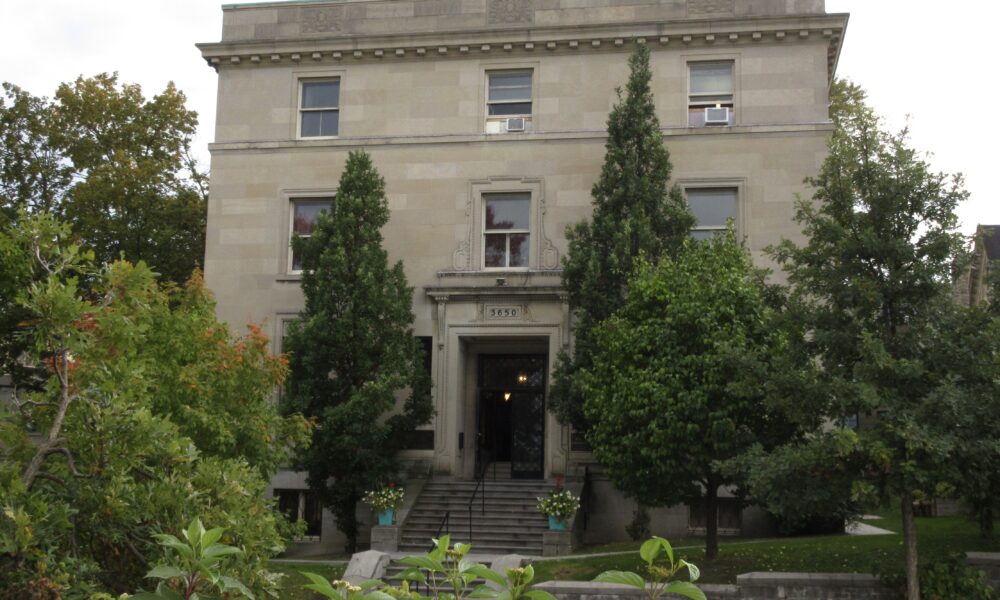
The hybrid meeting was held in Thomson House and on Zoom. The discussion primarily centred on three motions—5.4, 5.5, and 5.6—from the December 2023 Council meeting, which expressed solidarity with Palestine. After PGSS and McGill received a legal notice from an anonymous member on June 20 that asked both parties to abide by an interlocutory injunction, the McGill administration proposed modifications to the motions, which would uphold PGSS’ Memoranda of Understanding with the university. These amendments included changing the name of motion 5.4 from “Council stand in solidarity with Palestine” to “Motion on Divestment from Armaments and Efforts to Promote Peace,” and removing words such as “Gaza,” and amending mentions of “genocide” to say “war.” 

Many members abstained from voting on Motion 5.4. During the discussion, Member Services Officer Ambre Lambert offered insight on the importance for PGSS members to be familiar with the motions before voting as approving or rejecting them is their choice. She also added nuance to a previous discourse she held about advising voters to oppose Motion 5.4.

“I was encouraging students not to agree with the motion that was done last month [because the wording] was extremely restrictive and was losing the sense of the motions,” Ambre said.  “I do think they are still losing some of their original meanings but I also think that I don’t know if we’ll reach an agreement with McGill [if we keep on debating].”

Some attendees voiced concerns that abstaining could lead to commissioners reentering negotiations—and even arbitration—with McGill over the wording of these motions. Councillors also raised questions throughout the discussion about adding context around McGill’s “watered-down” wording as Lambert put it. 

The conversation turned to motion 5.6, originally called ‘Motion to support and encourage [Post-graduate Student Associations] PGSAs to address the ongoing genocide in Gaza and investigate their ties to settler-colonial violence and genocide against the Palestinian people.’ It was amended to be called ‘Motion to support and uphold the academic freedom and rights of freedom of expression, conscience, and assembly of PGSS members.’ Brenagh Rapoport from the Organization of Urban Planning Students highlighted the aspect of the motion that ensures PGSAs cannot condemn, penalize, or restrict students’ discussions or actions.

“Protecting our students from backlash from the university for [engaging in meaningful] action is really important [and] a material commitment to students not receiving [sanctions] for expressing opinions and engaging in political action […] is a concern for people in my department,” Rapoport said. 

Councillors stressed that work still needs to be done to ensure students know their rights to freedom of expression. In response, University Affairs Officer Racchana Ramamurthy suggested adding shorter versions of the Code of Student Conduct with important points on myCourses.

In the end, abstention was disregarded, and Motions 5.4, 5.5, and 5.6, all passed—with 24 votes in favour of 5.4 and 5.6, and 17 votes for 5.5. 

For the last part of the meeting, Shona Watt, Associate Director of Sustainability Projects Fund (SPF) presented the SPF, which funds environmental projects on campus. Since its founding in 2010, the initiative has allocated over $12.6 million CAD in funding to 370 sustainability-related projects. According to Watt, the SPF is the largest dedicated campus sustainability fund of its kind in Canada.

Moment of the meeting: 

With the meeting’s extended agenda, the Council put forth a vote to extend the meeting to 8:30 p.m.. While 10 members voted in favour of continuing, 15 voted against. As a result, the meeting was not prolonged and the remaining agenda items will be postponed to future meetings.

Soundbite: 

“It is 100 per cent your choice as a councillor and you have absolutely that option, to not accept those changes that are basically a compromise between us and McGill.” — Ambre Lambert, Member Services Officer, on voting members’ right to abstain on approving Motion 5.4.

Arts & Entertainment, Music

The stories and sounds of Montreal’s Black women DJs

Montreal’s cultural fabric is shaped by its artists. From writers and sculptors to fashion designers and chefs, there is a scene for everyone. When it comes to musical history, the city’s Black communities hold great significance. The music scene extends to DJing, with events like Igloofest and Aire Commune, along with collectives like Boiler Room, showcasing its vibrancy and diversity. Given this cultural backdrop, I sought to explore the experiences of Black women DJs whose perspectives are underrepresented despite their significant contributions. I interviewed three Black women DJs to understand what the art means to them—and how their identities influence their artistry. 

Drawing on her Cameroonian heritage and upbringing in France, Inès, who performs under the name Ms Baby, skillfully blends traditional and contemporary African and European electronic influences with the richness of popular African American music. The result is a sound that resonates beautifully within Montreal’s diverse landscape. Playing African music, especially traditional tunes, holds immense significance, as countless African artists have shaped music globally while going unrecognized for it. For Inès, it’s not just about playing songs; it’s her mission to give those artists their flowers, honouring and celebrating their contributions to the music world. 

Another voice in the scene is Asha, a Toronto-born DJ with Guyanese parents who entered the electronic music scene after living in Berlin. Like Inès, she noted that many DJs draw from diverse global influences, but the creators behind the sounds are often overlooked. She emphasized that DJing involves much more than playing music; it requires research and proper crediting of the artists.

“If there’s one thing I wish people understood better, it’s how much weight the music you play carries,” Asha explained. “When you take on the role of a DJ, you’re not just spinning tracks; you’re also a curator of culture and history.” 

Asha noted that this awareness is not only about respecting artistry but also about recognizing the political implications of music selection. “In my opinion, DJing is political,” she asserted. “It’s about acknowledging the producers you support and the cultural energies you’re promoting.”

For Janelle (IAMNOTMYHISTORY), the music she chooses to play is largely influenced by her Trinidadian background. When asked about her DJ name, Janelle shared that it reflects her awareness of how Black history is often simplified or distorted in educational contexts. She pointed to the importance of recognizing the depth and complexity of her heritage beyond a single narrative. 

Janelle emphasized that her name is also a personal declaration. “I don’t want to be defined by my past,” she explained. “I am not just my history; I am so much more.” Her perspective embodies her desire to remain present and open to growth, allowing her to evolve as an artist and an individual. “While my background informs my music, I want to continue creating and exploring new avenues without being confined by what I’ve already accomplished,” she said. 

All three women highlighted the unique challenges of being Black women DJs in a male-dominated industry. Inès emphasized the importance of representation, noting that seeing other Black women DJing fostered a sense of belonging. She described the frustrating expectation for Black women DJs to simply be grateful to be given opportunities, which often results in low performance expectations and relegation to less prestigious slots. Despite these obstacles, the three women expressed empowerment in their journeys, citing the joy of sharing music in the city as a key source of their success.

As Black women artists like Inès, Asha, and Janelle navigate the complexities of being minorities in the DJ scene, they are carving out spaces that honour their heritage while also embracing their multifaceted identities. In a city where a shared love of music fosters creativity and collaboration, these DJs remind us that the past does not define one’s future; instead, it serves as a foundation to build limitless possibilities. As they continue to break barriers and inspire the next generation, the unique contributions of Black women DJs enrich Montreal’s artistic landscape, ensuring that their voices are heard in the sound of the city.

Science & Technology

Exploring galactic evolution from the Big Bang to the Milky Way

On Oct. 3, McGill’s Trottier Space Institute presented a public talk titled “From Clouds to Cosmic Giants: The formation and evolution of galaxies.” This event featured Tracy Webb, associate professor in McGill’s Department of Physics and observational astronomer, who discussed the development of galaxies from the Big Bang to the present day. The talk also highlighted current innovations aimed at demystifying our understanding of these complex systems. 

Webb began her talk by discussing the galaxy we call home: The Milky Way. Amongst the whopping hundreds of billions of galaxies in our observable universe, Webb emphasized that the Milky Way is just one of many. 

“[The Milky Way] is sort of a regular galaxy in a regular group of galaxies, nothing really special […] except that it is home to us,” Webb stated in her talk. 

The composition of galaxies 

Galaxies are primarily composed of a large oval called the dark matter halo, which forms the body of a galaxy and accounts for most of its mass. At the center of the halo lies the bulge and disk—made up of stars and surrounded by what’s called the “interstellar medium.” At the very centre of the galaxy resides a supermassive black hole. 

“A galaxy has a total mass of [around] 1 to 2 trillion times the mass of our own sun, and that mass is made up of dark matter, which makes up about 90 per cent of the galaxy. Then we have gas and dust making up the next component, around seven per cent, and stars […] only make up about three per cent,” Webb explained. 

Galaxy classification 

After focusing on the components of a galaxy, Webb shifted to a broader topic: How galaxies are classified. Edward Hubble, astronomer and namesake of the Hubble Space Telescope, came up with a simple classification of galaxies based solely on their shape, known as the Hubble Tuning Fork. The first type of galaxy is elliptical galaxies, and the second is spiral galaxies. 

“There’s a whole bunch of galaxies that don’t fit into the Hubble Tuning Fork, [which we] call irregular galaxies,” Webb clarified. 

Galaxy formation and growth mechanisms

According to the Big Bang Theory—which is the idea that the universe began as a single point and has been perpetually expanding ever since—galaxies formed approximately one billion years after the beginning of the universe. Galaxies first coalesce as dense packs of gas and grow larger over time by merging with other galaxies. The Milky Way is on a collision course with our neighbouring galaxy, Andromeda, although the impact is still a few billion years away. 

Apart from collisions, galaxies also grow by absorbing the cosmic material around them. A more obscure growth mechanism of galaxies has to do with the supermassive black holes at their center, which are suspected of regulating galaxy growth during this process.

The future of telescopes 

Webb then moved on to talking about the use of telescopes in studying galaxies. When observing galaxies, telescopes behave as time machines. The images we see of galaxies actually show how they appeared billions of years ago since the further away they are, the longer it takes for light to travel to us. This means that when observing the Andromeda galaxy, we’re observing it 2.5 million years ago, and when observing the furthest galaxies visible through the Hubble Telescope, we’re actually observing them 13 billion years in the past.

The James Webb Telescope is a recent telescope project launched into space that surpasses the Hubble Space Telescope in terms of its observational capabilities. Another upcoming project is the Square Kilometer Array—an international effort to build the world’s largest radio telescope array, which is a network of separate telescopes located across the globe that operate as one. 

While many advancements are underway to deepen our understanding of the galaxy, much is left uncertain. The more knowledge we gain on galaxy formation, the better we will understand how the world we live in came to be.

Arts & Entertainment, Film and TV

Spike Lee inspires at Montreal International Black Film Festival’s Opening Night Gala

The Montreal International Black Film Festival (MIBFF) celebrated its 20th edition from Sept. 25 to 29, shining a powerful spotlight on the richness of Black cinema and emphasizing the importance of diversifying the cinematic landscape. MIBFF is the largest film event dedicated to Black cinema in Canada as well as the only bilingual Black film festival in North America. This year’s festival aimed to inspire attendees by illuminating Black filmmakers and offering a platform to advocate for Black storytelling within the industry. Academy Award-winning director Spike Lee was named the Honourary President of this year’s festival and took part in an intimate interview for the Opening Night Gala. 

Founded by Fabienne Colas, a director and producer who presides over 12 other arts and film festivals, MIBFF amplifies Black filmmakers and honours diverse narratives. The festival serves as a beacon for the importance of representation and inclusion on and off the screen. At the Opening Night Gala, Colas urged the industry and audiences to continue fighting for equal funding and grants for Black and BIPOC organizations. 

The crowd eagerly welcomed Spike Lee, a renowned filmmaker in the industry for over 45 years, upon his fourth appearance at MIBFF. Known for his thought-provoking body of work, the energy in the audience was palpable as Lee provided insight into the filmmaking process and industry. Lee’s approach is reflected in his unwavering passion to tackle social injustice, an aspect of filmmaking that is often overlooked.

Through his inspiring and stimulating conversation with Colas, Lee highlighted the persistent challenges that Black filmmakers face in gaining visibility for their projects as well as the need for increased representation behind the camera. Lee addressed the systematic obstacles faced by Black filmmakers, drawing parallels between the 35th anniversary of his radical film Do The Right Thing and the ongoing prevalence of racial injustice and police brutality, notably in regard to recent events such as the murder of George Floyd. While Lee’s filmography is distinguished by his urge to confront and raise awareness of social injustices, he also acknowledged the need for contemporary filmmakers to portray what resonates with their personal journey. When asked if he believed filmmakers today have a mission to raise awareness, Lee said that everybody has “different stories to tell.” 

There was a tangible sense of community and a shared purpose felt amongst the audience, with Lee’s candid nature serving as a refreshing view of the current film landscape. Having spent decades pushing the boundaries of storytelling within the industry, Lee shared invaluable advice to aspiring filmmakers, discussing the modern-day tools available to budding creatives as well as the importance of physical screenings. Proclaiming that “you have the tools,” Lee emphasized collaboration, maintaining that community and perseverance lead to success. Furthermore, he honed in on the need for Black creatives to occupy positions of authority behind the screen, rather than being outside the ‘room where it happens’. 

Lee’s personal anecdotes provided a glimpse into his journey, starting from watching classic Hollywood movies with his mother as a child to his current status as a legendary filmmaker. He also shared his most influential movies—highlighting Crooklyn as a personally significant project due to the family effort involved in the writing process and his own upbringing in Brooklyn; Lee confidently proclaimed that “Crooklyn beats everything”.

The festival serves as a testament to the importance of upholding Black cinema and the need to continue pushing for greater inclusion and representation within the film industry. As noted by Lee, events like MIBFF create crucial spaces for celebrating individual voices and serve as a call to action to both filmmakers and audiences to embrace their unique narratives.

Off the Board, Opinion

My support for Palestine is rooted in, not opposed to, my Jewish identity

Last year, I was having a conversation with a friend on campus. She shared her sense of internal conflict as a member of Montreal’s Jewish community, and her challenges in reconciling the views she grew up around with the headlines and protests surrounding her. Eventually, she turned to me and said: “But what I struggle with in how you express your views is—do you not care about Jewish people—your people?” 

I was startled. Why did my support for Palestine translate to her as a disregard for Jewish livelihoods? I contemplated how to answer such a loaded question, and was immediately transported back to my hometown in Madison, Wisconsin, seven years ago.

In 2017, on the eve of Rosh Hashanah, the memorial next to my synagogue was desecrated with swastikas and pro-Trump slogans. At the age of 13, I didn’t fully grasp the gravity of the situation or the degree to which escalating acts of anti-Semitism were fueled by white nationalism. But I felt an intrinsically altered atmosphere as I entered the Gates of Heaven synagogue that year. A temple normally brimming with renewed faith and joy was obscured by fear and apprehension, which persisted throughout the High Holy Days services. 

In my family, as we fast through Yom Kippur, the Day of Atonement, we each choose a book to read in its entirety as a method of reflection. That year, I opted for The Book Thief, a novel documenting a young girl growing up in Nazi Germany. As I turned each page and the descriptive violence and hatred directed towards Jewish people mounted, tears welled in my eyes. Why didn’t people do more to stop this?

“And that’s why I will always advocate for Palestinians’ right to peace, sovereignty, and dignity,” I responded to my friend. Being Jewish—being a part of a religious group that has been persecuted and targeted time and time again—means we don’t get to just care about ourselves. We know what atrocities can occur with that outlook. Unequivocally standing against any crime against humanity is how I honour my Jewish identity.

Right now—today, and every day until liberation—that means standing in solidarity with Palestine, and against the military state of Israel, as it persists in committing unjustifiable acts of genocide and settler-colonialism, under the establishment of an apartheid system where Jews are granted more rights than non-Jews. I will always condemn acts of antisemitism, but I refuse to succumb to the rhetoric that our safety is dependent upon the oppression of others. And I repudiate the dangerous conflation of Israel and Judiasim, which enables accusations of antisemitism to be weaponized, particularly against those advocating for Palestinian rights.

Equating Israel with Judaism—a logic deeply intertwined with the foundation of Israel and deliberately perpetuated by its leaders—exposes the problematic argument my friend expressed: That criticism of Israel and Zionism is inherently criticism of Jewish people—and, therefore, is an antisemitic threat to all Jews. This oversimplification reduces a diverse, multifaceted religion to the policies of a single country. Unfairly linking Jewish identity to the actions of the right-wing Israeli state manufactures a paradox in which Israel is beyond critique. In doing so, it silences legitimate and necessitated objections to violence, and ironically, fuels antisemitism by using Jewish identity as an impenetrable shield for state-sanctioned brutalities. As Jews, we have a moral obligation to resolutely reject any justification of atrocities committed in our name.
Far from offensive, criticizing the extremist Israeli government should be viewed as an act of care that mutually benefits all; the ethno-nationalist state that subjugates and dehumanizes Palestinians under the pretext of Jewish safety is antithetical to that very purpose. The Jewish struggle should always be for justice, liberty, and life. It cannot be tainted by hatred. As we face acts of antisemitism, we must counter divisiveness with solidarity, and demand collective liberation. Like other forms of nationalism, we should resist a Zionist doctrine that teaches fear, mistrust, and that the best response to Jewish vulnerabilities is more bullets, a taller wall, a more humiliating checkpoint. I cannot selectively care about Jewish people without advocating for a future where Palestinians can live freely, with sovereignty and dignity. Our lives are all inextricably intertwined.

Montreal, News

Hundreds call for greater action on climate change in Montreal-wide march

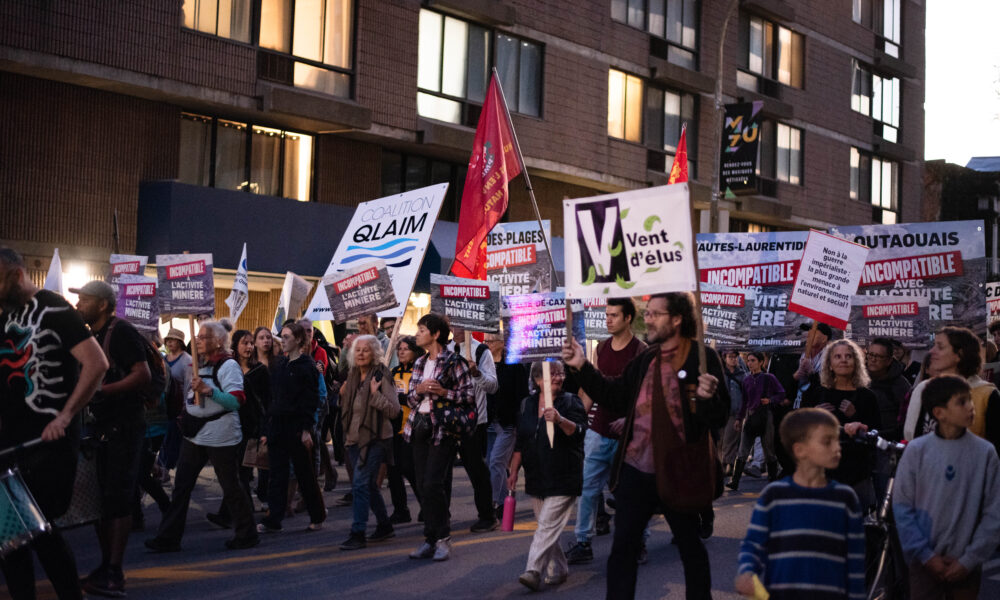
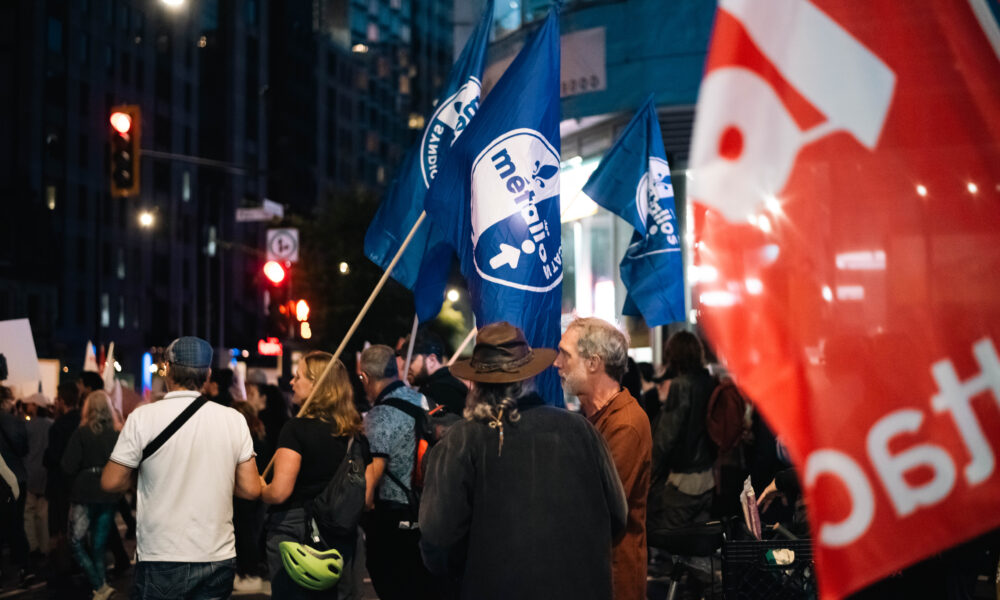
Over 400 people gathered at Monument à sir George-Étienne Cartier for Montreal’s annual climate march at 6:00 p.m. on Sept. 27. Ensemble pour la suite du monde—a collective of unions, activist organizations, and other groups—organized the march as part of a series of demonstrations happening across Quebec that day. 

As the sun set, protestors filled Avenue du Parc, carrying cardboard signs, bikes, and drums. The march took protestors down Rue Sherbrooke, past Roddick Gates, and ended in Dorchester Square at roughly 8:30 p.m., where several speakers took to a small stage to demand that the provincial government pursue democratically-governed action to mitigate climate change. 

A contingent of students from McGill also attended the march. Among them was Rebecca Hamilton, U2 Arts, who called for greater student involvement in climate justice activism at the university. Hamilton went on to stress the importance of community for collective action against climate change. 

“That’s what brought me out—the desire to be together with other people,” Hamilton said. “I feel excited about being at this broader action because it’s bringing together so many different sectors of Quebec civil society united by a shared vision for a democratic social-ecological transition.”

Hamilton urged the university to do its part to ensure a sustainable future through actions such as changing to renewable sources of heating, transforming its food systems, and subsidizing student passes to public transportation. 

Tamara Ghandour, U3 Science, who is involved in climate organizing at McGill, told The Tribune that they have been attending the march for the past several years. Ghandour explained that the climate march is an opportunity to rally students around the cause and to “set a precedent” for such mobilization at McGill. They noted that, although McGill committed to divesting from direct holdings in Carbon Underground 200 fossil fuel companies in December 2023, the university is still indirectly investing in companies contributing to climate injustice. 

“[McGill is] still investing in TD, which funded the Coastal GasLink project and a lot of pipeline projects on Indigenous territories in Canada,” Ghandour said. “Then also, obviously, McGill is investing in the genocide in Palestine, which is causing so much environmental damage. Carpet bombing releases a lot of carbon dioxide.”

In an email to The Tribune, the McGill Media Relations Office (MRO) explained that the university has taken several actions which “demonstrate the University’s environmental commitment.” These measures include McGill’s switch from natural-gas boilers to electric builders, which they estimate will reduce energy-related greenhouse gas emissions by 9000 tonnes CO2 equivalent per year. In addition, the MRO highlighted McGill’s support of sustainability initiatives on campus through the Sustainability Projects Fund, and their earning of a platinum sustainability rating under the Sustainability Tracking, Assessment, & Rating System in 2024. 

The MRO also wrote that McGill’s Board of Governors has mandated the Committee on Sustainability and Social Responsibility (CSSR) of the Board of Governors to explore divestment from companies that derive the majority of their revenue from the manufacture of weapons. Staff and students can share their opinions on this topic to the CSSR until Oct. 1 through a webform

When the march reached Dorchester Square, three speakers took turns addressing the crowd. President of the Fédération du personnel de soutien de l’enseignement supérieur within the Centrale des syndicats du Québec, Anne Dionne, spoke on behalf of the labour movement. Dionne demanded that the provincial government under François Legault listen to citizens and that decision-making surrounding climate justice be democratic. 

“As a society, we have a responsibility to protect our environment while guaranteeing decent living conditions for all,” Dionne said. “Workers’ rights advocates […] play a fundamental role. We have a duty to intervene to ensure that environmental policies are fair, inclusive, and respectful of all.”*

Marie Maltais—a Cegep student at Sainte-Foy in Quebec City—also took to the stage to represent the youth movement. Maltais argued that, although five years have passed since hundreds of thousands of protestors marched in 2019 to demand change, institutions—including the Quebec government—have yet to take action. Maltais also denounced collegiate institutions for failing to draw adequate attention to climate justice in many of their courses.

“Now is the time to stop encroaching on our time and that of the next generation,” Maltais said, “We are asking today that yesterday’s promises be kept, that is, to reduce greenhouse gas emissions, protect biodiversity, considerably reduce the production and accumulation of waste, and put in place a real energy transition plan for Quebec, in addition to starting a reform of education.”*

*This quote has been translated from French.

Campus Spotlight, Student Life

Beep! Beep! Why you should be using this bright yellow student service

Often, I recall the childhood excitement of the morning before a school field trip. I practically leapt from my bed, because the day was not like most. Quickly, I ran to the kitchen and packed my lunch for the journey ahead. One shoe, followed by the other; I moved through the front door. The morning dew was cold, the sun radiating onto the grass. I walked to the street corner and waited, the excitement making the minutes feel like hours. Suddenly, a large yellow vehicle came to whisk me away from my boring school life and into an adventure. As I embarked, I not only felt the start of a new day but the start of a new journey. I now reflect on that childhood whimsy and recognize how laborious being an adult truly is. Maybe the magic is gone; or maybe it’s just four wheels away.

Leaves changing, chapters turning, and midterms ever encroaching. While it is hard for students to think ahead to the upcoming reading week, here is a service to make transit during breaks easier. MustBus Co-Op is a Students’ Society of McGill University (SSMU)-funded student-run transit operation with the goal of making transportation affordable and efficient for McGill students.

If you are from Ottawa, Québec City, Toronto, Boston, or New York, MustBus is offering transportation to and from these cities during reading week. One advantage of taking a MustBus trip is that the service picks you up on Rue McTavish—conveniently close to the center of campus—as opposed to the Gare d’autocars on Rue Berri for Greyhound buses. As Drew Cassetty, U3 Arts, Co-President of MustBus says of his own experiences with Greyhound: “Vibes were just horrible.” The MustBus service also provides the same coach bus vehicle type as Greyhound at a fraction of the price. In addition to the considerable financial and time savings, there is a sense of comradery and safety traveling with a group of McGill students which also makes it a great opportunity to make new friends. 

A trip with Greyhound from Montréal to New York takes 15 hours and costs  around $230 CAD; whereas MustBus takes eight hours and costs $140 CAD. The savings are considerable and worth taking advantage of for students.

If you are not planning to travel for reading week, MustBus also provides Day Trip opportunities. In the past, the organization has gone to Mont-Tremblant, Niagara Falls, Tadoussac, and Sutton for various activities including hiking, apple picking and whale watching. These trips are a great opportunity for international and out-of-province students to explore the vast and beautiful landscapes of Canada. 

Looking to the future, in an interview with The Tribune, Cassetty and the other Co-President, Henry Shapiro, U4 Management, discussed an ambitious plan of action for the organization. The two talked of expanding the service to other universities in Montreal by starting a chapter with motivated groups of students at institutions like Concordia. 

MustBus allows students to travel in large groups, an incentive for students who wouldn’t otherwise be able to because of the cost. Additionally, the service opens up opportunities of travel for international students who aren’t able to rent a car. Shapiro additionally stated that they are trying to increase engagement amongst McGill’s international student population. 

 “[Generally speaking,] international students are more likely to travel solo,” Shapiro stated.

For Cassetty, one of the main purposes of MustBus is for students to form a strong bond around their common McGill identity, which provides a good opportunity for both international and local students to explore Quebec and access affordable transportation, all while meeting other McGillians. 

“Being a McGill student and going on this [MustBus day trip], you already have a base level of things in common,” he added.

Whether you want to explore “la belle province,” return home for school breaks, or just relive high school nostalgia, MustBus provides a service to fit those needs.

Lacrosse, Sports

Redbirds lacrosse plays third annual Legacy Game, reflect on Indigenous roots

Lacrosse is a sport rooted in Indigenous history and tradition, and it has maintained a significant place in Canada’s cultural tapestry since its inception. With its roots intertwined in Indigenous communities, lacrosse has long served as a unifying sport, fostering a sense of belonging and shared identity. At McGill, this spirit of unity is honoured through an annual Legacy Game played on the National Day for Truth and Reconciliation and hosted by the McGill Redbirds lacrosse team. 

The origins of lacrosse can be traced back thousands of years to Indigenous communities across North America; it was played first by the Haudenosaunee. Players participated in the game, often referred to as “The Creator’s Game” or “The Medicine Game,” for spiritual reasons beyond just the physical thrill of sport; they used it as a way to settle disputes and train warriors. The Haudenosaunee believed that the lacrosse stick, a symbol of the sport, had healing properties and used it in ceremonies and rituals.

In the 17th century, French settlers and missionaries witnessed the game and began playing it with modified rules. The 1994 National Sports of Canada Act established lacrosse as one of the county’s national games, along with ice hockey. The legacy and ongoing effects of colonialism—including residential schools and forced assimilation—has had a profound impact on Indigenous peoples and their relationship to their culture and traditions. Lacrosse, however, has emerged as a powerful tool for reconciliation and resistance

In the buildup to the third Legacy Game held at Percival Molson Memorial Stadium, Midfielder John Miraglia, U2 Arts, of the Redbirds lacrosse team sat down with The Tribune to discuss the depth of lacrosse as a cultural and spiritual sport and the importance of Truth and Reconciliation Day. 

“Celebrating Truth and Reconciliation Day is important to me because it reminds me how much bigger the game of lacrosse is than any individual player or team,” Miraglia said. “It’s part of a culture and helps us spark real conversations about Truth and Reconciliation.”  

Indigenous lacrosse players and teams have played a crucial role in raising awareness of issues impacting Indigenous communities and in promoting cultural pride. They have used the sport as a platform to share their stories, challenge stereotypes, and inspire younger generations. Non-Indigenous players must build these relationships by taking a more powerful role in raising awareness and promoting equity within the sport, on and off the field. 

Mirgalia spoke on the energy in the locker room leading up to this year’s match. 

“The Legacy Game first started in my first year at McGill, and every year there is an atmosphere around the game of importance, pride, and excitement,” he said. “We know the varsity lacrosse game is not the same as the traditional lacrosse game, but we hope to honour the sport by playing as a team and for the entire community surrounding the Legacy Game.”

Mirgalia underscored the initiative from Attacker Isaiah Cree in the establishment of the Legacy Games. 

“I would be remiss if I didn’t talk about Isaiah Cree when talking about this game,” he said. “He really took the initiative to get the game started back in 2022 and set an amazing example of educating our team and honouring the origins of our sport. He scored a hat trick in that first Legacy Game, and I will always remember that as a really special moment.”

Following Truth and Reconciliation Day, it is important to recognize the role that lacrosse has played in fostering reconciliation while also acknowledging the road ahead toward a truly inclusive and equitable society. With the role of lacrosse in developing a nation’s spirit, Canadians have a duty to uphold the integrity of Indigenous peoples, their sport, and their cultures beyond designated days of commemoration. By understanding the history and cultural significance of lacrosse, non-Indigenous Canadians can deepen their respect for Indigenous traditions and work towards a brighter future for all Canadians.

The Redbirds (7–0–0) won against the Carleton Ravens (3–4–0) on Sept. 30 in the Legacy Game with a score of (8-4).

Student Life

How to stay safe and minimize risk while protesting

Protesting plays a vital role in student life. Standing up for your rights, advocating for those of others, and raising awareness for causes that you hold dear are powerful ways to make your voice heard. Currently, we are witnessing one of the biggest waves of student activism since the Vietnam War. Recent movements on campus such as the Palestinian Solidarity Encampment from Apr. 27 to July 10, or the trans-rights protest march on Sept. 20, highlight the rise in student-led protests. Racialized people, queer and trans people, and other minority groups are particularly at risk, especially when it comes to injuries, violent interactions with police, and getting arrested. In response, The Tribune is committed to providing you with the best information and tools to minimize risk while protesting.

Wearing practical clothing 

Wearing comfortable shoes that you can walk and run with is a must. Protesting often requires standing and walking for long periods of time so it is best to be appropriately dressed for movement. Aim for simple and comfortable articles of clothing that covers skin as much as possible—this includes hoodies or long-sleeved shirts as well as pants rather than shorts. This comes in handy in case you fall or get hurt. Bringing extra clothes is important as well, so that you have something to change into if you are exposed to dangerous substances, or are splashed with a substance like paint or water. 

To avoid being recognized for privacy reasons, cover identifiable tattoos or visible marks. If you have dyed hair, you may want to conceal it, and if you have long hair, tying it up can prevent it from getting caught or causing unnecessary discomfort. Wearing facemasks, scarves, or bandanas to cover your face is the best way to protect your identity. 

What to bring to a protest

Always carry water as protesting outside, especially on a sunny day, can be dehydrating. Additionally, if you get hurt during a protest, applying water to your wound will help you avoid infections. Bringing a snack can also be a good idea to avoid fatigue. To carry those items, a backpack is often more convenient than an over-the-shoulder bag for comfort. It’s also a good idea to bring some cash, in case you unexpectedly need it for transportation. 

Make sure to protect your eyes for safety reasons with shatter-resistant eye protection like glasses—they can also help you protect your identity for safety. If possible, avoid wearing contact lenses and makeup, as those can trap irritating chemicals.

If you require any medication, such as an inhaler or EpiPen, make sure to carry it with you in case of an emergency or arrest. Also, you might want to wear a medical alert bracelet with information about any medical conditions or allergies you might have.

Know your rights and protest in group

Last but not least, when attending protests, it is important to always know your rights. The Canadian Charter of Rights and Freedoms grants you the right to participate in peaceful protests, protest on public streets, camp in public parks, and wear masks. However, your right to protest differs if you are on private property and does not protect riots or the right to blockade lawful activities. Knowing your rights under the law is crucial, especially if you wind up engaging with a police officer. 

The Tribune also recommends that you avoid protesting alone. Knowing other individuals at the protest is the best way to stay safe, ensuring you have support if any issues arise. It is also a good idea to have a pre-planned location to meet up with others in case anything happens, and to make sure your phone is charged for communication purposes. After the protest, debriefing with your group and talking about what you experienced can be a valuable way to process the event together.

Read the latest issue

Read the latest issue