Latest News

News

In pivotal week for South Sudan, experts discuss future

Matt Essert
Matt Essert

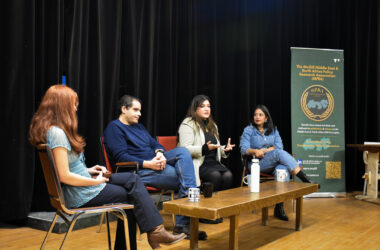
 On Thursday evening, a group of experts debated the possibility of an independent South Sudan on a panel discussion in the Lev Bukhman Room of the Shatner Building.

South Sudan, after six years of democratic self-governance, is seeking to gain its full independence from the rest of Sudan through a referendum held last week. However, the post-independence future for South Sudan remains enigmatic. Should the referendum pass, it’s unclear whether it would be a turning point for South Sudan, or simply an exacerbation of tensions with its neighbours like North Sudan.

At the discussion, the speakers seemed rather optimistic about South Sudan’s future. While fully recognizing the difficulties that lie ahead, they said that Sudan’s potential for progress and stability is significant.

In response to the title of the panel discussion, “An Independent Sudan in 2011,” Douglas Proudfoot, the director of Canada’s Sudan Task Force noted that “the title kind of misses the point … the real issue isn’t whether there is going to be an independent South Sudan or not. The real issue is how do we maintain peace and stability and an environment in which development can take place in Sudan in 2011 and the years that follow.”

Proudfoot later pointed out that Sudan currently has one of the worst Human Development Index scores and highest percentages of maternity deaths in the world. Moreover, Sudan seems to rely wholly on the United Nations and other non-governmental organizations for health care. According to Proudfoot, it’s an unsustainable strategy that needs to be dealt with through increased medical facility funding and more training for medical practitioners. Proudfoot claimed that, with ongoing corruption and political instability, though, the chances of the money being used for these purposes seem slim.

Kyle Matthews, the lead researcher at the Montreal Institute for Genocide Studies, pointed to the lack of adequate security and police forces in South Sudan. Matthews cited the town of Juba, where families have been repeatedly  raided, raped, and murdered. The hostage crisis in December is further evidence of Sudan’s instability. The speakers also invoked the possibility that Sudan could relapse into civil war, which would have global consequences.

Despite these problems, though, Proudfoot remained optimistic. He emphasized that South Sudan’s goals don’t implement policies carefully. If there is little resistance to South Sudan’s policies, progress will eventually be made when South Sudan’s government become more mature and stabilized. During this referendum, there has been a considerably lower level of violence than there was during the 2010 election.

While there have been many concerns about oil revenue sharing with North Sudan, Proudfoot said that these challenges could actually force the two regions to work together.

Marie-Joelle Zahar, associate professor of political science and research director for the Francophone Research Network on Peace Operations at the University of Montreal, agreed, saying that despite the country’s past, Sudan can still make substantial progress by learning from  previous mistakes and dedicating more effort to the improvement of civilian education and social institutions.

When asked whether the country will be recognized internationally, Proudfoot did not hesitate to answer “yes”, pointing to the legitimate processes—a comprehensive peace agreement, U.N. approval, and an official referendum—which South Sudan is undergoing to become a country.

McGill, News

New conservative student news source launched Monday

The year in campus media took perhaps its most interesting turn last Monday with the launch of the Prince Arthur Herald, a new online conservative student newspaper based at McGill.

The website’s political positions, which tend to be libertarian, are articulated in a 25-point Statement of Principles.

 “Our paper supports freedom of the individual, individual choice, and the free market as the most efficient [economic system] and the [one] that respects human dignity the highest [for] the organization of society,” said Editor-in-Chief Brendan Steven, U1 history.

Steven added, however, that the website, which so far has published exclusively opinion pieces, will encourage dialogue, both between different types of conservatives and  more generally between conservatives and liberals. Though most of its 17 columnists have backgrounds in international and domestic politics, there will also be columns on sports, culture, and the pro-life movement.  While many  columnists will have typical conservative leanings of one sort or another, among them are Zach Paikin, who is a former president of the Young Liberals of Canada, and Grace Khare, a board member of Queer McGill.

“Our hope is to engender voices that previously didn’t have a place in campus debate,” Steven said.

The Herald is undeniably a response to the McGill Daily, most explicitly with its formulation of a Statement of Principles, which is one of the Daily’s hallmarks.  Both Daily Coordinating Editor Emilio Comay del Junco and Steven acknowledged the two sources’ opposition.

“Obviously, we do take political positions that [the Herald] disagrees with, and they think there is a general conception that it is a response to the Daily,” del Junco said.

Though del Junco acknowledged a difference of opinion, he indicated that it was important to have a plurality of voices in campus media.

“In some ways it’s kind of unfortunate that it comes out as an opposition because I think there is a lot of space … for that kind of expression to happen,” he said.

The idea for the newspaper was born last semester, and Herald President Kevin Pidgeon, U2 history, began to build the site in December.

Their costs, so far, have been negligible. One of the advantages of the online-only format, they said, was that the students involved could easily foot the bill. For now, the editors and columnists are willing to work without payment. Though they plan to expand their operation in the future, the website will operate on low costs, so it will not have to run advertisements. Pidgeon explained that this was a way to establish an independent image for the Herald.

“One of the absolute classic condemnations of the right is, ‘You’re a mouthpiece for big business,’ and in some cases it’s absolutely true. But our aim is to do absolutely nothing of that sort,” Pidgeon said.

Though the Herald is based at McGill and is primarily staffed by McGill students, the newspaper wants to be read and written by students across Canada.

“Canada, at the end of the day, has elected a Conservative government; a lot of voters vote on conservative political principles,” Steven said. “Clearly in the broader political community there is a place for conservative values, so why not at university?”  

Pidgeon and Steven said that they planned to offer “24/7” coverage, a feature which they claimed distinguishes them from other campus media outlets.  The team of columnists and editors aim to put out between five and six articles a day.   

They have no plans to move to other media yet, but they have considered moving to print in the distant future.

Steven was not shy about his ambitions.

“We want to be Canada’s and McGill’s premier student news source,” he said.

McGill, News

City councillor donates own body

Former City Councillor Michael Fainstat donated his body to McGill’s Faculty of Medicine and Dentistry in a program that gives students hands-on experience with real bodies. Fainstat, who died at 87 on December 29, was known for his many contributions to the community and decided to make his body the last one.

The Faculty of Medicine and Faculty of Dentistry have a cadaver-donation program, where over 50 dead bodies are collected each year for purposes of study. A memorial is held every year to give thanks to the family members and friends of those who have donated their bodies.

“It’s a hands-on adventure for [students] for sure. They know what a body looks like in three dimensions, [and] computerized anatomy programs are great, but they’re still not  hands-on,” said Professor Sandra Miller, chair of the anatomy department. “When a human needs surgery you cannot look at it at a distance in a screen, you’ve got to have your hands in [it]. That’s what surgery is.”

When a body is received, it’s properly treated and stored at McGill’s morgue for at least six months until students use it in next fall’s classes.

“Each group of students gets their brand new group of individuals who have died the previous year,” Miller said. “And all over the world where our students go, because of our hands-on experience, they go into the operating room with great confidence.”

The program coordinators reach out to donors by simple word of mouth. Interested individuals complete the required paperwork and carry a card in their wallets stating their interest in donating their body to McGill.

“We need the whole body and the ones that we receive are generally elderly,” said Miller, who explained that most cadavers received die of old age or certain pathologies like Parkinson or cancer, which are acceptable for the program.

“These conditions are not a problem at all,” she said. “In fact, they are quite handy because students see pathologies or pacemakers in these organs and different repair mechanisms in the body. These are learning tools.”

At the end of each academic year, the majority of the bodies are cremated and deposited on a special site at the Mount-Royal Cemetery, where the university has a plaque designated for the program.

“If they are really good, we keep those for exam purposes, and they can last anywhere from five to 10 years, but normally the vast majority are cremated,” said Miller.

On January 9, a commemorative ceremony was held for Fainstat despite the absence of a body. A spokesperson of the Blythe Bernier Funeral House explained that Fainstat’s friends and family members were pleased with the event.

“It is not a happy moment but the ceremony ran smoothly,” said a spokesperson.

Other well-known Montreal figures have participated in the cadaver-donor program in the past, among them a former director of the Montreal Neurological Institute.

“It’s great that he’s done that, but he’s not the only celebrity to have donated his body. There have been a few over the years,” Miller said. “Every single donor is appreciated. Every body is highly valued.”

Science & Technology

Evidence of climate change washing up on Arctic shores

wallpaperbase.com

Science Outreach’s Cutting Edge Lectures welcomed the University of Alberta’s Professor Marianne Douglas to McGill’s Redpath Museum last Thursday to present her research on climatic warming in the Canadian High Arctic. Her recent research suggests that environmental warming is occurring at an alarming rate in certain arctic regions.  

“I think many people are aware that High  Arctic regions are changing, and they are changing very quickly,” Douglas said as she went on to identify evidence of the various environmental effects of warming Arctic temperatures, which include: coastal erosion, shrinking of ice over, earlier onset of spring conditions, increased plant productivity, new animal distributions, and net evaporation of shallow bodies of water.

“Understanding these changes provides insight into what future arctic conditions may prevail,” Douglas said. She outlined the many consequences of a warming Arctic for infrastructure (pipelines), vegetation, and animal distributions.  

Douglas specializes in paleolimnology, a method of research which examines lake sediments as a way of comparing past Arctic environmental conditions to the present. For scientists like Douglas, reading the data stored in these sediments is like reading a storybook that tells how a particular region has changed through the decades.  

“It’s like going back through time,” she said.

According to Douglas’s findings, temperatures show greatest warming at high latitudes like the Canadian Arctic because as sea ice melts, the region absorbs more summer heat. Lake sediments on Ellesmere Island in northern Nunavut indicate that several thousand years of cold environmental conditions radically changed in the 1990s to conditions typical of a warmer environment.  

Douglas projected that warming at the end of the century will add roughly 30 days of growing season in places like Ellesmere Island.     “But, I think we are already there,” she contends.  

Third-year McGill political science student Caitlin MacDonald was surprised by the drastic environmental changes Douglas described in her lecture.  

“We always hear about the seriousness of climate change, but are rarely presented with these kinds of eye-opening statistics,” MacDonald said.  

MacDonald said it’s important to increase awareness of these issues among students, adding that “it is our generation that will be most affected by Arctic warming and other environmental changes.”

Science Outreach Coordinator Ingrid Birker viewed Douglas’ slecture as a chance for McGill students to learn about cutting edge research on important scientific breakthroughs on climate change. She hopes the lecture will increase awareness, and put into perspective the significance of past and present research in the field.

 “I hope students can take away greater understanding and appreciation on the complexity of work like Dr. Douglas’s in investigating climate issues,” Birker said.

Student Life

Saucy explosion

I’d like to think that most criminals get their due. A horrible mishap that I had at my summer job this summer, though, has changed my mind. Now, I’m more inclined to think that for every criminal that gets punished, there must be 10 that fly under the radar.  

The scene:  my summer job  at a restaurant which will remain nameless. The players: me, a group of middle-schoolers, and a industrial sized jar of barbecue sauce. Every night at six, we served dinner to the whole group.  On this particular evening, we had a group of 85 sixth graders coming in for a chicken nugget supper. About 15 minutes before dinner time, my boss sent me downstairs to get a jar of barbecue sauce. I was about five hours into a long shift and feeling silly. Not violent, destructive, or drunk—just chastely, innocently silly.  I went down to the storeroom, picked up the jar of barbecue sauce, and put it on my head, like a Jamaican banana saleswoman. It seemed like a good idea. As I headed toward the stairs, I shook my hips left and right, imagining a crowd of admirers (let’s be honest, female admirers) oohhing and ahhing at how funny I was. I climbed the first two stairs before remembering too late that the ceiling was very low above the third.  

I missed the clearance. The barbecue sauce flew backwards and exploded. Many people exaggerate with the word “exploded,” but I don’t. There was barbecue sauce seven feet up on the walls. It had gathered in pools on the stairs. It looked like I had brutally and messily murdered a giant cockroach.  

After a few seconds of numbness, I started to panic. If anyone saw this, I would be fired. Not because it was necessarily such a big deal, but because it looked so bad.  

I came back upstairs, trying to be cool. We were only 15 minutes until dinner, so there was a lot to do. Upstairs, I would act as though nothing was wrong, and then go downstairs to scrape barbecue sauce into a bucket with a dough scraper. Bring the boss an onion, then go leap up and down with a bleached cloth to reach the highest signs of the explosion.  

Miraculously, the end was eventually into sight. I had soaked five rags completely through with sauce, but it started to look better. After about 30 minutes of on-and-off-again cleaning, the job was done.  

I am still waiting for the arm of justice to come down on me. Until it does though, the only traces of my crime are a slight discoloration in the wall around the third stair and a faint hickory smell.

Recipes, Student Life

Baked brie

blogspot.com

Having holiday bread and cheese withdrawal? Fear not. This baked brie is easy, oh-so-delicious, and guaranteed to disappear in 10 minutes or less. It’s served with caramelized onions and wrapped in puff pastry. If you don’t like onions, you can use cranberry relish and almonds, or even raspberries tossed in a little flour and sugar. Get some friends together, grab a bottle of wine (or several) and a couple baguettes, and relive the food comas of winter break.


Ingredients

One 8″ wheel of brie

One package puff pastry, thawed

3 large onions, julienned

3 cloves garlic, minced.

1/2 cup dry white wine

1 tsp brown sugar

1 egg yolk

Fresh thyme, minced

Flour for rolling out pastry

1 sliced baguette

A note on cooking wine: If you wouldn’t drink it, don’t put it in your food. A couple of good cooking wines are La Chamiza Chardonnay ($8.65 at SAQ) and Caliterra Reserva Sauvignon Blanc ($12 at SAQ).

Directions

1. Pre-heat the oven to 350 degrees Fahrenheit.

2. Grease a 9″ pie dish. Roll out each square of puff pastry. Cut one into a disc the same size as the brie. Roll the other out thinly enough that you can fold it around the sides of the wheel of brie.

3. Melt some butter in a large skillet over medium-high heat. Sauté onions until translucent and add the thyme. Reduce heat to medium and cook until onions are golden, stirring often, about (25 minutes).

4. Add the minced garlic and cook for a couple minutes. Add the first 1/4 cup of wine. Stir until liquid evaporates.

5. Sprinkle in the sugar and cook the onions until they are soft and brown (about 10 minutes).

6. Add the remaining 1/4 cup wine and stir until the liquid evaporates. Season to taste with salt and pepper.

7. Place the wheel of brie on the larger of the two pieces of pastry. Top with caramelized onions. Place the 8″ disc of pastry on top of the wheel and fold the larger pastry around the cheese so that you have covered the whole wheel without holes.

8. Place in a pie dish. Whisk the egg yolk with a little water and brush it over the top of the pastry.

9. Poke a few holes in the top of the pastry to let the steam out.

10. Bake in the oven for 25-35 minutes or until the puff pastry is nice and golden. Let it sit for at least 15 minutes before serving with  sliced baguette.

Student Life

Showering like a pro

There are only a few reasons to take a shower. One possible reason is that you are so smelly that strangers tell you as much. If a stranger complains that you are smelly, it means that you are so smelly that the stranger felt the need to tell you about it, an uncomfortable act for anyone. If a friend or family member tells you that you are smelly, you can probably just ignore it and write it off as playful teasing. But if you are so dirty that you raise dust clouds as you walk around sterilized areas, you may want to consider showering. It is important that you diagnose your level of dirtiness in sterilized areas since unsterilized areas comes with their own dirt and grime, which could easily mix with your dirt and grime and give you an inaccurate measurement of your filthiness.

If, alternatively, you are not smelly or dirty enough to meet these requirements but still want to take a shower, you should probably do something to get dirty or smelly enough to warrant the use of enough water to hydrate a mid-sized village in Siberia. Maybe you should join an intramural team, like volleyball or ball hockey. Ultimate Frisbee is also very popular in warmer months. Intramural sports are great for this because even though you aren’t good enough to play the sport at a competitive level, you still really like the sport and will probably get really into the game and work up a sweat. You could also just run in place for a few hours until you get sweaty enough to take a shower. This would be an especially good option if you don’t like spending time with other people, but do like showering.

If you have, probably begrudgingly, decided you need to take a shower, the first step in the process is to find a shower. Most showers are located in bathrooms or bathroom showroom stores. Some showers in bathroom showroom stores are not fully functional, so they will not be very useful for this instructional guide. At this point, you need to find a bathroom. Many bathrooms can be found in public places—these are called “public bathrooms.” Although these can be very useful in tight situations, they are often gross and sometimes do not have showers. Remember, locating a shower is a key part of this process, so don’t give up! Try looking in your own bathroom at home; you may be surprised to find exactly what you are looking for there.

Upon finding a shower, you should now attempt to bathe yourself. Most doctors agree that you should be naked when taking a shower, but some are just not comfortable with this. Don’t be embarrassed to wear your swim trunks in the shower the first few hundred times you attempt this tricky operation.

The next step is to turn on the water. This is probably one of the most difficult parts of the process. Although most showers differ in their setting for adjusting the water temperature, most shower knobs share one characteristic: every setting except one is excruciatingly hot or terrifyingly cold, and adjusting the knob or knobs by more than 1/16 of an inch will make the water temperature unbearable. You’ll probably need to spend a good 15 to 20 minutes determining a good temperature for your upcoming shower. Trial and error is a good method, although some showerers will collect samples of water in containers and measure them with an instant read thermometer, but this is best left to the pros.

At this point, you may have spent up to 20 minutes standing naked (or in swim trunks) in your bathroom testing the water temperature. After 20 minutes in the bathroom with the shower running, your roommates probably think you are just playing with yourself in the shower, which is totally not cool, so you should probably turn off the shower and pretend to dry off.

You may be upset that you didn’t actually bathe yourself, but hopefully you are honing in on the perfect setting for the water temperature. You probably weren’t even smelly or dirty enough to need a shower anyway, so don’t worry about it. Just put some gel in your hair, rub your face with olive oil, and you’ll be fine.

Sports

Redmen rally riles up rambunctious Carnival crowd

Holly Stewart

In front of the largest home crowd of the year, tied 2-2 in the third period, and killing off a five-on-three penalty, goaltender Hubert Morin and the McGill Redmen kept their composure and held off one more Carleton offensive onslaught. Following the successful penalty kill the Redmen were able to rally with three goals in the final period to defeat the Carleton Ravens 5-4 on Friday night and give the Management Carnival crowd of 1,355 something to celebrate.

“We stayed composed, and that was one of our keys tonight before the game,” said McGill Head Coach Kelly Nobes. “To keep our emotional composure, knowing we were going to have a big energetic crowd. And knowing that Carleton was going to come out hard—they’re a physical team and a high energy team so we were going to need to stay composed.”

“That’s our team—we never give up,” echoed Morin. “We have to work harder and stay focused all the time and even if they score a couple goals, we [have to] work through it and give our best and that’s how we came back.”

The third ranked Redmen (19-0-2) trailed 2-1 after the first period, and Carleton (11-6-2) continued to outplay the Redmen in the second. The Ravens created many scoring chances in the slot but Morin answered every time with clutch saves in traffic.

It wasn’t until captain Evan Vossen rocketed a slapshot into the top right corner of the net with six minutes left in the second that McGill was able tie the game at 2-2.  However, the Redmen got into penalty trouble to begin the third period after Vossen was sent to the box for roughing to end the second and Morin was given a delay of game penalty a minute into the third. Despite being two men down, Morin and the McGill penalty killers neutralized the Raven attack without conceding a goal.

Nobes credited Morin with keeping the Redmen in the game and until the offence were able to orchestrate the comeback.

“Hubert made saves at the right time tonight so that the momentum didn’t swing in the wrong direction,” Nobes said. “And that’s the sign of an experienced goalie and that’s oftentimes the difference in hockey games.”

Morin credited the massive crowd with helping energize him in the game’s tense moments.

“The crowd was pretty loud with all the energy and emotion—you’re so into it—you’re so focused and [that’s] how I made the key saves,” Morin said. “You’re on your toes the whole time and you just try something, and sometimes it works. It worked fine tonight.”

Leading the Redmen attack was playmaker Alex Picard-Hooper, who scored the first goal of the third period to give McGill their first lead of the game. He also set up the other two Redmen goals in the period. On the Redmen’s fourth goal, he made an incredible pass into the slot on the powerplay that defenceman Hubert Genest buried, and also assisted Vossen’s empty net goal. The three-point night extends Picard-Hooper’s CIS leading point total to a 47 points in 21 games.

“[Picard-Hooper’s] been pretty consistent for us,” said Nobes. “He’s a smart player and the puck sticks to his stick. He makes great passes and his head [is] always up.”

The hockey game was part of the Management Carnival schedule, which resulted in 1,355 fans showing up. The McGill crowd was extremely loud throughout the game celebrating the Redmen goals and taunting the Carleton players, namely their goalie Matthew Dopud, and defenceman Brad Albert.

“That was unreal,” said Morin. “It was our biggest crowd of the year and people were so loud and it brought us a lot of energy, it was good for us.”

Nobes agreed that the crowd energized the Redmen and created an amazing atmosphere to play in.

“It was great. It was awesome. It was outstanding,” he said. “It’s unfortunate it isn’t like that every night but [it’s] great to see all the McGill fans [come out to the game]—it made for a lot of fun.”

McGill’s next home game is on Wednesday, January 19 in a rematch against Carleton. While the crowd will not be nearly as big or energetic, the Redmen will hope to duplicate Friday’s result.

Behind the Bench, Sports

Steroids clouding MLB’s Hall of Fame judgements

Let’s start with the truth about Major League Baseball: 1) We’re still in the “Steroid Era.” 2) We’ve always been in the Steroid Era. This week’s example: a player under suspicion of juicing has been retroactively accused and it may jeopardize his Hall of Fame chances. Stop me if you’ve heard this one before.

In the wake of last week’s Hall of Fame induction vote, a donnybrook erupted amongst baseball writers and fans. Jeff Bagwell, the legendary first baseman with the funny batting stance and tremendous power, received a shockingly low number of votes in what has been widely accepted as an accusation of past steroid use. Until now, Bagwell’s name hadn’t appeared on the juicing marquee alongside Barry Bonds, Roger Clemens, and Mark McGwire.

Like Bonds and Clemens, Bagwell never failed a steroid test, and put up his best numbers before rules or a testing system were in place. By the time he entered the twilight of his career in 2001, he was already considered to be the fourth greatest first baseman of all time by stats analysis guru Bill James. Admittedly, this was BAP (Before Albert Pujols), but his numbers are fantastic. He was a pillar of his team and his community, and spent his entire career with a single team—the Houston Astros. In any other era, his Hall of Fame candidacy would be unquestioned. Unfortunately, Bagwell played amongst the juicers on the field and the jesters in the press who are all too happy to keep the steroid story mill churning. Unlike Bonds and Clemens, Bagwell wasn’t under suspicion during his career—he seems to be a victim of circumstance. Unlike many other baseball fans, I believe that juicers like Bonds and Clemens belong in the Hall. Put them in the “steroid wing,” or with some stupid asterisk, but get them in there, and fast. Hank Aaron and Mike Schmidt were admitted amphetamine users. Even the great Mickey Mantle used a primitive form of steroids late in his career.

Another legend on this year’s ballot, Rafael Palmeiro, has the on-field numbers to expect a first-ballot induction but barely got enough votes to stay on the ballot for next year. He lied about his steroid use before failing a test, and now he may never get in. The Hall of Fame is clearly romanticizing the past, and is caught up in a witchhunt zeitgeist.

Bonds and Clemens should be in the hall eventually, and they probably will. It would be tough to keep Barry Bonds out, and in retrospect we can say that the way he was railroaded into villainy by both the game and the media was both unprecedented and unparalleled. His demonization speaks to the mostly arbitrary nature of whom we as fans decide to like. There’s very little doubt that Barry Bonds is a total prick on and off the field. There’s also no question that he is one of the best left-handed hitters of all time.

Compare him to Roberto Alomar, one of this year’s inductees. In addition to a famous incident in which he spat in an umpire’s face, Alomar is also under suspicion of having had unprotected sex with an ex-girlfriend while suffering from AIDS.

Cheating in a game, which everybody else is doing anyway, is judged more harshly than lying to somebody about not having AIDS before having unprotected sex.

Did Jeff Bagwell cheat at baseball? Maybe, but that’s not the point this year. I’m not saying that the Steroid Era should be forgotten, but we already have our villains, our heroes, and our admitted juicers that people have forgiven and forgotten about, like Andy Pettite. There’s no need to look for more people to point the finger at.

Sports

Tennis Preview: Australian Open

The first Grand Slam event of 2011 began Sunday evening on the hard courts of Melbourne Park, Australia. While you’re shivering in front of your TV and watching the temperatures at centre court rise as the mercury in your apartment plummets, check out some of our picks for the men’s and women’s brackets.

Without question, the biggest story of the tournament is Rafael Nadal’s bid for a fourth straight Grand Slam win. Nadal, who won the Australian Open in 2009, was forced to retire last year in his quarterfinal match against Andy Murray because of tendinitis in his knee. Twenty-four-year-old Nadal, who has nine Grand Slam trophies to his name, made an incredible comeback in 2010, winning the French Open, Wimbledon, and the U.S. Open. He will now try to become the first man since Rod Laver in 1969 to win four majors in a row.

Roger Federer, regarded by many as the favourite, will try to stop the Spaniard. He proved that he’s capable by defeating Rafa at the Barclays ATP World Tour Final on November 28; he also won three majors in a row in 2006 and 2007 but was thwarted in his attempt for a fourth on both occasions by Nadal at the French Open. Can Roger repay the favour in Melbourne?

Finally, don’t forget about veteran Andy Roddick. Still possessing one of the most powerful serves in the game, the former world number one is now 28 years old and knows he doesn’t have much time left to capture a second Grand Slam title.

Prediction: Nadal over Federer in the final

Sleeper: Andy Roddick

On the women’s side, defending champion Serena Williams is sidelined with a foot injury and won’t be able to defend her title. In Serena’s absence, Kim Clijsters is the favourite to capture her first Australian Open.

Two other players to watch are Francesca Schiavone, who won her first Grand Slam at Roland Garros in 2010 at the age of 27, and the woman that Schiavone beat in Paris, homegrown talent Samantha Stosur. Stosur is the best hope for Australia on the men’s or women’s side. She broke the top five in the WTA rankings July and is sure to get raucous support at Melbourne Park.

Caroline Wozniacki, who finished 2010 as world number one, has never won a Grand Slam tournament but has been excellent on the WTA tour. Wozniacki has never beaten Clijsters, Henin, or either of the Williams sisters. She was runner-up at the 2009 U.S. Open and reached the 2010 year-end WTA Tour Championships where she lost to Clijsters in a compelling final. She may yet get another crack at Clijsters in Melbourne to prove her number one ranking is merited.

Maria Sharapova has an outside shot to return to her former winning ways. She missed significant action due to injury in late 2008 and early 2009, and hasn’t been the same since. If Sharapova is to get through her bracket she will need to get through 31-year-old Venus Williams and 21-year-old talent Viktoria Azarenka.

Azarenka has never made it past the quarterfinals of any Grand Slam event, but may benefit from a relatively weak bracket to go on and challenge Wozniacki in the semi-finals.

Prediction: Wozniacki over Clijsters in the final

Sleeper: Viktoria Azarenka

Read the latest issue

Read the latest issue