







Published by the SPT, a student society of McGill University
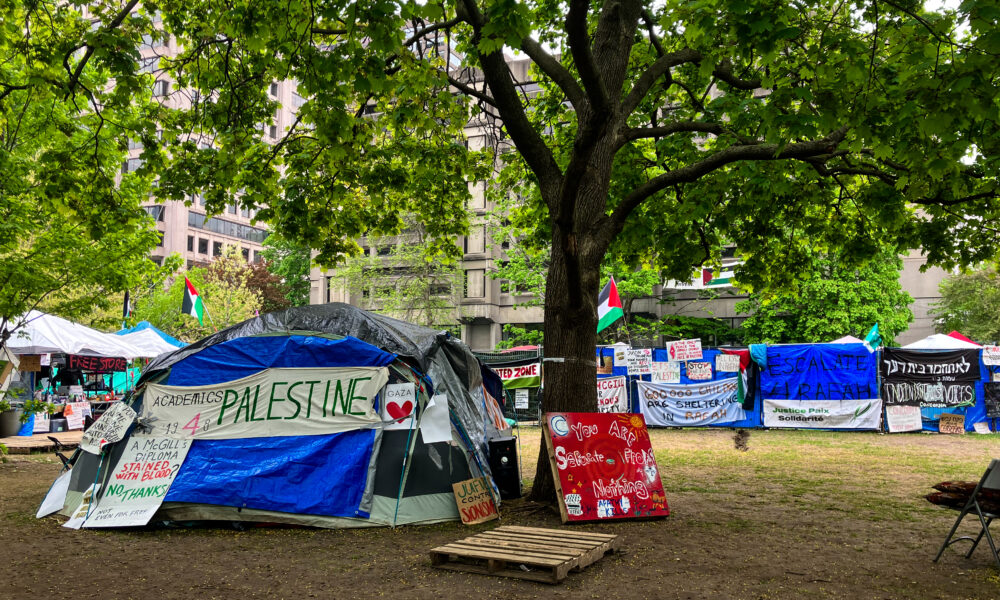
On May 15, the Superior Court of Québec rejected an injunction request put forth by McGill University to dismantle the encampment on the lower field of campus. The encampment—which has been in place since April 27—was established by students from McGill, Concordia University, and Université du Québec à Montréal (UQÀM) to pressure their respective universities to disclose and divest from financial ties to companies complicit in the Israeli genocide of Palestinians. They also demand that the universities condemn the siege on Gaza, compel the Canadian state to cease military contracts with Israel, and protect students from disciplinary action related to protesting.
Solidarity for Palestinian Human Rights (SPHR) at McGill is one of the student groups involved in organizing the encampment. A representative from SPHR, who wished to be unnamed, told The Tribune that the court’s decision is a “huge victory” for the movement.
“The injunction was rejected by the court for, you know, a different amount of reasons,” they said in an interview on May 15. “One of the outlined considerations was that this is part of a broader student movement in North America that is protesting the ongoing genocide. So this is a huge victory as a legal precedent, and for the student movement, of course, but this is also the second injunction that is rejected.”
The May 15 decision comes fourteen days after Justice Chantal Masse rejected a separate injunction request submitted by two McGill students, which had also asked for the encampment to be removed.
In a statement released on May 10, McGill President Deep Saini outlined McGill’s main reasons for submitting the injunction request. He stressed the alleged health and safety risks associated with encampment, claiming that the encampment appears to lack fire escape routes and blocks an emergency exit from McLennan-Redpath Library Building. He went on to state that “[t]he encampment has the potential to create unsafe situations unpredictably” by bringing counter-protesters to campus, citing May 2 counter-protests which resulted in the temporary closure of Roddick Gates and police presence on campus.
Saini also expressed that the encampment will likely force McGill to move convocation to a new venue, rather than take place on lower field. The move will cost an additional $700,000, according to McGill’s injunction request. In his decision, Justice Marc St-Pierre stated that McGill had already selected another location for convocation.
A representative from SPHR at McGill denied that the encampment was unsafe in a May 15 press conference, explaining that there are professionals in the encampment who are ensuring the health and safety of students. The representative did not further elaborate on this matter.
The representative also repeated their commitment to staying at the encampment until their demands are met.
“Our administration has not come back with any concrete proposal that meets our demands in a material way,” they said. “Instead, they decided to spend hundreds of thousands of dollars pursuing their students in a legal case that has failed.”
The McGill Media Relations Office reiterated in a statement on May 17 that the university respects students’ rights to protest as long as they do not violate McGill policies and the law. The Office also stressed its commitment to negotiate fairly with student protesters.
“Throughout this process, we have remained open to dialogue, having met six times with representatives of the McGill community involved in the encampment between May 3 and 10,” the Office wrote. “We are committed to continuing these discussions in good faith, in hopes that this engagement may lead to a solution.”
McGill will also be seeking an interlocutory injunction to end the “indefinite encampment on its property.” The McGill Media Relations Office stressed in a May 22 email to The Tribune that this request does not seek to ban protests on campus, but to remove the encampment.
On May 12, UQÀM students created an encampment on their campus, demanding that their university and all universities in Quebec adopt a policy of academic boycott against Israeli institutions complicit in the colonization of Palestine. A representative from Solidarité Palestine (SDHPP) à UQÀM, who wished to remain unnamed, explained that the UQÀM encampment was established both to pursue their demands of their university, and in response to the risk of removal that the McGill’s injunction request placed on the encampment there.
The representative also spoke to the knowledge they gained from the way that organizers of the encampment at McGill had approached cultivating relationships with internal members, the wider Montreal community, and the university administration. They noted that negotiating with the university, handling communications, and taking care of community members were among the responsibilities they had to learn how to facilitate as organizers of the encampment.
A representative from SPHR at McGill echoed the importance of community engagement at the encampment. They went on to attest to the way the encampment acts as a site of community-building for people across ages and backgrounds, detailing a new library and free store for members to use.
“We have essentially turned our university campus into a place of resistance, of collective knowledge,” the representative said. “This is what the library and all of these different infrastructures symbolize, it’s us reclaiming [the space] and making it a place for the community, in the absence of a space where you can speak about Palestine, and where you can mourn and grieve, but also fight for liberation.”
A graduate student at McGill, who wished to be unnamed, was among the supporters present near the encampment on the afternoon of May 15. In an interview with The Tribune, they criticized McGill for its failure to negotiate fairly with students and urged the university to listen to protesters.
“The students are clear, the demands are clear, and it’s very concise, and to the point, they just want McGill to divest,” they said, “After the [injunction was rejected in court,] it’s all about McGill now listening to the students and negotiating in good faith.”
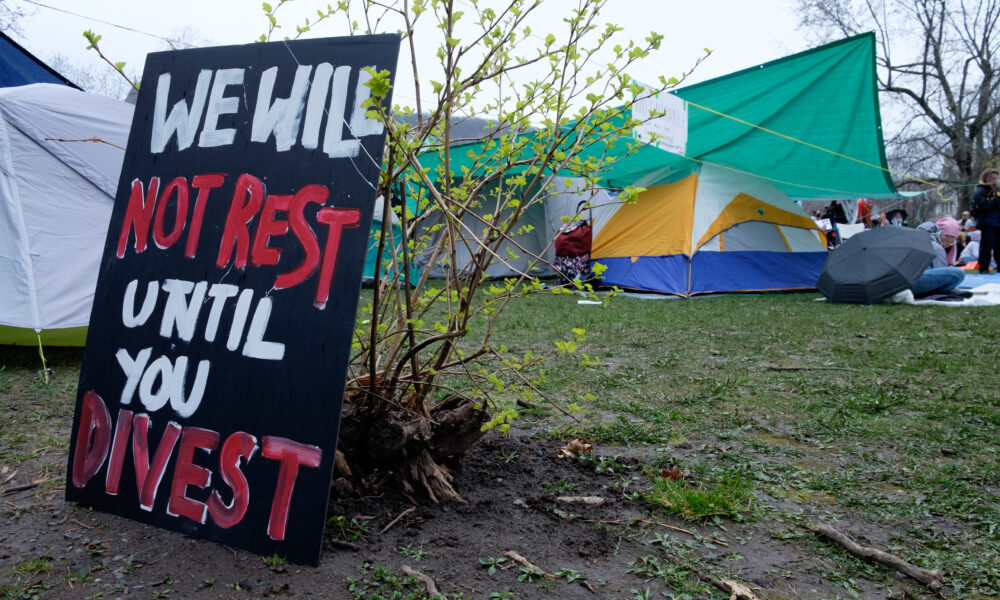
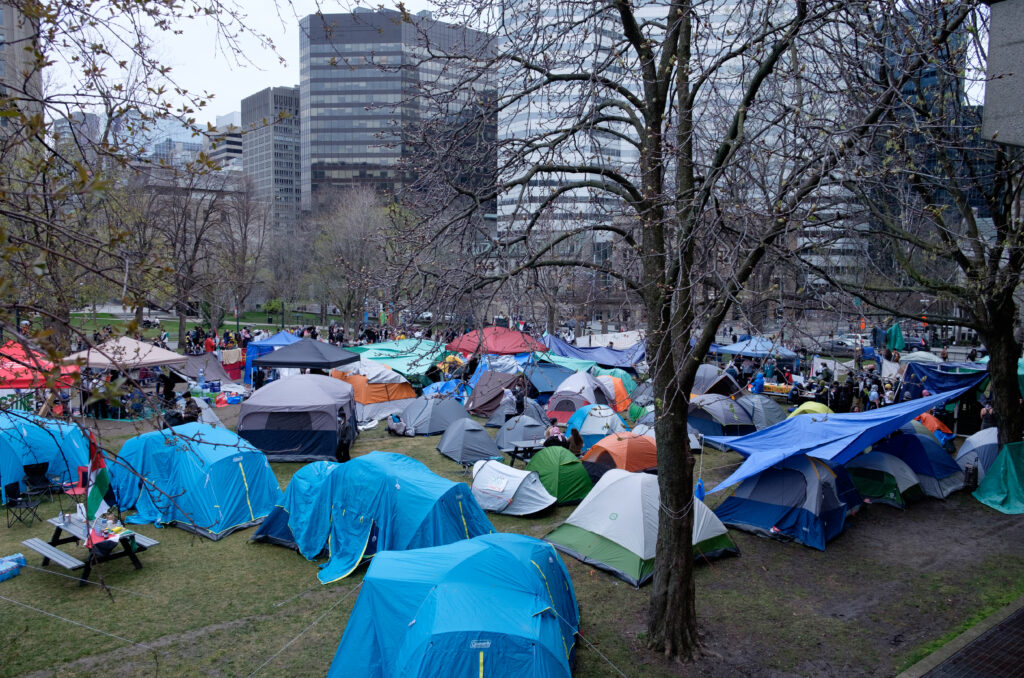
In the late afternoon of April 27, protesters led by students from McGill, Concordia University, and Université du Québec à Montréal (UQÀM) set up an encampment of around 20 tents on the lower field of McGill’s downtown campus to protest the universities’ complicity in the Israeli state’s genocide of Palestinians. Protestors demand that these universities disclose and divest from all financial ties to companies complicit in the genocide of Palestinians, condemn the siege on Gaza, and urge the Canadian government to end military contracts with Israel. Protestors also call for universities to protect students from any repercussions for protesting.
Solidarity for Palestinian Human Rights (SPHR) at McGill is among the student groups that organized the encampment. In an interview on April 29, a representative from SPHR at McGill who wished to be unnamed explained that the decision to begin the encampment came after the McGill administration refused to meet Palestinian solidarity groups’ demands throughout months of mobilization on campus.
“We’ve tried in so many ways to get McGill admin to listen to us, and they’re just not. Even now we’re presenting our demands and they’re not willing to negotiate according to the demands,” the representative told The Tribune.
The representative also explained that student groups from various Montreal universities chose McGill’s campus as the site of the encampment because of McGill’s renowned national reputation. The “ideal” location of the lower field was another important benefit of establishing the encampment at McGill as it is sheltered from cars and busy streets.
“McGill is one of the biggest schools [in] Montreal. It’s also got a really big reputation all over Canada, [and] it’s unprecedented that any encampment would happen at McGill,” they said.
The SPHR representative also stated that morale within the encampment was high, and noted that the encampment was continuing to grow in size. As of April 29, there were roughly 40 tents, with protesters including both students and professors.
Since April 27, McGill has sent multiple emails to staff and students providing updates on the university’s response to the encampment. In an email to the McGill community on April 27, Deputy Provost (Student Life and Learning) Fabrice Labeau stated that while the university “support[s] the rights of our campus community to freedom of expression and freedom of assembly within the bounds of McGill’s policies and the law,” the encampment violates these measures by occupying university property without approval.
On April 29, McGill President Deep Saini claimed that protestors at the encampment had used “hateful rhetoric” and expressed that he was upset “to see individuals occupying our campus to use it as a platform for obvious antisemitism.” Saini also denounced the encampment as a violation of McGill’s policies and the law, as well as a security risk.
In an interview with The Tribune on May 2, an organizer of the encampment—a McGill student who wished to remain unnamed—criticized the university’s representation of the encampment as potentially dangerous in their recent communications.
“This is obviously a peaceful encampment, as we have seen so far,” the organizer said. “None of our protestors have created any high tensions [….] As long as the administration undermines us, we’re going to be here. We won’t move until our demands are met.”
McGill released a statement on April 30 informing the public that the university had completed each step of their protocol regarding demonstrations on campus, and that they had chosen to involve police to resolve the issue.
The following day, Saini put out a statement condemning the presence of groups not affiliated with the university at the encampment.
“[N]o one, let alone individuals from outside McGill, has the right to set up an encampment on the University’s property, including the grounds,” Saini wrote. “Therefore, the encampment must be dismantled quickly, and this is non-negotiable.”
Saini went on to note that if McGill community members left the encampment, he would hold a forum for them to discuss their demands. Protestors did not take up Saini’s offer.
The encampment has also faced legal challenges from other students. On May 1, Quebec Superior Court Justice Chantal Masse rejected an injunction request put forth by McGill students Gabriel Medvedovsky and Raihaana Adira which sought to prohibit protesters from demonstrating within 100 metres of any McGill building over beliefs that the encampment threatened students’ safety. Justice Masse ruled that the defendants did not prove that the encampment blocked access to the campus or caused students harm.
Medvedovsky wished not to provide a comment to The Tribune. Adira could not be reached for comment in time for publication.
In an email to The Tribune on May 1, McGill Media Relations Officer Frédérique Mazerolle stated that McGill was “encouraged” by Justice Masse’s finding that the protestors were illegally occupying the area and that the university followed its protocols in responding to the encampment.
“[I]t must be emphasized that McGill University, […] was proactive, applied the process it set out, tried to negotiate an agreement for a progressive dismantling with the respect of certain conditions, gave warnings in the absence of an agreement and, finally, called for police assistance as a last resort, in order to put an end to this situation,” Justice Masse wrote in the ruling.
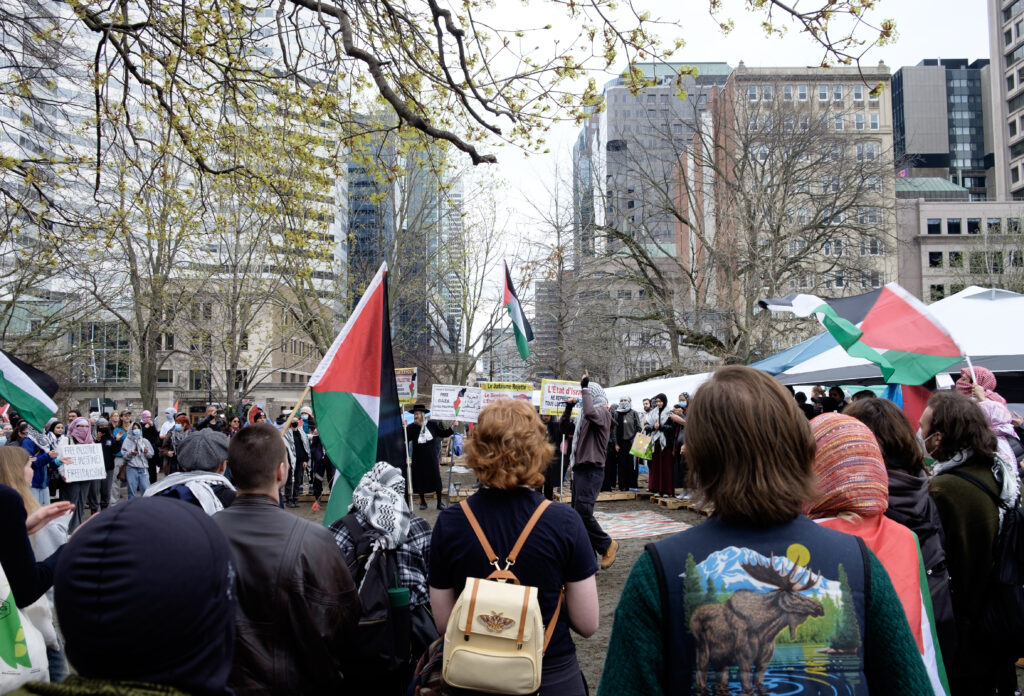
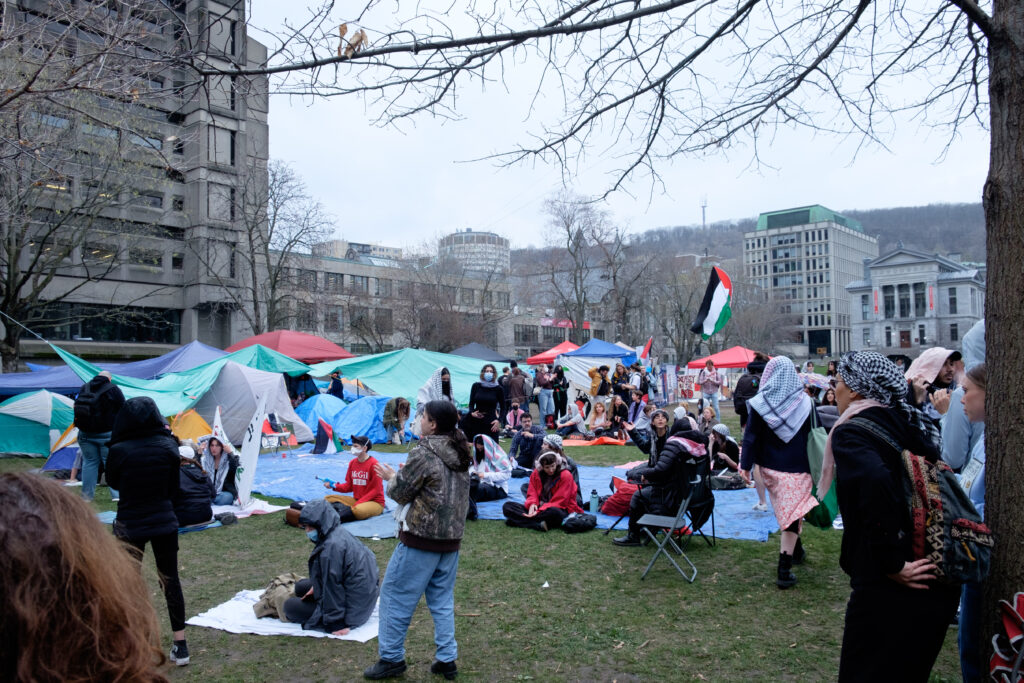
Since it was created, the encampment has also been a site of gathering for students, professors, and members of the wider Montreal community who wish to support it. Daily rallies, movie screenings, and group discussions are among the activities protestors have organized on the lower field.
Two Concordia students, who wished to be unnamed, expressed frustration at the failure of their university and McGill to respond to the demands of student protestors, but highlighted the importance of the encampment in compelling them to act.
“I think the universities will have to respond,” one student told The Tribune. “Even though we are students at their university doesn’t mean that we agree or are complicit in how they choose to operate.”
On May 2 at around 12:30 p.m., counter-protestors congregated on Sherbrooke Street in front of Roddick Gates across from the encampment to express their support for Israel. Some also called for the encampment to be dismantled. Earlier that morning, McGill alerted staff and students via email that police had been mobilized to campus and that the gates were closed for public use. The counter-demonstration left at roughly 3:15 p.m. and the gates were reopened soon after.
A McGill student present at the encampment on May 2, who wished to remain unnamed, was critical of the university’s involvement of police in their response to the demonstrations.
“It’s just appalling because […] they’re clearly trying to portray that [McGill] admin are the ones being reasonable, we’re the ones being unreasonable. But you’re sending our tuition money to fund genocide. Like, who’s really being violent here,” they told The Tribune.
Another Montreal community member who wished to remain anonymous explained to The Tribune on May 2 that they had been regularly coming to support the encampment before and after work. They noted that they felt less safe with the significant police presence on campus at the time, but also highlighted the importance of the community supporting the encampment to ensure it is not dismantled during the night.
“I think just being united, and having our presence, especially after midnight, is important,” they said. “It’s nice to have that presence. People were kicking soccer balls around at night, sharing food, making warm drinks, coffee, tea, things like that. It’s so sweet to see just like the community support, despite the police presence.”
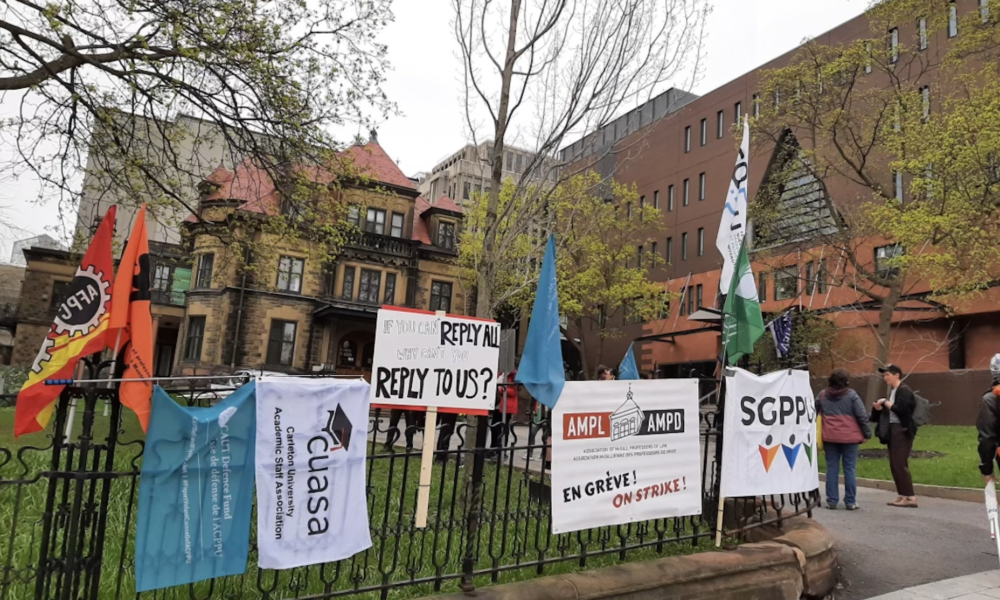
The Association of McGill Professors of Law (AMPL) called an indefinite strike on April 24 as negotiations stalled over their collective agreement (CA) with McGill. The CA, which will determine faculty governance as well as the pay and working conditions of law professors at the university, has been under negotiation for nearly a year and a half.
In a letter to students, AMPL noted that they saw a “brief uptick in the pace of negotiation” following the one-day strike they held on Feb. 13. However, they wrote that since then, the university has failed to maintain regular meetings with their bargaining team. In particular, AMPL noted that the university cancelled a bargaining session on April 9, which had been scheduled four months in advance.
Between April 9 and 11, AMPL held a strike vote in which more than 95 per cent of members participated. Over three-quarters of participants voted to pass a mandate for an indefinite strike if the bargaining committee was unable to come to an agreement in principle by April 24. Despite both parties’ efforts to come to a deal at their bargaining meeting on April 23, they were ultimately unsuccessful, prompting AMPL to commence its strike.
AMPL’s proposal for the CA contains 32 articles, 18 of which have been resolved. AMPL noted that of the 18 unresolved articles, several items pertaining to working conditions are nearly settled. However, various monetary proposals, such as salaries and employee benefits, as well as non-monetary proposals, such as administrative and faculty research support, as well as items regarding faculty governance, continue to be under negotiation.
Richard Janda, the chief negotiator for AMPL, told The Tribune that a point of contention in the negotiations is the fact that McGill has refused to accept that it cannot unilaterally change the terms of the contract after it has been signed since this would defeat its purpose.
“You can’t have a collective agreement which says that the employer can change the terms of the collective agreement,” Janda said in an interview. “Frankly, [it] runs contrary to labour law.”
Janda also explained that AMPL deliberately chose to start the strike at the end of April so that classes and exams would be impacted as little as possible. Instead, AMPL would leverage the submission of grades.
McGill Media Relations Officer Frédérique Mazerolle wrote in a statement to The Tribune that the university is working to ensure that law students graduate on time. The Dean and Associate Deans of the Faculty of Law will determine whether students’ work meets program requirements and is of sufficient quality to graduate. However, letter grades will not be assigned until the law professors have returned to work.
Janda noted that “this sets up the prospect of a graduation ceremony without professors present and having to cross a picket line.”
Mazerolle also underlined McGill’s commitment to reaching a collective agreement with AMPL. “Since the beginning of negotiations, in December 2022, our bargaining committee has met with AMPL’s committee 22 times. We have made progress on a range of fronts and wish to continue to work toward an agreement,” Mazerolle wrote.
However, Janda pointed out that these 22 meetings have been scheduled over a period of approximately 500 days and argued that the university may be prolonging negotiations longer than necessary.
“[McGill] perhaps [has] an incentive to drag this out as long as possible because we are the first union of professors at McGill,” Janda said. “I’m sure that the university is not anxious to establish the precedent that if you unionize, you can come to a collective agreement and improve your working conditions.”
Some students have expressed similar concerns over the length of the negotiating process. In a leaked email to McGill’s administration, one law student, who wished to remain anonymous, urged the university to come back to the bargaining table in good faith. Provost and Executive Vice-President (Academic) Christopher Manfredi, responded critically.
“Are our students incapable of reading?” Manfredi wrote. “In what world is attending 22 bargaining sessions a ‘refusal to negotiate.’”
The leaked email proliferated across social media. Manfredi has since issued an apology for his comments.
Dallas Jokic—a member of the Association of Graduate Students Employed at McGill (AGSEM)’s bargaining team—affirmed his union’s support for AMPL and noted that teaching assistants had a similarly frustrating experience negotiating their CA, which was resolved in April.
“As AGSEM saw recently, a strike is often the only thing that can make McGill budge at the negotiating table,” Jokic wrote in a statement to The Tribune. “McGill’s high-level administrators have shown consistent disrespect toward McGill’s workers and students; dismissing our demands as unreasonable, calling the cops on us, mocking us to other top administrators, and failing to make offers that reflect that McGill works because we all do.”
Harlan Hutt, President of the Association of McGill University Support Employees, also voiced his support for AMPL.
“AMPL’s strike actions have served as a critical part of the broader surge of labour action on campus in recent years. For the labour movement at McGill, AMPL’s impact is clear: the Education and Arts Faculties (AMPE & AMPFA) have both since voted to unionize, with more doubtlessly to follow,” Hutt wrote in a statement to The Tribune.
Organizations outside McGill have also shown solidarity with AMPL. At the picket line, McGill professors were joined by “flying pickets”—members from university unions across the country who flew to Montreal to show their support. The Canadian Law and Society Association has stated that they will not cross the picket line and will move their conference, which is scheduled to take place at the McGill campus in June if the strike is not resolved. Additionally, AMPL has received over $100,000 from unions across the country and $1,000,000 from Canadian University Teachers Association Defense Fund for their strike fund.
Janda asserted that AMPL has sufficient funds for their strike and will not be outlasted by the university.
“Just as McGill knows that what’s at stake here is the possibility of unionization across the campus, […] all of those Federations know that what’s at stake here is making sure that […] the future of unionization at McGill is protected.”
AMPL’s next bargaining meeting with McGill is scheduled for June 7.
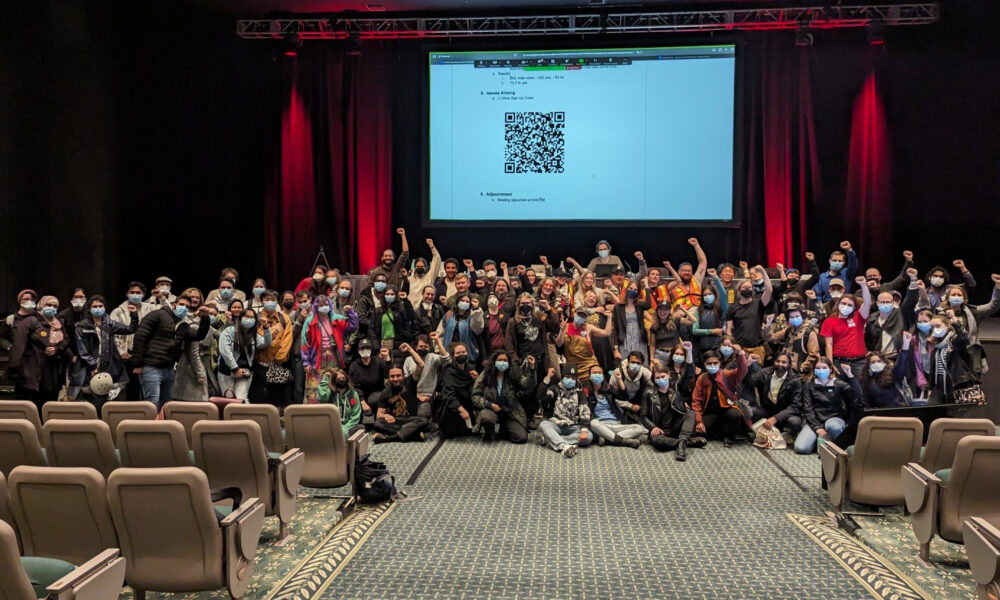
After nearly a month of striking, the Association of Graduate Students Employed at McGill (AGSEM)—the union representing Teaching Assistants (TAs)—and McGill reached a tentative agreement on Monday, April 15. On Thursday, April 18, AGSEM held a General Assembly (GA) for TAs, during which 75 per cent of attendees voted in favour of the tentative agreement, ratifying the agreement. The ratification of the agreement ended the strike, which began on March 25. Once the union signs the contract, for which a date has not yet been set, it will be enforced as the new Collective Agreement (CA) between TAs and McGill.
Out of AGSEM’s three major monetary demands that it set out in December 2023—a 40 per cent pay raise with a cost-of-living adjustment, health care, and indexation of work hours—the tentative agreement made the most headway regarding a pay raise. According to AGSEM’s press release about the union’s last bargaining meeting with the university, both parties agreed on a 15.5 per cent net pay raise over the next three years, or a 16.4 per cent pay raise compounded. The compounded raise, which considers the raise rate increase of the following years, indicates the increase. This raise will be executed incrementally, from August 1, 2023, to August 1, 2026.
The increase obtained for TAs starting in August 2023 and February 2024 will be paid retroactively to workers within 90 days of the CA’s ratification. McGill maintained a firm stance against AGSEM’s demands to potentially increase TAs’ wages if inflation is higher than three per cent per year, as part of a cost-of-living adjustment, in addition to the raises stated in the new CA.
The union and the university also did not agree on the indexation of TAs’ working hours to the number of students in the class. However, they tentatively agreed on clauses that would make the process of allocating TA work hours and teaching support budgets more transparent while creating ways for TAs to respond to the organization of their work and pay. According to Dallas Jokic, one of the AGSEM bargaining committee’s members, these new elements in the tentative agreement are a major win for the union.
“Our union, and pretty much every other TA union across Quebec and Canada has been fighting to index TA hours to undergrad enrollment for decades. While we were not able to win this, we were, for the first time, able to win real transparency in how TA hours are allocated and avenues to provide feedback when hours are cut or improperly allocated,” Jokic wrote in an email to The Tribune.
The tentative agreement also does not address AGSEM’s healthcare demands. Even though AGSEM wanted gender affirmation leave to be more clearly established within the contract, their attempt was unsuccessful. According to the union’s newsletter, McGill explained that gender affirmation leave is already included in the agreement through clauses relating to medical leave. Now, AGSEM calls on the university to include language establishing that misgendering and deadnaming are a form of harassment of transgender TAs in its Policy on Harassment and Discrimination, which will be reviewed during the 2024-2025 academic year.
In a written statement to The Tribune, McGill’s Media Relations Office stated that McGill will review the policy through a community consultation so that the university can address the issue of misgendering and deadnaming.
“We take the issue seriously, recognizing the deep challenges that trans members of our community can face,” the Office wrote. “The review of the Policy on Harassment and Discrimination must, according to its own terms, follow a community consultation and the issue about how to address meaningfully and seriously deadnaming and use of preferred names and pronouns will be looked at seriously in that context.”
Barry Eidlin, associate professor in the Department of Sociology, explained in a statement to The Tribune that this tentative agreement demonstrates the fruits of TAs’ organizing effort, but also how the university administration begrudgingly compromises in negotiations concerning on-campus unions, even during a strike.
“I think the AGSEM agreement is the product of a hard-fought strike. It’s far more than [TAs] would have been able to win without going on strike,” Eidlin wrote. “That being said, it leaves a lot of unfinished business, largely due to the McGill administration’s obstinate refusal to take TAs’ working conditions seriously.”
Eidlin also shared that he believed that, through the TA strike, the administration showed itself willing to create a divisive environment on campus instead of focusing on bringing an agreement that agrees with the university’s and the union’s conditions to life.
“They showed in their actions that they were far more interested in asserting their own power and dividing the campus community than in actually negotiating a fair agreement for TAs that addressed their core concerns. They demonstrated this in their policies, like ordering faculty to take on hundreds of extra hours of work normally done by TAs for no additional compensation or consideration. Not only was this an attempt to enlist professors directly on the side of management to undermine our own students, but it ran the risk of poisoning the campus climate for far longer than the strike lasted, pitting professors against students, and undergraduates against graduate students,” Eidlin stated.
As the tentative agreement was ratified, TAs are heading back to work in time to grade final exams. AGSEM says that the new CA will be signed as soon as the tentative agreement is translated from English to French—the official language for legal documents in Quebec. Until then, it is still possible that the tentative agreement be changed.
Jokic stated that, while some considerable demands were not met by the university, he believes that the strike had an obvious impact on the result of the year-long bargaining process, which started last September.
“We had to fight for every single win we got in this agreement, and while TAs deserve more, I think we can be proud of how much our strike won us.”
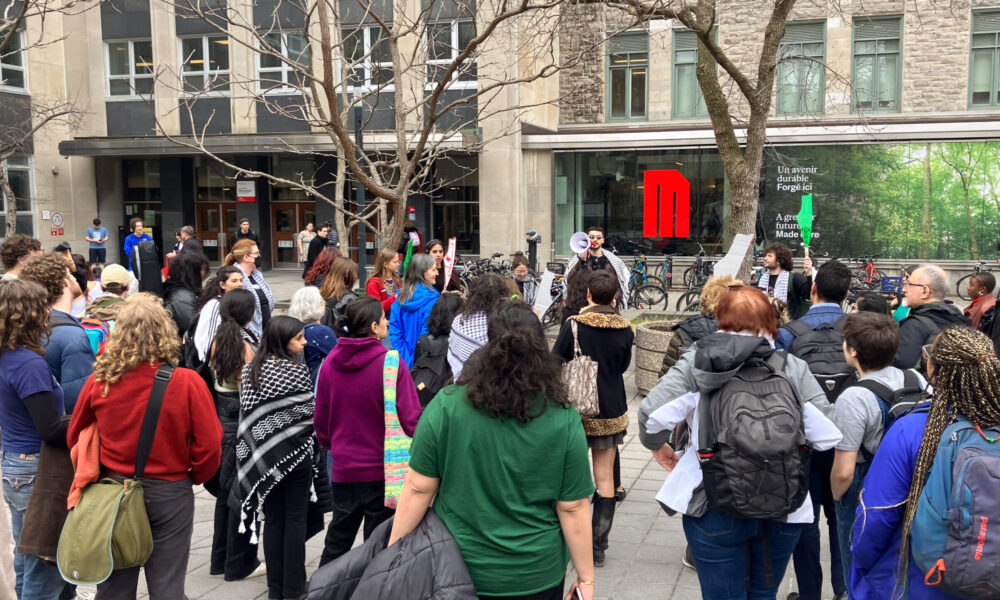
In the late afternoon of April 10, a crowd of around 50 staff and students gathered in front of the Nahum Gelber Law Library for a subversive “esprit rassembleur” tour of McGill. Led in collaboration by Profs4Palestine—a group of McGill professors united against the ongoing genocide of Palestinians—and students, the event took participants across campus to discuss the complicity of several McGill faculties in the ongoing genocide of Palestinians.
Omar Farahat—an associate professor in the Faculty of Law and an organizer of the event—acknowledged the importance of student-led mobilization on campus in support of Palestine over the last several months in a written statement to The Tribune.
“[The idea of collaboration] came after the administration sent several messages threatening police intervention and legal prosecution against protesting and striking students, which made this collaborative effort more urgent as a sign of solidarity among students and professors,” Farahat wrote.
On March 28, Provost and Executive Vice-Principal (Academic) Christopher Manfredi sent an email to the McGill community defending the university’s choice to call police to campus on student demonstrators, also noting that the police had made at least one arrest and that McGill was pressing charges. Manfredi ended the email by reinforcing the university’s commitment to protecting McGill’s esprit rassembleur—the idea of the university as a site where people come together and exchange ideas. The tour’s name is a reference to Manfredi’s use of the term in this email.
In an email to The Tribune, McGill’s Media Relations Office wrote that the university respects community members’ rights to freedom of speech and assembly as long as they remain within the limits of McGill’s policies and the law. The office stated that when demonstrators’ actions violate these rules, police will intervene to protect the safety of everyone on campus. They also explained that McGill will not sever academic ties with Israeli institutions “simply because of where [they are] located.”
“As the president [Deep Saini] stated in his Nov. 2 message to the community, weighing in on geopolitical crises around the world lies beyond a university’s mandate and role,” the office wrote. “Our academic mission is most faithfully served when institutional views are limited to what happens here on our campuses, so that all students, faculty, and staff feel included as members of our community, regardless of their identities and personal beliefs.”
After discussing the Faculty of Law’s complicity in the genocide of Palestinians, the tour moved to the Education Building. On the front steps of the building, speakers criticized the faculty’s academic partnership with Tel Aviv University—which is involved in research and development for the Israeli military—through the Sylvan Adams Sports Science Institute. They also denounced the faculty’s failure to recognize the ongoing scholasticide in Gaza, including the destruction of all 12 universities.
Following stops in front of the Bronfman Building and McConnell Engineering Building to discuss the faculties of management and engineering, the tour headed to the Macdonald-Harrington Building to discuss the School of Architecture’s academic ties to Israel. There, a student speaker and Professor Ipek Türeli condemned the faculty’s celebration of being gifted the professional archive of Moshe Safdie, who designed the Israeli settler city Modi’in on dispossessed Palestinian land. They also criticized the faculty’s curriculum for failing to make students aware that the buildings on which they attend class—as well as the “vacant plots” where they are asked to design architectural proposals—are on unceded or stolen land.
One of the main student organizers for the tour, Alex*, told The Tribune that the tour also reflects the changing strategies of activist groups for Palestine on campus over the course of the academic year.
“Last semester, we did a broader divestment strategy, so that targeted McGill’s investment portfolios,” Alex said in an interview with The Tribune. “This semester, we pivoted towards academic complicity, which I think is more dangerous, because it does the job of normalizing these institutions and the work that they do to support the Israeli state and the military. So the pickets and such have been like a shift in that kind of strategy, and this tour […] parallelled that shift.”
Rula Jurdi Abisaab, a professor at the Institute of Islamic Studies, was also among the event’s organizers and speakers. Abisaab noted that Solidarity for Palestinian Human Rights (SPHR) at McGill and Independent Jewish Voices (IJV) McGill organized a similar student-led alternative campus tour last semester. This event inspired a group of professors—including Abisaab and Professor Michelle Hartman—to bring together staff and students to create the Esprit Rassembleur tour.
“[SPHR and IJV] have created an atmosphere of awareness that is phenomenal [….] They were an inspiration to us,” Abisaab said. “We built on some of the scripts they had actually prepared earlier, and then we did our own scripts or additions.”
The tour ended at the Hochelaga Rock near Roddick Gates. Anna Shah Hoque, a course lecturer in the Institute for Gender, Sexuality, and Feminist Studies, highlighted that McGill positions the rock as a symbol of Indigenous representation on campus while they fail to take real steps toward decolonization.
“The rock gains more meaning than actual living lives and lost lives, so it mutes settler accountability in amending existing practices and policies on campus and elsewhere,” Shah Hoque said.
Furthermore, Shah Hoque emphasized the need to connect colonialism in Montreal and Quebec to that in Gaza.
McGill’s Media Relations Office stated that the university is working towards achieving its commitments to reconciliation as part of the 52 Calls to Action outlined in a 2017 Report of the Task Force on Indigenous Studies and Indigenous Reconciliation.
Abisaab also underscored the importance of connecting the university’s complicity in the genocide of Palestinians with its ties to slavery, colonization, and the oppression of Indigenous people to educate professors at McGill.
“Bringing all of these threads together was very important for professors to hear about,” Abisaab said. “[For] a lot of professors, unless you look, you’re not going to know how implicated McGill is.”
Poet El Jones, who was visiting McGill for a roundtable discussion on prison abolition at the Faculty of Law later that evening, concluded the tour by reciting a poem she wrote for Palestine.
“And they’ll say that our love is just hate in disguise, but there’s so much solidarity that can’t be denied, refusing their narrative of grow and divide to call for the value of each human life,” Jones said. “So we chant and we sing, and we march side by side, and our voices cry out as our crowds grow in size, ‘Long live Gaza, long live Palestine.’”
Farahat noted that rather than instill a sense of helplessness, the tour’s focus was to both educate attendees on McGill’s complicity in genocide and motivate them to take action against it.
“The idea is to dispel the myth that we live and operate in a neutral space, or that our lives are somehow separate and unrelated to the suffering of those facing occupation and genocide,” Farahat said. “By highlighting the ways our institutions participate in discriminatory and genocidal practices […] we show that we all have ways in which we can act or speak up that would contribute to the liberation of occupied and oppressed peoples.”
*Alex’s name has been changed to preserve their confidentiality.
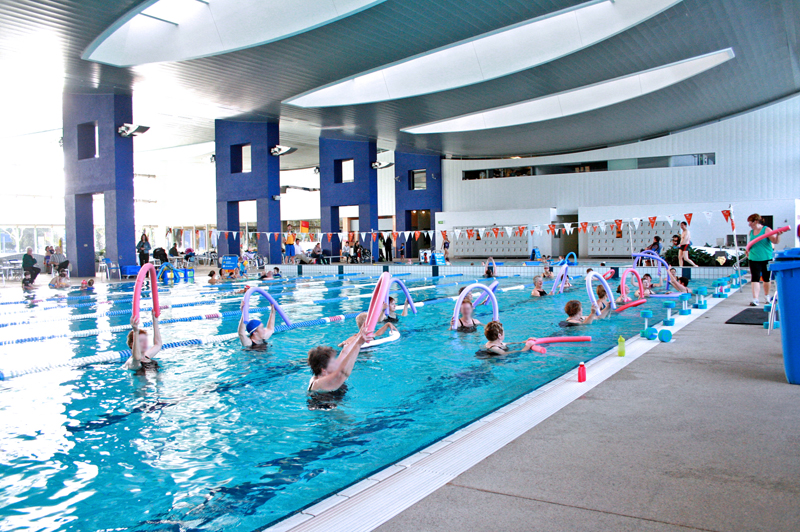
How many times have you committed to a new exercise program, only to dejectedly realize one day that a month has gone by, and you have completely forgotten about all those overly ambitious resolutions you had made? Fear not, this article’s goal is not to guilt trip you, but rather to highlight the need for personalized interventions that enhance physical activity according to individual needs.
In a world where physical inactivity affects an estimated 1.4 billion adults, addressing this global health challenge requires innovative strategies. Canada, with its rapidly aging population, faces a unique challenge: How to keep the baby boomer generation active and healthy after retirement.
Adrián Noriega de la Colina, a CIHR-Institute of Aging Fellow at McGill’s Neurological Institute-Hospital, and his team tackle this issue by proposing a roadmap that aims to decrease physical inactivity and reinforce adherence to consistent exercise in their recent publication.
“Of course pharmacological interventions are important, but I think one of the best and cheapest ways to enact prevention is through physical activity,” Noriega de la Colina said in an interview with The Tribune.
However, the traditional approach of general exercise guidelines often falls short, particularly for individuals with chronic conditions. Current clinical guidelines, such as the recommendation of 150 minutes of moderate exercise per week, result from population averages that do not take into account individuals’ diverse circumstances.
“There’s something that we [as physicians and researchers] are missing: We are either not communicating correctly, or we are not giving the patients what they need,” Noriega de la Colina noted.
Precision physical activity (PPA), which aims to tailor physical activity recommendations to individual needs by considering factors like age, sex, existing health conditions, and even living environments, is one solution.
Noriega de la Colina and his team created a roadmap that provides guidance for the implementation of PPA. The starting point would be deep baseline phenotyping for a detailed understanding of an individual’s characteristics and limitations, thereby ensuring the maximal possible health benefits.
“A phenotype is a conjunction of characteristics that define an individual, such as age and sex, socio-demographics, any comorbidities, [and] baseline level of activity.” Noriega de la Colina said.
The collection of multiple phenotypes gives rise to clustered profiles, which doctors then compare against an individual’s unique characteristics. Clinicians can then provide more appropriate interventions to optimize health benefits based on what profile matches a patient’s characteristics best.
Clinicians can then provide more appropriate interventions to optimize health benefits based on the best match between a patient’s characteristics and the profile multiple phenotypes
According to Noriega de la Colina, the proposed blueprint includes the following elements: How to start an intervention, how to maintain an individual’s engagement, and their preference of physical activity. All three components should be informed by factors such as socio-demographics, personal characteristics such as health conditions, and psychological determinants from perceived-barriers and self-motivation to one’s social and physical environment.
“So this [paper] is a framework for others to build on. And the idea would be that, through open science, we can collaborate more because the amount of data that you need for precision medicine is enormous,” Noriega de la Colina said.
PPA represents a paradigm shift in how clinicians and researchers approach the promotion of physical activity overall, particularly in aging populations. The ultimate goal is to provide customized therapy, where prescriptions for physical activity are as tailored as pharmaceutical treatments.
“Instead of saying ‘Go and walk 150 minutes and good luck,’ it would be better to be able to prescribe something much more suited for your needs,” Noriega de la Colina said. “Behavioural studies show that individuals have increased levels of compliance and adherence when they know specifically what they have to do.”
 Varsity Report Card: Fall 2025
December 3, 2025
Varsity Report Card: Fall 2025
December 3, 2025
 McGill Redbirds triumph in Legacy Game, honouring Indigenous roots of lacrosse
October 7, 2025
McGill Redbirds triumph in Legacy Game, honouring Indigenous roots of lacrosse
October 7, 2025
 A month of McGill Sports leaves room for improvement
September 23, 2025
A month of McGill Sports leaves room for improvement
September 23, 2025
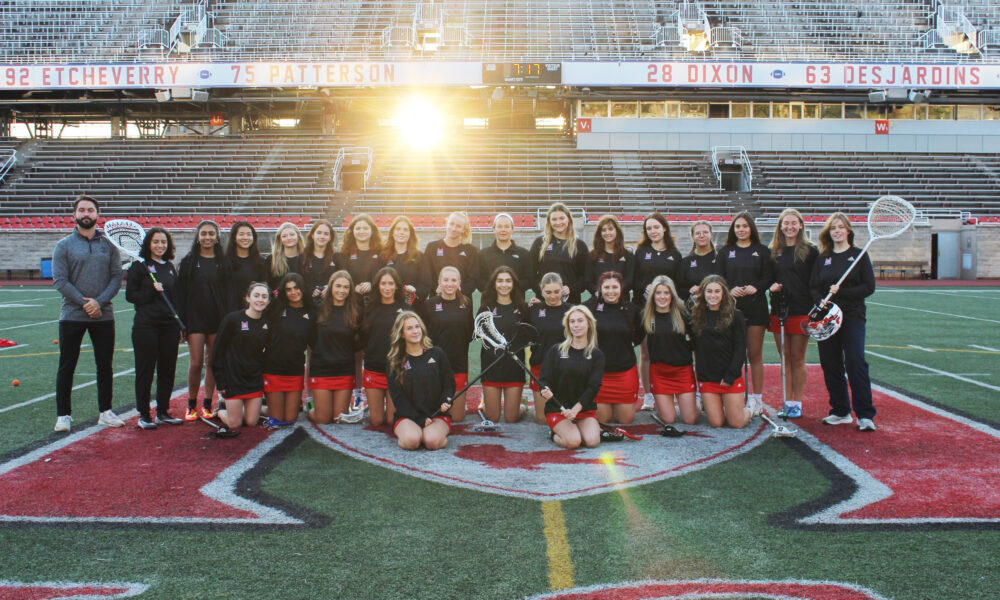
Given its Indigenous origins and role as the national sport of Canada, lacrosse holds great significance for many, including players on McGill’s women’s lacrosse team. Co-captain Rachel Anderson and teammates Gemma Hauser and Olivia Maracle-Hill sat down with //The Tribune// to discuss their connection to the sport and the importance of its Indigenous history for them as Indigenous players.
The 2023-24 season was filled with great improvements for the team, both on and off the field. They raised over $4,000 in their McGill24 campaign, received their first sponsorship deal with EY consulting firm, and earned a spot playing in the Ontario University Association (OUA) lacrosse league next season.
The Martlets’ entrance into the OUA was largely due to their on-field performance throughout the 2023-24 season. The team played against universities in Ontario and the United States. One of their competitors, the Queen’s University Gaels, recognized the Martlets’ improvements during a match-up against McGill this season, indicating that they, as a club team, could compete with the best.
“We actually got praise from the Queen’s lacrosse coach, which was huge, because they won the OUA last season and defeated all the other teams in Ontario,” Anderson told //The Tribune//. “When we heard this praise, I think [it] was a turning point for us.
The team attributes much of their success to head coach Duncan Lovell. Lovell grew up playing lacrosse, eventually playing for St. Francis Xavier University. Given his experience with the men’s game––despite its different style of play and greater physicality––Lovell provides the team with a competitive edge while adapting to the women’s game. Outside Lovell’s expertise, Anderson and Hauser explain that much of the team’s improvement stems from their sheer dedication and willingness to show up and compete at every practice.
“[Compared to last season,] it just feels like everyone relies on each other more, and it’s less like you’re dragging yourself to practice because it’s an obligation,” Hauser said.
Lacrosse is more than just a game for the Martlets team. The sport holds a deeper historical and personal significance for many players.
“My own experience as an Indigenous lacrosse player has been marked by the profound connection I feel to my heritage through this sport,” Anderson said. “Lacrosse is not just a game, but a means to express our identity and honour our ancestors.”
Anderson reflects on the knowledge of her community, emphasizing the ingrained significance that lacrosse holds for many Indigenous peoples. The three teammates explain that the origin and significance of lacrosse lay deep within Indigenous history. Maracle-Hill describes lacrosse as divinely gifted by the Creator to the Haudenosaunee, which is ancestrally played and used for healing purposes. At the game’s best, players use the sport to honour the land and their ancestors’ legacy: Acting as a way of establishing Indigenous sovereignty and upholding Indigenous ways of life and being.
The players expanded on not only an issue of gender inequity within lacrosse, but also a disconnect between McGill’s stated mission of truth and reconciliation, and the role that recognizing both men’s and women’s lacrosse plays in moving toward this goal.
“The men’s [Redbirds] lacrosse team having their heritage night and having dancers and speakers and a lot of Indigenous involvement in this one game, working towards truth and reconciliation [was amazing, but] I don’t even think it would be feasible for us to do something like that,” Maracle-Hill said.
With the lack of funding and support from both the McGill administration and McGill Athletics, the Martlets feel as though the university is doing them a disservice. The team emphasizes that McGill has the opportunity to work on their stated mission to “establish McGill University as a global leader in post-secondary institutions for reconciliation with Indigenous peoples” through the game of lacrosse, particularly with the sport being played on unceded territory of the Kanien’kehá:ka (Mohawk) territory. The team hopes that if the university were to bring greater awareness to the Martlets lacrosse team––through advertising and funding––they would not only be able to thrive in the OUA but demonstrate the significance of their sport because as Anderson says “[lacrosse] is more than just a game to us.”
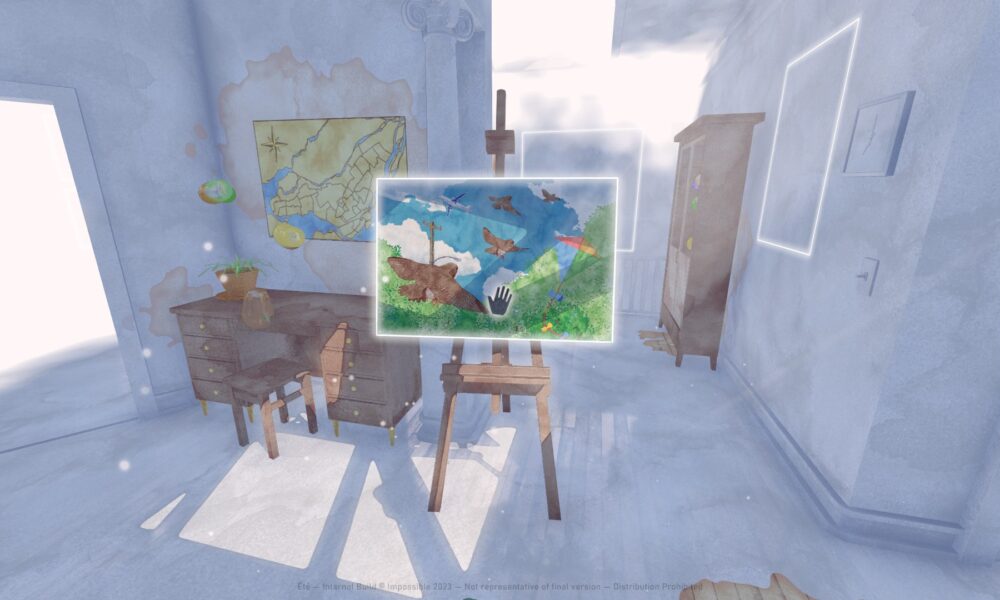
For many, thinking about video games elicits images of shooters, strategy titles, stressful levels, and intense gameplay. Été isn’t that. Developed by Montreal-based indie studio Impossible, the new PC game is all about relaxing. The player assumes the role of a budding painter who has just moved to Montreal for the summer and explores the city, paints watercolours, sells artwork, and decorates their apartment. The Tribune sat down with Lazlo Bonin, Founder and Creative Director at Impossible and a developer of Été, to discuss how the game came about.
Été’s origins
Bonin’s inspiration for Été didn’t come from other video games; instead, he drew on some unlikely sources.
“One thing that has been inspiring me a lot is the I Spy books,” Bonin explained. “I just love the whimsy of Walter Wick, the photographer [.…] There’s such a joy in finding all the elements in those pages. And I think that’s kind of what was the inspiration for this [game].”
By the time development started in early 2020, Bonin and the initial team had already invested years of effort in creating a proof-of-concept and securing funding.
“The first prototype for this game was in 2016, maybe even 2015. [….] There was a long period between 2016 and 2020,” Bonin explained. “Trying to get funding basically and pitching to different investors or public funds to get someone interested in this weird, poetic wandering game where you’re a painter [in] Montreal. [They] didn’t bite so much for a little while.”
A calm atmosphere
Été has been designed from the ground up to create a relaxing and inviting atmosphere. Unlike other games, there’s no way to fail, and the progression system lacks any rigidity. The main goal is to explore the city and create paintings you’re proud of.
“We don’t want people feeling like they have to work towards a specific goal,” Bonin elaborated. “What you’re really getting out of making all your paintings [and] selling your artworks at the auction is money. And money buys you decorations at various little shops you find toward the city. And you can use those to decorate your apartment and your studio space. So that’s like the ultimate goal—which is also just like a very open-ended and creative goal.”
It’s a simple life. Far from finals and schoolwork, Été is an escape to a world where people can make a comfortable living, interact with their community, and make art.
“Video games are often power fantasies that will give you guns or superpowers or whatever else. And obviously, that’s not what we’re doing. But we are still creating some kind of fantasy,” Bonin explained. “What is the ideal life of a wandering painter in Montreal? Cheap rent, walkable cities, people who pay you for your art, [and] you’re right next door to the coolest cafe in town and the cutest market.”
Showcasing Montreal
Having grown up in the Mile End, Bonin felt that Montreal would be the ideal backdrop for the game.
“I just love the city,” Bonin said. “I absolutely love the architecture, and […] I love the scale of Montreal as a city. I love the density; the duplexes and triplexes create these small pockets of space and community.”
Bonin mentioned that if he had not become a game developer, he would have considered pursuing urban planning. With Été, he’s able to blend both passions. Inspired by planning principles from books like A Pattern Language, Bonin’s focus is always on creating a human-scale, lively, and cozy version of Montreal.
“The scale of the city and the locations we make have very little room for cars. It’s very bike- and pedestrian-oriented,” he said. “If we would make streets to scale, we would realize that our playtesters, and ourselves, would just be kind of anxious while standing in the middle of the street, even though there were no cars coming.”
Été is slated to come out in 2024 on Steam, though no specific release date has been confirmed. The game will be available in both English and French. Currently, the game can be added to users’ wishlists.
 Critics must balance linguistic priorities with human impact when discussing Air Canada’s faux pas
April 7, 2026
Critics must balance linguistic priorities with human impact when discussing Air Canada’s faux pas
April 7, 2026
 The pattern behind Hassan’s denial of entry
April 7, 2026
The pattern behind Hassan’s denial of entry
April 7, 2026
On March 28, McGill’s Provost and Executive Vice-President (Academic) informed the campus community via email that “some protestors and picketers again attempted to disrupt University activities” and that “police made at least one arrest and the university has chosen to press charges.”
Reports suggest the disruptive actions were carried out in solidarity with McGill students engaged in a protracted hunger strike over the university’s position on the violence currently being inflicted on people in Gaza.
Addressing “those who choose to engage in protests or pickets going forward,” the Provost warned: “You have a range of legitimate, legal, peaceful options for raising awareness of your views,” and threatened that “where other options are chosen instead, consequences will follow.”
What kinds of “legitimate, legal, peaceful options” does McGill’s governance structure make available for the specific concerns expressed by these protestors?
These courageous activists are not seeking simply to “raise awareness” of their views (state-sanctioned killing and starvation of innocents because of their ethnicity and where they live is not something about which one has “views”). They are, instead, trying to persuade the Board of Governors to withdraw McGill’s investments from companies they believe “directly or indirectly support Israel’s apartheid state and its ongoing genocide against Palestinians” and to cut McGill’s ties with the Israeli state and Israeli universities.
Under the circumstances, this is not an outrageous request. Yet the university’s own mechanism for receiving expressions of concern about its investments all but guarantees the Board will never consider it.
The university’s investments are subject to review by the Committee on Sustainability and Social Responsibility (CSSR), which is mandated to ensure McGill does not invest in companies whose activities result in “grave injurious impact,” including those which “violate or frustrate the enforcement of rules of domestic or international law intended to protect individuals against deprivation of health, safety, or basic freedoms, or to protect the natural environment.”
Is petitioning the CSSR one of the “legitimate, legal, peaceful options” available to the hunger strikers and their supporters (1200 signatures, and counting), an institutional process through which they can express concerns about the role played by companies in which McGill invests in the grave injuries being committed against the people of Gaza and the West Bank?
As it turns out, not really.
An August 2023 revision to the CSSR’s terms of reference stipulated that “a legal person [i.e., a corporation] shall not be deemed to cause ‘social injury’ simply because it does business with other legal persons which are themselves engaged in socially injurious activities.”
Under this provision, if a group of McGill students discovered the university was investing in a company that provided support to Hamas in its horrific October 7 attack on Israeli citizens, they would have a hard time bringing this before the Board as a potential violation of the university’s policy on socially responsible investing.
Sadly, hypothetical examples are not necessary. We have before us an actual case in which a significant portion of the McGill community believes that companies in which the university invests are profiting from activities implicated in the killing, maiming, forced starvation, and displacement of thousands of innocent people in Gaza. Consideration of these claims and related evidence is deliberately undermined by the rules of the very body that supposedly exists to decide such grave questions on behalf of the university.
The option to express these concerns by “legitimate, legal, peaceful” means in a forum where this could have real impact has been effectively foreclosed. As a result, we are left with the heartbreaking spectacle of McGill students starving themselves and getting arrested, just to get the university’s attention.
The communique sent to the McGill community referred to McGill’s “//esprit rassembleur//,” a recent coinage intended to evoke a special McGillness supposedly at risk due to the unruly activities of human rights advocates, trade unionists, and the Gouvernement du Québec. But if there is a threat to McGill’s //esprit rassembleur//, it is not the alleged excesses of passionate protest, labour organization, and cynical public policy. It is university governance procedures that leave serious people without genuine options for bringing legitimate concerns to forums where consequential decisions are being made.
If the university’s administration is truly concerned about the political climate on campus, it could start by asking the Board to rescind its prejudicial definition of social injury so that the options available to people acting in good faith are real, instead of imaginary.