Latest News

McGill, News

RadLaw and LS4PM panel tackles global solidarity across Palestine, Sudan, and Congo

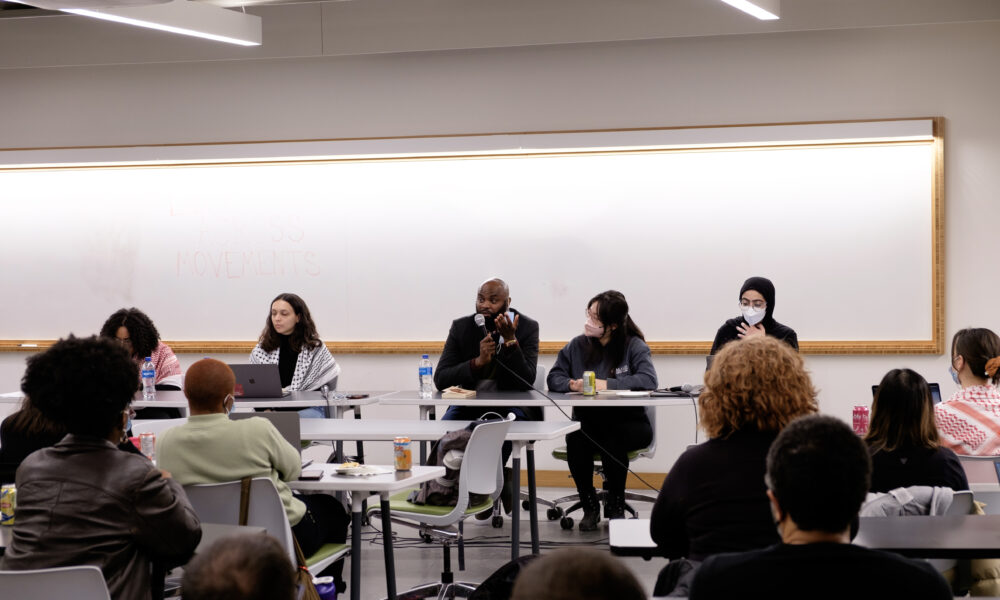
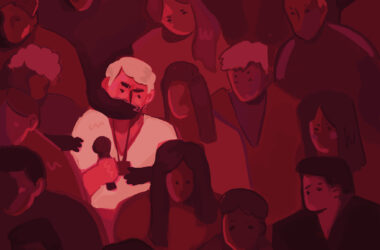
RadLaw McGill and Law Students for Palestine at McGill (LS4PM) hosted a community panel called “Liberation Across Movements: Palestine, Sudan, and Congo” on the evening of Feb. 24 in the New Chancellor Day Hall at the McGill Faculty of Law. The event rose out of a recognition of the need for solidarity amid the ongoing atrocities unfolding in Palestine, Sudan, and the Democratic Republic of the Congo (DRC).

The bilingual event featured three community speakers who did teach-ins on each respective conflict, followed by a discussion and audience question period. 

RadLaw and LS4PM member Fatima—a third-year Law student and first-generation Canadian from South Lebanon whose ancestors are from occupied Palestine—facilitated the event. It featured Duha Elmardi, a Sudanese organizer from the volunteer-based Sudan Solidarity Collective, Reem Said, one of the founding organizers of Montreal’s chapter of the Palestinian Youth Movement, and Patrick Mbeko, a Canadian geopolitical analyst of Congolese origin and author of many works specializing in Central Africa. 

The event began around 6 p.m. with a land acknowledgment by Fatima, who highlighted the importance of solidarity with Indigenous resistance and the role of pervasive anti-Blackness. 

“Anti-Blackness is a global issue with regards to systematic erasure of Black bodies, and the valuation of who’s deemed worthy of sympathy,” Fatima said.

Fatima encouraged the audience to engage with Quid Novi, the student-led journal at McGill’s Law School, where Black law students recently made a statement on the interconnectedness of Black and Palestinian liberation struggles. 

Next, each speaker provided the most critical context or background of their respective conflict. 

Mbeko stated that the spillover of the conflict in neighbouring Rwanda in 1994 led to the first and second Congo wars in 1996 and 2003, respectively, resulting in the death of over six million people. He noted that while this conflict continues, Western powers exploit the mineral-rich eastern region of the DRC.

“It reminds us what is happening today in Palestine. Where they say, we want a humanitarian pause but refuse a permanent ceasefire while people are being murdered. It’s the same logic that is being applied to the DRC today,” Mbeko said.

Following Mbeke, Said spoke, situating the ongoing atrocities in Palestine within the larger historical conditions of the region and highlighting the role of geopolitical interests that have led to the ongoing siege beginning Oct. 7. 

“We must understand Palestine through a materialist framework,” Said said. “That means that the genocide that we’re witnessing today is happening because of historical struggles over land and resources, and this is related to imperialist interests, and geopolitical goals in the region.”

Then, Elmardi provided an overview of the events and conditions leading up to the ongoing war in Sudan when fighting broke out between the Rapid Support Forces (RSF) and Sudanese Armed Forces (SAF) in the capital, Khartoum. Elmardi noted that the war began on April 15, 2023, but is rooted in the National Islamic Front’s coup in 1989, as well as colonial legacies from British rule. Khartoum remains an active warzone, there is a media blackout and a lack of domestic accountability

“There was a lot of coverage because they were evacuating all of the diplomats, NGO workers, and foreigners in the country,” Elmardi said. “As soon as the evacuations ended it’s no longer mainstream and very difficult to find news about Sudan.” 

The discussion then turned to a question-and-answer period. All three speakers highlighted how the conditions under which genocide and colonialism in their respective countries have unfolded should act as a guide for solidarity. 

“The imperialists are united, and so the people that are living under imperialism must unite as well,” Said said. 

Mbeko underscored the level of humanity required in maintaining solidarity across movements, and in determining how we articulate and defend ourselves. 

“Everyone needs to understand what is happening. I said it earlier, but today, I feel Palestinian, I feel Sudanese, I feel Quebecois, I feel whatever you want. I am a citizen of the world and I refuse the categorizations that the media presents us, because they are a part of the same imperialist system.”

*Mbeko’s quotes have been translated from French by the author.

This piece was updated at 4:57 p.m. on Feb. 27.

McGill, News

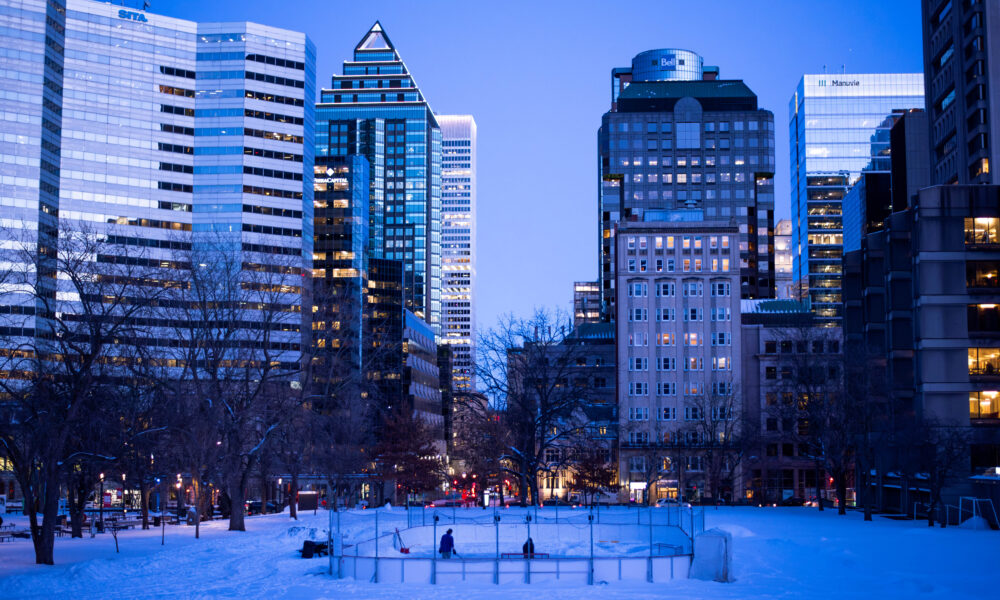
McGill sues Quebec over tuition hikes, cites discrimination and lack of consultation

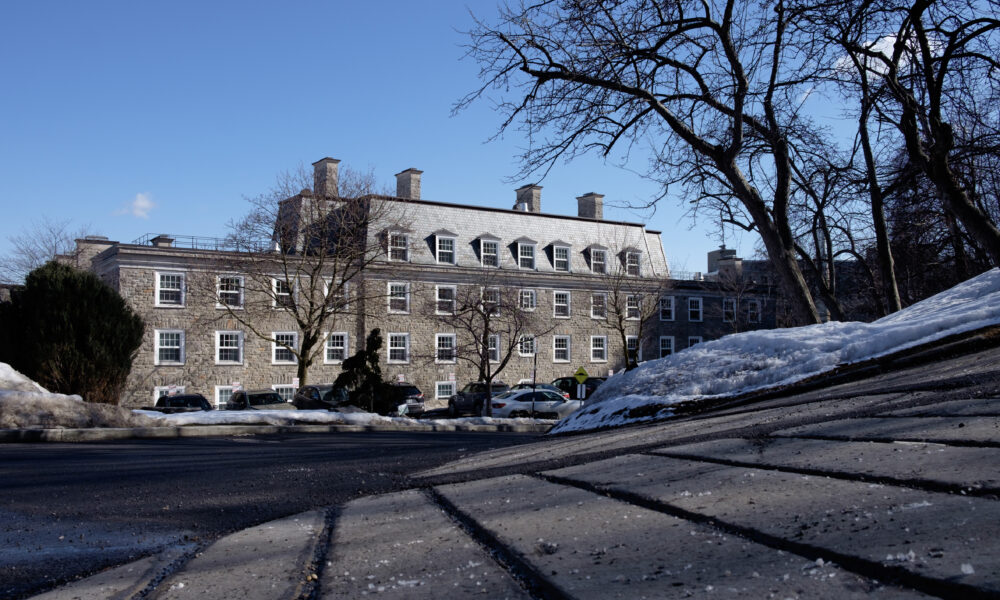
On the morning of Feb. 23, McGill announced that the university has filed a lawsuit against the Quebec government over tuition hikes. These mean that new out-of-province students attending anglophone universities in Quebec will pay roughly 30 per cent more than in previous years. This announcement came alongside the news that out-of-province applications to McGill dropped by over 20 per cent this year. Concordia, which also saw a significant decline in applications, filed a separate suit over the tuition hikes the same day. 

In the suit, the university claims that the tuition hikes are discriminatory, as they target anglophone students; that they constitute an overreach on behalf of Quebec’s Minister of Higher Education, Pascale Déry; that they were instituted without proper consultation with universities; that they are “a disguised and illegal tax” created without the permission of the National Assembly; and, finally, that as an obstacle to accessing education across provinces, they create an unconstitutional barrier to interprovincial trade.

In an email to The Tribune, Media Relations Officer Frédérique Mazerolle pointed out that the university’s concerns about the tuition hikes have been echoed by the committee in charge of advising the Minister of Higher Education and the Minister of Education on issues surrounding the accessibility of education.

“The government’s own Comité consultatif sur l’accessibilité financière aux études, composed of representatives of government and French-language universities and [CEGEPs], who said that the decision risks compromising access to a quality education and depriving Quebec society of potential talent. Therefore, the Committee ‘strongly urges the government to reconsider this decision.’”

Gregory Kelley, a member of the Quebec National Assembly who represents the Jacques-Cartier electoral district, which includes Macdonald Campus, spoke with The Tribune about the implications of the tuition hikes and of McGill’s lawsuit. Kelley, who is a McGill graduate, celebrated the university’s decision to “fight against something that they see as being unjust,” but wishes it had not come to this.

“I think that it’s […] extremely frustrating to see that McGill and Concordia have to go to the courts, because this can easily be avoided by just not having this policy in place at all,” Kelley said. “But it is a little bit of the style of the current government. If we look at Bill 40, the challenge to the school boards thing, again, there was no need to have a court battle over the constitutional rights, the English-speaking community to manage and control its own school boards.”

Kelley also spoke to the lack of consultations carried out prior to the tuition hikes being announced.

“Some of the principals of our institutions have learned about this announcement through a tweet,” Kelley said. “From what I understand, the consultations that were being done beforehand were more directed towards developing a francisation plan, which McGill and Concordia and Bishop’s were all about working on. And then all of a sudden they hear this different announcement come from the CAQ [Coalition Avenir Québec] government that took them completely off guard [….] It just so goes again that the CAQ was sort of making things up on the back of a napkin.”

Students’ Society of McGill University (SSMU) Vice-President External Liam Gaither believes that the university’s decision to sue was a predictable one. He emphasized, however, that he thinks the decision is less about its students and more about protecting its own financial viability. 

“I think that it [the lawsuit] will certainly put the question to students and whether they want to participate in activist mobilizing against tuition hikes, and my response to that is, I think both things have to happen in tandem,” Gaither said to The Tribune. “We can’t just let the university handle this on our behalf, because the university actually does not represent us; they represent themselves [….] This is a move to protect the university’s bottom line, more so than the affordability of education for students in Quebec.”

Gaither pointed out that the student body has been grossly overlooked throughout negotiations over the tuition hikes. He urges the creation of a “roundtable-style consultative body” as discussions continue. 

Hockey, Sports

Black Ice: The absented presence of Black Canadians in hockey

Who invented the slapshot? If you answered Bernard Geoffrion of the Montreal Canadiens in the 1950s, you are mistaken. The correct answer is Eddie Martin of the Halifax Eureka in 1906. Who was the first goalie to drop to a knee in order to stop a puck? If you thought it was Ottawa Sentator’s Clint Benedict you are again, incorrect. It was actually Henry Franklin. Now, as you might be tempted to open another tab on your computer to Google “What league were the Halifax Eureka in” or “Henry Franklin hockey,” pick up a copy of Black Ice: The Lost History of the Colored Hockey League of the Maritimes, 1895-1925 by Darril Fosty and George Fosty—it will likely save you some time. 

The Fosty brothers’ 2007 book delves into the history of the Coloured Hockey League of the Maritimes (CHL). Founded in Halifax, Nova Scotia, the league was organized by Black Baptists and Black intellectuals in 1895 and became a driving force in the push for equality for Black Canadians. However, like much of Black history in Canada, the CHL is purposefully erased from Canadian historical memory to serve white supremacy. 

“As [many] Black Canadian scholars argue, Black people are an absented presence in Canada,” Debra Thompson, a professor in McGill’s Department of Political Science, explained. “Black people are absented or purposefully erased from Canadian history, but also present in that so much of Canadian history is about presenting Canada as being the Promised Land.” 

Vinay Virmani––a producer working with UNINTERRUPTED Canada––embarked on Black Ice, the documentary, drawing on the Fosty brothers’ book. Charles Officer, a Canadian documentary filmmaker who passed away earlier this year, reached out to Hubert Davis to suggest he take on the project. Davis, an alumni of the McGill varsity basketball team, did not have a background in hockey, however, he viewed directing Black Ice as a “Trojan horse.” Davis hoped to use hockey as a catalyst to explore the Black experience in Canada, by delving into the history of the CHL and its descendants, alongside gathering testimonies from both current and former hockey players in Canada. 

The documentary focuses on the CHL and the Black community that lived in Africville, where one of the teams––the Africville Seasides––were based, until the city of Halifax forcibly relocated its residents and destroyed the community’s infrastructure in the 1960s.  

“[The people who lived there] have such love for this place and this idea of community, […] I feel like that was something that kind of got lost in the Black experience in Canada,” Davis told The Tribune. “When things dispersed, like when people had to leave for economic reasons or systemic racism […] I think they lost some of that identity of who, or what, community builds […] [W]hen you look at a lot of other cultures that have been able to keep that intact, they still have this sense of belonging and place and I think we, unfortunately, lost that in Canada.”  

The documentary highlights how white Canadian media undermined Black hockey culture and the quality of play in the CHL to maintain white dominance of the sport, despite the CHL’s success. The CHL, achieving great popularity in the late 1800s and early 1900s, consistently attracted more than 100 fans to its games and generated sufficient gate revenue to compensate its players. Hoping to gain access to part of the revenue, white teams in Halifax requested to play exhibition games against CHL teams, breaking the colour barrier. However, cartoons in the Sydney Post portrayed Black players as violent, unsportsmanlike, and unskilled, leading to a diminished interest among white fans in paying to see them play. 

Understanding the history of systemic racism and its active role in belittling the skill of Black hockey players spoke to Davis’ goal of fleshing out the historical context in which racist incidents occur today. 

“It’s really hard to understand a problem without having a bigger context,” explained Davis. “[When] you [go] back and look at the history of hockey, [you see the] Black experience has always been tied to hockey [and] you realize how ridiculous the whole thing is. How absurd it is [to claim] Black people don’t belong in hockey when they are some of the pioneers of the sport.”

Yet, as highlighted through testimony from players such as Blake Bolden and Akim Aliu, systemically racist perceptions of Black players as being “uncoachable” continue to strip Black players of opportunities to excel. 

“When I started reading the stories about some of the current-day players, what was going on with them, I was still a bit taken aback,” Davis continued. “I was a little bit shocked at just how brazen some of the incidents were and how, and [….] it seemed like it was kind of glossed over a lot of times.” 

While on an individual-team basis, the Montreal Canadiens and the Toronto Maple Leafs demonstrated support for the documentary, Black Ice has largely been neglected by the mainstream professional hockey community. Davis explained in taking on the project, some hockey insiders warned him that the documentary would likely not go over well with the National Hockey League (NHL). 

“As a documentary filmmaker, to make something that is specifically about a sport and then be told what you should or shouldn’t say is always a very curious thing to me,” Davis said. 

However, given the NHL’s unwillingness to collaborate with the Hockey Diversity Alliance––an organization that many of the players in the film are members of––on a number of fronts, their lack of acknowledgment of the documentary itself is unsurprising. 

While the sport is moving in a better direction in terms of inclusivity, Thompson explained that practices of predatory inclusion are commonplace in hockey. The term predatory inclusion, as popularized by Keeanga-Yamahtta Taylor in her book Race for Profit, is used to describe instances when marginalized communities are included in spaces they were historically excluded from on exploitative and predatory terms. While Taylor uses the term to describe the way in which Black people were included into the real estate market after explicitly racist housing policies came to an end, Thompson explored how it can be applied to hockey. 

“In the film, I use predatory inclusion to talk about the ways that Black people are so frequently included in these institutions, often for-profit […] [in ways] that are ultimately quite harmful,” Thompson said. “Nobody ever asks what happens after we are included, what are our lives like? What violence do we face? What if being included is itself violent, dangerous, predatory, exploitative?” 

Many point to the NHL’s “Hockey Is For Everyone” campaign as an example of the hypocritical nature of rhetorics of inclusion in hockey. However, Thompson believes that initiatives like these can be reconceptualized in a more positive light. 

“In another interpretation of [Hockey Is For Everyone], it can be seen as a normative assertion,” Thompson said. “In order to make that normative assertion, more genuine and less hypocritical, what we want to see from leagues from institutions for organizations is a genuine, concerted effort to ensure that teams are not racist, that these environments are not harmful for Black folks and other people of colour.” 

For Thompson, this more hopeful conception allows for a symbiotic relationship between initiatives at the professional level and their realized impact at the youth level. 

“We see youth leagues that are not toxic, and that are promoting the same kind of egalitarian values that the leagues are promoting at the other end. That’s kind of the hopeful thing,” Thompson said. “Things can be hypocritical and hopeful at the same time.” 

To draw out this connection, the documentary spotlights Seaside Hockey, a local youth hockey program in Toronto named after the Africville Seasides. The program was co-founded by Kirk Brooks, his son and current Arizona Coyotes skill development coach Nathaniel Brooks, and former NHL player, Anthony Stewart. In the documentary, Kirk discusses his relationship to hockey and the mission of Seaside. 

“What I loved about [Kirk] is that he was like this representation that the Black experience in hockey has always been present,” Davis explained. “He grew up playing hockey, it’s part of his life and he had always known about the Coloured Hockey League so none of these stories were a surprise to him [….] Going back to Herb Carnegie and Willie O’Ree and all these [players], there’s always actually been a presence. Not all of them are well known or famous, but a lot of them have been behind the scenes and I think Kirk represented that.”

For Davis, gaining insight into those with generational knowledge about the Coloured Hockey League, including interviewing descendants of former players, provided him with a “certain kind of pride.” Despite tackling harrowing stories of racism told by a number of former and current players including Saroya Tinker, Wayne Simmonds, Willie O’Ree, and Matt Dumba, Black Ice illustrates this very pride felt by many players by putting their love for hockey on display. 

“I didn’t play hockey and by the end of the documentary, I kind of wish that I had,” reflected Thompson. “Black Ice really captures the complexity of Black livingness because in a world that focuses so much on Black death, and destruction and domination, to emphasize that like we are here, we’re still here, we’re still doing this and there are beautiful things that remain about this incredible game.” 

Black Ice will be screened at Taverne 1909 near the Bell Centre on Feb. 20 at 6:00 p.m.. Tickets can be reserved online free of charge.

Editorial, Opinion

Black-Palestinian solidarity serves as an example of liberation for all, by all

On Nov. 4 2023, the same day as the largest pro-Palestine rally that Montreal has seen to date, Black feminist Robyn Maynard gave a speech delineating the intricate correlations between genocide and colonialism. In this same speech, Maynard turned to the parallels between the oppressions of Black and Palestinian people, emphasizing the exigency of addressing the Canadian government’s support for systems of apartheid and occupation. Black and Palestinian fights for freedom have historically been intimately connected. Understanding and acting on these linkages of common oppression is necessary to make meaningful progress toward liberation for all, by all.

Black-Palestinian solidarity has been a prominent union between movements for decades. Emerging most clearly during the Black activism of the late 1960s and its support of the Palestinian cause in the 1967 Arab-Israeli war, solidarity between the two groups remains vital in more recent Black Lives Matter activism, such as the Ferguson uprisings in Missouri and Israel’s 2014 attacks on Gaza. On Aug. 9 2014, Ferguson police officer Darren Wilson—whose chief spent a week in Israel in 2011 being trained by Israeli police, intelligence, and security forces––fatally shot 18-year-old Michael Brown. Brown’s murder resulted in a series of protests and riots that sparked intense conversation worldwide regarding the systemic racism in policing, police violence, and the militarization of American police forces. As Palestinian protesters joined in support of the Black diaspora in Ferguson, Black and Palestinian activists foregrounded the shared struggle of fighting against a highly militarized police force. That same summer, the Israeli military perpetuated assaults on Palestinians in the West Bank and killed more than 2,000 Palestinians in Gaza. Following the murder of George Floyd in 2020 by Minneapolis police officers, Palestinian activists demonstrated their solidarity yet again by painting murals in the streets—notably on the Israeli Separation Wall in the West Bank—and echoed the infamous phrase “I can’t breathe” during confrontations with Israeli security forces.

Many critical Black-led movements proved to be important models for subsequent activism. The Civil Rights movement of the 1960s fundamentally altered protest culture, introducing boycotts and sit-ins, shaping the movement to divest from South African apartheid in the 1980s, and, more recently, the 2020 Black Lives Matter uprisings. Black social justice movements have always condemned the imperialism that pervades the Canadian state and all its institutions.

Despite the importance of Black activism, anti-Blackness is particularly pervasive in both the political and institutional response to Black-led movements, including their pro-Palestine fight. This often manifests itself in the violent suppression of peaceful protests, with institutions frequently involving police—such as during the 1969 Sir George Williams Affair or the altercation between Zionist students and pro-Palestine students selling keffiyehs at Concordia University in Nov. 2023. While universities are intended to act as spaces that facilitate free speech, debate, and protest, their administrations continuously choose to invoke police power and to put Black students in harm’s way.

Yet, Black student groups at McGill—the Black Students’ Network and McGill African Students’ Society in particular—have a long and consistent history of showing support for Palestinian human rights, despite the threat of violence. Unlike North American white progressive students, Black people have never had the luxury of ignoring oppression––no matter where it occurs. Black and Palestinian struggle emphasizes that all must take on the burden of a shared fight for liberation.

Students must take the time to thoroughly educate themselves on both the ongoing injustices in Gaza and here in North America to avoid the sanitization and erasure of history. The McGill administration must stop extracting from Black lives and step up to provide a platform for these stories to be shared. Palestinians remain under a physical and intellectual blockade that academia perpetuates and reproduces. We must learn from Black anti-imperialist freedom fighters, from the Black Panthers who made contact with the Palestinian Liberation Organization, to Black anti-apartheid leaders such as Nelson Mandela and Reverend Jesse Jackson meeting with Yasser Arafat, to contemporary Black activists organizing in solidarity with Palestinian liberation. The connections that strengthen Black-Palestinian solidarity must be uplifted toward the end of occupation from North America to Palestine.

Arts & Entertainment, Poetry

Black and Palestinian poets’ aesthetics of solidarity bring us to new worlds

Every February, like clockwork, literary institutions— mega-chain bookstores, Amazon, Oprah, and English departments—advertise the urgent necessity of reading a Black writer. Whether it’s Invisible Man, Omeros, or Things Fall Apart, these institutions commodify and repackage Black writers into a promise to the susceptible and well-intentioned reader. The hope? Upon turning the final page, you will be transformed, magically becoming more anti-racist. “Congratulations,” the end of the book reads, “you have tackled white supremacy one novel at a time.” The purpose? To strip Black writers of their insurgent politics and their visions for liberation.

This capitalist, imperialist, and institutional effort to aestheticize African, Caribbean, and Black diaspora literatures reveals an underlying problem: Erasing these authors’ longstanding solidarities with Palestine. In doing so, the Black-Palestinian struggle becomes something of the past, something accessed only through retrospection. Black writers understood these terms of conscientious engagement. Do not forget that in 2006, eight years after Toni Morrison published Paradise, a novel that critiques chauvinistic Black (and American) nationalisms on stolen, Indigenous lands, she co-wrote and signed a letter denouncing Israel’s liquidation of a Palestinian state. Hollowing anti-imperialism from Morrison and from the people and institutions that have sustained Black life, including Malcolm X, the Black Panthers, and Black Lives Matter, these historical accounts ignore the call of liberation. Almost 76 years after the Nakba and four months into Israel’s destruction of Palestinian archives, publishing houses, and universities, along with the killing of thousands of Palestinians in Gaza, we must refuse despair by returning to these Black and Palestinian cultural archives.

From the Americas to Israel, Black writers and Palestinian writers have a shared history of struggle against the inventions and imperialist projects of the West. Our narratives represent the need for a liberated poetics, one that returns poetry to its roots—that of making new worlds. This solidarity counters and reveals the violence that underwrites the nation-state, the language of “human animals,” the language of “Hamas-controlled Gaza,” the language of “Palestinian minors killed.” Dionne Brand’s poem “prologue for now – Gaza,” published on Oct. 27, exposes the insidious terror of the West’s coordination of this genocide, concluding “liberal democracy has entirely failed and failed to even hide its / fascisms / this narrow path of language / leads me here.” Invoking poetry’s truth against representative government’s fascism, Brand banishes the neocolonial present to envision an alternative future.

To write against American imperial formation and interventionist policy, Black women writers ground themselves in Palestine and urge their audiences to commit themselves to an anticolonial struggle not-yet-here. This is Audre Lorde’s historical imperative of “So it is better to speak / remembering / we were never meant to survive.” This is June Jordan inhabiting Palestinian self-determination through the Black woman’s body, “I was born a Black woman / and now / I am become a Palestinian /… / It is time to make our way home.” The collective vision of the plural first-person bonds reader and speaker as we move, openly and transformatively, toward a free Palestine.

These historical linkages speak to the uneasy transition between oppression and freedom for Black and Palestinian peoples. At the turn of the 20th-century, Black writers drew from our oral traditions—blues and jazz particularly—to impart embodied cultural knowledge on their readers and the next generation. Asserting the self against oppression adapted onto the line. So when Gazan poet Refaat Alareer circulated his “If I Must Die” before his murder, we hear echoes of Claude McKay in his poem “If We Must Die” after the 1919 Red Summer’s white supremacist terror and racial riots. Where Alareer’s speaker concludes, “If I must die / let it bring hope, / let it be a story,” McKay’s speaker ends, “Like men we’ll face the murderous, cowardly pack, / Pressed to the wall, dying, but fighting back!” Between the blazes in Gaza and American cities, 100 years indexes this allusion between the Harlem Renaissance and Alareer writing for life until an Israeli Defence Force airstrike killed him and his family, his brother, his nephew, his sister, and three of her children.  

Our writers alone will not end this genocide. How do we close-read a bomb? Create rhythm from the screams? This cultural tradition of Black-Palestinian solidarity indispensably guides us against this unbearable form of life. Let our shared struggles be a story.

Commentary, Opinion

The Memory of a Bee Sting: Unveiling Black Women’s Anger

Microaggressions are like a bee sting. You can always recover from the sting, but the memory of the pain lasts forever. Microaggressions are the tiny pricks that slowly erode your self-esteem. And, because society deems acts of casual racism acceptable, these pricks persist. People believe  it is fine to touch a Black woman’s hair—a profoundly complex and hard-to-comprehend aspect of our identities that narrates our individuality. These metaphorical bee stings etch the memory of the pain that we carry. It is in those moments of anguish that I find the answer to the question: “Why do Black women carry so much anger?”

It was November 2022, the middle of the rush hour commute on the Montreal metro. Exiting at Atwater for an early class, I felt it—the unfamiliar, yet subtle tug at the end of my head that pulled me back ever so slightly. Though I never lowered the volume,  the melody in my earbuds stopped. I unconsciously drowned out the music as my head swiveled around and laid eyes on a stranger weaving her fingers through my braids. I felt confused in that moment, but that reaction disguised what truly resided deep down: My anger at this violation of my identity and safety.

I still remember the sting of that moment like it was yesterday. The metro zooming past every five minutes would make the chorus of shuffling footsteps and swishing coats grow louder and softer as more people went about their daily commute. Yet, as the stranger continued to grasp my hair like a lifeline, I could only stare silently, like a statue struck by Medusa.

Rage overtook me and started to bubble up to the surface as she wielded my strands of braids. Yet the only protest I could muster was a soft-spoken “Why are you touching me?” in French. At that moment, I only saw red, but my filtered response was the only communication I could use as I did not want the narrative of the “Angry Black Woman” to come to fruition. This harmful stereotype characterizes Black women as being overly aggressive, angry, and difficult to deal with without provocation. Though cultural institutions and the media stylize and dramatize this narrative, it is intentionally perpetuated to control and undermine Black women’s expressions of valid emotions. So, I refrained from voicing my genuine reaction, afraid that the consequences of that negative image would hurt more than the subtle act of grabbing my hair.

Each time someone reaches for a Black woman’s hair, it singles all of us out, emphasizing the dissimilarity between us and the majority. The deliberate act of grabbing our hair reinforces the notion that we are somehow the other. It induces a sense of unworthiness compared to women without hair like ours who receive the respect we yearn for and demand. Envision growing up understanding that you could never fit into the imaginary box created for you. A box defined by society’s narrowed standards and expectations that were never intended for Black people, let alone Black women. While you hold this idea deep down, whenever these microaggressions occur, they serve as a poignant reminder that, no matter how hard you try, you may never adhere to the norm. 

Nobody wants to feel like an outlier, like the last kid picked in gym class, the emotional toll these experiences take makes us feel like we will never even be a part of the team. It’s akin to swatting away a persistent bee, only for it to return with greater force, each sting fueling the emergence of the anger that is associated with the “Angry Black Woman” stereotype—a stereotype that is unfairly thrust upon us, exacerbating the emotion it falsely claims is intrinsic, rather than justified.

Society has stung us so many times as Black women that sometimes the only way to articulate the excruciating nature of the situation is through anger—an emotion that deserves acceptance and not dismissal. We have every right to be angry when our boundaries are disrespected. Black women, like everyone else, deserve respect, and persistently grabbing our hair—our crown, a pivotal piece of our identity—without consent demonstrates a lack of regard, and rather, pure objectification. Appreciate our hair, and acknowledge its uniqueness or styling, but please do not touch it, for the bee’s sting may heal but the mark it leaves lasts forever.

Arts & Entertainment, Theatre

Black Theatre Workshop’s ‘Diggers’ is a tribute to essential workers

In a town, on a hill, within a graveyard, there are two gravediggers. Solomon (Christian Paul) and Abdul (Chance Jones) live, breathe, and work the graves, day in and day out, weathering torrential rains, pandemic, and death. They are overworked. They are tired. They continue to dig.

Solomon and Abdul are the foundational characters of Diggers, a play co-commissioned by Black Theatre Workshop and Prairie Theatre Exchange to undergo its world premiere during Black History Month. Diggers is part of playwright Donna-Michelle St. Bernard’s 54-ology, a project where she and her collaborators work to bring to life performance works inspired by stories centered in and around each of Africa’s 54 sovereign states. The play is a love letter to gravediggers in Sierra Leone, one of many countries to experience Ebola outbreaks and their devastating casualties in recent years. 

It’s a unique performance. The audience enters to see bleachers surrounding a fenced-in stage where Abdul sweeps rubber “dirt” near a raised grave. Meanwhile, the audience trickles in, watching him; he is alone. The house lights dim. We watch Abdul with more intention.

Not much happens during the 90-minute runtime. We see the daily routine of wake, dig, sleep—a fact of life that many in Sierra Leone and elsewhere face every day. Early in the play, Solomon’s nephew Bai (Jahlani Gilbert-Knorren), a young adult in his early twenties, comes to visit the graveyard. He is jumpy and full of life, and then his auntie sends him to stay and work as a gravedigger. Bai is unskilled in the art of gravedigging; Solomon and Abdul dig in sync while Bai exudes effort, trying to keep up. He breaks one of their precious shovels. On their radio, you can hear an announcer mention a pandemic. The gravediggers make no mention of it. The bodies keep arriving. 

The stage’s fence is a curious part of the set design. Does it keep the gravediggers in or the townspeople out? Only one woman visits the three during the performance: Sheila (Warona Setshwaelo), a town council member who brings them food provisions. I think Abdul has a crush on her—he smiles and seems lighter at her small kindness. But the gravediggers need more than food; they need supplies to fix their south wall, raincoats to survive the downpours, and sandbags to prevent the collapse of their graveyard. Yet the town needs gloves for their doctors. Their people need medicine. In a town without enough means, how do you support all essential workers? 

There’s a sense of powerlessness in each character’s eyes, as they realize the overwhelming number of bodies is continuing to arrive with the beeping of trucks. Each gravedigger relies on different coping mechanisms to keep up their spirit. Bai has a DIY model of their town, made of scraps and dedication. Solomon has an imaginary dog, a memory of his real dog who had since passed. The others agree not to shatter the illusion, telling Solomon not to let it escape. And Abdul has this, his mind, internal strength, and total resilience. He taps a finger to his forehead when he speaks that line. He says, “you can bust my back, my knees, my shovel. But don’t take this. That’s for me.”

In a town, on a hill, within a graveyard, there are three gravediggers. Stuffed onto a tiny stage, the four actors bring the show’s message to life; essential workers are the backbone of any community, and despite their perseverance, it is exhausting work. They are the individuals who carry the life and death of a community. It is individuals like Sheila who help them survive. Diggers isn’t trying to explain this real situation—but it shows its audience that their comfort relies on others’ depraving labour. 

Campus Spotlight, Student Life

Podcasting with BSN’s Soul Talks

Just over a year ago, McGill students Pamela Fankem, U2 Science, and Zoë Anum, U1 Arts, helped launch McGill’s Black Students Network’s (BSN) podcast Soul Talks. By engaging in deep chats on topics like mental health, relationships, and media, Soul Talks has become a space that centres Black discourse and community. 

Active members of the McGill committee, both Fankem and Anum joined the BSN in their first years of university. Fankem serves as the Vice-President (VP) Media, while Anum is the VP Internal. The BSN already had plans to create a podcast and a joint interest from Fankem and Anum—who share a passion for graphic design and Black discourse—brought the idea to fruition.

Fankem explained the importance of her collaboration with Anum in an interview with The Tribune.

“Zoë and I have similar but different perspectives on a lot of things. It’s good to bounce off each other and we have a similar work style.” 

Fankem and Anum both take very creative approaches to deciding what they want to talk about in each episode. This usually consists of individual brainstorming and then collective discussion that weaves their ideas together. 

For Anum, this creative process is all about being free. She believes that “with podcasting, it’s important to document your thoughts and not be too critical about your own ideas.” 

The discourse between the co-hosts serves as a reminder that despite the shared experiences among members of McGill’s Black community, being a Black student is not a monolithic experience and we can learn from each other through conversation. 

Recalling their February 2023 “HAIR HISTORY 101” episode, Fankem and Anum discussed how they interviewed Claudestine Williams-Tucker, owner of Montreal’s Studio Claudi, because they were curious to know why braiders were hiking up their prices. After Williams-Tucker explained the hours braiders work and how their earnings often fall under minimum wage, Fankem and Anum felt more empathetic and understanding of the city’s soaring braiding rates. Their perspectives on the matter shifted due to that critical discourse. For the co-hosts and many guests and listeners, Soul Talks has provided a safe space for Black discourse. Given that Black students at McGill are few and far between, creating a sense of community was critical. For them, the podcast has become a space for authenticity and an absence of perceived judgment from outsiders.

Williams-Tucker is not the only guest who has been featured on Soul Talks. In fact, guests are a key element of the podcast whereby Black students at McGill frequently feature, including last year’s BSN President, Ashley Jonassaint (BA ‘23). Fankem and Anum attested to the fact that guests often help enrich conversations and broaden perspectives. Fankem explained that having guests on is also beneficial from an engagement and outreach standpoint.

“If we have people coming from outside, their friends also want to listen because they are promoting it,” Frankem said. “It keeps our community of listeners actively engaged.”

Fankem and Anum have formed a well-functioning, harmonious system of collaboration. Reflecting on their experience so far hosting Soul Talks, they spoke warmly about their seamless partnership. Their compatibility as colleagues makes the work so much more meaningful and enjoyable. The podcast is their outlet outside the confinements of academia and friendships: A platform that they have creative control over. 

“It’s nice to look back at all the things we have done and see how much more confident we have become at sharing our opinions,” Fankem told The Tribune

Fankem and Anum have ambitious plans for the semester ahead. They started the semester with a “NEW YEAR, NEW ME,” and their latest episode “YOU ARE WHAT YOU EAT” is their first for Black History Month discussing social media and how media consumption shapes our identities. Looking into the year ahead, they aspire to heighten their social media presence through collaborations and regular posts. 

An annual Black History Month collaboration with CKUT is in the works.

McGill, News

Professor David Austin’s ‘Black Politics in Dark Times’ talk explores history as a methodology

On Feb. 12, a small crowd gathered in the Rare Books Collection in McLennan Library for a talk by David Austin entitled “Black Politics in Dark Times: Revisiting Fear of a Black Nation After Ten Years.” Austin—a McGill alum and professor in the McGill Institute for the Study of Canada and in the Humanities, Philosophy, and Religion Department at John Abbott College—offered reflections on his 2013 book Fear of a Black Nation: Race, Sex, and Security in Sixties Montreal and on its second edition released in 2023. In the book, Austin discusses the history of Black political organization in the city and its connections to organizing beyond Montreal, as well as state surveillance and policing of Black political organizers. 

“This book’s overarching thesis can be summed up in the following way: We live with the deep-seated racial codes that have roots in slavery and colonization, codes that were designed to discipline and punish people of African descent in the Americas—Black subjection to capital for the purpose of economic production,” Austin said, reading from the second edition’s preface. “Today, these codes are deeply rooted in a fear of Black self-organization and of Black folks in general, as well as Black-white and Black-Indigenous solidarities.” 

During the talk, Austin reflected that much of the discussion surrounding the book tends to focus on two events—the 1968 Congress of Black Writers and the Sir George Williams protests in 1969—rather than on his larger argument. Austin highlighted that he instead views these events as “vehicles” to discuss the politics at play behind them.

One of the changes Austin made in creating the second edition of Fear of a Black Nation was including a map marked with the events discussed in the book. Not only does the map illustrate Montreal, it represents the city in connection to other locations of political importance, such as Detroit and New York. Rather than seeing Black organizing in Montreal during the sixties as a “micro-history,” Austin emphasized that it is entangled with national and transnational politics in an interview with The Tribune

“Let’s think about Montreal as a kind of cosmopolitan composite, Caribbean […] Black Island that is tied to the politics of Indigenous struggles, Quebec nationalism, Canadian nationalism,” Austin said. “And then Black nationalism and Caribbean nationalism become part of that conversation […] informing those other conversations and […] interacting with them [….] So the particular site is Montreal. But it’s a universal expression of Black political struggles in multiple places, and a universal expression of what it means to be free and the struggle for freedom.”

Devanie Dezémé, U2 Arts, was among the talk’s attendees. In an interview with //The Tribune//, she explained that she attended the event to learn more about the history of Black people in Montreal.

“I grew up here in Montreal, but I never really had a sense of the history of Black people in Montreal, not just in the sixties, but even before that,” Dezémé said. “And you know, [Austin] was mentioning the archives [on Black political organizing] at McGill and elsewhere, and I think I’m going to try to seek them out.”

Camille Georges, another attendee, explained that through her position as Black Community Outreach Associate at McGill’s enrolment services, she noticed that the Black youth she works with were “missing” an education about Black history. 

“This whole idea of identity, and how do you fit into this narrative is really interesting to me, because I’ve been following the work of David Austin for a little bit, and […] just to know our history is grounding to help us move forward,” Georges said. “I would consider myself a community organizer, so these types of talks are really important to me just to learn about what happened in the past.”

Austin also spoke to the importance of using Black organizers’ history to make sense of the present and stressed that “history is a methodology” for imagining the future. 

“For me, there’s a different sense of urgency when it comes to invoking history. Because […] we’re talking about surveillance, we’re talking about policing. We’re talking about a myriad of issues and problems, incarceration. They were talking about all these questions back then, and we’re still dealing with them today. So how do those conversations from that time inform our understanding of those questions today? That’s the point.”

Read the latest issue

Read the latest issue