
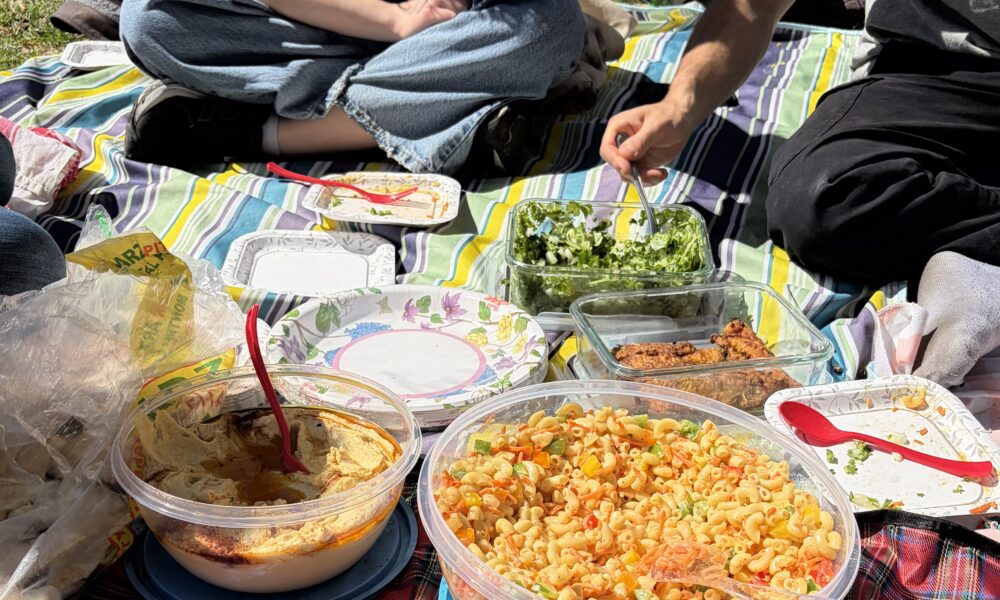

On May 9, Students for Palestine’s Honour and Resistance (SPHR) at McGill hosted a gathering to commemorate the two-year anniversary of Montreal community members establishing the Gaza Solidarity Encampment on McGill’s Lower Field. 743 days later, community members of all ages met for a potluck, arts-and-crafts, and a letter-writing campaign for Palestinian political prisoners, intended to raise awareness of, and inspire solidarity against, Israel’s prison conditions.
SPHR organizers set up picnic blankets with canvases, paints, and bags of red, black, white, and green beads for jewelry-making, offering homemade hummus and pita to anyone stopping by the event. Event-goers danced to the music of live drummers.
In an interview with The Tribune, two members of SPHR, Alex* and Moon,* explained how the day’s anniversary gathering symbolically returned members of the movement for Palestine to the site of the encampment, which was a space chosen to subvert administration-imposed restrictions on pro-Palestine organizing at McGill.
“With McGill censuring and censoring SPHR, we were not able to book spaces on campus [….] The encampment was a really rare opportunity for people to actually be together organizing in the same physical space,” Alex said. “It was also an occupation of this already stolen land.”
Alex and Moon expressed that the day’s event also demonstrated the persistent nature of student activism against Israel’s genocide in Gaza at McGill, which they stated will continue to exist until the McGill administration’s stance regarding the Boycott, Divest, and Sanction (BDS) movement changes.
“Universities see [student activism] as having a four-year shelf life,” Alex said.
“But SPHR has been an organization for over 20 years, and despite students coming and going, the movement has never died down,” Moon added. “As long as McGill is still invested in those companies that kill our people, we will be here to demand divestment.”
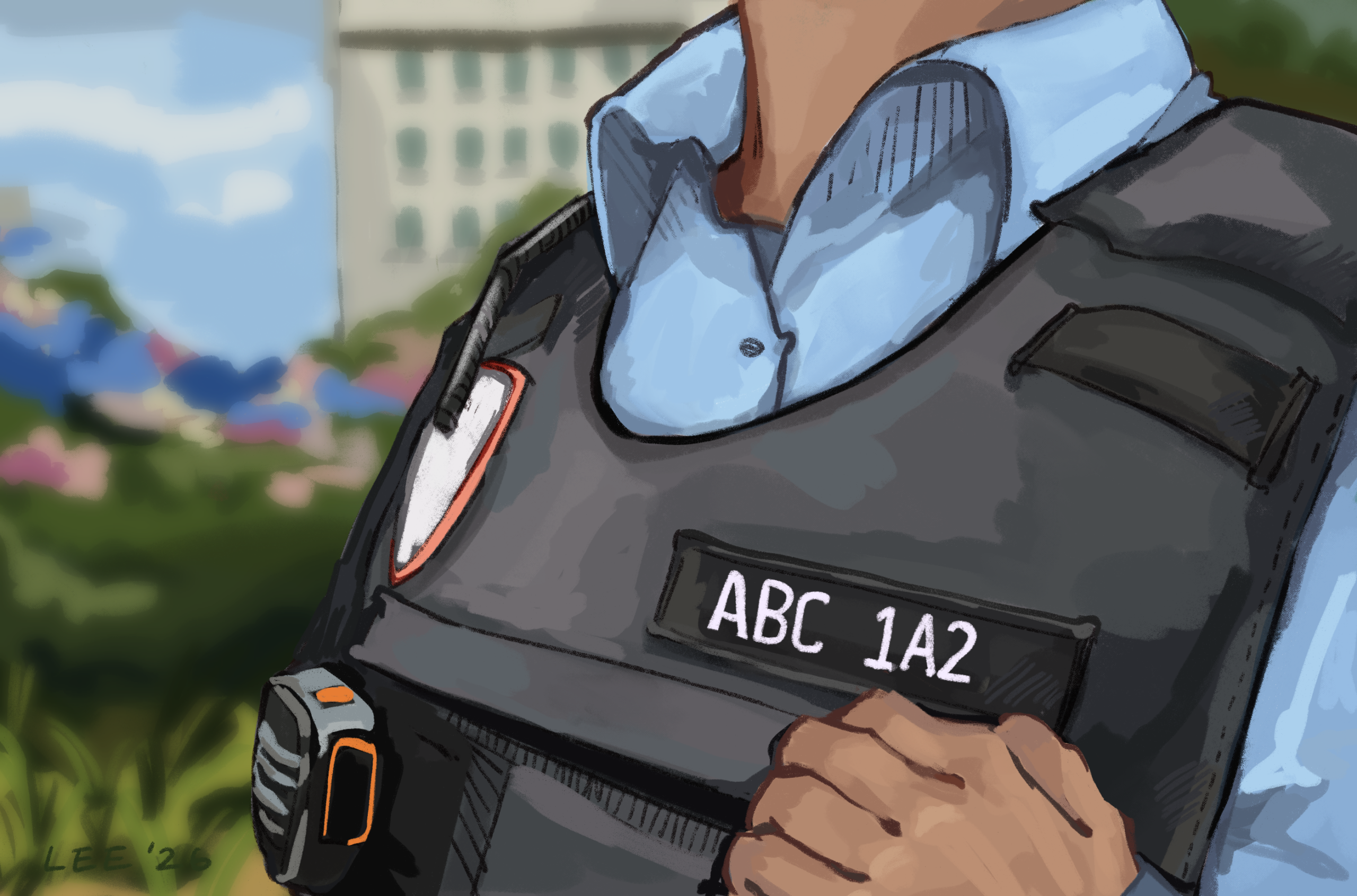
At around 4 p.m., a McGill security officer arrived at the field and questioned attendees about the event. The officer asked about the purpose of the gathering and the music playing over the speakers. Alex emphasized the discrepancy in McGill security’s treatment of SPHR’s event compared to other community gatherings taking place concurrently on the Lower Field.
“I see people sitting on campus getting some sun, I see people throwing Frisbees around, [and] nobody’s harassing them,” they said. “But when we come and sit just to have some music, have our flags up, display our identity proudly, all of a sudden, that raises questions from security.”
Alongside the encampment anniversary gathering, Montrealers gathered on rue Sherbrooke to protest Quebec’s Bill 21, Bill 94, and Bill 9: The three closely related provincial laws restrict public servants from wearing religious symbols at their workplaces. McGill security officers stood stationed in front of the Roddick Gates, facing the protest.
“When we look at McGill’s security posture, we see the same thing as always. All their security guards posted on the perimeter looking outwards,” Alex stated. “My question is, what are [they] defending?”
Alex added that although intense scrutiny by security officers is an ongoing issue in organizing contexts, it will not deter the movement for Palestine.
“We’re no strangers to checkpoints. We’re no strangers to stops and searches,” Alex said. “Our countries have been securitized, have been colonized, [and] have been dominated by Western imperial powers. We’re familiar with all this, and it doesn’t scare us.”
The event also incorporated a letter-writing session for Freedom for Palestinian Political Prisoners, a campaign sponsored by the Palestinian Youth Movement. The initiative seeks to send 10,000 letters to the 10,000 Palestinian political prisoners currently detained in Israel under isolated and dangerous conditions. As representatives of SPHR noted, these prisoners are being tried under discriminatory Israeli laws, making campaigns that raise awareness of these legal contexts and demonstrate solidarity with detainees crucial.
“Just recently, [Israel] passed the [Death Penalty for Terrorists Law] with a 99 per cent conviction rate, which ultimately sentences Palestinian prisoners to death by hanging,” Moon said.
“So, it’s important not to neglect our prisoners […] [so] that they know we’re here for them, that the world hasn’t forgotten them,” Alex added.
On the nearby Y-intersection, Ned,** a musician, photographer, and painter who regularly attends advocacy events in Montreal calling for Palestinian liberation, stood drumming on his darbuka. In an interview with The Tribune, he described how live music plays a role in cultivating a social movement’s momentum.
“When there’s music playing [on a speaker], it’s nice, but when somebody’s playing live music, it’s another level of attention that you can bring to the cause,” Ned said.
Ned also incorporates painting and photography into his art-based advocacy. For the past few years, he has painted illustrations on the stone columns of the Roddick Gates every day to commemorate Palestinians killed by Israel’s genocide in Gaza, only to return to campus to find his paintings washed away. Ned emphasized that regardless of such setbacks, Montreal community members remain committed to organizing against Israel’s colonial project in Palestine.
“Despite all of the censorship [by removing these pieces] and despite the illegal dismantlement of the [Gaza Solidarity Encampment at McGill], we’re still moving forward,” he said. “Today is very special [….] Everybody here is incredibly talented and is putting their bodies on the line to stand for humanity, to speak against the genocide [for] our people that are unable to speak about their own cause.”
Alex explained how local artists like Ned’s participation in SPHR-led and Montreal-wide organizing for Palestine reflects the movement’s importance and resonance beyond only the McGill student body.
“We’re not all students here, and that’s a talking point that the university has used to discredit people who took part in the encampment,” Alex said. “But this campus does not exist in a McGill bubble [….] We’re here to say that we’re part of Montreal [….] We’re here to pop that bubble.”
SPHR organizers further discussed ongoing attempts by McGill to disincentivize on-campus organizing for Palestine: the university’s 2024 uprooting of the white pine sapling planted by Kanien’kehá:ka women to commemorate the encampment; the McGill Senate’s implementation of a new Student Code of Conduct in November 2025 expanding McGill’s disciplinary response capabilities; McGill’s imposition of legal and disciplinary charges against students involved in the Gaza Solidarity Encampment; and, most recently, the McGill Board of Governors’ approval of the Identification Policy for Access to Properties Owned, Occupied, or Used by the University on April 23, allowing McGill security officers to request that anyone on campus present them with valid government identification, or remove their face covering.
Alex and Moon described how these attempts reflect McGill administrators’ frequent portrayals of pro-Palestine advocacy at McGill as representing only a minor fraction of the student body, despite also arguing the movement is of a threatening size and physically acting against it.
“This is a desperate attempt to simultaneously portray us as a small, fringe, and irrelevant group of students, but also as this larger than life, well-funded, externally-motivated entity,” Alex said. “How can we both be a small minority who the right thing to do is ignore, while also being a large existential threat to the university?”
Looking forward, SPHR highlighted the upcoming Nakba 78th Anniversary Protest they are helping to organize a student contingent for. The protest will take place on May 16, beginning at 2 p.m. in front of the Consulate General of Israel in Montreal.
For Moon, true engagement in pro-Palestine advocacy goes beyond demonstrating allegiance from afar, and must instead involve an active effort toward progress.
“We are a part of the fight for liberation on the outside,” Moon said. “I don’t want to go to an institution that is marked by the blood of my people.”
*Alex’s and Moon’s names have been changed to preserve their privacy.
**Ned preferred to be referred to solely by his first name.