


Latest News

Art, Arts & Entertainment

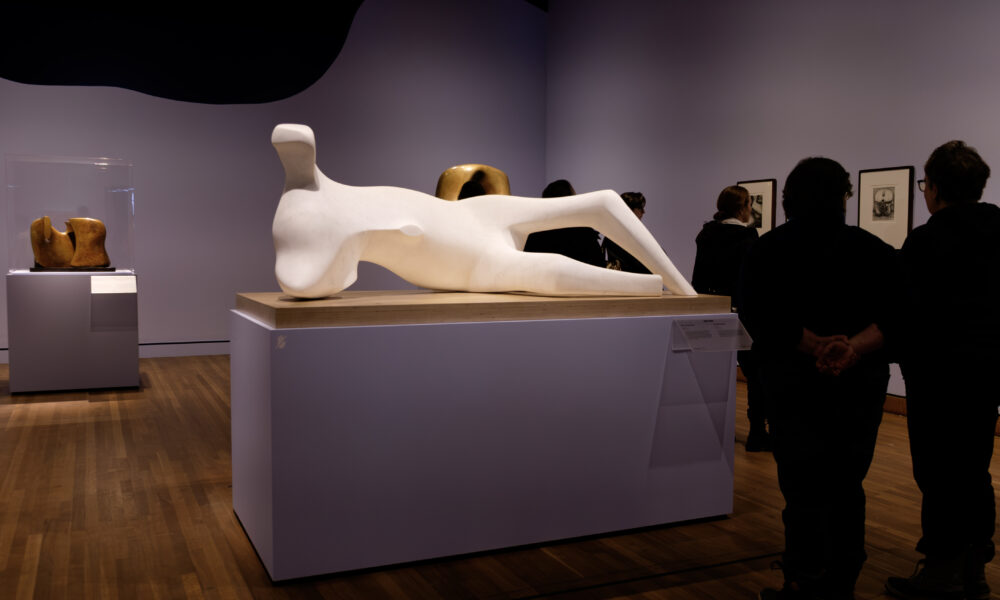
Reframing nature with Georgia O’Keefe and Henry Moore

The exhibition is not organized temporally. The rooms move from bones to stones, from landscapes to recreations of O’Keeffe’s and Moore’s studios. It weaves and jumps through the 20th century, from New York to Mexico to Scotland, from gastropod shells to irises to pelvises.

Georgia O’Keeffe and Henry Moore: Giants of Modern Art, organized by the San Diego Museum of Art and the Montreal Museum of Fine Arts, and curated by Anita Feldman and Iris Amizlev, opened in Montreal on Feb. 10. 

The exhibition has a certain preoccupation with twos: O’Keeffe and Moore, inner and outer, sculpture and painting, earthy bodies and human bodies. O’’Keeffe’s paintings feature objects in pairs: Feather and leaf. Sawbone and fungus. Moore’s sculptures often function simultaneously as frames and framed—you can look at them, but you can also look through them.

And if you stand at the right angle, you can see O’’Keeffe’s paintings through Moore’s sculptures. The exhibition space is set up to reflect the art inside; Moore-like keyholes in one room’s walls stretch partway to the ceiling, allowing space to complete the picture. Another room is divided with jagged, cliff-like shapes jutting out from either side—cliffs that could exist in an O’Keeffe painting.

Recreations of the artists’ studios sit roughly in the middle of the exhibition, not at the start. Moving through the exhibition, it becomes clearer why. O’’Keeffe and Moore focused on objects that had lives before they did: Bones, mountains, shells. The artists are perhaps placed partway through the journey because the story started long before either of them lived. 

Where does the body end—and does it end at all? Moore’s sculptures can be read as reclining bodies, but also as landforms, dipping in and out, curving at parts. One of O’Keeffe’s paintings—perhaps my favourite in the exhibition—Barn with Snow, depicts a winter landscape at Alfred Stieglitz’s farm. The Gallery label includes a quote from O’’Keeffe, written about Gaspésie: “[T]he beautiful barns looked old, as if they belonged to the land.” She visited Quebec in 1932 and became enamoured with the Gaspé Peninsula. Far from her New Mexico studio, she encountered another landscape at once soft and rolling; jagged and foreboding—land that doesn’t seem to finish where bones and barns begin. Barriers, beginnings, and endings often blur within the exhibition. Perhaps they don’t exist at all.

Zooming in and out, the story changes. O’Keeffe and Moore look at objects so closely that they become something else entirely: Moore’s Working Model for Oval with Points seems to be a study of peculiar shape, something not often found in nature—but was inspired by observing the inside of an elephant skull. A point existing inside a shell. 

O’Keeffe’s From the River Pale (1959) derived inspiration from a bird’s-eye view of rivers snaking through landscapes (with the rapidly rising popularity of air travel likely in mind). I initially thought it was an up-close shot of a leaf. But O’Keeffe modelled the shape and flow of the rivers from a tree branch. A close view of a branch becomes a wide view of a landscape: Both are equally detailed.

If the whole exhibition is considered to be the shell, then the paintings, sculptures, sketches, and perhaps even museum-goers, become the invisible machinations inside. The curvature of bone inside the elephant skull; the careful folds of the jack-in-the-pulpit. Exhibition spaces made by their art, art made by exhibition spaces; museums made by people, people made by museums. 

Digital-media conceptions of learning often result in information overload at high speed. Stories are everywhere, all of the time, accessible immediately. But perhaps a greater volume of knowledge can be procured from single sources—taking the time to know something you care deeply for. O’Keeffe and Moore focus intently upon certain objects unfolding over time. Bones and flintstones take time to record their stories and emerge. Flowers take time to unfurl. O’’Keeffe and Moore take the time to stop and look.

“When you take a flower in your hand and really look at it, it’s your world for the moment. I want to give that world to someone else. Most people in the city rush around so, they have no time to look at a flower,” O’Keeffe wrote, her quote featured on the gallery walls. “I want them to see whether they want to or not.”

Georgia O’Keeffe and Henry Moore: Giants of Modern Art runs until June 2, 2024. Tickets are available online or in person at the MMFA. 

Off the Board, Opinion

Go Club, Go

Taking pride in silly things is one of life’s little pleasures. Developing a minor god-complex over these same silly things is cautionable. Yet, as founder, captain, and president of my high school Go Club, I held a minor tyranny over a room full of my own classmates weekly—and I turned out just fine. 

Go is a Chinese board game, thought to be the oldest board game in existence. In a sign of the fast-approaching technological singularity, an artificial intelligence model finally managed to beat a top professional player in 2016, shocking those who view Go as an innately human art. The difficulty––previously thought only to be playable by the intuitive human mind––lies in the game’s sheer complexity. Pieces are placed on the intersections of a 19 by 19 grid, resulting in a number of possible combinations that are simply incalculable by me right now.

The gameplay itself is aesthetically pleasing, with a controlled clicking of polished shell and stone pieces onto the tight grid of a wooden goban. Not that my Go Club had the traditional clamshell pieces. My Go club had plastic pieces with magnets glued preciously into their centres. We had cheap magnetic boards, and small plastic bowls to collect captured stones. We also were eating lunch, and my friends had very sticky fingers. 

The time spent hand-washing pieces aside, being Go Club captain was a very cool position. To be clear, I mean cool as in popular, as in major spendable social capital. In my eyes, Go Club captain was as cool as one could get in a college-prep high school where the primary form of bullying was GPA mocking. And, as a little lesbian nerd in Texas, it was a place where I managed to blossom a minor superiority complex, like a little bespectacled wildflower poking her young, smackable head through a concrete sidewalk. 

Every Friday, I would take great pride in laying out the boards and helping pair people off as they came in. Then, I would stalk around the room, making comments on gameplay and giving tips. Mind you, I was not very good myself, so I’m not quite sure how seriously my commentary was taken. I reached a casual level of 15 kyu (25 kyu is total beginner, and one is almost professional) according to the online platform I spent my free time playing on. 

I was, however, very obviously passionate. I would play online Go during lectures and on the bus, I would teach anyone who’d sit still with me. I bought boards, founded a club, and even ran a meme account in the hope of boosting participation. 

Members would flag me down, asking me for help. We would work through moves, putting down pieces to try out variations and discussing which types of stone formations were most  efficient. The atmosphere was laid-back, with glimpses of passion and thrill that come from executing a complex strategy. Despite my hoodies, my messy backpack, and my generalized teenage grossness, I felt respected in the space I had created. 

Maintaining your confidence is hard. Academics are competitive, and require an ability to compartmentalize that can break down when life gets rough. You will move, and lose friends and spaces that grounded you. And, worse, there will always be someone cuter than you (so I’ve heard). Constant ego-death is a beautiful and normal byproduct of young adulthood. 

So, get freaky with what you take pride in. Remember, the more niche, the less competition. As long as there isn’t another ex-Go Club captain, founder, and leader-for-life in my immediate vicinity, I will always walk with a little––but perceptible––pep in my step.

Student Life, The Viewpoint

To tip or not to tip: The question of gratuities in the age of ‘tipflation’

Across Canada, tipping is a central part of the dining and service experience, considered by many to be a form of expressing satisfaction with the service provided and a personal reward for exceptional staff. However, research released last year by the Angus Reid Institute has uncovered that 78 per cent of Canadians now believe that tipping is expected, regardless of the quality of service.

With many individuals employed within the tipping-based industry—particularly students—relying on gratuities as a critical source of income, consensus regarding tipping etiquette is increasingly causing divisions as the cost of living rises.

In conversations with The Tribune, students from McGill and across Montreal expressed their relationships with tipping—both on the giving and receiving ends.

Saaya Fujita, an exchange student from Japan and employee at the Japanese restaurant Japote in Montreal, highlighted her complicated relationship with Canadian tipping culture.

“As there’s no tipping culture in Japan, I’ve experienced many awkward situations here in Montreal. I was told I don’t necessarily have to tip, but one time I was forced, and many other times I’ve felt so much pressure,” Fujita said.

However, Fujita’s experience as an employee within the tipping industry in Montreal has also had its benefits.

“As a worker though, the experience has been quite different. I’ve worked both in Japan and Montreal,” Fujita said. “In Japan, it’s taken for granted that workers behave well, even though they cannot [receive a] tip. Here, however, I can get a lot just by doing service as I’m used to, which makes me feel good.”

Another young person belonging to the international student community at McGill and thus unfamiliar with this phenomenon is Michael Cunningham, a Ph.D. student from Ireland. For Cunningham, tipping has lost its meaning in Canada, since it is an expectation rather than a reward for exceptional service.

Cunningham’s detachment from the personal implications of tipping is not a new feeling; “tipflation” and “tip-creep”—the spreading and embedding of tipping into new and existing industries—are on the rise, particularly with many point-of-service transactions now involving automated tipping on card machines.

For Carly Beard, U2 Arts and employee at Gerts Bar and Café, her position as a student means she appreciates the difficulty this creates for student customers.

‘‘You should be able to click a button to choose to tip, not feel obligated to,” Beard said. “I try not to look at people when the screen comes up, as I don’t want to influence them.”

Amongst the rising anti-tipping discourse, however, lies a significant number of students who rely on tipping as a critical source of income. 

For Silvano Vezio, a first-year psychology student at the Université de Montreal and tipping-based employee at Ferreira, a Portuguese restaurant on Peel, tipping is important for both employers and employees.

“I think [tipping] should be encouraged [or] even mandatory in places where you receive service,” Vezio said. “We know that […] [places] that encourage tipping can’t afford to pay their employees at a high hourly rate [….] I’m a student and can’t work more than two days a week […] I’m working less but getting an advantageous pay.” 

However, for U2 Arts student Lyla Stauch, tipping is not always necessary for the survival of businesses. 

“There’s now an expectation for everyone to tip regardless […] I think this represents a deeper structural issue.”

Stauch’s argument is not a new one; rather, this sentiment is shared across the country. The Angus Reid Institute study has shown that 73 per cent of Canadians now believe that tipping is a way for employers to underpay their employees. With tip-based workers receiving a lower minimum wage of only $12.20 in comparison to the non-tip wage of $15.25, many are increasingly noticing an overreliance on customers for providing more substantial wages to staff.

To combat this, some establishments such as vegan restaurant Folke in Vancouver or popular restaurant Larry’s in Montreal have recently adopted a no-tipping model, where wages are being increased in order to compensate for a lack of tipping. Whilst this model has yet to be widely adopted elsewhere, this move appears to many a step in the right direction for tackling this culturally embedded issue, encouraging employers to take responsibility for providing adequate wages to employees.

McGill, Montreal, News

Anthropologist and filmmaker Sheila Walker showcases documentary and discusses the plurality of Black communities

Cultural anthropologist and documentary filmmaker Sheila Walker hosted a discussion for McGill faculty members and students on the morning of Feb. 14 on the individuality of Black peoples across the globe, especially outside of the Atlantic world. On the evening of Feb. 14, Walker’s documentary, Familiar Faces, Unexpected Places: A Global African Diaspora, was screened at the McCord Stewart Museum

Hosted by McGill’s Faculty of Law, the event began with an acknowledgement from Frédéric Mégret—Co-Director of McGill’s Centre for Human Rights & Legal Pluralism—that James McGill, the university’s namesake, enslaved at least five Black and Indigenous people throughout his life. Mégret recognized that McGill’s wealth, which was built by exploiting the labour of the people that he enslaved and his participation in transatlantic slavery, was part of the foundation of the university. 

Tamara Thermitus, Boulton Senior Fellow in the Faculty of Law, subsequently introduced Walker and spoke to the importance of including Black history in curriculums.

“I think it’s important to talk [about the fact that] there’s not a Black community, but there’s multiple Black communities. When we say there’s only one Black community, we erase part of our history again,” Thermitus said. “Black History Month is not only an event, but it’s also a time for reflection and taking stock.”

Walker began by highlighting the central theme of her research: Exploring Black communities outside of North America and Africa. She also asserted that the history of genocide of Indigenous peoples and the mass enslavement of Black people is what shaped the continents. Thus, Walker argued, defining all of the Western hemisphere as a “European creation” leaves out the majority of the historical demographics of the Americas. 

“There’s a problem with seeing the Americans then as a European creation [….] It was originally characterized as a meeting of two worlds,” Walker said. “I think some Native Americans [said] ‘What do you mean meeting? It wasn’t a meeting.’ And then some Africans said, ‘What do you mean two worlds? What about us?’ So, it was really a meeting of three worlds.” 

Several hours later, Walker’s film Familiar Faces, Unexpected Places: A Global African Diaspora was screened at the McCord Stewart Museum and was followed by a joint discussion between Walker and Michael P. Farkas, President of the Board of the Roundtable on Black History Month. Walker’s 30-minute film focused on the global nature of the African diaspora, shedding light on Black communities such as the ones in Argentina, Chile, and India. The film also looked into various aspects of global Black spirituality, focusing on Black Saints in the Catholic church. 

In an interview with The Tribune, Walker explained that the film is made with footage that she shot with no intention during her travels, but that ended up showing the commonalities and differences within various Afro-communities. While she was well-versed with the African diaspora in the Americas, she became interested in researching non-Atlantic Black communities after a 2006 conference in India. 

“While there, I met Afro-Indians from various parts of the country,” Walker said. “Did I know they were there? No. So, it was a great experience, and then I got to know more about the global nature of the African diaspora, and the sense of consciousness of peoples’ belonging to the African diaspora.” 

Following the film screening, Sarr led a discussion with Walker and questioned whether the countries that Walker investigated were conscious of having Black communities. 

“Many [countries] like Argentina, there’s a lot of denial […] that there’s even a Black community. As a minority group in the country, they are severely marginalized [….] Especially [in] Turkey, India, Bolivia, where it’s less known that there’s even a Black community,” Sarr said. 

Walker went on to explain that while there are countries, such as Chile, with governments that deny the very existence of African citizens, it’s becoming increasingly difficult to take this stance as African peoples across the globe have mobilized for their recognition. 

“All the countries in the Americas have organized groups of African descendants, in places where they’re generally denied to exist,” Walker said. “In the past 20 years, they have done so much to recuperate their African culture.”

Science & Technology

A look into the economics of cannabis legalization

With cannabis as the most popular illegal drug worldwide, the recent increase in legalization has sparked discussions among economists. Upon analysis of legalization, impacts on crime and violence, drug consumption, and taxation, there have been calls for a review of the cannabis market and its reformation policies by governments and industry experts alike. 

Should governments fight legalization policies, or do they assist with reducing the influence of the black market? Can the legal market compete with the black market? These questions are addressed in “Weeding Out the Dealers,” a paper published in the Journal of Economic Behavior and Organization. 

In this paper, Tiffanie Perrault, a postdoctoral researcher in economics at McGill, examined several policy goals, recent legislative reforms, and the outlook of the cannabis market in Canada. Perrault is also dedicated to studying the different ways the legalization of marijuana can be implemented to pave the way for a future of regulation and reform. 

From a public policy perspective, legalizing and taxing cannabis can bring in a new source of revenue. Looking to the US, the state of Colorado collected USD 325.1 million of tax and fee revenue in 2022, and the state of Washington collected USD 515.2 million in the same year. 

According to existing research, policies controlling drug use through taxation are more efficient than prohibiting the drug. Overall, prohibition fuels violence, high incarceration rates, and racial discrimination while stretching law enforcement resources thin. In contrast, in the US and Canada, legalization leads to a decrease in overall criminality and generates tax revenue but at the cost of increasing overall cannabis consumption. 

The primary focus of Perrault’s research is on legalization and taxation, and how the legal market can start to overtake the black market. 

“In order for the legal retailers to actually compete against the black market, they need to introduce more competition,” Perrault explained in an interview with The Tribune. “You need [a] quality dimension, and the other important aspect is risk.” 

The researchers broke consumer behaviour in relation to the cannabis market into five areas, for instance risk aversion, attention to legality, and reactions to price differences. 

Furthermore, Perrault discussed a strategy to fight against the black market by reducing its ability to compete with the legal one. 

“The idea is that you want the black market not to be able to compete anymore, so you want to push their price down to the marginal cost,” Perrault explained. 

By forcing them to lower their prices, the black market’s profitability and competition will diminish significantly. Based on the article’s model, by not repressing illegal providers, we allow them to compete fiercely and push the price of cannabis down, increasing consumption of illegal cannabis post-legalization by 64 per cent. 

Despite the introduction of new reforms, Perrault noted that the black market will always respond strategically to keep their businesses alive. One mistake policy makers often make when rethinking cannabis policies is focusing solely on the price of products and neglecting their quality. 

“So, we need this improvement in quality, and then it enables you to raise the price [of legal cannabis]. And because you raise the price, you can control the increasing demand that is subsequent to legalization,” Perrault said. 

In the end, Perrault’s study highlights the relationship between legalization of high-quality cannabis and sanctions against illegal trade. Legalization will be effective at regulating the demand for cannabis if consumers are compelled to buy good quality, legal cannabis rather than uncertified illegal products, and, at the same time, if illegal suppliers are targeted by repressive measures that drive them out of business. 

With continuous efforts, governments will weed out the dealers of the cannabis market while curbing the legal demand for the drug by raising its price. 

Campus Spotlight, Student Life

Bloody good work

If you are a McGill student who menstruates, you’re likely familiar with those seemingly-magically-refilled little caddies in the washrooms stocking plenty of tampons and pads for those in need. The force behind these little baskets is no period fairy, mind you; rather it is the team of six McGill students running the Students’ Society of McGill University (SSMU) Menstrual Health Project.

The SSMU Menstrual Health Project, which started in 2017, aims to provide free period products to the McGill community. It does so by stocking many of the women’s and gender neutral washrooms on campus with pads and tampons, as well as providing free menstrual discs, menstrual cups, tampons, pads, and period underwear at monthly on-campus pickups.

The reasoning behind this initiative is simple: Many are now realizing that menstrual products are a basic hygienic need, akin to toilet paper or soap, but can be very costly. 

Julia Miracle, U4 Arts, is the SSMU Menstrual Health Project Commissioner. She credits much of the program’s momentum over the past few years to funding from student fees and from the Sustainability Projects Fund (SPF).

“We had a pretty big rollover of student fees from COVID-19 years, and we received $50,000 from the SPF in 2022, so we were able to scale up and out so much bigger and faster than [programs at] other universities,” Miracle explained in an interview with The Tribune.

On top of this, her committee works to secure partnerships with period brands such as Saalt, Aisle, and Joni, which have been instrumental to the success of the program. Joni  provides the project with bamboo-based disposable products like tampons and pads, while Saalt and Aisle supply reusable products for monthly pickups, like menstrual discs, cups, and underwear. 

These initiatives are growing nationwide, especially following recent legislation from the federal government requiring free menstrual products to be provided in federal workspaces. Since its debut in 2017, the project has grown in recognition on campus and has been well-received by the McGill community, menstruators or not. 

“When I first started on the team in 2021, no one knew about us, and we hadn’t started the monthly pickups,” Miracle said. “It’s been really cool to see how big this has gotten and how much more we’ve been able to communicate with students about our goals.”

For Miracle, much of this communication is around ending period stigma. 

“I think a larger goal for us is to kind of shift the needle in the conversation as well by talking about it in a way that’s not gendered and not like making it on the burden of the individual,” she said.

At monthly pickups, Miracle’s team puts this into action by trying to convince even those who don’t menstruate to take a box of products to keep at hand in case someone else is in need. 

“You never know if someone else is going to need it; just throw it on a shelf in your washroom at home,” Miracle explained.

The initiative’s seemingly seamless execution can be credited to many factors, funding from the SPF and brand partnerships among them. However, Miracle recognized one vital factor above all: The four coordinators on the team who run the program on the ground. 

“Whenever you see a product in the washroom, just know that that’s like our small team of four people going out there every week, keeping those stocked, and I want to give them more credit.”

The SSMU Menstrual Health Project will be hosting its next monthly pickup on February 23, from 11 a.m.-2 p.m. in the Leacock lobby.

Science & Technology

“Defying time and season:” Black McGill scientists through history

The history of science and technology is still reckoning with the contributions of Black researchers. White supremacy has deployed the sciences, and their ideal of objectivity, to dehumanize Black people, experiment on them, and legitimize slavery, colonialism, and dispossession. With the fights for medical and environmental justice still urgent and Black scientists excluded from these critical disciplines, there is no better time to explore the deep history of Black scientists’ struggles and innovations. The Tribune discusses some of the Black scientists whose presence and research have shaped this campus, people who former McGill professor Barbara Althea Jones would have said, “defied time and season.”

William Wright (1827-1908)

William Wright was the first Black doctor (and first person of colour) to receive a medical degree in Canada and become part of British North America. Born in Quebec City while slavery was still legal, Wright taught at McGill for 30 years as Chair of Materia Medica (pharmacology) and served as co-founder and editor for the journal Medical Chronicle. When students eventually voted him out for not keeping up with medical developments, he became ordained as a priest.

Charles Lightfoot Roman (1889-1961)

Roman was the grandson of runaway enslaved people who took flight through the Underground Railroad. Roman’s uncle and namesake, Charles Victor, also worked as a physician and surgeon with specialties in ophthalmology and otolaryngology. The elder Charles dreamed of attending McGill, and Charles Lightfoot ultimately fulfilled this ambition, graduating in 1919 after serving in the First World War. In Quebec, he was also a leading voice in the field of industrial medicine.

Kenneth Melville (1902–1975)

While you might know Kenneth Melville from the eponymous Black Faculty Caucus, Melville was a pharmacologist and civil rights icon in his own right. From his experience as a top student at McGill in 1926 to his research proving that adrenaline is not a sympathetic neurotransmitter, Melville broke barriers in the sciences at McGill as Chair of McGill’s Department of Pharmacology and Therapeutics. He fought discrimination both in Montreal and abroad, once being arrested at a 1960 medical congress in Atlantic City after the cafeteria refused to serve him and fellow scientists because they were Black.

Barbara Althea Jones (1936 – 1969)

Jones was a Trinidadian geneticist who served as an assistant professor at McGill until she died suddenly at the age of only 32. She was the first Caribbean woman to receive a PhD, which she completed in 1965 at Cornell. A “geneticist by vocation, and poet by avocation,” Jones had a vibrant career as a poet, performer, and visual artist. Her collection of poetry, Among the Potatoes, registers the natural world, the Caribbean, the monotony of campus life, and the Black struggle, evincing modernist technique, avant-garde flourish, and radical worldliness. Whether she was writing poetry, teaching lectures, advocating for Black Canadians, or collecting science textbooks, Jones made clear that she was working “Towards a new black man, towards the full realization of man’s consciousness and potential, and towards a new humanism.”

Julius Garvey (1933-)

Son of pan-Africanists Marcus Mosiah Garvey and Amy Jacques Garvey, Julius Garvey received his undergraduate and medical training at McGill. As a cricketer, Garvey represented Canada in a game against England. In 1961, he interned at the Royal Victoria Hospital before moving to the United States for the rest of his surgical career. Garvey was only seven when his father Marcus died, and he would lead the unsuccessful charge to have President Barack Obama posthumously pardon his father, one of the most influential Black nationalists of the 20th century.

Dorothy Thomas Edding (1935-2023)

In the 1950s, the young Thomas Edding travelled from Jamaica to Montreal to start her university studies in physiotherapy. By 2001, after 11 years of spearheading collaborative work with the University of West Indies (UWI) as a McGill professor, Thomas Edding would help build UWI’s School of Physical Therapy with an undergraduate curriculum and, in 2009, a graduate curriculum. A community builder in Montreal as well, Thomas Edding chaired scholarship and educational leadership at the Quebec Black Medical Association and the Women’s Canadian Club of Montreal.

Science & Technology

Immunotherapy and artificial intelligence for melanoma treatment

Malignant melanoma, a cancer that originates in melanin-producing cells, is the deadliest variety of skin cancer. In the past 11 years, immunotherapy has increased the median survival rate of advanced melanoma from nine months to six years. However, it is still a developing treatment.

Farida Zakariya, a masters student in McGill’s Division of Experimental Medicine, explored the use of artificial intelligence (AI) in immunotherapy of melanoma in a new review paper.

“One major problem of immunotherapy is the diversity in response rate across different cancer types,” Zakariya wrote in an email to The Tribune. “Some cancers like melanoma are very responsive to immunotherapy while others are not or become resistant over time.” 

Currently, the most common immunotherapy for melanoma stimulates the production of antibodies that bind to immune checkpoint inhibitor proteins. These proteins are usually found on the surface of healthy cells and inhibit cytotoxic T-cells—an immune system “weapon” that recognizes and induces cell death in infected or cancerous cells. When a T-cell comes into contact with a checkpoint inhibitor protein, it receives a signal to turn off and leave the cell alone. 

Cancer cells sometimes produce these same checkpoint inhibitors to avoid detection. When a patient undergoes immune checkpoint inhibitor therapy, checkpoint inhibitors become covered with antibodies, T-cells are inhibited from turning off, and the cancer is recognized and killed.

However, not all cancers are responsive to treatment, and some patients experience a recurrence of their cancer with newfound resistance. Thus, developing different therapies is crucial. 

The potential role of mutanome in developing immunotherapies is a new subject of research. 

“Mutanomes are the entire mutations that underlie a particular type of cancer. Every cancer is different and within the same cancer type, the underlying mutations differ from person to person,” Zakariya wrote. 

Via sophisticated whole genome profiling and next-generation sequencing, researchers can now obtain the complete genomic profile of the mutanome of each patient and an understanding of its spatial folding in the genome for more precise treatment

Vaccine immunotherapies take data from mutanome sequencing to re-create patient-specific neoantigens—unique proteins that cancer cells present on their surface. If a range of expected neoantigens are injected into the patient, T-cells learn to diversify their targets, and the tumor is destroyed. 

In reality, however, cancer treatments are never this straightforward. Therapies are altered by differences in the absorption and metabolism of treatments. Furthermore, there is a real lack of research into how these responses vary by ethnicity, sex, and disease stage, an information gap that causes groups of patients to slip through the cracks. 

Genetic variations between patient’s genomes, along with the mutations of the cancers themselves, create an overload of data for researchers to consider. This is where AI comes in. 

From identifying neoantigen DNA in the mutanome to developing personalized vaccines and predicting metastatic risk—the chances that the cancer will spread—AI’s ability to detect patterns in large data sets has the potential to revolutionize individualized treatment. 

“[AI] will greatly eliminate most of the barriers that the large scale sequencing required for the application of mutanome [sequencing] in melanoma immunotherapy,” Zakariya wrote. 

While AI is already changing the landscape of treatment and drug discovery, it has limitations: The dynamic relationship between the mutanome, immune system, signaling pathways, and the patient’s biological makeup and environment are challenging for current static models. 

“This [problem] is not something AI can solve for now, but it can increase the turnaround time of the drug discovery process,” Zakariya wrote, “[This] enabl[es] more hits to be identified within a short period of time and increas[es] sequencing and testing capacities. Thus, ensuring that more medications will be available for cancers in the near future.”

Zakariya is currently researching the effects of inhibiting a protein linked to cancer resilience to investigate its role in the tumor’s response to immunotherapy. “I am hoping that the paper will unlock new pathways that can be explored by researchers in the pursuit of a cure for cancer.” 

Opinion

The Deadly “Start-Up Nation”

Three McGill course trips to Israel have something in common: Under the guise of promoting technological innovation, they tout the name “Start-Up Nation.” This moniker derives from the 2009 book Start-up Nation: The Story of Israel’s Economic Miracle, that examines how such a young state now boasts the highest number of start-ups per capita in the world. Adopting this narrative, the Desautels Faculty of Management and the Faculty of Engineering lead heavily subsidized, accredited courses on touring the supposedly innovative tech start-up scene of Israel. In these courses, the faculties portray technological innovation as an apolitical, neutral force striving for progress and social good. 

In reality, these start-ups produce the technology foundational to Israel’s surveillance system. By way of cameras, drones, and satellites, Israel uses this tech to illegally profile, detain, prosecute, and kill Palestinians in the West Bank and Gaza. Critics of Israel are not alone in recognizing the connection between start-ups and violence—the Start-up Nation authors themselves note that the omnipresence of the Israeli military is a major factor in the concentration of tech start-ups. However, the authors consider this link to be a beneficial byproduct of young soldiers honing their leadership, rather than a direct consequence of American and Israeli funding that fuels technological and imperialist innovation for military and police activities. These operations, which uphold occupation and perpetrate genocide, are justified through the discourse of opportunity and innovation. Under the guise of entrepreneurial spirit and evident across several faculties, McGill’s contribution to Israeli settler-colonialism is extensive and in a long history of reciprocal collaboration between McGill and genocidal Israeli institutions.

Although course descriptions for the Start-Up Nation courses are coded with the innocuous language of Silicon Valley innovation, they are not far from the land-grab tactics used to entice white Europeans to settle Turtle Island with promises of cheap, fertile land. Touted as a trip to the nation of opportunity, the promotion for the Engineering course FACC 501 encourages McGill students to pitch business ideas to Israeli venture capital firms aiming to attract foreign business owners. Additionally, during the FACC 501 course, McGill students frequently learn from model start-ups which are, in reality, military contractors for the Israeli Occupation Forces. In 2022, Professors Jiro Kondo and Brian Rubineau, Desautels Faculty Scholar in “EDI and Ethics,” brought students to visit Au10tix, an Israel-based facial recognition company that provides intelligence for airports and border control and is affiliated with Shin Bet, the Israeli Security Agency. 

Israel’s start-up economy is not an organic phenomenon—it is a continuously manufactured attempt to legitimize Israel’s statehood amidst its project of settler colonialism. Domestically, the Israeli regime relies on imperialist tactics of military dominance to maintain its occupation. On an international scale, Israel needs investments from foreign capital to establish economic legitimacy and independence in a global market system. In the Global North, programs such as McGill’s FACC 501 are essential in facilitating this influx of capital. Particularly in the tech market, Israeli investors incentivize the migration of new business ventures to Israel, benefitting from government and military subsidies for “innovation.” By way of direct financial incentive, McGill students participating in the FACC 501 course are encouraged to establish new businesses in Israel, thereby expanding Israel’s settler economy. Thus, student meetings with venture capital firms do not serve as innocent networking opportunities—they are a necessary component of Israel’s colonial project, and ultimately, a form of settlement.

The Start-Up Nation courses stand out at McGill because they are heavily subsidized, advertising that nearly all participant expenses are covered by gifts from external donors. One major donor is Heather Reisman, Indigo Books founder and former Governor of McGill, who also created the HESEG foundation for ‘lone soldiers’ to provide funding to foreigners who join the Israeli military. Whether sponsoring university students networking with military contractors or funding young Canadians who join the Israeli regime, Reisman’s “philanthropy” serves a clear purpose. By facilitating the export of Canadian capital and personnel, Reisman’s donations at McGill bolster the system of international economic and settler exchange that legitimizes the Israeli state—and by direct extension, the violence of its occupation of Palestine. The Start-Up Nation courses stand as undeniable evidence of our university’s deep-seated support for the Israeli occupation and the genocide of Palestinians—a stance which echoes McGill’s many histories and ongoing participation in colonial violence. 

Science & Technology

Searching for sustainable heating methods in McGill’s basements

With the advent of sustainable architecture, complex and innovative techniques for increasing energy efficiency have proliferated. But what if the key to this puzzle lies in the basements of 19th-century Canadian institutional buildings, built to resist the extreme cold of Canadian winters prior to the widespread adoption of electricity?

In particular, McGill’s Royal Victoria Hospital (RVH) and the original Centre Block on Parliament Hill share an intriguing system for natural heat recovery called a thermosiphon, which uses some clever architecture to recirculate hot air throughout the building. The RVH site currently hosts McGill’s New Vic Project, which is the subject of an ongoing lawsuit and investigation as the Kanien’kehá:ka Kahnistensera (Mohawk Mothers) fear that there may be unmarked Indigenous graves on the site. 

In a recent study published in iScience, Anna Halepaska, a PhD candidate in McGill’s Peter Guo-hua Fu School of Architecture, and her colleagues, Annmarie Adams and Salmaan Craig, sifted through archival records, performed calculations, and conducted experiments in order to understand the dynamics of the RVH’s thermosiphon.

The process started by figuring out exactly what the system even looked like in the first place. 

“It was a very long, slightly confused process of discovery,” Halepaska said in an interview with The Tribune. “We have all of these archival drawings from the 1890s when [the hospital] was first built that show many different possible systems, and we really weren’t sure which was the final one we were working with.”

Having followed the architectural paper trail, the researchers had enough information to start theorizing about how the thermosiphon system in the RVH may have worked and do some preliminary calculations.

“The concept with the thermosiphon, essentially, is like siphoning gas out of a car,” Halepaska explained. “So you’re pulling a fluid against its natural tendency.”

The architects of the RVH achieved this by using another necessary part of the building: The exhaust chimney, which was roughly 20 metres tall and vented both the exhaust air and the smoke from the hospital’s furnace. The exhaust, naturally rising up and out of the chimney,boosted by the heat from the furnace, created a low-density pocket beneath it. 

“All of that [air] rising up, it needs to be replaced with something,” Halepaska said. “So the designers used the siphon to pull air up to the wards and then back down to the basement.”

This “used” air, which had circulated through the hospital and was pulled back down to the basement, was then vented out through the exhaust chimney. On its way to the exhaust chimney, the warm air flowed through a brick channel, heating the brick as it travelled. This channel, in turn, heated up the “plenum,” where new, cold air was taken into the building. 

This scheme allowed for a degree of “preheating” the incoming air, solving a critical design issue for buildings in Canadian climates: The traditional method of heating air used heat transfer from hot water pipes, but in the frigid Canadian winters, cold air straight from the outside ran the risk of freezing the water and bursting the pipes. 

So this was the concept: Using the motive force from the exhaust chimney to cycle used, warm air back through the basement, where it could heat up incoming air before it hit the hot-water pipes. But the question remained—Did it work? The researchers set out to answer this question through a series of experiments. 

“The first set of experiments was just understanding how the flow loop circulated, without even getting into heat recovery,” Halepaska said. 

Halepaska’s team started with a salt bath experiment, which utilizes the density difference between saline and freshwater to mimic the density difference between hot and cold air. Following this, they employed a larger model, which used actual airflow to track the change in temperature gradients. Finally, they developed a mathematical model to generalize the behaviour that they observed. 

The system functioned nicely, creating a stable flow loop, and recovering heat at close to 50 per cent efficiency. But there was a catch: In order for the air to cycle, there has to be a temperature fluctuation within the building. 

“For heat recovery to happen, there’s this kind of implicit necessity that there is a temperature difference between spaces, which is really contrary to the Western idea of thermal comfort in a building,” Halepaska noted. “We have this idea that every room in every building, and every season, in every climate, should be 21 degrees Celsius, which is absolutely ridiculous.”

Read the latest issue

Read the latest issue