

Latest News

Sports

Delving into the world of sportswashing engulfing pro-sports

What is sportswashing? 

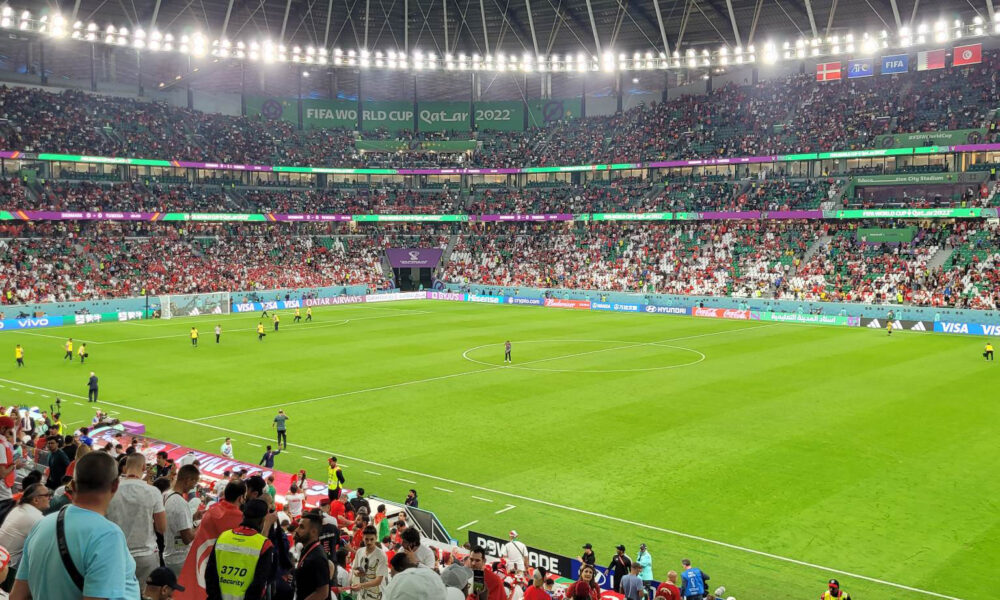
Sportswashing has been the buzzword of choice for Western commentators in the sports world for the last three years. In rapid succession, Saudi Arabia’s sovereign Public Investment Fund (PIF) acquired Newcastle United in Oct. 2021 then bought into the top tier of men’s professional golf via LIV Golf, the PGA Tour, and DP World Tour merger. Then, the 2022 World Cup was held in Qatar. To top it off, Saudi Arabia nationalized four soccer teams in their own Saudi-Pro League, providing the league with limitless cash and newfound access to top-tier talent. First to join was Cristiano Ronaldo in Jan. 2023, and the league has since the signed big names such as Karim Benzema, Sadio Mané, and Neymar Jr. and pushed numerous competitions, such as the FIFA Club World Cup final and the SuperCopa de Espana to be held in Saudi Arabia. 

Gulf investment in Western sports began when the Abu Dhabi United Group investment fund bought Manchester City in 2008 and the  Qatar Sports Investment (QSI) fund bought Paris Saint-Germain (PSG) in 2011. While these acquisitions are different in practice, they all stem from these states’ shared desire to diversify their economies away from oil production and engage in sportswashing––a form of propaganda whereby groups, including high profile individuals, private businesses, and governments, use sporting events, competitions, and sponsorships as a means to improve their public reputation. These investments tend to divert attention from scandals stemming from problematic business ventures, corruption scandals, environmental disasters, or human rights violations.

How money took over professional sports

As sports clubs grew in popularity over the years, investors came to see professional sports as a worthwhile business opportunity. An influx of cash led to improvements in infrastructure, creating a professional ecosystem in which team owners collected gate revenue from local supporters, with players being able to make a living playing pro sports. 

However, as the sports industry expanded, costs of operation soared, and financial stability was far from certain. Locally owned teams with limited financial prowess struggled to ensure the survival of their clubs. Many leagues did not have frameworks in place mandating community ownership, leaving the door open for outside investors. These investors come in the form of  individuals, businesses, and governments with deep pockets that were able to pay the freight associated with the increased costs of running these operations. 

The bubble keeps growing

Since then, professional sports franchises’ values have increased exponentially over the years. European soccer club Chelsea F.C. was sold in a deal worth $5.4 billion dollars in 2022, up from the $190 million it was bought for in 2003. A.F.C. Bournemouth, a much smaller club, sold for $147 million in 2022. On our side of the pond, the National Football League’s Chicago Bears were purchased for a mere $100 in 1920 and have a franchise value of $6.3 billion today according to a 2023 Forbes estimate

The value of a professional sports franchise is often difficult to predict. Most are run as private businesses and therefore do not release their financials publicly. However, a certain scarcity in owning a famous sporting franchise lends the asset its value. Even when their associated revenues do not necessarily justify these high valuations, many potential suitors are often vying to purchase any given team when its owner is looking to sell, driving up the eventual price when the asset is sold. 

When any professional sports franchise is sold today, only a small subset of the population can actually afford to buy it. Teams, for the most part, are not being purchased by local business owners, but by wealthy investors. Of course, some of these investors have a personal connection to the team and their community or are motivated by civic pride. Increasingly, however, ulterior motives such as the notoriety of being in an exclusive club of professional sports team owners or the accumulation of personal wealth drive the purchase of teams.

We need to be more critical of sportswashing in all of its forms

When we discuss sportswashing, invariably Gulf investment is at the tip of everyone’s tongues. However, sportswashing is not limited to these––it is endemic to the professional sports ecosystem. 

Front-of-shirt partnerships with gambling companies, such as Brentford F.C.’s renewal of their sponsorship with Hollywood Bets, is a glaring example of sportswashing, as the renewal occurred shortly after the English Football Association banned Brentford’s star striker for eight months for having a gambling addiction. How is this not criticized as sportswashing?

Potential investment into Manchester United from QSI—a group with strong links to the Qatari state—was criticized by fans as anti-competitive, as the QSI owns PSG in France as well, and denounced as sportswashing. Despite that, when Sir Jim Ratcliffe, the CEO of INEOS, invested into Manchester United via the petrochemical company, he did not receive the same amount of backlash. INEOS also owns OGC Nice and their investment is clearly intended to distract from INEOS’s terrible environmental track record.

These examples are not about states, but nevertheless, they are commercial entities using a professional team (or network of teams) to clean up their public image. 

Sports teams everywhere deserve better

The legacy of Reagan- and Thatcher-era market liberalization means that it is not only the world of sports that has embraced investment from morally questionable sources. Sports teams are businesses, but they mean so much more to their communities than purely commercial entities. Ownership by corporations, such as the Red Bull network of clubs, can compromise the beliefs of entire leagues. In the case of Austrian club RB Salzburg, Red Bull erased the 82-year history and identity of the previous club, SV Austria Salzburg, leading to heartbreak for supporters who saw their beloved club fall to ruin. Even in the case of their German club, RB Leipzig, founded in 2011, Red Bull used a loophole in the Bundesliga’s strict 50+1 fan ownership rule to own the club and tie it to their corporate identity. In Germany, football clubs are perceived as having a social duty to their fans rather than being vessels for some ulterior motive, and Red Bull’s conduct with RB Leipzig compromises those morals, making them the country’s most hated club

As described in a 2022 paper in Sports, Ethics and Philosophy, the tragedy of sportswashing is two-fold: Fans, players, coaches, and journalists become complicit in the immoral actions undertaken by problematic owners, and the sporting heritage of local community institutions is compromised. 

The Western world should view the widespread rot of sportswashing as a mirror through which to examine its own faults. After all, how did we get to this point? Who set the rules which allowed this to happen? It should not be up to supporters to give up their childhood club because of morally bankrupt ownership.

Still, there are reasons for hope. The Green Bay Packers are the only non-profit, supporter owned major sports team in North America. The Packers mobilized fan investment to engage in stadium upgrade projects without threatening to uproot the team thereby stiff-arming municipalities into investing public dollars into private infrastructure that does not generate local economic growth. They’ve also won four Super Bowls, most recently in 2010. The Bundesliga is famous for its 50+1 supporter ownership rule, which includes Bayern München, one of the most successful clubs on the planet. The story of Luton Town F.C., promoted to the Premier League last season, is a heartwarming example of the situations of other “phoenix clubs’” saved from ruin by supporters. Community is what sport institutions are rooted in.

Sports teams deserve so much more than to be vessels for the aims of some greater entity, divorced from the reality of community building. It simply isn’t fair to those who sport is actually for, the millions who love the game. The integrity of sport is long gone, and we must bring widespread change or risk losing sight of who sports is actually for. And after we lose that, what else is left?

All figures mentioned in the article are in USD.
Out on the Town, Student Life

Bring on the bubbles

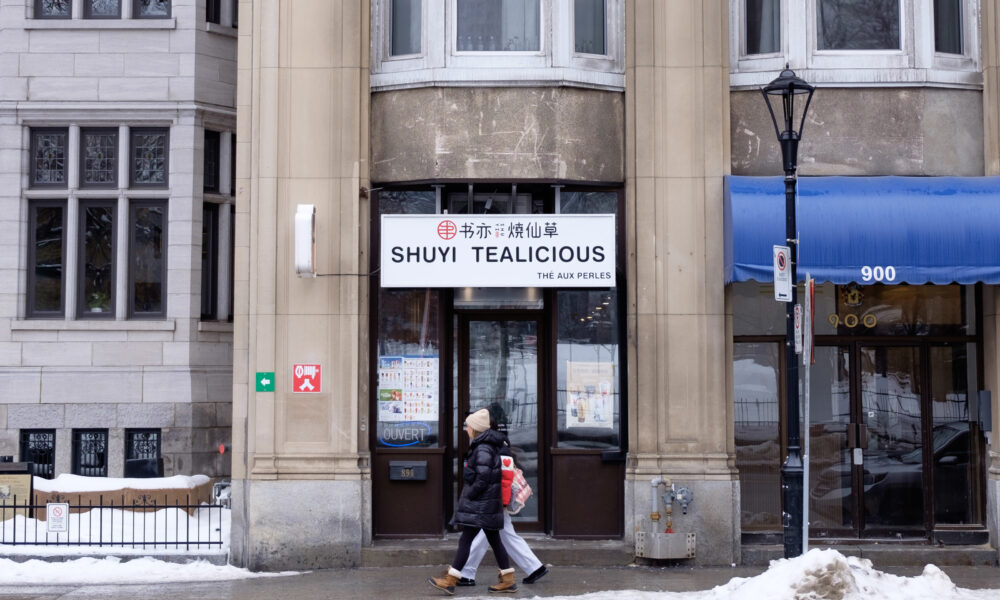
When I embark on my (albeit short) commute to campus every day, it’s hard to miss the steady stream of students flooding into Shuyi, the bubble tea shop across the street from Roddick Gates. By the time I make it into my lecture hall, it seems that I’ve seen more bubble tea cups than I have coffee cups. Are McGill students going bonkers for boba?

Well, yes. But it turns out it’s not just us: Students across North America love this sweet treat. A recent survey found that 94 per cent of young adults aged 20 to 29 bought bubble tea in the last three months—more than coffee.

Wondering where you can get your boba fix in Montreal? The Tribune has you covered with this guide to some of the best bubble tea shops near campus. 

Shuyi Tealicious

Address: 896 Rue Sherbrooke O.

Hours: Monday-Friday 11 a.m.-8 p.m., Saturday-Sunday 12-8 p.m.

Distance from campus: Two-minute walk

Price (out of three): $$$

Shuyi was the first bubble tea place I tried when I moved to Montreal, and it did not disappoint. The shop’s wide range of flavours and proximity to campus make it a hit with students and working professionals alike. However, this shop is on the pricey side, with a regular signature milk tea costing $6.65. For more complex flavours and larger sizes, you can expect to pay upward of $10. But this is the price you pay for the ease of picking up some boba between classes. 

The Alley Montreal

Address: 1256 Rue Guy

Hours: Sunday-Thursday 12-10:30 p.m., Friday-Saturday 12-11 p.m.

Distance from campus: 20-minute walk, 12-minute metro ride

Price: $$

Conveniently located near the Guy-Concordia metro station, The Alley describes itself as a “hybrid destination where unique bubble tea blends and coffees meet.” With enticing flavours such as peach oolong and crunchy tiramisu milk tea, it’s a great place to indulge in a mouth-watering new treat. The shop also comes equipped with individual working pods, a group room, and a lounge area, making it the perfect study destination. 

Ocha

Address: Rue 1651 St. Catherine O.

Hours: Every day 12-10 p.m.

Distance from campus: 21-minute walk, 13-minute metro ride

Price: $$

If you want to enjoy a tasty donut along with your bubble tea, look no further than Ocha. This boba spot located west of campus offers Vietnamese coffee and mochi donuts to go along with your fruit-, matcha-, or milk-based bubble tea. Ocha is also known for its warm, homey atmosphere, filled with indoor plants and lots of natural light, making it a great spot to recuperate after a long day of classes.

L2 Lounge

Address: 71A Rue De la Gauchetière O.

Hours: Sunday-Thursday 11:30 a.m.-10:30 p.m., Friday-Saturday 11:30 a.m.-11 p.m.

Distance from campus: 26-minute walk, 17-minute metro ride

Price:

With nine locations throughout the city, L2 is a great place to go for reliable—and slightly less expensive—bubble tea. Its flavours include Oreo cookie smoothie, pina colada, and winter melon. If none of those appeal to you, L2 also offers a make-your-own-bubble-tea option, where you can choose from a variety of bases, flavours, and toppings.

Kung Fu Tea

Address: 55 Rue Notre Dame O. & 218 Rue St. Catherine E.

Hours: Every day 11 a.m.-9 p.m.

Distance from campus: 32-minute walk, 33-minute metro ride; 27-minute walk, 18-minute metro ride

Price: $$ 

With its main location in Montreal’s Old Port, Kung Fu Tea is a great spot to grab boba while being a tourist in your own city. The shop offers a wide range of authentic Taiwanese teas. Kung Fu Tea also boasts a secret menu and serves egg waffles—a popular dish in Hong Kong. If you’re looking to get bubble tea at a discount, keep an eye on the shop’s Instagram for flash sale announcements.

Commentary, Opinion

The real value of a McGill degree

What makes McGill a good school to attend? Is it the superior facilities? The enormous introductory classes? Much of the value in attending McGill stems from the McGill degree as a form of cultural capital. In other words, having the McGill name on a resume lends clout. A McGill degree signifies an elite education and, consequently, membership in elite circles. McGill serves not just as an educational institution, but also as an institution complicit in reproducing the elite. To reduce class disparities, proponents of higher education must confront the harsh reality that education is not the great equalizer that it promises to be. 

Many McGill community members emphasize that attending the university guarantees social status as an individual who is exceptionally intelligent, hard-working, and determined. This is a gross generalization: Meritocracy is a myth. While it would hold true in an egalitarian world, meritocracy is, unfortunately, not a reality under systems of domination. Education falls victim to the social inequality between the privileged and the marginalized. Those with access to capital of all kinds have inherent advantages in the educational system, as it is built for them. These advantages start from a very young age. When children first attend school at age five, those from elite backgrounds have significant exposure to the dominant culture that schooling reproduces and are considered intelligent purely because they were lucky enough to have well-educated parents. 

Schooling continues to widen this gap by tracking students according to their abilities as they progress through the education system. Tracking usually takes the form of dividing children by perceived academic aptitude. Regardless of their potential for achievement, children identified as having lower academic ability––an identification greatly influenced by  race and class ––often lack the opportunities their peers have.

When students apply to McGill, class differences become entrenched again, as families, communities, and schools which comprise privileged backgrounds typically funnel students into higher education without great effort on their own part. For these students, attending high calibre post-secondary institutions is the expectation, rather than a marker of achievement. At university, the divide only widens. Richer students are able to pad their resume with extracurricular activities and have sufficient time to dedicate to their studies, whereas those from lower-income backgrounds may have to juggle part-time work with their studies. Navigating university is hard for everyone, but it is exponentially harder for those without familial experience and support. Graduating from McGill with a solid resume and a good GPA is overwhelmingly easier when a student’s upbringing has dealt them a good hand.

Entering the workforce does not reduce the effect of class disparities—if anything, it intensifies them. Background, far more than merit, determines work hierarchies after graduation. Those who know how to play by the rules of the game end up with better positions and better pay. At work, fitting in with coworkers and superiors is easier when an employee shares a common culture. Shared passions and hobbies create camaraderie, but these pastimes and activities are typically linked to class. Put simply, people want to help others whom they can relate to. Class is unseen and seldom talked about, yet pervasive throughout every person’s life. Moreover, race and ethnicity have an overwhelming effect on an individual’s ability to “fit-in” as white supremacy and settler colonialism regulate dominant workplace cultures. As we progress through our lives, social stratification becomes increasingly hard to mitigate. This is why institutions have to do everything in their power to reverse these systemic inequalities. 

While elitism in universities like McGill is not solely responsible for inequality in Canada, it makes up the apparatus that impedes class mobility and ensures elite reproduction beyond the educational system. Eliminating the mechanisms that perpetuate class inequality in society will take a significant amount of time and effort. On an individual level, however, the first step is to recognize and acknowledge privilege and move beyond maintaining systems of power. 

While elitism in universities like McGill is not solely responsible for inequality in Canada, it makes up the apparatus that impedes class mobility and ensures elite reproduction beyond the educational system. Eliminating the mechanisms that perpetuate class inequality in society will take a significant amount of time and effort. On an individual level, however, the first step is to recognize and acknowledge privilege and move beyond maintaining systems of power.

Arts & Entertainment, Film and TV

Nathan Fielder’s ‘The Curse’: A failed attempt at a satire on gentrification

Though The Curse was enigmatic and uncomfortable, I really thought that I would enjoy Showtime and A24’s newest television show starring Nathan Fielder, Emma Stone, and Benny Safdie. I have a fondness for Fielder’s previous works, such as Nathan for You and The Rehearsal. I especially enjoy his awkward humour that often makes you want to crawl out of your own skin, especially in his various schemes involving real people. So, part of the appeal of The Curse would be seeing a more serious side to Fielder—I’ve never seen him in anything that attempts to explore serious themes, whatsoever. 

The show’s premise is not entirely clear and also incredibly hard to explain, even after watching all ten episodes. What I’ve gathered and have chosen to believe is this: The Curse focuses on Asher Siegal (Fielder) and Whitney Siegal (Stone), a couple who build eco-friendly homes in Espanola, New Mexico, with the goal of “improving” the lives of its mostly Indigenous community members. Most of the show focuses on their filming of a new HGTV-style show titled “Fliplanthropy,” though the title later changes to “Green Queen” because Whitney wants the show to focus more on her. The concept behind this fictional program is much clearer than that of the actual show: The Siegals are building environmentally-conscious, passive homes and are trying to find people to move into them. Basically, they’re actively gentrifying the community while trying to create the opposite impression. 

While the final results are not that strong, the one plotline that The Curse successfully pulls off is showing the surface-level impacts of gentrification and how far some are willing to go to achieve it. In episode five, the Siegals’ high-end clothing store experiences high rates of shoplifting. Instead of having the store call the police every time something is stolen, Whitney tells the store manager to charge her credit card, hoping to keep the neighbourhood’s crime rates artificially low in an attempt to entice future home-buyers to the community. Similarly, when trying to justify the gentrification, the Siegals hire a “Native American consultant” to work on their show to avoid their seeming too out of touch. 

Overall, the show misses the mark on almost all of the issues it tries to address. The other premise of the show, aside from the couple’s HGTV episode, is the curse that a little girl puts on Asher in the first episode. After pretending to give her money in the parking lot as a photo op for the show, the girl places a “curse” on him. Afterward, Asher becomes superstitious and paranoid. While the plot was most likely supposed to focus on the consequences of gentrification, it later evolves into Asher becoming the stereotypical white saviour of this family. However, like most plotlines on this show, it doesn’t explore either potential aspect of the plot to its fruition. Instead, it cuts the narrative in a way that leaves its viewers confused—especially in regard to whether the curse is real, or if it’s just a joke that the girl decided to pull. 

As the season progresses, the show attempts to explore more and more plotlines without tying them all together. While that can work in some cases, the result here is quite messy and disjointed. I expected better from Showtime, A24, and especially Fielder, in terms of both the comedic element and in terms of the quality of the storylines that they could’ve pulled off with a little more effort. If some of these extraneous storylines were scrapped, there could have been more room to explore the issues with gentrification. The show then could have been a fantastic satire condemning home-improvement networks over the concept of “flipping” homes in low-income communities with a slight supernatural twist.

Montreal, News

Trans health clinic strives to address gaps in mainstream health care

Dozens gathered at the Concordia McConnell Building on Jan. 23 to support the launch of three specialized pop-up clinics that seek to address unmet needs in the public health care system. Delivered by Community Healing Days, a collective of alternative and traditional therapists, they will focus on providing trans, menstrual, reproductive, and perinatal health care.

The clinics will operate approximately once a month, offering low sliding scale rates to make their services more accessible to low-income patients. The clinics are funded by SHIFT Concordia’s Deep Investment Fund and will be run out of Studio 414 in downtown Montreal. The project includes a research component coordinated by McGill assistant professor Suparna Choudhury. This research aims to identify gaps in mainstream healthcare and the demographics most underserved. Organizers at Community Healing Days hope that their pilot project will serve as a model that can be replicated elsewhere in the city and beyond. 

The new trans health care clinic will support patients as they prepare for and heal from gender-related surgeries. This support is offered through workshops and bodywork provided by trans and allied practitioners.

At the launch event, organizers stressed the need for more accessible care, especially amid the current health care crisis in Quebec. Kota Rook, a coordinator for the new trans health clinic, emphasized the difficulties that marginalized communities face when accessing care. 

“We really particularly want to center people with very low income, and people who are racialized, Black, Indigenous, people of colour,” said Rook. “Because the more layers of things we’re experiencing in the world, the more barriers there are to health care.”

The Students’ Society of McGill University (SSMU) adopted a Gender Affirmation Care Plan last year, which expanded the Health and Dental Plan to cover more gender-affirming care procedures. However, Jacob Williams, a representative from McGill’s Trans Patient Union, highlights that the plan has some serious limitations. Currently, the plan requires students to obtain a gender dysphoria diagnosis before undergoing a procedure—despite the fact that this is not a legal requirement for receiving gender- affirming surgeries in Quebec. Furthermore, it does not cover certain procedures such as fertility preservation, nor the supplies needed for recovery after surgery. Additionally, the Plan’s maximum coverage is $5,000 for any one procedure with a lifetime maximum of $10,000. 

“It’s a drop in the bucket,” said Williams. “The coverage amount is so low [that] it’s only really useful for a very small amount of things.” 

Amina Kudrati-Plummer, SSMU’s VP Finance, told The Tribune that although they do not yet have any statistics on the success of the Gender Affirmation Care Plan, they are aware of students’ concerns and are hoping to increase coverage in the future. 

“At SSMU, we are working towards expanding the overall coverage to meet the needs of the students more comprehensively,” said Kudrati-Plummer said.

Some members of the McGill community hope that projects like Community Healing Days’ new clinics can help address the unmet health care needs of students. Choudhury said that there is a disparity between the health care that is needed and what is available. 

“These kinds of modalities have lots to offer and are sorely missing from what’s freely available [and] accessible to students,” Choudhury stated. 

Others, including Keith Bellec-Warrick, finance coordinator of Union for Gender Empowerment at McGill, maintain that larger-scale change is needed to address the health care needs of trans people. 

“It’s a question of a large-scale funding and organizational failure,” Bellec-Warrick said in an interview with The Tribune. “We welcome more changes in the future, but they’re not a favour, they’re not a gift. They are some attempt at addressing long- standing failures,”

Williams echoed Bellec-Warrick’s sentiment on welcoming change while emphasizing the need for wider structural changes to health care. 

“I’m very grateful that projects like these exist [but] this shouldn’t be their job,” Williams said. “And it saddens me that like, basically, community organizers have to be the ones to step in to provide health care when [public] clinics can’t afford to.”


In the Jan. 30 print issue, The Tribune republished the piece “Dozens protest against CAQ’s anti-trans policies” under the title “Trans health clinic strives to address gaps in mainstream health care.” The Tribune apologizes for this layout oversight, to our contributors, and to the members of the queer and trans community who organized these separate events and gave us their time and words in interviews. 

In next week’s issue, the intended article will be reprinted with this correction. We appreciate the opportunity to cover these events, and promise not to make this same mistake again.

McGill, Montreal, News

Discovery of asbestos in Arts building disrupts ‘Legally Blonde’ production, worries students who frequent the space

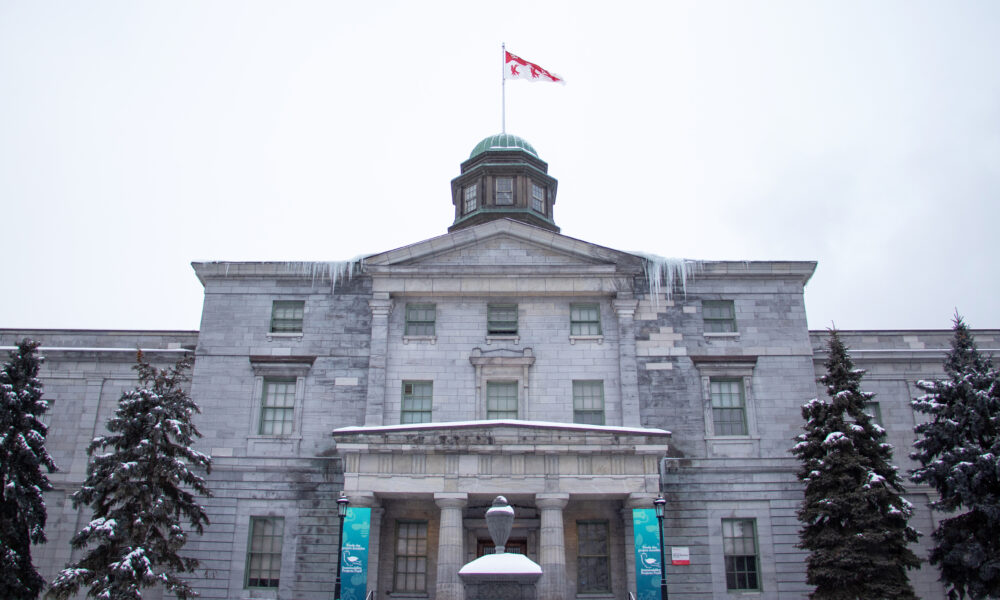
On Sunday, Jan. 21, students in the Department of English received an email from their chair, Professor Erin Hurley, who shared a Jan. 19 announcement from Facilities Management and Ancillary Services (FMAS). The announcement explained that plaster debris found at the back of the stage in Moyse Hall had tested positive for asbestos, a carcinogenic material used in construction between 1930 and 1990. The message specified that several spaces in the McCall MacBain Arts Building—including the stage (room 165A), room 165, room 165C, room 100, and part of the basement—are off limits as testing continues and FMAS does “remediation work.” This announcement comes after McGill closed three buildings at the Macdonald Campus early last year due to the discovery of asbestos, prompting McGill’s Internal Audit unit to look into the handling of the situation. The investigation culminated in a report, 25 recommendations, and the creation of a task force

Unlike last year’s asbestos-related closures, no university-wide message has been sent about the Moyse Hall closure. According to McGill Media Relations Officer Frédérique Mazerolle, “Communications may be expanded to the wider community depending on the information gathered through the assessments currently underway.  ” As of Jan. 29, the webpage for Moyse Hall contained a notice that the theatre and nearby rooms were temporarily closed, but did not state a reason. 

Asbestos is a health risk when the lightweight fibres become airborne, which often happens during demolition and construction projects, or when there is damage to a building. If materials containing asbestos are left undisturbed or sealed, they are not thought to be a health risk. Air samples were taken in the Arts Building on Jan. 19; according to Mazerolle, the results “indicate that air in Moyse Hall is within the regulatory thresholds set by the Government of Quebec and as well as our more stringent McGill thresholds.” Quebec’s cut-off for office and classroom settings to be considered safe is 0.1 asbestos fibres per cubic centimetre, and McGill’s is 0.01.

Sarah Pattloch, U3 Arts and the lighting designer for the Arts Undergraduate Theatre Society’s (AUTS) Legally Blonde production—which was slated to take place in Moyse Hall before the asbestos was discovered—found out about the closure of Moyse Hall days before an official email went out.

“We were in the theatre in Moyse for the first day of tech on Jan. 15th, on the Monday, and then the theatre was closed and we weren’t allowed in on the 16th and on the 17th,” Pattloch said. “We had a group Zoom meeting for cast and crew on the 17th, where we found out why we weren’t allowed in. Our production manager and director and maybe a couple of people had been having meetings with Erin Hurley […]  and stuff, where they found out this information, on Wednesday the 17th.”

The Legally Blonde production ultimately had to change venues last minute, as the show started on Jan. 26, proving stressful for those involved. 

“We had to really tone down what we were doing for set, for sound, for lighting, for all of the technical aspects, because at that point we’d already lost a week of tech, so we didn’t really have time to add all that we wanted to if we would have been in Moyse,” Pattloch said. “And also the new venue doesn’t really allow for the same level of production that we were going to be doing.”

According to Kimberly Hönig, U4 Arts, AUTS President, and Production Manager of Legally Blonde, the production was also forced to abandon their live band, as it did not work in the new space. She also pointed out that the closure of Moyse Hall has resulted in an immense financial burden for AUTS. Materials, such as musical instruments which they rented, are now locked inside Moyse Hall.

Hönig shared that many members of the Legally Blonde team are uneasy in light of the news that they were exposed to asbestos. She believes that McGill has not done enough to keep students informed or alleviate concerns. 

“In terms of the health repercussions of the asbestos exposure, I mean, a lot of us on the team have been in and around Moyse Hall for a few years, since we’ve been at McGill, so that’s definitely a concern,” Hönig said. “Especially because we don’t really have any information coming from McGill, about what the health repercussions are [….] We were in that space and moving around that space for an entire day before we knew anything.”

Hönig pointed out that there has been little to no communication from university administrators over the issue, but instead, the English dDepartment and Moyse Hall technicians played a key role in relaying information.

“I want to stress that the communication that I’ve received about the closure of Moyse Hall and the asbestos and the warnings and all of that has not come from McGill specifically, or the health and safety team,” Hönig added. “I have been getting that information, and all my communication, through Professor Erin Hurley, the chair of the English dDepartment, and the technicians at Moyse Hall [….] The only message that we’ve gotten from McGill or from the health and services team is that official message that kind of went out to all the English undergraduate students.”

Pattloch, similarly, feels the university has not been maintaining an open dialogue with students.

“I haven’t been in contact with anyone directly from the department. I saw that they sent out like one email, at least a few days after we found out the news, so […] the email didn’t tell us anything else,” Pattloch said. “All the other information that I’ve been getting—about what’s closing, what they’re trying to do, if they’re trying to open at any point—has kind of come from different people that I know in classes, or in other departments, or with some other kinds of connections.”

The Tribune reached out to Hurley, who stated that McGill’s communications team was fielding all questions about the situation. 

In response to a question about how the university plans to address students’ and staff members’ concerns and anxiety about potentially being exposed to asbestos, Mazerolle stressed that the risk is low.

“Government health authorities state that ‘health problems associated with asbestos are in the general population’; they are more common in people who work in areas where there is high exposure for a prolonged amount of time, such as in an asbestos mine and factories that manufacture parts containing asbestos,” Mazerolle wrote. “However, people with concerns may wish to consult a health care professional.”

Although Mazerolle claims that “Students and staff associated with the Department of English received an email about the situation on Jan. 19, as well as a more recent update [on Jan. 25] that included the fact [that] air tests undertaken in Moyse Hall were within regulatory thresholds,” students in the English department have told The Tribune that they were only formally notified of the asbestos on Jan. 21, and did not recieve a follow-up with results of the air quality tests.

According to Mazerolle, there is not yet a set date for when Moyse Hall will be deemed safe and reopened.

McGill, News

McGill reduces students’ OneDrive storage from 1 TB to 20 GB

On Jan. 15, McGill announced it would reduce the amount of Microsoft OneDrive cloud file storage space for each student from one terabyte (TB) of general storage—or 1,000 gigabytes (GB)—to 20 GB of general storage and 20 GB of Outlook email storage. The storage limit will come into effect on May 31, at which point students with over 20 GB of files or Outlook storage will be unable to store new files or send and receive emails, respectively, until their storage is reduced. The new limit will apply only to personal storage and will not affect collaborative storage spaces such as Sharepoint sites. 

In their announcement of the reduction, McGill claimed that Microsoft changed storage limits in their licensing structure due to cybersecurity risks that come with storing large amounts of unused data in forgotten files. The university also stated that Microsoft implemented the changes to curb environmental concerns associated with the electricity usage of maintaining unnecessary files. 

Steven Ding, assistant professor in McGill’s School of Information Studies, explained in an email to The Tribune that limiting “per-user space allowance” is a common industrial practice to prevent against cybersecurity threats.

“The provision of excessive storage space to users often creates a deceptive sense of security—leading to user neglect in properly inspecting, organizing, backing up, and managing the stored files, with a reliance instead on syncing everything quietly through the cloud,” Ding wrote. “Particularly for universities, which are common targets for cyber attacks, this unmonitored large storage capacity significantly expands their vulnerability.”

In an email to The Tribune, McGill Media Relations Officer Frédérique Mazerolle explained that McGill chose to reduce OneDrive storage due to changes in Microsoft’s licensing structure, which limited the available storage at each licensing level. She explained that if the university had kept the same amount of storage, costs would have significantly increased, having a “financial impact” on the university.

Connor O’Keefe, U1 Science, is among the students with over 20 GB of files in OneDrive general storage. O’Keefe uses OneDrive to store lecture recordings as well as data for a McGill research group he is part of, and he questioned the financial motivation behind McGill’s decision.

“I think that citing environmental reasons and stuff doesn’t make a lot of sense. I mean, sure, but […] it’s clearly some measure to cut costs,” O’Keefe said in an interview with The Tribune. “[McGill] says it’s some change that OneDrive is using for their plan. But I have friends in other schools, and it doesn’t seem to be mirrored.”

In an interview with The Tribune, Inan Upadhyay, a second year master’s student in electrical engineering, explained that using OneDrive grants him greater flexibility because it allows him to access files across different devices, including the desktop computer that McGill issued him for research. He expressed disappointment with McGill’s decision and called the storage reduction “impractical.”

“Since I work in a lab environment, I store a lot of manuals, a lot of instructions,” Upadhyay said. “I’m pretty surprised to learn McGill is making this decision. Twenty GB of files is really nothing, as many software take that much amount of storage [to run].”

Mazerolle claimed that McGill’s decision reflects the administration’s research on OneDrive usage in the student population, that found that a 20 GB limit was adequate for 90 per cent of students. Mazerolle also wrote that McGill will provide additional storage for those who require it for academic activities by submitting a form, which will be available on the IT Support site

“We acknowledge that some students will require more storage to accomplish their academic tasks, for example, those conducting academic research,” Mazerolle wrote. “Exceptions can be requested and will be considered/evaluated for students who justify the need for additional storage.”

For Oliver Fernie, a second-year master’s student in engineering, while the storage reduction may not impact a large percentage of students, it is still another financial burden.
“Cloud storage doesn’t cost much so it’s not […] a massive hit for students to replace it but it’s still annoying to have the convenience taken away for those who get good use out of it,” Fernie wrote to The Tribune. “We pay enough in tuition already and McGill certainly isn’t skint.”

Commentary, Opinion

Blanchet’s tale of “two Quebecs” embodies the Bloc Québécois’s hypocrisy

Montreal is a city characterized by its liveliness and natural beauty. The numerous events that take place on the island, such as the Nuits d’Afrique and Jazz Fest music festivals highlight the city’s diversity and boast its reputation as a tourist hotspot. Most enticing, however, is that Montreal is composed of a mixture of people from various backgrounds. But despite increasingly inflammatory rhetoric from the Bloc Québécois and attempts to distance the province from Montreal’s diversity and to characterize Quebec as monocultural––there is not one type of Quebecois identity. 

Yves-François Blanchet, the leader of the Bloc Québécois, worries that Montreal is becoming disconnected from the rest of Quebec. He even goes as far as to claim that there are “two Quebecs,” where Montreal is an undesirable multilingual city, and the rest of Quebec is its “generous host society.” This rhetoric attacks not only English speakers, but speakers of the hundreds of other languages found on the island. From Inuktitut to Tagalog to Tamil, Montreal hosts a vast array of written and spoken languages. This multiplicity makes the city so appealing to both tourists and immigrants. 

Blanchet believes that the history, language, values, and culture of Quebec are becoming marginalized––a severely misguided view. Though Montreal is part of Quebec, it does not represent Quebec as a whole—nor should it. Most non-French speakers are concentrated within Montreal, while the rest of the province remains predominantly French-speaking. As for Blanchet’s concerns about the loss of Quebec’s culture, a question arises: Who defines Quebec’s culture? 

Blanchet makes a shockingly contradictory statement when he insists that Quebec should be “one culture […] with all its diversity.” How would it be possible for the province to consist of one culture and simultaneously be diverse? Quebec’s culture should not be a single entity, but rather a compilation of all the cultures that are present within it. Newcomers would stand more comfortably and proudly within their Quebecois identity if it honoured who they are. 

Blanchet further stated that there are two Montreals divided between the East and the West of the island. Linguistic and cultural variation is undeniable among the inhabitants of Montreal, and an incredibly enriching aspect of the city. Blanchet’s assertion is yet another attempt to pit Montrealers against each other. This irony comes from Blanchet being disturbed by a perceived separation between two parts of Montreal and between Montreal and the rest of Quebec, yet he is content with the notion of Quebec being separate from the rest of Canada. 

In Blanchet’s mind, it is catastrophic for Montreal to be distinct from the rest of the province, but it is perfectly acceptable for Quebec to be distinct from Canada. The separatist movement in Quebec often has exclusionary undertones. This way of advocating for a culture composed of similar people with similar ideologies ultimately scares away those who choose not to assimilate. Blanchet continues to fabricate this narrative as a means to perpetuate his ulterior motive: Conformity to a poorly defined “Quebecois culture” and the erasure of cultural diversity on the island of Montreal—and in the province of Quebec in its entirety.

Promoting multilingualism will allow Montreal’s vibrancy to carry on and will strengthen acceptance within the city. We cannot allow political leaders to interfere with this goal and we, as Montrealers, must continue to promote and fight for not only diversity but also inclusion in a society where political discourse fosters a culture of exclusion and separation. It is our responsibility to push back against the cultural and linguistic hierarchy that our leaders establish and to bring forth a new model where all individuals with their respective languages and cultures are recognized and valued as Quebecers in their own right.

Out on the Town, Student Life

Looking for an icy escape? Take to the rink!

Montreal winters, for all their downsides, do make the city a great place for skating. It may be negative 10 and cloudy, but that shouldn’t stop you from heading outside. Whether you’re a beginner or an expert, there are plenty of options throughout the city that’ll offer you a great break from studying.

If skating in Old Port is your desired vibe, The Tribune recently created the perfect winter itinerary for spending a day in the historic district, including some time on the ice. For the rest of the city, keep reading for a list of skating rinks near campus.

McGill Lower Field Skating Rink

Distance from campus: Zero-minute walk 

Cost: Free entry, no skate rentals available

If you’re hoping to fit in a quick skate on the way to your 8:30 a.m. class, look no further than the lower field skating rink. Conveniently located on the west field, this not-so-hidden gem offers beautiful views of downtown and campus. As an added bonus, using McGill’s services always makes the cost of tuition (at least the pre-Legault rates) feel more worthwhile.

McGill McConnell Arena

Distance from campus: Five-minute walk

Cost: $3 for members, $5 for non-members, no skate rental available 

If you’re craving a nice warm-up before you get on the ice, an uphill walk on University Street is sure to scratch that itch. Skating at the arena requires booking your slot in advance through their website, which might ruin your dream of spontaneously skating when your heart desires. But at least it guarantees a nice amount of open space.

Beaver Lake

Distance from campus: 30-minute walk, 30-minute bus ride

Cost: Free entry, skate rentals available for $12.75

If the thought of walking to the McConnell Arena wasn’t too enticing, walking up to Beaver Lake probably isn’t your vibe. Luckily, the 11, 165, 166, and 465 bus lines can take you there. Though the real Beaver Lake has been closed for years due to concerns about ice quality, the adjacent refrigerated rink is a beautiful substitute, with its lights and music providing a great ambiance. But, be careful, it can get quite busy on weekends.

Esplanade Tranquille

Distance from campus: 15-minute walk, five-minute metro ride

Cost: Free entry, rentals available for $13.05

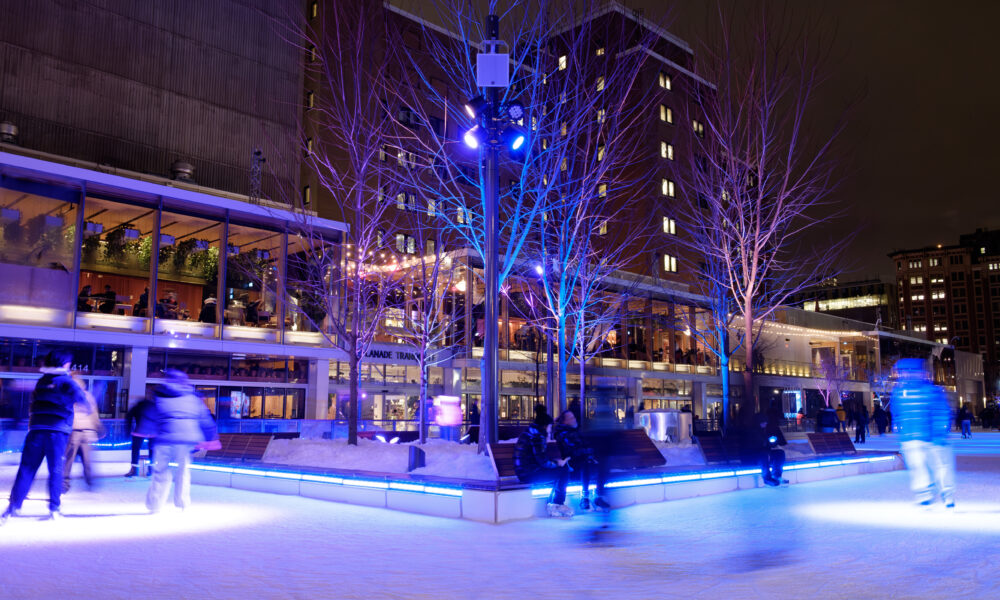
The newest entrant to the list sits at the heart of Quartier-des-Spectacles, with a lovely panoramic view of the area. This refrigerated rink is sometimes a victim of its own success as long lines can form on the weekends, especially for rentals. When your legs get tired, head inside to the lounge, sit by the fireplace, and take out a book or borrow a board game.

Atrium 1000

Distance from campus: 15-minute walk

Cost: $10 entry, rentals available for $9

Located on the main floor of one of Quebec’s tallest buildings, this indoor rink offers an option for those days when spending time outside isn’t too appealing. The large skylight means you don’t feel too removed from the outdoors though, making it ideal for those who get caught off-guard by walking outside to the early sunsets of Montreal winters.

Montreal’s outdoor rinks

Distance from campus: Varies

Cost: Free entry, rentals available at some rinks

As a city home to a long winter, Montreal has an established network of outdoor rinks across the island, including Jeanne-Mance Park and Cabot Square. Most rinks are not refrigerated, making them very dependent on the weather conditions. Luckily, Montreal’s city portal does track the quality of ice rinks so you can better prepare. The portal is only available in French so remember, “anneau” refers to ice rings and “avec bandes” refers to rinks with boards, which are typically good for playing hockey. 

Science & Technology

Cracking into the mysteries of avian eggshells

Bird eggs, with their delicate embryos encased in protective shells, have been fine-tuned by millions of years of evolution. In a fertilized egg, each component is optimized to help the chicken embryo grow, protect it from bacterial invasion and predators, and ultimately allow it to break out of the shell and enter the world as a young chick. While the yolk and the egg white are often the stars of this show, especially for lovers of a sunny-side-up fried egg, the thin membrane just inside the eggshell plays an equally important role. It fulfills the dual purpose of providing an additional layer of protection against bacterial invasion and acting as an intermediary between the egg white and the shell.

Marc McKee, professor in the Faculty of Dental Medicine and Oral Health Science and the Faculty of Medicine, recently co-authored a paper with his doctoral student Daniel Buss and Natalie Reznikov, professor in the Department of Bioengineering, zooming in on this membrane, and specifically examining how the wet, organic fibres that make it up attach to the mineral in the eggshell.

“I work in the mineralized tissue field, also known as biomineralization, ” McKee explained in an interview with The Tribune. “It’s a joy for me to work in a field that lies at the intersection of biology, geology, and mineralogy.”

This attachment is intriguing because it binds together a hard inorganic material—the calcium-containing mineral of the shell—and a soft organic material—the fibrous network of the membrane.

Additionally, the bond between them is robust, making it a potentially valuable model for bioengineers looking to adhere other organic fibrous materials to minerals. McKee’s lab set out to investigate how the two materials attach to one another.

“Why is it that when you crack open an egg, you have to peel that membrane off the shell?” McKee said. “And if you look with high-powered electron microscopes, even if you peel it off, and you look at the shell, some fragments of the membranes are still attached.”

The team used X-ray and electron tomography, which involve capturing hundreds to thousands of images that can then be assembled into an incredibly detailed 3D model. Armed with these high-resolution images of the eggshells, they could dive into the detailed structure of the membrane-shell attachment.

First, they confirmed what scientists had already discovered: At the scale of micrometres, some fibres of the membrane actually penetrate the inner portion of the shell. However, using 3D electron microscopy, they could go a step further, zooming in to nanoscale resolution.

“When we delved very deep at the nanoscale into a single fibre using cryo-preservation techniques,” McKee explained, “we discovered that mineral ‘nanospikes’ entered the fibres themselves.”

This ‘nanospiking’ technique is critical because it adds another level of integration, which McKee explained is especially important when you have soft, wet membrane fibres trying to integrate into a hard mineral shell.

“We realized that it’s one thing to incorporate a fibre, but this fibre could still slide in and out of the rock, right? It’s wet, it’s soft, and it’s likely slippery. Within hard eggshell mineral, that attachment ‘rope’ could easily pull out. That’s not a very good attachment, and that would be disastrous for the egg,” McKee said. “We figured out that this nanospiking anchors these wet protein fibres so they can’t move in and out.” 

This remarkable mechanism, in which membrane fibres link into mineral at the microscale, and in turn, mineral penetrates into the fibres at the nanoscale, allows for a robust, secure attachment between the two different materials.

While this research is specific to the egg, there are other points of organic-inorganic contact in our bodies, such as where ligaments attach to bones. This discovery presents new insights about the eggshell membrane of bird eggs, and points the way toward further work aimed at understanding what happens when minerals meet organic material.

Read the latest issue

Read the latest issue