Latest News

McGill, News

McGill’s #LawNeedsFeminismBecause goes nationwide

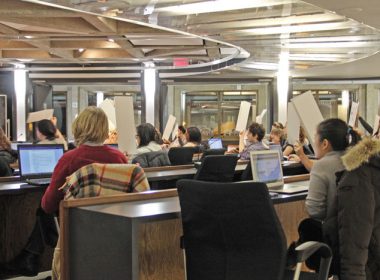
On Jan. 23 and 24, the Feminist Collective of McGill Law held their third annual photo campaign to start a conversation about feminism. This year, the campaign has shifted towards a legal perspective of feminism, rather than on the feminist movement in general. The event saw 100 students participate–a significant increase from the 33 that took part in April 2016.

By getting people to complete the sentence “Law needs feminism because” and have a photo taken with their completed phrase, Rachel Kohut, third-year law student and organizer of the campaign, wanted to encourage participants to define the terms ‘law’ and ‘feminism’ using their unique perspectives. Kohut said she hopes that the photos can act as a medium to advocate for more diversity and inclusivity within the legal profession.

“The legal profession continues to struggle integrating feminism into practice,” Kohut said. “In your first years of law school, you’re often reading early 20th century texts written by men, and although efforts have started to be made to change this, it can still be demotivating at times. Add on conversations about how you ‘should’ dress or what you should and should not disclose during interviews, and when you should ‘ideally’ have a kid if you want to make partner, it is no wonder that many women leave law firms after only a few years of practice.”

The campaign has gained traction and publicity across Canada. This year, law faculties at 13 other universities joined the #LawNeedsFeminismBecause (#LNFB) social media campaign, including the University of Toronto and the University of British Columbia. Seneca College is also joining the effort, organizing a photo event for paralegals, law clerks, and legal assistants. Furthermore, #LNFB has also expanded to health care, with the McMaster School of Medicine planning to launch the #healthcareneedsfeminismbecause movement in May 2017.

McGill Law remains the anchor of the growing project by orchestrating photo campaigns with other law faculties across the country, organizing a national forum on March 11, and providing institutional support for a movement that is now growing into an organization.

Kohut attributes the success of the campaign to its artistic elements, accessibility, and timing.

“I definitely didn’t expect the campaign to go this viral, my Facebook inbox exploded with all the messages I was getting,” Kohut said. “People are ready to talk about feminism in law and #LNFB provided the means.”

Ellie Marshall, leader of the #LNFB movement at UofT, knows Kohut through mutual friends and was eager to join the campaign.

“The campaign is still ongoing at UofT, as we plan to have another event later in the year to hear student voices on feminism and the law,” Marshall wrote in an email to The McGill Tribune. “There were about 50 students actively involved in the campaign and many more interested. We’re happy with the positive response and new channels for conversation that have opened up.”

Kohut said that there are days that can be overwhelming, but that her favourite part of the campaign is hearing people talking about their struggles in law school and visions for the legal profession.

“It is easy to get caught in the law school bubble,” Kohut said. “It’s nice to break that bubble and see people coming together from different law schools. People are organizing and it’s very empowering, you know that you’re not alone.”

Florence Paré, a fourth-year law student, said that the McGill #LNFB event in January was well organized.

“Individuals were assigned specific time slots, pictures were taken very quickly and professionally, and other people’s quotes of the day were still on the table, so we got to read a few for inspiration before they were published,” Paré said. “It was an enjoyable atmosphere [….] I thought the campaign was nice and I’m curious to see what will come out of it.”

The #LNFB national forum on March 11 will encourage discussion and collaboration among students and legal professionals on feminism. The forum will explore four themes to help participants to gain a better understanding of how to reshape the legal profession: Feminist legal mentorship, student experience, alternative legal careers, and legal recruitment. The forum will be held in Montreal and profits will be used to publish a book that combines the #LNFB portraits and stories together into a cohesive narrative.

Kohut is both surprised and proud of how far the movement has come.

“The next step is really about honing what’s already been done by feminist lawyers before us and to continue building a strong sense of community,” Kohut said.

McGill, News

Mitigating the effects of the U.S. travel ban on Canadian campuses

On Friday, Jan. 27, U.S. President Donald Trump signed an executive order banning citizens of seven Muslim-majority countries from entering the U.S. for 90 days. Additionally, the order put a halt on all refugees for 120 days and Syrian refugees, specifically, for an unspecified period. Issued against Iran, Iraq, Libya, Somalia, Sudan, Syria, and Yemen, the ban has been the subject of protests around the world.

As complications caused by the actions of the executive branch of the American government unfold, Canadian universities have taken initiatives to address current and potential difficulties faced by their students, staff, and researchers. According to McGill Provost and Vice-Principal (Academic) Christopher Manfredi, academic members of the McGill community will be prevented from participating in important scholarly meetings in the U.S.  

“We are very concerned about the consequences of the imposed travel restrictions,” Manfredi wrote in an email to The McGill Tribune. “Both with respect to the immediate effect on our students and researchers, who are citizens of the seven countries named in the executive order, […] and to the potentially detrimental and longer-term effect on institutional partnerships and scholarly exchange that are the bedrock of a 21st-century global academic community.”

Manfredi and his team seek to address the implications of the ban and how the university can support community members in need of help. Using an online form, the Office of the Provost has encouraged people to share how the executive order has impacted them and voice their opinions on how the university can respond. Further actions will be decided after reviewing the submissions received from the form, which remained open until Feb. 2.  The university has already extended the Fall 2017 undergraduate, graduate, and continuing studies programs application deadlines until March 11 for students from the seven affected countries.

McGill law students were among the first to take immediate action to help those affected by the executive order. Led by third-year law student Sydney Warshaw, law students went to the Montreal Airport on Jan. 30 to ensure that legal aid was provided to those prevented from boarding U.S.-bound flights. According to Alec Angle, second-year law, the group hopes to identify how many people in Montreal have been affected by the ban.

Students have been encouraged by the Faculty of Law to write letters to the Minister of Justice, the Minister of Immigration, and their Members of Parliament to express their concerns. A campaign for writing letters was set up in the New Chancellor Day Hall Atrium, and the Faculty is considering establishing a legal clinic that will allow students to reach out for information.

“Basically, we want to ensure that the Government of Canada is proactive in dealing with the harms of the U.S. ban, even if our government has no power to change the policy itself,” Angle said. “We were able to write and mail about 100 letters on the first day of the campaign.”

Associate Dean of Graduate Studies Richard Gold has invited international students conflicted about applying to U.S. schools to instead apply to McGill by extending application deadlines for graduate programs. McGill’s law program qualifies students to write the bar exam in a number of U.S. states.

Some McGill students now risk being detained at the border while travelling to the U.S. for fellowships, internships, academic conferences, and job interviews. Concerns were recently raised over whether visiting students would be able to return home after McGill’s Model United Nations (McMUN) conference, held from Jan. 26 to Jan. 29. McMUN organizers reported that all delegates returned home safely.  

At the Students’ Society of McGill University (SSMU) Legislative Council meeting on Feb. 9, a motion will be presented to decide whether external political advocacy should be mandated. SSMU will also donate to the Centre for Research-Action on Race Relations (CRARR) and plans to support future student initiatives in response to the executive order.  

Other Canadian campuses aim to provide support as this situation continues to unfold. At the University of British Columbia (UBC), approximately 30 employees and 350 students are directly affected, according to UBC Managing Director of Public Affairs Susan Dandard. UBC has established a task force with the goal of determining what degree of assistance the university can offer those targeted by the ban. UBC is also working closely with McGill, the University of Toronto, and other Canadian universities to establish a coordinated approach to assist international scholars suffering from the travel restrictions.

“We could provide aid to students, faculty, and staff suffering hardship due to the travel restrictions,” Dandard said. “We are currently assessing the needs of our students, faculty, and staff. UBC’s administration sets aside money for contingencies like this. We are offering counselling services for anyone feeling distressed. We can also help faculty, staff, and student access immigration and travel advice.”

McGill, News

Norman Cornett’s dialogic philosophy of education

McGill University has yet to address grievances over the lack of transparency surrounding the dismissal of Religious Studies Professor Norman Cornett in 2007. Although McGill did not approve of Cornett’s unorthodox pedagogic style, the professor continues to promote his dialogical philosophy of education as a guest instructor in universities in North America and Europe.

Inspired by Mikhail Bakhtin’s “The Dialogic Imagination,” Cornett sought to create a teaching style that encouraged creativity, believing it to be what distinguishes humans from other species.

“I don’t teach [students] for a grade or for a diploma, I teach them for life,” Cornett said. “Once you finish your education here, to what bookstore do you go to get the textbook for life? How do we learn to think for ourselves, to make our own decisions, to make informed decisions? That is the key to becoming full board citizens of our world.”

According to his website, Cornett adopted the traditional lecture format for a more personalized classroom experience. Cornett asked students to write reflections based on the stimuli of a piece of art, sculpture, music, or text without revealing the name of the artist and telling the class not to worry about grammar. The professor would then invite the creator of the piece to join the class and respond to the student’s reflections on the piece. Instead of being graded on exams, students were evaluated solely on participation.

“It gave you that kind of challenge which was really transformative,” Emily Rose Antflick, a student of Cornett’s between 2001 and 2004, said. “[… It] was one of the first times in my entire schooling history where I clearly have been asked without any curriculum expectations to just respond from my authentic self.”  

Cornett invited a string of distinguished guests to attend his lessons, including former prime minister Paul Martin, jazz pianist Oliver Jones, Academy Award winner Ethan Hawke, and celebrated Canadian Director Alanis Obomsawin. Obomsawin, who usually covers indigenous issues in her documentaries, decided to depict Cornett’s plight in her 2009 documentary, “Professor Norman Cornett: Since when do we divorce the right answer from an honest answer?”

According to Rosanna Marmont, a student of Cornett’s last course at McGill in 2007, the opportunity to interact with such influential individuals empowered students and gave them the confidence to follow their passion. Marmont said that Cornett’s courses inspired her to become an artist, explaining that he gave her the confidence to become a sculptor.

“We think that we are not able to be journalists, we are not able to be artists, we are not able to be these things,” Marmont said. “[Cornett] would empower his students. He would tell us  that we could do these things, that our opinions were worthy of being heard. It encouraged us to pursue our path, our natural callings, and to have that courage.”

The McGill administration terminated Cornett’s contract without warning at the end of the Winter 2007 semester, after 15 years at the university. This sparked public outcry within the student community, as seen by the swarm of letters that were received by the The McGill Tribune at the time.

The university offered Cornett a severance package with a non-disclosure clause, which he rejected for ethical reasons.

“If you stand for dialogue, then you stand for always being able to speak truth to power,” Cornett said. “No amount of money could buy that.”

The university has yet to issue a statement on the reason for Cornett’s dismissal. Only current Sociology Professor and former Provost between 2005 and 2015 Anthony Masi addressed the issue by defending the university in a letter to Le Devoir in July 2007. Masi denied that potentially controversial in-class debates on Middle Eastern conflicts played any role in the decision and insisted that the McGill does respect freedom of speech.

The McGill administration’s treatment towards Cornett demoralized many of his students. Marmont cited Cornett’s dismissal as one of the reasons she transferred to Concordia University the following year.

Cornett has not allowed this experience to prevent him from pursuing his love for education. He has been invited by higher education institutions to conduct workshops for postgraduate students, such as the University of Leipzig and l’ Université du Québec à Montréal. He has also translated a variety of French books into English. His most recent publication is a translation of Naim Kattan’s Farida, a book portraying the often forgotten Jewish communities in Iraq.

McGill, News

Board of Governors approves major research grants

On Feb. 2, the McGill Board of Governors (BoG) held its first meeting of 2017. The session opened with an update on major achievements by McGill students within the last year, highlighting the fact that three students received a Rhodes Scholarship–the highest number of any Canadian university this year. The approval of two grants and a presentation of the Report on the Open Forum on Sustainability followed. During the meeting, Board members also expressed concern about the effect that the recent U.S. presidential election may have on the scientific community in Canada.


Report on the Open Forum on Divestment

The question of the university’s divestment from the fossil fuel industry has become a common topic of discussion at McGill’s BoG meetings.

Divest McGill was originally created in 2012 to lobby the university to divest its endowment from its fossil fuel partners. Following a February 2015 petition submitted to the BoG’s Committee to Advise on Matters of Social Responsibility (CAMSR), Divest McGill held an April 2016 sit-in, protesting the Board’s decision not to divest.

In response to this Feb. 2015 petition, Principal Suzanne Fortier organized the Open Forum on Sustainability to address the recommendations of the 2016 CAMSR report on divestment. The Open Forum was chaired by Faculty of Law professor Frédéric Bachand, who also compiled and presented a report to the Board on the conclusions of the forum’s discussions.

“It was a lot of work, but I think it was a worthwhile exercise,” Bachand said. “Many of the questions that were discussed were sensitive, but I was amazed at the turnout of our community members who participated extensively and responded very positively to the Principal’s invitation to offer advice and insight.” 

One hundred thirty-five students attended the Open Forum in September 2016. According to Bachand’s report, it identified several measures to reduce McGill’s carbon footprint, including the implementation of a target date for McGill to become a carbon neutral institution and the development of sustainability-focused curriculum.


CFREF award and International Progressive MS Alliance grant

Following standard procedure when accepting grants, Vice-Principal (Research and Innovation) Dr. Rosie Goldstein gave a short presentation on the Canada First Research Excellence Fund (CFREF) award and the International Progressive MS Alliance grant received by the university. The Board unanimously approved the motion to accept the grants.

The CFREF award given to the university is valued at $84 million and is offered by the Social Science and Humanities Research Council, the Natural Science and Engineering Research Council, and the Canadian Institute of Health Research. It is intended to promote research and innovation in the field of neuroscience.

The International Progressive MS Alliance grant is valued at €3.8 million ($5.4 million CAD), and will be used to develop new MRI outcome measures that could result in more efficient preliminary assessments of drug efficacy, potentially resulting in shorter and less costly clinical trials, according to the official report said.

Concern over threats to scientific community

Although not part of the agenda, Post-Graduate Students’ Society (PGSS) Secretary-General Victor Frankel addressed the media blackout of the U.S. Environmental Protection Agency (EPA) on Jan. 21.

“[The media blackout] is absolutely against McGill’s mission to disseminate science and to make the world a better place,” Frankel said. “I am wondering if we could take the leadership and also engage with other universities across Canada to make a similar statement condemning the silencing of science and scientists. We need to respond viciously.”  


Legal Information Column, Private, Student Life

A Little Look at Small Claims Court

As Elle Woods once quipped, exercise gives you endorphins, and endorphins make you happy. However, it’s doubtful that anyone is happy if their exercise involves running to court to defend themselves against a lawsuit. The Legal Information Clinic at McGill wants to demystify how courts work so students know how to assert their rights—even in front of a judge.

Small Claims Court

Everyday cases are often taken to the Court of Quebec’s Small Claims Division, also known as the Small Claims Court. Only cases where the amount being claimed does not exceed $15,000—excluding interest—can be taken to Small Claims. Also, a Small Claims Court does not deal with certain issues, such as residential leases, child or spousal support payments, or damage to reputation. Common issues that do make it to Small Claims Court include suing to obtain a refund for a service done inadequately or incorrectly or suing to make someone pay for a service rendered. 

Representation

Unlike other courts, lawyers are /not/ allowed to represent parties at Small Claims Court, though each side can consult a lawyer before the hearing. As a consequence, the parties are on somewhat equal footing, and the lack of lawyer presence speeds the process up. 

People in the Courtroom

In the spirit of being a relatively accessible way to seek justice, hearings at Small Claims Courts are less formal than those at other courts in Quebec. Even so, there can be quite a number of people are present in the courtroom. Invariably, there will be a plaintiff—the person suing—and a defendant—the person being sued. A judge—who hears the arguments and decides the order in which people will speak—will also be present, as will a clerk—who ensures that the court records are complete—and a bailiff—who keeps order in the courtroom. Finally, there might be witnesses if either side wishes to bring them to testify, and members of the public who are curious about the case are permitted to attend. Since courts are public, each side can bring friends or family members for moral support during the hearing. 

Whereas other courts in the Quebec judicial system typically require people to come prepared to argue the law, Small Claims Court is more permissive of people coming with just the facts of the case, because the judge will try to tease out the legal issues during the hearing. Of course, understanding the law before going to court might help someone decide whether or not they want to just negotiate a settlement with the other side instead of arguing in court.

Language During Court

In Quebec, each side can speak in either French or English during the hearing. However, this often means that one side might speak in French, while the other side speaks in English. Judges can try to switch between French and English to accommodate both sides in such a situation, but parties may consider hiring an interpreter to guarantee that they will understand everything that’s being said.

Evidence

Generally, the plaintiff has to bring enough evidence to convince the judge that their side of the story is true. The judge does not have to be 100 per cent convinced, but they have to be more convinced than not in order for the plaintiff to win. At Small Claims Court, evidence includes documents such as contracts, letters, and photographs, as well as witnesses, who either write a statement for the judge or testify in person. 

The Judgment

The judge can decide to issue the judgment immediately after the hearing; however, in some cases, they might want to take more time to think about the case. If the latter occurs, the judge has four months to issue the judgment. In either situation, a copy of the judgment will be issued in writing. Since Small Claims Court is supposed to provide a slightly more informal and faster form of justice, its judgments are final, and, therefore, there is no appeal. 


To have an idea of how the judge thinks, past judgments are available through free online databases. One such database is called CanLII. For more more resources in preparation for Small Claims Court, read Justice Québec’s factsheet here. Visit Éducaloi for further accessible legal information, or check out the Young Bar of Montreals free service to help people who have to appear in Small Claims Court prepare for their hearing. 

To ask your own question, contact the Legal Information Clinic at McGill with the directions found at www.licm.mcgill.ca. According to the Act respecting the Barreau du Québec, only lawyers and notaries can provide legal advice or counsel. The LICM, therefore, only provides legal information. For legal advice, please contact a lawyer.

Out on the Town, Private, Student Life

Candide Cafe charms La Petite Patrie and New York Times with its rose latte

Tucked among a row of shops in Little Italy sits Candide Café. Candide Café was the realization of a long-time dream for owners Coralie and Mickael Rossi. The pair worked for five years in a Starbucks Café in France, with the plan to eventually open their own coffee shop. The shop attracts a mixed crowd of young, working professionals, families with kids, and, now, tourists from New York City. This new cutsomer-base was drawn to Candide after reading its favourable review in the New York Times’ article “Five Places to Go in Montreal.” The article, which features Candide Café, among other local hotspots, highlights its famous rose latte. 

“As we came from Starbucks, we knew we had to add a specialty, so we wanted to create something original,” Mr. Rossi said. “The most ordered drink [in every country] is the latte, so we wanted to do a special latte. The rose latte was the flavour, which is just as floral and delicate as we needed [….] It’s a Mediterranean inspiration. It’s something fun that we never did before.”

The rose latte is unique and satisfying. Served in a simple white mug, the foam is topped with a sprinkling of dried rose petals, the fuchsia colours enlivening an otherwise simple-looking drink. The rose flavour is subtle and smooth, which complements the bitterness of a regular latte. The drink is a refreshing change from the syrup-pumped specialty lattes of chain coffee shops. 

The rose latte is only one aspect of Candide’s popularity, however. While many other third-wave coffee shops in Montreal place high-quality artisanal coffee above all else, Candide’s friendly staff prioritize quality distant barista-customer relations.

“As we were from Europe, we used to communicate [and create a relationship] with every customer we had,” Mr. Rossi said. “[We] use that here and create, like, a community in the coffee shop. We know a lot of customers and their drinks. It’s like a community and something sort of strong.” 

Candide’s vibe defines it as a local hangout spot. On any given day, the baristas chat with customers and children read books from its library. At the centre of its hominess are Coralie and Mickael, who have succeeded in creating a rare coffee shop environment that balances an urban ambience with charm and quality service. 

(Paige Mysliviec / The McGill Tribune)

However, the Candide story has taken an interesting turn. Rossi revealed alternate plans for their future as owners, as well as for the shop itself. 

“Last summer, the bank came to us saying, if you want, we are going to follow you to open a second one and launching something bigger,” Mr. Rossi said. “We haven't [taken a holiday for eight years], so when the opportunity was here, we [had] two [options]. The one, we are launching a second Candide and we are working like crazy people for the next five years, or we can change our life, sell the coffee [shop], and [do] a world trip. So we choose the world trip.”  

The shop has been up for sale since the beginning of January, with a lot of interest pouring in. It is hard to think of Candide in the hands of anyone other than the Rossis, who founded the shop and raised it like a child. 

"We don't know who we are going to choose, but we want to give the [coffee shop] to someone who is going to take care of it,” Mr. Rossi said. “We put a lot of love and passion in it [….] It is a small Candide dream to think that we are going to [come] back in five years in Montreal and [have] a coffee in here." 

For now, Candide stays put, while the Rossis hold meetings with new interested owners. Customers will continue to flock to this local coffee staple, but soon, without the familiar faces of the Rossis milling about. One can only hope that the future proprietors will nurture and love it with the same passion as the Rossis. Candide stands out among others of its kind for the warmth it spreads to its customers and its community.


An earlier version of this article incorrectly stated that Candide Cafe is located in Little Italy, and that Coralie and Mikael Rossi worked at Starbucks Cafe for a duration of 8 years prior to opening Candide Cafe. In fact, Candide Cafe is located in La Petite-Patrie, and Mr. and Mrs. Rossi worked at Starbucks Cafe for five years. The Tribune regrets this error.  

Sports

Point-Counterpoint: Political Speech in Sports

With all the attention afforded to athlete’s political opinions, The McGill Tribune discusses the question of whether or not athletes should speak politically during “sports time.” For the purpose of this article, “sports time” is defined as all pre- and post-game press conferences, along with any statements made during a sporting event

McGill, News

The McGill Commitment advances experiential learning

The McGill Commitment, a project spearheaded by the Office of the Deputy Provost Student Life and Learning Ollivier Dyens, has gained significant traction after being granted a $300,000 yearly fund from the Office of Provost and Vice-Principal Academic Christopher Manfredi in May 2016. Since its conception in Fall 2015, the Commitment has organized its initiatives into four pillars that embody Dyens’ vision for McGill’s future: International campus, innovative academics, leading research, and fostering self-development.

“The McGill Commitment, essentially, is to help students and provide students with what we call a 21st-century education,” Dyens said. “What [kinds] of skills can we give students that will be useful for the next 50 years?”

The Commitment includes a wide variety of faculty-specific projects, as well as initiatives for McGill’s School of Continuing Studies. The Provost’s fund has already been allocated to a number of initiatives in Fall 2016, including $100,000 towards the Faculty of Science’s Labs Without Borders program, which sends students to conduct field research for a semester at various locations around the world, including the Arctic.

The Skills Development Program, which will launch in Fall 2017, was given $145,000 from the Provost’s fund. The program is intended to encourage undergraduate students to expand their soft and professional skills in free co-curricular workshops. The workshops will be organized into five skill-based streams, tentatively named global citizenship, health and wellness, leadership, collaboration, and discovery. Sophia Kapchinsky, the Skills Development officer at Teaching and Learning Services, has coordinated the Program since its inception in July 2016.

“Our students do need education outside of their course-based curriculum,” Kapchinsky said. “It's impossible to learn how to collaborate, or how to become a better writer, or how to negotiate, or how to engage with your community by being taught [in a course lecture]. You have to go through an experiential learning process in order to gain those skills.”

The Skills Development Program, which is set to launch in September 2017, will draw contributions from faculty units, administrative units, student groups, and additional offices, including McGill IT and the McGill Office for Sustainability to design the project. It will partner with  over 2,000 existing workshops at McGill to curate a curriculum based around improving particular skills. The program will continue to expand its list of workshops by building campus partnerships.

“Students can almost choose their own adventure, in the sense that they can choose which stream of the program to participate in,” Kapchinsky said. “If they want to develop their leadership skills, they can participate in the leadership stream. [….] There are different streams, and you can take the workshops and the offerings in any order you want to build [those] streams and to finish the program.”

The Skills Development Program, which falls under the McGill Commitment’s fostering self development pillar, focuses on providing students tools to cope with the personal growth they experience in university.

“It’s often the first time that students are moving out of their parents’ house, the first time that they’re starting to manage their own finances, the first time they’re managing their own housing situation,” Kapchinsky said. “They’re moving into this bigger pond where they become a smaller fish.”

In addition to the McGill Commitment, the Vice Provost’s office has also been granted $7.8 million over three years from the Ministère de l'Éducation et de l'Enseignement supérieur for student professional development and to help them intern abroad.

“We’re going to put $5.8 million into increasing internships, but mostly [into] increasing mobility,” Dyens said. “[We’ll be] funding students so they can go abroad, so they can go to field courses, so they can have an internship, and we can pay transport and room and board. We’re really putting a lot of emphasis on trying to develop [students’] professional skills.”

The Quebec fund would subsidize study abroad and field semesters, most of which include significant travel and living fees. Kalyna Kruczowyj, the International Education officer, says that these costs are the primary reason students are unable to pursue studies abroad.

“Every time a survey [about study abroad] comes out, it’s always because of financial considerations that students don’t participate in a lot of these things,” Kruczowyj said. “Some of them, they can participate in some that are less expensive [….] Basically, the funding is trying to open accessibility to all students.”

Arts & Entertainment, Film and TV

Metafiction and Bees: Joketown 16 throws the kitchen sink at comedy

In a city where everyone has a friend who dabbles in comedy, it’s sometimes hard to tell the contenders from the pretenders. But as the 16th iteration of Joketown proved on Jan. 28, sometimes the best way to separate the wheat from the chaff is pure, unadulterated competition. As part of a sort of comedic battle of the bands, the night’s performers converted the small, hole-in-the-wall Theatre St Catherine into the kaleidoscopic village of Joketown—where the jokes are so fresh they’re sold in stores, and the only crime is being unfunny.

The rules were simple. Four teams were given a week to craft their own yuk-worthy little section of the town, guided by a series of unrelated themes provided by the organizers. This week’s typically non-sequiturial signposts were “the good old days,” “bees,” and “a very important telegram,” which provided plenty of absurd ammunition for the writers to work with. At the end of the show, the crowd would vote with their applause to determine who would win the coveted title of Mayor of Joketown. 

With the title of Mayor on the line, the stakes were high. Thankfully, each troupe was on their A-game. Up first was defending champion Emory Fine, who swung for the fences by staging a highly postmodern “Joketown within Joketown”—a version of the entire evening’s entertainment condensed into a dizzying 20 minutes. It was dazzlingly high-concept for a local comedy show, if not a too little cute for its own good. Still, Fine deserves credit for crafting what was undoubtedly the most ambitious sketch of the night.

Continuing the meta trend was Lise Vigneault’s “Private Eye Ladies,” a deliriously surreal send up of ‘70s low-budget television, complete with foxy detectives, absurdist commercial breaks, and an evil beekeeper who just wants to play the maracas. However, the sketch’s most potent weapon was its characters’ delivery—a deadpan, robotic drone that constantly delivered laughs. They even had their own corny theme song. 

Next up was Jason Grimmer, whose sketch recounted the harrowing tale of a man sent to Joketown prison for prop comedy. Though it showed promise, this sketch was probably the weakest in a very strong field, suffering from pacing issues and flubbed lines. It did feature a couple of barn burners, though; namely in the form of a morose, MILF-obsessed inmate imprisoned for being a poet—the least funny of all professions.

“Private Eye Ladies” seemed like the obvious winner before the last performance of the night brought the house down and cemented comedian Alex Brown’s coronation as Mayor. Centred around a local joke shop owner who is gradually turning into a bee, the sketch was a perfect mixture of meta humour and puke jokes. The sketch’s defining moment was when our hero, forced to decide whether to remain being human or to accept his newfound beedom, picks up a tiny skull and, after what seems like an eternity of comedic tension, finally takes the bait and says “to bee or not to bee.” In a spellbinding gamble, Brown staked the climax of her sketch around the success of a Hamlet bee pun. Amazingly, it worked. She was the deserved winner by a mile, capping a thoroughly chuckle-worthy night of some of Montreal’s best up-and-coming comics. 

Joketown is put on at Theatre St Catherine every month of the year. The date of the next show will be announced on the venue’s website.

Out on the Town, Private, Student Life

The Mile End Deli brings Montreal cuisine south of the border

Restaurateur Noah Bernamoff has brought a taste of Montreal to the streets of Brooklyn. In early 2010, Bernamoff opened the Mile End Deli, a restaurant serving up reimagined Montreal classics in the trendy Boerum Hill neighbourhood, which is popular among foodies for its plethora of highly-ranked restaurants.  

Since its opening, the Mile End Deli has become a local institution that attracts diners seeking to reminisce about life in Montreal by way of its cuisine. In March 2016, Prime Minister Justin Trudeau even paid the restaurant a visit.  

“People love Montreal and they have really fond memories [of] visiting, including New Yorkers and people around the country,” Bernamoff said. “Sometimes it [comes] back to bite us because people make the comparison, which is something that is endemic to [the] deli and some other kinds of categories of food, kind of old-school foods, […] like bagels, pizza, everyone sort of loves to rank them in some sort of order from best to worst.”

Bernamoff, McGill alumnus and Montreal native, took a path into the restaurant industry that was far from conventional. The 2005 Political Science graduate initially pursued a career in music and later moved to New York to attend the Brooklyn Law School. However, while on tour with his band, Lovely Feathers, Bernamoff developed a passion for cooking. 

“The way a band’s schedule works is that you’re on tour for awhile and you’re back for awhile, so it's sort of like long stretches of, like, home and away,” Bernamoff said. “I really started during those years to pick up cooking as an occupier of time, not an occupation, but something to do that was interesting, that engaged my creativity and my dexterity […] and I just kind of continued from there.”

Without any experience in business management or in the hospitality industry, Bernamoff decided to open a restaurant, and the Mile End Deli was born. Bernamoff drew his inspiration from the Mile End neighbourhood and the tradition of Jewish delis in Montreal when creating the restaurant’s menu. Bernamoff’s roots in the Mile End are deep; he was not only a resident of the Mile End, but can trace his family history to the area as well. 

“My grandparents grew up in [the] Mile End and Outremont, back in the 30s and 40s, so [the idea behind the Mile End Deli] is historically relevant from my upbringing,” Bernamoff said. “Then, when I was attending McGill, I lived in the Plateau, and then [the] Mile End for six or seven years.”

Many of the menu’s items pay homage to Montreal institutions: the “Beauty” is an egg sandwich named after the Plateau’s popular breakfast joint, Beauty’s, and the “Ruth Wilensky” is a fried salami sandwich inspired by the signature dish at Wilensky’s Light Lunch

Yet, the Mile End Deli is far from the traditional Montreal deli. Bernamoff and his team of chefs collaborated to reinvent the dishes of the Mile End so that they reflected the convergence of cultures in the area. Revamped cultural dishes, such as a smoked meat burger, chicken shish taouk pita, and dandan noodles with broccoli are all on its current menu. 

“It’s not meant to be a carbon copy [of Montreal delis],” Bernamoff said. “[.…] It’s meant to be inspired by the classics from the neighbourhood, and also [symbolic of the fact] that [the] Mile End has become a melting pot.  It was an immigrant melting pot 70, 80 years ago. We are inspired by not just Jewish deli, we try to mix the Jewish deli part into the food of a community that is somewhat of a melting pot.”

Additionally, the quality ingredients used at the Mile End set the restaurant apart from other delis. The Mile End Deli prides itself for using fresh and locally-sourced ingredients.

“[The Mile End Deli] was the first deli in the [U.S.] where we knew where everything was coming from and so we also played up that narrative,” Bernamoff said. “Everything was being handmade and not processed in a big factory using commodity-grade beef and turkey, the salmon is natural and coming from naturally sustained aquaculture farms.”

In addition to the flagship restaurant in Brooklyn, the deli has expanded to locations in NoHo and Midtown Manhattan. For Montrealers who find themselves hungry and homesick in New York City, the cure just might be a classic reuben sandwich at the Mile End Deli. 

Read the latest issue

Read the latest issue