Latest News

a, Baseball, Sports

10 Things: Spring training

1) Billy Goat snuff

From the Billy Goat curse to the Bartman incident, the Chicago Cubs have known nothing but despair and ineptitude for over 100 years. Plug in Jon Lester, Jason Hammel, Miguel Montero, and Dexter Fowler to go along with Joe Maddon behind the bench, and this could be the year the Cubs win the pennant. Can’t imagine it? Go check out “Back to the Future Part II”!

  • 2) Now batting for the Yankees, number who?

    For the first time in 20 years, someone other than Derek Jeter will jog out to shortstop for the New York Yankees. 25-year-old Didi Gregorius will have the daunting task of filling the void left by “#2.” There’s nothing tougher than following a legend. So how does Gregorius stack up to “The Captain?” His career .243 batting average would be considered a slump for the recently-retired captain.

  • 3) Doing the box step

    “After a pitch, you [have] to stay in the box? I call that bull s—” Red Sox slugger David Ortiz said regarding the MLB’s rule changes. New commissioner Rob Manfred is implementing a new rule requiring each batter to keep one foot in the batter’s box throughout his at-bat in order to speed up the game. Will it work? Depends how good you are at thinking inside the box.

  • 4) Seeing green

    Since being hit in the eye by a pitch in early September, Giancarlo Stanton has been seeing nothing but green, signing a 13-year, $325 million contract with the Miami Marlins in November. Stanton then sat back and watched the Marlins reel in Dee Gordon, Martin Prado, Mat Latos, and Dan Haren. If Stanton can stay healthy, this team looks poised for their first playoff run since its 2003 World Series Championship.

  • 5) Pocketed aces

    What can $210 million buy you? The Nationals discovered that to be the right price for former Cy Young winner Max Scherzer. Washington inked the ace to a lucrative seven-year contract, making Scherzer the highest-paid right-handed pitcher in MLB history. Add Scherzer to a pitching staff already including Stephen Strasburg, Jordan Zimmerman, Gio Gonzalez, Doug Fister, and Tanner Roark, and this group is certainly one shutdown that Washington wants to see.

  • 6) More questions than answers

    After breaking thousands of hearts, last year the Toronto Blue Jays went out and made big moves, bringing in Russell Martin and Josh Donaldson. Unfortunately, the Jays still have question marks all over the field, with a shaky pitching staff and a mediocre bullpen. The Jays are counting on big performances from Brett Cecil and Dalton Pompey—not a good position to be in. Only time will tell if Alex Anthopoulos is a baseball genius or if his tenure in Toronto is coming to a close.

  • 7) International men of mystery

    The recent success of Cuban baseball players has created a frenzy down South. In November, the Diamondbacks signed Cuban slugger Yasmany Tomas to a six-year, $68.5 million contract. Three months later, the Red Sox spent $63 million to acquire 19-year old Cuban infielder, Yoan Moncada. While Cuba has been a baseball factory as of late, there are a lot of eyes on Korean shortstop Jung-Ho Kang. It’s uncertain how he will fare with the Pirates, but he did crush 40 homers last year, albeit in the comparatively weak Korean Baseball Organization.

  • 8) Batman and Bane return to Gotham

    From the shadows—or a PED scandal—a super villain has returned to wreak havoc on the poor citizens of Gotham. Alex Rodriguez is back, and he’s looking for money—$21 million to be exact. Fortunately for Gotham, a dark knight has risen. After missing the 2014 season due to Tommy John’s surgery, Matt Harvey is back on the mound for the Mets and is looking to save New York from the evil Rodriguez and the rest of the Yankees.

  • 9) How the West was won

    Over a dozen players moved in and out of the NL West this year. Add in all the crazy moves the Athletics and Mariners made, and off-season should have heads spinning. One thing’s for sure: This season, the West Coast is certainly the best coast.

  • 10) Worst to first … again?

    From 2012 to 2013, the Boston Red Sox went from baseball bottom dwellers to World Series champs. Fast forward to 2014, and the Sox were once again trapped in the AL East’s basement. After a plethora of off-season moves, the 2015 Red Sox look like top contenders for October’s hardware. Can Pablo Sandoval, Hanley Ramírez, and a handful of new pitchers bring Boston back to baseball’s best?

a, Martlets, Sports

Basketball: Martlets win fourth consecutive RSEQ title


McGill Martlets
53


UQÀM Citadins
51


There is a basket at Mitchell Gym in Lennoxville, QC that needs new mesh. The old netting is now in the possession of Head Coach Ryan Thorne and the Martlet basketball team following a thrilling 53-51 win over the UQÀM Citadins Saturday afternoon that gave McGill its fourth consecutive conference title.

The game itself was one for the ages, featuring 15 lead changes, with the final—and ultimately decisive—shift coming with less than a minute to play in the fourth quarter. Down by one point, junior forward and game MVP Mariam Sylla worked her way to the hoop to drain the game-winning basket, putting home a lay-up with 26 seconds to play. She would make a free throw with a couple seconds left to reach a season-high of 25 points in addition to 14 rebounds for the double-double.

“I thought the way [Sylla] played was consistent with how she played all year,” Thorne said. “It’s kind of what we expect from her. I think she was pretty poised down the stretch and when things were a bit in question, that’s who we went through. She’s one of our leaders. She’s a captain, and she’s our best player, and when it comes down to it [Sylla] is [who] you go [to.]”

Great players come through when their teams need them most, and Sylla did just that, dropping eight points in the final 6:22 of the fourth quarter to help push the Martlets past the Citadins. McGill was forced to lean especially hard on Sylla following an injury to junior centre Alex Kiss-Rusk early on.

Kiss-Rusk has been a consistent contributor for the Martlets down the stretch this season, and was McGill’s second-leading scorer after Sylla in its semifinal victory over Laval two days prior. 

“It definitely affected the rotation and […] I think that was the biggest adjustment,” Thorne said. “I think that the players [who] step in […] have a pretty good understanding of what needs to be done—the fundamentals, and the basics of what we do [….] Losing that length affected the defensive side of our game and our inside scoring, but overall, it was pretty much a bit of a next-man-up situation.”

Beyond Sylla, the Martlets had a difficult time making shots, shooting only 33.3 per cent from the field. Not including Sylla, McGill shot a combined 26.8 per cent, including just one make on 15 tries from beyond the arc. UQÀM fared only slightly better, shooting 34.4 per cent as a team. It was McGill’s ability to get to the free-throw line and convert that gave them the edge, hitting 14 of 21 free throws compared to UQÀM’s eight of 15.

Senior forward Gabriela Hebert and freshman point guard Marika Guerin both stepped up in Kiss-Rusk’s absence, contributing nine points apiece in 28 and 24 minutes of playing time,  respectively. Hebert also pulled down six rebounds. Those kinds of performances will be important for the Martlets with the CIS Final 8 tournament beginning on March 12 and Kiss-Rusk’s health in question.

Despite this added adversity, the Martlets should feel very comfortable entering nationals. McGill has reached the tournament in each of the past three seasons, losing just a single game this season. That being said, it has been almost 20 years since the program has earned a medal in the CIS tournament, with the 1996 squad taking home a bronze.

This group may be McGill’s strongest in recent memory. Although an RSEQ Championship banner sure is sweet, the allure of a CIS gold medal is far greater. It is a tall order to come out on top in this final tournament, but it is one that the Martlets no doubt feel ready to take on.

a, News

Ta-Nehisi Coates speaks to McGill about race relations in the United States

Ta-Nehisi Coates, senior editor at The Atlantic, spoke at McGill on March 6 about the state of race relations in the United States. The talk was organized by groups including the McGill Debating Union (MDU), McGill Black Students’ Network (BSN), Women of Colour Collective at McGill Law School, and Media @ McGill.  

The talk was moderated by Rachel Zellars, a Ph.D. student at McGill who is currently studying critical race theory and met Coates when they were both undergraduate students at Howard University.

Coates spoke extensively about how events in the past year motivated for him to write an essay addressed to his 14-year-old son. The deaths of black Americans Michael Brown and Eric Garner at the hands of the police in Ferguson, Missouri and New York City, respectively, were decried by the public on the account of being racially motivated. The events sparked protests against police brutality, institutionalized discrimination, and economic inequality throughout 2014. 

“I thought about all the young black folks in America, in an era of Trayvon Martin, in an era of Renisha McBride, in an era of Jordan Davis, in an era of Michael Brown, in an era of plunder, and in an era of Obama, trying to make sense out of their world, and I remember how confused I was,” Coates said, listing other black people who died after being attacked by the police. “It was just the most painful feeling to not know what was going on.”

Coates explained that the protests and public outcry were encouraging,  but the experience of seeing black persons being attacked by the police was not a surprise to him. Coates’ essay sought to help his son understand why his son cannot afford to be shocked. 

“Americans believe in what historian Barbara Fields has helpfully dubbed ‘racecraft’,” Coates read from his letter. “The idea that race is a defined, indubitable feature of the natural world, and from this unalterable condition, we derive racism as a natural by-product, an innate need to reduce and destroy those who are darker or lighter than us [….] But race flows from racism, not the other way around. And the desire to be white has never been so much a matter of genealogy or physiognomy, as hierarchy.”

On Nov. 24, a grand jury decided not to indict Darren Wilson, the officer who shot and killed Brown in Ferguson. Coates read the portion of  his essay where he recounted how he spoke to his son after the decision.

“The men who left [Michael Brown’s] body on the street, like some awesome declaration of their inviolable power […] I had known these men would go unpunished from the moment I heard Michael Brown’s name,” he said.  “What I told you is what your grandparents tried to tell me: That this is your country, that this is your world, that this is your body, and you must find some way to live within this world, and within this body.”

Coates went on to distinguish differences between the upbringings of white children and black children, asserting that black children typically live in households with lower socioeconomic means and are exposed to more violence than white children. 

Furthermore, Coates argued that the use of academic discussions of racism should not diminish the visceral effect of violence that is being perpetrated by society. Coates argued that one cannot disassociate the violence inherent in racism through academic language, as it takes away from the everyday violence that many black people deal with in numerous aspects of their lives.

“[The violence] compounds—everything about you, how you dress, how you carry yourself, how you laugh, what you laugh at, what you say, what you don’t say,” he said. “I came to understand that my country was a galaxy, my portion was black.”

Denizhan Ukyur, U3 Management and president of the McGill Debating Union, found that Coates’ talk was effective and powerful.

“The effects of racism feel distant to a lot people [….] The emotions people feel are hidden behind words, facts, and technicalities,” Ukyur said. “He brought the visceral emotions of violence that people are feeling into the imagination of people who don’t necessarily have the connection that other people do.” 

Isabelle Oke, U1 Arts and political coordinator for the BSN, mirrored those feelings.

“His point about violence, where he was saying that there are a lot of people who look down on protesters—but because of its relation to violence and the language we use to distance ourselves from actual violence that happens to actual violent people strongly stuck with me,” she said. 

Alex Langer, a U3 Arts student, expressed that Coates presented a powerful message.

“What [Coates] does so well […] is taking something that you know is there,  kind of formed in the back of your head,” he said. “He just spells it out and expresses things that everybody knows but doesn’t know in a simple, beautiful, clear, and concise way that just makes [everyone] understand.”

a, McGill, News

EUS 2020 presents proposed reforms to governance structure in town hall

The Engineering Undergraduate Society (EUS) hosted a town hall to present its ideas for restructuring the executive committee and reassigning responsibilities in the governance team. The process is part of EUS 2020, a long-term project that aims to improve EUS operations and increase representation of EUS members.

The proposal will reduce the number of executives from the current eight to seven,  removing the Vice-President (VP) Services position and restructuring the responsibilities of the remaining positions. In addition, the EUS 2020 team proposed the creation of a directorship structure, which would create leadership positions under each VP that focus on certain aspects of the EUS, such as websites and technology. 

As the EUS leadership structure is defined in its constitution, the proposed changes will require corresponding constitutional changes before they can be implemented. Carlos Capriles, a member of the EUS 2020 team who worked on the restructuring, clarified that the referendum required to pass these constitutional changes would not occur this semester. 

“This is a conversation we want to be able to have […] so you know where we’re coming from,” Capriles said. “The ideas developed here will continue to be developed through the next year [….] This is not an individual mission, this is more than that—it’s the future of the society.”

In response to questions regarding the reduction of the executive team, EUS President Robert Forestell said that the restructuring will have VPs and directors working closer together to alleviate individual VP workloads.

“If we reshape the positions and have them more centred around certain areas, the areas [covered] will be bigger […] and that’s where the directorship structure will come in to alleviate this,” Forestell said.

VP Finance David Bailey suggested that the proposed structure, where VPs would manage directors, would be difficult in practice because it requires VPs to become good managers in addition to handling their portfolio duties. 

“I consider myself a decent manager, but we still had many stumbling blocks in getting things done,” Bailey said. “We need to first get directorships to work a bit better [….] The idea is to play around with the directorship structure until they’re very independent and can work very well, and once you get to that point where […VPs] can just get updates, then you can confidently split things up [….] My recommendation would be to leave the executive structure [changes] to later, [and] put in the directorship structure in the meantime.” 

The project will continue to seek feedback from students, according to Capriles. 

a, Research Briefs, Science & Technology

Research Briefs—Mar. 10, 2015


  • Working out boosts grey matter

    A recent study of adult twins has shown that an exercise routine can do more than just burn fat. Researchers from the University of Jyväskylä in Finland analyzed data from 10 pairs of adult male twins who had grown up playing the same sports, but in recent years had engaged in different fitness regimes.

    Most studies that try to determine the effect of exercise on physiology and health run into problems when trying to tease out the different effects of environment, genetics, and individual backgrounds. But because the twins in the study all grew up in similar environments and had similar exercise histories, the scientists were able to rule out environmental and genetic factors in their analysis.

    The study found that a greater level of physical activity was associated with a lower body fat percentage and larger grey matter volumes in the striatal and prefrontal cortex. Active twins were also better able to maintain their blood glucose levels, something that indicates a reduced risk of type II diabetes.

    What makes these findings notable is the timeframe under which they developed. The twins had lived near-identical lifestyles up until three years before the study took place, indicating that the differences in physiology appeared after only a few years of differing levels of physical activity.

  • Archaeologists discover 2,600-year-old brain

    In 2008, archaeologists excavating an Iron Age site in York England, made a surprising find. From inside a decapitated head, scientists from the York Archaeological Trust found a preserved brain.

    “I peered through the hole at the base of the skull to investigate,” said Rachel Cubbitt, of the York Archaeological Trust in an interview with the Daily Mail. “To my surprise, [I] saw a quantity of bright yellow spongy material. It was unlike anything I had seen before.”

    While it was assumed that the brain was approximately the same age as the site where it was found, it was only this year that scientists were able to put an exact number on its age: 2,600 years. The brain’s longevity is attributed to its owner’s timely burial, as a thick layer of mud would have starved the brain and skull of oxygen for the past two millennia and prevented soft tissue from decomposing.

  • Scientists use 3D-printing to model human brains

    In a paper published in Tissue Engineering: Part C, a team of Australian scientists used conductive polymers in a 3D-printed model brain to differentiate neural stem cells.

    First announced last year, the project aims to use 3D bio-printing technologies to build scaffolding on which scientists can grow neurons, mimicking a functioning human brain.

    “With the opportunity and realization that natural and synthetic biomaterials can be used to support and control cell and tissue engineering, I believe we can better model healthy and disease biology for understanding disease processes, drug development, and tissue replacement therapy,” said Professor Jeremy Crook from the University of Wollongong.

    The project team’s most recent publication details its use of this scaffolding to electrically stimulate stem cells. Researchers used a conducting polymer called polypyrrole to build the model brain, and then looked at how stem cells developed on the film.

    They found that cells that had been electrically stimulated were more likely than un-stimulated cells to become neuronal cells—grey matter—rather than glial cells—white matter. The stimulated cells also exhibited increased branching of neurites, the parts of the cell responsible for connecting to other neurons. These findings have the potential to be used in research and as therapy for neurological diseases.

a, Montreal, News

Over 1,000 march against austerity cuts in provincial education funding

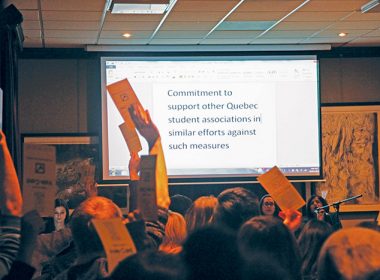
Approximately 1,500 people protested against austerity cuts in education on Feb. 28. The march from Université du Québec à Montréal (UQÀM) to McGill University was organized by several student unions, including the provincial student unions Fédération étudiante Universitaire du Québec (FEUQ); Fédération étudiante collégiale du Québec (FECQ), the Labor Union Centrale des Syndicats du Québec (CSQ); and the Association Québécoise des Centres de la Petite Enfance (AQCPE), a union for child care centre workers. 

In December 2014, the Quebec government announced that it would aim to cut $700 million in public service jobs and salaries. Earlier in January, the government proposed a decrease in the number of school boards, amongst other changes, in order to balance the budget.

According to Jonathan Bouchard, president of FEUQ, the march was a signal to the provincial government to preserve the current public services. 

“The main message was a cry out to the government [that] Quebec absolutely requires an investment in education in the next budget,” Bouchard said. “From daycares to university and research, all orders of education are affected by the liberal government’s austerity measures, and quality and accessibility to these services are compromised.”

Bouchard stressed the negative impact the cuts would make on education, and said the group would continue to mobilize against austerity. 

“It is important to view this march as part of a bigger mobilization against the austerity measures implemented by the government,” Bouchard said. “Education is at the verge of being affected for years to come, and we have to pull together to demand a better future for our education system and our society as a whole. Smaller actions will take place throughout the spring in order to grow and continue mobilization.”

Guillaume Parent, a business school student at UQÀM  and participant at the march, said that while he understood that the government needed to make cuts for financial reasons, he felt  that the austerity measures did not take into consideration the people’s voice.

“I know it’s not easy because there’s a lot of bureaucracy and other stuff—so in a sense what they’re doing is necessary—but I don’t think they’re doing this the right way,” Parent said. “For instance, they’re talking about closing some healthcare offices, but that will make people go from their small village to their big town, making them ride for an hour [to get there….] They should […] really listen to what the people want and the needs of the population.”

Gabriel Provost, a history student at UQÀM and participant at the march, cited a report created by the Coalition of Consumer Associations in Quebec (CACQ) and its proposal for increasing the provincial government’s revenues through measures like increasing tax brackets and fully publicizing the drug system.

“[The government] wants to remove the fiscal burden, but essentially what [they’re] doing is making us pay more everywhere [except] in our taxes,” Provost said. “Prosperity is something you cultivate. You cannot impose austerity on a population and expect for everything to go well.”

a, McGill, News

SSMU and PGSS students vote to increase QPIRG fee

Students voted to approve an increase in Quebec Public Interest Research Group (QPIRG)-McGill’s opt-outable fee, raising it from $3.75 to $5.00 per semester. The fee passed by 62.9 per cent, and is set to be implemented starting in Fall 2015. The Students’ Society of McGill University (SSMU) and the Post-Graduate Students’ Society (PGSS) saw 13.7 per cent and 18.8 per cent voter turnouts, respectively, among constituents.

QPIRG is an organization mandated to increase awareness of social justice issues through research, advocacy, and events—including Rad Frosh and Social Justice Days. QPIRG has chapters in other Quebec universities, as well as similar research groups in universities around North America.

According to Robin Reid-Fraser, a member of the QPIRG Board of Directors, allocation of the additional funding will be evaluated over the next few months, but will also include many short-term initiatives.

“We’ve been talking about, in the short term, [putting] more funding towards our working groups, who haven’t had a funding increase in years; our programming; our applied student research platform, Community University Research Exchange (CURE); creating more staff positions; and our resource library,” she said. “In the long term, we’re planning on improving the accessibility of the [QPIRG offices].”

Fraser stated that the fee increase garnered support on campus during its limited campaign period.

”Because our campaign period ended up starting just a few days before Reading Week, we were a little worried about being able to reach as many people as we wanted to in such a short time,” Reid-Fraser said. “Fortunately, we had lots of people helping with the campaign, and it felt like we were really able to spread the word [….] It was also greatly appreciated how receptive students were, despite the fact that midterms were going on for a lot of people as well.”

a, Arts & Entertainment, Music

‘Tis the winter of Mike Dubue’s discontent

Mike Dubue, founder and frontman of Ottawa-based experimental indie band Hilotrons, has spent the last few years stylizing discontent. Hilotrons’ latest album, To Trip with Terpsichore, is not so much about anger but more of an overarching dissatisfaction with the way things are.

“Each song is relative to a situation,” Dubue said. “Every song is a social commentary on something that’s going on.”

For Dubue, the album is a musical discourse, addressing the gamut of social and political issues, primarily those within Canada. However, Dubue isn’t radiating towards angst-driven electropop. The album’s lyrics have a bite to them, but the sound is upbeat.

“I don’t think there’s anything quite angry in the sense that [the album] is very calculated,” Dubue said. “It shows discontent, but we’re not necessarily angry or not thinking logically.”

The new album isn’t the only avenue Dubue is taking to tackle social commentary. Since 2009, he has been writing film scores, and this past year he crafted the soundtrack for the 1928 silent Canadian film, Carry On, Sergeant!

“This one was a lost film, an anti-war film, very interesting cinematically though it’s never really been discussed in any university film class,” Dubue explained. “It’s lost to its own history in Canada though it’s relevant to cinematic history worldwide.”

Interestingly, Dubue’s passion for films runs much deeper than just the musical aspect—though he does love the music, he has a collection of movie soundtracks on vinyl. Dubue is a self-described film buff, and as he looks to the progression of his career, he sees it taking a more theatrical turn.

“Eventually I’d like to make films,” Dubue claimed. “I want to be a film director when I’m in my forties.”

For the time being, Dubue is still committed to Hilotrons, his band of 14 years. And while the band has always been a part of him, the line-up of the band has changed drastically over its decade-plus existence, with only Dubue and drummer/engineer Philip Shaw Bova acting as consistent members in the band. Dubue, to his credit, has welcomed the changes.

“The way that I work musically, I’ve always been at the helm of this band,” Dubue said. “[The band is] constantly trying to evolve or change, and any type of change is welcome. I don’t know that our sound is married to any ideas; we’re open to constant change.”

Part of that constant change comes from playing a variety of shows all over. Throughout the years, Hilotrons has played at a variety of venues, and while sometimes touring can get repetitive, Dubue says that for him, it’s all about keeping things fresh and interesting.

“Even if we’re on tour playing the same set, we still try to make it a new experience and a righteous experience,” Dubue said, adding that even the worst of shows can have a silver lining. “Even in the most shitty of circumstances, the fact that you’re playing music somewhere, it’s not something to be taken for granted.”

Of all the places Dubue has played, one of the most stand-out experiences happened in Montreal, as part of the annual Pop Montreal festival.

“We did this soundtrack to a gay porn [film] at Cinema de L’amour,” Dubue explained. “It was this 1960s pornography. So the porn was going on the screen, and we were set up on the floor playing along [….] It got a really awful review but we sold the place out.”

Ultimately for Dubue, who whistles while he thinks and laughs through his memories, it’s all about the experiences that comes with the music.

“Practice, learn to read music, perhaps move out of the country, move to a place where you can tour and make a living,” Dubue said. “No musician should be complaining about playing music.”

a, Letters to the Editor, Opinion

Letter to the editor: Women-only hours a regressive step

Soumia Allalou argues in favour of women-only gym hours, citing in support her religious beliefs which forbid her from sharing a gym with men. In Canada we are fortunate to live in a secular, non-segregated society where men and women live and work together. I believe that introducing segregation of the sexes for religious reasons would be a regressive step.

Increasing gym usage by under-represented groups is a laudable goal, but I don’t believe that excluding other groups is the solution. Maybe the students concerned could learn from the example of the Women in Physics (WiP) group in the Department of Physics. WiP aims to increase female participation in Physics at all levels, but their events are open to all, regardless of sex. I would argue that such an inclusive approach ensures support from all members of the community, male and female, and is preferable to exclusion and segregation.

a, Letters to the Editor, Opinion

Letter to the editor: Women-only gym hours not a final solution

After reading the Tuesday, Feb. 24 issue of the McGill Tribune, specifically the commentary “Exercising Justice at the McGill Fitness Centre”, I feel it’s important to point a few things out.

I believe that with regard to women who are insecure using the gym due to the presence of men, women-only gym hours should be viewed as a stopgap measure or band-aid solution at best. Men will not vanish simply because women use the gym at a different time, nor will the sexual aggression or harassment that is at the root of this problem.

Being afraid of working out simply because men are there—and condoning this fear with women-only gym hours—is a tacit accusation that all men are boorish and judgmental, and cannot be trusted in a co-ed environment. I would never deny that women disproportionately face harassment and aggression from men in many aspects of their daily lives, but simply separating those two genders is not a final solution; it is a temporary one that addresses a symptom instead of the actual issue, and disenfranchises the majority of well-mannered men who frequent the gym in the process. The actual issue is enforcing proper conduct and a respectful, safe environment for all patrons of the McGill Fitness Centre, regardless of gender or fitness level, which requires effort and coordination from the staff at the fitness centre and the clients as well.

In addition, the notion of paying for a service that you do not use seems to only bother people when it’s their money on the line. Childless couples pay taxes so we can enjoy free primary and secondary education and cheaper tuition; people without cars pay taxes so our roads are maintained; people with jobs pay taxes so that people without jobs can have access to a better safety net. The idea that paying for access to the Athletics Centre as part of our tuition is unfair simply because one chooses not to use it absolutely boggles the mind. Not to mention that the extra cost of the fitness centre is completely optional. Nobody is being forced to pay for that at all.

The assertion that a lack of women-only hours is denying people their rights is also incorrect. Everyone who pays still has the right to use the fitness centre. Whether or not they exercise their right to use that facility is up to them, and any of their own personal preferences (excluding religious considerations, which I believe are a separate but related issue that requires more consideration) are just that—preferences. There is no such thing as a right to never be self-conscious, and as such, co-ed hours are not denying anyone rights, but they do present a conflict with some people’s preferences. Forbidding a portion of the clientele from using the gym at certain times would actually be directly curtailing their right to use the facility. 

People getting fit and having fun are of course the top priorities of the McGill Fitness Centre. Women-only hours at a gym may help some women transition into using the gym during co-ed times as well, which is a positive thing. But the ultimate solution to people’s pervasive insecurity is not to sequester them. I would argue that this actually prevents lasting change. The solution is to make all visitors to the McGill gym unavoidably aware that menacing, intimidating, or lecherous behaviour is grounds for punishment, or ejection from the gym. Creating a welcoming environment, encouraging a cultural change in gyms, and helping people to overcome their insecurities would benefit not just women, but all clients.

It is everyone’s responsibility to make co-ed spaces inherently safe spaces.  No judgment, no intimidation, from anyone. This cannot be achieved in the long-term with ham-fisted solutions like single-gender hours. 

Read the latest issue

Read the latest issue