Latest News

a, McGill, News

Forum on diversity and inclusivity in Engineering discusses intersectional perspectives

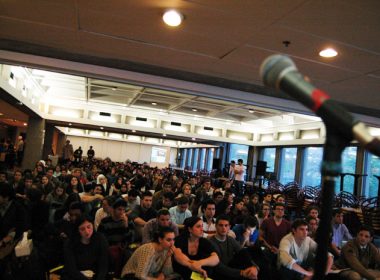
Last Thursday, the Engineering Undergraduate Society (EUS) and the Faculty of Engineering hosted a forum about diversity and inclusivity in the field. According to the faculty’s website, the forum aimed to allow members of the engineering community to discuss their experiences with the challenges they faced regarding diversity and inclusivity, as well as possible solutions.

McGill’s enrolment report for Fall 2013 states that the Faculty of Engineering had an undergraduate student enrolment ratio of 24.9 per cent female students to 75.1 per cent male students. However, female students constituted a majority 56 per cent of the entire undergraduate student body for Fall 2013 term.

Keynote speaker Dr. Karen Tonso of Wayne State University explained how societal interactions could create a sexist culture that ignored women’s contributions to the field and discouraged women from joining in the first place. 

“Female scientists continue to face discrimination, unequal pay, and funding disparities, and these disparities increase […] relative to rank,” she said. “Engineering has a sexist culture [….] It’s built up via social interactions, through ‘guy talk’ […] through jokes and language that degrade women. It’s built up through women being thought of as technically incompetent sexual beings.”

Tonso continued her speech by explaining the importance of diversity.

“Engineering creates and produces the technologies of everyday life,” she said. “Without the participation of members of diverse communities, engineers run the risk of losing sight of the world and their role in it, and this affects their technological creations.”

The keynote speech was followed by a panel discussion. Tal Arbel, professor at  the department of electrical and computer engineering, spoke about the apparent discrepancy between the provincial government’s investment in engineering—a $1.5 million investment over three years for development of technology start-ups was announced in the 2014-2015 provincial budget—and women’s involvement in the field. Only 13 per cent of the members of the Ordre des ingénieurs du Québec, a provincial organization of engineers, are female.

“There’s a lot of opportunity for employment [in] fields ranging from aerospace to digital arts,” Arbel said. “All the parts are in place, so you’d think that a balanced proportion of the native population would feel encouraged and excited to participate in these new opportunities [….] Surprisingly that is not the case [….] By permitting half of the population to opt out, Quebec is losing its chance to emerge as a leader on the global stage in various sectors of engineering.”

Arbel also spoke to the importance of female mentorship for students.

“Once you’re in the program […] and all your colleagues are male and teachers are male, certainly that will make you question your belonging and feel isolated,” she said. “I do think that having female professors not only affects the way female students feel, but it also affects the way everybody else feels [….] I also think that female professors bring a new perspective to teaching.”

Sara Houshmand, a 3rd year PhD counselling psychology student and a member of the panel, highlighted the effects of the gender-race intersection on students from a psychological perspective.

“[When] we tend to segregate race from gender from disability, we miss the intersection of identities [….] These different ‘isms,’ these difference aggressions coexist and they’re not additive, they take on a whole new face on their own,” Houshmand said. “Mental health-wise, racial microaggressions are associated with depression […] feelings of exclusion, and hopelessness [….] Physiologically, racism has generally been attributed to chronic stress, and tends to have the same impact as chronic stress.”

Tanja Beck, access services advisor for the Office of Students with Disabilities, spoke on how the intersection of social identities could be used to address bias.

“One of the most important points when it comes to preventing biases and stereotypes is that you know your own social location,” she said. “You know which privileges you have and [which] you don’t have […] because we all have learned biases, from our parents, from schools, from peers […] we have to reflect everyday on our biases; it’s a very self-referential exercise.”

Houshmand added that creating a dialogue regarding the challenges faced by marginalized groups was essential.

“The only thing we can do is help to disseminate this knowledge,” Houshman said. “Sometimes there’s the making things mandatory, but unfortunately, it’s not just something you can shove down someone’s throat [….] I think that the leadership can take [a] stance and can speak to why it’s important and encourage people to go to these kind of things.” Houshmand said.

Robert Forestell, U3 Mechanical Engineering and president of the EUS, discussed the challenges of raising awareness.

“It’s very effective in terms of sharing ideas and strengthening our views and getting on the same platform, but the bottleneck is to actually implement them,” Forestell said. “It’s one thing to tell our faculty top-down ‘this is what inclusivity means,’ but it’s really a whole other thing to have students recognize that about themselves. One of the goals of this forum is to see how we can all get there as a community.”

a, McGill, News

Seeds of Change seeks community for growth at McGill

McGill University Advancement, which promotes the university through  fundraising and alumni-engaging activities, launched an online crowdfunding initiative named Seeds of Change in May 2014, which has since raised more than $50,000 and funded nine projects.

“We wanted to help students to get the exposure they need to maintain and expand their worthwhile projects,” reads the McGill Seeds of Change program’s website.

Projects currently seeking funding through the website include four varsity athletics teams. Traditionally, varsity teams receive financial support from McGill Athletics and through alumni booster groups. According to Samantha Rogers, development and alumni relations at McGill Athletics, funding from alumni has significantly decreased for many teams.

“Some of the older, traditional teams like men’s hockey and football already have a huge donor base and support network amongst alumni,” Rogers explained. “It’s the smaller teams that need more immediate assistance because […] a lot of those [booster] groups have died down.”

For Martlet soccer Head Coach Jose-Luis Valdes, whose squad has created the Warrior Women project, the additional funding will be primarily for team-building portions of trips.

“[We] need the funding for four extra days where we’ll play Division I and Division II schools,” Valdes explained. “These extra few dollars that we are fundraising for [equates to] the possibility of leaving for seven days and [focusing] on team-building and not having to spend it all on buses […] and coming back home.”

Another of the projects currently seeking funding is the Quartier de l’Innovation (QI) Projects Fund. The campaign is led by the student working group at the QI, whose goals are to promote the concept of the QI, an extensive McGill-backed project in Southwest Montreal.

“We hope that the fund will create resources for professors and students to apply to if they have innovative projects for the [QI] district,” said Chloe Vadot, U3 Arts, a member of the QI student working group. “This crowdfunding campaign is really the preliminary step where we’re hoping to hire an intern to develop a strategy to create the fund.”

McGill is not alone in its university-led crowdfunding initiatives. The University of Alberta and Carleton University have both launched similar programs to promote student projects and scholarships. On a broader scale, companies such as Indiegogo, Kickstarter and Experiment—formerly known as Microryza—have moved into the crowdfunding market.

Peter Younkin, an assistant professor specializing in strategy and organization at the Desautels Faculty of Management, attributes the rise in crowdfunding to lower capital costs and the proliferation of technology.

“There’s two parallel trends, the first of which is a dramatic growth in entrepreneurship in general […] driven by lower costs of capital,” Younkin explained. “Technology has gotten a lot cheaper so it’s easier for people to put together these sites and distribute content internationally in a way that wasn’t really feasible 10 years ago.”

While platforms like Indiegogo and Kickstarter are for consumer-based initiatives, McGill’s platform is primarily for students. Experiment is for research-based funding—a trend that Younkin stated may be troubling in the light of decreased government funding for research. “I don’t anticipate that taking off across the spectrum,” Younkin said. “It might be useful for people studying pharmaceuticals, biotech products [but…] if people start using it to fund research then the government might say we don’t need to give more money to research.”

According to Vadot, much of the value added by Seeds of Change is its relationship with the university.

“There’s a lot of other crowdfunding platforms that exist but using one that’s really rooted in McGill gives us access to a huge alumni network,” Vadot said.

For those in Athletics such as Valdes, varsity teams’ partnership with Seeds of Change can have a tremendous impact. He acknowledged that although varsity teams do get funding from McGill Athletics for team-building and off-season activities, additional support is required.

“‘Friends of McGill Soccer’ [was] never a very active group,” Valdes said. “Now, [after collaborating with Seeds of Change,] we’re getting more interest than we’ve ever had before and gotten more funding in the last two weeks than we [had] in the last two or three years.”

a, Arts & Entertainment, Music

Album Review: Flying Lotus – You’re Dead!

You’re Dead!, the latest album from musician-producer Flying Lotus, is one that stubbornly refuses to adhere to the limitations of genre. Whether it’s the walking bass at the end of “Tesla,” the distorted guitar riffs that open “Cold Dead,” or the 8-bit sounds on “Dead Man’s Tetris,” Flying Lotus is not afraid to mix and match various effects and styles for the purpose of realizing his dementedly brilliant vision.        

It doesn’t always sound deranged though, and the album’s most accessible moments are some of its most thrilling. On “Never Catch Me,” rapper Kendrick Lamar lends his virtuosic lines to a neo-soul cut that sounds a bit like a B-side from Robert Glasper’s Black Radio. But unlike many of the tunes from that record, “Never Catch Me” lacks a big, catchy hook that defines the song. It’s Flying Lotus at his most radio-friendly, but he still refuses to compromise his vision in the interest of accessibility.        

On “Moment of Hesitation,” he references straight-ahead jazz similarly to how he cribs from neo-soul on “Never Catch Me.” The genre is a blueprint, not a mandate. In “Moment,” the legendary jazz pianist Herbie Hancock echoes amorphous, wandering saxophone lines with floating keyboard chords that respond to the horn without being beholden to it, all while double-time percussion drives the rhythm underneath them. Like “Never Catch Me,” the song references its influences while breaking free enough to sound wholly original.

Sometimes the album gets outright bizarre, as in the case of the playful, schoolyard-like rhythm juxtaposed with trance-like synthesizer lines on “Ready Err Not,” but it all sounds like the pure self-expression of a challenging genius. You’re Dead is pastiche of the highest order.

Loggers logging in lgos
a, Sports

10 Things: Lumberjack World Championships

  1. The Lumberjack World Championships has been held at the Lumberjack Bowl in Hayward, Wisconsin every year since 1960. Over 100 participants compete in 21 events for $50,000 in prize money. The competition is split up into men (lumberjacks), women (lumberjills), and team events.

  2. In addition to the Lumberjack World Championships, other lumberjacking competitions around the world include ESPN’s Great Outdoor Games, The World Logging Championship, The Stihl Timbersports Series, and various interscholastic competitions, including the Southern Forestry Conclave and the European Championship in Forestry Skills.

  3. In the block chop event, competitors use a five-pound axe to chop all the way through a standing aspen log 12 inches (300 mm) in diameter and 28 inches (710 mm) tall as fast as they can. The current world record is a blistering 15.94 seconds, set by New Zealand’s Jason Wynyard in 2006.

  4. In the hot saw, competitors use a customized chain saw with a modified engine, usually taken from a personal watercraft or snowmobile. When the judge yells start, competitors make three horizontal cuts in a 20-inch (510mm) diameter white pine log. All three cuts must be made in a six-inch span, and must go cleanly through the entire log. Matt Bush of the United States set the world record in the event at 5.085 seconds in 2003.

  5. There are various speed climbing events at the World Championships, in which competitors race up and down 60-foot (18m) or 90-foot (27m) tall cedar poles. Contestants wear specialized climbing cleats and hold on to a special harness that loops around the other side of the pole to hoist themselves up step-by-step. Brian Bartow holds both the 60-foot and 90-foot pole climb records at 12.33 seconds and 19.87 seconds respectively.

  6. The boom run is a race between two opponents running simultaneously across two parallel chains of floating logs tied end to end from one dock to another. The logs tip and slope perilously depending on which side the contestant’s weight is, leaving many competitors in the water.

  7. Logrolling—or ‘birling’—is an event in which two contestants stand on either ends of a floating log in a body of water and compete to see who can stay on longest. They wear special spiked ‘birling’ shoes, allowing them to grip the log better. The aim is to spin the log rapidly by running quickly in place, forcing the other contestant to keep up or fall off. Competitors also often dig a heel into the log to stop the rotation quickly, and try to make their opponent fall off. The cardinal rule of logrolling is to never take your eyes off your opponent’s feet.

  8. Jack and Jill is a team event composed of one male and one female competitor per team. Using a two-person bucksaw, the teams must cut through an entire 20-inch (510mm) diameter white pine log, alternating pulling and pushing cuts from each side. The world record time for the Jack and Jill is 6.17 seconds, set in 2005 by Jason and Karmyn Wynyard.

  9. The team relay consists of teams racing through a selection of lumberjack sports including a 60-foot climb, a hot saw, a block chop, and more. In one format, the team to complete all of the events the fastest wins. In an alternative format, teams earn points for finishing in the top three in each event, and the team with the most points walks away victorious.

  10. At the end of the competition, the Tony Wise All-Around Champion–named for the founder of the original Lumberjack World Championships–is awarded to the lumberjack who scores the most points across all the events. Wynyard is the current champion with a total of 11 Tony Wise awards to his name.

a, Arts & Entertainment, Music

Deep Cuts: Homesick Harmonies

Steel Rail Blues

Artist: Gordon Lightfoot

Album: Lightfoot!

Released: January 1966

Gordon Lightfoot is Canada’s preeminent folk musician, and he demonstrates it on this song from his first album, crafting a melodious chord progression that hums along like a relaxing first-class train ride while the lyrics carry the weight of freight cargo. The first four verses set the listener up for a happy ending where the lonesome, beaten-up rambler gets to reunite with his girl back home who has, “Sent me a railroad ticket too/ To take me to her lovin’ arms.” But then—since it is a blues song—we find out that he gambled his ticket away and won’t be coming home on that big steel rail after all.

On The Road

Artist: Max Webster

Album: High Class in Borrowed Shoes

Released: March 1, 1977

The acoustic “On the Road” is a rare departure from the hard rock that dominates Max Webster’s catalogue, but a welcome one. Kim Mitchell’s lush guitar strumming whisks us along as he reflects on the touring lifestyle. Straightforward observations like “On the road/ The heart is slow/ The mind is not clocked/ The feet are sore,” account for most of the lyrics. However, Mitchell saves his most insightful commentary for the chorus, acknowledging that the road offers freedom, but: “Freedom some say is when you get back home.”

Where U Goin

Artist: Arkells

Album: Michigan Left

Released: October 18, 2011

Everybody studying at an out-of-town school gets hit by a bit of homesickness at some point, even if they don’t care to admit it. There’s no hiding from it on this track, which culminates in a dorm-room conversation—taking place at McMaster University, where the Arkells formed—that shows us how those insecurities can easily bubble to the surface when we try to hide them: “And you know in your bones/ This may never feel like home/ Tonight (tonight, tonight).”

Carry Me Home

Artist: Hey Rosetta!

Album: Hey Rosetta!

Released: November 19, 2012

Nothing breeds homesickness quite like staying in a cheap hotel with stinky pillows on Christmas Eve, which is exactly what Tim Baker opens this track by singing about. Once the bells kick in after the first verse, the juxtaposition between the cheerful music and depressing lyrics is about as glaring as it gets. It’s cliché to talk about not taking things like home and family for granted, but this song reinforces why we should keep doing it anyways.

a, News, PGSS

PGSS Council endorses AGSEM union drive, creates Sustainability Committee

Last Wednesday, the Post-Graduate Students’ Society (PGSS) Council heard a presentation regarding a motion that would endorse the Association of Graduate Students Employed at McGill’s (AGSEM) drive to increase the scope of teaching support workers that they represented. In addition, Council passed motions concerning the Post-Graduate Student Life Reform Package, the creation of a PGSS Sustainability Committee, and the adoption of the Universal Public Transit Pass for students.

AGSEM union drive endorsement

Justin Irwin, president of AGSEM, presented a plan to expand the membership of AGSEM to include teaching support workers such as tutors, note-takers, graders, course assistants, and undergraduate teaching assistants. PGSS passed a motion to officially endorse the drive.

“[Teaching support workers] do very similar work to graduate student TAs, and often identical work, but make very different sums of money,” Irwin said. “A graduate student working as a teaching assistant makes $26.85 per hour including vacation pay, whereas an undergraduate or someone working as a grader or marker is paid basically depending on what the hiring end of the department they’re working for determines is appropriate.” 

Irwin pointed out the lack of standardized pay for teaching support workers and undergraduate teaching assistants, and noted that these workers have no protection from workplace issues.

“If any issues arise, whether it’s harassment in the workplace—which hopefully doesn’t happen all that often, but is still a problem sometimes—or any issues of getting paid, these people basically have to speak for themselves and represent themselves,” Irwin said. “They don’t have the protection of the union.”

Creation of the PGSS Sustainability Committee

Post-graduate psychology student Regine Debrosse and PGSS Environment Commissioner Amanda Winegardner presented a motion to create a PGSS Sustainability Committee, which was passed by Council. The motion proposed an amendment to the Student Activities Manual, allowing for the creation of a committee that operated in line with McGill’s existing approach to sustainability.

“This is an important motion because, with the termination […] of the sustainability coordinator position, we don’t have anyone who’s responsible for these types of issues,” Winegardner said. “So I think this is a good step.”

Universal public transit pass

External Affairs Officer of the PGSS Julien Ouellet presented the Executive Committee’s motion to support the creation of a Universal Public Transit Pass for McGill students. The motion was passed by Council.  It would combine students’ I.D. card, Opus Card, and student rebate card into a single pass.

“It’s basically a Montreal student Mastercard,” Ouellet said. “It will fuse all the cards you need into a single card.”

The card will be brought forward to Je Vois Montreal, a forum that decides on new products designed to revitalize the city. Ouellet hopes that the project will help with another larger goal to extend student fares to graduate students over 25.

“Students who are 25 years old or older cannot benefit from the reduced student fare in Montreal,” Ouellet said.” What we want to do is to use that opportunity to push this agenda through. It’s part of our work plan, and we’re really hoping it will be able to put a foot in the door for that particular project.”

PGSLF Reform Package

The Post-Graduate Student Life Fund (PGSLF) funds post-graduate student associations out of a fee levy paid by all PGSS members.  PGSS Financial Affairs Officer Danielle Meadows discussed amendments to the fund during Council.

“The idea behind changing the PGSLF system is to really put [the fund] back in students’ hands, to take it out of our office’s hands and really let the students be the drivers of their own destiny,” said Meadows. “It’s their money—they can use it and do what they’d like.”

The main change made to the PGSLF concerns post-doctorate fellows, whose student association—the  the Association of Post-Doctorate Fellows (APF)—currently receives no money from post-doctorate student fees. Instead, the funds go towards the student’s corresponding program student department. The proposed amendment would allocate 75 per cent of post-doctorate student fees to student departments and 25 per cent to the APF.

“Post-doc fellows are typically counted for [in] both [the] APF and their [own] department,” Meadows said. “At the moment, they have no funding, and in previous years they’ve come to the [executives] and the Council directly requesting that we take money out of other areas of our budget and allocate it to them [….] But that’s not really fair and it’s not giving them a sustainable mechanism for having funding going forward.”

The 75/25 split was in part influenced by feedback from some of the larger graduate student associations. These associations often must give up greater amounts of their budget to APF .funding through the current funding process due to the higher numbers of post-doctoral fellows, and would therefore support an alternative source of funding for the APF.

Marc Webster playing Rugby
a, Men's Varsity, Sports

No quarter given in attritional draw between McGill and Concordia

The Redmen (2-1-2) were clearly frustrated at the final whistle of Friday’s game against Concordia (3-1-1). (more…)

a, News, SSMU

SSMU Council discusses cycling referendum, conflict of interest policies

Traditional Territory Acknowledgement Statement

Last Thursday, the Students’ Society of McGill University (SSMU) Legislative Council passed the “Motion Regarding the Adoption of a Traditional Territory Acknowledgement Statement,” which requires a statement of acknowledgement over McGill’s physical situation on traditional Kanien’kehá:ka territory be read at all future SSMU Council meetings and major SSMU events. 

The motion is similar to a motion of the same name passed by the Arts Undergraduate Society (AUS) Council in late September 2014, and was sponsored by VP University Affairs Claire Stewart-Kanigan, VP External Amina Moustaqim-Barrette, and Arts Senator Kareem Ibrahim.

“It’s a growing practice amongst universities, and McGill has historically been behind in supporting indigenous students,” Stewart-Kanigan said.

“It shows our effort to decolonize education and bring attention to the too often ignored issues facing First Nations communities,” Ibrahim said. “The land McGill occupies is unceded Kanien’kehá:ka traditional territory, also known as the land of the Mohawk First Nation. This is just one step in a very long journey that we have both as an institution and as a larger community here in Montreal to recognize the consequences of colonialism, how we are inherently a part of that process, and how these effects continue today in very prominent ways.”

Cycling referendum

Council also approved a plebiscite question for the second Fall Referendum ballot asking students if cycling should be allowed on lower campus and if SSMU should lobby the McGill administration to allow bikes on campus.

As a plebiscite question, the ballot has no weight beyond gathering data on student preferences, but some councillors expressed concern that the vote would mislead the student body by implying direct change as a result of the referendum.

McGill’s dismount policy, which required bikers to dismount and walk their bikes on campus since May 2010, was met with mixed reactions with the installation of swinging metal gates at the Milton entrance in September 2013. The bike gates were vandalized and faced formal opposition from AUS and SSMU council, leading to their removal in October 2013.

A Cycling Working Group was created to explore possible solutions after this incident. According to the motion, the working group recommended to McGill a “Shared Space” policy be implemented on campus, instead of the current dismount policy.

“Shared Space is an approach to street design that minimizes the separations between cyclists and pedestrians, forcing all mode users to share the space, and where the pedestrian is considered the primary user of the shared space and has the right of way at all times,” read the motion for the plebiscite question.

Conflict of interest regarding councillors’ employment

The Council also voted to allow special permissions to two councillors employed in SSMU operations, who would otherwise be prohibited from being employed by SSMU while on Council as per Bylaw I-2 Article 3.5.

Councillor Zacheriah Houston and councillor Alexander Kpeglo-Hennessy, working at the Student Run Cafe (SRC) and Gerts Student Bar respectively, were granted permission to continue their employment after heavy debate on the floor.

“I’ve always recommended not adding councillors to be employed by the SSMU, for the reason that there could be potential situations where I have to make an intervention with an employee […] who is also above me,” SSMU General Manager Pauline Gervais said.

Issues of conflict of interest were discussed as well as to whether the councillors had intended to pursue employment at the operations run by SSMU prior to being elected into their position at Council.

Event and services finances

VP Internal J. Daniel Chaim also discussed his work on SSMU’s annual Halloween party, 4Floors. According to Chaim, this year’s ticket prices would have to be increased from $15 to $25 per person in order to gain the necessary funds to improve the event from prior years. He explained that the increased price was necessary in order for the event to break even, which it struggled to do last year.

“We spent a while debating financial accessibility and the success of the event,” Chaim said. “It was financial accessibility that was was most in our minds, but we didn’t really didn’t have a choice [….] I’d rather tell people there was a deficit last year and we need to account for that.”

Council also approved the Audited Financial Statements for the 2013-2014 fiscal year. Gerts Bar reported more than $8,000 in profit, which was attributed to increased sales since its renovation two years ago. The SRC reported a $51,000 loss, primarily due to start-up costs such as equipment and training.

a, Student Life

Escape from reality with Echappe-Toi

Echappe-Toi, a real-life simulation experience based on Montreal’s Parthenais Prison, launched in Montreal on Tuesday, Oct. 7. Created by Montreal entrepreneurial lab Les Entrepreneurs Associés, the game offers participants 60 minutes to escape from a room using teamwork and a variety of clues.

Popularized by Japanese role-playing video games in which players are locked inside a room and must use their environment to escape, the experiences known as ‘Real Escape Games’ have been implemented worldwide to incredible success. Seventeen countries have established escape games so far, with Montreal being the third city in Canada to implement the simulation.

Located on the same street as the historical location of the Parthenais Prison, Echappe-Toi places participants in a room imitating a real cell from the prison. According to Emmanuel de Gouvello, one of the founders of Echappe-toi, a great impetus for introducing the game to Montreal was the unique cultural history of the location. 

“Historically, [this] is a jail street,” de Gouvello said. “What we like is that [the game] is related to the part of the city where we are, because Montreal has such an incredibly rich story.”

Setting up the game proved to be difficult in Montreal, where the creators had to consider a number of complex factors, including the bilingual nature of the participants. To add to the difficulty, Echappe- Toi chose not to engage in standard industry practice and visit other escape games for inspiration, opting instead to build the game from the ground up. De Gouvello stated that to do otherwise would render Echappe-toi a copycat experience.

“I know it’s not traditional, because normally you would go see your competition, see how they work, and try and take their idea,” he said. “But I love the idea of being truly original with an idea that has been developed by others in the world.”

Escape games have had an astonishingly low success rate internationally, with only three per cent of participants completing a successful escape, according to de Gouvello. As such, the Echappe-toi team views the game as a means to an end in order to create team chemistry—with escaping the room being just one of the desired goals. With two to six players allowed in each room, the game offers a variety of different clues and activities that appeal to a number of different skillsets, including more tactile-based clues and cryptographic puzzles.

After each session, the Echappe-toi team offers participants a debrief of their activities. According to co-founder Jérémie Abbou, the game appeals to a variety of clients who are intent on improving group dynamics.

“We build packages for schools, friends, families, and companies,” Abbou said. “[Packages include] group coaching, how to emphasize team building, [and] how to improve your efficiency.”

Although Echappe-toi has just launched, the founders are already thinking of new scenarios and rooms in anticipation of repeat customers—despite the fact that the game is almost fully booked for the next three months.

“We will make sure the game evolves,” de Gouvello said. “We’ll change the puzzles inside if you come back or if we have leaks, [so] there’s still value for everyone [….] We already have a few ideas in stock.”

However, the team’s primary focus has stayed steady throughout the process: Making sure that people enjoy their experience at Echappe-toi.

“It’s fun,” said Philippe Prevost, head of marketing for Echappe-toi. “And that’s what people are looking for, the pursuit of happiness […] That’s the objective of the team operating this event—that people leave happy.”

a, Science & Technology

Experts discuss life in outer space

Spanning two days, the Annual Trottier Public Science Symposium “Are We Alone?” took the audience to the moon, Mars, and beyond. Focusing on the origin of life in our solar system, the series explored the where and how of alien life.

Monday

Monday’s first speaker, Planetary Society President Jim Bell, discussed the journeys of Spirit, Opportunity, and Curiosity—three Mars rovers—as they furthered the search for microbial life in our solar system. Following him was Jill Tarter, director of the Search for Extra-Terrestrial Intelligence (SETI) Institute, explaining the possibility of sentient life and our current methods of finding it.

Bell started by presenting the idea that if we can prove that life evolved on another planet, then we know that it is not a cosmic coincidence—all of the universe should be full of life. Mars, due to the presence of water on its surface, is a prime target for this. Rovers have been sent to ancient lakes and bodies of water in order to study potential traces of life. By observing soil and air samples, or by taking photographs of the Martian surface to investigate the different layers of rock, scientists can extrapolate the conditions and determine how habitable they may be.

One of the major goals for NASA’s next mission is to set up a sample-return capsule, which could be brought back to Earth and analyzed.

Tarter pointed to the hundreds of thousands of confirmed extrasolar planets that have been discovered within a ‘habitable zone’—regions with sufficient atmospheric pressure to support liquid water—as necessary to study. She believes that there are more habitable planets than we are testing for because our definition of what makes planets livable is too narrow.

The goal of Tarter’s and SETI’s efforts is to detect a signal from an alien species, in order to answer two major questions: How close are other intelligent civilizations, and how far away are we?

Tuesday

Professor Sarah Seger began Tuesday’s talks by addressing some common questions about the search for another Earth. Called the ‘Indiana Jones of astronomy,’ Seger researches the edges of exoplanets—planets that do not orbit Earth’s sun— and their identification.

To set the stage for her talk, Seger gave the audience a glimpse of the vastness of the universe and the diversity of star systems. However, the detection of exoplanets is only the first step in the search for life. After astronomers find a planet, they still need to determine whether it contains any signs of biological activity.

So far, the search has produced an impressive list of exoplanets, but no sign of extraterrestrials. Even if scientists do find life markers, interstellar distances mean that a trip to visit any celestial neighbours would take millennia.

So why bother? Why search for something so far away when humans won’t be able to visit it for thousands of years?

The answer, according to Seger, is because one day, humans will make the trip.

“The desire to explore is so huge, so amazing, that one of our legacies of finding exoplanets is the thought that hundreds, thousands of years from now, people going on this trip [to other star systems] will look back at all of us here and they’ll say, ‘Wow, those were the first people who went out and tried to find those other worlds,’” she said.

Skeptic Joe Nickell shifted the audience’s focus away from the stars and back to Earth. As the world’s only full-time, professional paranormal investigator, Nickell touches upon tales of Earth’s more mythological inhabitants. The two mythologies represent different aspects of humanity’s relationship with the planet.

“Bigfoot is the symbol for [the world’s] endangered species,” he said.

As Nickell put it, humanity’s fascination with the infamous Sasquatch reflects the curiosity about our own origins in the natural world.

“We’re looking away from this planet,” Nickell said. “We’re looking to the moon, the stars, and so forth, and we’re imagining that there may be life out there.”

The speakers’ descriptions of the search for life beyond Earth revealed more about humans than about aliens. Even if life is not universal, the desire to find it is.

Read the latest issue

Read the latest issue