Latest News

a, Men's Varsity, Sports

Split sours homecoming weekend for Redmen hockey

The McGill Redmen (2-2-0) faced two Ontario teams on consecutive nights this past weekend, and split the games, handily defeating the Nipissing Lakers in a dominant 8-1 performance Friday night and falling to the Laurentian Voyageurs 5-2 Saturday night. (more…)

a, Behind the Bench, Hockey, Sports

Behind the Bench: Narrative from nothing

When the Ottawa Senators appointed their superstar forward Jason Spezza captain one year ago, the response from the media was immediately critical. (more…)

a, Arts & Entertainment, Music

Album Review: Hey Rosetta! – Second Sight

When its previous album Seeds (2011) was being recorded, Hey Rosetta! was coming out of a phase where the band had been touring extensively for the first time, and—quite fittingly—planting musical seeds in the towns and cities it performed in. The album, with its oscillation between boisterous anthems and measured melodies, reflected the mindset of a band that was giving audiences exhilarating live shows at night in between the hours of quiet introspection they had on the road. To a certain extent, Second Sight replicates that balance, but the frenetic feeling that characterized the band’s more spirited songs in the past has been replaced by light tones and a controlled electricity that—despite flashes of generic repetition—sparks several quality songs.

Poppy, radio-friendly single “Kintsukuroi” suggested a new musical focus when it was released in August, and with Second Sight, the band shows us that this was indeed the case. Most of seven tracks leading up to “Kintsukuroi” feature a kind of airy instrumentation, dynamic percussion, and middling pace that grow somewhat tiresome and—unfortunately for such a unique, orchestral seven-piece group like Hey Rosetta!—sound reminiscent of other indie acts such as Local Natives (“Promise”) or Vampire Weekend (“Neon Beyond”).

As is usually the case with Hey Rosetta! albums, Second Sight’s best songs are the ones that sound like only they could have written them. “Gold Teeth” combines elements of Seeds’ standouts “Seventeen” and “Young Glass” with the band’s evolved sound to produce a superb song that is bursting with hope and excitement underneath its poised surface. “What Arrows” and “Cathedral Bells” are two of the album’s quietest and strongest tracks, initially carried by Tim Baker’s gentle vocals as soothing music slowly builds up around him.

Even though the sum of its parts isn’t as great as it could be, Second Sight is loaded with good music and good vibes, and at the end of the day, certainly feels like a worthwhile experiment.

a, Science & Technology

The substance of style

Since the invention of the printing press, news media has endeavoured to employ capitation in the interest of magnetizing readers into ratifying their viewpoints and escalating their market share. The McGill Tribune is no exception, as the paper employs strategic readership engagement tactics in order to endue its student body readership with information, material, and divertissement.

Wait, what? That’s the question Harvard professor Steven Pinker asks in The Sense of Style, his latest book related to psycholinguistics. Pinker’s previous book, 1994’s influential The Language Instinct, stated that despite widespread disagreement, our collective language and grammar skills are not devolving, which Pinker, in Sense, reaffirms: Writing is not getting worse—it’s always been bad.

Pinker believes his new book can help. He was introduced to a number of adulations last Friday at a lecture organized by the McGill Writing Centre: A professor at Harvard, one of Prospect and Foreign Policy magazines’ top 100 public intellectuals, one of TIME’s top 100 influential people, and a prolific and popular author. It is this last distinction, however, that really gives Pinker the authority to write about writing; a boastful blurb from The Economist on Sense claims that Pinker writes “like an angel.” Last week’s public lecture gave students the opportunity to see if he speaks like one, too.

Pinker, after acknowledging his connection to McGill—BA Psychology, 1976—in a lecture hall that, according to him, “hasn’t changed in 40 years,” abruptly dove into Sense. The “curse of knowledge,” as Pinker calls it, is a significant cause of bad writing. According to Pinker, contrary to popular belief, writers today aren’t deliberately obscure, nor has their craft been dumbed down by the internet. Instead, Pinker says, bad writing is the difficulty in imagining what it is like for someone else not to know something that the writer knows, because people often project their knowledge, however specific, onto others.

What is to be done about this? Pinker sees some value in traditional ‘prescriptivist’ guides, such as the classic 1959 The Elements of Style by William Strunk and E.B. White. Furthermore, he claims that he doesn’t have the desire, to say nothing of the ability, to supplant The Elements of Style. However, Sense reflects Pinker’s wish for a 21st century style guide.

“[The book uses] the science and scholarship of language, […] modern grammatical theory, […] evidence-based dictionaries, research in cognitive science on what makes sentences easy or hard to read, and historical and critical studies of usage,” Pinker said.

Drawing from these areas has led Pinker to believe that a good model for writing is the so-called ‘classic style’: Simple and concise prose that does away with elaborate filler and meta examination of its subject—the introduction to this article, for example—responsibility-shifting passive voice, and hedging without much opposition. Classic style instead makes liberal use of example, and invites the reader to gaze out of “a window unto the world” through which the writer points directly to topics they are trying to explain, and does so neither by confusing the reader nor insulting their intelligence.

According to Dr. Sue Laver, director of the McGill Writing Centre, The Elements of Style is no longer assigned to McGill undergraduates. Much of the praise for the guide has stemmed from its concise precision; the book heeds its own advice to “omit needless words.” Writing is hard, however, and poor prose has spawned a whole curriculum of courses at McGill to improve writing—and has frustrated Stephen Pinker enough that he felt the need for a new style bible. Brevity and clarity have always been fashionable, but there is no doubt that The Sense of Style will inspire more ink to be spilled on how to write less.

a, Campus Spotlight, Student Life

Campus Spotlight: McGill Women In Leadership

Feminist movements have received a surge of recognition from mainstream media in response to Emma Watson’s He For She speech at the United Nations. Women’s roles in the professional world is one of the most recent conversation topic for McGill Women In Leadership (MWIL) club, which seeks to address these issues and change the way they affect young women’s goals.

“Our mission [is to] inspire young women to aim high in their career aspirations, regardless of the field they wish to enter,” explained Erica Pedersen, MWIL’s co-president.

MWIL, founded in 2012, was created to provide a space to empower young women in today’s society, but membership is open to everyone, regardless of faculty, gender, or identity. The club seeks to discuss and overcome the barriers that may hold women back from achieving their goals, particularly the pressures of a society that heavily values exterior beauty and passive personality traits.

“My biggest hope for [MWIL] would be that more girls would be aware of it and what it [stands] for,” said Paige Burla, VP Events of MWIL. “I think it’s such an important concept to get girls involved in.”

The club holds a variety of events throughout the year, with the goals of inciting discussion about female empowerment, connecting young women with opportunities within and beyond university, and collaborating with local charities—such as Artistri Sud, a Montreal-based organization that teaches entrepreneurship training for women around the world to create sustainable micro-enterprises.

MWIL organizes personal development events such as MWIL Talks, which are bi-weekly sessions where members can participate in informed dialogue about current events relating to feminism, as well as skill-development workshops.

“[These workshops] hone important professional skills and prepare our members for leaving university,” Pederson said.

Furthermore, members also have the opportunity to participate in excursions such as last year’s CBC tour and the TEDx Montreal Women Conference. Showcasing the successes of different women from multiple backgrounds can inspire young women, demonstrating that ambition and leadership are not traits limited to men.

MWIL’s larger events are centred on professional development with speaker series and panel discussions. Female guest speakers come in and provide valuable insight into different industries, with a focus on male-dominated fields. In 2015, MWIL will host its first conference, where a panel of six keynote speakers will give presentations. This is also a significant networking occasion that will aid in MWIL members’ entrance into the professional world.

“We hope that the opportunity to hear these incredible women’s stories will inform and inspire our members to follow in their footsteps and continue to equalize the gender disparity still present in many professions,” Pederson said. “[Eventually, this becomes a chain effect, and the next generations will have] more female role models in leadership positions.”

Although MWIL is still a relatively new club, its focus is on providing concrete opportunities.

Marielle Wall, U0 Arts student, suggests that expanding outside of business or sciences will attract more members.

“[Personally,] I would be looking […] more into women in [film and] women working in comedy, just because I have more of an interest in that area,” Wall said.

As a relatively new club with limited sources, MWIL is looking for ways to integrate the needs of McGill’s large and diverse female population and to empower all students in recognizing such needs.

“If one person’s life could be changed— or at least impacted postively—through […] the MWIL network, then we’ve succeeded,” Burla said.

a, Student Life

‘Tis the season for apple picking

Fall is one of the best seasons of the year; the temperatures are mild, the falling leaves are beautiful, and the harvest bountiful. Montreal offers many opportunities to make use of the season and engage in fall activities, including mazes, hay rides, petting zoos, horseback riding, and most importantly, apple picking. Below are the best places for a perfect apple picking getaway just outside of the city.

1. La Ferme Quinn

La Ferme Quinn offers fruit and vegetable picking all year. At the moment, the farm has apples, sweet corn, and pumpkins that can be picked. For $20, Quinn Farm offers an 18-pound apple bag to fill. There are numerous varieties that are available—updated weekly on the farm’s website—allowing for a mixed bag of apples to be brought home. The farm also has an ample amount of other attractions, such as their animal barn with pigs, sheep, chickens, goats, horses, and even a llama. For those who want to unlock their inner child, there is a farmyard playground featuring a straw castle, tire pyramid, labyrinth, and duck races. This family farm provides the perfect weekend escape from the stresses of school and a way to reconnect with nature. For the perfect end to a trip to Quinn Farm, visit the farm shop, which offers baked goods made with the products of the farm.

2. Le Verger Labonté

Le Verger Labonté is the closest farm to downtown Montreal, located only 25 minutes away. This orchard was founded in 1989, when approximately 2,000 trees were planted. It is now owned by Nathalie Gervais, who is committed to providing quality apples, friendly service, and freshly baked muffins. The farm has one of the most diverse variety of apples to pick, with themed years, this year being the theme Pömmland. Access to the field costs $2, with additional costs to fill a 10-pound bag ($12) or 16-pound bag ($16). In 2005, the farm added a corn maze that supposedly takes 90 minutes to get through. However, plan to stay longer, as the corn maze is extremely fun. There is also a restaurant, Pet’t Bistro, which offers freshly cooked meals to enjoy with friends.

3. Les Vergers Petits et Fils

Les Vergers Petits et Fils has an extremely long apple picking season, beginning in late August and lasting well into November. They were one of the first apple orchards in Quebec to resist the use of chemical treatment on their apples. Instead, the farm grows   organic crops by leveraging predatory insects found in nature. The prices are also very reasonable—$15 for an 18-pound bag, with the price per bag decreasing with the more bags purchased. One of the biggest attractions about this apple picking location is that customers can end the day at the farm’s pancake restaurant and indulge in delicious, warm pancakes and Québec maple syrup. Les Vergers Petits et Fils also has its own cider house, where the farm makes cider wine with apples. The cider house alone is worth the trip.

a, Martlets, Sports

McGill Athletics Fall 2014 team previews: Part III

Redmen Hockey

The Redmen, who went 4-3-1 in the pre-season against a combination of teams from the CIS and the NCAA, have gotten off to a middling start in OUA competition. The first two weekends have been marked by a win and a loss each, hardly the form that the reigning OUA East Champions have exhibited in years past.

The slow start should not be a cause for concern; the squad returns many of the core players from last year’s successful season. Jacob Gervais-Chouinard, who made the CIS All-Tournament team last season, returns between the pipes. Up front, the forward pack is headlined by OUA all-star centre Cedric McNicoll, who led the Redmen with 55 points last season. The former AHL player has ample support at his side as the team returns with the next three leading forwards.

On the blueline, the Redmen will surely miss the leadership, puck moving ability, and talent of the CIS Most Outstanding Defenceman, Ryan McKiernan, who exhausted his eligibility and has moved on to the professional ranks. If a leader can emerge from the crop of defenceman, Head Coach Kelly Nobes’ squad has a chance to make another deep run in the playoffs. For a program only three years removed from hoisting the CIS National Championship, success late in the season is expected and wholly possible.

Martlet Hockey

The Martlet hockey team is looking to defend its 2013-2014 CIS National Championship title, its second in the last three seasons. The Martlets have had a strong pre-season, beating all CIS opponents save for Queen’s, and going 2-2-0 against NCAA Division I teams.

The Martlets will rely heavily once again on senior forwards Leslie Oles, Katia Clement-Heydra–last year’s CIS Player-of-the-Year–and junior winger Gabrielle Davidson, to provide leadership and offensive prowess. Seniors Adrienne Crampton and Michelle Daignault will lead the Martlet defence, while defenceman Brittany Fouracres will play important minutes after spending this past summer with the Canada Under-22 team. Mélodie Daoust has also returned to the team after winning an Olympic gold medal with Team Canada in Sochi last year, though an off-season knee injury will keep her sidelined until January. When she does return, expect it to be an added jolt to the nation’s top program. Junior Taylor Hough and sophomore Brittany Smrke will take on a larger role between the pipes after last year’s starter Andrea Weckman graduated.

The Martlets open their season at McConnell Arena Oct. 24 at 7 p.m. against cross-town rivals Université de Montréal, in what will be a rematch of both the RSEQ and CIS Finals. The Carabins prevailed in the RSEQ Final, but the Martlets came out on top in the end, claiming the CIS title.

Martlet Volleyball

Martlet volleyball ended last season in heartbreaking fashion. The team sat one win away from the playoffs with two games remaining in the season, but the squad fell short of the post-season after hard fought losses against Montréal and Sherbrooke. Though the Martlets and Vert et Or finished with identical records, the latter snuck past with the strength of its slim lead in the head-to-head record between the two teams.

Optimism is widespread prior to this season, however, as the squad has had a fine pre-season, and enters the regular season ranked 10th in the weekly CIS Top 10. While the graduation of team captain Genevieve Plante will certainly hurt, this team has capable veterans who should be able to fill her shoes. Daphnee-Maude Andre-Morin and Marie-Christine Lapointe, both fifth-year seniors, will provide ample leadership, while starting setter Yasmeen Dawoodjee will be expected to take on a greater load in her senior year. Look for junior power hitter Ashley Norfleet to build on her breakout season this year.

The Martlets will start their season on the road with four games at Montreal’s CEPSUM Stadium against Cape-Breton, Dalhousie, Acadia, and Saint-Mary’s. Their home opener will be played in Love Competition Hall on Friday, Oct. 7th against Laval.

Martlet, Redmen Swimming

The Redmen swimming team had an up-and-down season last year, finishing 12th amongst men’s teams in the CIS Championships. The squad has added six freshmen to its team and hopes to use this season to develop new talent and have integrated the rookies succesfully, tasting early season success. At the first Coupe de Quebec swim meet, where McGill won gold in the 4×50 freestyle, placed silver in three individual events, second for the 4×200 m freestyle and two bronze medals. With a young squad and a promising start to the season, the Redmen will expect steady performances at these events.

The Martlets had a succesful season last year, finishing seventh at the CIS National Championships and third in the RSEQ. The squad is poised to return its best athletes, headlined by Katie Caldwell and Simone Cseplo. Caldwell,   now a junior, was the CIS Rookie-of-the-Year and the RSEQ Swimmer-of-the-Year, while Cseplo was an All-Tournament performer last season.

Additionally, Valerie De Broux and Fanny Gervais-Carter, both of whom broke school records last year, return to the fold. The Martlets squad is deep, has elite talent, and has veteran leadership. Although the Montreal Carabins and Laval Rouge et Or remain national powerhouses, McGill’s program is rising. A top-five finish at Nationals is a lofty ambition, but it remains within the realm of possibility.

Nadia Verrucci takes the stage as Alice's mother
a, Arts & Entertainment, Theatre

Billy howls into obscurity

There’s not much subtlety in Fabien Cloutier’s Governor General’s Award-nominated play Billy (The Days of Howling)—currently making its English language debut at Theatre La Chapelle—nor does that seem to be the playwright’s goal. Rather, Cloutier aims to explore the themes of delusion, judgement, and class relations, all of which he does successfully. Unfortunately, this comes at the price of having characters without any shade of nuance or features that distinguish them beyond their broad archetypal roles, and the cast isn’t able to provide it on its own.

This isn’t to say that seeing these archetypes interact with one another isn’t intriguing. The three-actor cast consists of a young, working class father (Davide Chiazzese), a slightly older middle class mother (Nadia Verrucci), and an older woman whose class is less clearly defined (Susan Glover). Other characters—including the titular Billy—are only alluded to, never seen. Although the relationships between the three are unclear at the beginning, details are revealed as the play progresses.

Cloutier’s method of revealing these facts—and the narrative which they shape—is fascinating, even if the drama itself ends up disappointing. For most of the play’s nearly 90-minute, intermission-less running time, all three characters deliver soliloquies that range from being thematically connected to acting more as alternate perspectives on the same situations.

The situation that gives the play its primary dramatic thrust centres around Billy’s father and the mother of Alice, another girl in Billy’s daycare. Billy’s father is an easygoing parent who’s content to let his son eat Cheetos and play video games, while Alice’s mother is an uptight matriarch who wouldn’t dream of letting her daughter near sugary cereal. She’s so disgusted by his appearance, hygiene, and class that she decides one morning to follow him. She’s even more appalled when her sleuthing leads to her witnessing him and his wife leave Billy in the car while they go into a fast food restaurant to have donuts and coffee.

Whatever good intentions she may have had are distorted by her obsession, to the point where her need to feel superior to the other parents surpasses her concern for their son. This is further buttressed when juxtaposed with the father’s similarly detail-obsessed soliloquy about a mixed martial arts fight, as well as the older woman’s fixation on a bulletin board that she hopes to have put up.

The sparse set, consisting entirely of stuffed animals, wooden boxes, and shovels, gives the opportunity for the conflicts to grab the viewer’s attention, but the characters—at the heart of them—are too flimsy to be engaging. Just as each of the characters judge each other based on superficial features, Cloutier appears to define them through their basic biographical details.

The father’s coarse language, passion for video games, and general lack of cultural awareness paint him as a working class Philistine figure. The mother’s concern for nutrition and pride in her intelligence portray her to be middle class. The older woman fits the ‘crazy cat lady’ stereotype thanks to her delusional belief in her connection with the hosts of her favourite radio show—where she refers to the men as “my boys.” The playwright tries to complicate his stereotypes somewhat through the use of a speech by the father in which he denounces impoverished people who take advantage of welfare. However, the speech mostly serves to highlight his ignorance, thus further propagating the insidious working class stereotypes presented in the drama.

The actors have not been given much material to work with, but their performances only serve to emphasize the clichés strewn throughout the play. Chiazzese’s portrayal feels closer to a sketch comedy rendition of a New York City cabdriver than a fully fledged human being. He’s funny, but his humour doesn’t help to create a compelling character. Verrucci’s performance is too intent on conveying the mother’s righteous fury to reveal anything else about her. Glover brings the most nuance of the bunch, but her character is too helpless to be interesting.

Rather than functioning as a character study, Billy (The Days of Howling) comes across more as a social experiment attempting to discover the results of the interactions between different cross sections of society. It might make for an interesting sociological study, but it fails to yield powerful drama.

Billy (The Days of Howling) runs until Oct. 25 at Theatre La Chapelle (3700 Saint Dominique) at 8 p.m. with an additional show being offered on Oct. 25 at 3 p.m. Student tickets are $28.50.

a, Editorial, Opinion

Editorial: Fall 2014 General Assembly endorsements

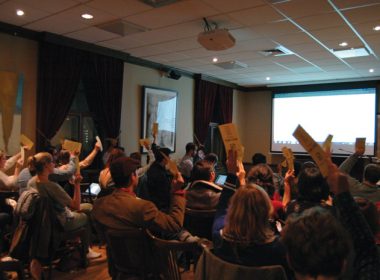
Tomorrow (Wednesday) marks the Fall General Assembly of the Students Society of McGill University (SSMU). Here are the Tribune’s endorsements on the four resolutions. (more…)

a, Off the Board, Opinion

Off the board: Embracing duality

“What’s your background?”

As a biracial person, I hear this question at least once a month, or several times a day if I am new to the community. (more…)

Read the latest issue

Read the latest issue