Latest News

a, Student Life, Student of the Week

Student of the week: Alexander Langer

Always interested in human rights, Alexander Langer worked as an intern last summer at the Roma Community Centre in Toronto, an organization serving the Roma community across Canada. The organization provides assistance including education, settlements, and legal services.

Langer says he appreciates the work that organizations like the centre do to promote human rights.

“Society is judged on how we treat vulnerable people, especially asylum seekers and refugees,” he says. “They crawl out of poverty, they lift themselves out [by] their bootstraps, and I think it is invaluable for society to encourage them to do so.”

He tells the story of a friend from Hungary, who is a refugee in Canada. As a Roma, he faced persecution in his homeland—he was spit on, fired from jobs for no reason, and threatened—and his family came to Canada to build a better life.

After the friend volunteered at the community centre, the organization helped his family find a sponsor and navigate their way through the refugee system. Now with the help of humanitarian workers, his friend is able to put his past behind him and start anew.

Langer believes he had a tangible impact at the organization. Witnessing the impact of the organization on individual lives has influenced his outlook on the time he spends in the classroom.

“I felt like I managed to concretely accomplish things [at the community center],” Langer says. “I love the university, but a lot of times it seems like it doesn’t really matter to the actual world.”

As the chair of exhibition debates with the McGill Debating Union, Langer has managed to combine his enthusiasm for advocacy work with his involvement in the McGill community. He organizes events that attempt to foster discourse on critical world issues, including an upcoming debate on March 13 to discuss freedom of speech and hate speech.

Given his political science major and his commitment to human rights, Langer says he has considered a future in politics.

“I think if I were to get involved in politics, […] it would be working policy,” Langer says. “I would struggle to contain my out-there views—I am socially libertarian. I would struggle to make the compromises necessary to be an elected official.”

The main point Langer wishes to impart to McGill students is that to make a difference, you have to take real action.

“The disadvantage of [studying in university is] we aren’t actually doing anything,” he says. “A lot of kids on campus sit around and talk critical theory, but they are scared to get out and get their hands dirty. They are afraid of having to swallow [that] the world isn’t like university.

If you want change, you can’t just sit around; you have to get out there and do something and engage with the world as it is.”

McGill Tribune: What is your biggest pet peeve?

Alexander Langer: People walking slowly on the sidewalk right in the middle so no one can get around them.

MT: Salty or sweet?

AL: Salty—sweet is kind of sickly.

MT: Favourite pizza slice?

AL: Chicken with goat cheese, sundried tomatoes, and mushrooms.

MT: If you were stranded on a desert island, what one item would you bring?

AL: Maybe The Lord of the Rings—I could finally get through it. Practically, there are lots of things I would want, but if I could only bring one, I don’t need to be practical. I am going to die at some point.

MT: What makes you the happiest?

AL: Spending time with my family—especially my niece and nephew.

MT: If you could travel to one country, where would you go and why?

AL: This is difficult, but it would be Spain. Three words of explication—sun, wine, and fish.

a, Martlets, Sports

Hockey: Martlets fall short in RSEQ; set sights on Nationals

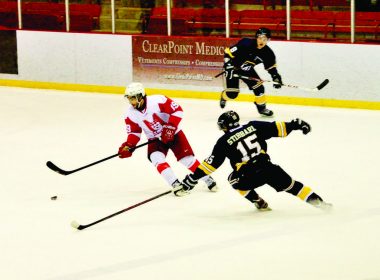
Led by two goals and an assist from team captain Kim Deschenes, the no. 1 ranked Montreal Carabins toppled McGill 6-3 on Saturday to take home the RSEQ women’s hockey championship. Despite winning the first game of the best-of-three series, the Martlets were unable to seal the deal, as the Carabins escaped two must-win games to capture the Dr. Ed Enos Cup.

The Martlet squad looked dominant in the first frame of Saturday’s contest, controlling the puck and out-skating its opponents on both ends of the ice. However, with less than five minutes remaining in the first, freshman forward Jordan McDonnell was called for a bodychecking call that would prove to be costly for McGill.

Slicing through the exhausted Martlet penalty kill, Montreal’s Deschenes needed only a few seconds to get open outside the McGill crease and tap in a perfect feed from Carabins teammate Janique Duval.  Deschenes would later add what proved to be the winning goal on an assisted play three minutes into the second period.

Trailing by three goals with the minutes winding down in the final period, McDonnell got the home crowd back on its feet with a slapshot that found the back of the Montreal net to make the score 5-3. With McConnell Arena beginning to rumble for the first time since the second period, Martlet Head Coach Peter Smith pulled the team’s goalie to put McGill a player up. However, the Carabins would put the game away with an empty netter shortly thereafter.

Despite outshooting Montreal 45-24, the Martlets were undone by a sloppy second period in which they failed to convert on three power plays, including a crucial 5-on-3 opportunity. Montreal goaltender Elodie Rousseau-Sirois was spectacular, making 42 saves on the night to keep her team alive.

“We had a lot of shots on goal and we couldn’t find the back of the net, so you have to give [Rousseau-Sirois] a lot of credit,” Smith said.

Meanwhile, Martlet goalie Andrea Weckman had an uncharacteristically quiet game on Saturday.

Weckman, who was pulled late in the second period after letting in four goals on 23 shots, suffered only her second defeat in what has been an otherwise impressive season. The four goals—the most allowed by Weckman in any game this season— pushed her goals against average up to 1.25 on the year, still good for no. 1 in the league.

Sophomore Taylor Hough replaced Weckman to finish the game, limiting Montreal to one goal on nine shots over the remaining 23 minutes.

Leading the way once again for the team was senior forward, Katia Clement-Heydra, the heroine of Game 1 of the series and RSEQ Player-of-the-Year, chipped in a goal and an assist in McGill’s last game of the season, which proved too little too late as her team fell just short of bringing home the  conference championship.

“[Clement-Heydra] has grown tremendously,” Smith said. “She’s gotten better every year, but the leap this year was huge [….] She came back in September and worked real hard to get fit and gain confidence, and it’s made a huge difference in her game.”

The season, however, is far from over for the Martlets. Despite the loss, they will travel to Fredericton to compete in the CIS Championship, which will take place from March 13-16. Though the team qualified for the tournament on a wildcard berth, Smith and the Martlets are undaunted by the challenge they will face in the championships.

“We would have like to go out riding on a win, but we’ve put that aside,” Smith said. “We’re a team that learns from our mistakes, and I think our team has gotten better with every speed bump we’ve hit.”

a, Research Briefs, Science & Technology

Research Briefs

Sea turtles “lost years” uncovered

When sea turtles hatch, the first few hours of their lives unfold as a desperate obstacle course as they attempt to reach the ocean. Dodging sea gulls, footprints, and crabs, many of these scampering hatchlings—little over an inch in diameter—do not survive the trek from their nest to the water. For the baby sea turtles that do withstand this test of survival, little is known as to what happens to them until they become juvenile turtles—the size of a dish plate—which return to the coastal areas where they forage and continue to mature.

For decades, scientists have tried to discover the whereabouts of these sea turtles during their oceanic stage, also termed their “lost years,” before they return to the coast. This task proved difficult, as researchers lacked an effective method of tracking the creatures—satellite tags proved too bulky and impeded the organisms’ movement.

However, as technology improved, the tags got smaller. This enabled marine scientist and sea turtle biologist Kate Mansfield and her lab at Florida International University to properly track the turtles and map out their “lost years.”

The team remotely tracked young loggerhead sea turtles in the Atlantic Ocean using solar-powered satellite transmitters the size of smartphones. They collected 17 hatchlings from the beaches and raised them until they were three and a half to nine months old. At this point, the turtles’ shells were up to seven inches long—large enough for the transmitters to be glued on for tracking. Mansfield and colleagues then released the turtles from a boat 11 miles offshore in the Gulf Stream off of Florida.

Based on long-term hypotheses, the team expected that the turtles would head up towards the Azores. Surprisingly, findings showed that many of the turtles dropped out of the outer currents leading to the Azores and into the center of the North Atlantic Gyre and Sargasso Sea.

Interestingly, the tags’ temperature sensors were consistently several degrees higher than the turtle’s local water temperature. Sargassum seaweed accumulates in the centre of the gyre, and researchers believe that this temperature difference indicates that the seaweed mats keep the cold-blooded turtles warm, thereby helping their growth.

Mansfield’s team is currently trying to expand their techniques to study other types of sea turtles, hopefully providing us with an even clearer picture of the “lost years.”


Giant virus revived from ancient permafrost 

Scientists in France have discovered a new type of virus within a 30,000-year-old sample of thawing Siberian permafrost, and have managed to revive it.

The virus, called Pithovirus sibericium, infects amoebas and is not a threat to humans yet, according to Chantal Abergel, a research scientist at the Centre national de la recherche scientifique (CNRS) and co-discoverer of the virus.

The Pithovirus, named for its large size, is only the third member of the family of giant viruses discovered by virologists a decade ago. Abergel told the Globe and Mail that this specific strain does not mutate frequently, so there is little risk of “genomic drift” into a more lethal strain.

However, researchers still express concern about the discovery.

“The thawing of permafrost either from global warming or industrial exploitation of circumpolar regions [may cause] future threats to human or animal health,” the researchers said in their recent paper published in the National Academy of Sciences.

Permafrost is a good storehouse for microorganisms due to its composition. According to Natural Resources Canada, permafrost is soil at or below the freezing point of water (0 °C) for two or more years, and is usually found underneath the “active layer” of soil. Most of the world’s permafrost is located in high latitudes near the North and South poles. The soil’s cold temperature can be compared to a big freezer that preserves these microorganisms.

While the risk of thawing viruses to human health is still being investigated, the overall message is clear.

“What we’re trying to say is to be careful when you go into layers that haven’t been disturbed in several thousand, or even millions of years. We risk digging up things we don’t necessarily want to see,” Abergel told the Globe and Mail.

a, Features

The curious case of Busty and the Bass

The searching notes of a saxophone float over the bar’s quiet murmur,  cutting across open bottles and muted conversations. A drum line slips between the notes, riding the low strums of the bass playing alongside it. Trumpets, trombone, guitar, and the sweet shiver of keys all gradually fold themselves into the music.

It’s the rare sort of mature and cohesive jazz that would be surprising to see out of a group of young musicians, yet here they are—nine young McGill students playing together with ease. U3 Nick Ferraro on alto saxophone; U2 Scott Bevins and U2 Mike McCann on trumpet; U2 Chris Vincent on trombone; U2 Evan Crofton on keys and vocals; U2 Eric Haynes on keyboard; U2 Louis Stein on electric guitar; U2 Milo Johnson on bass; and U2 Julian Trivers on drums.

However, the busy lineup actually reads as one name: Busty and the Bass.

Tonight, the band is at its best, grooving along with every note it plays. The song continues unabashed in its beauty, carving out dips and crescendos on the turn of a note. As it draws to a close, Ferraro gives one last bold, lurching cry on his saxophone. The ending is grandiose and gorgeous, leaving a courteous pause for the expected applause.

But aside from my cheers, the response is hollow—just a couple detached claps from the few patrons present. The band’s music is tailor-made for a live audience, meant to be absorbed by a moving crowd. The lack of response is uncomfortable, and the performance feels incomplete.

I am the only McGill student here, and I don’t understand why.


My first experience with Busty and the Bass was at McGill’s Open Air Pub (OAP). As with most OAP introductions, it was loud, happy, and took place over a couple beers. The group played its way through a number of songs, switching from jazz-pop tunes to more funk-inspired music, including a crowd-pleasing rendition of Britney Spears’ “Toxic.”

Created two years ago under the tall ceilings of Solin Hall, the band affectionately known as ‘Busty’ began with a group of musicians who came together one evening during a house party.

“We had never met before and spontaneously started jamming,” said Haynes. “It was sweaty and messy, but somehow it just worked. While recovering the following morning, we realized we’d had too much fun to let it happen just once.”

(Alexandra Allaire / McGill Tribune)

(Alexandra Allaire / McGill Tribune)

Dancing with the crowd that day at OAP, it was hard to believe that I had never heard much about McGill music or its student bands. These musicians were miles away from the earnest high school bands I had naively equated them with.

In my time at McGill, I had not set foot inside the music building—primarily due to my science background and a lack of classes outside of my faculty. As a result, my evening at OAP had introduced me to a whole new side of McGill that I had never experienced. Judging by the reactions of those around me, it seemed like the other students were just as surprised to hear that the musicians on stage were McGill music students.


Founded in 1904, the McGill Schulich School of Music is housed in the Strathcona Music Building and  made up of over 850 students and 240 faculty members. Wide stone steps lead to a lobby of oil paintings; just down the hall is the New Music Building, a gleaming glass structure of world-class studios and audio research labs.

While technically part of the downtown McGill campus, the 10-metre span of University Street acts as a much larger barrier to the rest of campus.

“There’s Carrefour [Sherbrooke], there’s the music building right next to it, and then there’s campus,” said Vincent, the trombone player for Busty and the Bass. “So the music building’s completely off campus, and most of the students never even see [it]. And unfortunately, playing at Gert’s is probably the biggest nightmare of the music school because [Gert’s has] the worst sound system in the whole city. That would be the primary means of interacting with the general student body, and it’s just pathetic because it’s so hard to do.”

For those who aren’t studying music and don’t have any friends in the faculty, the Schulich School of Music can be one of the few unknown spots on campus despite its close proximity to McGill’s core. And for music students, the opposite holds true: it can be tough to break out of the music faculty.

“It’s really easy to get tied into this bubble because you have classes in the [music] building,” said Johnson, the bassist for Busty and the Bass. “When you don’t have classes, you’re practicing in a 10m x 10m white room and only see other people who are doing the same things you are. So it’s very easy to get tied up in that world where you’re either in class with people who are doing the same thing as you, or you’re practicing next to people who are doing the same things as you.”

The Schulich School of Music is internationally renowned for its programs and has notoriously tough entrance requirements. However, there is a lack of knowledge about the faculty on campus, despite the hundreds of concerts and events presented by the school every year.

The problem may be that when most students look for music in Montreal—a city known for its artistic temperaments—their first instinct is to look outside of McGill. Of the students I knew, most would keep an eye out for big-name artists playing at the Bell Centre, while others would look for smaller shows played by Montreal musicians in local bars.

“It hadn’t crossed my mind that there would be opportunities for [listening to] music in our own school,” said U2 Arts student Chris Burnett. “[I guess] most students just wouldn’t think to look so close to home for entertainment.”

Nearly everyone I knew had never seen nor heard McGill student music. I hadn’t either—at least not in the Faculty of Music—so I decided to go behind-the-scenes with Busty and the Bass to get a glimpse of their musical process.

(Alexandra Allaire / McGill Tribune)

(Alexandra Allaire / McGill Tribune)


The walls of the room were nearly bare. Cables, stands, and headphones lay strewn around the room. There was one large audio mixer in the centre of the room flanked by a number of stereos. A monitor had been placed in front of the mixer, the screen showing a mosaic of audio tracks. In the far corner stood a small TV streaming a live feed of the musicians in the other room.

The band was at the Strathcona Music Building late on a Monday night to record two new tracks, “All Me” and “Light It Up.” I was told that the process would likely take the band into the early hours of the morning.

When I arrived, Haynes, Stein, and Crofton were busy setting up their instrument stations.

“This is the second out of three steps this evening,” explained Haynes. “Earlier, [Johnson] and [Trivers] came in and recorded the bed track—the bass and the drums. Right now, we’ve got the rest of the rhythm section—acoustic piano, synths and pads, and guitar—[and] we’re going to be recording on top of that.”

As the band started recording, I began to appreciate the hard work and dedication Busty and the Bass put into every note of music they produced. The band’s audio engineers, Gintas Norvila, Dave Ison, and Xavier Bourassa, gave the musicians constant feedback in the studio. The consistent repetition between takes pushed the session past the one hour mark; by the time the rhythm section had finished recording, it was obvious that everyone was exhausted. As Haynes, Stein, and Crofton packed up their instruments, I heard the sound of horns warming up—the brass section was about to start their portion of the track.

After the night’s studio session, Norvila, Ison, and Bourassa would spend a few weeks editing and mixing the recordings until they produced a satisfactory track. The band has so far released a six-track album of some of their most popular songs, with more on the way.

Live music has become increasingly more valuable for many as faceless songs have come to dominate the scene. That’s really what Busty and the Bass is all about—the show.

As the months passed from my first experience with Busty and the Bass, I watched as the band’s popularity grew. On Sept. 6, the day after their performance at OAP, the band had just over 400 ‘likes’ on Facebook. Today, Busty and the Bass has nearly 1,500—a number that continues to rise.

I followed the band as they played their way across Montreal, Kingston, Toronto, and back again, taking on smaller events of just a couple dozen fans, to packed venues of over 100 people. I started seeing friends and friends of friends at their shows—everyone I knew seemed to know Busty and the Bass. The band was making a name for itself across campus at a staggering rate.

Today, Busty and the Bass has an unparalleled fan base on campus. The band has grown exponentially since the beginning of the year, and will continue to push to expand their music and audience.

(Alexandra Allaire / McGill Tribune)

(Alexandra Allaire / McGill Tribune)

According to Stein, the band’s success has been due to their opportunistic approach.

“This year, we had the attitude of just playing for as many people as possible because not that many people know us,” he said. “So it’s been a combination of us just taking almost every gig offered and broadening our audience very fast.”

Natalie Yergatian, U0 Music, believes that the reason behind Busty and the Bass’s popularity is based off of the way in which they present themselves.

“I think Busty does a great job of marketing themselves,” she said. “They have a product that they’re selling, and people like it.”

On February 22, 2014, Busty and the Bass announced that they were doing an East Coast tour over reading week. The tour would take them through Vermont, Massachusetts, Connecticut, D.C., and New York.

“Our stance with Busty and the Bass is to reach out to other people on campus,” Haynes said. “[We will always be] loyal to our student groups—that will always be our target audience. But it’s good to be accessible to as many other people as we can and as many different age groups as well [….] We’re hopefully going to do as much as we can over the summer and pick up where we left off next year.”

However, Busty has not been the only McGill music group to have risen in prominence this year. Other bands such as VLVBVMV have increased their presence on campus and in the wider Montreal community. Independent musicians out of McGill have also started to draw attention among students. Jordan Benjamin, who goes by the stage name Benj., is a rapper and singer who has garnered a large following among students.

This growth may be indicative of the wider McGill student body’s increased appreciation for McGill music. Numerous student groups and clubs on campus have featured Busty and the Bass this year. For the musicians trying to make a name for themselves, students in the Faculty of Music have also started to recognize the benefits for increased exposure to the general student body.

“I definitely think the music school is starting to realize that you need an audience, and that most of the audience is people who are not in music,” said Stein.

“There are musicians here [who] I believe have something to say, and deserve to be heard,” Yergatian said. “If I had to say something to the rest of the McGill student body, it would be: Make an effort to check out shows, because there are amazing musicians at McGill.”


A short while ago, I went to see Busty and the Bass again. They were playing at La Sala Rosa this time—a joint bar and music venue. It was comforting to hear the band’s familiar sound—the meringues of saxophone, the deep shrug of bass, the light dance of keys, the swing of guitar, the feathery brush of drums, and the rich bellows of brass.

The performance reminded me of that moment months ago, watching Busty and the Bass alone at a local bar. Except this time, there was one noticeable, key difference. Echoing around the room was the sound of dozens of people laughing and dancing to the music—the way Busty and the Bass was meant to be enjoyed.

For far too long, McGill music has wanted an audience. Students are finally listening.

a, McGill, News

Canadian Studies seminar connects undergraduates across the country

Ken Dryden is taking technology in the classroom to a new level this semester, with a Canadian Studies course that uses technology to connect classes at McGill and the University of Calgary.

As a former Montréal Canadiens goalie, lawyer, and Liberal member of parliament, Dryden has been a university lecturer for the McGill Institute for the Study of Canada since 2012.

His seminar “Making the Future” challenges students to engage with current Canadian issues and their future. Topics include health and healthcare, Canada and the world, diversity, and public engagement. While Dryden has taught this course at McGill for three years, this is the first year  he is teaching the course between two universities.

“The idea was that if it can be done in one place, then it can be done in more than one,” Dryden said.  “Let’s see if the premise of the course works, and that it’s engaging and useful, and then let’s see if we can do it in two places.”

Dryden proposed the idea to universities across Canada, and Calgary was the first to respond with interest.

“Originally, I thought that I would just travel to the different places and deliver [the course] twice,” he said.  “It was actually [the University of Calgary’s] idea to do it electronically.”

Dryden travels back and forth between the two campuses, teaching nine classes at McGill and five at Calgary. There are multiple screens in both the McGill and Calgary classrooms, where audio and video of the classrooms are live streamed to each other.

The typical structure of the class includes a guest lecturer, a question and answer period, and time for discussion of the issues.

“The format of it is actually entertaining,” Patrycja Nowakowska, an McGill L3 law student in the class, said. “Seeing Calgary being teleported to us is really neat.”

Video streaming is only one part of how the students interact with one another. Their first assignment was a paper completed in groups of two or three McGill students and one Calgary student, which required interaction over the Internet outside of class time.

Dryden said technology and technological capability is a lesson on the future in itself, and that it’s necessary to use it to prepare students for their work later on in life.

“A lot of your work in the future will be dealing with people at a distance, people you don’t know, people who may not have the same work styles, who may not have the same capacities in their space,” he said.

Students found that the group assignments were fairly simple to organize with minimal complications.

“The time difference is really the only challenge, finding a time when everyone can be on Google Docs or on Skype,” Lawrence Angel, U2, arts, said. “We form connections with these people.”

Dryden said he hopes the discussion of the issues reaches into the future and affects how students might deal with them 40 years from now. Since the students will be the ones working in the future, he wants them to engage with these issues now.

“If you were going to be working for another 40 years, how would you see healthcare?  How would you approach it differently?”

Students have reacted positively to Dryden’s class and his technology-based teaching style.

“He’s an excellent facilitator; he knows the right words to pick to really engage the students to think deeper beyond the first level of thinking,” Zack Barsky, U3 Management, said. “He really makes you think about what you’re saying, why you’re saying it, [and] how it’s important.”

Dryden hopes to expand the course to more universities over the next few years.

“We’re always working towards 2017—the 150th anniversary of the country, where there is a natural instinct to stop, look around, see where we’ve been, [and] ask ourselves where we want to go,” he said. “[The year 2017] can carry that kind of larger national conversation, if, in fact, we have the structured way of having that happen. So part of all of this is to connect [the students] to that.”

a, Sports

10 Things: Cricket

1

There are three forms of cricket: the 20/20, One Day International (ODI) and the Test match, the last of which can last up to five days. In 20/20 cricket, each side has a maximum of 20 overs to score as many runs as possible. An over is a six-ball period before the bowler is changed. In ODI’s, this total increases to 50 overs a side …

2

… Which is only surpassed by the marathon Test matches, the most traditional form of the game. Each side gets a maximum of two turns at bat without an overs restriction, which in some cases still doesn’t produce a definitive winner or loser! Thus, Test matches require a greater amount of strategy …

3

… In a game played between two teams, each fielding 11 players. However, there are only 13 athletes combined on the pitch at one time—two for the batting side and 11 for the bowling side. The objective for the batting side is to score as many runs as possible, while the bowling side must collect 10 outs before the inning is complete.

4

Groucho Marx, an American comedian, went to a cricket game in 1954 and famously said, “[Cricket] is a wonderful cure for insomnia. If you can’t sleep here, you really need an analyst.” In order to combat criticisms of boredom, England introduced 20/20 cricket in 2003 in an effort to ramp up the excitement, creating shorter games, and encouraging players to take more risks.

5

The ICC (International Cricket Council) is the governing body for international cricket, the most popular form of the sport. There is no single competition to determine the world champions in Test cricket. Teams tour different countries and play series of matches, which eventually produces a world leader in the ICC rankings.

6

In the first ever official international cricket match, played in New York in 1844, Canada beat the United States by 23 runs. Though the North American rivalry has been over for the last 20 years due to funding issues, the inaugural match had nearly 20,000 spectators with $120,000 worth of bets placed.

7

Cricket was the United States’ national sport until the Civil War. Indeed, the United States’ boasted the best fast bowler in the world, Bart King, in the early 1900s, and the Philadelphian cricket team at the time was good enough to draw against English touring sides. North of the border, Canada’s first Prime Minister, John A.

8

Historically, teams would include both upper-class amateurs and working-class professionals. The amateurs generally chose not to bowl because they did not want to exert too much physical effort. Class divides extended for quite some time—as a working-class professional, Sir Len Hutton was not allowed to captain England until 1952.

9

Even though its early history was mired in classism, cricket was one of the few sports in which apartheid era South Africa was banned from official international matches. In doing so, the cricket community showed its respect for the non-white cricketing nations of the West Indies, India, Pakistan, and Sri Lanka.

10

Cricket is the oldest professional team sport in the world. It was at the heart of the British Empire, which spread a sporting culture around its colonies and the world. As a result, the primary cricket playing nations of the world are all former British colonies.

a, Opinion

Eliminating ethnocentric tuition policies

Quebec has always made the preservation of the French language and culture within the province a priority.  In many areas of Quebec, speaking French is not only encouraged, but necessary. This custom of preserving Quebec’s French roots merits praise; however, it should not come at the cost of alienating people of different backgrounds. The bilateral agreement between France and Quebec which allows French students to receive Quebec tuition while studying in the province is one such example of an exclusive policy whose terms disadvantage other international or out-of-province students without French citizenship.

The agreement, signed in 1965, incentivizes native French speakers to come to Quebec to receive their university education. The policy has certainly succeeded in attracting French students, thereby promoting the use of French within the province. It also gives French students the ability to experience university abroad at an even lower price than they would pay in France. Despite the benefits of this agreement, its exclusion of non-French citizens is tinged with the ethnocentric tendencies that Quebec has been known to display in its relations with France.

At a public Canadian university such as McGill, it doesn’t seem entirely right that French students should have a lower tuition than others, especially when some of those excluded from the tuition agreement also speak French. There are, indeed, other French-speaking countries whose students may receive exemptions on their tuitions. However, the list is brief and restricts the number of students from each country who may receive lowered tuition. If Quebec is truly concerned about promoting the use of French, all francophones should be given equal advantage, regardless of their citizenship. Such a change would encourage even more French-speaking students to come to Quebec, and it would promote greater equality among students whose tuition rates are widely disparate.

There is no easy way to level tuition prices in order to treat all students equally.  One option would be to raise the tuition for French students in order to decrease the margin of difference. However, in order to attract enough French students to Quebec, tuition rates in the province must be low enough to compete with the low prices of education in France. If the McGill tuition rate for French citizens were to be raised too high, French students would lose their incentive to come to Quebec to receive their education, which would be detrimental to the preservation of Quebec’s culture and language. There are also, of course, budgetary concerns. One must acknowledge that the province simply cannot afford to lower the tuition equally for all students. Therefore, a more inclusive policy to give advantage to all fluent French speakers, regardless of nationality, would be a good first step.

A language test to determine proficiency for all students claiming French as a first language would allow all francophones to receive the same benefits. While such a policy would still exclude non-French speakers from the lowered tuition, it would, in theory, be a more equitable policy than the current agreement, which excludes many francophone students from the same tuition exemptions as their French counterparts.  If this change were to be implemented, Quebec’s defensive preservation of French language and culture, historically characterized by its ethnocentric, colonial relationship with France, would be replaced by a more inclusive promotion of French that would include people of all backgrounds, which would be a step in the right direction.

a, Arts & Entertainment, Film and TV

Wrong answers are blowing in The Wind Rises

How much responsibility does a filmmaker working from non-fictional material have to accurately represent his subject? It’s a complicated question, and one which muddles the The Wind Rises, an animated biopic that writer-director Hayao Miyazaki re-released with an English cast of voices that replace those in the original Japanese version. The film follows the life of Japanese military airplane designer Jiro Horikoshi (voiced by Joseph Gordon-Levitt), whose planes were incredibly effective killing machines and an asset to the Japanese military efforts during the Second World War, assisting with the slaughter of soldiers around the world. But The Wind Rises is not about the destruction that Horikoshi’s efforts wrought; rather, Miyazaki uses the film to emphasize the engineer’s identity as a dreamer, a lover, and an artist.

Airplanes fascinate young Jiro (voiced by Zach Callison), and he hopes to one day become a pilot. He looks up to the Italian aeronautical designer Giovanni Caproßni (voiced by Stanley Tucci), who inspires him to turn his aspirations into his life’s work. Though Jiro is discouraged when he realizes his poor eyesight prevents him from ever becoming a pilot, he revives his joie de vivre by learning that he can still design airplanes, even if he can’t fly them.

Jiro’s ambition leads him to study at a university. As he takes a train there, he meets a young girl named Nahoko (voiced by Emily Blunt), who catches his hat as it flies through the air. Jiro quickly repays her kindness when an earthquake hits and her caretaker Kinu (voiced by Mae Whitman) is unable to evacuate due to her broken leg. Jiro creates a makeshift splint for her and fetches water for both girls. Although, he leaves them abruptly and continues his trip to the university, Miyazaki leaves little room for doubt that Jiro and Nahoko will be reunited somewhere along the designer’s journey.

The scene on the train indicates one of the film’s major flaws: Miyazaki’s awkward attempt to merge straightforward realism with fantastical elements that feel lifted from the bizarre universes of his earlier films. As Nahoko attempts to catch the hat, it flies just out of her reach for a while before conveniently hanging in the air right in the range of her grasp. Touches of magical realism like these—which permeate The Wind Rises—are cute and add a touch of whimsicality to the mostly somber tone which Miyazaki strikes throughout the film, but they undermine our ability to take the narrative seriously. It’s hard to treat the film as a sober depiction of Jiro’s life when these elements continuously reappear to remind us that it takes place in a world fundamentally different from our own.

Miyazaki further undermines the gravity of the story through the simplistic depictions of his characters and the banal platitudes with which they speak. The short temper and rash judgements of Jiro’s boss Kurokawa (voiced by Martin Short) make for brief moments of comic relief, but they fail to lay the foundation for a substantive or believable character. Likewise, the German Castorp (voiced by Werner Herzog) comes off as little more than a bland manifestation of the “wise old man” archetype frequently found in Hollywood films. While the generic advice he provides Jiro helps to solidify his status as a father figure to the confused youngster, it also makes him seem more like a fortune cookie than a fully-realized human being.

This all would be less of a problem if Miyazaki wasn’t depicting real events, but he’s dealing with someone whose actions had an undeniably violent impact on the course of history. The portrayal of someone who created formidably destructive machinery deserves more gravitas than Miyazaki’s fanciful touches and paper-thin characters allow for. His focus on Jiro’s genius and artistry rather than the death it caused provides too narrow of a historical view to be taken seriously. I can’t help but wonder how audiences would have reacted if a filmmaker had used this approach to tell the story of the makers of Zyklon B or the atomic bomb. I don’t imagine viewers would have too much patience for such a film, and The Wind Rises is no more deserving of their attentions.

a, Student Life

International Women’s Day: facts & figures

This past Saturday marked the 103rd annual International Women’s Day (IWD). On March 8, people across the globe celebrated women and recognized the steps taken on the path toward gender equality.

At McGill, women have come a long way in the last century. The first female students were admitted in 1884, 41 years after the first male students. Today, women make up 56 per cent of the student body.

However, IWD also highlights the challenges that women continue to face. Each year, Canada picks a theme for IWD, included ending violence against women, women’s rights, and women in leadership. This year, the theme for Canada’s IWD was “Canadian Women—Creating Jobs One Business at a Time,” to acknowledge women’s contributions in shaping the Canadian economy.

a, Science & Technology, Student Research

This Month in Student Research: Finding the art in developmental biology

Known for its excellence in research, McGill University is home to a host of professors and scientists whose work contributes to scientific innovation. In tribute to the amazing work conducted within McGill’s walls, each month, Science and Technology features a student researcher who has helped further the cutting-edge science conducted at the laboratories. 

Di Hu stands a mere 5’2”, but what she lacks in height she makes up for in passion and her bubbly demeanor. Over the past four years at McGill, the U3 Anatomy and Cell Biology major has worked in six different laboratories, created three different posters, discovered a novel gene, and became involved in four papers—one of which she recently submitted to the Journal of Biomedical Sciences as first author.

Hu’s gateway into scientific research is unique from most undergraduate students at McGill. Hu actually attended an arts middle school, where she explored music and visual arts before pursuing more science-based courses in high school, and ultimately at McGill.

“In that time in my life in middle school, [I realized] how important creativity is, and that I always want to make something new,” Hu said. “I took that to McGill—I don’t want to just learn from a textbook for the rest of my life, I want to make advancements. My favourite aspect of [research] is the creativity.”

Hu was unsure at first as to what type of research she was interested in pursuing—or whether that was even in her future at all—but she knew that she wanted the experience. She recalled her first lab position where she performed data analysis in electron microscopy.

“It was very simple work. I didn’t know much about electron microscopy at the time, but I could delete blurry pictures.”

As Hu progressed in her U1 courses that semester, the picture quickly unfolded as to what she was passionate about.

“I was sitting in BIOL 200, and that was the class that really changed my life,” Hu said. “I realized how much I loved molecular biology, the questions involved, and the implications that fundamental research has in human health and disease.”

From this point forward, Hu’s advancements in the realm of research seemed to flow naturally. She took inspiration from each lab she worked in and looked forward to other laboratories that she could explore.

“I learned in Dr. Richard Roy’s lab that I really like development [….] However, I realized that ‘Yes, I like development, but I wanted to work with mammals,’” said Hu. “Dr. Maxine Bouchard was giving us a lecture about kidney development the next semester in BIOC 212. That was when I realized, ‘Wow, understanding the process of kidney development can help us understand congenital disease as well as cancers [….] I asked him if I could join his lab after class and he let me.”

However, it was Hu’s experience as a summer student at SickKids hospital that opened her eyes to the career she is currently pursuing. Unlike her other lab experiences, her work with Dr. Norman Rosenbloom pulled her away from the lab bench and into the clinic.

“[Because Rosenbloom] is both a researcher and a physician, I got to see the patient-driven motivation behind [his research] and it was so cool,” Hu explained. “That was when I realized that I want to be a physician scientist. It just made so much sense for me. I want to be at the bedside and I want to talk to patients and help them on a one-on-one basis and also use that to inspire questions at the lab.”

Although Hu initially applied to PhD-MD programs, throughout the application process she noticed how much more fluidly she could write the PhD aspect of the application. While Hu traveled to Oxford for the holidays over Christmas break, she decided to apply to the school’s graduate program. Taking a chance, she wrote the application on the plane back to Canada—little did she know she would be accepted into this five-person program.

“I felt like there was just a natural flow in what I did, and I was really just pursuing what I like to do,” said Hu.

As a pre-med Science student, Hu never would have imagined that after four years of undergraduate studies at McGill she would be jetting off to Oxford in the Fall to start her PhD. Yet, it was these unexpected experiences in the lab that have proved invaluable, both in terms of her class work and her own professional development.

“It definitely helps put what I’m doing in class into deeper context,” Hu said. “Memorization, you know, I don’t think I do that anymore at all. I understand it and can picture it. It also makes you realize what is important and what is not.”

“I think one of the most important things I have learned in research is to embrace failure,” Hu said. “It really changed my life to be calmer and say, ‘Yes, I may fail,’ because you are always failing at research. Be open-minded and learn from failure and recognize it and improve. It kind of made my life better.”

McGill Tribune: If you could describe yourself in three words, what would you say?

Di Hu: “Passionate, natural, and creative.”


MT: What is your favourite part of developmental biology?

DH: “I think [one] aspect is that it is so funny and weird that all of the processes in developmental biology do the exact same things in cancer. The only difference is that the embryonic environment is very sterile, but the adult environment is very toxic. The same processes in different environments lead to very different things. To study development is to study cancer, and I think it is a very powerful tool.”


MT: If you could have one superpower what would it be?

DH: “To know what others are feeling—emotions. I try to be aware, but sometimes, you don’t know.”


MT: Do you have a favourite article of clothing?

DH: “Definitely like a head thing—it is like a hair accessory. I feel like head accessories are the future. I love these, they are so much fun.”

Read the latest issue

Read the latest issue