Latest News

a, Arts & Entertainment, Music

Kanye can’t touch the sky with his ego weighing him down

“I am the next Walt Disney. I am the next Steve Jobs.”

When you bring up Kanye West in conversation, you’re likely to be greeted with two very distinct opinions. On one hand, we have the adamant defenders, die hard ‘Yeezies’ who can spend hours attesting to West’s creative brilliance; opponents can be seen rolling their eyes, mumbling about the egotistical media junkie who had the audacity to compare himself to Jesus on the cover of Rolling Stone.

All this being said, why is it that Kanye West—a man who has clearly secured his place in hip-hop history through his outspoken tirades and lyrical antics—has failed to move past his defined role as fanatic producer/rapper into the business world like his peers Jay-Z and Pharrell Williams? Contrary to what West might have you believe, it all comes down to his ego.

“There are only two types of people in this world: haters and dreamers. The only difference between them is that haters let go of their dreams.”

Just the other week, West performed at the Bell Center, making up for the previously planned November show that was cancelled due to technical difficulties. West took 22 minutes out of his performance to give what some news outlets have dubbed a “quality of life” speech. He spoke to the crowd on a large array of topics; ranging from his potential, his hopes, his dreams, and most importantly, his legacy. Public opinion, West claimed, is what has been holding him back from reaching his greatest potential. In the speech, he acknowledged his egotistical ways and his borderline manic outbursts in the past year—but he largely dismissed them, calling them the ideals of a genius, not the ravings of a lunatic.

“It ain’t about me. It’s about y’all, and it’s about us.”

Perhaps West is exaggerating how harshly the industry has stifled his potential. His performance was nothing short of mesmerizing, exactly what you’d expect from a man who’s referred to himself as both a “pop enigma” and “this generation’s greatest rapper.” There were explosions, women dressed in what can only be described as nude pantyhose  suits, an imitation Jesus, and Yeezus wearing a variety of bejewelled masks. The bass reverberated with every note and the crowd was electric. They knew every line, bounced to each individual beat; any minor change that took place on stage was noted and greeted with boisterous cheers and high-pitched squeals. West was a god among his worshippers.

“I’m a celebrity… I am God’s vessel.”

However, Kanye West is not doing himself any favours to counter the stereotypes being thrown at him by his detractors. His view that the media wants to stifle him because he is a black man from a low socio-economic upbringing is interesting when you consider that his net worth is $100 million, making him one of the most successful college dropouts in the business. West claimed during his monologue that the walls he was hitting in his efforts to produce his own clothing line were a result of corporations’ greed and unwillingness to break away from what was expected of them. Public opinion is holding him and all of the other innovators back. As he described in what was my favorite line of the night: “Someone wants to walk over here [to the Bell Center] without a coat on because they’re naturally hot inside or some shit and they tryna walk over here and public opinion be like ‘motherfucker, put a coat on!’”

 “All of y’all gave my voice the power and I never take that for granted. And since you gave my voice the power, I will have the courage to use my voice whenever necessary.”

Is public opinion holding Kanye West back? Does he have a point when he says that racism and class stratification are not only alive in America but also thriving? Well, yes and no. No one can reasonably doubt that things like racism and class discrimination still exist—not just in America but also throughout the world. Public opinion too does play a large role in how we as consumers perceive people, events, and products, and West’s outbursts have arguably been overplayed to stir up a widespread opinion that he is nothing more than a self-absorbed lunatic. But West is lying if he claims he doesn’t play the media game just as hard as it plays him. Standing in a crowd full of adoring fans asking them to cheer if they agree with him is not a difficult task.

“Let’s see if they print anything I said tonight. That would be surprising.”

Ultimately, it isn’t the media, big business, or corporations holding West back—it’s his ego. I have been a fan of West for years because of his larger-than-life personality and his steadfast belief that he can do anything; but when you constantly aim for unreachable heights, one day, you have to face that even “god” has his limits.

a, News

EUS VP Communications sanctioned for mocking Farnan apology

An executive in the Engineering Undergraduate Society (EUS) has apologized to the Students’ Society of McGill University (SSMU) for mocking an apology issued earlier this month by SSMU Vice-President Internal Brian Farnan.

On Feb. 9, Vice-President Communications Luis Pombo sent a satirical apology through the EUS listserv, which mimicked the format and nature of Farnan’s Jan. 27 apology for racial insensitivity.

Pombo’s joke triggered an EUS equity complaint. In response, the EUS executive team, in consultation with the EUS equity commissioner, imposed a number of sanctions on Pombo. In addition to Pombo’s apology to SSMU, these include equity sensitivity training and the revocation of EUS listserv and publications responsibilities, which will now fall under the president’s portfolio.

EUS President Carlos Marin said the problem stemmed from Pombo conveying personal opinions from his position as an executive.

“[He] as an individual may disagree with SSMU’s Equity Policy […] but [he] cannot, as a representative of the EUS, make a joke out of that; that’s completely unacceptable,” Marin said. “[He] cannot send an official e-mail from an official communication channel of the EUS making fun of the concept of equity.”

Pombo accepted full responsibility, noting that his mock apology was part of his initiation into the Plumbers’ Philharmonic Orchestra (PPO), an Engineering student group.

“As part of my PPO initiation I was given a set of tasks,” Pombo told SSMU Council on Thursday. “One of these tasks, however, was to send out a fake apology to all engineering students. In what can only be described as a lazy attempt at comedy, I decided to satirize Brian Farnan’s apology.”

Without the listserv and work on publications, Pombo will continue to manage the EUS web developing team and the yearbook, among other tasks.

Some students, such as Alex Grant, U2 Engineering, said the response was appropriate.

“I think [the sanctions] are probably a good middle between taking him out totally and leaving him how he is,” Grant said. “There’s absolutely no way that he could just be let off the hook for that.”

Other students such as Morgan Grobin, U3 Engineering and a chief of the PPO, said the response to Pombo’s mock apology was too harsh.

“I think anyone who is mildly intelligent realizes that [the e-mail is] mocking the SSMU equity process itself, and not mocking equity or Brian Farnan personally,” Grobin said. “What Luis did was a mistake [… but] I don’t think he should be stripped of all of his powers [….] Maybe something that would have been more productive would have been an open forum with Engineering students to talk about equity.”

Grobin also criticized the process by which the sanctions were decided.

“The [executive team] is only eight people; they’re elected representatives, but they only represent the interests of the EUS executive, and there wasn’t consultation from year representatives who represent all the students in the Engineering body,” Grobin said. “That’s why Council exists—so that no decision gets pushed through that’s inappropriate or unfair.”

However, Marin argued that the executives abided by EUS Equity Policy.

“That’s how our process of the Equity Policy works […] and the fact that [the complaint was about] someone from our team made it more appropriate,” he said.

Marin also said that despite negative reaction surrounding the incident, increased discussion about equity among students was a positive outcome.

“There’s this stereotype that in Engineering we don’t care about these things,” he said. “As leaders of the [Engineering students’] community, [we] have to make sure that this discussion happens. And I think it’s happening.”

a, Recipes, Student Life

Mind-blowing baking with Betty, Duncan, and Mr. Christie

Triple threat brownies

(tastykitchen.com)
(tastykitchen.com)

A classic dessert combining Oreos, chocolate chip cookies, and brownies to make a glutinous trifecta.

Ingredients:

1 box brownie mix

1 roll cookie dough

1 box Oreos

2 eggs

¼ cup water

¾ cup oil

1 handful chocolate chips


Directions:

1. Preheat oven to 375 oF.

2. Grease a baking dish and linebottom with cookie dough.

3. Press a layer of Oreos on top ofcookie dough.

4. In a bowl, mix together brownie mix,eggs, water,chocolate chips, and oil.

5. Pour mixture on top of cookies.

6. Bake in oven for 45 minutes oruntil cooked through.


Cookies and cream cake

(tasteofhome.com)
(tasteofhome.com)

It’s like cookies and cream ice cream, but in a super moist cake.

Ingredients:

1 cup vanilla cake mix

1 cup icing sugar

¼ cup butter

¼ cup milk

1/2 box Oreos, crushed

Directions:

1. Preheat oven to 350oF, and blend together cake mix, eggs, and ice cream together until thoroughly mixed.

2. Split cake mix between three greased 8 x 8 inch baking dishes.

3. Bake for 25 minutes or until cooked through, then place in refrigerator until cakes are cooled.

4. Remove cakes from pans.

5. Frost top of one cake and sprinkle with Oreo crumbs.

6. Stack second cake on top and repeat previous step.

7. Repeat with third cake.

8.  Frost sides of cake. Cover with remaining Oreo crumbs.


Oreo fudge


(claremanson.deviantart.com)

Because no one has time for stoves and candy thermometers.  

Ingredients:

1 box vanilla cake mix

3 eggs

1 pint melted vanilla ice cream

2 12 oz tubs vanilla frosting

1 box Oreos, crushed

Directions

1. Mix together cake mix and sugar in microwave safe bowl.

2. Add butter and milk, but do not stir.

3. Microwave for 2 minutes on high.

4. Immediately add crushed Oreos and stir.

5. Spread mixture into pan.

6. Refrigerate for 1 hour.

a, McGill, News

Senate debates fairness of exams weighted over 75%

Rules regarding professor adherence to exam weight may stay the same, despite student concerns raised at the Feb. 19 Senate meeting.

Deputy Provost (Student Life and Learning) Ollivier Dyens responded to questions raised by student senators as a result of a motion passed at the Winter General Assembly of the Students’ Society of McGill University (SSMU).

The question demanded improved adherence and visibility to requirements in the university’s Student Assessment Policy. For example, it cited the rule that a final examination cannot comprise more than 75 per cent of a student’s grade, and that any examinations constituting more than 50 per cent of a course grade must take place during the final examination period.

Dyens acknowledged that professors’ compliance with the policy may have depended on varied interpretations of the rules. He also stated that justifiable exceptions to the policy already exist, and that any other exceptions could be brought to the administration.

“Justifiable exceptions are already built into the policy,” the response reads. “As long as students have been informed well ahead of time, usually prior to the end of the add/drop period, a final exam worth more than 75 per cent of the final grade is permitted and can be scheduled.”

Cameron Butler, Macdonald Campus Students’ Association representative, said that despite such justifications for exceptions, students continued to feel that greater adherence to the policy was necessary.

“I took linear algebra—MATH 133—which is a required course for science and engineering students, and that   course’s final was 85 per cent,” Butler said. “It’s a required course for freshman students in first semester where they have a final that is virtually their entire course [….] There isn’t the choice to drop that course because you think the evaluation is unreasonable.”

Although the question from SSMU proposed the mandatory inclusion of relevant sections of the assessment policy on course outlines, Dyens said he was hesitant about taking this course of action or making promises.

“We’re going to wait before we inquire on whether that is the best policy or not,” Dyens said. “The course outline is already long enough. We don’t want a course outline that goes on for 20 to 28 pages, because it defeats the purpose—people don’t read it.”

Discussion on Interdisciplinary Research

Interdisciplinary research collaborations were the topic of another discussion at Senate. Two main focuses included obstacles and barriers to interdisciplinary learning, teaching, and research, as well as practical steps for McGill to promote interdisciplinary collaborations.

Numerous senators touched on their personal experiences and offered a range of proposed resolutions.

“The biggest obstacle in my experience is a lack of awareness of what other people are doing in the topic that you’re interested in,” Sean Ferguson, dean of Schulich School of Music, said.

Political Science professor Catherine Lu proposed ideas for removing such obstacles.

“Interdisciplinary research is actually very difficult to do,” Lu said. “I trained in a specific field, and I feel like I need a whole lifetime plus another lifetime to get to know [another….] I have a suggestion about incentivizing people for pursuing for obviously intellectual reasons, but also for the institution to provide support [….] One thing to be done may be team-teaching, and giving rewards or at least not creating barriers to [interdisciplinary research].”

Budget

Provost Anthony Masi presented further developments to the 2015-2019 projected budget.

He unveiled an estimated value of $27.1 million—the provincial government’s forecasted reinvestment in the university for the 2015 fiscal year. The new number is McGill’s share of the total $1.8 billion to be invested into provincial universities in the next five years.

“The Quebec Government has announced a reinvestment for universities over the next five years,” Masi said in his presentation. “In theory, that should provide $27 million in our budget next year. Now, [there was] an ongoing $19 million cut in our budget, so this looks like progress.”

Masi also presented an updated deficit value, which had dropped to $10 million, compared to the $10.4 million proposed last Fall.

PPP Protest

Outside of senate, several members of the McGill community held a demonstration demanding increased transparency on the People, Processes, and Partnerships plan (PPP).

Set to come into effect on May 1, the PPP aims to centralize 13 departments in the Faculty of Arts into four administrative service centres.

Protesters distributed copies of a letter addressed to Principal Suzanne Fortier to attendees of Senate, which stated that Dean of Arts Christopher Manfredi had ignored the community’s objections to the PPP.

“We believe Dean Manfredi is steamrolling the PPP over the concerns raised by faculty, students, and staff,” the letter reads. “In addition, he has disregarded evidence that the PPP is harmful rather than helpful. Dean Manfredi’s actions have eroded our confidence that he is acting in the best interest of the faculty.”

Gretchen King, a graduate student in art history and communication studies, said Manfredi’s lack of transparency throughout the process has created a tough situation for academic support staff.

“The PPP creates new positions—new managerial positions—but we don’t know what those job descriptions are,” she said. “We only anticipate absolute failure in a situation in which staff are being overworked, and we staunchly oppose that.”

In addition, King said Manfredi had not consulted unions of affected workers.

“We ask you to support our request that the Dean create a democratic process and respond to the following demands: [to] release the details—including budgets, job descriptions, alternative plans, and process mapping—on the PPP website [and to] respect and act in accordance with the collective agreements of affected workers,” the letter reads.

Another protestor, Cayley Sarochan, a graduate student in art history and communications studies, said the protest was also held to point out larger issues in the decision-making process of the university.

“One of the main reasons this is important is because it’s also an issue of democratic governance in the university,” Sarochan said.

a, Arts & Entertainment, Theatre

Players’ production of Peter Pan forces audiences to grow up

A university is the ideal place to stage the story of a boy who never wants to grow up; few understand the sentiment of wanting to be a little kid and have fun forever better than those of us on the cusp of adulthood. As we stress over midterms, job recruitment, and our impending entrance into the “real world,” the Peter Pan way of life becomes the unattainable ideal. Peter is the ultimate procrastinator, using his particular brand of fantastical avoidance to stay young forever.

Our admiration of Peter’s eternal youth makes it all the more ironic that the Players’ Theatre interpretation of J.M. Barrie’s Peter Pan is not intended for children. Those nostalgically searching for the Disney-esque adventure of their childhoods had best look elsewhere; director Kelly Richmond and her cast have restored Peter Pan to all of its violent, tragic, and somewhat unsettling glory. The characters are darker, the body count is high, and the sexual tension is unexpectedly prominent for a story about youthful innocence. Parental discretion is advised.

The play begins when lights fade in on an ordinary-looking bedroom. As the familiar-looking members of the Darling family enter the scene, the audience relaxes and settles in for a story they presumably know well. Once the characters begin to interact, this sense of ease disappears—these are not the characters imagined by Walt Disney. Mr. Darling (Jeff Araujo) is deceitful and childish; Wendy Darling (Charlotte Doucette) is antagonistic; the usually sweet Mrs. Darling (Maka Ngwenya) comes off as harsh. Despite the slow pace of the first scene, these unexpected personalities and the dynamics between the characters stave off any potential dullness.

As the story moves to Neverland, the pace picks up. With an impressive set change facilitated by the cast themselves, the audience is transported to a land of adventure. More unexpectedly nasty characters appear, from a spiteful Tinkerbell to murderous mermaids. The pirates are loud and fearsome, Tiger Lily and her braves are quietly unnerving, and fights erupt every few minutes. The use of contrast between the fantasy world and the real one emphasizes the other-worldliness that exemplifies Neverland.

The play’s main character, Peter Pan, is brought to life by Rebecca Pearl. Pearl brings new dimensions to the captain of the Lost Boys, successfully portraying the fear and mania beneath his cocky exterior. Through her impressive performance, Pearl creates a tragic hero: a character to both applaud and pity as he fights against the inevitable passing of time.

Much needed comic relief comes in the form of the Lost Boys. Jordan Pollock, Shanti Gonzales, James Worsnop and Sophie van Bastelaer bring a wonderful childishness to Nibs, Slightly, Curly, and Tootles. Their amusing antics and adorable misunderstandings add lightness to this otherwise heavy tale. You will be hard pressed not to ‘aww’ at Tootles’ pouting and Slightly’s naiveté.

One of Richmond’s most interesting directorial choices is the inclusion of a narrator—a voyeur of sorts—in the form of the author himself: J.M. Barrie (Mark Weissfelner). Barrie sits with the audience, explaining the story and commenting on Peter’s thoughts and actions. Weissfelner perfectly portrays an author’s connection to his characters, giving Barrie’s interactions with Peter a paternal feel. Often voicing what the audience is thinking, Weissfelner as Barrie connects the dream of eternal youth in Neverland to reality, where wanting only to have fun is our greatest fantasy.

Turning a well-known children’s story into something challenging and thought provoking is no easy feat, but the Players’ production of Peter Pan pulls it off. Richmond and her crew shatter expectations, creating a show with depth that manages to surprise even those who think they are familiar with the tale.


Peter Pan runs from Feb. 26th – March 1 at 8 p.m. at Players’ Theatre (SSMU Building). Student tickets are $6.

a, Baseball, Sports

Moving an MLB team

In 2005, the Montreal Expos packed up their franchise and moved to Washington D.C., changing their name to the Nationals in the process; this is just the latest instance of a professional baseball franchise relocating. In other leagues, the topic of franchise relocation has its usual suitors. For the NBA, the city of Seattle is proposed every summer as a potential destination for a new franchise. The NHL’s possible scenarios include moving a team to Seattle or to Quebec City, while the NFL’s perpetual destination with which to threaten underachieving franchises is Los Angeles. However, the MLB’s answer is not as clear. Pitchers and catchers have already begun to report to their teams, and the annual migration to Arizona and Florida for spring training is only a few weeks away. If a ball club were to express an interest in moving, where should it relocate?


Moneyball in Mexico City

Despite a metropolitan population exceeding that of New York City, Mexico City is often overlooked as a potential landing spot for an MLB team. It was one of nine cities that placed expansion requests in 1994, with Tampa Bay and Arizona eventually being rewarded teams. Twenty years later, it’s time that America’s national pastime finally move south of the border. With the MLB doing all it can to expand the game internationally, a team in Mexico seems logical. While owners would certainly have concerns about the ability to generate revenue in a market with a lower GDP per capita relative to current MLB markets, a team in Mexico City could potentially capture an entire  nation, as the Blue Jays do in Canada. Although Mexico is a soccer-crazed country, it still plays host to a 16-team professional baseball league and a few minor leagues.

Mexico City would not be without its problems. A new stadium would need to be built, one that takes into account the home-run-friendly altitude at which it sits—about 2,240 metres above sea level. Even with the risk associated with this move—a failure in Mexico City would significantly hurt the league’s prospects for further international growth—the potential rewards make it well worth it.

—Wyatt Fine-Gagné


A field of San Jose dreams

Last year, the Oakland Athletics won the AL West for the second year in a row. That’s the kind of dominance you would expect to see rewarded by sold-out stadiums every night of the season, right? Wrong. The A’s came in a hair ahead of the Mariners—losers of 91 games in the very same division—with an average attendance of 22,337, the seventh-worst mark in the league.

If I were Lew Wolff, the owner of the A’s, that disparity would be plenty reason to start looking for a new home. Luckily, Wolff doesn’t need to look far. A mere 40 miles away, the city of San Jose presents the perfect opportunity for the A’s to relocate. Situated in the heart of the affluent Silicon Valley, San Jose is the fastest growing city in California, boasting a population of almost a million people compared to Oakland’s 400,000. The mere addition of Santa Clara County to the A’s territory would increase the team’s fan base by up to 70 per cent. Plus, the close proximity of Oakland to San Jose would eliminate the risk of alienating fans in nearby Contra-Costa and Alameda counties.

—Elie Waitzer


Charlottebound and down

During the 2013 MLB season, there were 24 players from the state of North Carolina—the eighth-most in the United States. In addition to this, the Charlotte metropolitan area is the fifth largest in the Southeastern United States, and continues to be the fastest-growing in the whole country—making it a logical choice for the location of the next big-league ball club. North Carolina’s current sports teams are limited to the NBA’s putrid Charlotte Bobcats, the NFL’s resurgent Carolina Panthers, and college basketball’s blue-bloods at Duke and the University of North Carolina. Fans have shown that they are more than willing to support a team if the on-field product is above-average—the Panthers have averaged a near 99 per cent attendance by capacity for home games in the past three years while going 25-23 over the same time span. Furthermore, there would be very little overlap between the regular seasons of the NBA, NFL, the NCAA, and the 162-game schedule of professional baseball. On an economic level, this just makes sense. Owners will have the option of moving to a market that is not saturated with other ball clubs, while tapping into an area that will welcome a new team to support.

—Mayaz Alam

a, Men's Varsity, Sports

Hockey: McNicoll, Rose pile on the goals in Redmen’s sweep of Stingers

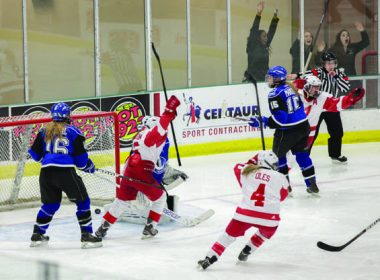
The McGill Redmen put their best-of-three OUA East quarterfinal series to an early close last week with back-to-back wins against the Concordia Stingers. The series ran the gamut both on the scoresheet and on the ice; while the first game was unusually quiet for the two rivals, the second was punctuated with an abundance of goals and frequent trips to the penalty box for both teams.

Wednesday night’s matchup at McConnell Arena got off to a subdued start, and remained that way until sophomore forward David Rose opened the scoring early in the second period. Although Concordia struck back less than a minute later, another goal by Rose and an insurance marker from third-year Marc-Olivier Vachon sealed the deal by the end of the period. Along with Rose’s two-goal effort, the game featured a spectacular playoff debut by freshman goaltender Jacob Gervais-Chouinard, who recorded 30 saves in the 3-1 Redmen victory.

Game 2 on Friday opened to a markedly different atmosphere. In front of a lively home crowd, the Stingers brought the desperation of a team facing elimination. However, Concordia played catch-up through the first half of the game before the Redmen finally pulled away for good, posting a resounding 8-4 victory. Sophomore centre Cedric McNicoll led the charge with a hat-trick, while winger Neal Prokop tallied two of his own, including the game winner. Both are in their first seasons as Redmen, and have had a profound impact on the team’s success this season.

“Prokop is a 6’4” forward, and he has been able to bring [a] big, physical, rangy presence that we lack,” Redmen Head Coach Kelly Nobes said.” McNicoll played three years of pro hockey […] in the American Hockey League. He’s clearly a star in the league. He has exceptional vision, and he makes guys around him better.”

The McGill offence has been explosive of late, averaging 6.6 goals per game in its last five matchups and registering a hefty 41 shots on the Concordia goal on Friday. Much of the Redmen’s success came courtesy of their special units, which received no shortage of opportunity with both teams combining for a total of 42 penalty minutes. McGill capitalized on their opportunities, burying four goals.

“Special teams are a factor in the playoffs,” Nobes said. “In terms of our power play, it has been real good since Christmas [….] It’s good to have a power play that works for you because it keeps the other team honest in terms of taking penalties.”

This dominant showing in the first round is sure to come as a comfort to the Redmen, who suffered a shocking early exit in the first round of last year’s playoffs. The team fell at the unlikely hands of the Nipissing Lakers, despite having won the University Cup at the CIS National Championships the year before. Last year’s squad was marred by injuries, an issue that the current team has been able to avoid so far.

“Last year we had 150 man games lost to injury, [and] we had eight regulars sitting in the stands in the playoffs,” Nobes explained. “When we have had injuries, we’ve had a very deep bench that we’ve been able to use, so we haven’t had to play shorthanded. ”

The Redmen now travel to Trois-Rivieres, where they will face off on Wednesday, Feb. 26 against UQTR in the OUA East semifinals, and will be back at McConnell on Mar. 1. The no. 2 seeded Patriotes are fresh off a series sweep of their own, having faced little resistance from the seventh-place UOIT. They can expect McGill to provide stiffer competition; so far, the two teams have split their season series 1-1.

a, Opinion

Voter ID laws: Disenfranchisement under dubious justification

On February 4, the Harper government unveiled its proposed Fair Elections Act, which, among other things, claims to simplify regulations, give law enforcement more autonomy, and increase the donation limit to campaigns. One of the more notable provisions would significantly strengthen voter identification requirements and dispose of the previous provision that allowed for voters to take an oath and present a witness in lieu of a government-issued document. These events have attracted controversy, with a lawyer from the American Civil Liberties Union (ACLU), Witold Walczak, warning that the reforms could pose a serious threat to the civil rights of many Canadians. Last month, Walczak helped to overturn a similar law in Pennsylvania, where a judge declared the reforms unconstitutional.

Walczak’s comments are best understood in context of America’s long history of conflicts over voting rights. In the U.S..suffrage was not effectively realized until 1965, with the implementation of the Voting Rights Act. In the months leading up to the November 2012 presidential election between Barack Obama and Mitt Romney, several states enacted new, more restrictive voter ID laws allegedly aimed at combating voter fraud. However, many observers, especially those on the left, interpreted these measures as a thinly veiled attempt by Republican lawmakers to depress turnout among certain demographic groups; after all, those most greatly impacted by the laws were students, recently naturalized citizens, and those in poverty—all of whom are crucial elements of the Democratic voter base.

Now, similar accusations are being made against the Conservative Party in Canada. It’s important to note, however, that the proposed changes in Canada are far less restrictive than those of their American counterparts. Under the Canadian version, voters will still be allowed to present 39 different forms of official identification, including phone bills or bank statements. By comparison, the Pennsylvania law required a document issued by the State Department of Transportation, making obtaining acceptable proof of identity significantly more difficult.

In assessing the necessity and appropriateness of these measures, it is crucial to consider the prevalence of voter fraud in both countries. In the United States, the question of whether voter fraud is a real issue is widely disputed, but most sources claim that there is little evidence of significant deception by voters themselves. In fact, one study even claims that from 2000 to 2012, there were only 10 documented cases of voter impersonation, a microscopic number in a country with average voter turnout of more than 100 million. In Canada, there has been at least one documented event involving voter impersonation; during the 2011 Canadian federal election, a polling division officer and clerk in Ontario knowingly vouched for several voters illegally.

While reforms like the Fair Elections Act have the potential to bring about marginally cleaner elections, they also may yield damaging effects that must not be brushed aside or discarded. These include a likely decline in turnout, as indicated in an analysis published in the Harvard Law and Policy Review, and a general sense of alienation among targeted minority groups.

One of the groups most directly impacted by these reforms in Canada is Aboriginal Peoples—particularly those who live on reserves and lack government-issued documents proving their place of residence—as well as seniors who reside in nursing homes and students, who often relocate seasonally. For these groups, the changes will be significant, and may cause logistical problems for interested voters, as well as loss of interest in political participation for many others.

Despite the fact that Canada’s reforms are milder than those passed in the United States, it is always better to err on the side of caution than run the risk of denying hundreds of thousands of people a basic right, enshrined in Section 3 of the Charter of Rights and Freedoms. Strengthening electoral laws will not increase the integrity of elections if it disenfranchises specific groups of people. Because of the relative lack of conclusive evidence that voter fraud is a major problem, pursuing this cause so forcefully is a misguided step for the Harper administration. Ultimately, any democracy that celebrates its commitment to the protection of civil rights should recognize that nationwide voter suppression is a far greater threat to liberty than voter fraud has ever been.

a, Montreal, News

Demolition of historic Montreal mansion halted by QC culture minister

The scheduled demolition of the historic Redpath Mansion has been suspended, following the intervention of Quebec Culture Minister Maka Kotto on Feb. 17.

Built in 1886, Redpath Mansion is a 128-year-old building located west of campus. A four-storey student residence was scheduled to replace it.

To stop the construction, Kotto invoked the Law on Cultural Heritage.

“If the minister is of the opinion that there is a perceived or real threat of significant degradation of a property that may have heritage value, the Minister may make an order […] directing that work or an activity be terminated,” the law reads.

The suspension can last for no more than a 30-day period. In the interim, the ministry will conduct an assessment of the mansion’s condition, which will determine its fate.

According to Heritage Montreal, Redpath Mansion is one of the rare remaining examples of Queen Anne architecture in the city. Located at 3457 Avenue du Musée, the building is one of the structures listed on a “threatened emblematic sites” list by Heritage Montreal.

Heritage Montreal has expressed support for Kotto’s intervention.

“This exceptional gesture will allow us to reflect on this long—neglected case,” their press release reads. “Heritage Montreal celebrates this action and is pleased to offer its collaboration with the minister and with the Mayor of Montreal in order to encourage a quality project, uniting heritage and new architecture.”

Owner Amos Sochaczevski and his son, Michael, have tried to develop the site for several decades. A seven-storey condominium project had been proposed before the Ville Marie borough council ruled against it for exceeding the area’s height limit.

Michael Sochaczevski, who planned to demolish the building, obtained a construction permit from Ville Marie borough on Dec. 19, 2013.

Anik de Repentigny, communications officer of Ville Marie, said the borough had no power to stop construction once the permit was issued. She also noted that the Redpath Mansion had never been declared a provincial heritage site, nor included in an area of protection for historical monuments.

“There are urban planning by-laws that both the borough and the City conform to; the project that was presented was consistent with them [and] there were no grounds upon which to refuse,” de Repentigny said. “The consultative committee for urban planning at [the] borough, looked at it […] and were in favour of [the plan].”

Mario Polèse, research professor at the National Institute of Scientific Research Urbanization Culture Society, said the dilapidated state of the building would make it difficult to preserve.

“The owner basically let it deteriorate, but part of the blame also goes to current government policy, which doesn’t in any way discourage owners from doing so,” said Polèse. “It’s probably too late to save the building at this point. The best outcome given the situation is for whatever new [building] to keep the essential architectural in place, so at least we don’t lose the heritage.”

Polèse cited the Saint-Jacques Cathedral at Université du Québec à Montréal (UQAM) and many skyscrapers downtown as examples where the old facade is integrated into the new structure.

“It is more costly to integrate the old building with the new one, but on the other hand, if it comes out considered as a success, you will get your money back in the end, as the resale price on the building will also be greater,” he said. “It really depends on the imagination of the architect who is going to redo it. Old structures are not contradictory with modernization.”

a, News

Management plagiarism and admissions policies under discussion

Qualitative assessments for admissions and a new plagiarism policy are currently under discussion between the Management Undergraduate Society (MUS) and the faculty’s administration.

Admission’s Policy

The MUS is discussing adding more qualitative measures to the current admission requirements for prospective BCom students.

Currently the Faculty of Management only considers incoming students’ transcripts. MUS Vice-President Academic Affairs Ross McDonach said proposed changes were being researched by a working group— including six professors, the associate dean of student affairs, the admissions policy secretary, and himself, due to the increasingly widespread use of qualitative assessment methods in schools across Canada.

“We’re one of the only schools in Canada with a purely quantitative admissions policy; we only look at transcripts and numbers,’’ McDonach said. “Hopefully we’ll have some small additional [qualitative measures] to [the proposal].”

Hussam Maqbool, U3 Management, said the use of qualitative measures would be beneficial in revealing a student’s capabilities to both the university and future employers.

“They should put more emphasis on extracurricular [activities] when it comes to admissions because grades don’t always reflect someone’s potential,” Maqbool said. “Employers are now demanding well-rounded students, so it doesn’t make sense to take on students just based on academic prowess.”

Methods that other universities use that could potentially be implemented by the  Faculty of Management include admissions essays and interviews.

While no details have been confirmed as to when these changes could take place, McDonach said he hopes to present a proposal to the Faculty Council by next year.

Plagiarism Policy

A new plagiarism policy under discussion could reintroduce the use of “Turnitun”—a software program designed to detect plagiarism. The program was previously used by the faculty, but was cancelled for this year due to budget cuts.

McDonach also expressed interest in mandating that students submit a statement of originality with all assignments.

“A statement of originality […] basically wants [students] to put [their] name on it and say that […they] did not use any unacknowledged sources,” McDonach said. “[It is] taking the student code of conduct, condensing the points relevant to essays and assignments, and putting it on a paper so students understand what they’re responsible for.’’

Jamie Kawkabani, U3 Management, said both measures would act as disincentives for plagiarism.

“Provided it’s effective, I see no reason not to adopt [the software],” Kawkabani said. “As for the signed document, I feel that it would not be taken seriously unless there were serious legal ramifications of failing to abide by it; but ultimately it would be more of a deterrent rather than a detector, of plagiarism.”

The plagiarism policy is currently in its discussion phase. McDonach said he intends to create student surveys on the ideas prior to presenting them to Faculty Council sometime next year, though this has not yet been confirmed.

“The plagiarism policy has already been to Council for discussion purposes only,” Donach said. “We’re just taking advice [….] I do want to see what students think and then next year, I think it will be ready for presentation.”

Read the latest issue

Read the latest issue