Latest News

a, McGill, News

McGill Residences’ hall director restructuring draws criticism

Fall 2014 will see the implementation of a new hall director structure in the McGill Residences system.

The changes to residence operation mark a shift from the current format, where one part-time director oversees each residence, to a system where full-time administrators each will serve groups of multiple residences. Hall directors currently serve as both  faculty or staff at the university, as well as disciplinary officers and supervisors for floor fellows within residences.

According to Managing Director of Residences Life and Customer Relations Janice Johnson, the change, announced first in November 2013, comes as a result of students’ increasing needs and a difficulty retaining directors.

“One of the really great advances of our age is that there’s been so much improvement in mental health support for people,” Johnson said. “So students are coming to McGill—and not just residences—with greater needs around support than they have in the past.”

Since current hall director positions are part-time, switching to full-time directors would help adapt to increasing needs, according to Johnson.

“We have more behavioral issues in residences, we have more discipline cases in residences,” Johnson said. “There is more intervention required in residences [….] That sucks up a lot of hall directors’ time.”

The new model is currently being piloted in a group of three residences—one director is responsible for Royal Victoria College (RVC), Carrefour Sherbrooke, and Varcity515. Next year, the model will be expanded to all residences.

Sean Reginio, a floor fellow at RVC since Fall 2011, said he has experienced both the old and new models.

“When a director is responsible for three buildings, the chance that an emergency is going to occur on a Saturday night in more than one building is quite high,” Reginio said. “So it leaves floor fellows in a really vulnerable position where they won’t have that base support.”

Reginio also reported that the relationship between floor fellows and hall directors has become less personal since the transition.

“Under the current model, one director has to bond with upwards of 20 floor fellows instead of five, six, or seven,” he said. “So it makes it really difficult to bond within your own team and with the director, and that sets the precedent for the entire year, making it harder for the floor fellow to reach out to that director.”

The new model was developed by Johnson in consultation with current Hall Director and Senior Advisor on Residence Life Programs Ria Rombough, and other colleagues at conferences on student housing. Although it has been approved by both Deputy Provost (Student Living and Learning) Ollivier Dyens and Provost Anthony Masi, members of the McGill residences community have expressed concern regarding a lack of consultation in making the change.

“[We were notified] the week before finals started,” said  one floor fellow, who asked to remain anonymous. “It was a deliberate decision to exclude floor fellows from consultation until a decision was made [….] The only reasonable way to justify why they wouldn’t want our feedback is either because they legitimately think it’s not valuable [… or] that they wanted to ignore the information that we were going to bring to the table in their decision.”

According to Reginio, consultation with floor fellows could have led to the consideration of other options that would not have resulted in removal of the hall director position.

“If we’re having issues recruiting directors, instead of proposing that we change the director model, maybe we should improve on recruitment tactics,” Reginio said. “Many floor fellows have gotten the impression that our recruitment tactics for directors are really, really lacking, and not very effective.”

In the reorganized model, McGill faculty would no longer have the opportunity to serve as

hall directors, but would have the option of applying to become a Faculty-Mentor-in-Rez. According to the McGill student housing website, faculty in the new position would commit to engaging with the student community a certain number of times during their stay in residence.

Brenda Shanahan, former hall director of New Residence Hall and staff member of the university, acknowledged a growing demand for such services but argued in favour of alternative ways to address it.

“At my time in the residence hall, I recognized that there was a need for increasing professional resources,” Shanahan said. “It was unrealistic to expect part-time hall directors to deal with the full range of problems that were occurring. That being said, it seemed to me that the answer was not to eliminate those who were hall directors […] but to increase professional resources available in the residence life office, in the counselling office.”

Despite criticism, Johnson said that the new model would be moving forward. She encouraged members of the McGill community to join an implementation workgroup, which will decide on specific details of the new model.

“What halls do we group together? What does a Faculty-Mentor-in-Rez do versus what does a hall director do?” she said. “These are the kinds of things we want to think about; that’s the kind of stuff that the stakeholders need to help figure out in this.”

Still, floor fellows expressed concern with the precedent that such a lack of consultation would set. Reginio spoke on possible discussions that floor fellows intended to have in the future.

“We must sacrifice our time to discuss ways in which we can protect the residence system that we believe in,” Reginio said. “This time has proven to be quite taxing, but floor fellows are still eager to push for what is best for our students.”


Full disclosure: Carolina Millán Ronchetti, Editor-in-Chief, is a floor fellow at New Residence Hall. 

a, Student Life

Springing into Spring fashion

With all of the cold and dreary weather Montreal has experienced this winter, it feels as if spring is anything but near. As sales on Winter/Fall collections begin to wind down, we can look back to the spring previews at Spring/Summer fashion weeks in the fall to serve as a much-needed reminder that warmer weather is just around the corner. From new innovative ideas to the resurrection of classics, this year’s shows have given us a sneak peak of what we can expect to see popping up around stores in the not too distant future.

Trends for women

Topshop Mina Sequin Skirt makeupmusicfashion
Topshop.com

Embellished detailing: High-piled sequins, lamé, and paillettes will make for the perfect night-out ensemble next season. With collections ornately decorated from head to toe, subtlety is definitely not the name of the game this season.

Metallics: Bright, shining metallics in every shade are a common trend among designers. From Diane von Furstenberg’s high-shine golden dresses to Max Mara’s sheer metallic tops, there will be no shortage of sheen come springtime.

Sporty-meets-sophisticated: Athletic-inspired clothing seems to be a clear favourite for the upcoming season. Designers like Tommy Hilfiger and Marc Jacobs have filled their collections with track, swim, and tennis-inspired pieces that are probably the last thing you’d want to wear to the gym.

Cropped jackets: Loose, cropped silhouettes made their mark on the runways in the fall in a variety of materials and prints. While a stark contrast in respect to length with the popular boyfriend blazer, these jackets are just as oversized and boxy, if not more so.

Printed clothes - red and white oriental print sweatshirt by river island
theguardian.com

Art-inspired prints: “Fashion as art” will come alive this spring in the literal sense, with everything from jackets to skirts decked out in bold, museum-worthy prints. Prada in particular has transported a number of lithographs and commissioned paintings onto their pieces, taking full advantage of this new trend.

Trends for men

Florals: Floral prints in a wide variety of colours will be making their mark next season in men’s fashion. They’ll be appearing on everything from button-up dress shirts to board shorts.

Double breasted blazers: The resurrection of 1940’s era fashion seems to be a theme in men’s spring fashion collections, with double breasted blazers leading the movement. This classic piece is making a comeback, and it’s no longer just for your grandfather.

White on white: All-white suits were featured at a wide range of shows from Billy Reid to Brooks Brothers. Mixing different textures of white is key to keep this look from becoming tacky.

old-navy-blue-floral-printed-plainfront-twill-shorts-934-product-1-4151404-573169419_large_flex
oldnavy.ca

Colour blocking: The classic black t-shirt has some new competition. Characterized by contrasting blocks of colours within the same piece, colour blocking gives an edgy, yet casual effect to all types of clothing.

Bomber jackets: This classic and extremely versatile staple piece appeared all over the runway last fall. While 3.1 Phillip Lim’s collection showcased a more futuristic twist on the jacket, Balenciaga offered a throwback to the original WWI pilot design. Whether they’re wool, suede, or leather, these slim fitting jackets will go with just about everything.

Photos courtesy of Polyvore, TopShop, Lyst, and Old Navy.

a, Arts & Entertainment, Film and TV

The film that cried wolf

What would you do with a $100 bill?

Deposit it in your bank account, perhaps; or maybe buy that new sweater you’ve been eyeing for a while. If you’re Jordan Belfort (Leonardo DiCaprio), however, the bill is perfect as a crumpled wastebasket ball—or for snorting cocaine. In DiCaprio and director Martin Scorsese’s fifth film together, the cocaine lines run long, while, unfortunately, the depth of the experience falls short.

Belfort is the drug-loving lead in Scorsese’s financial caper The Wolf of Wall Street. The film follows the stock wizard as he sweet-talks his way into the pockets of his clients, using the illicit cash for heavy substance-infused sex parties. And yet there’s a cloying sweetness to Belfort’s words. As he stands in the middle of the cash-filled carousels dancing on screen, those around him take on the ugly look of their personalities, even as wads of bank notes fall from the sky.

The movie begins with the sleek visage of a lion—Belfort’s image of choice for his firm, Stratton Oakmont. An animated lion appears on screen, prowling the offices of Stratton in a searching swagger—which is exactly what Belfort does throughout the movie. Money, drugs, pleasure; these are the stimulants that Belfort seeks in this colourful orgy of a film.

Drugs of all kind fill the screen from start to finish: grainy lines of cocaine, habitual pills, and of course Quaaludes, the party drug of choice for the crazed suit-and-tie lechery that follows Belfort in his 25-hour days. Scorsese depicts the blurred minds of the characters perfectly through the antics on screen—office sex parties and drugged helicopter landings are but a few examples of this “Walled world.” Yet the best example of The Wolf of Wall Street’s temperament is Belfort himself. Scorsese has the millionaire walking on a razor-thin edge throughout the movie, with soul-grabbing speeches layered with bouts of manic emotion.

DiCaprio—spectacular as Belfort—is the face of the film, lending his signature voice to the character’s effortless salesman abilities. We are not the only audience DiCaprio speaks to; throughout the movie, he wrenches, twists, and caresses the hearts of the Stratton employees in easy manipulation, raking in cash for Belfort and capturing our admiration in one smooth swoop. Jonah Hill stars alongside DiCaprio as Donnie Azoff, Belfort’s unstable right-hand man. DiCaprio and Hill have an instant chemistry on screen—the two are genuinely funny, adding an extra dimension to the busy scenes.

But beyond the flair of naked prostitutes, fantasy parties, and overpowering drug use, The Wolf of Wall Street falls flat. Even the humour fails to mask the empty message the movie attempts to send. Scorsese and DiCaprio spend so much time having fun on screen that any deeper implications to Belfort’s actions fail to hold any weight. The three-hour film is one hour too long, and is short another key character to balance the script. As it stands, the movie is a DiCaprio monologue, which loses the power of its potential attraction to viewer fatigue.

The Wolf of Wall Street is based on the real-life Belfort’s memoir by the same name. Belfort spent 22 months in jail, and is now a successful motivational speaker. While it is clear that the film tries to portray his insular financial world as ridiculous and absurd, the lack of a strong denouement only serves to highlight Belfort’s successes and his enjoyable run at the top of the monetary food chain.

Ultimately, The Wolf of Wall Street is a confetti of drugs, prostitutes, and cash that fails to leave any meaningful lasting effect. DiCaprio and Hill are spectacular, but in the end, they are merely the sweet-talking salesmen guiding you through your Quaalude-cocaine-trip. When you emerge from the haze, you are left with nothing but the memory of DiCaprio’s silky voice and a hot blur of confetti.

a, Men's Varsity, Sports

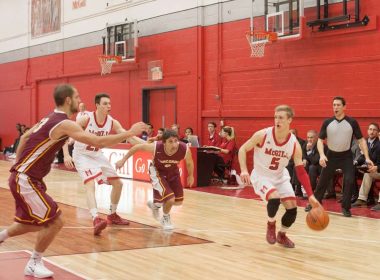
Hockey: Redmen send Queen’s packing at Carnival game

One-thousand-four-hundrend-and-twenty-seven screaming fans exploded when Mathieu Pompei of Laval, QC, scored the game-winning goal for the no. 5 ranked McGill Redmen against the visiting Queen’s Gaels in the annual Management Carnival game. Pompei’s goal made it 2-1 just 27 seconds after Queen’s broke through on a rare 3-on-1 breakaway to knot the game at one apiece.

With back-to-back wins against Queen’s, McGill grabbed the top spot in the OUA Eastern Conference, pulling away from the reeling Gaels.

From the onset, the Redmen kept up a relentless attack on the opposing zone, setting and resetting its offence inside Queens’ blueline. Feeding off of a fierce fore-check, the home squad struck early on a power play goal by defenceman Ryan McKiernan at 12:26 into the first frame. McKiernan leads the team with 25 points on the season, and is now tied for the CIS lead in goals among defencemen.

“We kept the puck,” said Redmen Head Coach Kelly Nobes. “We spent a lot of time in their zone and moved the puck around well.”

The strategy proved simple yet devastating.  Taking a page out of legendary Chinese general Sun Tzu’s The Art of War, the Redmen played their best defence through offence all night, never letting the Queen’s attack settle into a comfortable rhythm and outshooting their opponents 38-26.

The early onslaught could have proved a knockout punch if not for the solid play of the Gaels’ goalie Kevin Bailie, who routinely kept his team in the game.

(Alexandra Allaire / McGill Tribune)

“You can’t ignore [Bailie],” said Nobes. “He made some big stops for them and kept it close.”

The script was flipped in the second period, as the Redmen were hamstrung by penalty trouble early on. This time, it was rookie Redmen goalie Jacob Gervais-Chouinard’s time to shine as he stifled the barrage of shots with several spectacular pad saves.

“They came out strong in the second period but our penalty kill was better,” Nobes said. “Chouinard didn’t see as much rubber, obviously, but he played great.”

By the time third period rolled around, the only people not standing at their seats were in line for beer, further adding to the uniqueness of the Carnival game.

“The spirit was incredible, we’ve never seen it like that,” Nobes commented on the rambunctious fans in attendance. “A lot of people came out to support the guys, and [the team] definitely felt it.”

As the final minute played out, the crowd erupted into a “Three cheers for McGill” chant as the Gaels pulled their goalie in an effort to take the man advantage.

With seven games remaining in the regular season, the race for the OUA Eastern Conference pennant should go down to the wire. At the time of press, the top five teams are separated by a mere six points following McGill’s blowout 7-2 victory against RMC on Saturday.  Next week, the Redmen travel to Ontario to play against Laurentian on Jan. 24 and Nippissing on Jan. 25 in their last road trip of the season.

At this point in the year, every moment is crucial as McGill looks to distance itself atop the crowded Conference. Looking ahead, Nobes isn’t too concerned about the home stretch considering his experience leading teams to the promised land.

“I’m not one to make predictions,” said Nobes. “We focus on the present and try to get better with every game.”

a, Student Life

Student of the Week: Daniel Binette

If you’ve ever wondered why someone would sacrifice their Saturday night to give strangers a free ride home, ask U3 Arts student Daniel Binette.

Binette is Vice-President Operations of DriveSafe, a student organization that provides free rides for students on Friday and Saturday nights. As long as their three to four rented vans aren’t too busy, you can call DriveSafe to have a volunteer pick you up anytime between 11 p.m. and 3 a.m. from anywhere on the Island of Montreal.

Binette has volunteered for DriveSafe since his first year at McGill. Now, as VP Operations, Binette is responsible for co-ordinating van rentals from Discount Car & Truck Rentals and helping to train volunteers.

Binette began volunteering with the program after a suggestion from his floor fellow in Douglas Hall.

“I would never say I […] came to McGill to drive kids home, but it’s a really funny service,” he admitted. “When people take it, they’re really happy to get a free ride home.”

On his DriveSafe trips, Binette not only helped those he picked up, but also his residence by bringing in extra cash.

“We would always take the empties from our rez back to Provigo and put [the money] towards our rez budget and we actually made a fair amount of money,” Binette said. “We’d take back like 80 dollars worth of empties and that actually helped council. “

Even though he doesn’t drive as much as he used to, if you catch a ride with Binette he has the perfect playlist for your end-of-the-night trip home.

“It’s really funny playing music when students are leaving bars,” he said. “They really like hearing stuff like [Sprit of the West’s] Home for a Rest.”

While many other schools have programs like WalkSafe, DriveSafe is a relatively unique service that ensures student safety, but also provides an added convenience.

“Our mandate is to help students who don’t have a safe way of getting home—whether that’s because they’re on their own, don’t have money, or don’t feel safe where they are,” Binette said. “What I’ve taken away is actually helping people when they’re really in a bad spot [….] To take them home and take them home safe­—that’s a really rewarding and valuable service.”

In addition, Binette says he enjoys venturing to places a bit further than just trips across the city.  Having travelled a lot with his family, he’s been fortunate enough to visit numerous destinations, including a trip to Mount Kilimanjaro in 2005.

“I was the youngest person to climb it that year,” he said. “I was impressed that I was actually able to do it. My dad couldn’t make it to the top, but my brother and I did; he was 15 and I was 13. When you’re 13 you’re not thinking ‘Oh I’m so small,’ but in retrospect I [was] like a toddler.”

More recently, he has also trekked part of Mount Everest and visited Israel and Jordan.

Binette’s international interests have extended to his academics. As a political science major, his primary interest is in comparative politics.

“I lived with somebody in Nepal for a month that worked for the UN High Comission for Refugees; she was a lawyer by trade and did refugee law and international law,” Binette said. “That was really interesting for me [….] I plan on going to law school in September, so that’s the trajectory that I’m taking. It’s more just an interest, learning about different countries’ political structures.”


If you could be in any movie what would it be?

I love Woody Allen movies; I love the quick funny dialogue in it. I love Midnight in Paris. I think it’s one of the best movies.

If you could make a Twitter handle what would it be?

@OverheardintheDriveSafeVan

What was your favourite job?

Last summer I did financial analysis on 110 charities for Charity Intelligence Canada. They’re the first company in Canada dedicated to analyzing the charity sector [….] The results are pretty shocking—it takes the Heart and Stroke Foundation over 50 cents to raise one dollar.

What is your favourite punctuation mark?

Interrobang. Nobody knows what it means, but it’s provocative.

What are your pet peeves?

1) Bad grammar, like when people use “your” for “you’re.”

2) People who wear clothes that are inappropriate for the weather—like when it’s five degrees outside and people are wearing Canada Goose [jackets]­­—that pisses me off. Or that one guy who, when it’s minus two, is wearing shorts.


DriveSafe can be reached at 514-398-8040

Fri. and Sat. 11 p.m. – 3 a.m. 

a, Arts & Entertainment, Theatre

The 25th hour: a strong finish at TNC’s playwriting dash

The stakes were high last Saturday evening at Morrice Hall’s Tuesday Night Café Theatre (TNC). With the pride of winning McGill’s most temporally concentrated dramatic competition—not to mention the promise of free pitchers of beer at Bar des Pins afterwards—on the line, a trio of hastily prepared student-written plays were pitted against each other with hopes of claiming victory at TNC’s annual 24 Hour Playwriting Competition.

In order to do so, they would have to garner the majority vote of the students in the audience and the preference of guest judge Prof. Myrna Selkirk of the English department. Although the dual judging format led to an inconclusive competitive result—the two panels delivered different picks—the important result was the competition itself, which produced three distinctly entertaining plays.

The challenge of the competition is that students, who are selected by the TNC executives based on writing samples, have 24 hours to write a play from scratch. Then, they’re given another 24 hours to direct a group of randomly assigned actors who will be dramatizing the scripts they just wrote.

While the short window of time allotted for writing and practicing appears daunting, Emma Myers, co-writer/director of That’s All There Is, wasn’t overwhelmed by the experience of preparing a play under short notice.

“Honestly, we pretty much just cranked it out in a couple hours,” she tells me. “The process was pretty free-flowing. We didn’t really have to edit it too much or go back on what we initially decided to do. It was really fun, really low-key; we weren’t stressed out.

“In the morning we typed it up and realized we were four pages short so we decided to add an extra scene, which ended up being [a] flashback scene.”

The competition’s other guideline was that every play needed to begin with the words “I woke up like this” and finish with the words “Your man ain’t never seen a booty like this”—both phrases being pulled straight from the most recent Beyoncé album.

Each play took its plot in noticeably different directions. Thoby King’s The Death of Queen Bee (the student-pick for best play) fully embraced the Beyoncé effect and centred its story around a boy who starts uncontrollably spewing out Beyoncé lyrics every time he thinks of death (which happens comically often), and who eventually finds solace in a girl who has a similarly quirky compulsion to douse herself in milk when she’s attracted to a boy. Caleb Harrison’s The Body (Selkirk’s pick) explores how a situation unfolds when a man is found dead and a shop worker, prostitute, and Evangelical couple determine what should be done about it. Myers and co-writer Julia Edelman crafted a story about a female McGill student with a slew of issues that include her immature mother; smooth-talking, gangster-wannabe boyfriend; and backstabbing roommate.

Of the three plays, That’s All There Is featured the widest variety of roles, and Myers explains how a spontaneous casting decision solved the problem of not having enough actors for a scene—while also leading to one of the play’s funnier moments.

“We didn’t know if we would have anyone to play Debbie [one of the mothers dropping a child off at residence] until today,” she says. “And then Jacob came in, and we were like, ‘Can you do drag?’ and he was like, ‘Yeah,’ and it ended up being perfect.”

However, that was only the second-most pressing issue that had to be resolved in rehearsals.

“One of the girls in our cast, Lydia, who played Anna, has a milk allergy,” explains Myers. “A serious milk allergy where if she touches a dairy product—like the milk that was poured all over our set [during King’s play]—she could actually stop breathing. So that was pretty scary when we found out that they were going to be using milk. But we dealt with it, and it was fine.”

High as the stakes were for the excellent 2014 installment of the 24 Hour Playwriting Competition, sabotage by milk sounds like something we can probably rule out from King as a tactic for securing a competitive edge.

a, Football, Sports

Point counterpoint: Manning vs. Brady

This weekend’s AFC Championship game pitted the Denver Broncos against the New England Patriots. The two squads are led by NFL icons Peyton Manning and Tom Brady, respectively. Although the Broncos defeated the Patriots and are headed to the Super Bowl, the question of who will leave a stronger legacy is still up for debate. This week, two contributors weigh in on the debate between the two future Hall-of-Famers.


Manning

Though it needs no reminder, the current season Peyton Manning is coming off of has been nothing short of astonishing considering his advanced age and his supposed fragility, having undergone four neck surgeries. The four-time (soon to be five-time) MVP anchored what was statistically the greatest offence in the history of the NFL. The Broncos recorded a whopping 606 points which topped the amount put up by the Tom Brady and Randy Moss-led New England Patriots (589) that went undefeated in 2007. On top of that, Manning surpassed Drew Brees’ mark for most passing yards in a single season (5,477), and Tom Brady’s mark for most touchdown passes thrown in a single season (55). Manning also became one of only six players to throw seven touchdown passes in a single football game.

This season included, Manning now sits at 64,964 career passing yards and 491 career passing touchdowns. Presuming he sticks around the NFL for a few more seasons, it’s only a matter of time before he surpasses Brett Favre’s illustrious records.  Favre took 302 career games just to achieve those records. Manning is on the verge of breaking them with only 240 career games under his belt. It’s worth noting that the greatest passer rating Tom Brady ever recorded was 117.2 in the aforementioned undefeated season with superstar receiver Randy Moss.  Peyton Manning owns two of the five greatest passer ratings ever recorded in the NFL, one of which was higher than Brady’s best.

Of course, we could talk about Manning’s lack of Super Bowl wins and relatively mediocre post-season playoff record compared to that of Brady’s, but the reality is that football is a team sport, one in which the quarterback has to rely on his defence to come out on top and win the big one. Brady would probably be the first person to tell you that it takes help, and even a bit of luck to get the job done. Needless to say, he won three Super Bowls playing alongside elite defences and the golden foot of some guy by the name of Adam Vinatieri. Brady does have a significantly better head-to-head record, but that doesn’t change the fact that Manning has more fourth quarter comebacks, more game-winning drives, and has the more recent Super Bowl victory between the two. Brady is clutch, but he hasn’t quite delivered the goods when it’s mattered most, coming up short in five playoff games despite being favoured for the past 11 he’s played in.

While neither quarterbacks have performed their best on the big stage these last few years, the clock is slowly running out on both of their careers.  Without a doubt, Brady is spectacular in his own right, but with that being said, I’d be hard pressed to find a better all-around player under centre than Peyton Manning.

Dan Gilbert

Brady

When it’s all said and done, Tom Brady and Peyton Manning will likely go down as the two greatest quarterbacks to ever play in the NFL. The debate will never cease as to which of the two has the rightful claim to be deemed the greatest of all time; however, when it comes to a lasting legacy on the game of football, Brady’s is one that Manning will never be able to surpass.

Resorting to a numbers debate in this matter would be futile, with both quarterbacks tallying up staggering career statistics. While Manning will undoubtedly finish with higher totals in most categories, passing yards and touchdowns don’t determine legacy. Records are made to be broken, and it is only a matter of time before another quarterback throws for more touchdowns, or more yards in a season. Peyton Manning is arguably the greatest regular season quarterback of all time; but unfortunately for Manning’s legacy, the regular season isn’t what matters.

Ask any player, any coach, or any team owner, and they will tell you that their one and only goal is to win. As Herm Edwards once famously said, “You play to win the game!” Ultimately, the lasting legacy left by these two living legends will boil down to winning.

With three Super Bowl victories and five AFC Championships, Tom Brady’s legacy will go down as one of the—if not the single—greatest of all time. After all, when you are a die-hard fan of a team, you don’t remember the year when they went 13-3 in the regular season, but lost in the divisional round; you’ll remember the season when your team went to the biggest stage in sports and took home the Lombardi trophy. It’s that moment that lives on in your memory; it’s that moment that you’ll tell your kids about.

Throughout his career, Brady has time and time again performed better than Manning when it has mattered the most. With a .720 winning percentage in the playoffs compared to Manning’s .426, as well as a .775 regular season winning percentage  vs. Manning’s .696, Brady comes out on top.

For 14 years in the league, Brady has consistently led his team to championship games and Super Bowl appearances. With that being said, if you had to choose one quarterback to build a team around, or one quarterback to be the face of your franchise and lead the team to the promised land, Brady is your man.

As the 199th overall pick, Brady has defined his career as one of the most clutch performers in NFL history. While Brady’s numbers speak for themselves, his lasting legacy—the legacy that will overshadow that of Manning’s—is that of the greatest winner in all of football.

— Drew Allen 

Editors’ pick: Manning

Although Tom Brady has more Super Bowl titles under his belt, Peyton Manning’s continued dominance in the record books cannot be matched. The notion of Brady being unflappable when it matters most has waned. While both players will go down as two of the greatest quarterbacks in NFL history, it is Manning who will likely leave the greater legacy.

a, Arts & Entertainment, Music

Bruce Springsteen—High Hopes

Bruce Springsteen has spent his career using extraordinary elements to spice up the seemingly mundane. Be it through the illumination of small-town New Jersey life through deceptively sparse poetry, or the energizing of simplistic song structures with larger-than-life guitar riffs, Springsteen has often found a way to milk material to its maximum potential. On his latest release, High Hopes, he tries applying the same treatment to a group of unreleased songs with the aid of longtime Rage Against the Machine guitarist Tom Morello and some considerably ornate-sounding instrumentation—but the seasoned formula falls well short of yielding its past fruition.

One particularly egregious example is the new recording of “The Ghost of Tom Joad,” on which he combines the aesthetics of his stripped-down original with those of the manic Rage Against the Machine cover. Though the symbolism of Morello and Springsteen recording the song together lends the track a nicely sentimental touch, it’s too musically incongruous to retain the power of either version. Morello’s flashy guitar playing stands out uncomfortably against Springsteen’s typically raspy vocals, and the guitar solo ending the track verges on self-parody.

There’s quite a bit of material on here that stayed previously unreleased for good reason. The repetition throughout album closer “Dream Baby Dream” feels tedious almost immediately. The extraneous Shakespeare references on “Frankie Fell in Love” suggest a nervous high schooler struggling to use his book smarts to impress at a party. Though High Hopes has moments that work, such as when Springsteen sings accompanied only by the percussion and Morello’s heavily processed chords, they are too few and far between to make the album an enjoyable listen. Springsteen will need to try harder if he has ‘high hopes’ for recording relevant music again.

a, Arts & Entertainment, Music

The Pixies—EP-2

Last Monday The Pixies released their new album, EP-2, apparently as a second park to their album of September 2013, titled EP-1. This new release seems to complete a transition from the band’s old alternative rock style to true blue hard rock—their new sound is now well-developed, with many moods across four daring tracks. The band has musically grown a lot since their formation in Boston, 1986, and their irresistible energy carries them through yet another magnificent and unique album.

Instruments you will hear in this album include vibrant, gritty electric guitar (heavy on the feedback); on-point, fast-paced percussion; and glittering electric sounds. In EP-2, the band takes full advantage of their talented vocalist, Black Francis, to experiment with some scream-o elements in the first track. While the style of this album may be different for the Pixies, they once again summon their uninhibited energy,  for which their tried and true fans love them.

The trajectory of the album is strong right from the first track, “Blue Eyed Hexe,” which is clean with a pure hard rock sound. On the second track, the band retains the same vibrant energy, with more of a contemplative and curious tone that the Pixies often achieve through thoughtful lyrics and the distortion of sounds. On the third track, their passion reaches a plateau, curling and bouncing around a beautiful, unrequited love song called “Greens and Blues.” The album ends with a song called “Snakes” that is more reminiscent of their older music.

In short, this album is quite different from anything else the Pixies have written, but faithful fans and new recruits will love the old-time Pixie energy.

a, Opinion

The most wonderful time of the cinematic year

There is a buzzing excitement that accompanies otherwise regular movie outings during this time of year. The experience becomes fraught with glowing expectations, brought on by compulsive IMDb-monitoring, the constant bombardment of film posters, and the onset of awards season.

Just last week saw the announcement of the 2014 Oscar nominees, the same week during which the Golden Globes and the Critics’ Choice awards took place.

The excitement is accompanied by an uneasy trepidation for all of us who grow too easily attached to certain films or actors and take a certain loss or lack of nomination as a sign of great injustice. Such is the inevitable disappointment of the awards season.

Between the saddening absence of Woody Allen and the frustrating grand total of one non-white Best Actress winner, I try very hard throughout the year to pass the award shows off as trivial; subjective; wastes of time. As Allen is quoted as saying in the film “Woody Allen: A Documentary,” “I think what you get in awards is favoritism. I mean, people can say ‘my favourite movie was Annie Hall,’ but the implication is that it’s the best movie. And I don’t think that’s possible—I don’t think you can make that judgment.”

Allen’s movies, including Annie Hall, have won wide acclaim from viewers and shows, yet he appears adamant about refusing acceptance of any kind of award.

Despite the shortcomings of the various awards, with each new year, I find myself excited to watch the shows all over again, eager to try and predict the recipients of various accolades.

My excitement begins in the early months of fall, when the first batches of good movies begin to roll into  theaters. This excitement builds until the holiday season, which commonly sees the greatest number of “the good movies,”—films made with critical acclaim and awards in mind—in comparison to the largely critically underwhelming releases of the spring and summer.

I find the awards to serve many purposes: a second vacation from the burden of already knee-high readings assigned, a distraction from the bitter weather; an antidote to my homesickness for the West Coast.

But to be more honest, I love following the awards shows because they are the perfect entertaining conclusion to an entertaining year—a grand finale to months and sometimes years of dedication that go into making two hours of whatever heartbreaking, surreal, exciting, or sobering narrative ends up on our screens. The shows are potent in their glamour and exclusivity, both of which draw so many of us to observe and admire, as if we can imagine ourselves seated across from teasing hosts, handsome announcers, and celebrated entertainers. It’s a bright, grand end to the year. And although the Best Picture award may not accurately describe its recipient, its announcement is a satisfying conclusion to a long year of movie-going—and a fitting prelude of things to come.

Read the latest issue

Read the latest issue