Latest News

a, Men's Varsity, Sports

Slow out the gate, McGill seeks eighth straight

Eight straight—that’s been the only thing that’s left to accomplish for the Redmen rugby team this year.

From the first whistle of the season, an eighth straight RSEQ Championship was the goal. Now, the Redmen (7-1) are one win away from hoisting another RSEQ Championship in their 13th consecutive appearance in the title match following a 24-6 domination of the Montreal Carabins (2-7) in the RSEQ semifinals this weekend.

This season provided a different experience for a program that is used to blowout victories, as every yard, every try, and every win had to be earned. The team’s first three games were all victories, but the total margin of victory was only 13 points, compared to last year’s total of 42 after the same number of games.

The squad didn’t waste any time on Friday, looking determined from the outset. It was clear that the visiting Carabins were outmatched  in both physicality and talent. McGill overcame the troubles it had faced earlier in the season handling the ball and making plays, blanking the visiting Carabins 17-0 in the first half.

Junior scrum-half Humza Turab explained that the strong start is a result of disciplined execution.

(Wendy Chen / McGill Tribune)

“We followed our game plan really well,” Turab said. “Everyone knew what their job was and did it to the best of their ability.”

Centre Hugo Peurois put the first points on the scoreboard early at the 23-minute mark, while junior forward Noam Berson rounded out the scoring in the first half with a try of his own in the 36th minute. Berson was also named MVP of the game for his efforts off of set pieces and in open play.

Cameron Perrin, McGill’s senior fullback, was stellar once again as he led the squad in scoring with nine points. Perrin was perfect on his conversion attempts, and added a penalty goal in the first half.

The team now moves on to the finals to play cross-town rival Concordia. McGill and Concordia’s rugby programs have a very rich and recent rivalry. Two years ago, the Redmen won 28-7 over Concordia to notch its sixth consecutive championship. In last year’s RSEQ final, the Redmen eked by the Stingers with a score of 24-18 to claim the title. The lone blemish on McGill’s record this season comes from Concordia, who broke the team’s 12-game winning streak in a 19-13 victory at Concordia Stadium. Needless to say, the squad will have ample motivation for the chance to beat the Stingers once again; but in order to do so, the team needs to make a few adjustments.

“We will need to make sure everyone is on the right page, and we need to cut down on the penalties—especially [on] our own half [of the field],” Turab said. “If we can do that, we have a really good chance of going for the eighth straight banner.”

The RSEQ Championship will be held at Molson Stadium on Friday, Nov. 22 at 7:00 p.m.

a, News

Protestors interrupt class of professor accused of death threat

Last Wednesday, a group of approximately 10 student protestors caused the cancellation of a class taught by a McGill professor accused of issuing a death threat against a former graduate student.

The protestors are demanding that the professor’s class be cancelled.

The protest comes after professor Gary Dunphy’s decision to appeal a ruling by McGill’s Committee for Student Grievances (CSG) that his behaviour constituted harassment.

The incident in question comes from an exchange between former McGill graduate student Amr El-Orabi and his then-supervisor, Dunphy, which El-Orabi recorded and sent to Global News.

In the recording, El-Orabi tells Dunphy he is leaving his studies prematurely. When El-Orabi asks, “Is there anything else that you want from me?” Dunphy responds, “Yes, your death.”

After returning to his home in Egypt, El-Orabi filed a grievance against Dunphy through McGill’s CSG. In September, the committee ruled in El-Orabi’s favour, though the university will not disclose the contents of the ruling.

Participants in last Wednesday’s demonstration said they were unsatisfied with McGill’s response to the case. Ten students entered Dunphy’s Insect Biology and Control class with signs calling for Dunphy’s resignation.

“[Dunphy’s] behaviour […] was qualified as constituting harassment and threat of physical violence by university instances,” announced a demonstrator who wished to remain anonymous. “These types of behaviours are one instance of a broader university system imbued with racism and rape culture. It is unacceptable that the university administration does not take this matter seriously and take the appropriate steps to protect its students.”

Due to the demonstration, Dunphy’s class ended one hour earlier than scheduled. The demonstrators chanted and followed the professor as he left the room.

Natascia Borsellino, U3 Science, said she was frustrated that her class was cut short because of the demonstration.

“I think it’s just absolutely disrespectful to do that during class,” Borsellino said. “It’s not okay; we have exams. I get it—they can protest outside his office, they can protest in the streets—but in the classroom, it’s a bit much. I have a midterm today, and I came to this class, and I just wasted my time.”

Dean of Students André Costopoulos said there were other ways by which the demonstrators could have conveyed their message.

“We’re always listening and always wanting to improve our policies and procedures, which are far from perfect,” Costopoulos said. “There’s a question of respect for the rights of others here. We have to respect the rights of others to complete their academic training and to perform their academic duties in a safe, respectful environment.”

Before leaving, the demonstrators announced that they would continue to protest Dunphy’s position at McGill.

“Until professor Dunphy resigns, or until the university cancels his classes, we are going to be taking it into our hands to prevent him from teaching,” one demonstrator said.

Another protestor, who also wished to remain anonymous, said the group chose this method of protest because it expressed their belief that Dunphy should not be teaching at McGill.

“Other types of protests may not have put that belief into action in as effective of a way,” the protestor said. “Protesting outside his office would not have stopped him from teaching. Our intention was to stop him from teaching, and thereby, to achieve the goal that we see the administration [is] totally unable to achieve.”

Costopoulos said the university has no plans to cancel Dunphy’s class, and that McGill is exploring options to minimize the possibility of future disruptions

“We have to respect the rights of the students to complete their semester and to complete their courses,” Costopoulos said. “The course is continuing, and it will be in a safe, appropriate environment.”

Costopoulos added that the demonstrators are being investigated in accordance with McGill’s Code of Student Conduct and Disciplinary Procedures, due to several complaints his office has received about the incident.

“When we receive complaints from members of the community, this could result in an allegation of a breach of the Code,” Costopoulos said. “If disciplinary officers find that there’s potentially a breach of the Code, they will bring formal allegations against students, and that may result in disciplinary action.”

a, News

SSMU Special GA addresses $21,000 Frosh deficit, seeks input for Student-Run Café

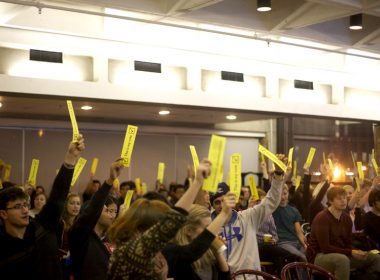
A $21,000 deficit from frosh and the opening of the student-run café were at the forefront of discussion at last Wednesday’s special General Assembly (GA) for the Students’ Society of McGill University (SSMU).

Reasons for the special GA

The special GA took place following the Oct. 9 GA, which failed to meet quorum— an attendance requirement of 100 students who must be present for the GA to pass motions as binding resolutions.

With only approximately 50 students in attendance, October’s forum could not pass motions such as ratifying appointments to SSMU’s BoD, the society’s highest governing body.

The special GA maintained quorum throughout the evening. SSMU President Katie Larson said councillors had made a greater effort to advertise the special GA on campus.

“We were a little bit more active in trying to communicate the urgency,” Larson said. “I did make a bunch of materials for councillors to distribute at meetings and reminded them that it’s their obligation per our constitution and by-laws to promote the event.”

Attendees of the GA voted in favour of appointing fifteen councillors to the BoD. An active BoD is required for some decisions regarding SSMU’s financial matters. For example, SSMU needs a BoD to purchase stocks to add to its investment portfolio, and to hold a liquor license for Gerts.

“In order to hold [a liquor permit], you have to have a company that’s in legal standing,” Larson said. “If we don’t have a BoD, we can’t declare our corporation to the government [….] If our corporation status is in jeopardy, eventually it would go down the chain and we could get our liquor license revoked.”

Following the special GA’s success in reaching quorum, Larson said Council would make additional efforts to advertise and promote awareness for the Winter GA.

“We’re going to probably hold an open forum or some kind of session at the beginning of the Winter semester […] to say, what is the GA and what are [students] expecting from it,” Larson said.

$21,000 Frosh deficit

Students at the GA also called on executives to explain the $21,000 deficit Frosh incurred this year, which was announced last Thursday at SSMU’s Legislative Council.

“Who is responsible for the $21,000 loss in Frosh, and why hasn’t there been a clear explanation on this?” Luis Pombo, U2 Engineering, asked.

According to SSMU Vice-President Internal Brian Farnan, there were a number of factors involved with the loss.

“A couple things were miscalculated months in advance of the actual event of frosh,” Farnan said. “All money that was funneled through frosh, a percent of that goes to PayPal, [but] this was not actually accounted through the budgeting process [.…] Certain mistakes were made when calculating the taxes [.…] In addition, there was a brand new system implemented that actually split up sponsorship revenues with faculties this year.”

Pombo said the deficit indicated “incompetence” in frosh planning.

“If you’re going to use an online payment system, you should know that they charge a fee to use their services,” Pombo said. “Same with the issue with the sponsorship money—whoever was in charge of it should have known.”

According to Farnan, SSMU’s in-house accounting services will review proposed Frosh budgets in future years to avoid these problems in the future.

“Most of these mistakes were budgeting so, as you can see, there’s a very, very simple explanation,” he said. “Our plan is to actually involve the accounting department next year, since it is such a sizable budget—$200,000. This can’t just be handled by students anymore.”

Student-Run Café seeks student engagement

Josh Redel, manager of the upcoming Student-Run Café (SRC), gave a presentation that encouraged students to become involved with the project as it moves towards its January 2014 launch.

According to Redel, SSMU will host sessions in the upcoming weeks to hear student feedback on the existing plans. Discussion topics will include how the physical space should be used, what the true meaning of “student-run” is, and what the ultimate mission and vision of the café should be.

Redel said the café will make an effort to keep students engaged throughout the year.

“You’ll be able to text in feedback after your meal,” he said.  “Additionally, we’ll be holding events on the regular—once, if not twice a month—having big community conversations about SRC.”

Redel said the menu will include low-cost vegan, vegetarian, and gluten-free options. Although it will accept debit, credit, and cash, the café will not be able to accept Martlet meal plans this upcoming semester, although Redel said it could be possible in the future.

“Unfortunately, McGill is going through a pretty big change right now with how they accept meal plan cards on campus, so they will not be able to provide us with a system for that,” Redel said. “But they’re very much on board for future endeavours with the meal plan.”

Discussion sessions will take place in the Madeleine Parent room on Wednesday, Nov. 20 at 3:00 p.m., Tuesday, Nov. 26 at 4:00 p.m.,and Friday Nov. 29 at 12:00.

a, News, SSMU

Revised SSMU budget defers projected 2014 deficit

The Students’ Society of McGill University’s (SSMU) Council has approved a revised 2013-2014 budget that broke even after initial projections forecasted a $90,000 deficit from last fiscal year.

According to the budget presented at Council last Thursday, SSMU currently projects a surplus of $50,000 for fiscal year 2014. The $50,000 surplus will be transfered into the Capital Expenses Reserve Fund (CERF).

The approved budget does not account for capital expenditures—long-term expenses such as software and equipment. According to Vice-President Finance and Operations Tyler Hofmeister, SSMU will be spending more than the $50,000 on capital expenditures this year, which means there is a potential risk of deficit in future years.

SSMU President Katie Larson told the Tribune that SSMU will have to take  measures to address the potential future deficit.

“The rent [of the SSMU Building] is increasing while tenant revenue is decreasing, allowing for more student space, but at a cost,” she said. “This indicates that the SSMU base fee will be raised to reflect the situation, because at its current state it is dire and unsustainable.”

Hofmeister said another option is to change the SSMU investment portfolio into an endowment fund.

“This means that a certain amount [….] will be taken from the investment portfolio each year to help pay for capital expenditures,” he said.

Last year’s projected deficit is largely a result of ongoing negotiations with the McGill administration regarding the SSMU Building lease, which has been under negotiation since Fall 2011.

Other increased building costs include rent for the building and lost revenue from tenants who have terminated their leases, such as Lola Rosa and Voyage Campus. The building budget, which comprises all expenses and revenues generated by the SSMU Building, has a deficit of $437,360.

To account for the incoming projected deficit from last year, the various categories of SSMU’s overall budget, including the personal executive committee budget, the building budget, and the club fund has been drastically reduced from the initial version of the budget. These include expenses involving general administration, information technology (IT), office supplies, travelling and conference fees, and telephone bills.

“As we knew we were beginning with a deficit, preliminary cuts were made during the revision process where departmental officers were asked to analyze their budgets, reduce excess spending, and improve the overall accuracy of their budgets,” the budget report reads.

The general administration budget, overseen by SSMU General Manager Pauline Gervais, represents the largest portion of the budget. It includes all salaries for SSMU staff, bank fees, and legal fees. Salaries, which represent the largest expense of SSMU, underwent large cuts.

“Student salaries have been reduced by 10 per cent to reflect the fact that only 90 per cent of budgeted hours for student staff are worked,” Hofmeister said.

In addition, each executive’s budget has been reduced by $1,000 from last year.

The IT budget includes expenses related to the SSMU website, computer software, repairs and maintenance, contract services, hardware purchases, and the Old McGill yearbook.

“It is worth noting that in the initial budget, the IT department was budgeted at over $70,000 and has since been cut to […] about $17,300.” Hofmeister said.

In addition, this year’s frosh ran a $21,000 deficit, mainly due to SSMU’s failure to account for taxes in their sponsors’ quotes.

“The most significant changes between the [frosh] budget that was used and the actuals come from an over-estimation of sponsorship,” Hofmeister said. “[Sponsors] didn’t include the taxes we were charged on sponsorship commission, which over-inflated this figure by about $10,000.”


a, News, SSMU

Behind SSMU’s investment gridlock

The upcoming Nov. 13 special General Assembly (GA) will seek to address issues that could not be settled during the October GA due to its failure to meet quorum. One of these issues will be to ratify appointments to SSMU’s Board of Directors (BoD).

Without a BoD, the Students’ Society of McGill University (SSMU) is unable to purchase stocks to add to its collection of investments—worth approximately $2.65 million. This means SSMU cannot add potentially lucrative investments to their portfolio, which hinders its ability to generate revenue.

The portfolio is currently managed by Lester Asset Management (LAM), a Montreal-based portfolio management firm owned and co-managed by three individuals, including McGill Management professor Ken Lester.

The National Bank is LAM’s custodian bank, which means that they are responsible for safeguarding SSMU’s portfolio. National Bank can effectively prevent LAM—and by proxy SSMU—from ordering new purchases on stocks or bonds until required paperwork, such as corporate resolutions voted at SSMU Council or General Assemblies (GAs), are updated. The forms are related to SSMU’s corporate resolutions, which detail SSMU’s financial decisions.

“We have to refresh our forms every two years, but it just so happened that we [changed] our custodian [last year],” Lester said. “National Bank said […] that they’d respect the paperwork from the old custodian for a year and let us trade for a year, but now they won’t let us buy until we get all the rest of the paperwork in.”

Lester said the decision to switch custodians from Fidelity, LAM’s previous bank, to National Bank last year was based on a number of factors.

“The main reasons for choosing [National Bank] over Fidelity were price, service, size, and current client satisfaction,” he said.

According to SSMU Vice-President Finance and Operations Tyler Hofmeister, SSMU’s investments are currently fiscally modest, and so he does not expect the current portfolio’s value to change drastically while SSMU remains unable to make new investments.

“[The portfolio] looks conservative,” Hofmeister said. “Most of the holdings are in more secure investments, such as utilities, telecommunications, and fixed income securities.”

Although the National Bank places restrictions on SSMU because they lack a BoD, they do not limit the selling of shares, according to Hofmeister. This means that SSMU can continue to pursue their intention to divest from certain companies—plans that arose from concerns about unethical practices.

SSMU’s Financial Ethics Research Committee (FERC) is responsible for establishing policies that guide and maintain the social responsibility of SSMU’s investments. Last year, the committee drafted a checklist of companies deemed unacceptable for investment.

“We gave this filter to LAM [and gave them] 10 [companies] we [wanted] to divest from,” last year’s FERC coordinator Adam Winer said. “SSMU policy dictates that we can’t be invested in companies that derive a large share of their profits from fossil fuels, or whose core business activities involve the extraction and distribution of fossil fuels, whether in connection to tar sands in Canada or globally.”

At the Winter 2013 Midpoint Review of SSMU’s investments, FERC researched the companies and determined which ones violated SSMU’s bylaw for socially responsible investment—for example, SSMU is committed to avoiding companies associated with environmentally harmful areas or human rights abuse.

In one instance, the committee recommended that the FERC further research Bell Alliant Inc., a telecommunications provider that has partnerships with companies involved in the tar sands, rather than divesting from them.

“Though their partnerships with tar sands companies sparked some discussion among the committee, our conclusion was that providing networks to tar sands companies is unavoidable for a telecommunications corporation,” the review said.

On the other hand, FERC recommended that SSMU immediately divest from Fortis Inc., a distributor of natural gas and electricity, due to their high level of association with the tar sands.

Hofmeister explained that the policies shaping the decisions SSMU makes are listed can be found in the SSMU policy book on their website. According to Lester, two divestments remain to be made, which he will make when a “trigger moment” occurs for the stocks, to allow him to sell them at an optimal price.

In terms of future outlook for the portfolio, Hofmeister explained that in light of SSMU’s projected budget deficit for upcoming years, SSMU is considering utilizing the investment portfolio as part of a long-term solution.

“[We are looking to change SSMU’s] investment portfolio to an endowment fund,” Hofmeister said. “This means that a certain amount […] decided upon with the SSMU General Manager, SSMU Comptroller, myself, and LAM will be taken from the portfolio each year to help pay for capital expenditures.”

In order to break from the current state of financial limbo facing SSMU’s investments, the upcoming GA will need to meet quorum of 100 students to officially appoint the BoD.

a, News

Suzanne Fortier installed as 17th McGill Principal

with bagpipes and traditional academic robes marked the installation of Suzanne Fortier as McGill’s 17th Principal and 13th Vice-Chancellor on Nov. 5.

Fortier, who is the first female McGill graduate to hold the positions, officially started her term Sept. 5. The installation is a symbolic ceremony in which Canadian Governor General David Lloyd Johnston presented the university’s Royal Charter and seal to Fortier’s keeping.

The Governor General has been the official Visitor of McGill since 1852, which means that he represents the founder, the public, and the Crown’s connection to the university. Johnston also has deeper ties to McGill, having served as the university’s Principal and Vice-Chancellor between 1979 and 1994.

To complete the official installation, McGill Chancellor Arnold Steinberg invested Fortier with the titles of Principal and Vice-Chancellor, after which Fortier took the Oath of Office, where she pledged to “faithfully carry out [her] duties.”

Other attendees included Quebec Minister of Higher Education Pierre Duchesne; members of the National Assembly and Canadian Senate; McGill faculty members, students, administrative, and support staff; and members of other academic institutions such as Harvard University and the University of British Columbia.

Université de Montréal Rector Guy Breton welcomed Fortier to her new position on behalf of all Canadian universities.

“I know that you will take the best possible care of [McGill], because I know your passion for knowledge,” he said.

McGill chemistry professor Hanadi Sleiman, who gave an official greeting speech as a representative of McGill’s faculty members, expressed hope that Fortier’s leadership would promote the development of research and teaching at McGill.

“McGill has been able to attract an unusually large number of superb new faculty members who have joined our excellent current faculty members over the last 10 years,” Sleiman said. “[Fortier] arrives at a very special time of growth and optimism at McGill when world-class research and teaching initiatives are under way in every department and every unit of this university.”

Sophia-Maria Giannakakis, a SSMU Councillor who spoke on behalf of McGill students, asked Fortier to keep students in mind throughout her term as principal.

“Remember, that within our playful youthfulness lie serious scholars, ready to make a contribution to the upcoming world and to society any which way we can,” she said. “Even if [our] beginnings may be unique and diverse, we are students eager to learn from amazing people and to continue learning for the rest of our lives.”

Fortier used an analogy to describe McGill’s current status as a university at a crossroad of change as it reinvents itself for the 21st century.

“It is not easy to push ourselves with questions for which there are not neat solutions,” Fortier said. “It is not easy to accept that sometimes it is not our answers that are wrong, but our questions. It can be a challenge to cultivate this highly dynamic culture filled with intense debate and intense confrontation of ideas. We are the great collider, and even if the collider sometimes overheats, physics tells us that this is where you find the most exotic particles; the new ideas, the new paradigms; the discoveries.”

She described the direction in which she wants to take the university under her leadership.

“Our sights are set high,” Fortier said. “We want our university to be a place of choice for the brightest talents [….] We want a teaching and research environment that is dynamic and innovative. We want an educational experience that resonates a lifetime, and a university that responds to the needs of its neighbourhood, its province, its country, its world.”


a, Features

Rising voices

The first time I performed at a poetry slam, my hands began shaking the moment I stepped onto the stage and didn’t stop until the car ride home. I was out of breath as I recited the last lines of my poem, and continued to sound as though I had ran a marathon until well after my piece was over. Yet, this was one of the most prolific experiences I’d ever had and did not deter my interest in the world of spoken word.

Due to my longstanding interest in spoken word, I was thrilled to hear that the Canadian Festival of Spoken Word (CFSW) was going to be hosted here in Montreal this year. The CFSW is an annual celebration of spoken word and poetry featured in various cities across the country. In past years, it’s jumped from Ottawa to Vancouver, Toronto to Halifax, and Calgary to Victoria. Divan Orange, Cabaret du Mile End, and a handful of other venues—which usually hold slams and showcases throughout the year—welcomed 44 spoken word artists from all across Canada this past week to share their work with other spoken word enthusiasts. This year, the CFSW was directed by Moe Clark, who coordinated programs, panels, and an array of workshops such as “Safer Spaces in Slam” and “Career and Community in Spoken Word.”


Spoken word is often defined broadly as a word-based performance of storytelling, or more frequently, of poetry. Although similar perhaps to the term ‘slam poetry,’ spoken word differs in that it encompasses poetry as well as multiple other forms—including but not limited to rap, stories, and monologues. Unlike spoken word, slam poetry originated from the ‘poetry slam,’ which focused on a competition of prop-less, music-less performance poetry.

GAINING POPULARITY ONLINE

Although spoken word is by no means a new art form, it has recently garnered a great deal of attention on the internet, with spoken word performance videos passed around on some of the most viral networks used today. These videos have gained traction on sites like Youtube, Facebook, and Upworthy, a site that curates specific videos almost destined to go viral.

Adam Mordecai, an Editor-at-Large of Upworthy, explained that the first time he realized the virality of spoken word was when he posted a poem written and performed by Shane Koyczan called “To This Day,” which is an autobiographical recount of being bullied as a child.

(Cassandra Rogers / McGill Tribune)

“Once it gripped me, I was in complete thrall, and didn’t even realize what I had while I was tearing up and watching it on repeat,” Mordecai said. “If I were to tell people they were watching spoken word before they clicked it, they would run screaming to the hills [….] It’s only when they see it, […] the humanity, raw emotion, and powerful words combined into an amazing performance do they understand what they just watched was powerful [….] Authenticity is what makes it shareable.”

Though Mordecai explained that there hasn’t exactly been a conscious decision to share more spoken word videos, he noted that once shared videos receive a lot of attention, and a curator will “try to recreate the magic. Once a curator has success with spoken word, they hunt down more.”

“We just love that it resonates and performs well,” Mordecai emphasized.

Jeremy Loveday, a performance poet, director of Youth Outreach for the Victoria Poetry Project and Concordia graduate who helped run Youth Roots Day during CFSW, said that people who had not been previously exposed to spoken word can easily be drawn in by these videos.

“I think it’s so rare in your day-to-day life that you hear people eloquently speak their truth,” Loveday said. “I think that that’s what these spoken word videos allow—they allow for people to poignantly speak their emotions.”

Chris Masson, who performed at CFSW and is a member of the Throw Poetry Collective, a Montreal organization dedicated to celebrating spoken word, explained how people’s interest in spoken word is often piqued by a thirst for a more genuine voice.

“So much of the poetry you hear […] is so sincere,” Masson said. “There’s a hunger for that in our lives today. We’re much more accustomed to irony and sarcasm—some sort of meta-commentary—than we are to sincerity and metaphor.”

Loveday attributed the length of these videos to their viral nature as well. “In the poetry slam format, [the performances are] three minutes. A viral video is usually a short video. That [short length] really lends itself to people listening to the message [of the performances.]”

Masson noted that he was by no means surprised by how much attention spoken word and slam poetry has received.

“I think [slam poetry] really speaks to people,” Masson noted. “To me, it’s no surprise that these things are getting shared. This is the point of why they’re made—to say things that matter in an artful way that just amplifies their meaning and their impact.”

For many, just watching the videos is not enough once they’ve been introduced to spoken word. A more engaging way to expose yourself to even more great performances is to see a live show.

With spoken word festivals—such as the CFSW—and regular poetry slams and showcases, the focus is at a much more personal level, with viewers sitting in the audiences as the performers on stage bring their carefully crafted words to life through a potpourri of slant rhymes, alliteration, and blank verse. Most believe that a live experience is much more electric than just sitting in front of the computer.

Patrick Ohslund is a performance poet from Oakland, California and is currently working toward his MA here at McGill on spoken word and its ability to create culturally relevant curricula. Ohslund reflected on the unmatchable atmosphere that exists in a venue during a slam.

“[The audience feels] like they had a really genuine experience with humanity that wasn’t pre-planned, pre-packaged. [It is] much more a synthesis of what was in that room in that moment,” Ohslund said.

(Cassandra Rogers / McGill Tribune)

Jonah Himelfarb, a U2 physiology student and spoken word artist who performed this past week at CFSW, explained the uniqueness of a live show.

“The electricity from the audience and the other poets [is] distinctly noticeable [….] It’s impossible to attend a poetry slam and not feel moved,” Himelfarb said.

But it’s not just the meter and rhyme of a spoken word piece that makes the audience erupt with snaps and murmurs of agreement. Perhaps the largest contributor to the ‘buzz-worthy’ quality of spoken word is the theme of each particular piece. The focus is often to provide a personal perspective on issues at large in society or to recount an experience that holds a substantial amount of meaning to the performer.


ENSURING A SAFE ENVIRONMENT

Due to the volatile nature of many of the topics presented at these performances, the question of ‘safe space’ is often discussed both within and outside the community. Performers and poets deal with heavy and frequently controversial matters that can both spark interest in some audience members while troubling others.

Ohslund explained that the definition of ‘safe space’ comes with its own set of complications.

“The concept on safe space in slam is flawed,” he said. “It’s a free speech space, which is categorically not a safe space. [But] there are some times where free speech […] can cross over to a place where it’s just blatantly disrespectful. [So instead,] it’s a free speech space with a notion of mutual respect.”

Masson explained the way he starts off each of the workshops he runs in order to foster that sense of respect.

“What I always start out with is saying that this is a space of acceptance. And if someone is sharing something, you need to respect that,” he said.

Loveday believes that showing everyone that he too is willing to open up and share helps to create that space of acceptance.

“I start every classroom workshop with a performance,” Loveday said. “[It shakes] things up a bit, showing them that this isn’t a normal day in the classroom. You’re creating an atmosphere where you’re showing a vulnerability, which will allow them to feel safer to do that as well.”

With such an intimate setting for these performances, it’s natural to find spoken word enthusiasts cultivating a tight-knit sense of community amongst themselves.

“There ends up being a community around the event and that ends up being really valuable and what keeps a lot of people coming back,” Masson said. “And since it’s a community based on expression, inclusion, acceptance, [and] mutual encouragement, it ends up being, almost always, a really wonderful community to be a part of.”

(Cassandra Rogers / McGill Tribune)

Montreal in particular, for a variety of reasons, helps to foster an even more unique flair within this community. Throw Poetry Collective embraces Quebec’s bilingualism in their slams. As an English speaker with less fluency in French, Masson explained how something that might be conceived as a burdensome language barrier is actually quite valuable to a slam listener.

“The bilingualism forces me to hear other things that they’re saying,” Masson said. “Even if I miss some of the literal meaning, I can pick up on emotion and body language.”

Beyond the city’s bilingualism, Montreal also boasts another unique aspect in its slam poetry scene.

“Montreal seems to have less of an established slam culture compared to Toronto or Vancouver,” Masson said. “There’s less of a defined genre or style that exists, so there’s a lot more experimentation, a lot more variety of what you see up on stage.”

McGill has also done its part in promoting the spoken word scene on campus. Coffee houses and open mic nights have featured poetry readings, and students like Himelfarb have reacted positively to the increased interest.

“I hope that more McGill students become involved in the spoken word community [….] I think it’s fantastic that people are taking initative to organize spoken word events geared toward McGill students.”

The last time I performed at a slam, my hands were no longer shaking the way they had before. I was still out of breath, but this time, from the sheer exhilaration I felt over being able to share my poems. Both during my performance and after the event, it was immensely rewarding to hear the audience’s reactions to my pieces. It was incredible to be able to have conversations with all the other poets who had just shared a piece of themselves by being up on that stage. It has only made me realize that whether you are a writer or a listener, whether you attend slams every other weekend or post riveting performances on your Facebook news feed, you will likely find spoken word and the community it fosters ready to welcome you with open arms.


a, Science & Technology, Student Research

Concrete canoe design team unsinkable

The Kraken lurked next to the Engineering Café for the first few months of the school year, unbeknownst to most students. Created by McGill’s concrete canoe design team, the Kraken competed last May at the Canadian Concrete Canoe Competition (CNCCC). The competition started in 1995 and aims to allow university students to gain design experience in a non-academic environment.

According to Steven Cerri, co-captain of McGill’s concrete canoe team, over 200 teams and 3,000 students have competed since the start of the Canadian competition. “Every year, thousands of spectators come to watch as students demonstrate the research, design, testing, and leadership skills that they have gained from the building of their concrete canoes,” he said.

The team consists of 70 undergraduate students, most of whom  study Civil Engineering, although there are also students present from other Engineering programs, as well as from the Faculties of Science and Education. The team is responsible for designing, building, and casting a canoe completely out of concrete that is buoyant. To succeed, students must create an effective concrete mix, design a canoe shape, and build a mould.

Cerri admits that he has often been asked why anyone would want to build a boat out of concrete. Heavy, brittle, and weak in tension—concrete is not a conventional boat-building material.

“So why do we do it?” Cerri said. “To use the world’s most common building material in an unconventional sense? Perhaps. For the design challenge? Maybe. The way I see it, the concrete canoe team is much more than these challenges, and [this is] more than simply building a boat. The team is a way for young engineers to tackle problems, be innovative, build friendships, and teach each other. These qualities will be indispensable once the students become practicing engineers

The competition is divided into four events: the design paper, the oral presentations, the final product, and the races—each of which are worth equal points. Races consist of male and female endurance and sprint races, but they also include a final co-ed race.

Last year, the team competed for the first time since 2009. They look forward to competing again this spring with more experience under their belt—this time hoping to make the podium.

“The team is [currently] in the development and testing phase of the year,” Cerri said. “We are experimenting with new innovative materials in our mix design, and are making about 25 new mix designs a week.”

According to Cerri, the team is composed of six different sub-teams that focus on different tasks requiring different skill sets. These include the mixing, construction, aesthetics, design and analysis, and sponsorship and procurement groups.

In addition to working on creating a successful concrete mix, the construction team is in the process of building a quarter scale mould, which will allow the team to test and prove new design ideas before implementing them on the full-scale canoe.

“The design and structural analysis team has created over 25 prototype shapes for the canoe and now are developing a mathematical formula which rates the performance of a canoe based on certain geometric parameters of the boats shape,” Cerri added.

Cerri, and his co-captain Joseph Yazbeck decided to start up the team to fill a void in Civil Engineering at McGill.

“The other Engineering department had multiple design teams but nothing that involved Civil Engineering,” Cerri explained, “So it was an easy decision be a part of this new team that gives Civil Engineering an opportunity to have a design team oriented towards it. The concrete canoe team led the path, and now, there are three Civil Engineering oriented design teams including Concrete Canoe. But really, what could be cooler than a boat made of floating concrete?”

While many of the sub-teams are not accepting new members at this time of the year since they are too deep into their work, the construction and aesthetics team are still open to new members.

Students are encouraged to contact [email protected] for more information.

a, Science & Technology

Ask Scitech

With cold and flu season upon us, we all remember the saying, “Don’t go out in the cold or you’ll catch your death.” However, this phrase is a widespread misconception.

According to Thomas Tallman, doctor of osteopathic medicine and emergency medicine physician at Cleveland Clinic in an interview with WebMD, there is no correlation between cold weather and catching a cold.Tallman explained that even though some people believe that hot, dry air makes the mucous in your lungs dry up—increasing your susceptibility to catching the cold—humidity is irrelevant to getting sick.

This myth originated from the ‘symptoms’ shared when one is cold and when one has a cold. A person in cold weather tends to feel dryness in the nose, throat, and could develop a cough.

Likewise, the common cold is an upper respiratory tract infection caused by over 200 viruses—the most common of which is the rhinovirus. Symptoms of the cold include coughing, sneezing and a sore throat—similar to what happens when you’re stuck in the cold for a long time.

Rhinovirus stimulates an inflammatory immune response, resulting in symptoms after as little as 20 hours. Usually, this inflammatory response is sufficient to eliminate the infection after  a week, on average.

Some wonder whether a compromised immune system is what gives you a cold. One of the biggest misconceptions associated with cold and flu is the belief that a stronger immune system makes you impervious to these germs.

“You can be as healthy as an ox and still get a cold,” Tallman said. In other words, the cold and flu don’t only affect immunocompromised patients.

So how does one cure the common cold? You can’t. There is no cure.

“There’s nothing you can do but wait it out,” Tallman says. Several medications are available to relieve symptoms, and garlic juice, lemon juice, ginger, and tea with honey are also great methods to reduce coughing.

Quite simply, washing your hands is the best method of prevention from catching the common cold.

The flu, however, is another story. While it’s possible to develop cold-like symptoms for a day, these symptoms do not compare to the fever, muscle soreness, or nausea commonly associated with the flu. The influenza vaccination is particularly recommended for immunocompromised patients—those with asthma, chronic lung disease, the elderly, or pregnant women—as they are all at high risk of developing pneumonia during the flu.

Furthermore, Tallman explains that while some people take vitamin C and zinc to prevent coming down with the flu, there isn’t enough evidence to strongly support this claim. Some studies are available, however, that show these measures shorten symptoms.

As far as treatment goes, Tallman warns cold and flu patients to avoid antibiotics.These products are used to treat bacterial infections—not viral infections—meaning they will cause more harm if used improperly. In fact, unnecessary use of antibiotics is one of the leading causes of a growing problem of antibiotic resistance among microbes,  and the proliferation of ‘superbugs.’

The Centers for Disease Control and Prevention (CDC) recommends the use of antiviral medications as early as possible upon the sign of flu symptoms—they are most effective when taken within the first 48 hours.

The CDC also recommends the use of oseltamivir and zanamivir—both are neuraminidase inhibitors that minimize the duration and severity of symptoms associated with the flu.

In the end, these widespread cold and flu misconceptions have become almost culturally transmitted from generation to generation. To set the record straight, although you might not enjoy it too much, braving that cold air won’t necessarily land you home on the bed for a week.

a, News

PGSS seeks to withdraw from Canadian Federation of Students

Canadian Federation of Students legal case

Graduate students at McGill are seeking once more to leave the Canadian Federation of Students (CFS).

On Nov. 6, the Post-Graduate Students’ Society of McGill University (PGSS) heard from a group of graduate students who have started a petition to withdraw from the national student association.

“Individual PGSS members […] have mobilized to demonstrate to CFS once more that the members of PGSS do not want to stay within CFS,” PGSS Secretary-General Jonathan Mooney said. “We support this effort to get CFS to recognize that PGSS is no longer a member.”

PGSS Councillors Ge Sa and Matthew Bouchard, two organizers behind the petition, started the petition to leave CFS because they said it lacks transparency and because PGSS’s interests are already represented on a provincial level by the Fédération étudiante universitaire du Québec (FEUQ).

“As a member of PGSS, I do not believe our membership to CFS is a trustworthy, efficient, nor productive relationship,” Bouchard said. “There are certain things that you can lobby for on a federal level, but we’re already affiliated with other organizations on a federal level that would lobby in our defence, like […] the U15 Group of Canadian Research Universities.”

Sa also cited financial reasons behind their desire to leave.

“[CFS] never publish their budget […] so we have absolutely no idea how they operate, how they use our money,” Sa said.

PGSS, which has been a CFS member since 1993, has attempted to leave the organization before. On Oct. 19, 2009, members submitted a petition to CFS asking to hold a referendum to leave, also citing issues regarding CFS’s transparency. Although PGSS’s petition acquired the mandatory number of signatures required to hold a referendum, CFS did not set the dates for the referendum within the required 90-day-period.

Consequently, PGSS filed court proceedings to ensure that the referendum would take place. One day before the court hearing was set to take place, CFS set the referendum period to take place Mar. 31 to Apr. 1, 2010. Eighty-six per cent of the 869 PGSS members who voted were in favour of leaving CFS at that time.

“CFS has consistently refused to recognize the results of this referendum and the matter is currently before the courts, with PGSS seeking a declaration that it is no longer a member of the CFS,” PGSS’ executive summary of the case reads.

The new petition aims for CFS to recognize that PGSS members have considered themselves to not belong to CFS since the 2010 referendum.

According to Mooney, PGSS is prepared to pay any necessary court fees through their Special Projects Fund and a Contingency Fund, although these funds were not created with the purpose of paying CFS-related costs.

Since the first unsuccessful attempt to leave in 2010, PGSS has not paid CFS fees but has continued collecting an equivalent fee from students to hold in the Special Projects Fund.

“CFS sends the PGSS letters claiming we continue to owe them dues even after PGSS members voted to leave in 2010,” Mooney said. “All told, we estimate their claim to amount to around $400,000 over the years.  Although we are very confident in our legal case, to be responsible we have to plan for every scenario.”

If PGSS wins the legal case, Mooney said the accumulated Special Projects Fund could instead be used to construct a daycare or to modernize Thomson House.


Association of Postdoctoral Fellows to receive grant

A motion passed at Wednesday’s Council meeting will allocate a grant of $1,500 to the Association of Postdoctoral Fellows (APF).

“The APF is a semi-autonomous association which frequently organizes events and activities targeted at and responding to the needs of postdoctoral fellows at McGill,” the motion reads.

Mooney said the motion would facilitate the allocation of funds for events and activities targeted towards postdoctoral fellows.

“Currently, the APF has no budget and must apply for a grant each time from the executive committee of the PGSS for every activity and event they wish to plan,” Mooney said.

According to the motion, the grant will create a better situation for postdoctoral fellows since neither PGSS nor McGill can fully accommodate their needs.

“Postdoctoral fellows have specific needs and problems which neither the PGSS nor McGill is fully capable of responding to,” the motion reads.

Read the latest issue

Read the latest issue