Latest News

a, Recipes, Student Life

Tribune Trick-or-Treats

Ghost Marshmallows

Makes 32 ghost-shaped marshmallows

Ingredients

3 tbsp unflavoured gelatin powder

½ cup cold water

2 cups granulated sugar

½ cup corn syrup

½ cup cold water

1 tbsp vanilla extract

2 egg whites

1 cup confectioners’ sugar

Cooking spray

Instructions

1. Spray metal baking pan with a thick layer of cooking spray (or oil).

2. Shake gelatin powder into a bowl of cold water and let stand.

3. In a saucepan over low heat, combine sugar, corn syrup, and cold water. Cook and stir with a wooden spoon until sugar is dissolved.

4. Once sugar is dissolved, increase the heat and bring mixture to a boil—do not stir the mixture during this step!

5. Remove heated sugar mixture from stovetop and pour over gelatin in bowl. Stir vigorously.

6. Using a whisk or hand mixer, beat mixture until thickened and white. The mixture’s volume should appear to increase

7. Add vanilla extract to the gelatin mixture.

8. In another bowl, beat egg whites until they form stiff peaks.

9. Gently fold in egg whites to gelatin mixture until just combined.

10. Pour completed mixture into baking pan and sift about ¼ cup confectioners’ sugar over the top.

11. Put marshmallows in refrigerator and allow mixture to firm for four hours to one day.

12. After chilling mixture, go around the edges of the pan with a knife and gently remove marshmallows onto cutting board.

13. Cut into desired shapes, such as ghosts.

14. Cover marshmallows with remaining confectioners’ sugar.

15. Store marshmallows in a cool and dry location.


Homemade Twix Bars

Ingredients

Cookie base:

1¾ cups all-purpose flour

1 cup cold butter

½ cup dark brown sugar

Caramel filling:

¾ cup butter

½ cup dark brown sugar

3 tbsp corn syrup

1 can sweetened condensed milk

2 tsp vanilla extract

Chocolate coating:

1 package chocolate chips

1 tbsp butter

Instructions

1. Preheat oven to 350oF.

2. Mix all ingredients for the cookie base together until clumpy.

3. Press mixture onto cookie sheet and bake for about 20 minutes until golden brown.

4. Combine all butter, brown sugar, corn syrup, and condensed milk for the caramel in a saucepan.

5. Heat caramel mixture over medium heat until boiling, stirring continuously.

6. Reduce heat to low and allow caramel to simmer for 5-10 minutes—keep stirring!

7. Remove the caramel from the heat and add vanilla extract.

8. Pour caramel over the baked cookie base.

9. Cool in refrigerator until caramel has hardened.

10. Melt chocolate chips in the microwave with butter (to prevent your chocolate from burning).

11. Pour melted chocolate over cookie and caramel, refrigerate to cool.

12. Cut into candy bar sized pieces.


Candy Eyeballs

Ingredients

½ cup peanut butter

3 tbsp butter

1¼ cups confectioners’ sugar

2 tsp vanilla extract

1 bag white chocolate chips

M&Ms

Red frosting

Instructions

1. In a bowl, cream peanut butter and softened butter together.

2. Add confectioners’ sugar and vanilla extract, mixing together until smooth.

3. Cover a cookie sheet with wax paper, aluminum foil, or saran wrap.

4. Roll peanut butter mixture into balls and place on lined cookie sheet.

5. Refrigerate balls until hardened (approximately half an hour).

6. Melt white chocolate chips in microwave.

7. Dip cooled peanut butter balls into melted chocolate and place on cookie sheet.

8. While the chocolate coating is still warm, add an M&M on the top of the ball.

9. Let eyeballs harden in fridge.

10. Use red frosting to draw on blood vessels.

11. Wait for icing harden.


a, Art, Arts & Entertainment

Rallumons le Red Light reclaims Montreal’s Red-Light District

Whatever its faults, Montreal’s entertainment district cannot be described as poorly lit. On the evening of Oct. 24, a new artistic illumination joined the gaudy lights at the intersection of St. Laurent and Ste. Catherine. An excited crowd came to witness the unveiling of Rallumons le Red Light, an installation gracing the face of the 2-22 building.

The project’s name is a nod to its situation in Montreal’s former Red Light District. It aims to reclaim the ‘red light’ by re-illuminating the area and paying homage to a somewhat shady chapter of the city’s history—gambling, prostitution, and illicit drinking were activities typical to the area.

The installation, referred to as an “illumination” by its creators, is the product of a collaboration between La Vitrine, the cultural centre that occupies the 2-22 building, and Moment Factory, a Montreal-based studio that creates multimedia installations in public spaces. Moment Factory’s multimedia approach combined several types of performance art at the unveiling in an impressive display of Montreal talent.

As the audience assembled in the middle of the notorious intersection for the unveiling, 2-22 stood dark and quiet, lit only by a few dim red spotlights. The building’s face is made of glass crisscrossed by steel beams and three interior runways on which the red light screens are mounted. Actor Maude Guerin appeared behind glass above the building’s entrance and paid tribute to ‘The Main,’ as St. Laurent is affectionately called, with a dramatic monologue from Chante de Sainte Carmen de la Main. As the final line—“on rallume le red light”—rang out, the red lights sprang to life on the runways around her and began undulating in time to slow ambient music. They then picked up speed, flashing and spinning in time to upbeat electronic music in an impressive display of digital engineering.

(Cassandra Rogers / McGill Tribune)

The lights served as backdrop and accompaniment to each of the acts that followed: first a performance by the O’Vertigo dance group, then an opera excerpt performed by singers from l’Atelier lyrique de l’Opera de Montréal, and finally a breathtaking circus act by Les 7 doigts de la main—all of their homegrown talent, and all performing from the precariously high runways. The lights’ infinitely changeable nature complemented the performance, and will ensure that the installation captivates passersby in the months to come.

The event’s only pitfall was the interactive game played via smartphone that the announcers tried desperately to organize, in accordance with Moment Factory’s mission of creating interactive art experiences for the audience. In this case, however, the interactive aspect did not enhance the installation whatsoever. It was fraught with technical difficulties that created a major anticlimax; one audience member remarked that the game had turned them into “a thousand confused people.”

La Vitrine’s decision to mount the Red Light installation in public view on the façade of 2-22 is not a surprising one for an organization that works to make art and performance accessible to all Montrealers. The display can be appreciated by any and all passersby, which reflects La Vitrine’s mission of promoting culture to the public rather than reserving it for the elite, and also celebrates Montreal’s checkered past. All in all, definitely worth a look.

The Rallumons le Red Light installation can be seen on the face of the 2-22 building, 2 Ste. Catherine E.

a, News

UN Special Rapporteur criticizes government’s response to Maple Spring

Last Wednesday, United Nations Special Rapporteur Maina Kiai spoke on the challenges facing Canada and other civil societies in protecting the right to freedom of peaceful assembly and association.

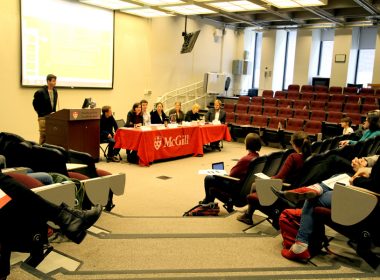
Hosted by the McGill Centre for Human Rights and Legal Pluralism, the lecture was attended by approximately 50 members of the McGill and Montreal community.

In 2012, Kiai and several other specialists publically condemned the Canadian government’s reaction to the 2012 student protests against tuition increases. He pointed specifically to police reaction to the protests, as well as Bill 78—an emergency bill passed in 2012 that required protestors to give police at least eight hours’ notice of demonstrations.

“What surprises me was the reaction of the government of Canada,” he said. “It reacted very much the same way as governments that are generally known as repressive would react. I thought the Canadian [government] would be open to criticisms, open to constructive ideas, and to engage in a dialogue rather than go on the attack.”

Kiai said that, in civil societies—where individuals and non-governmental institutions seek to improve the welfare of citizens—associations and protests should be able to form without registration with, or authorization from, the government.

“You don’t need to get authorization from the government in order to have peaceful protest,” he said. “Notification rather than authorization is what is important.’’

As a Special Rapporteur for the UN, Kiai cannot impose laws upon Canada or any country he inspects. However, Kiai emphasized the importance of countries creating laws that uphold the international sanctions on the rights to freedom of assembly and association that he recommends.

“All we can do is put [the sanctions] out and hope that people will pick it up in their daily work,” Kiai said. “I can condemn the city of Montreal, but beyond that it is up to you guys [.…] The sanctions need to be done in Canada, by Canadians through Canadian mechanisms; we can only support them.”

Kiai added that government relations within civil societies have to be both transparent and expressive.

“Any state that wants to know how its people are feeling should give them the space to express that,” Kiai said. “A state that really cares for its people should be able to allow as much space for protest and for speaking out as it can.”

Pearl Eliadis, a professor at McGill’s Faculty of Law and co-organizer of the event, said that the purpose of hosting the event was to raise awareness of the importance of freedom of assembly and association, and to enable students to protect themselves through knowledge of their human rights.

According to Eliadis, these topics are particularly important in light of the Maple Spring student protests.

“Freedom of association and assembly are obviously of great issue to Quebec given the Maple Spring, but also we’re starting to see the connection with the international and global issues on the repression on civil societies,” Eliadis said. “Students need to be engaged, but at the same time, they need to be able to protect themselves. [It’s] an issue around making sure they’re safe and that they understand their rights and responsibilities.’’

Eric Moses Gashirabake, a First Year law student who attended the event, praised Kiai’s promotion of awareness of the barriers faced by civil societies around the world. Gashirabake pointed to Kiai’s experience in Kenya, where he worked as the chairman of Kenya’s National Human Rights Commission.

“[Kiai] is in a minority of activists in Kenya doing amazing things to promote democracy,” Gashirabake said. “From someone who is going on the ground not just in Kenya but internationally to look at the similarities and points of convergence [in different civil societies], it’s a nice opportunity for us students—regardless of what we’re studying—to know that this is a civic duty that we can all be engaged in.”

The speech was one of two public lectures preceding Kiai’s presentation of the first full report of his findings from his time assessing freedom of assembly and association in various countries to the UN in New York on Oct. 29.

a, News

McGill Senate discusses need to reform structure and operations

The McGill Senate could face changes to its membership and operation following a discussion about its purpose at its Oct. 16 meeting.

Principal Suzanne Fortier said a working group of senators will be formed to create recommendations about potential changes to Senate’s structure and operations, which will  then be voted on at a future Senate meeting.

Topics under consideration at Wednesday’s meeting included Senate’s purpose and function, as well as time allocation, size, the principal’s role to chair meetings, and Senate’s role in making academic decisions. McGill’s Senate is the main governing body that oversees the academic activities of the university. According to its Rules of Procedure, Senate can revise the conduct of their own meetings.

“The present rules may be amended by a majority vote of those present at any regular or special meeting,” the document reads.

However, approval from the Board of Governors is required in order to revise Senate’s composition.

At Wednesday’s meeting, some senators said they were dissatisfied with the lack of debate motions receive before passing through Senate. Post-Graduate Students’ Society (PGSS) Secretary-General Jonathan Mooney pointed to Senate’s format as part of the problem.

“Rather than just getting presentations for information and approving things that have already been decided, there need to be opportunities where the competencies and qualifications of Senate are used in the decision making process,” he said. “There should be times when we disagree. We should get some engagement that way.”

Political Science Professor and Faculty of Arts Representative Catherine Lu used McGill’s decision to offer Massive Open Online Courses (MOOCs) last year as an example of an academic decision that passed without much input or debate by Senate.

“When I started [on Senate], I thought I’d be taking part in decision making about academic matters of the university,” she said. “I was astounded by the lack of process with respect to [the decision] last year [.… Senate’s] participatory role was neglected; open discussions failed to allow Senate to contribute.”

Religious Studies Representative Haley Dinel suggested that Senate needs to take steps to encourage debate.

“Senate is the ideal institution to have debates on any given issue,” Dinel said. “Perhaps we should have a 20-minute window in which senators could bring forth issues to debate.”

Another suggestion was to provide more information to senators ahead of the meeting to allow them to consider the information. Arts Representative Lydia White suggested presenting fewer annual reports to make more time for Senate to discuss policy-related issues.

“Our annual reports are quite uncontroversial,” White said. “Making them available to senators to ask questions about them without presenting them […] would free up time for the more policy-related issues that Senate might be discussing.”

However, Faculty of Science Representative Gregory Dudek argued that many issues addressed at Senate require a large amount of time for explanation, and that there is not enough time to both fully explain and debate these topics in meetings.

“It’s hard to imagine engaging in debate on big issues without having meetings every day,” he said.

Other senators questioned the composition of Senate. Law representative Guillaume Blais pointed to his previous experience as a member of the University of Guelph’s senate to suggest reducing the number of senators and doing more work in smaller committees.

“At Guelph, this same discussion resulted in reducing the number of Senate members,” Blais said. “There’s merit to work being done in committees.”

107 voting members currently sit on McGill’s senate. In comparison, Guelph’s Senate has 162 members (reduced from 215 members in 2011), and the University of British Columbia has approximately 100.

Another recommendation was from Faculty of Medicine Representative Gary Pekeles, who advocated for Senate to be led by someone other than the principal.

“This committee [should] not be chaired by a single administrator,” Pekeles said. “We should look for leadership coming from the floor.”

Faculty of Science Representative Graham Bell said the conversation ultimately reveals fundamental concerns about the way that Senate operates.

“The question is whether Senate is necessary at all,” Bell said. “The conclusion of the debate is that we are uncertain about what we are in this room for, and perhaps that’s a point well worth investigating. Apparently, in some respects, the business of Senate is failing to perform its function.”

a, News

New $2,500 Dentistry student fee to help fund faculty relocation

Incoming Dentistry students for Fall 2014 will pay a new mandatory $2,500 fee per semester to contribute to the Faculty of Dentistry’s $18 million relocation project.

The fee is the result of a student-initiated referendum question run  through the Dental Students’ Society (DSS), and will not affect current students.

Announced on Oct. 18, the relocation project will move the faculty’s facilities to a new location on the corner of McGill College Avenue and Rue Sherbrooke by June 2014.

The project includes the modernization of most of the faculty’s activities, including research, clinical teaching, and its undergraduate teaching clinic.

The faculty has raised $6 million to date to fund the $18 million move, mainly through donations from faculty supporters. The remainder will be funded through a loan.

The referendum question, which was proposed by DSS President Sina Hashemi, was approved by 87 per cent of current students, although the fee will only affect new students.

According to Hashemi, the decision to exempt current students from the contribution is due to two reasons.

“First, current students were not aware of this contribution prior to applying and therefore would not have been able to budget accordingly,” Hashemi said. “Second, this contribution may have affected their decision to attend McGill’s Faculty of Dentistry.”

The fee will amount to $800,000 per year and will help cover repayment of the faculty’s loan. Total student fees paid by first-year dentistry undergraduates from Quebec are currently $7,134, while out of province Canadians pay $15,556.

Hashimi said that DSS’s decision to impose the fee was voluntary.

“The faculty suggested the students consider contributing to the faculty,” Hashemi said. “The DSS felt it necessary to help fund the move because we will be contributing and investing in our careers.”

Austin Chang, a grade 12 student from British Columbia and prospective McGill Dentistry applicant, said the fee may influence his intention to attend the university.

“This new fee greatly affects my desire to apply for McGill Dentistry, as the extra expense will take a significant toll on my student budget,” Chang said. “Since it is all students [who] would be using the new facilities, then it is all students that should help in compensation for the move. Perhaps a lessened fee for current students would be better than none at all.”

Yuxin Mei, U3 Dentistry, voted ‘yes’ in the referendum to impose the fee and said he would still choose to come to McGill even if he had to pay the fee.

“McGill has always been my top choice and I’d even pay another $10,000 to go to this school because as a Quebec resident, it’s still cheaper than [Dentistry programs in] the rest of Canada.”

The relocation comes as the result of the closure of the Royal Victoria Hospital (RVH) in 18 months. As a result, the RVH dental department will need to move into the space currently occupied by the faculty in the Montreal General Hospital (MGH).

According to Paul Allison, dean of the Faculty of Dentistry, the relocation is also intended to consolidate the faculty’s activities and address its outdated equipment and lack of space.

“The clinic itself is probably 20 years old, so the equipment needs to be replaced,” Allison said. “There’s a considerable lack of space [and] the lab hasn’t seen any major renovations since the 1980s.”

Allison added that the move will benefit students and the greater community by bringing everyone together in one space. Currently, the Faculty of Dentistry has teaching and research activities in a number of locations. By June 2014, the faculty plans to have completely vacated MGH and to have mostly vacated the other buildings, aside from some offices and research activities that will remain in their current locations.

“[It] will provide the public with easier access to our clinic by public transportation,” Allison said. “The new space will bring research, clinical teaching, graduate, and dental services together, and become the hub of the Faculty’s community outreach activities, all in a state-of-the-art facility.”

a, Science & Technology

Montreal’s maple trees: where monoculture meets bigotry

If you take a walk up Mount Royal, you may notice that about a third of all the yellow leaves have peculiar black spots. These spots are caused by Rhytisma, a black tar fungus which lives parasitically in the leaves of deciduous forest species, and is killing Montreal’s maple trees. Surprisingly, the Mont Royal maples were not always at risk of Rhytisma.  In fact, this situation arose by a misguided attempt to ‘clean up’ the city of Montreal.

During the 1950s, there was a general consensus in Montreal that the city needed to be turned around. During prohibition, Montreal had become a place where Americans travelled for drinking, gambling, and prostitution—earning it the nickname ‘sin city.’

Jean Drapeau, Montreal’s mayor at the time, was particularly concerned with ‘immoral behavior,’ including displays of homosexuality and intoxication, which were occurring in the underbrush of Mont Royal. In response, he ordered that the bottom two-thirds of the maple trees on the mountain were clear-cut in an effort to expose the area. Unfortunately, Drapeau’s plan had a major unforseen consequence. Clearcutting resulted in mass erosion and landslides, as there were no longer any trees to hold the dirt in place. This forced the mayor to plant more trees in the area he had just cleared. Keeping it simple, he selected one species, the Norway maple, which is what gives Mount Royal its yellow colouring in the fall.

However, the Norway maple was a foreign, imported species that grew much faster than the red maples already populating the mountain. Since the Norway maple reproduced more efficiently than their relative—they yielded more seedpods and grew much faster—consequently displacing the native population of trees. Mount Royal’s diversity had been replaced by a single species.

Nature was not meant to support monocultures. According to Donald Sheppard, associate professor of molecular mycology at McGill University, without diversity or variation within an ecosystem, species have no chance of evolving strategies or acquiring traits to avoid pathogens. If one tree is susceptible to the pathogen, all trees are at risk since they are genetically identical.

Mount Royal was nicknamed “Mont Chauve.” (spacing.ca/montreal)

This problem has reproduced itself throughout history. The Irish potato famine is a classic example. During the 1800s the Irish solved their problem of feeding a growing population by planting the Lumper potato variety. By only planting one species, the potato crop lacked genetic diversity. When the environment changed and an airborne potato fungus swept through the country in the 1840s, the entire crop of potatoes was devastated.

Fortunately, the Norway maples seem to be able to tolerate the Rhytisma infection. Though the fungus has spread dramatically, its prevalence depends on the weather conditions of the spring and fall. According to Sheppard, the fungus grows on the leaves, which then die and fall to the ground. Therefore, in order for the fungus to infect neighbouring trees, the spores must be carried up and off the leaves and back up into the trees. This action increases with a long and rainy fall season coupled with strong winds.

The spring also has an impact on the infection. Jennifer Llewellyn, a horticulturalist with the Ontario Ministry of Agriculture, told the Montreal Gazette, explains that the fungus will survive the winter on the leaves infected by spores. “When you have a cold spring, leaves take longer to emerge and develop, so there is a longer period of exposure to the fungi spores.”

How can you get rid of it? Since spores can survive the winter, raking and destroying the leaves is the easiest way that we, as Montrealers, can reduce the chances of the disease reoccurring next spring.

a, Sports

Montreal hosts second annual NBA Canada Series

The NBA returned to Montreal for another year this past Sunday, Oct. 20 as part of the 2013 NBA Canada Series. The game featured the Boston Celtics and the home team Minnesota Timberwolves playing in the Bell Centre as a part of the league’s pre-season schedule. This is the third time in four years that the NBA has hosted a pre-season game in Montreal. The Timberwolves pulled off the victory, winning the match 104-89 over the Rajon Rondo-less Celtics. Kevin Love starred for Minnesota with 22 points on 6-14 shooting, while pulling down nine rebounds in over 32 minutes of play. Boston’s Gerald Wallace tallied 16 points on 50 per cent shooting in the loss.

The Timberwolves (3-2) have used this pre-season as a project for integrating Love back into the lineup, after the power forward sat out the majority of last season due to hand and knee injuries. The team also acquired shooting guard Kevin Martin this summer in a three-team trade with Oklahoma City and Milwaukee, which sent Luke Ridnour and a 2014 second-round pick from Minnesota to the Bucks. As a result, the roster has had to learn to integrate Martin into the flow of its offence.

“It’s a really, really tough guard when you have a guy like [Martin] who is so fast, can get open, runs the break, and can shoot the ball from distance,” Love noted. “He only needs a split second [….] We have been waiting for a really solid wing scorer like Kevin who at one time was scoring 24 points a game. He’s a 20-point-a-night guy who’s [shown] that throughout this pre-season.”

Martin certainly got off to a quick start against the Celtics (1-6), as he netted three of his game-high five three-pointers in the first-quarter to give Minnesota a quick 11-point lead. Boston struggled to find a flow to its offence in the first half, often settling for contested mid-range shots and sloppy passes. However, the Celtics came on strong to finish the second-quarter, posting a score of 57-51 heading into halftime.

(Alexandra Allaire / McGill Tribune)

The Timberwolves appeared to gain traction going into the fourth-quarter, with back-up point-guard J.J. Barea replacing Ricky Rubio due to foul trouble late in the third. Barea scored six points within 90 seconds in the fourth to open up the gap between the two teams.

Rubio set the tone for the Timberwolves throughout the match with his aggressive mindset. The 6’4” point-guard out of El Masnou, Spain, attacked the paint looking to either draw fouls or kick the ball out to the team’s perimeter shooters. Rubio finished the game with seven assists, on par with last season’s average of 7.3 assists per game. Beyond his highlight-reel passes, however, Rubio has become a much improved shooter from three-point range. The 180 lb guard shot 2-3 from distance, in stark contrast to his 29.3 per cent three-point shooting from last season.

Although it is still early, it is clear that Rubio has worked hard to add another dimension to his game.

“He’s really been shooting the ball particularly well in practice,” Love said. “So I just told him, ‘Get it out of the way now,’ so when Oct. 30 comes around, we can start knocking them down even more. I know what he’s capable of.”

With Martin added to the roster, Love healthy, and Rubio shooting well, the three-point shooting for Minnesota looks to be a marked improvement over last season’s pedestrian 30.5 per cent figure. The biggest issues for the Timberwolves will be on defence, where the team lacks a legitimate interior defender—a necessity in today’s NBA game. Although Nikola Pekovic and Love can hold their own in one-on-one situations, neither offers a serious shot-blocking presence.

“We have to improve [on] defence,” Rubio said. “On offence we have enough talent to score. But our goal has to be to get some more stops. Because at some point [we’re] going to miss some shots, [so] on defence we have to be solid.”

(Alexandra Allaire / McGill Tribune)

In contrast to Minnesota, Boston’s hopes for the season run in a completely separate direction. After losing Paul Pierce, Kevin Garnett, and Head Coach Doc Rivers to the Brooklyn Nets in a blockbuster off-season trade, the Celtics are looking to bottom out in hopes of snagging a top lottery pick in next year’s loaded draft. While the team waits for Rondo to return from an ACL injury, Boston will bank on the development of defensive-specialist Avery Bradley. With his improved shooting, ball-handling, and locker room leadership, Bradley’s development will be key for the Celtics’ future.

Timberwolves fans will look forward to a team that has the potential to return to the playoffs after a nine year post-season drought. However, Head Coach Rick Adelman must work to patch up the porous interior defence before the team can be treated as true contenders.

Minnesota hosts the Orlando Magic for its home opener at the Target Centre on Oct. 30. The Celtics will visit the Toronto Raptors at the Air Canada Centre for its first game of the 2013-2014 NBA season.

a, Features

The fabric of Montreal

Fashion is often seen as both a desired reality but also a delusion of grandeur. Beautiful and awe-inspiring, it has a way of persuading and tempting us with its elegance and irresistable allure. Like a skillful couturier, the industry weaves commerce with philanthropy and constructs the diverse and welcoming fabric of a community. Available for us to tailor to our own individualities, the individual’s interpretation of fashion plays a prominent role both at McGill and in Montreal.

Fashion as an industry is highly lucrative. A commercial behemoth, the establishment brings in an annual revenue of $1,200 billion USD, as reported by the International Textile Manufacturers Federation (ITMF).

In this way, the fashion industry is home to a diverse group of young and passionate designers. 20-year-old Renee Wang is a fine arts student studying Fashion Design at Parsons The New School For Design in New York. Wang has interned for DKNY and worked as a stylist’s assistant for Elle Magazine Russia edition. To her, the business aspect of fashion is an irrefutable truth.

“If I were to describe the industry in one word, it [would be] ‘money.’ [This] is an industry dealing with millions of dollars,” Wang said. “It is a growing market, [and] people are caring about how they dress more and more.”

Of course, this phenomena is not unique to the fashion capital of New York. Here at McGill as well, several clubs have taken notice of fashion’s unique capacity to gather attention and capital, as well as to advance more than just corporate interests. Runway fundraisers deliver in thousands of dollars each year, and have quickly become a platform for students to acquaint business with philanthropy.

In 2008, SynesthASIA was founded by three directors who created annual charity fashion shows in Montreal. The trio’s mission was to raise funds and combat Asia’s social issues—namely poverty, gender inequality, and environmental degradation. Throughout the years, SynesthASIA has seamlessly weaved together  humanitarian aid with artistic expression; the club’s name is a play off the word “synesthesia,” representing the diversity of fresh talents that colour Montreal.

SynesthASIA Director Hana Bell explains that the organization has partnered with several popular brands.

“We have worked with American Apparel, French Connection UK, ModaSuite […just] to name a few,” Bell said. “Fashion is definitely crucial to the SynesthASIA identity.” Evidently, this endeavour has been wildly successful; in only three years, SynesthASIA has contributed over $25,000 to charity.

This tactic is not exclusive to SynesthASIA. The Commerce and Administration Student Charity Organization (CASCO) takes business modules out of the classroom and applies them to their annual dance and fashion show. The group’s goal is to raise money for The Montreal Children’s Hospital Foundation and highlight social responsibility. Last year, CASCO grossed over $14,000 in one evening, and received the Best Philanthropic Event of the Year Award at both the Management Undergraduate Society (MUS) Awards, and the Student’s Society of McGill University (SSMU) Awards.

In terms of fashion’s contributions, however, both clubs stress that dollar signs are only the tip of the iceberg in Montreal.

CASCO Executive Directors Majd Steitieh and Ruth Talbot expresssed that fashion has a peculiar charm in attracting an audience and inspiring cohesiveness within a community.

“Fashion and the cause work side by side […] to encourage people to come to our event because [it’s] not a classic night out. Fashion has become part of our show […. because it’s] visually effective [and] helps expand our audience. And the great thing about fashion is that [it’s] dynamic and ever-changing, so the community will only get larger and stronger as it attracts more people,” Steitieh and Talbot wrote.

Bell also saw the runway as the integral link between art and the community. “Fashion [connects] all forms of fine art, [and allows] an entire community to feel included. [It] increases engagement,” Bell said.

On that note, Bell, Steitieh, and Talbot all agreed that fashion strikes a perfect balance between flash and substance. By getting people interested in fashion and charity, organinzations have been able to establish a sense of community, especially at a school like McGill. Over the years, this has created a space for individuals to express themselves. More and more, fashion has emerged through students, bloggers and designers as an outlet for self-expression. It has become something we can create and re-work each day to construct an image unique to ourselves.

Kira Ludmer-Kott is a fashion blogger on Campusfashionista.com who specializes in reporting trends within McGill and around Montreal. To Ludmer-Kott, items you choose to sport are an immediate proclamation of your identity. 

“The clothes I wear, the accessories I choose, and the shoes I put on not only say something about my style, but also [about] who I am,” Ludmer-Kott said. “People say that first impressions are most important; so why not dress everyday like it’s your first impression?”

For McGillians in particular, fashion is omnipresent and pervades every facet of campus culture. We no longer wear clothes; we wear fashion. Conveniently, it only takes a five-minute walk on Saint Catherine Street to see this in action.

Ludmer-Kott emphasized that this phenomena is true city-wide, and can be extremely contagious.

“Montreal is such a great place to play with fashion. We are truly a city that likes to express itselt,” Ludmer-Kott said. “[McGillians] are affected by the fashion that surrounds them; all it takes is seeing one person wearing something you find nice [for you to] go out and try something like it.”

Nevertheless, fashion isn’t exactly a utopia devoid of flaws or shortcomings—rather, the industry is cutthroat and mercurial. Fashion can be an intense love-hate relationship. Critics of the industry have complained that fashion’s transition from ‘just clothes’ to ‘individual statement’ is superficial, focusing solely on profitable glamour and outer beauty.

To this, Ludmer-Kott explains that it is difficult to draw the line between wearing clothes and having it judged as a statement.

“I don’t think any of us have a choice but to let the clothes on our backs define us,” she said. “Don’t get me wrong, I realize that there is more to a person than the clothes that they wear. [But] when I look at someone, their clothes tell me a story about who they are.”

To anyone who deems fashion frivolous, Ludmer-Kott presented the famous words from The Devil Wears Prada: Even a minute decision like selecting a shade of blue “represents millions of dollars and countless jobs, and it’s comical to think that you could make any choice which exempts you from the fashion industry.”

Wang echoed this sentiment and emphasized that fashion is very much about hard work from behind the scenes.

“Consumers [often] take the designers’ effort for granted,” she explained. “A dress that seems minimal may take up to weeks to make. [Consumers habitually] neglect the amount of effort it takes to pattern-make the dress and give the best fit to the body while maintaining simplicity.”

To Montreal-based fashion designer François Beauregard, renowned for his minimalistic and classic designs, this was all too familiar.

“I work all the time,” Beauregard remarked. “[Sometimes it’s] 45 days in a row, non-stop. So you can imagine, […] every day you need to be on the [go….] There’s always something to change.”

For Beauregard, fashion is shaped by the individual, who, in turn, is transformed by the industry. “I don’t look at fashion [as] it used to

be." Said the designer. "[Before,] it was almost a religion. [Now fashion is] just fashion, it’s very superficial. [But I have learned to] appreciate difference[s]. I don’t [concern myself] too much [with] what others do anymore. Fashion has made me more confident [in] myself and in my own work.”

Despite the vast abstraction of in industry as a whole, Wang however, had no trouble summing up what fashion often means to people vested in the creative process.

“Fashion is attitude." She said. "It has no limit.”

a, Sports

Mixed bag for McGill at annual Redbird Classic

Martlets

This past weekend at the annual Redbird Classic, the reigning CIS Rookie-of-the-Year, Miriam Sylla, showed why she has the talent to lead the McGill Martlets to another RSEQ title and a deep post-season run at the CIS National Championships. She led the team in scoring and rebounding over the weekend while the Martlets swept their opponents. Sylla had ample support throughout the tournament as other standouts included junior forward Gabriela Hebert and junior point-guard Diana Ros.

Each year three teams congregate in Montreal over one weekend for a round robin slate of exhibition games held in Love Competition Hall. This year’s lineup included the Memorial Sea-Hawks, Western Mustangs, and Toronto Varsity Blues. Last year’s tournament’s winless showing was disappointing for the squad. However, this year’s team was keen on using the weekend as a launch pad for a successful season.

The Martlets emerged victorious over the Sea-Hawks in the first game with a score of 62-43 on the backs of a stingy defence and balanced scoring. Jennifer Silver, a rookie forward, proved to be an offensive sparkplug off the bench as she made the most of her 13 minutes of playing time by scoring 13 points. Ros, fresh off of her appearance with Team Canada at the Summer Universiade, orchestrated the offence to the tune of six assists, which offset her poor shooting night. McGill’s defence forced 25 turnovers with 12 steals and two blocks. Memorial was consistently forced into bad shots en route to shooting below 30 per cent from the field and a ghastly 35.7 per cent from the free throw line.

The squad’s second game, a tilt against the Western Mustangs, was a tougher challenge, as McGill needed to rally back from an early 11 point deficit to emerge victorious 68-66. The game was tied up in the final minute before rookie guard Carolann Cloutier showed her clutch gene, calmly hitting a jumpshot to give the Martlets the victory. Cloutier was second on the team with 13 points, behind Sylla’s 14. Hebert stuffed the box score with a team leading six assists and eight rebounds while also chipping in with eight points. McGill shot a blistering 51.6 per cent from the field in the second half while holding Western to 33.3 per cent during the same time frame. The Mustangs remained in the game primarily by capitalizing off of McGill’s 26 turnovers and going 13-15 from the charity stripe. However, Western’s inability to score from the field and stop McGill from doing so in the second half ultimately led to their demise.

In the final game, McGill faced off against Toronto in a tight contest that ended with the hosts winning 71-64 behind the efforts of Sylla, Ros and Hebert. McGill had the lead for most of the game, but was never able to stretch the lead to more than 10 points. Ros entered the game shooting 3-19, but was soon able to find her rhythm as she led the Martlets with 16 points. Ros once again showed skill ful control at the reins of the offence by registering seven assists. She also registered six rebounds, the highest figure on the team. Hebert also had 16 points while Silver notched 10 points, making the most of her second straight opportunity to start. McGill once again showed an inability to take care of the ball, as their 27 turnovers point to a weakness that the team must address.

The team now travels to North Andover, Massachusets to play Merrimack College in the NCAA in what should be a difficult test. The team then starts their RSEQ season on Nov. 8 against Laval. If their exhibition record is to prove indicative of their regular season, the Martlets have an excellent opportunity to make their third straight trip to the National Championships.

– Mayaz Alam 


(Wendy Chen / McGill Tribune

Redmen

The McGill Redmen basketball team hosted its annual Redbird classic tournament at Love Competition Hall this weekend. The fans that came to watch were not disappointed, as the tournament boasted a wealth of talent from the four competing teams. The University of Alberta Bears, Guelph Gryphons, Queens Gaels, and McGill Redmen faced off over three days of round robin action. This year’s tournament comes at a time that is critical for establishing pre-season rankings and fine-tuning skills before the regular season.

McGill, 5-3 in the pre-season, found itself up against an extremely inexperience Guelph team that consisted of nine freshmen. The game looked evenly matched at the outset with the first quarter ending in a slim six-point lead for McGill. However, as the first half advanced, the Redmen exposed Guelph’s inexperience and demonstrated the skill that propelled them to a fifth place finish in last year’s national championships. As the gap on the scoreboard widened, the animosity between the two teams became apparent. Both teams were given technical fouls as the fourth quarter consisted of altercations and shoving matches down low. Fourth-year guard, Simon Bibeau, led McGill with a game high 14 points and third-year forward, Vincent Dufort, added 12 points and 10 rebounds.

Redmen Head Coach David DeAverio was pleased overall with the team’s effort.

“I’m happy with the way we competed,” DeAverio said. “It’s so early and there are so many things we need to clean up on the defensive end, but the effort was very good.”

Day two of the tournament saw McGill take on the University of Alberta Bears, the consensus trophy favourite going into the weekend. The matchup got off to a fast-paced start as both teams’ raw athleticism was evident. Everything seemed to click for McGill, as the first quarter ended with a 22-20 lead off of inspired efforts by rookies Francois Bourque and Michael Peterkin. The Alberta coaching staff tightened the screws in the second quarter as the Bears began to fire on all cylinders. Alberta outscored McGill 27-8 in the second quarter, a deficit that proved to be insurmountable for the hosts. Jordan Baker and Joel Friesen led the way for the Bears with 19 and 18 points respectively. The Bears were able to maintain their standing as the team to beat in the tournament, besting McGill by a score of 72-63.

Third year guard Ave Bross commented on McGill’s hopes to make up for their poor showing at CIS Nationals last year.

(Alexandra Allaire / McGill Tribune)

“[Alberta] is a very strong team and our second quarter simply was not good enough to beat one of the top teams in the country,” said Bross. “We played much tighter in the second half but it was too little too late.”

In the final game of the weekend the Redmen were unable to finish off a determined Queen’s Gaels squad in overtime, and ended up falling 86-78 to an opponent that they had beaten by double digits as recently as last weekend. McGill dug itself into a hole to start the game, trailing nine points at the end of the first quarter. They were able to stay in the game behind the efforts of Bibeau and fellow guard Thomas Lacy who exploded for 19 points. The points were not coming easy for McGill as they shot an anemic 30.6 per cent from the field and 15.8 per cent from three-point range. Bibeau found the basket by getting to the foul line, making 8 of 11 free throws. Despite the disappointing finish for the reigning RSEQ champions, the tournament afforded the coaching staff a good opportunity to test out different lineup combinations and to identify players who will be able to handle a larger role in the upcoming season.

– Joshua Zigler

a, News

Quebec Liberal leader outlines party values, stance on Charter

On Oct. 18, the Quebec Liberal Party (PLQ) McGill hosted PLQ leader Philippe Couillard and local Liberal Members of the National Assembly at McGill’s Thomson House.

This event marked Couillard’s first introduction to the McGill community as the leader of the PLQ. His predecessor, Jean Charest, resigned last September following the party’s loss in the provincial election. Couillard, a former neurosurgeon and professor at Université de Sherbrooke, spoke on the history of the PLQ and its values.

“I always start by telling people who we are—the history of our party, founded in 1867, centred around the economy, jobs creation, and individual freedoms,” Couillard said.

Couillard also spoke on the party’s stance on current issues and policy, notably the debate surrounding the Quebec Charter of Values, a bill proposed by the incumbent Parti Québécois. The bill seeks to implement certain provisions such as restricting public sector workers from wearing conspicuous religious symbols. Couillard spoke on the PLQ’s opposition to the bill and the importance of individual freedoms.

“We don’t like [the proposed charter] at all. Because we are so much attached to individual freedoms that we will never allow the government to jeopardize those freedoms that we had fought so hard for,” Couillard said. “That’s why we are going to be tough on those issues.”

Although the crowd was small—approvimately 50 members of the McGill and Montreal community were present—attendees were engaged throughout the event, and Couillard’s answers to questions were regularly met with rounds of applause. Luca Varone, a U3 Law student and PLQ supporter, said that he was impressed by Couillard’s presentation.

“I wanted to get to know Couillard a little better [….] He has struck me as a rather sincere politician and this event confirmed my impression,” Varone said. “I was struck by not only the conciliatory tone but also the positive rhetoric […] he commands by [making] clear statements [….] As a result of this, I think I would consider getting more into the Liberal Party.”

As a campus group, PLQ McGill acts as a liaison between the PLQ and McGill students looking to become involved with the party. Marten Crevier, U2 Arts and member of PLQ McGill, spoke on the club’s goal to raise awareness for the party and Quebec politics as a whole.

“To introduce the values of PLQ to people [is not our only goal],’’ Crevier said. “A good number of students are international students […] so simply to educate people on the political dynamic in Quebec is an interesting thing.’’

Couillard spoke on the importance of speaking at events in order to access the younger generation, which he said is a basis of support for the party.

“We have a very powerful youth wing in our party that gets 33 per cent of the vote in large convention, which is unique in Canada,” Couillard said. “So to be able to recruit members in CEGEP and universities for us is extremely important—either [to] become members or […] interested in our ideas.’’

The PLQ will continue its tour of universities with visits to Laval and UQAM in the coming weeks.

Read the latest issue

Read the latest issue